URLs, DNS and bit streaming
| English | Chinese | Pinyin |
|---|---|---|
| Domain Name System | 域名系统 | yù míng xì tǒng |
| Uniform Resource Locator | 统一资源定位符 | tǒng yī zī yuán dìng wèi fú |
| protocol | 协议 | xié yì |
| domain name | 域名 | yù míng |
| resolver | 解析器 | jiě xī qì |
| bit streaming | 流式传输 | liú shì chuán shū |
| real-time | 实时 | shí shí |
| on-demand | 点播 | diǎn bō |
| buffer | 缓冲 | huǎn chōng |
| bit rate | 比特率 | bǐ tè lǜ |
| lossy | 有损 | yǒu sǔn |
| compression | 压缩 | yā suō |
The phone book that ran the internet
- Until 1983 every computer on the internet found the others by downloading one text file, HOSTS.TXT, from a single machine at Stanford. Every time a new computer joined, the file grew and everyone fetched it again.
- Paul Mockapetris replaced the file with a distributed system of servers, each answering for its own part of the name space. He called it the Domain Name System.
- It is why you type a name and not twelve digits, and why a website can move house without telling you.
- This lesson is the address you type, the system that looks it up, and how a video reaches you before it has finished arriving.
The URL
- A Uniform Resource Locator 统一资源定位符 (URL) locates one resource on the web:
https://www.example.com/about/contact.html. - The protocol 协议,
https, says how to fetch it. The domain name 域名,www.example.com, names the server in a form people can read. The path,/about/contact.html, names the file on that server. - A URL may also carry a port number and a query string after
?, but protocol, domain and path are the three the exam asks for.
In https://www.example.com/about/contact.html, what is https?
https is the protocol; www.example.com is the domain name; /about/contact.html is the path.
Match each part of https://www.example.com/about/contact.html to its name.
A URL is protocol + domain name + path — the protocol says how, the domain says which server, the path says which resource.
The Domain Name System
- Computers deliver to IP addresses, not names. The Domain Name System 域名系统 (DNS) is a distributed set of servers that translates a domain name into an IP address.
- The browser asks a resolver 解析器. If the resolver has not cached the answer, it asks a root server, which points it to the top-level domain server for
.com, which points it to the authoritative server forexample.com, which returns the IP address. - The browser then connects to that IP address and requests the path. The whole lookup takes milliseconds and is cached so it rarely repeats.
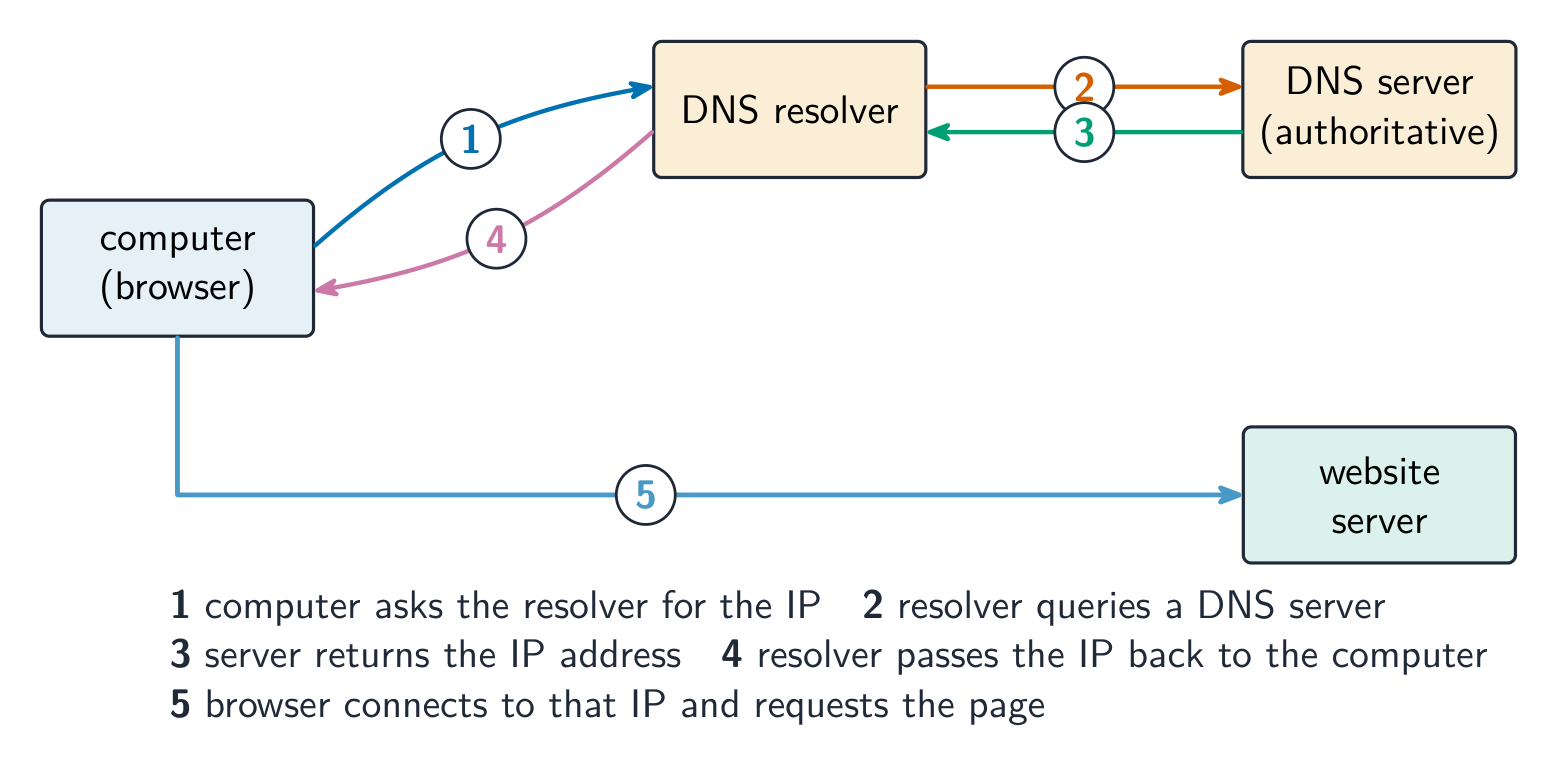
Resolver, root, top-level domain, authoritative: then the browser connects
How DNS finds a website
Step through a DNS lookup. The network routes by IP, not by name — so before anything loads, DNS must turn the domain name into an IP address.
The Domain Name System (DNS) mainly:
DNS resolves human-readable domain names to the numeric IP addresses the network actually uses.
Worked example: from typed address to loaded page
- The user types the URL. The browser separates the protocol, the domain name and the path.
- The browser sends the domain name to the DNS resolver, which queries the DNS hierarchy until an authoritative server returns the server's IP address.
- The browser opens a connection to that IP address and sends an HTTP request for the path.
- The server returns the page, and the browser renders it. Four steps, and the DNS step is the one most often missed.
Put a DNS lookup in order, from typing the address to loading the page.
The resolver walks the hierarchy (root → TLD → authoritative) until it gets the IP, then the browser connects.
Why DNS exists
- People remember names; routers deliver to numbers. DNS lets both be true at once.
- A site can move to a new server, or spread across many, by changing its DNS record. Users type the same name.
- The system is distributed, so no single server holds every name, and it is cached at every level, so the load is spread.
Why does the web use DNS rather than having users type IP addresses? Select all that apply.
DNS is about names, flexibility and distribution. The lookup adds a few milliseconds; it does not speed up the page itself.
Bit streaming
- Bit streaming 流式传输 sends multimedia as a continuous stream that the receiver plays as it arrives, instead of downloading the whole file first.
- Real-time 实时 streaming is captured and sent as it happens, live sport or a video call. You cannot rewind, and low latency is vital.
- On-demand 点播 streaming plays a file already stored on a server. You can pause and rewind, and the server can send ahead.

The buffer sits between the network and the player
Streaming media plays as it arrives, without first downloading the whole file.
That is the defining feature of streaming — the receiver plays the stream as it comes in (with a small buffer), rather than waiting for a full download.
Compared with real-time (live) streaming, on-demand streaming:
On-demand content is pre-recorded, so you can pause/rewind and the server can buffer well ahead. Live streaming can't be rewound and needs low latency.
Buffers and bit rate
- A buffer 缓冲 stores a few seconds of data before playback starts, so a brief dip in the network does not stop the picture. On-demand streams can buffer far ahead; a live stream can only buffer a little, or it stops being live.
- The bit rate 比特率 is the number of bits per second the stream needs. It must stay below the broadband speed, or data arrives slower than it is played and the playback stalls.
- Lossy 有损 compression 压缩 keeps the bit rate down: moving pictures hide small losses, and the stream must fit the bandwidth.
Why does a streaming player use a buffer?
The buffer holds a few seconds ahead of what is playing, so short slow-downs in the network don't cause the playback to stall.
For a stream to play without stalling, its bit rate must stay ____ the broadband speed of the connection.
If more bits per second are needed than the connection delivers, data arrives more slowly than it is played and the buffer empties.
Worked example: why compress before streaming live?
- Explain why a video is compressed before it is streamed in real time.
- The uncompressed stream would need more bandwidth than the connection has, so frames would arrive late and playback would stall.
- Compression cuts the number of bits, so the bit rate stays below the broadband speed and the delay stays small.
- Less storage and cost are needed at both ends. A late packet in a live stream is simply dropped, because a live stream cannot wait for it.
Worked example: the real-time pipeline
- Describe how a live event is streamed to viewers.
- The camera and microphone capture and sample the event. The data is encoded, using compression to shrink it.
- The stream is sent across the network as packets. The viewer's device buffers a little, then plays, dropping any packet that arrives too late.
- Compare on-demand: the file already exists, so the server can send ahead, the buffer can be large, and the viewer can pause and rewind.
Put the stages of real-time streaming in order.
Capture, encode, send, play. The compression happens before sending, which is what keeps the bit rate inside the bandwidth.
Marks that slip away
- DNS turns a name into an IP address, never the other way round in an exam answer, and it is not what carries the page.
- Real-time streaming can still use a buffer; it is just a small one. What it cannot do is rewind.
- Bit rate is compared with the connection's speed. If the bit rate is higher, the stream stalls; say which is which.
- The protocol part of a URL is
https, notwww.wwwis part of the domain name.
In a real-time stream, a packet that arrives too late is held until it can be played in its proper place.
A live stream cannot wait: a late packet is dropped and playback continues. Only on-demand streaming can afford to wait, because it buffers far ahead.
You've got it
- a URL = protocol + domain name + path; DNS turns the domain name into an IP address through resolver → root → top-level → authoritative servers
- DNS exists so people use names, routers use numbers, and a site can move without changing its name
- bit streaming plays media as it arrives: real-time is live and cannot rewind, on-demand is stored and can
- a buffer covers network dips; the bit rate must stay below the broadband speed, which is why streams use lossy compression