The internet, the web and IP addressing
| English | Chinese | Pinyin |
|---|---|---|
| internet | 互联网 | hù lián wǎng |
| World Wide Web | 万维网 | wàn wéi wǎng |
| protocol | 协议 | xié yì |
| modem | 调制解调器 | tiáo zhì jiě tiáo qì |
| dedicated line | 专线 | zhuān xiàn |
| ISP | 互联网服务提供商 | hù lián wǎng fú wù tí gōng shāng |
| cell phone network | 蜂窝网络 | fēng wō wǎng luò |
| IP address | IP地址 | IP dì zhǐ |
| IPv4 | 第四版互联网协议 | dì sì bǎn hù lián wǎng xié yì |
| IPv6 | 第六版互联网协议 | dì liù bǎn hù lián wǎng xié yì |
| subnet | 子网 | zi wǎng |
| network ID | 网络标识 | wǎng luò biāo shí |
| host ID | 主机标识 | zhǔ jī biāo shí |
| subnet mask | 子网掩码 | zi wǎng yǎn mǎ |
| public IP address | 公有IP地址 | gōng yǒu IP dì zhǐ |
| private IP address | 私有IP地址 | sī yǒu IP dì zhǐ |
| NAT | 网络地址转换 | wǎng luò dì zhǐ zhuǎn huàn |
| static IP address | 静态IP地址 | jìng tài IP dì zhǐ |
| dynamic IP address | 动态IP地址 | dòng tài IP dì zhǐ |
| DHCP | 动态主机配置协议 | dòng tài zhǔ jī pèi zhì xié yì |
A network so successful it ran out of numbers
- When the internet's addressing scheme was designed in 1981, its 32-bit addresses allowed about four billion devices. That seemed inexhaustible for an experiment linking a few hundred universities.
- The last free blocks were handed out in 2011. Every phone, laptop, camera and sensor on Earth wants an address, and there were not enough to go round.
- The replacement has 128 bits: enough for every grain of sand on the planet to have billions of addresses each.
- This lesson is the internet 互联网 itself, the World Wide Web 万维网 that runs on it, and the addresses that let a packet find one device among billions.
The internet and the World Wide Web
- The internet is a global network of networks that communicate using a common protocol 协议 suite, TCP/IP.
- The World Wide Web (WWW) is one service that runs over it: hyperlinked documents identified by URLs, requested with HTTP or HTTPS and shown in a browser.
- Email and file transfer are other internet services that are not part of the web. Webmail uses both: the mailbox is a web page reached through a browser, while the email itself travels across the network of networks.

The web rides on the internet; so do services that are not the web
What is the relationship between the internet and the World Wide Web?
The internet is the global network; the WWW is one service on it (hyperlinked documents). Email and file transfer are other internet services.
Match each term to what it is.
The internet is the infrastructure; the web is one service on it. IPv6 has far more addresses than IPv4.
Hardware that supports the internet
- A modem 调制解调器 converts the computer's digital signal into an analogue signal for a telephone line, and back again at the other end: modulation and demodulation.
- The PSTN, the public telephone network of exchanges and lines, carries dial-up and DSL connections. A dedicated line 专线 is leased between an organisation and its ISP: always on, a fixed bandwidth that is not shared, faster and more reliable, but expensive.
- On the cell phone network 蜂窝网络 a phone sends data by radio to the nearest tower; the towers are linked to the phone company's network, which routes the data to the internet, and the phone is handed from cell to cell as it moves.

Three routes onto the internet
Network route lab
Follow data from a device through network hardware and protocols.
Match each piece of internet hardware to its job.
Three routes with three trade-offs: cheap and slow, expensive and reliable, mobile.
IP addresses: IPv4 and IPv6
- An IP address IP地址 uniquely identifies a device on a network, so a packet can be delivered to it.
- IPv4 第四版互联网协议 is 32 bits, written as four denary numbers from 0 to 255 separated by dots,
192.168.1.10: about $4.3 \times 10^{9}$ addresses, now exhausted. - IPv6 第六版互联网协议 is 128 bits, written as eight groups of four hexadecimal digits separated by colons,
2001:0db8:0000:0000:0000:ff00:0042:8329; a run of zero groups shortens to::. About $3.4 \times 10^{38}$ addresses.
How many bits are in an IPv4 address?
IPv4 is 32-bit (four numbers 0–255). IPv6 is 128-bit.
The main reason IPv6 was introduced is that:
IPv4's ~4.3 billion addresses are exhausted; IPv6's 128 bits give about $3.4 \times 10^{38}$ addresses.
Worked example: is this an IPv4 or an IPv6 address?
192.168.3.2: four groups, dots, denary numbers under 256. IPv4.2001:db8::42:8329: colons, hexadecimal digits, and::standing for the missing zero groups. IPv6.192.300.1.1is not a valid address of either kind: 300 does not fit in 8 bits.- The questions test the format: number of groups, the separator, the digit system, and the range of each group.
Which of these are valid IPv4 addresses? Select all that apply.
Four denary groups from 0 to 255. 300 does not fit in 8 bits, and colons with hex digits make an IPv6 address.
Subnetting
- A large network is split into subnets 子网. An address then has two parts: the network ID 网络标识, the same for every device in the subnet, and the host ID 主机标识, unique to each device.
- The subnet mask 子网掩码 marks the split:
255.255.255.0says the first 24 bits are the network part, so up to 254 hosts share the last 8. - Benefits: broadcasts stay inside their subnet, so there is less traffic on each part; one department's devices can be secured separately; and the network is easier to manage and to grow.
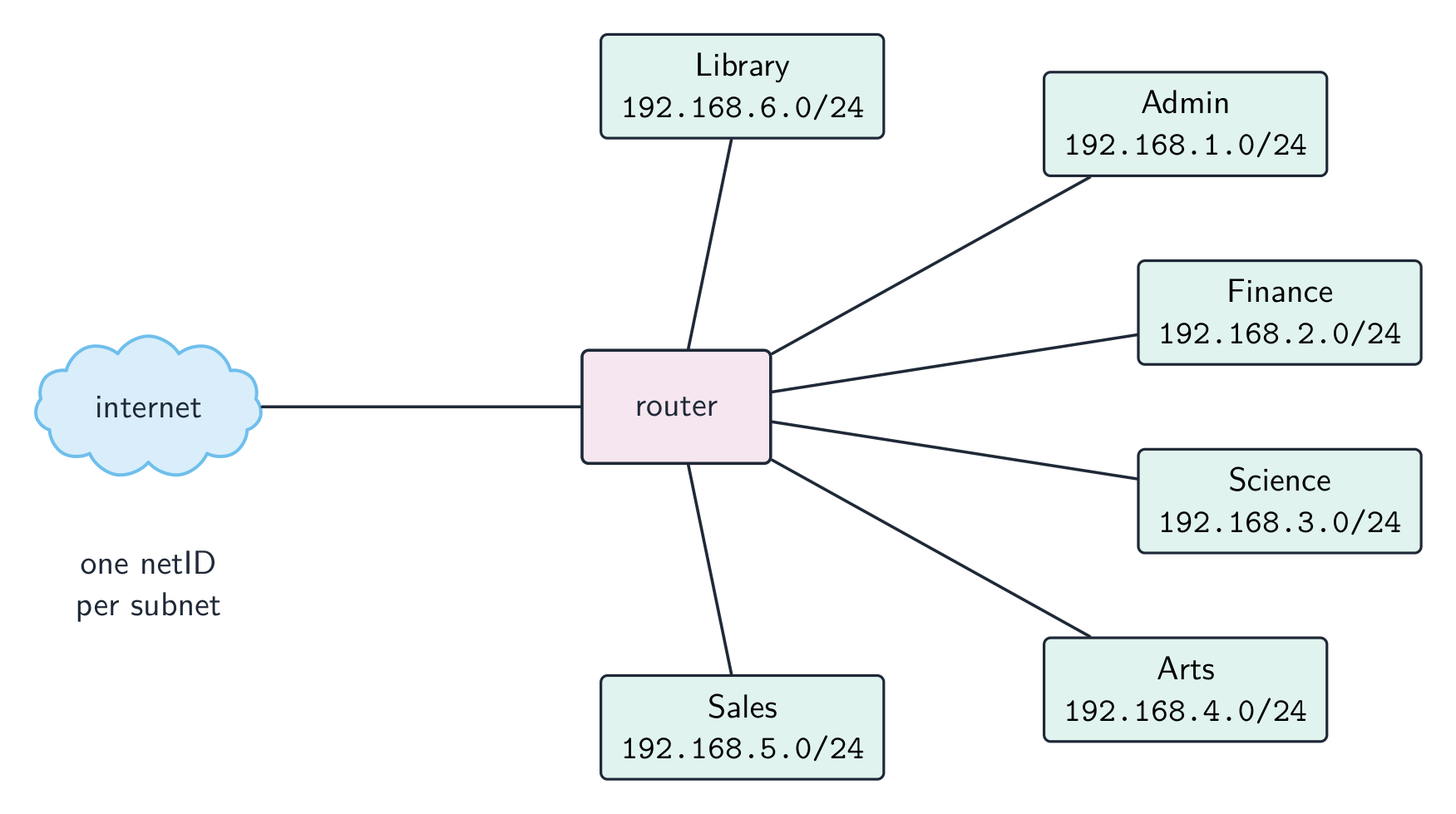
One network, several subnets, one network ID each
A subnet mask is used to:
The mask (e.g. 255.255.255.0) marks the network bits, splitting the address into network and host portions.
Worked example: reading a subnet mask
- Device address
192.168.5.37, mask255.255.255.0. - The mask has ones in its first 24 bits, so the network ID is
192.168.5.0and the host ID is37. - Two devices with addresses
192.168.5.37and192.168.5.200share a network ID, so they are on the same subnet and a switch can deliver between them.192.168.6.4has a different network ID, so a router is needed. - "Describe two benefits of subnetting" wants two of: less broadcast traffic, separate security, easier management.
With the mask 255.255.255.0, the device 192.168.5.37 has the network ID 192.168.5.0 and the host ID ____.
The mask's 24 ones cover the first three groups; the last group is the host part.
Public and private addresses
- A public IP address 公有IP地址 is globally unique and routable across the internet, allocated by the ISP 互联网服务提供商.
- A private IP address 私有IP地址 is used only inside a LAN, is not routable on the internet, and is reused by millions of LANs,
192.168.x.xfor example. Devices with private addresses reach the internet through NAT 网络地址转换 in the router. - The security implication: a device with only a private address cannot be reached directly from the internet, which is a layer of protection, while a public address is visible to the whole world.
A private IP address (e.g. 192.168.1.5):
Private addresses work only inside the LAN and are not routed on the internet; NAT lets them share a public address.
A device with only a private IP address can be contacted directly from anywhere on the internet.
Private addresses are not routable on the internet; the device is reached only through NAT in its router, which is a layer of protection.
Static and dynamic addresses
- A static IP address 静态IP地址 never changes. It is set by hand or reserved, and it suits a server that clients must find at a known address.
- A dynamic IP address 动态IP地址 is allocated by DHCP 动态主机配置协议 each time a device connects and may be different next time. It suits laptops and phones, and it uses a limited pool of addresses efficiently.
- Static costs more and needs administration; dynamic is automatic but a device's address cannot be relied on.
A static IP address is most suitable for:
Servers need a fixed address so clients can always reach them. Client devices usually get dynamic addresses from DHCP.
Worked example: the descriptions the tables want
- Public: visible on the internet, unique across it, allocated by the ISP.
- Private: visible only inside the LAN, reused by many LANs, needs NAT to reach the internet.
- Static: never changes, set by hand or reserved, as a server needs.
- Dynamic: allocated by DHCP each time the device connects, may change. One row each, and the pairs are opposites.
Which protocol hands out dynamic IP addresses to devices when they join a network?
DHCP allocates an address from a pool for a lease period. DNS resolves names, HTTP carries web pages, NAT translates private addresses to a public one.
Marks that slip away
- The internet is not the web. Email is on the internet and not on the web; webmail is on both.
- IPv4 groups run 0 to 255, because each is 8 bits. A group of 256 or 300 is a wrong answer, not a typo.
- A private address is not "less secure". It is the reverse: it cannot be reached from outside without NAT.
- A dynamic address is handed out by DHCP, a protocol, not by "the internet". Name it.
You've got it
- the internet is a network of networks on TCP/IP; the WWW is one service on it; modems, the PSTN, dedicated lines and the cell network carry traffic onto it
- IPv4: 32 bits, four denary groups 0–255, exhausted; IPv6: 128 bits, eight hex groups with colons
- a subnet mask splits an address into network ID and host ID; subnets cut broadcast traffic and separate security
- public addresses are unique and routable, private ones live inside the LAN behind NAT; static for servers, dynamic from DHCP for everything else