Break-even analysis
Introduced| English | Meaning |
|---|---|
| break-even point/breɪk ˈiːvən pɔɪnt/ | The output or sales level at which total revenue equals total costs. |
| contribution/ˌkɒntrɪˈbjuːʃn/ | Sales revenue minus variable costs, available to cover fixed costs and then provide profit. |
| fixed costs/fɪkst kɒsts/ | Costs that do not change with output over the relevant period and production range. |
| break-even output/breɪk ˈiːvən ˈaʊtpʊt/ | Fixed costs ÷ contribution per unit (revenue = total cost). |
| total revenue/ˈtəʊtl ˈrevənjuː/ | The total income received from selling goods or services before costs are deducted. |
| margin of safety/ˈmɑːdʒɪn ɒv ˈseɪfti/ | The amount by which actual or forecast sales exceed break-even sales. |
The point where you stop losing money
- A new café pays rent and wages from day one, but takings build slowly. At some level of sales, it finally covers its costs.
- That magic level is the break-even point 盈亏平衡点.
Selling price is 15 and variable cost per unit is 9. What is the contribution per unit?
Difficulty 2/5 · 140 coins + a small bonus on first completion today
Contribution = 15 − 9 = 6.
Selling price minus variable cost per unit gives the ______ per unit.
Difficulty 1/5 · 100 coins + a small bonus on first completion today
Contribution covers fixed costs, then becomes profit.
Contribution 贡献
- Contribution per unit = selling price − variable cost per unit.
- Each unit sold "contributes" this much towards covering fixed costs 固定成本.
Fixed costs are 3,000 and contribution per unit is 6. What is the break-even output (units)?
Difficulty 2/5 · 140 coins + a small bonus on first completion today
Break-even = 3000 ÷ 6 = 500 units.
At the break-even point, the business makes:
Difficulty 1/5 · 100 coins + a small bonus on first completion today
Revenue exactly equals total cost — no profit, no loss.
The break-even point
- Break-even output 盈亏平衡产量 = fixed costs ÷ contribution per unit.
- At this output, total revenue 总收入 exactly equals total cost — no profit, no loss.
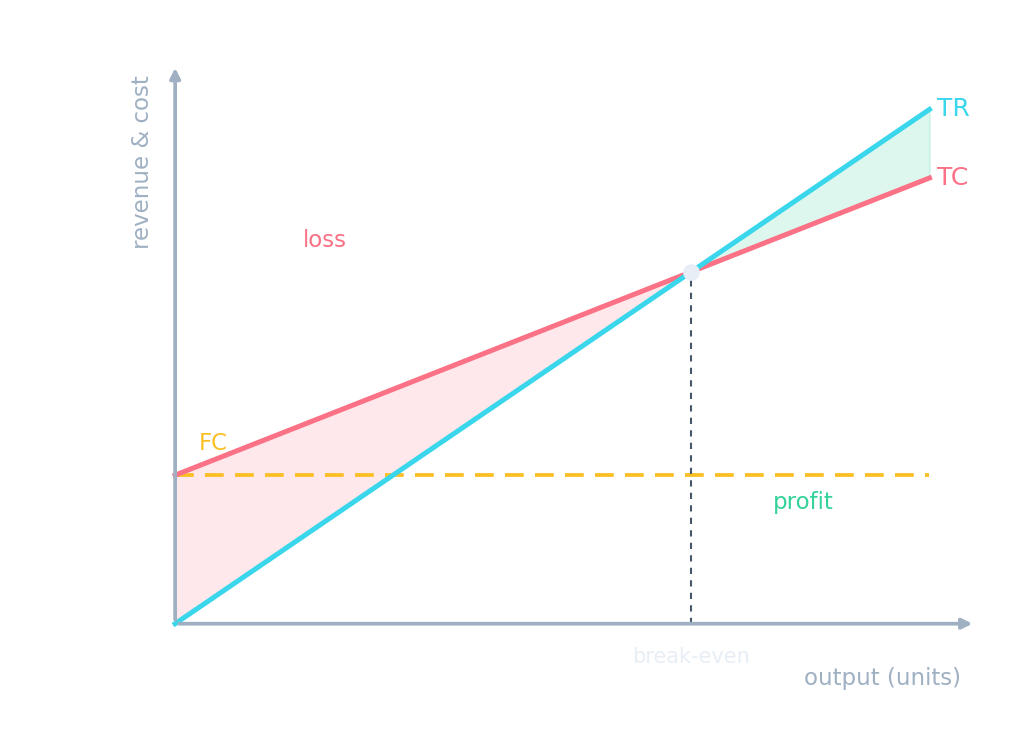
Below break-even the firm makes a loss; above it, a profit.
Break-even output is 400 and the firm sells 520. What is the margin of safety (units)?
Difficulty 2/5 · 140 coins + a small bonus on first completion today
Margin of safety = 520 − 400 = 120 units.
Margin of safety 安全边际
- Margin of safety = actual output − break-even output.
- It shows how far sales can fall before the firm makes a loss.
Worked example. Price 20, variable cost 12 → contribution = 8. Fixed costs 4,000 → break-even = 4000 ÷ 8 = 500 units. If the firm sells 650, the margin of safety is 650 − 500 = 150 units.
Test the assumptions behind break-even
$Q_{BE}=\frac{F}{p-v};\quad \pi=(p-v)Q-F$
Changing sales volume changes profit while fixed costs remain. The starting values match the lesson example.
You've got it
- contribution per unit = price − variable cost per unit
- break-even output = fixed costs ÷ contribution per unit (revenue = total cost)
- margin of safety = actual − break-even output: how far sales can fall
Write from a margin of safety of 60
- Price is 20 and variable cost is 12. Fixed costs are 1600.
- The firm sells 260 units.
- Find contribution, break-even output and the margin of safety.
Price is 20, variable cost per unit is 12 and fixed costs are 1600. The firm sells 260 units. What are the contribution per unit, the break-even output and the margin of safety?
Price minus variable cost is 8. Fixed cost divided by 8 is 200. Sales minus 200 is 60.
What is the margin of safety?
Difficulty 1/5 · 100 coins + a small bonus on first completion today
Sales of 260 are 60 above the break-even output. Other options — 120 units (the lesson margin); 200 units (the break-even output).