Budgets
Introduced| English | Meaning |
|---|---|
| budget/ˈbʌdʒɪt/ | A financial plan setting out expected income, expenditure or resource use over a period. |
| income/ˈɪŋkʌm/ | Money received by a person or organisation over a period. |
| expenditure/ekˈspendɪtʃə/ | Money spent on goods, services or other purposes over a period. |
| variance analysis/ˈveərɪəns əˈnæləsɪs/ | variance analysis |
| variance/ˈveərɪəns/ | In budgeting, the difference between a planned or expected financial value and the actual result. |
| favourable/ˈfeɪvərəbl/ | favourable |
| adverse/ædˈvɜːs/ | adverse |
| inflexible/ɪnˈfleksɪbl/ | inflexible |
Planning with numbers
- "Spend sensibly" is useless advice without a target. Businesses plan their finances with budgets 预算.
- A budget turns objectives into concrete financial targets — and a way to check progress.
Budget control cycle
Follow how a budget becomes a control system, not just a number.
A budget is:
Difficulty 1/5 · 100 coins + a small bonus on first completion today
A budget plans expected income, spending or profit.
What a budget is
- A budget is a financial plan for the future: expected income 收入, spending, or profit.
- Common types: a sales/revenue budget, an expenditure 支出 budget, and a profit budget.
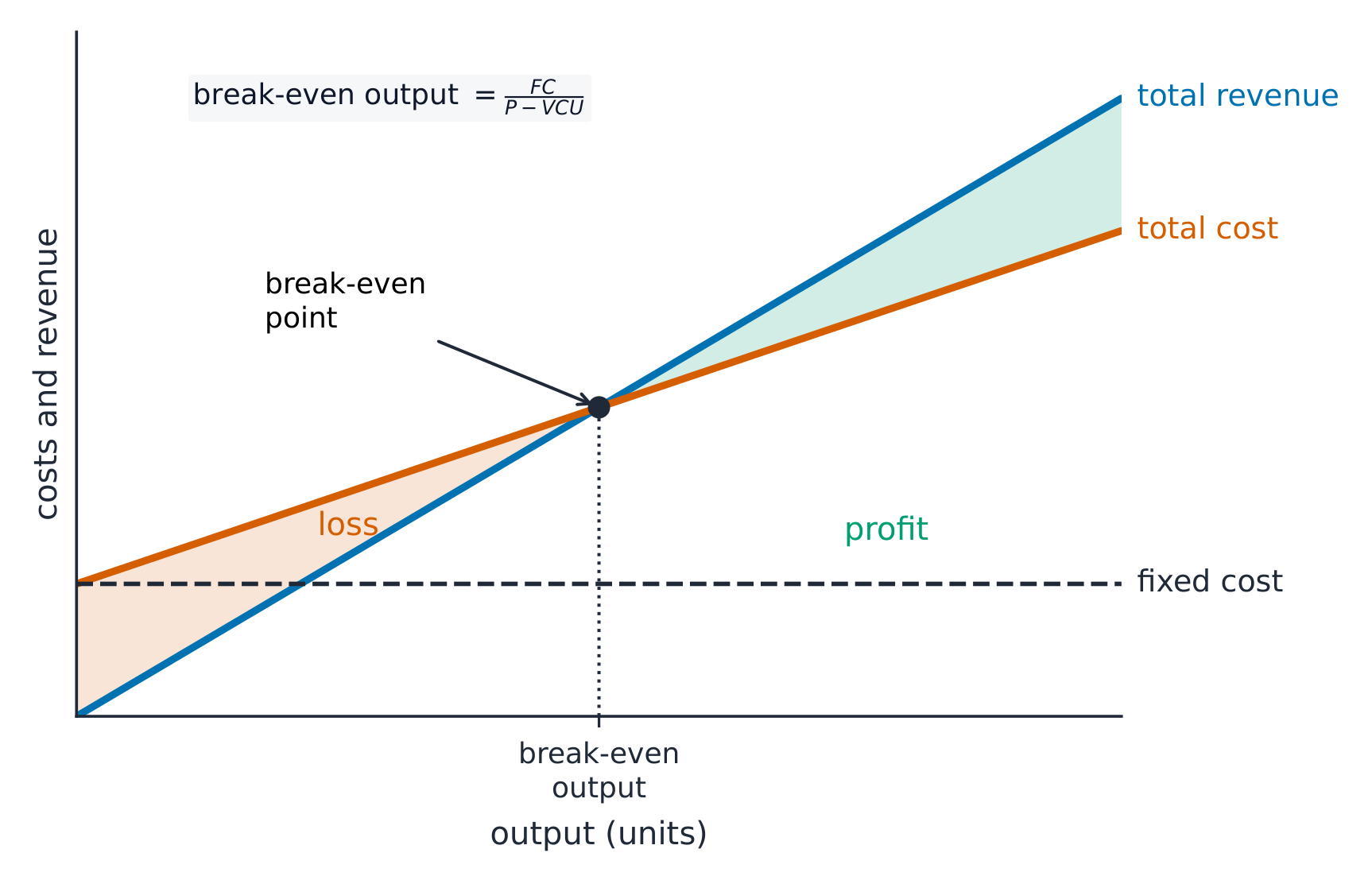
The break-even point is where total revenue equals total cost
Budgeted cost is 4,000 and actual cost is 4,300. What is the size of the variance?
Difficulty 2/5 · 140 coins + a small bonus on first completion today
Variance = |4300 − 4000| = 300 (adverse, as cost rose).
Actual sales above the budgeted figure is a variance that is:
Difficulty 1/5 · 100 coins + a small bonus on first completion today
Higher-than-budgeted revenue is a favourable variance.
A variance where the actual result is worse than budgeted is called ______.
Difficulty 1/5 · 100 coins + a small bonus on first completion today
Adverse = worse than budget; favourable = better.
Variance analysis 差异分析
- A variance 差异 is the difference between the budgeted and the actual figure.
- Favourable 有利: better than budget (higher revenue, lower cost). Adverse 不利: worse than budget.
Worked example. Budgeted cost 5,000; actual cost 5,600. Variance = 600 adverse (costs were higher than planned). Budgeted sales 8,000; actual 8,500 → 500 favourable.
Which are benefits of budgeting? (Select all that apply.)
Difficulty 2/5 · 140 coins + a small bonus on first completion today
Budgets aid planning, control and motivation, but cannot guarantee profit.
Why budgets help
- They aid planning, control and motivation (clear targets).
- But they can be inflexible 缺乏弹性 and may demotivate if set unrealistically.
A favourable variance isn't always good news. Spending far below budget might mean under-investment (e.g. skipping maintenance) that causes problems later. Always ask why a variance arose.
You've got it
- a budget is a financial plan: expected income, spending or profit
- a variance = budgeted − actual; favourable (better) or adverse (worse)
- budgets aid planning, control, motivation — but can be inflexible
Write from an adverse variance of 600
- Budgeted cost is 5000. Actual cost is 5600.
- Find the variance and say whether it is adverse.
Budgeted cost is 5000 and actual cost is 5600. What is the size of the variance, and is it adverse or favourable?
Actual cost is 600 above budget, so the variance is adverse.
What is the cost variance?
Difficulty 1/5 · 100 coins + a small bonus on first completion today
Spending more than the budget is an adverse cost variance.