Lipids
Introduced| English | Meaning |
|---|---|
| triglyceride/ˈtrɪɡlɪsəraɪd/ | A lipid formed from one glycerol and three fatty acids joined by ester links. |
| glycerol/ˈɡlɪsərɒl/ | A three-carbon alcohol with three hydroxyl groups, forming part of the structure of triglycerides. |
| fatty acid/ˈfæti ˈæsɪd/ | A carboxylic acid with a hydrocarbon chain, commonly a component of lipids such as triglycerides. |
| ester bond/ˈestə bɒnd/ | A covalent linkage formed between a carboxyl-derived group and an oxygen attached to a carbon group, as in fats. |
| saturated/ˈsætʃəreɪtɪd/ | Describing a solution unable to dissolve more solute under stated conditions, or an organic molecule with no carbon-carbon double or triple bonds. |
| unsaturated/ʌnˈsætʃəreɪtɪd/ | Containing one or more carbon-carbon double or triple bonds rather than only single bonds. |
| hydrophobic/ˌhaɪdrəˈfəʊbɪk/ | Unable to mix readily with water, or tending to avoid contact with it. |
| hydrophilic/ˌhaɪdrəˈfɪlɪk/ | Water-attracting; describes heads of phospholipids and polar groups that interact with water. |
| phospholipid/ˈfɒsfəlɪpɪd/ | A lipid with a phosphate-containing hydrophilic head and hydrophobic fatty-acid tails, commonly forming cell-membrane bilayers. |
| bilayer/ˈbɪleɪə/ | A structure made of two layers; a cell membrane contains two layers of phospholipid molecules. |
A store of fat cannot replace a membrane
- A fat droplet stores fuel, while a cell membrane separates two watery environments. Both involve lipids, but the molecules need different structures for these jobs.
- Follow the structure: long hydrocarbon chains suit fuel storage; a molecule with a water-interacting head and two tails can organise into a membrane.
Build a triglyceride 甘油三酯
- A glycerol 甘油 molecule has three OH groups. Each fatty acid 脂肪酸 has a COOH group and a hydrocarbon chain. Three fatty acids join one glycerol by three ester bonds 酯键; forming each bond by condensation releases one water molecule.
- An ester link contains the group –C(=O)–O–. Complete hydrolysis uses three water molecules to break the three links, producing glycerol and three fatty acids. The fatty acids need not all be the same length or type.

This is a schematic of the three chains; an ester link contains a carbonyl C=O and a C–O link, rather than a glycosidic or peptide group.
Building a triglyceride
Watch one glycerol join three fatty acids. Each ester bond forms by condensation, removing one water — three bonds, three waters.
A triglyceride is made from:
Difficulty 1/5 · 100 coins + a small bonus on first completion today
A triglyceride = 1 glycerol + 3 fatty acids, joined by ester bonds (each forms by condensation).
Glycerol joins each fatty acid by an ______ bond, formed by condensation.
Difficulty 1/5 · 100 coins + a small bonus on first completion today
Three ester bonds form, removing three water molecules in total.
Put the formation of a triglyceride in order.
Difficulty 3/5 · 200 coins + a small bonus on first completion today
Each ester bond forms by condensation; three bonds release three water molecules.
Four triglyceride molecules are completely hydrolysed. How many ester bonds are broken and how many glycerol, fatty-acid and water molecules are involved? Explain the ratios.
Each triglyceride has three ester links, so four have twelve. Hydrolysis uses twelve water molecules and produces four glycerol and twelve fatty-acid molecules. Water is a reactant in hydrolysis, not a product.
Count carbon-carbon double bonds
- A saturated 饱和 fatty-acid chain has no C=C bonds. An unsaturated 不饱和 chain has one or more: one is monounsaturated and more than one is polyunsaturated. Count C=C within the hydrocarbon chain, not the C=O in the COOH group.
- A cis C=C bond introduces a kink, so neighbouring chains cannot pack as closely. Comparable fats with more cis-unsaturated chains often melt at a lower temperature; double-bond number and chain length are separate features.
Every fatty acid contains a carbonyl C=O group. That does not make every fatty acid unsaturated: saturation here concerns carbon-carbon bonds in the chain. A drawing's bent line alone is weaker evidence than an explicitly shown C=C.
Match each fatty acid type to its feature.
Difficulty 2/5 · 140 coins + a small bonus on first completion today
Saturated chains have no C=C. Common cis-unsaturated chains have kinks that hinder close packing, often lowering melting temperature compared with otherwise similar saturated chains. Chain length and bond arrangement also matter.
Fatty acids P, Q and R contain 18, 16 and 18 carbon atoms respectively. Their chains contain zero, one and two C=C bonds respectively. All have a carboxyl C=O. Classify their saturation and compare P with R using two separate structural features.
P is saturated, Q monounsaturated and R polyunsaturated. P and R have the same carbon-chain length but differ in carbon-carbon double-bond number. Their shared carboxyl C=O does not make P unsaturated; chain length is not the test of saturation.
Explain hydrophobic storage
- The long hydrocarbon parts are non-polar. A triglyceride is hydrophobic 疏水 overall: these large non-polar regions do not interact with water enough for it to dissolve, and it has no hydrophilic 亲水 phosphate head like a phospholipid 磷脂.
- Insoluble triglyceride droplets do not have the large osmotic effect that the same stored fuel would have as many separate dissolved molecules. Hydrophobic does not mean an active force pushes water away.
Relate the store to its function
- Oxidation of triglycerides releases much energy per unit mass, about twice that of carbohydrate. Their many carbon-hydrogen bonds contribute to their fuel value; energy is released by the overall oxidation reaction, not simply by breaking a bond.
- They can be stored without the large amount of associated water found with glycogen, making a light long-term fuel store. Fat deposits also reduce heat loss under the skin and cushion organs; these are different functions from forming a membrane.
A migratory animal needs much stored fuel with little carried mass. High energy per gram and storage without much associated water explain why triglyceride is useful. “It is insoluble” explains an osmotic advantage, but does not by itself explain the high energy yield.
One reason triglycerides are good long-term energy stores is that they:
Difficulty 1/5 · 100 coins + a small bonus on first completion today
Lipids release ~2× the energy per gram of carbohydrate, are insoluble, and store no water.
Two equal-mass reserves can supply different amounts of energy. Explain two reasons a triglyceride reserve can be useful for an animal carrying fuel over a long journey. Link each reason to a property of the reserve.
Triglyceride oxidation releases much energy per gram, so a given carried mass can supply more fuel energy than carbohydrate. Triglycerides are stored with little associated water, reducing the mass carried for the reserve. Insolubility also avoids the large osmotic effect of separate dissolved fuel molecules, but does not itself explain a high energy yield.
A phospholipid has two different regions
- In a typical glycerol-based phospholipid, glycerol links to two fatty acids and a phosphate-containing head group. Compare its two tails with the three fatty acids of a triglyceride; this is a structural comparison, not a claim that the cell simply swaps a tail for phosphate in one step.
- The phosphate head is hydrophilic and polar; the hydrocarbon tails are hydrophobic and non-polar. Use both regions to explain how the molecule interacts with water.
A phospholipid forms membranes because it has:
Difficulty 1/5 · 100 coins + a small bonus on first completion today
The polar head is attracted to water and the non-polar tails avoid it, so phospholipids arrange into a bilayer.
Explain a bilayer 双层
- In water, phospholipids form a bilayer with heads facing the watery environments on both sides and tails facing each other inside. The membrane's centre is hydrophobic; the cytoplasm side is watery too.
- Triglycerides lack the hydrophilic phosphate heads needed at the water-facing surfaces. They form fat droplets rather than the same stable membrane bilayer; “both are lipids” is not a reason to exchange them.
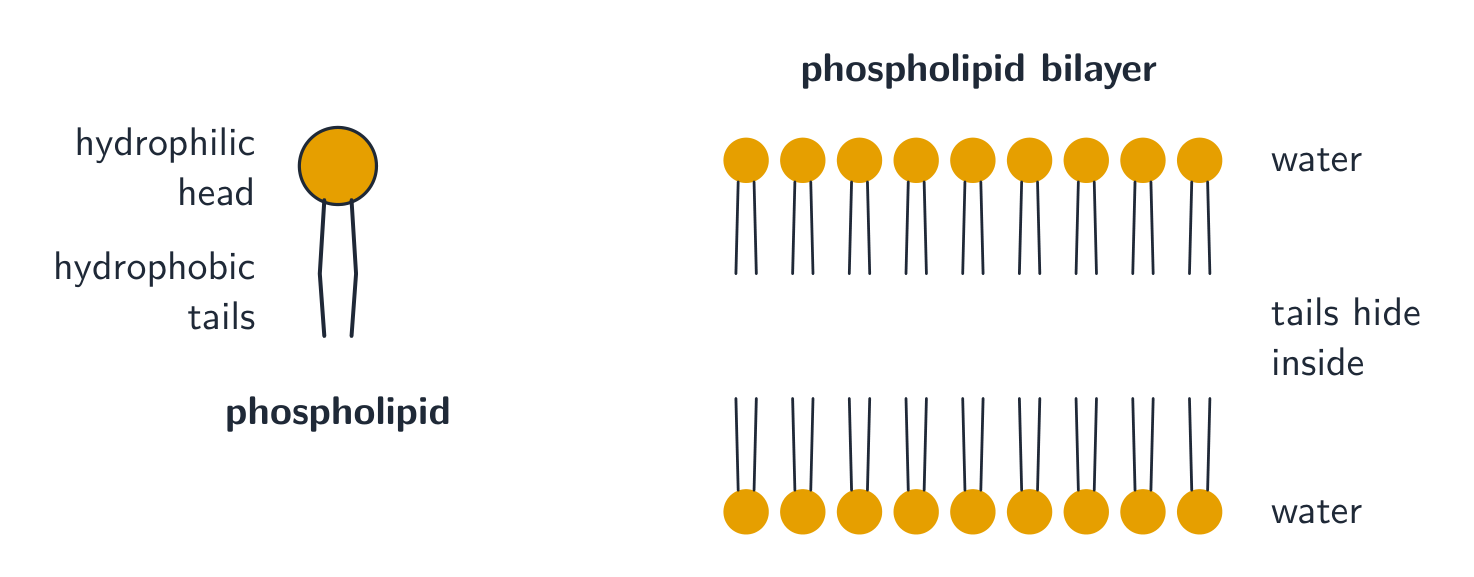
Both membrane surfaces meet water; the tails occupy the interior.
In a phospholipid bilayer, the hydrophilic heads point inward and the hydrophobic tails face the water.
Difficulty 1/5 · 100 coins + a small bonus on first completion today
False. The hydrophilic heads face the water on both sides and the hydrophobic tails point inward, away from water.
In a phospholipid bilayer separating cell contents from tissue fluid, identify where the phosphate heads and fatty-acid tails face. Explain why the heads face water on both sides rather than pointing only towards the outside of the cell.
Both the cytoplasm and tissue fluid are aqueous. Hydrophilic polar heads face those watery regions at the two surfaces. Hydrophobic non-polar tails face each other in the centre, away from water. The centre of the membrane is not a watery compartment.
You've got it
- A triglyceride contains glycerol, three fatty acids and three ester links; condensation releases three waters, and complete hydrolysis uses three.
- Saturated means no C=C in the chain; unsaturated means at least one. Do not count a carboxyl C=O as C=C.
- Explain storage using high energy per mass, little associated water and insolubility.
- A phospholipid has a polar hydrophilic head and two non-polar hydrophobic tails; these regions explain its arrangement in a bilayer.
A student proposes replacing membrane phospholipids with triglycerides because both contain glycerol and fatty acids. Evaluate the proposal using their molecular structures.
Use head/tail structure to explain membrane assembly, rather than only listing the shared elements.
A fatty acid has a C=O in its carboxyl group but no C=C in its hydrocarbon chain. Which statement is correct?
Difficulty 1/5 · 100 coins + a small bonus on first completion today
Saturation classifies carbon-carbon bonds in the fatty-acid chain. A carboxyl carbonyl is a carbon-oxygen double bond, present in both saturated and unsaturated fatty acids.