연못에 돌을 던지면 고리가 바깥쪽으로 퍼져 나갑니다. 하지만 물면에 떠 있는 잎을的观察해 보세요 — 잎은 오직 위아래로만 흔들릴 뿐이며, 파도와 함께 이동하지 않습니다.…
English narration · English + 中文 subtitles burned in · 영어 내레이션 · 영어 + 중국어 자막 burned-in
3.1
General properties of waves · 파동의 일반적인 성질
Syllabus
English
Core
Supplement
1 Know that waves transfer energy without transferring matter
2 Describe what is meant by wave motion as illustrated by vibrations in ropes and springs, and by experiments using water waves
3 Describe the features of a wave in terms of wavefront, wavelength, frequency, crest (peak), trough, amplitude and wave speed
4 Recall and use the equation for wave speed $v = f \lambda$
5 Know that for a transverse wave, the direction of vibration is at right angles to the direction of propagation and understand that electromagnetic radiation, water waves and seismic S-waves (secondary) can be modelled as transverse
6 Know that for a longitudinal wave, the direction of vibration is parallel to the direction of propagation and understand that sound waves and seismic P-waves (primary) can be modelled as longitudinal
7 Describe how waves can undergo: (a) reflection at a plane surface (b) refraction due to a change of speed (c) diffraction through a narrow gap
9 Describe how wavelength and gap size affects diffraction through a gap
8 Describe the use of a ripple tank to show: (a) reflection at a plane surface (b) refraction due to a change in speed caused by a change in depth (c) diffraction due to a gap (d) diffraction due to an edge
10 Describe how wavelength affects diffraction at an edge
한국어
핵심
보충
1 파동이 물질을 이동시키지 않고 에너지만을 전달함을 안다.
2 줄이나 스프링의 진동 및 수파 실험으로 나타나는 파동 운동의 의미를 설명한다.
3 파동의 특징을 파면, 파장, 주파수, 봉우리(최대값), 곡선(최소값), 진폭 및 파속에 대해 설명한다.
4 파속 공식 $v = f \lambda$을 기억하고 사용한다.
5 횡파에서는 진동 방향이 전파 방향과 수직임을 알고, 전자기복사, 수파 및 지진 S파(보조파)가 횡파로 모델링될 수 있음을 이해한다.
6 종파에서는 진동 방향이 전파 방향과 평행함을 알고, 음파 및 지진 P파(일차파)가 종파로 모델링될 수 있음을 이해한다.
7 파동이 다음과 같은 현상을 겪는 방법을 설명한다: (a) 평면에서의 반사, (b) 속도의 변화에 따른 굴절, (c) 좁은 틈을 통과할 때의 회절.
9 파장과 틈의 크기가 틈을 통한 회절에 미치는 영향을 설명한다.
8 리플 탱크(Ripple tank)를 사용하여 다음을 보여주는 용도를 설명한다: (a) 평면에서의 반사, (b) 깊이 변화로 인한 속도 변화에 따른 굴절, (c) 틈에 의한 회절, (d) 모서리에 의한 회절.
10 파장이 모서리에서의 회절에 미치는 영향을 설명한다.
Source: Cambridge International syllabus · 출처: Cambridge International syllabus
English
Transverse vs longitudinal waves
A wave 波 carries energy 能量 from place to place without carrying matter. For example, a water wave makes a floating cork bob up and down, but the cork does not travel along with the wave. You can make a wave on a rope by shaking one end up and down, or on a long spring by pushing one end back and forth. In a ripple tank 波纹水槽 (a shallow tray of water with a light above it) you can watch water waves on a screen below.
Describing a wave
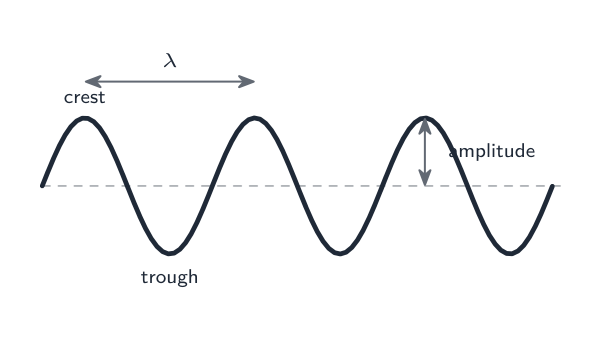
wavefront 波前: a line joining points on a wave that move together (for example, the top of one ripple)
wavelength 波长 ($\lambda$): the distance between two neighbouring wavefronts (one full wave)
frequency 频率 ($f$): the number of waves passing a point each second, measured in hertz (Hz)
crest 波峰 (also called the peak 峰, the top) and trough 波谷 (bottom)
amplitude 振幅: the largest distance a point moves from its rest position
wave speed 波速 ($v$): how fast a wavefront travels
These are linked by the wave equation:
$$v = f\lambda$$
Worked example. A sound wave travels at $340\ \text{m/s}$ and has a frequency of $170\ \text{Hz}$. Find its wavelength.
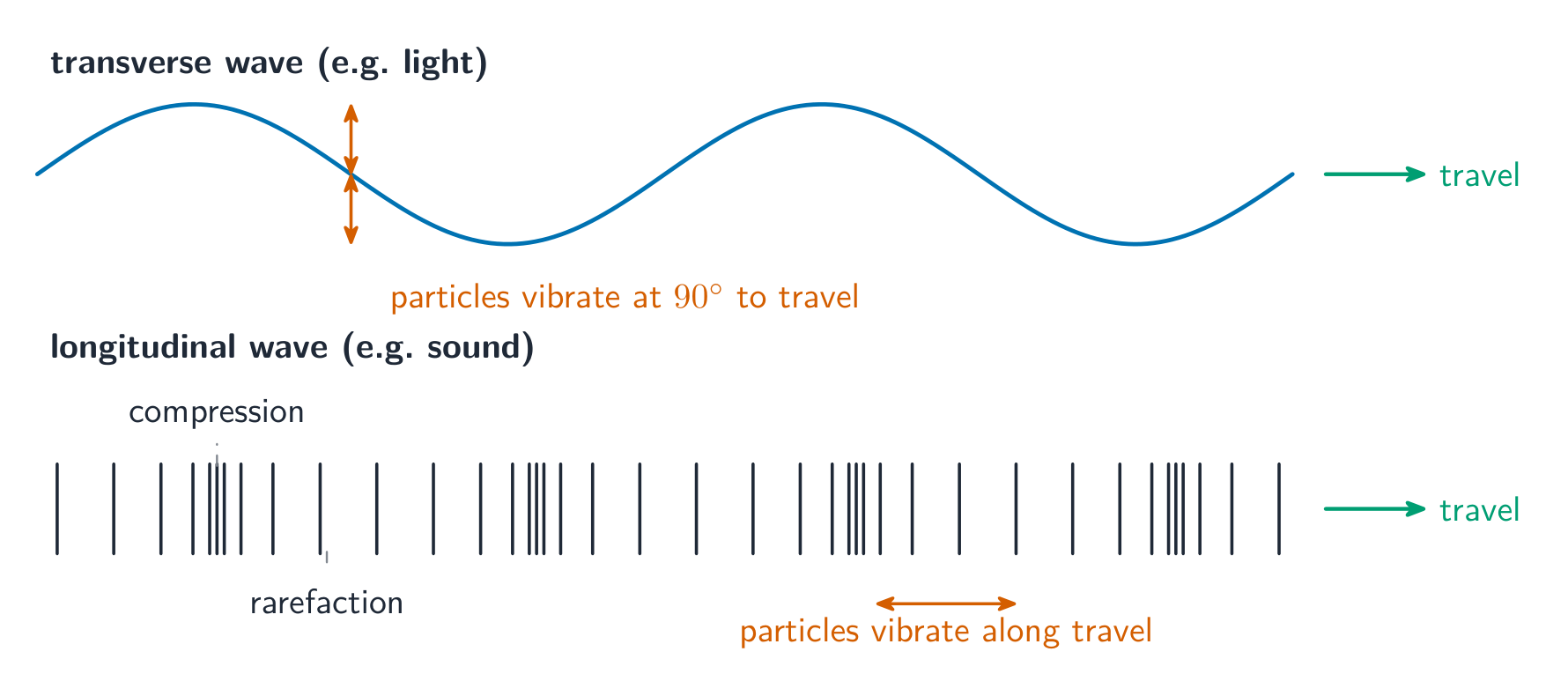
In a transverse wave 横波 the particles vibrate at right angles (90°) to the direction the wave travels (its propagation 传播). Light, water waves and seismic S-waves (the sideways shaking in an earthquake) are transverse.
In a longitudinal wave 纵波 the particles vibrate along the same direction as the wave travels. Sound and seismic P-waves are longitudinal.
Wave behaviour
All waves can show three behaviours, which you can see in a ripple tank:
reflection 反射: the wave bounces off a surface.
refraction 折射: the wave changes speed (and usually direction) when it enters a different material or depth.
diffraction 衍射: the wave spreads out after passing through a gap or around an edge. The spreading is greatest when the gap is about the same size as the wavelength.
한국어
횡파 vs 종파
파동은 물질을 함께 운반하지 않고 에너지만을 한 곳에서 다른 곳으로 이동시킵니다. 예를 들어, 물결이 떠 있는 마개를 위아래로 흔들지만 마개 자체는 파동과 함께 이동하지 않습니다. 줄的一端을 위아래로 흔들거나 긴 스프링的一端을 앞뒤로 밀어당김으로써 파동을 만들 수 있습니다. 리플 탱크(하단에 조명이 있는 얕은 물 그릇)에서는 아래 스크린에 물결을 관찰할 수 있습니다.
파동 묘사하기
파면(wavefront): 파동 위에서 동시에 움직이는 점들을 연결한 선 (예: 하나의 리플의 정점)
파장 ($\lambda$): 두 인접한 파면 사이의 거리 (완전한 파동 하나)
주파수 ($f$): 매초某 지점을 통과하는 파동의 개수이며, 헤르츠(Hz) 단위로 측정함
정점(crest) (또는 봉우리 peak, 최상단)과 저점(trough) (하단)
진폭(amplitude): 한 점이 평형 위치에서 이동할 수 있는 최대 거리
파속(wave speed) ($v$): 파면이 이동하는 속도
파동의 구성 요소: 파장, 진폭, 봉우리와 골짜기
이들은 파동 방정식으로 연결됩니다:
$$v = f\lambda$$
파장은 두 정점 사이의 거리이며, 진폭은 평형 위치부터 정점까지의 높이입니다
작업 예제. 소리의 파동이 $340\ \text{m/s}$로 이동하며 주파수는 $170\ \text{Hz}$입니다. 이 파동의 파장을 구하십시오.
**횡파(transverse wave)**에서는 입자가 파동이 진행하는 방향(그의 전파 propagation)과 직각(90°)으로 진동합니다. 빛, 물결, 지진 S-파(지진의 좌우 흔들림)는 횡파입니다.
**종파(longitudinal wave)**에서는 입자가 파동이 진행하는 것과 같은 방향으로 진동합니다. 소리, 지진 P-파는 종파입니다.
횡파에서는 입자가 진행 방향에 대해 수직으로 진동하며, 종파에서는 진행 방향과 평행하게 진동하여 압축부 및 희박부를 만듭니다
파동의 행동
모든 파동은 세 가지 행동을 보일 수 있으며, 이는 리플 탱크에서 확인할 수 있습니다:
반사(reflection): 파동이 표면에 튕겨 나가는 현상
굴절(refraction): 파동이 다른 물질이나 깊이에 진입할 때 속도(보통 방향)가 변하는 것
회절(diffraction): 파동이 틈을 지나거나 모서리를绕过后 퍼지는 현상. 틈의 크기가 파장과 거의 같을 때 퍼짐이 가장 큽니다.
평면파가 좁은 틈을 지나면 곡선파로 퍼지며, 틈의 폭이 약 한 파장일 때 회절이 가장 강함리플 탱크의 평면파는 직선 장벽에 반사되며, 반사된 파면은 도달했을 때의 각도와 동일한 각도로 나갑니다
Explore · 탐색하기
Properties of waves · 파동의 특성
y = a sin(bx + c)
A wave: a is amplitude, b sets the wavelength. · 파동에서: a는 진폭이며, b는 파장을 결정합니다.
Explore · 탐색하기
Transverse & longitudinal waves · 횡파 및 종파
Flip between a transverse wave (particles bob up and down, like water and light) and a longitudinal one (particles slide back and forth, bunching into compressions, like sound). The wave moves; the particles stay put. · 물과 빛처럼 입자가 위아래로 움직이는 횡파와 소리와 같이 입자가 앞뒤로 미끄러져 압축 영역을 형성하는 종파 사이를 전환해 보십시오. 파동은 이동하지만 입자는 제자리에 머물러 있습니다.
Explore · 탐색하기
Two waves overlapping · 두 파동의 중첩
Change the second wave. Where waves meet they add — sometimes reinforcing, sometimes cancelling. · 두 번째 파동을 변경하세요. 파동이 만나는 곳에서는 더해집니다 —Sometimes 증폭되기도 하고 Sometimes 상쇄되기도 합니다.
1 Define and use the terms normal, angle of incidence and angle of reflection
2 Describe the formation of an optical image by a plane mirror and give its characteristics, i.e. same size, same distance from mirror, virtual
3 State that for reflection, the angle of incidence is equal to the angle of reflection; recall and use this relationship
4 Use simple constructions, measurements and calculations for reflection by plane mirrors
3.2.2 Refraction of light
Core
Supplement
1 Define and use the terms normal, angle of incidence and angle of refraction
2 Describe an experiment to show refraction of light by transparent blocks of different shapes
6 Define refractive index, $n$, as the ratio of the speeds of a wave in two different regions
3 Describe the passage of light through a transparent material (limited to the boundaries between two mediums only)
7 Recall and use the equation
$$n = \frac{\sin i}{\sin r}$$
4 State the meaning of critical angle
8 Recall and use the equation
$$n = \frac{1}{\sin c}$$
5 Describe internal reflection and total internal reflection using both experimental and everyday examples
9 Describe the use of optical fibres, particularly in telecommunications
3.2.3 Thin lenses
Core
Supplement
1 Describe the action of thin converging and thin diverging lenses on a parallel beam of light
2 Define and use the terms focal length, principal axis and principal focus (focal point)
3 Draw and use ray diagrams for the formation of a real image by a converging lens
6 Draw and use ray diagrams for the formation of a virtual image by a converging lens
4 Describe the characteristics of an image using the terms enlarged/same size/diminished, upright/inverted and real/virtual
7 Describe the use of a single lens as a magnifying glass
5 Know that a virtual image is formed when diverging rays are extrapolated backwards and does not form a visible projection on a screen
8 Describe the use of converging and diverging lenses to correct long-sightedness and short-sightedness
3.2.4 Dispersion of light
Core
Supplement
1 Describe the dispersion of light as illustrated by the refraction of white light by a glass prism
2 Know the traditional seven colours of the visible spectrum in order of frequency and in order of wavelength
3 Recall that visible light of a single frequency is described as monochromatic
한국어
3.2.1 빛의 반사
핵심
보충
1 법선, 입사각 및 반사각의 의미를 정의하고 사용함
2 평면 거울에 의한 광학적 상의 형상을 서술하고, 그 특성(동일한 크기, 거울로부터 동일한 거리, 가상의 상)을 나열함
3 반사 현상에서 입사각은 반사각과 같음을 밝히고, 이 관계를 기억하여 활용함
4 평면 거울의 반사에 대한 단순 도식, 측정 및 계산을 수행함
3.2.2 빛의 굴절
핵심
보충
1 법선, 입사각 및 굴절각의 의미를 정의하고 사용함
2 서로 다른 모양의 투명한 블록에 의한 빛의 굴절을 보여주는 실험을 서술함
6 굴절률, $n$를 두 매질에서의 파동의 속도의 비로 정의함
3 빛이 투명한 물질을 통과하는 경로를 서술함(두 매질 사이의 경계면에만 국한).
7 식
$$n = \frac{\sin i}{\sin r}$$
을 기억하여 활용함
4 임계각의 의미를 설명함
8 식
$$n = \frac{1}{\sin c}$$
을 기억하여 활용함
5 실험적 예시와 일상생활의 예를 들어 내부 반사 및 전반사를 서술함
9 광섬유의 용도, 특히 통신 분야에서의 적용을 서술함
3.2.3 얇은 렌즈
핵심
보충
1 평행광선束에 대한 얇은 수렴 렌즈 및 얇은 발산 렌즈의 작용을 서술함
2 초점 거리, 주축 및 주초점(초점)의 의미를 정의하고 사용함
3 수렴 렌즈에 의한 실상의 형성을 위한 광선도를 그리기 및 활용함
6 수렴 렌즈에 의한 가상의 상의 형성을 위한 광선도를 그리기 및 활용함
4 확대/동일/축소, 정립/역설, 실상/가상 등의 용어를 사용하여 상의 특성을 서술함
7 단일 렌즈를 확대경으로 사용하는 방법을 서술함
5 발산 광선을 역방향으로 연장할 때 가상의 상이 형성되며, 스크린에 직접 투사되지 않음을 알고 있음
8 근시 및 원시의 교정을 위해 수렴 렌즈와 발산 렌즈를 사용하는 방법을 서술함
3.2.4 빛의 분산
핵심
보충
1 유리 프리즘에 의한 백색광의 굴절을 통해 빛의 분산 현상을 서술함
2 가시 스펙트럼의 전통적인 일곱 가지 색상을 주파수 순서 및 파장 순서에 따라 알고 있음
3 단일 주파수의 가시광선은 단색광이라고 불림
Source: Cambridge International syllabus · 출처: Cambridge International syllabus
English
A converging lens forms an imageTotal internal reflection
Reflection
When light hits a mirror, it reflects. We measure angles from the normal 法线 (a line at 90° to the surface).
The law of reflection: the angle of incidence 入射角 equals the angle of reflection 反射角.
A plane mirror 平面镜 forms an image that is the same size as the object, the same distance behind the mirror, and virtual (it cannot be caught on a screen).
Refraction
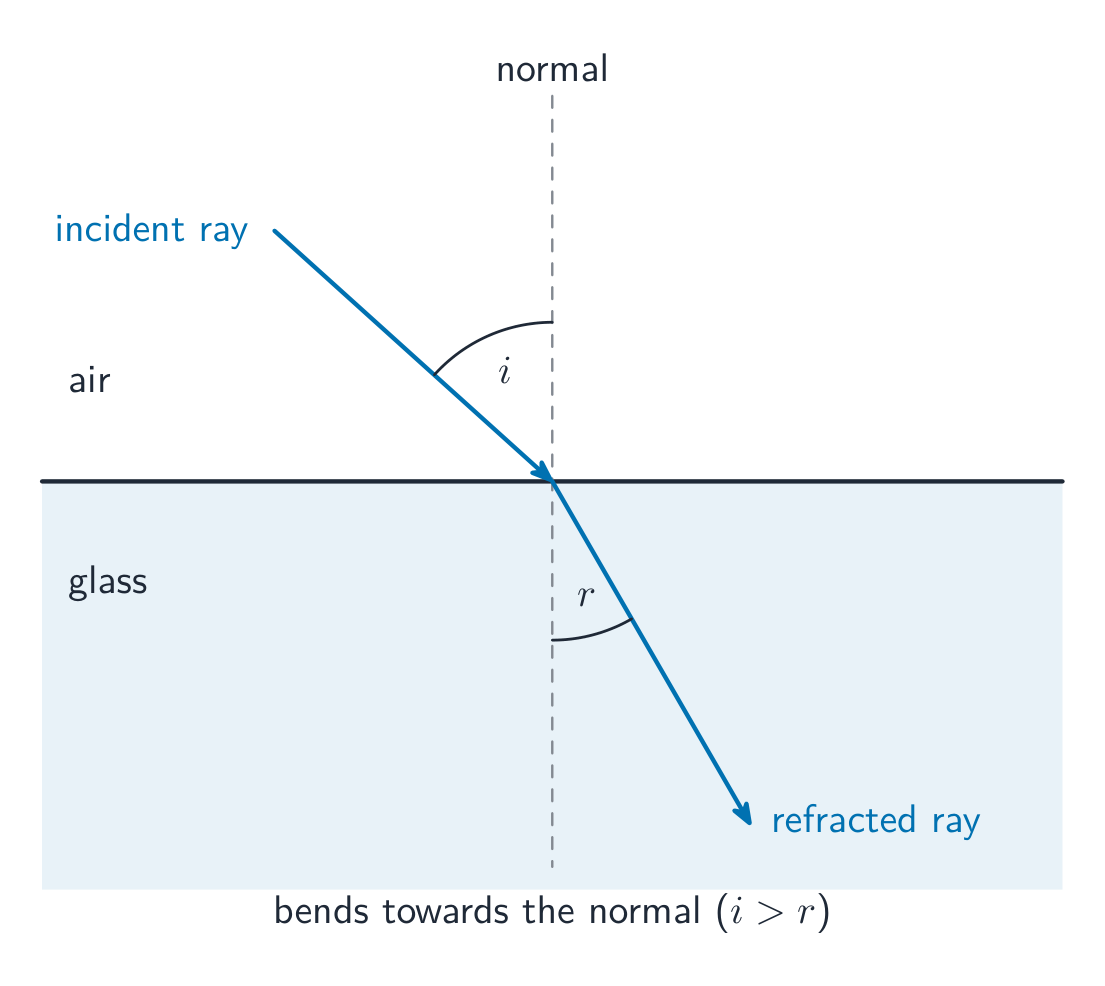
When light passes from one material into another, it changes speed and bends. The angle in the second material is the angle of refraction 折射角.
Seeing refraction. Shine a narrow ray from a ray box 光线盒 into a rectangular glass block standing on paper. Mark the ray going in and the ray coming out, remove the block, and join the marks to draw the ray inside the glass. Draw the normal where the ray enters and measure the angle of incidence and the angle of refraction with a protractor. Repeat with a semicircular block or a prism: the ray always bends towards the normal on entering the glass and away from the normal on leaving.
The refractive index 折射率$n$ compares the speed of light in the two materials:
$$n = \frac{\sin i}{\sin r}$$
Worked example. A ray of light passes from air into glass. The angle of incidence is 60° and the angle of refraction is 35°. Find the refractive index of the glass. (Take $\sin i = 0.87$ and $\sin r = 0.57$.)
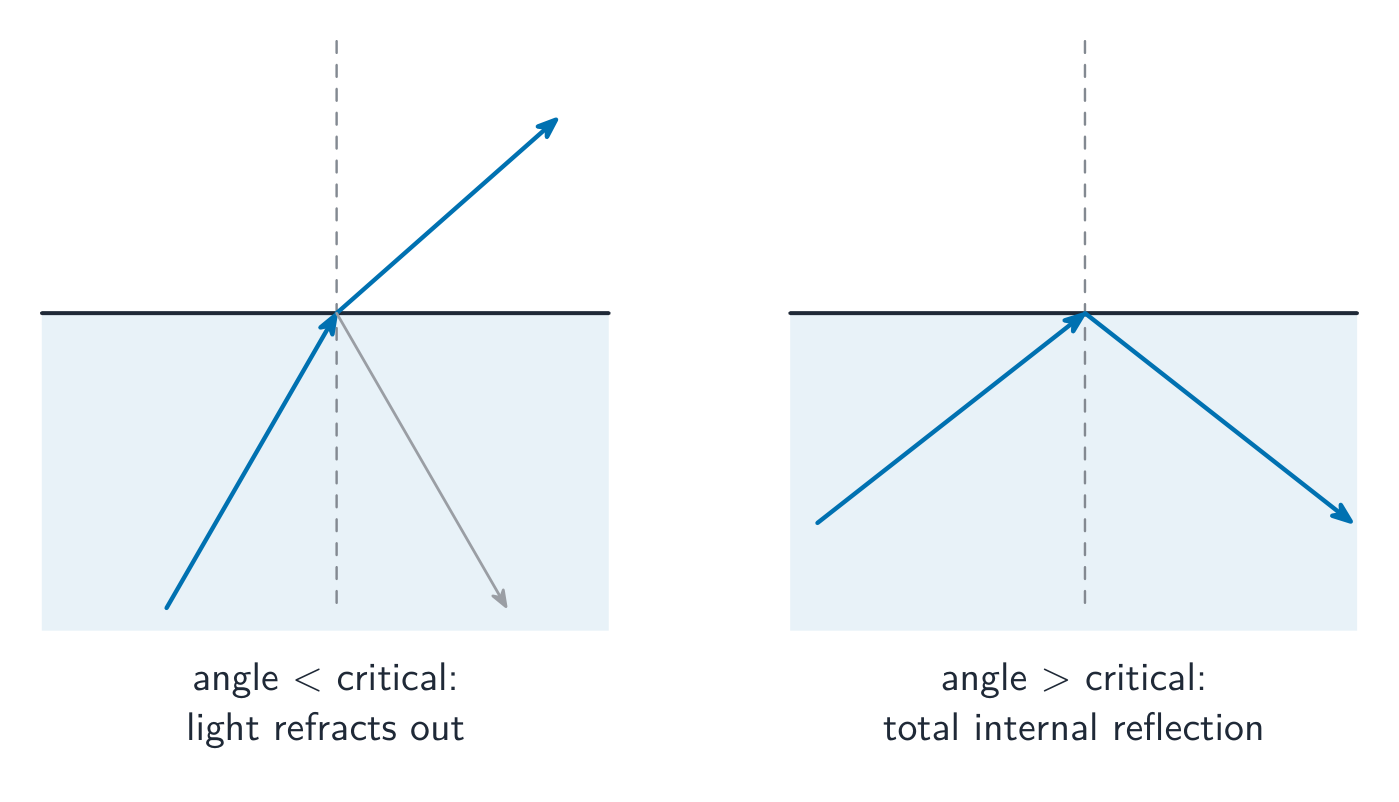
When light tries to leave glass or water and the angle is too large, it cannot get out and instead reflects completely. This is total internal reflection 全反射. It happens when the angle inside is bigger than the critical angle 临界角$c$:
$$n = \frac{1}{\sin c}$$
This effect is used in optical fibres 光纤, thin glass threads that carry light signals for telephones and the internet.
Lenses
A converging lens 凸透镜 (fat in the middle) bends parallel rays inwards to a point called the principal focus 焦点. The principal axis 主光轴 is the straight line through the centre of the lens at right angles to it; the principal focus lies on this axis. The distance from the centre of the lens to the principal focus is the focal length 焦距. A diverging lens 凹透镜 (thin in the middle) spreads parallel rays out, as if they came from a focus on the incoming side.
A converging lens can form a real image 实像 (rays really meet; can be shown on a screen) or, when the object is very close, a virtual image 虚像 (rays only seem to come from it). Used close to the eye, a converging lens is a magnifying glass 放大镜.
Describe an image with three pairs of words: enlarged 放大的 or diminished 缩小的 (or the same size), upright 正立 or inverted 倒立 (upside down), and real or virtual. An object far beyond the focus gives a diminished, inverted, real image (as in a camera). An object between the focus and the lens gives an enlarged, upright, virtual image (a magnifying glass).
Correcting sight. A person with short-sightedness 近视 sees near things clearly but distant things are blurred: the eye focuses the light in front of the retina 视网膜 (the back of the eye). A diverging lens in front of the eye spreads the rays out first, so they focus on the retina. A person with long-sightedness 远视 sees distant things clearly but near things are blurred: the eye focuses the light behind the retina. A converging lens brings the rays together a little before they enter the eye.
Dispersion
A glass prism 棱镜 splits white light into the colours of the spectrum 光谱. This splitting is called dispersion 色散.
The order of colours is red, orange, yellow, green, blue, indigo, violet. Red light has the longest wavelength and the lowest frequency; violet is the opposite. Light of a single frequency (one pure colour) is monochromatic 单色.
한국어
수렴 렌즈는 상을 만듭니다전반사
반사
빛이 거울에 닿으면 반사된다. 각도는 **법선(표면에 90°로 수직인 선)**에서 측정한다.
반사의 법칙: **입사각(angle of incidence)**은 **반사각(angle of reflection)**과 같습니다.
**평면 거울(plane mirror)**은 물체와 동일한 크기의 상을 만들고, 거울 뒤에서 동일한 거리에 형성되며, **가상(virtual)**입니다 (스크린에 잡힐 수 없음).
평면 거울에서 입사각 $i$은 반사각 $r$과 같으며, 둘 다 법선으로부터 측정함
굴절
빛이 한 물질에서 다른 물질로 통과할 때 속도가 변하고 휘어집니다. 두 번째 물질에서의 각도를 **굴절각(angle of refraction)**이라고 합니다.
공기에서 유리로 갈 때 빛은 느려지며 법선 쪽으로 휘어지므로 $i > r$
굴절 관찰하기. **광원 박스(ray box)**에서 좁은 광선을 종이 위에 세워둔 직사각형 유리 블록으로 비추십시오. 들어오는 광선과 나오는 광선에 표시를 하고, 블록을 제거한 후 표시를 이어 유리 내부의 광선을 그리십시오. 광선이 유리进入하는 지점에 법선을 그리고, 분광기를 사용하여 입사각과 굴절각을 측정하십시오. 원반 모양 블록 또는 프리즘으로 반복하십시오: 광선은 유리进入 시 항상 법선 쪽으로 휘어지고, 유리 exiting 시 법선에서 멀어집니다.
굴절률$n$은 두 물질 내에서의 빛의 속도를 비교한다:
$$n = \frac{\sin i}{\sin r}$$
작업 예제. 빛의 광선이 공기에서 유리로 들어갑니다. 입사각은 60°이고 굴절각은 35°입니다. 유리의 굴절율을 구하십시오. ($\sin i = 0.87$과 $\sin r = 0.57$을 사용하십시오.)
빛이 유리나 물을 빠져나오려 할 때 각도가 너무 크면 빛은 밖으로 나가지 못하고 완전히 반사됩니다. 이를 전반사라고 합니다. 내부 각도가 임계각$c$보다 클 때 발생합니다.
$$n = \frac{1}{\sin c}$$
임계각 이하에서는 빛이 굴절하여outside로 나가지만, 임계각 이상에서는 빛이 전방사됩니다
이 현상은전화와 인터넷의 신호를 전달하는 가늘고 긴 유리 실인 광섬유에 활용됩니다.
전반사는 빛이 각 섬유를 따라 계속 튀어 다닐 수 있게 하여 끝부분에서 빛을 내보내도록 합니다
렌즈
수렴 렌즈(가운데가 두꺼움)는 평행 광선을 안쪽으로 휘어지게 하여 주초점이라는 점으로 모으게 합니다. 주축은 렌즈의 중심을 지나 렌즈에 수직인 직선이며, 주초점은 이 축 위에 위치합니다. 렌즈의 중심부터 주초점까지의 거리를 초점 거리라고 합니다. 발산 렌즈(가운데가 얇음)는 평행 광선을 바깥쪽으로 퍼뜨리는데, 마치 입사측에 있는 초점에서 온 것처럼 보입니다.
수렴 렌즈는 평행 광선을 주초점에서 만나게 하며, 초점 거리 $f$는 렌즈와 초점 사이의 거리입니다
수렴 렌즈는 광선이 실제로 만나는 실상(화면에 나타낼 수 있음)이나, 피사체가 매우 가까울 때는 광선이貌似 오직 그곳에서 온 것처럼 보이는 가상상을 만들 수 있습니다. 눈 근처에서 사용할 때 수렴 렌즈는 확대경이 됩니다.
세 쌍의 단어로 상을 설명하십시오: 확대 또는 축소(또는 같은 크기), 정립 또는 역설(뒤집힘), 그리고 실상 또는 가상상. 초점 너머 멀리 있는 물체는 축소되고 역설된 실상을 만듭니다(카메라와 같음). 초점과 렌즈 사이에 있는 물체는 확대되고 정립된 가상상을 만듭니다(확대경과 같음).
시력 교정. 근시는 가까운 것은 잘 보이지만 먼 것은 흐릿하게 보입니다: 눈이 빛을 망막(눈 뒤쪽) 앞에 초점을 맞춥니다. 눈 앞에 놓인 발산 렌즈가 먼저 광선을 퍼뜨려 망막에 초점을 맞추게 합니다. 원시는 먼 것은 잘 보이지만 가까운 것은 흐릿하게 보입니다: 눈이 빛을 망막 뒤에 초점을 맞춥니다. 수렴 렌즈는 광선이 눈에 들어가기 전에 약간 모이게 합니다.
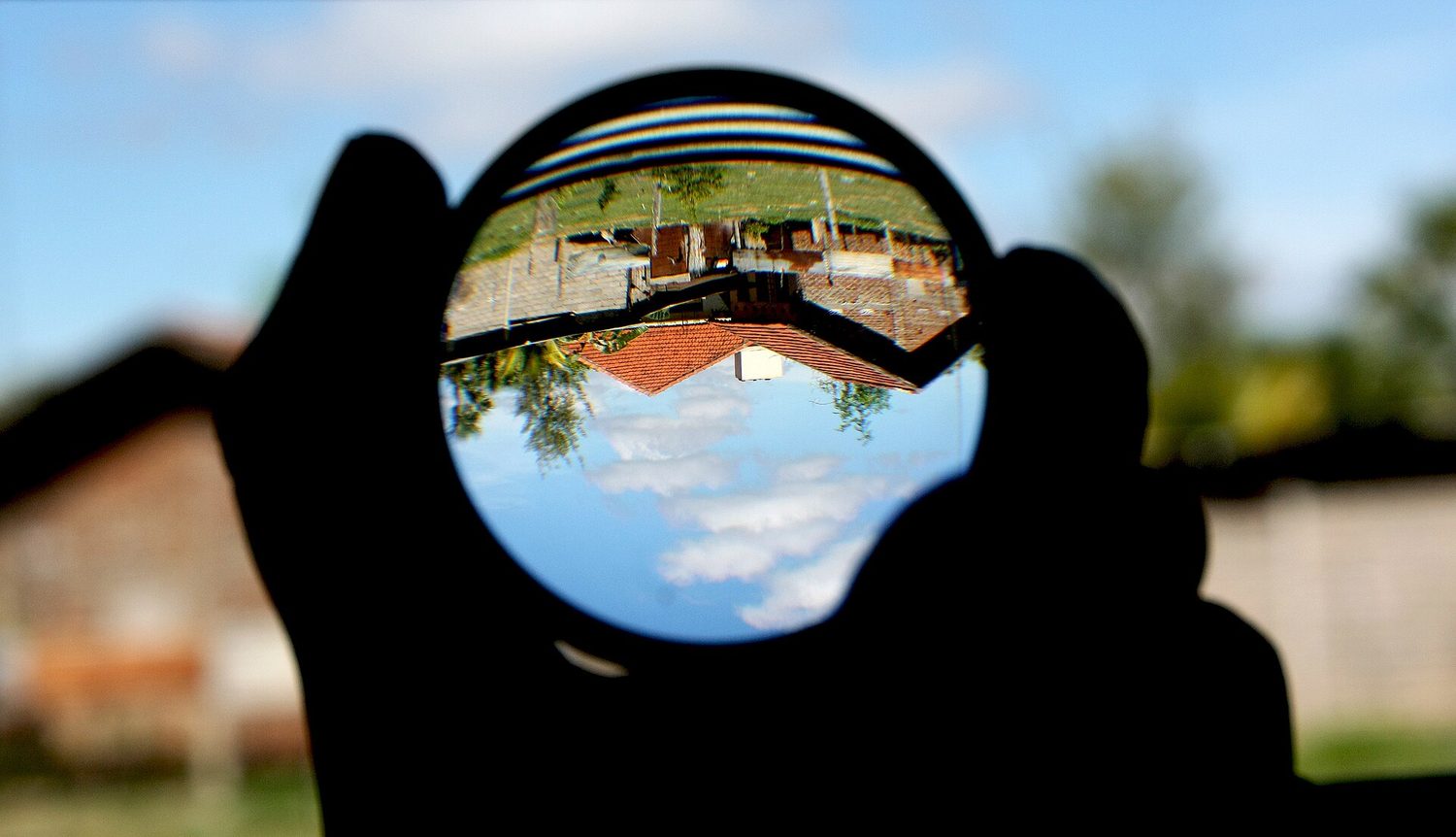
눈에서 떼어놓고 사용하면 수렴 렌즈는 실상을 만드는데, 여기서는 뒤집힌 집들이 역설되어 보임
분산
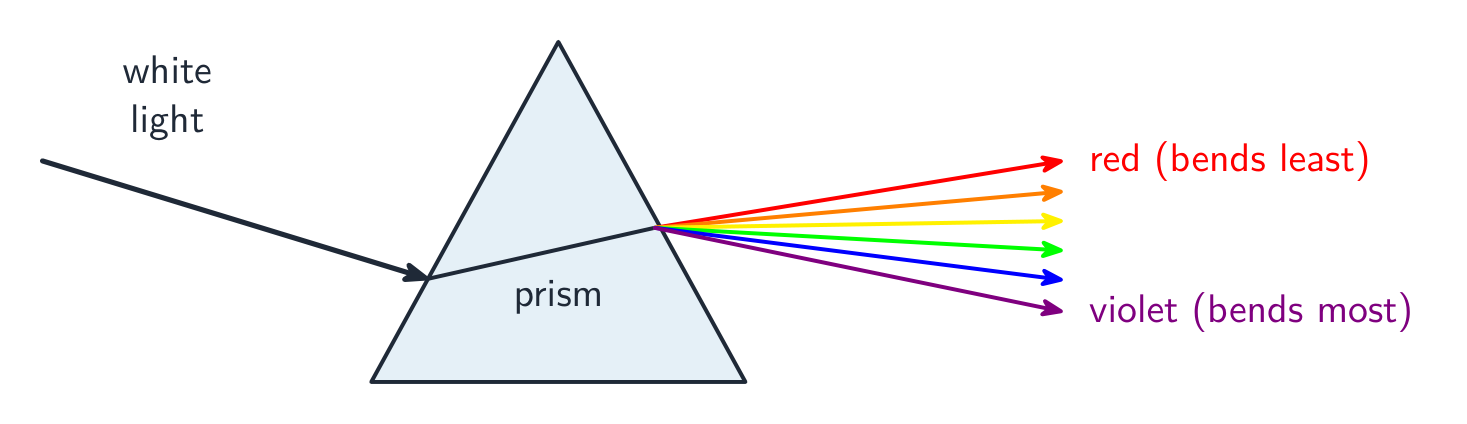
유리 프리즘은 백색 빛을 분광선의 색으로 나눕니다. 이러한 빛의 분리는 분산이라고 합니다.
프리즘은 보라색 빛을 가장 많이 굴절시키고 빨간색 빛을 가장 적게 굴절하므로, 백색 빛이 분광선으로 퍼집니다
색의 순서는 빨강, 주황, 노랑, 초록, 파랑, 남색, 보랑입니다. 빨간 빛은 가장 긴 파장과 가장 낮은 진동수를 가지며, 보라색은 그 반대입니다. 단일 진동수(순수한 한 색)의 빛을 단색광이라고 합니다.
실제 유리 프리즘으로 들어온 백색 빛은 모든 색상의 완전한 분광선으로 퍼집니다
Explore · 탐색하기
Bend a light ray · 빛의 선을 굽히기
Shine light into water, glass or diamond and change the angle. The ray slows and bends toward the normal — the denser the material (higher n), the more it bends. That bending is why a straw looks broken in a glass, and why diamonds sparkle. · 빛을 물, 유리 또는 다이아몬드에 비추고 각도를 변경하십시오. 빛의 선은 느려지며 법선에靠近하여 굽힙니다. 물질이 밀도일수록(높은 n일수록) 더 많이 굽힙니다. 이 굽힘 현상이 마늘줄기가 유리잔에서 부러져 보이거나 다이아몬드가 반짝이는 이유입니다.
Explore · 탐색하기
Image formation by a converging lens · 합수 렌즈에 의한 상 형성
Trace the three special rays from the object — where they meet is the image. Move the object closer than the focal point to flip it into a magnifying glass. · 물체에서 세 가지 특수 광선을 그리세요. 이 광선이 만나는 지점이 상입니다. 물체를 초점보다 nearer로 이동시키면 확대경이 됩니다.
1 Know the main regions of the electromagnetic spectrum in order of frequency and in order of wavelength
2 Know that all electromagnetic waves travel at the same high speed in a vacuum
6 Know that the speed of electromagnetic waves in a vacuum is $3.0 \times 10^8\text{ m/s}$ and is approximately the same in air
3 Describe typical uses of the different regions of the electromagnetic spectrum including: (a) radio waves; radio and television transmissions, astronomy, radio frequency identification (RFID) (b) microwaves; satellite television, mobile phones (cell phones), microwave ovens (c) infrared; electric grills, short range communications such as remote controllers for televisions, intruder alarms, thermal imaging, optical fibres (d) visible light; vision, photography, illumination (e) ultraviolet; security marking, detecting fake bank notes, sterilising water (f) X-rays; medical scanning, security scanners (g) gamma rays; sterilising food and medical equipment, detection of cancer and its treatment
4 Describe the harmful effects on people of excessive exposure to electromagnetic radiation, including: (a) microwaves; internal heating of body cells (b) infrared; skin burns (c) ultraviolet; damage to surface cells and eyes, leading to skin cancer and eye conditions (d) X-rays and gamma rays; mutation or damage to cells in the body
5 Know that communication with artificial satellites is mainly by microwaves: (a) some satellite phones use low orbit artificial satellites (b) some satellite phones and direct broadcast satellite television use geostationary satellites
7 Know that many important systems of communications rely on electromagnetic radiation including: (a) mobile phones (cell phones) and wireless internet use microwaves because microwaves can penetrate some walls and only require a short aerial for transmission and reception (b) Bluetooth uses radio waves because radio waves pass through walls but the signal is weakened on doing so (c) optical fibres (visible light or infrared) are used for cable television and high-speed broadband because glass is transparent to visible light and some infrared; visible light and short wavelength infrared can carry high rates of data
8 Know the difference between a digital and analogue signal
9 Know that a sound can be transmitted as a digital or analogue signal
10 Explain the benefits of digital signalling including increased rate of transmission of data and increased range due to accurate signal regeneration
한국어
핵심
보충
1 전자기 스펙트럼의 주요 영역을 주파수 순서 및 파장 순서에 따라 알고 있음
2 모든 전자기파는 진공 내에서 동일한 높은 속도로 진행함을 알고 있음
6 진공 내 전자기파의 속도는 $3.0 \times 10^8\text{ m/s}$이며 공기 중에서는 거의 동일함을 알고 있음
3 전자기 스펙트럼의 각 영역의 일반적인 용도를 서술함: (a) 라디오파; 라디오 및 TV 전송, 천문학, RFID (b) 마이크로파; 위성 TV, 휴대전화, 전자레인지 (c) 적외선; 전기 그릴, 리모컨 등 단거리 통신, 침입 탐지 경보, 열화상, 광섬유 (d) 가시광선; 시각, 사진 촬영, 조명 (e) 자외선; 보안 표시, 위조 지폐 감지, 소독 (f) X-선; 의료 영상, 보안 검사 (g) 감마선; 식품 및 의료기기 살균, 암 진단 및 치료
4 과도한 전자기 복사에 노출될 때 인체에 미치는 해로운 영향을 서술함: (a) 마이크로파; 체내 세포의 내부 가열 (b) 적외선; 피부 화상 (c) 자외선; 표피 세포 및 눈 손상, 피부암 및 안과 질환 유발 (d) X-선 및 감마선; 체내 세포의 변이 또는 손상
5 인공 위성과의 통신은 주로 마이크로파를 이용함을 알고 있음: (a) 일부 위성 전화는 저궤도 인공위성을 사용함 (b) 일부 위성 전화 및 직방 위성 TV는 정지궤도 위성을 사용함
7 중요한 통신 시스템의 대부분이 전자기복사를 이용함을 알고 있음: (a) 휴대전화 및 무선 인터넷은 마이크로파를 사용하는데, 이는 벽 등을 관통할 수 있고 송수신에 필요한 안테나가 짧기 때문임 (b) 블루투스는 라디오파를 사용하는데, 이는 벽을 통과하지만 신호가 약해지기 때문임 (c) 광섬유(가시광선 또는 적외선)는 케이블 TV 및 고속 브로드밴드에 사용되는데, 유리가 가시광선 및 일부 적외선에 대해 투명하기 때문에 가시광선과 짧은 파장의 적외선은 높은 데이터 전송률을 전달할 수 있음
8 디지털 신호와 아날로그 신호의 차이를 알고 있음
9 소리는 디지털 또는 아날로그 신호로 전송될 수 있음을 알고 있음
10 디지털 신호화의 이점을 설명함: 데이터 전송 속도 증가 및 정확한 신호 재생으로 인한 전송 거리 증가
Source: Cambridge International syllabus · 출처: Cambridge International syllabus
English
The electromagnetic spectrum is a family of waves that all travel at the same high speed in a vacuum 真空, $3.0 \times 10^8\ \text{m/s}$. In order from longest wavelength (lowest frequency) to shortest:
As you go from radio waves to gamma rays, the frequency rises, the wavelength falls, and the energy (and danger) rises. The speed of electromagnetic waves in air is almost the same as in a vacuum.
Satellites. Communication with artificial satellites 人造卫星 mainly uses microwaves, because they pass through the atmosphere. Some satellite phones use satellites in low orbit 低轨道, close to the Earth. Other satellite phones, and direct broadcast satellite television, use satellites in geostationary orbit 地球静止轨道, which stay above the same point on the Earth.
Digital and analogue signals
Radio waves and microwaves carry information as signals, and a signal is either analogue 模拟 or digital 数字. An analogue signal varies continuously and can take any value; a digital signal is a stream of just two values, on or off (1 or 0). Sound can be sent as either kind of signal: a microphone gives an analogue signal, which can be turned into a digital one.
Modern communication prefers digital signalling for two reasons the exam asks for:
a higher rate of data transmission;
a greater range: a weak digital signal can be regenerated back to a clean 1/0 exactly, because only two levels have to be told apart, so noise picked up along the way is removed. An analogue signal cannot be cleaned up this way, so its noise builds up.
한국어
전자기 스펙트럼은 모두 진공$3.0 \times 10^8\ \text{m/s}$에서 동일한 높은 속도로 이동하는 일종의 파동 그룹입니다. 가장 긴 파장(가장 낮은 진동수)에서 가장 짧은 파장으로 순서대로:
영역
일반적인 용도
과도 노출 시 위험성
라디오파
라디오 및 TV 신호, 천문학, RFID 태그
—
마이크로파
휴대폰, 위성 TV, 요리
신체 세포 가열
적외선
리모컨, 열화상 카메라, 그릴, 광섬유
피부 화상
가시광선
시각, 사진 촬영
—
자외선
물 소독, 지폐 검사
피부암, 눈 손상
엑스선 X
의료 및 보안 검사
세포 손상
감마선
기기 소독, 암 치료
세포 변이
라디오파에서 감마선으로 갈수록 진동수는 높아지고 파장은 짧아지며, 에너지(및 위험성)는 증가합니다. 공기 중 전자기파의 속도는 진공의 속도와 거의 같습니다.
위성.인공위성과의 통신에는 주로 대기를 통과할 수 있는 마이크로파를 사용합니다. 일부 위성 전화는 지구에 가까운 저궤 위성을 사용합니다. 다른 위성 전화와 직접 방송 위성 텔레비전은 지구 위의 같은 지점을 항상 가리키는 정지 궤도 위성을 사용합니다.
라디오파에서 감마선으로 갈수록 파장은 짧아지고 진동수 및 에너지는 증가함
디지털 및 아날로그 신호
라디오파와 마이크로파는 신호를 통해 정보를 전달하며, 신호는 either 아날로그 또는 디지털입니다. 아날로그 신호는 연속적으로 변동하여 어떤 값이나 가질 수 있으며, 디지털 신호는 on 또는 off(1 또는 0)라는 두 가지 값만 가진 스트림입니다. 소리는 두 종류의 신호 중 어느 것으로든 전송될 수 있으며, 마이크는 아날로그 신호를 제공하여 이를 디지털 신호로 변환할 수 있습니다.
현대 통신은 시험에서 요구하는 두 가지 이유로 디지털 신호를 선호합니다:
더 높은 데이터 전송 속도;
넓은 범위: 약한 디지털 신호는 오직 두 가지 수준만 구분하면 되므로, 경로를 따라 잡힌 노이즈가 제거되어 청정한 1/0 상태로 정확히 재생될 수 있다. 아날로그 신호는 이렇게 정화할 수 없으므로 노이즈가 누적된다.
Explore · 탐색하기
Slide across the spectrum · 스펙트럼을 가로지르기
Radio waves, visible light and gamma rays are all the same wave — only the wavelength changes, and with it the frequency, photon energy and everyday use. · 라디오파, 가시광선 및 감마선은 모두 같은 파동이며, 오직 파장만이 달라지고 그에 따라 주파수, 광자 에너지 및 일상적 용도도 달라진다.
1 Describe the production of sound by vibrating sources
2 Describe the longitudinal nature of sound waves
10 Describe compression and rarefaction
3 State the approximate range of frequencies audible to humans as 20Hz to 20000Hz
4 Know that a medium is needed to transmit sound waves
5 Know that the speed of sound in air is approximately 330–350m/s
11 Know that, in general, sound travels faster in solids than in liquids and faster in liquids than in gases
6 Describe a method involving a measurement of distance and time for determining the speed of sound in air
7 Describe how changes in amplitude and frequency affect the loudness and pitch of sound waves
8 Describe an echo as the reflection of sound waves
9 Define ultrasound as sound with a frequency higher than 20kHz
12 Describe the uses of ultrasound in non-destructive testing of materials, medical scanning of soft tissue and sonar including calculation of depth or distance from time and wave speed
한국어
핵심
보충
1 진동하는 진동원에 의한 소리 생성을 서술함
2 소리파의 종파적 성질을 서술함
10 압축 및 팽창을 설명함
3 인간이 들을 수 있는 주파수의 대략적 범위가 20Hz부터 20000Hz임을 밝힘
4 소리파를 전달하기에는 매질이 필요함을 알고 있음
5 공기 중 소리 속도가 약 330–350m/s임을 알고 있음
11 일반적으로 소리는 고체에서 액체보다 빠르고, 액체에서 기체보다 빠르다는 것을 알고 있음
6 거리와 시간을 측정하는 방법을 사용하여 공기 중 소리 속도를 구하는 방법을 서술함
7 진폭과 주파수의 변화가 음의 세기와 높이에 미치는 영향을 설명하다
8 반향을 음파의 반사로 설명하다
9 초음파를 20kHz 이상의 주파수를 가진 소리라고 정의하다
12 초음파의 비파괴 검사, 연부 조직의 의학적 영상 촬영 및 소나(시간과 파동 속도를 이용한 깊이 또는 거리 계산 포함)에서의 활용을 설명하다
Source: Cambridge International syllabus · 출처: Cambridge International syllabus
English
Sound is made by a vibrating object. It is a longitudinal wave: the air is squeezed into a compression 压缩 (particles close together) and stretched into a rarefaction 稀疏 (particles far apart).
Sound needs a medium 介质 (a material) to travel through, so it cannot travel through a vacuum.
Humans can hear frequencies from about $20\ \text{Hz}$ to $20\,000\ \text{Hz}$.
Sound travels much slower than light (about $340\ \text{m/s}$ in air), and faster in liquids and solids than in gases.
A larger amplitude makes a louder sound (greater loudness 响度); a higher frequency makes a higher pitch 音调. So a dolphin's rapid clicks are high-pitched, and a hard drum-hit (big vibration) is loud.
A reflected sound is an echo 回声.
Measuring the speed of sound. Two students stand a known distance apart, for example 500 m, measured with a tape or a trundle wheel. One bangs two blocks of wood together. The other starts a stopwatch when they see the blocks hit and stops it when they hear the bang. Light arrives almost at once, so the time measured is the time the sound takes, and speed = distance ÷ time. Repeat and take an average to reduce the reaction-time error. The echo method needs one person: clap at a known distance from a large wall and time the reflected sound, remembering that the sound travels there and back.
Worked example. A student stands 85 m from a large wall and claps once. The echo returns 0.50 s later. Find the speed of sound.
The sound travels to the wall and back, a distance of $2 \times 85 = 170\ \text{m}$, in $0.50\ \text{s}$:
Ultrasound 超声波 is sound above $20\,000\ \text{Hz}$ – too high for humans to hear. Its uses rely on reflection: sonar measures water depth, medical scanning images a baby or soft tissue, and non-destructive testing finds cracks inside metal without cutting it open. Like an echo, an ultrasound pulse travels there and back, so halve the total distance to reach the object.
Worked example. A sonar pulse returns from the seabed $0.10\ \text{s}$ after it is sent; sound travels at $1500\ \text{m/s}$ in water. The pulse covers $s = v\times t = 1500\times0.10 = 150\ \text{m}$ there and back, so the sea is $150/2 = 75\ \text{m}$ deep.
한국어
음파는 진동하는 물체에 의해 생성됩니다. 종파입니다: 공기는 입자가 서로 가까운 압축과 입자가 서로 먼 소밀도로 늘려집니다.
소리는 이동하기 위해 매질(물질)이 필요하므로 진공을 통과할 수 없습니다.
인간은 약간 $20\ \text{Hz}$부터 $20\,000\ \text{Hz}$까지의 주파수를 들을 수 있습니다.
소리는 빛보다 훨씬 느리게 이동합니다(공기 중 약간 $340\ \text{m/s}$), 그리고 기체보다 액체 및 고체에서 더 빠르게 이동합니다.
진폭이 클수록 더 큰 소리(큰 크기)가 나며, 주파수가 높을수록 높은 음높이가 나옵니다. 따라서 돌고래의 빠른 클릭음은 높은 음높이를 가지며, 두드림이 강할 때(큰 진동) 큰 소리가 납니다.
반사된 소리는 에코입니다.
음파의 속도 측정. 두 명의 학생이 줄자나 로우러 휠로 측정한 '). 예: 500m)'와 같은 알려진 거리에서 서 있습니다. 한 사람이 나무 블록 두 개를 맞붙입니다. 다른 사람은 블록이 부딪히는 것을 보면 스톱워치를 시작하고 소리를 들으면 멈춥니다. 빛은 거의 즉시 도달하므로 측정된 시간은 소리가 걸리는 시간이며, 속도 = 거리 ÷ 시간입니다. 반복하여 평균을 내면 반응 시간 오류를 줄일 수 있습니다. 에코 방식은 한 사람만 필요합니다: 큰 벽에서 알려진 거리에서 박수치고 반사된 소리의 시간을 측정하며, 소리가 туда и обратно travels to there and back임을 기억하세요.
해설 문제. 한 학생이 큰 벽에서 85m 떨어진 곳에 서서 한 번 박수칩니다. 에코가 0.50초 뒤에 돌아옵니다. 음파의 속도를 구하십시오.
소리는 벽에 가고 다시 돌아오는 거리 $2 \times 85 = 170\ \text{m}$를 $0.50\ \text{s}$ 동안 이동합니다:
초음파는 $20\,000\ \text{Hz}$보다 높은 소리 – 인간이 들을 수 없을 정도로 높은 주파수입니다. 그 용도는 반사에 기반합니다: 소나는 수심을 측정하고, 의료 초음파 검사는 태아나 연부 조직을 이미지화하며, 무손상 검사는 금속을 절단하지 않고 내부 균열을 찾습니다. 에코처럼 초음파 펄스는 거那里和回来那里和回来 travels there and back하므로, 총 거리를 반으로 나누어 대상까지의 거리를 구해야 합니다.
해설 문제. 소나 펄스가 보낸 후 $0.10\ \text{s}$ 뒤에 해저에서 돌아옵니다. 물중에서의 음파 속도는 $1500\ \text{m/s}$입니다. 펄스는在那里和回来那里和回来 there and back covers $s = v\times t = 1500\times0.10 = 150\ \text{m}$因此海深为$150/2 = 75\ \text{m}$.
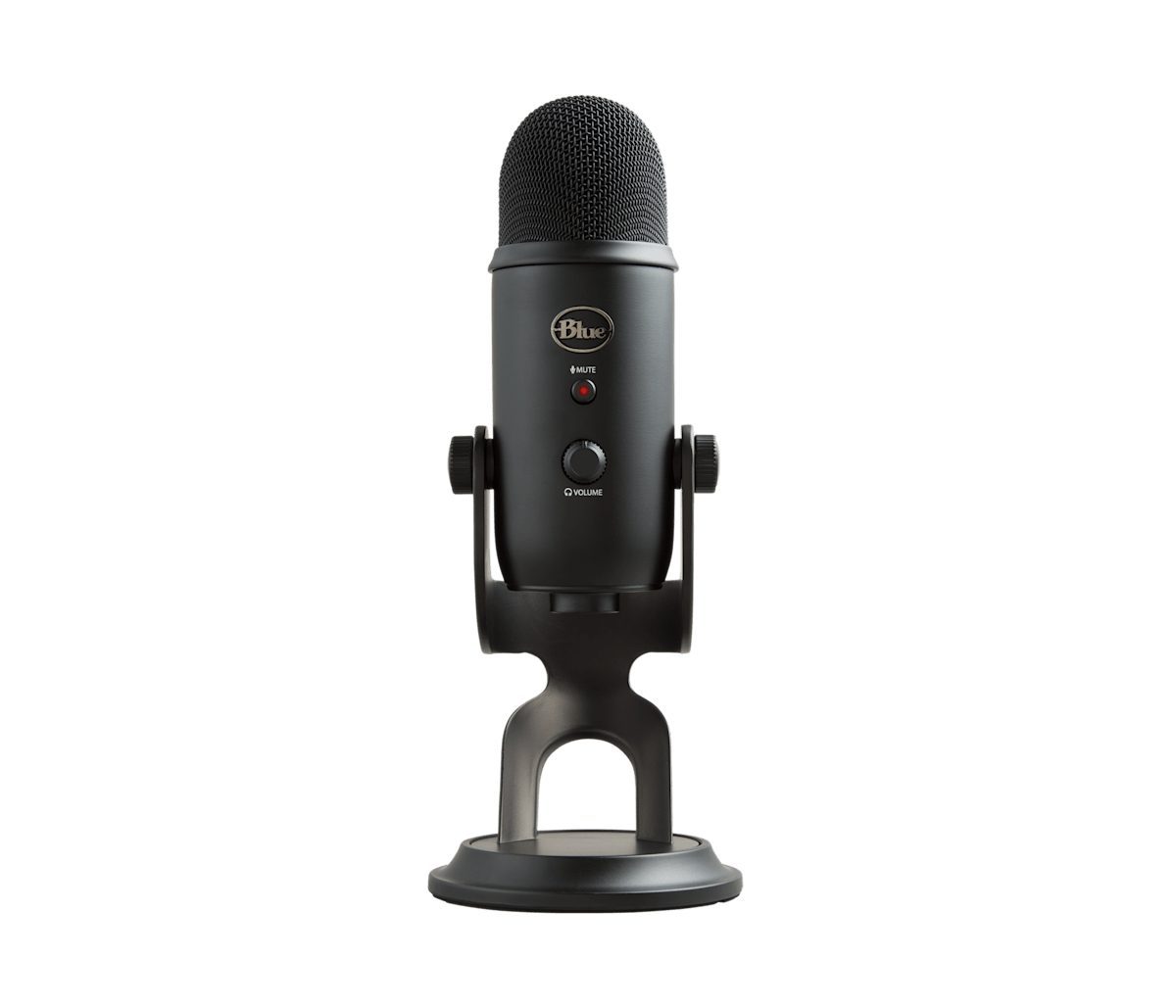
마이크로폰은 공기 중의 소리 진동을 전기 신호로 변환합니다
Explore · 탐색하기
Sound · 소리
y = a sin(bt + c)
Louder = bigger amplitude; higher pitch = higher frequency. · 더 큰 소리 = 더 큰 진폭; 더 높은 음조 = 더 높은 진동수.
Learn $v = f\lambda$ and be ready to rearrange it. Measure all angles of incidence, reflection and refraction from the normal (the line at 90° to the surface), never from the surface itself.
Transverse waves vibrate across the direction of travel (light, water); longitudinal waves vibrate along it (sound). Sound needs a medium, so it cannot cross a vacuum; light can.
Total internal reflection happens only when light travels from a denser material to a less dense one and the angle inside is bigger than the critical angle.
Know the electromagnetic spectrum in order — radio, microwave, infrared, visible, ultraviolet, X-ray, gamma. All travel at the same speed in a vacuum; frequency and energy rise from radio to gamma.
Going into a denser material (air → glass) light slows down and bends towards the normal; leaving it (glass → air) light speeds up and bends away.
한국어
$v = f\lambda$를 숙지하고 변형할 준비를 하십시오. 입사각, 반사각, 굴절각은 모두 표면 자체가 아닌 법선(표면에 대해 90°인 선)으로부터 측정하십시오.
파는 이동 방향과 수직으로 진동합니다(빛, 물); 종파는 이동 방향과 평행하게 진동합니다(소리). 소리는 매질이 필요하므로 진공을 가로지를 수 없으나, 빛은 가능します.
전체 내부 반사는 빛이 밀도가 높은 물질에서 밀도가 낮은 물질로 이동할 때 그리고 내부 각도가 임계각보다 클 때만 발생합니다.
전자기 스펙트럼을 순서대로 알아야 합니다: 라디오, 마이크로파, 적외선, 가시광선, 자외선, X선, 감마선. 모두 진공에서 동일한 속도로 이동하며, 라디오에서 감마선으로 갈수록 주파수와 에너지가 증가합니다.
밀도가 높은 물질로 진입할 때(air → glass) 빛은 느려지고 법선 쪽으로 굽습니다; exiting it (glass → air) 빛은 빨라지고 법선에서 멀어지는 방향으로 굽습니다.
Interactive lessons on this topic · 이 주제에 대한 인터랙티브 수업
Work through it step by step, with instant-check exercises. · 즉시 체크 기능 exercises를 통해 단계별로 진행하세요.