반응 막대를 부러뜨리면 불이 켜집니다. 손난로를 잡으면 따뜻해집니다. 즉석 냉팩을 열면 얼음처럼 차가워집니다. 모든 경우, 화학 반응은…
English narration · English + 中文 subtitles burned in · 영어 내레이션 · 영어 + 중국어 자막 burned-in
5.1
Exothermic and endothermic reactions · 발열 반응과 흡열 반응
Syllabus
English
Core
Supplement
1 State that an exothermic reaction transfers thermal energy to the surroundings leading to an increase in the temperature of the surroundings
4 State that the transfer of thermal energy during a reaction is called the enthalpy change, $\Delta H$, of the reaction. $\Delta H$ is negative for exothermic reactions and positive for endothermic reactions
2 State that an endothermic reaction takes in thermal energy from the surroundings leading to a decrease in the temperature of the surroundings
5 Define activation energy, $E_a$, as the minimum energy that colliding particles must have to react
3 Interpret reaction pathway diagrams showing exothermic and endothermic reactions
6 Draw and label reaction pathway diagrams for exothermic and endothermic reactions using information provided, to include: (a) reactants (b) products (c) enthalpy change of the reaction, $\Delta H$ (d) activation energy, $E_a$
7 State that bond breaking is an endothermic process and bond making is an exothermic process and explain the enthalpy change of a reaction in terms of bond breaking and bond making
8 Calculate the enthalpy change of a reaction using bond energies
한국어
핵심
보충
1 발열 반응이 열 에너지를 주변 환경으로 전달하여环境温度 상승을 일으킴을 서술한다.
4 반응 중 열 에너지의 전달을 해당 반응의 엔탈피 변화, $\Delta H$,라고 한다. $\Delta H$는 발열 반응에서 음수이고 흡열 반응에서 양수이다.
2 흡열 반응이 주위 환경으로부터 열 에너지를 흡수하여 주위의 온도가 감소함을 밝힘
5 충돌하는 입자가 반응하기 위해 가져야 하는 최소 에너지를 활성화 에너지, $E_a$,로 정의한다
3 발열 반응과 흡열 반응을 나타내는 반응 경로 도해를 해석한다.
6 제공된 정보를 사용하여 발열 반응과 흡열 반응에 대한 반응 경로 도해를 그리고 표시한다: (a) 반응물, (b) 생성물, (c) 반응의 엔탈피 변화, $\Delta H$, (d) 활성화 에너지, $E_a$
7 결합 끊기기는 흡열 과정이며 결합 형성은 발열 과정임을 명시하고, 반응의 엔탈피 변화를 결합 끊기와 형성 관점에서 설명한다
8 결합 에너지를 사용하여 반응의 엔탈피 변화를 계산한다
Source: Cambridge International syllabus · 출처: Cambridge International syllabus
English
Reaction profile: exothermic energy change
In every chemical reaction, energy is transferred. The reaction is either exothermic or endothermic, depending on which way the energy moves.
An exothermic reaction 放热反应 gives out thermal energy 热能 to the surroundings 环境. So the temperature of the surroundings goes up.
An endothermic reaction 吸热反应 takes in thermal energy from the surroundings. So the temperature of the surroundings goes down.
Examples of exothermic reactions are combustion 燃烧 (burning a fuel) and neutralisation 中和 (an acid reacting with an alkali). An example of an endothermic reaction is the thermal decomposition 分解 of a compound (breaking it down using heat).
한국어
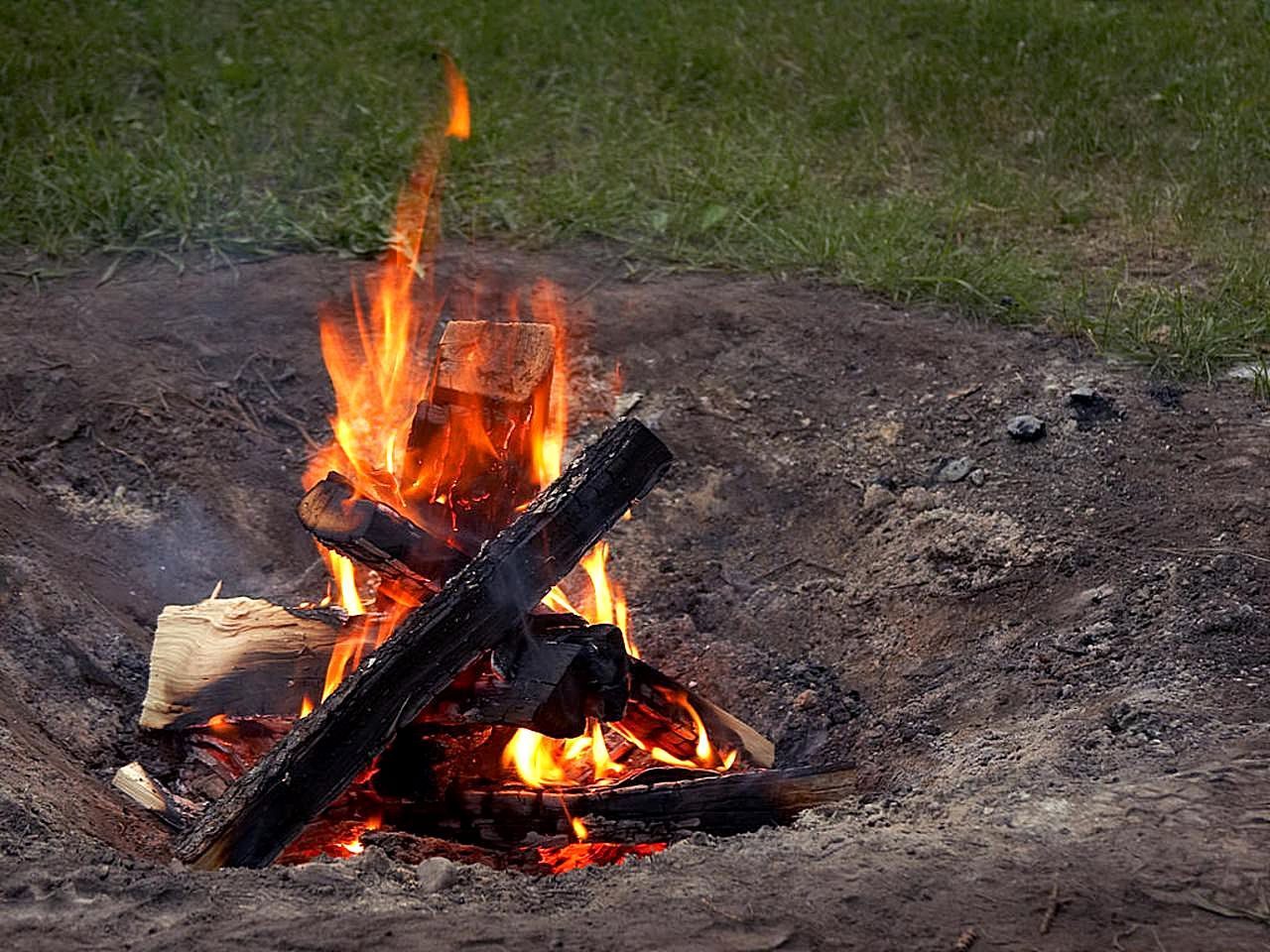
반응 프로파일: 발열 에너지 변화나무를 태우는 것은 발열 반응이며, 주변 환경으로 열을 방출합니다.
모든 화학 반응에서 에너지가 이동합니다. 에너지의 흐름 방향에 따라 반응은 발열 또는 흡열 반응이 됩니다.
발열 반응은 주변 환경으로 열에너지를 방출하므로, 주변 환경의 온도가 오릅니다.
흡열 반응은 주변 환경으로부터 열에너지를 흡수하므로, 주변 환경의 온도가 내립니다.
발열 반응의 예로는 연소(연료 연소)와 중화(산과 염기의 반응)가 있습니다. 흡열 반응의 예로는 화합물의 열적 분해(열을 사용하여 분해하는 과정)가 있습니다.
발열 반응은 주변을 따뜻하게 하고, 흡열 반응은 주변을 차갑게 합니다
Explore · 탐색하기
Exothermic & endothermic · 발열 & 흡열
ΔH = products − reactants · ΔH = 생성물 − 시약
Exothermic drops to lower-energy products (releases heat); endothermic climbs to higher. · 발열 반응은 저에너지 생성물로 떨어지며(열 방출); 흡열 반응은 고에너지 쪽으로 상승한다.
The amount of thermal energy transferred in a reaction is called the enthalpy change 焓变. It is written as $\Delta H$ and has these signs:
$\Delta H$ is negative for an exothermic reaction, because energy leaves the chemicals.
$\Delta H$ is positive for an endothermic reaction, because energy is taken in.
한국어
반응에서 이동한 열에너지의 양을 엔탈피 변화라고 합니다. 기호는 $\Delta H$이며 다음과 같은 부호를 가집니다:
$\Delta H$는 발열 반응에서 음수(-) 입니다. 화학 물질에서 에너지가 빠져나가기 때문입니다.
$\Delta H$는 흡열 반응에서 양수(+) 입니다. 에너지가 흡수되기 때문입니다.
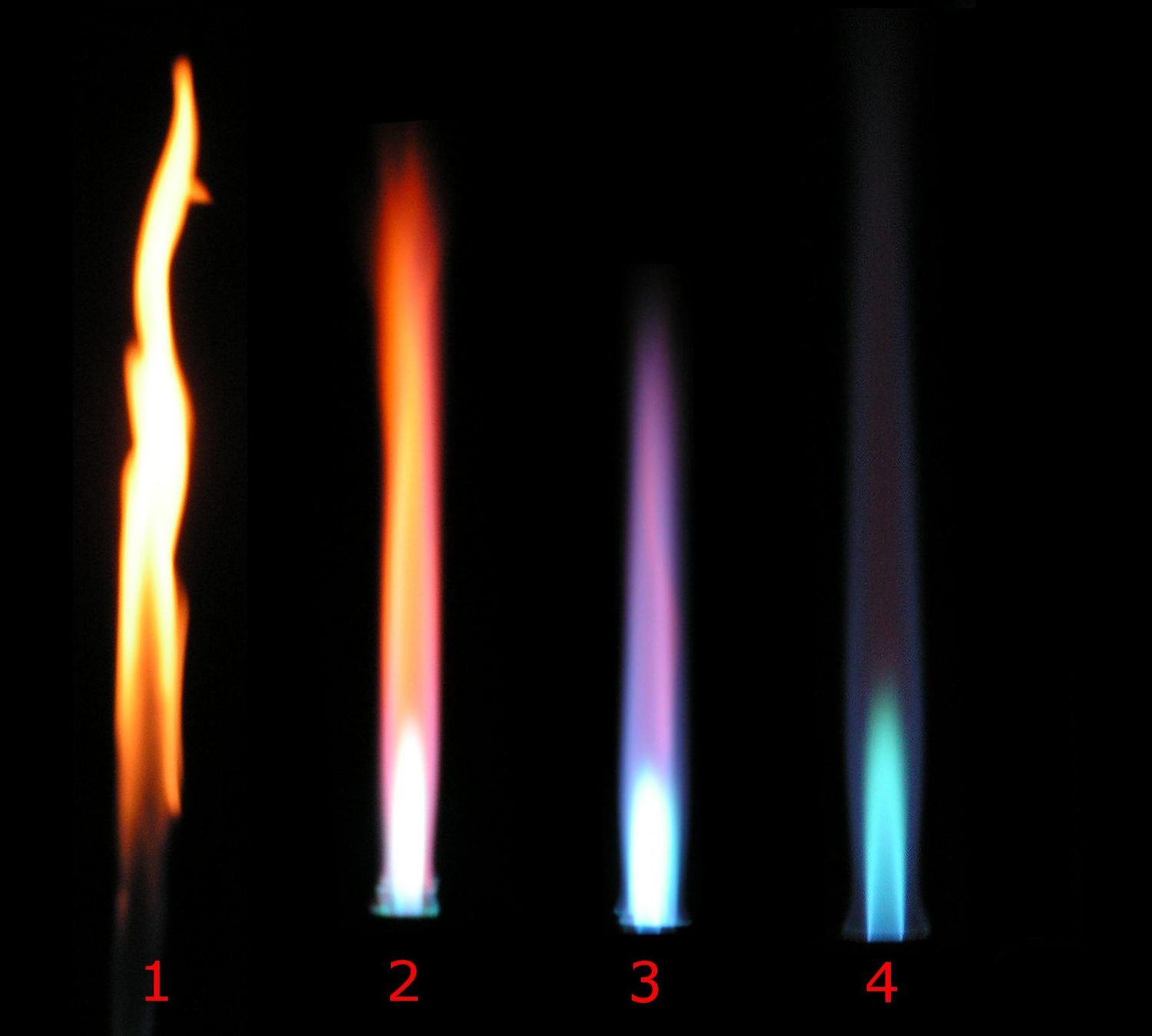
번젠 불꽃이 에너지를 공급함: 엔탈피 변화 ΔH는 일정 압력에서의 열 이동량
5.1
Activation energy · 활성화 에너지
English
Particles do not react every time they meet. The activation energy 活化能 ($E_a$) is the smallest amount of energy that colliding 碰撞particles 粒子 must have before they can react. It is like a hill the particles must get over before the reaction can happen.
한국어
입자가 만나면 매번 반응하지 않습니다. 활성화 에너지($E_a$)는 입자가 반응하기 전에 충돌할 수 있는 최소한의 에너지량입니다. 이는 입자가 반응이 일어나기 전에 넘어야 할 '산'과 같습니다.
Explore · 탐색하기
Activation energy · 활성화 에너지
Ea = the energy barrier · Ea = 에너지 장벽
Every reaction must climb the activation-energy barrier before products can form. · 모든 반응은 생성물이 형성되기 전에 반드시 활성화 에너지 장벽을 넘어야 한다.
5.1
Reaction pathway diagrams · 반응 경로도
English
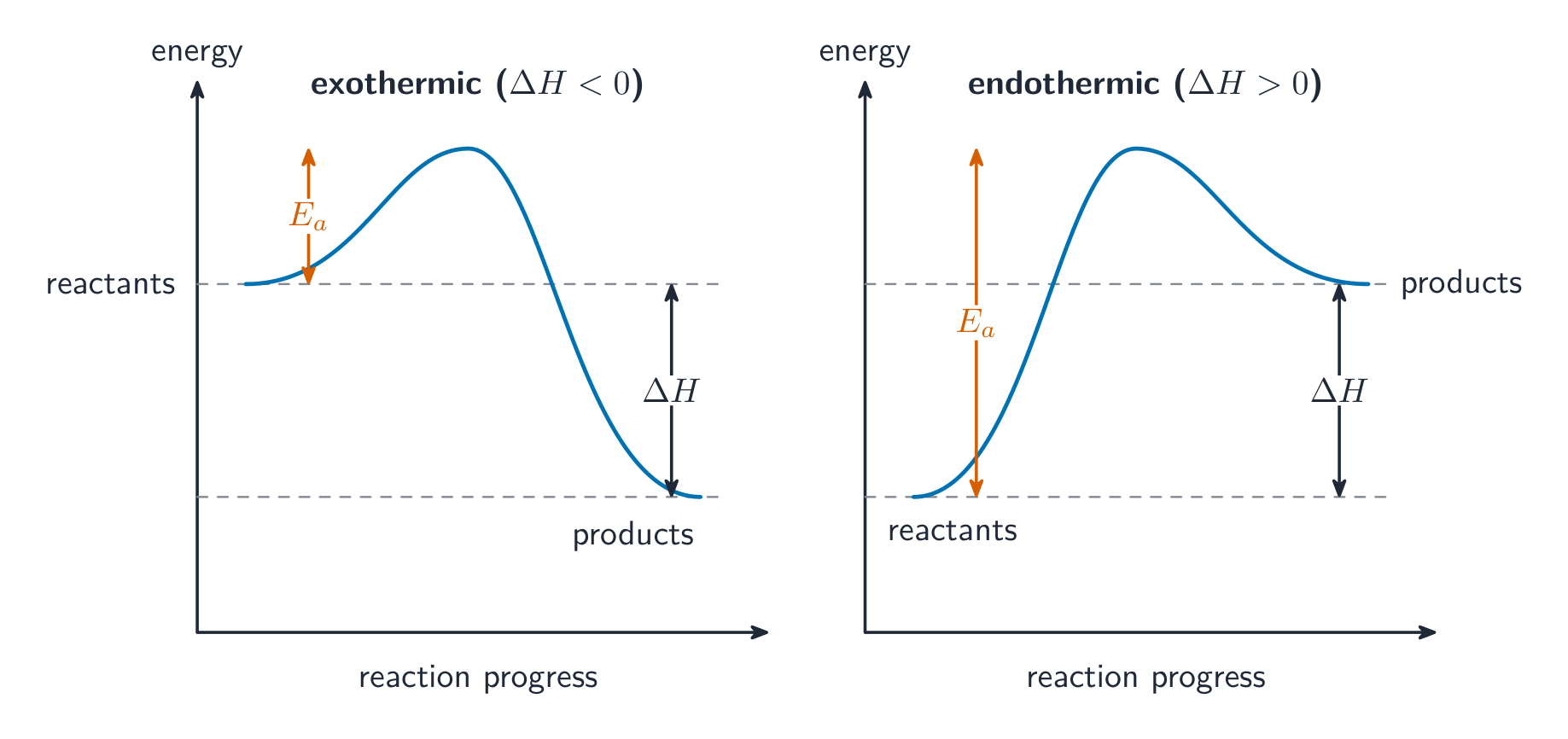
A reaction pathway diagram 反应进程图 shows how the energy changes as a reaction happens. Energy is on the vertical axis, and the progress of the reaction is on the horizontal axis.
The line starts at the energy level of the reactants 反应物.
It rises over a 'hill' — the height of this hill is the activation energy $E_a$.
It then falls or rises to the energy level of the products 生成物.
The gap between the reactant level and the product level is the enthalpy change $\Delta H$.
For an exothermic reaction, the products are lower than the reactants, so energy is given out and $\Delta H$ is negative.
For an endothermic reaction, the products are higher than the reactants, so energy is taken in and $\Delta H$ is positive.
한국어
반응 경로도는 반응이 진행됨에 따라 에너지가 어떻게 변하는지를 보여줍니다. 세로축에는 에너지가, 가로축에는 반응의 진행 상황이 표시됩니다.
선은 시약의 에너지 준위에서 시작됩니다.
'산' 위를 올라갑니다. 이 산의 높이가 활성화 에너지 $E_a$입니다.
이후 생성물의 에너지 준위로 내려가거나 올라갑니다.
시약 수준과 생성물 수준 사이의 차이는 엔탈피 변화 $\Delta H$입니다.
발열 반응의 경우, 생성물이 시약보다 낮으므로 에너지가 방출되며 $\Delta H$은 음수입니다.
흡열 반응의 경우, 생성물이 시약보다 높으므로 에너지가 흡수되며 $\Delta H$은 양수입니다.
발열 반응은 시작점보다 아래에서 끝남($\Delta H<0$); 흡열 반응은 위쪽에서 끝남($\Delta H>0$)
Explore · 탐색하기
Reaction pathway diagrams · 반응 경로 도표
Drag ΔH and the activation energy. Exothermic releases energy; endothermic takes it in; the hump is the energy barrier. · ΔH와 활성화 에너지를 드래그하십시오. 발열 반응은 에너지를 방출하고, 흡열 반응은 에너지를 흡수하며, 돌출部分是能量壁垒。
5.1
Bonds and energy · 결합과 에너지
English
A reaction involves breaking the bonds in the reactants and making new bonds in the products.
Bond breaking 断键 takes in energy, so it is an endothermic step.
Bond making 成键 gives out energy, so it is an exothermic step.
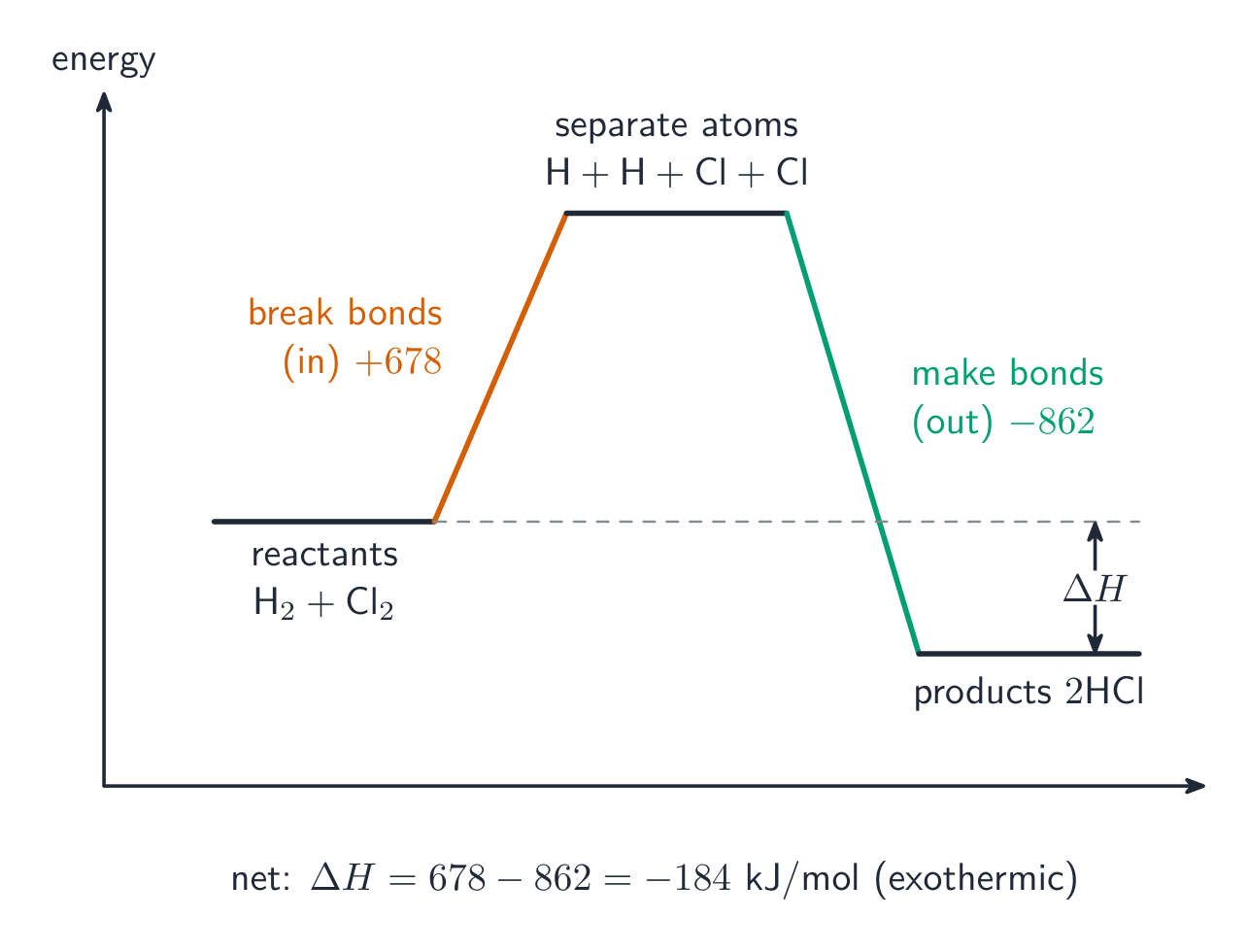
The bond energy 键能 is the energy needed to break one mole of a particular bond. You can use bond energies to find the enthalpy change:
$$\Delta H = (\text{energy to break all bonds}) - (\text{energy released making all bonds})$$
If more energy is given out making bonds than is taken in breaking bonds, the reaction is exothermic ($\Delta H$ negative). If less energy is given out, it is endothermic ($\Delta H$ positive).
Worked example
For the reaction $\text{H}_2 + \text{Cl}_2 \rightarrow 2\text{HCl}$, use these bond energies (in kJ/mol): H–H $= 436$, Cl–Cl $= 242$, H–Cl $= 431$.
Bonds broken: one H–H and one Cl–Cl $= 436 + 242 = 678$.
Bonds made: two H–Cl $= 2 \times 431 = 862$.
$$\Delta H = 678 - 862 = -184 \text{ kJ/mol}$$
The answer is negative, so this reaction is exothermic.
한국어
결합의 끊김과 형성은 에너지를 이동시키며, 여기서는 불꽃이 그 에너지를 공급합니다.
반응은 시약의 결합을 끊고 생성물의 새로운 결합을 형성하는 과정을 포함합니다.
결합 끊기는 에너지를 흡수하므로 흡열 단계입니다.
결합 형성은 에너지를 방출하므로 발열 단계입니다.
결합 에너지는 특정 결합 1몰을 끊는 데 필요한 에너지입니다. 결합 에너지를 사용하여 엔탈피 변화를 구할 수 있습니다:
$$\Delta H = (\text{energy to break all bonds}) - (\text{energy released making all bonds})$$
결합 형성 시 방출되는 에너지가 결합 끊기 시 흡수되는 에너지보다 많으면 반응은 발열($\Delta H$ 음수)입니다. 반대로 더 적으면 흡열($\Delta H$ 양수)입니다.
풀이 예제
반응 $\text{H}_2 + \text{Cl}_2 \rightarrow 2\text{HCl}$에 대해 다음 결합 에너지를 사용하십시오(kJ/mol): H–H $= 436$, Cl–Cl $= 242$, H–Cl $= 431$.
끊어진 결합: H–H 하나와 Cl–Cl 하나 $= 436 + 242 = 678$.
형성된 결합: H–Cl 두 개 $= 2 \times 431 = 862$.
$$\Delta H = 678 - 862 = -184 \text{ kJ/mol}$$
정답이 음수이므로, 이 반응은 발열 반응입니다.
결합을 끊기는 데 에너지를 흡수함($+678$); 결합을 형성하면 더 많은 에너지를 방출함($-862$); 따라서 $\Delta H = -184$ kJ/mol
Exothermic gives out heat, so the surroundings warm up and $\Delta H$ is negative; endothermic takes in heat, so the surroundings cool and $\Delta H$ is positive.
Bond breaking takes energy in (endothermic); bond making gives energy out (exothermic). Use $\Delta H = (\text{energy to break bonds}) - (\text{energy released making bonds})$.
If more energy is released making bonds than is used breaking them, the reaction is exothermic. Always check the sign of your final answer.
On a reaction pathway diagram, an exothermic reaction ends lower than it starts; an endothermic one ends higher. The height of the hill is the activation energy.
한국어
발열은 열을 방출하므로 주변이 따뜻해지고 $\Delta H$은 음수; 흡열은 열을 흡수하므로 주변이 차가워지고 $\Delta H$은 양수입니다.
결합 끊기는 에너지를 흡수함(흡열); 결합 형성은 에너지를 방출함(발열). $\Delta H = (\text{energy to break bonds}) - (\text{energy released making bonds})$을 사용하십시오.
결합 형성 시 방출되는 에너지가 결합 끊기 시 소모되는 에너지보다 많으면 반응은 발열입니다. 항상 최종 답의 부호를 확인하십시오.
반응 경로도에서 발열 반응은 시작점보다 낮게 끝나는 반면, 흡열 반응은 높게 끝난다. 산의 높이는 활성화 에너지이다.
Interactive lessons on this topic · 이 주제에 대한 인터랙티브 수업
Work through it step by step, with instant-check exercises. · 즉시 체크 기능 exercises를 통해 단계별로 진행하세요.