understand the purpose of business activity: combining factors of production (land, labour, capital, enterprise) to make goods and services that satisfy people's needs and wants
understand the economic problem: needs and wants are unlimited but resources are scarce, so choices must be made
understand opportunity cost: the next best alternative given up when a choice is made
explain the concept of added value (selling price minus cost of bought-in materials) and how a business can increase added value
부가가치(판매 가격 - 구매 원자재 비용)의 개념을 설명하고 기업이 부가가치를 증가시킬 수 있는 방법을 설명하기
기업이 성공하거나 실패하는 이유를 이해하기 (예: 경영 능력, 자금, 경쟁)
Source: Cambridge International syllabus · 출처: Cambridge International syllabus
Shops competing on a high street: businesses make goods and services to meet people's wants.Businesses make goods and services to meet people's needs and wants
A business 企业 is an organisation that makes goods 商品 or provides services 服务 for customers 顾客.
Goods are physical things you can touch — bread, phones, cars.
Services are useful actions done for you — a haircut, a bus ride, a doctor's visit.
The purpose of business activity is to use resources 资源 to make goods and services, so that people's needs 需要 and wants 欲望 are met.
Needs are things you must have to live: food, water, shelter, clothes.
Wants are things you would like but can live without: a holiday, a games console.
Factors of production
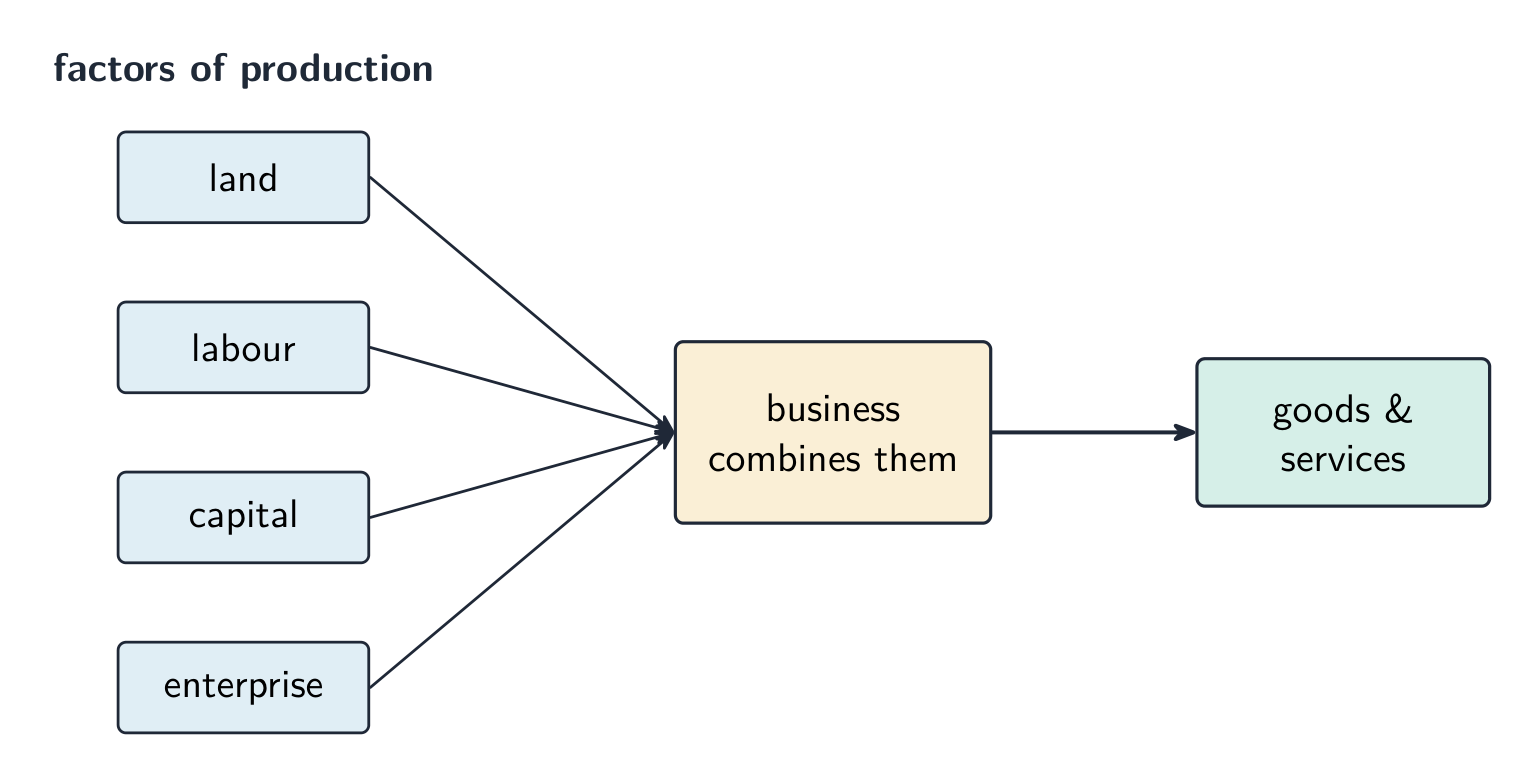
To produce anything, a business brings together four factors of production 生产要素 — the resources needed to make goods and services.
Factor
What it means
Example
land 土地
natural resources
farmland, water, oil, minerals
labour 劳动力
the work of people
workers, managers
capital 资本
money and the man-made tools bought with it
machines, factories, vehicles
enterprise 企业家才能
the skill to bring the other three together and take risks
the owner's idea and effort
The four factors of production are combined to make goods and services
The economic problem
People's needs and wants are unlimited. But resources are scarce 稀缺 — there are not enough of them for everything. This is the economic problem 经济问题.
Because resources are scarce, you must always choose. You cannot have everything.
Opportunity cost
When you choose one thing, you give up the next best thing. The opportunity cost 机会成本 is the next best choice you give up.
Example: a business has some money and spends it on a new machine. Now it cannot also spend that money on a bigger shop. The bigger shop is the opportunity cost.
The opportunity cost is the next best choice you give up
Added value
Added value 增值 is the difference between the price a business sells a product for and the cost of the raw materials 原材料 bought in to make it.
$$\text{added value} = \text{selling price} - \text{cost of bought-in materials}$$
Added value is the selling price minus the cost of bought-in materials
A business can increase added value by:
raising the price, often through a strong brand 品牌 or better design,
lowering the cost of materials, for example by finding cheaper suppliers,
improving the product so customers will pay more.
Worked example. A furniture maker buys the wood and fabric for a chair for £40 and sells the chair for £110. The factory rent is £6,000 a month. Find the added value per chair.
The rent is a deliberate distractor. Added value counts only the cost of the bought-in materials, so rent, wages and other running costs stay out of it - they matter for profit, not for added value. Subtract only what was bought in to make the product, and never treat added value as if it were profit.
Why businesses succeed or fail
A business is more likely to succeed when it has:
good management 管理 — skilled leaders who plan well,
enough finance 资金 — money to pay bills while it grows,
a product customers want, and an edge over the competition 竞争 (the other businesses selling similar things).
A business may fail and close down when it runs out of cash, manages money badly, or cannot compete. Weak management and poor cash control are the most common causes.
Explore · 탐색하기
Value added lab · 부가가치 실험실
Change the bought-in cost, the selling price and other costs to see how business activity creates value added. · 구입 비용, 판매 가격 및 기타 비용을 변경하여 사업 활동이 부가가치를 어떻게 창출하는지 확인하십시오.
classify business activity into primary, secondary and tertiary sectors with examples
understand the changing importance of business sectors (de-industrialisation) in developed and developing economies
distinguish the private sector and the public sector and give the features of each
Source: Cambridge International syllabus · 출처: Cambridge International syllabus
The three sectors
We sort all business activity into three groups, by how far the work is from the final customer.
Sector
What it does
Examples
primary sector 第一产业
takes natural resources from the earth
farming, fishing, mining, oil drilling
secondary sector 第二产业
makes goods from raw materials
building, manufacturing 制造业, food processing
tertiary sector 第三产业
provides services
shops, banks, transport, tourism
Business activity runs from the primary sector through to the tertiary sector
How the sectors change
The importance of each sector changes as a country grows richer.
In a developing economy 发展中经济体 (a poorer country building up its industry), the primary sector is often large — many people farm.
As the country grows, the secondary sector grows too.
In a developed economy 发达经济体 (a rich, industrialised country), most people work in the tertiary sector.
De-industrialisation 去工业化 is when the secondary sector shrinks and the tertiary sector grows. This has happened in many developed economies as factories move abroad.
Private sector and public sector
The private sector 私营部门 is made up of businesses owned by private people and groups. Most aim to make a profit 利润. The public sector 公共部门 is made up of organisations owned by the government, which aim to provide a service to the public.
Private sector
Public sector
Owner
private people and companies
the government
Main aim
usually profit
provide services to everyone
Examples
shops, factories, private firms
state schools, public hospitals, the army
Explore · 탐색하기
Classify business activity · business activity 분류하기
Sort real firms by the sector they mainly belong to. · 실제 기업을 주所属行业 sector에 따라 분류하십시오.
describe the characteristics of a successful entrepreneur (risk-taker, hard-working, innovative, confident, organised)
explain the contents and purpose of a business plan and how it helps a business raise finance
explain why and how governments support business start-ups (grants, loans, training, advice)
measure the size of a business (number of employees, revenue/sales, capital employed) and the limitations of each measure
explain why some businesses remain small and why/how businesses grow (internal/organic growth and external growth: mergers and takeovers, horizontal, vertical and conglomerate integration)
explain economies and diseconomies of scale (purchasing, financial, managerial, technical, marketing)
한국어
성공적인 기업가의 특성을 서술하기: 위험 감수, 근면함, 혁신성, 자신감, 조직력
사업 계획서의 내용과 목적을 설명하고 그것이 기업이 자금을 조달하는 데 어떻게 도움이 되는지 설명하기
정부가 기업 창업을 지원하는 이유와 방법(보조금, 대출, 교육, 자문)을 설명하기
기업의 규모를 측정하기 (근로자 수, 매출액/매출, 운용 자본) 및 각 측정 방식의 한계점 설명하기
일부 기업이 작은 규모를 유지하는 이유와 기업이 성장하는 이유 및 방법(내부/유기적 성장 및 외부 성장: 합병 및 인수, 수평, 수직, 복합 통합)을 설명하기
규모의 economies(规模经济)와 diseconomies(规模不经济)를 설명하기: 구매, 금융, 관리, 기술, 마케팅
Source: Cambridge International syllabus · 출처: Cambridge International syllabus
The entrepreneur
An entrepreneur 企业家 is a person who sets up a business and takes the risk of running it. Successful entrepreneurs usually:
are willing to take risk 风险 — to risk their own money on a new idea,
work hard and do not give up,
are innovative 创新 — full of new ideas,
are confident and good at making decisions,
are well organised, able to manage time, money and people.
What successful entrepreneurs are usually like
The business plan
A business plan 商业计划书 is a document that describes the business and its future. It usually contains the business idea and objectives, the product, the market 市场 it will sell to, who will run it, and a plan for the money.
A business plan has two main uses:
it makes the owner think carefully and plan ahead,
it helps the business raise finance 筹集资金 — banks and investors want to see a plan before they lend or invest.
Government support for start-ups
A start-up 初创企业 is a brand-new business. New businesses create jobs and help the economy grow, so governments often support them with:
grants 补助金 — money given that does not have to be paid back,
low-interest loans 贷款 — money lent on easy terms,
training and advice for new owners,
lower taxes in the first years.
Measuring the size of a business
You can measure how big a business is in several ways. Each one has a weakness.
Measure
How it works
Limitation
number of employees 员工
count the staff
a high-tech firm can have few staff but large output 产量
revenue 收入 (sales)
the value of everything sold
a firm selling cheap goods may sell a lot yet be small
capital employed 所用资本
the total money invested in the business
hard to compare between different industries
Staying small or growing
Some businesses stay small on purpose: the owner wants to keep control, the market is small, or the product is specialised.
Businesses that want to grow bigger — to achieve growth 增长 — can do it in two ways.
Internal growth 内部增长 (also called organic growth): the business grows by itself, by selling more, opening new branches, or adding new products. It is slower but lower-risk.
External growth 外部增长: the business joins with another business. This is faster. It happens through a merger 合并 (two businesses agree to join into one) or a takeover 收购 (one business buys control of another).
External growth is classified by the kind of business that is joined.
Type
What joins
Example
horizontal integration 横向一体化
two firms at the same stage of the same business
two car makers join
vertical integration 纵向一体化
two firms at different stages of the same business
a car maker buys a tyre maker
conglomerate integration 混合一体化
two firms in completely different businesses
a car maker buys a food company
Economies and diseconomies of scale
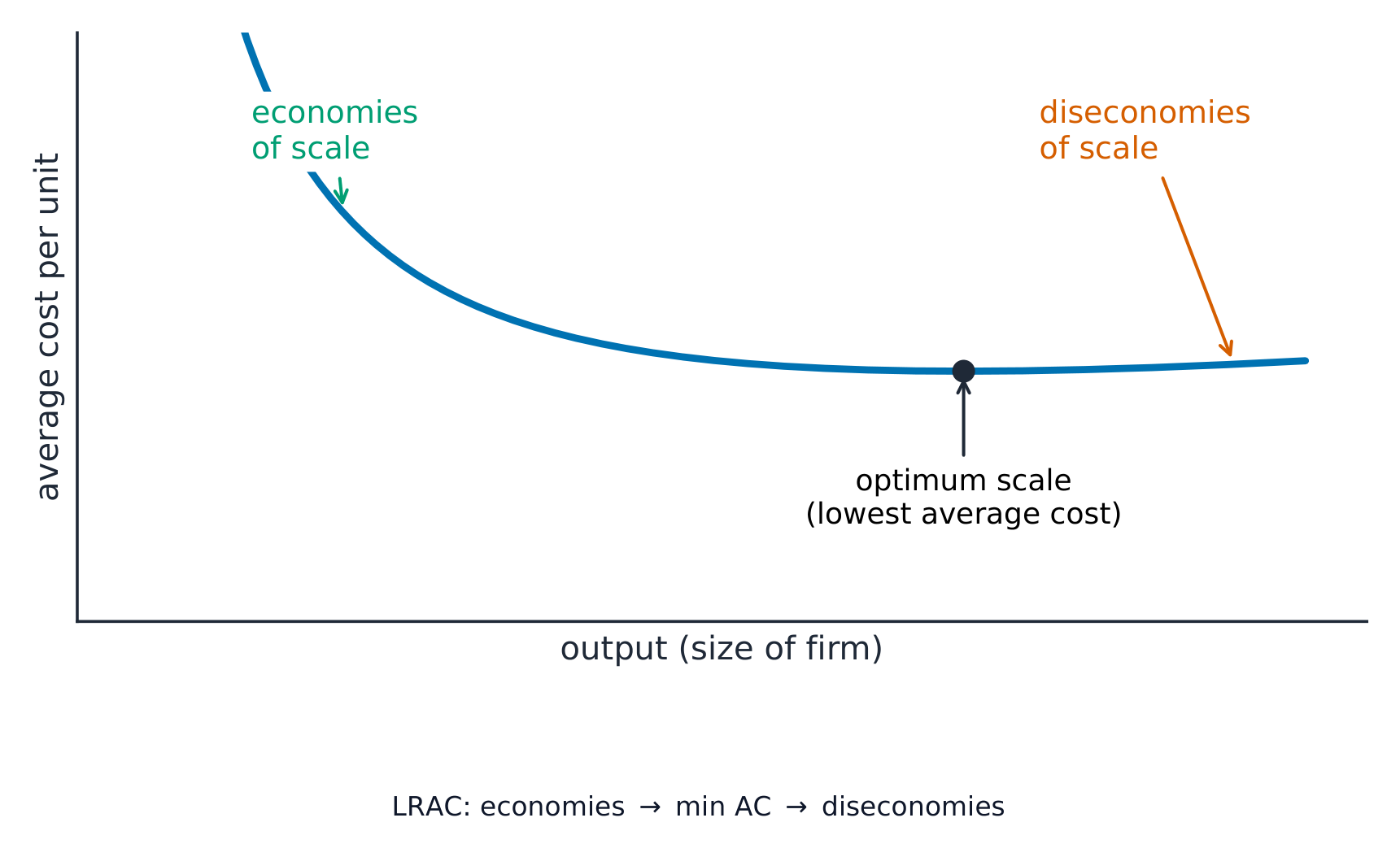
As a business grows, its cost per unit can fall. These savings are called economies of scale 规模经济.
Type
How the cost per unit falls
purchasing
buying large amounts of materials brings a lower price
financial
large firms can borrow money more cheaply
managerial
the firm can afford expert managers
technical
the firm can use large, efficient machines
marketing 营销
the cost of advertising 广告 is spread over more goods
If a business grows too big, the cost per unit can start to rise again. These are diseconomies of scale 规模不经济. They happen because communication 沟通 in a huge firm gets worse, workers feel less important and work less hard, and managers find the firm hard to control.
Average cost per unit falls (economies of scale) then rises (diseconomies of scale) as a firm grows
Explore · 탐색하기
Business case lab
Classify real decisions so the main business concept becomes concrete. · 실제 의사결정을 분류하여 주요 business concept를 구체적으로 만드십시오.
describe the features, advantages and disadvantages of sole traders, partnerships, private limited companies and public limited companies
explain the difference between unlimited and limited liability and between incorporated and unincorporated businesses
describe franchises, joint ventures and social enterprises and their advantages and disadvantages
explain the features of public sector business organisations (public corporations)
한국어
개인 사업자, 합자, 비공개 유한회사, 공개 유한회사의 특징, 장점, 단점을 서술하기
무한 책임과 유한 책임의 차이, 그리고 법인化和非法人化(incorporated and unincorporated) Businesses의 차이를 설명하기
프랜차이즈, 합작 사업, 사회적 기업(social enterprises)을 서술하고 그 장점과 단점을 설명하기
공공 부문 기업 조직(공공 기관)의 특징을 설명하기
Source: Cambridge International syllabus · 출처: Cambridge International syllabus
A company headquarters: businesses range from sole traders to giant public limited companies.
Liability
Liability 责任 means who must pay the debts 债务 if a business cannot pay them itself.
With unlimited liability 无限责任, the owner is personally responsible for all the debts. If the business fails, the owner may lose personal things, like a house or car, to pay them.
With limited liability 有限责任, the owner can only lose the money they put into the business. Their personal things are safe.
Incorporated and unincorporated
An incorporated 法人 business has a separate legal identity from its owners. The business itself can own things and be taken to court. Its owners get limited liability. Companies are incorporated.
An unincorporated 非法人 business is not separate from its owner in law. Sole traders and partnerships are unincorporated.
The four main types
A sole trader 独资企业 is a business owned by one person.
Advantages
Disadvantages
easy and cheap to set up
unlimited liability
the owner keeps all the profit
hard to raise finance
the owner makes all decisions
long hours, no one to share the work
private (accounts stay secret)
the business ends if the owner stops
A partnership 合伙企业 is owned by two or more people who share the work, the decisions and the profit. They usually sign a written agreement.
Advantages
Disadvantages
more owners bring more capital
unlimited liability (in most cases)
work and ideas are shared
the profit is shared
easy to set up
partners can disagree
one partner's mistake affects everyone
A private limited company 私人有限公司 (often "Ltd") is owned by shareholders 股东, but its shares cannot be sold to the public. The owners are often family and friends.
Advantages
Disadvantages
limited liability
more legal rules and paperwork
easier to raise capital than a sole trader
shares cannot be sold to the public
control stays in a small group
accounts must be shared with the government
A public limited company 公众有限公司 (often "plc") is a large company whose shares 股份 can be bought by the public on the stock exchange 证券交易所.
Advantages
Disadvantages
can raise very large amounts of capital
expensive and complex to set up
limited liability
accounts are fully public
well known, so easy to borrow
anyone can buy shares, so there is a risk of takeover
the original owners may lose control
Shareholders may receive a share of the profit, called a dividend 股息.
Business types split by liability: unincorporated (unlimited) and incorporated (limited)
Other forms of organisation
Franchise 特许经营: a person (the franchisee 加盟商) pays to use the name, products and methods of an existing successful business (the franchisor 授权商). The franchisee gets a known brand, training and lower risk, but must pay fees and a share of the profit and has less freedom. Many fast-food chains work this way.
Joint venture 合资企业: two businesses agree to share the cost, risk and profit of one project, while staying separate companies.
Social enterprise 社会企业: a business that trades to help society or the environment, not only to make profit. Most of its profit is put back into its social aims.
Public sector organisation
A public corporation 国有企业 is a business owned and run by the government, such as a national rail or postal service. Its aims include giving an important service to everyone, not only making a profit.
Explore · 탐색하기
Choose the ownership form · 소유 형태 선택하기
Compare ownership, control and liability in real business types. · 실제 business types 간의 소유, 통제 및 liability를 비교하십시오.
Added value = selling price − cost of bought-in materials. A business raises it with a strong brand, better design, or cheaper materials.
Know the three sectors: primary (extracts raw materials), secondary (makes goods), tertiary (services). As a country develops, employment shifts from primary towards tertiary.
Unlimited liability (sole traders, partnerships) puts the owner's personal things at risk; limited liability (Ltd, plc) limits any loss to the money invested.
A stakeholder is anyone affected by the business, and their objectives often conflict — owners want profit, workers want higher pay, the community wants less pollution.
Economies of scale cut the cost per unit as a firm grows; growing too big brings diseconomies of scale (cost per unit rises).
금전적 동기 부여 방법을 서술하시오: 임금(시간급/조급), 연봉, 커미션, 보너스, 이익 공유, 부가 혜택
비금전적 동기 부여 방법을 서술하시오: 직무 교대, 직무 풍부화, 직무 확장, 자율성, 팀워크, 교육, 승진 기회
Source: Cambridge International syllabus · 출처: Cambridge International syllabus
English
Motivation 激励 is the drive that makes people want to work hard. A well-motivated workforce 员工队伍 — all the employees 员工 in a business — brings real benefits:
higher productivity 生产率 — each worker produces more,
lower absenteeism 缺勤 — fewer workers stay away from work,
lower labour turnover 员工流动率 — fewer workers leave, so the business spends less time and money hiring and training new staff.
Motivation theories
Three thinkers explain what makes workers work hard.
Thinker
Main idea
Taylor
Workers are mainly motivated by pay. Pay them more for more work (piece rate) and they work harder.
Maslow
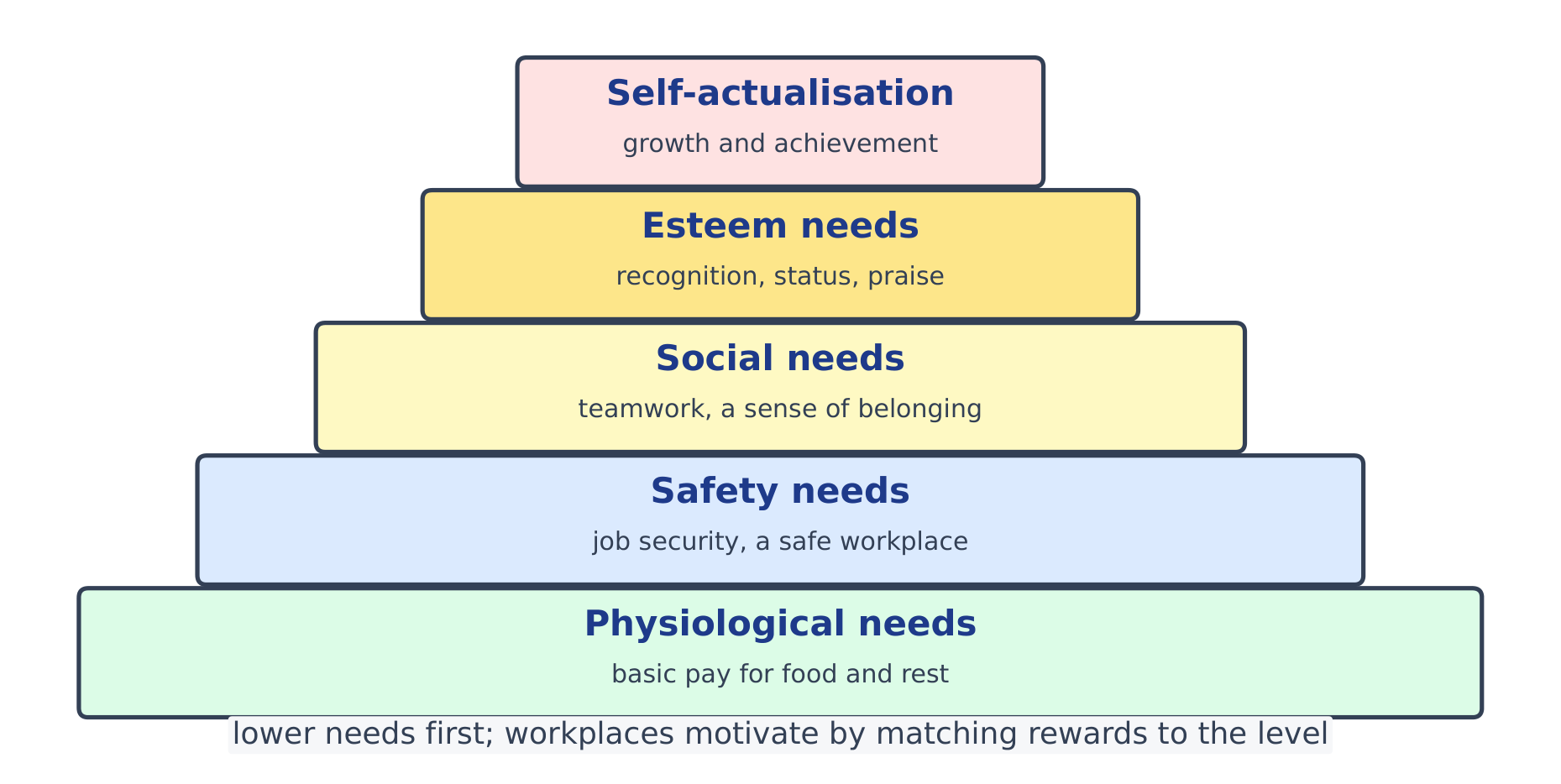
People have a hierarchy of needs 需求层次: five levels, from basic pay and safety up to respect and reaching your full potential. You must meet the lower needs before the higher ones can motivate.
Herzberg
Two groups of factors. Hygiene factors 保健因素 (pay, conditions, rules) do not motivate, but poor ones cause unhappiness. Motivators 激励因素 (achievement and responsibility) truly drive people to work harder.
Financial methods of motivation
These reward workers with money.
Method
What it means
wage 工资
regular pay, often by the hour or week
time rate 计时工资
pay for each hour worked
piece rate 计件工资
pay for each item made
salary 薪金
a fixed yearly amount, paid monthly
commission 佣金
pay based on how much you sell
bonus 奖金
an extra payment for good work
profit sharing 利润分享
workers get a share of the company's profit
fringe benefits 额外福利
extras like a company car, free meals or health care
Worked example. A factory pays a piece rate of £3 per item. Anya makes 210 items in a week. Ben is on a time rate of £12 per hour for a 40-hour week. Who earns more, and what risk does the piece rate carry? Anya earns 210 × £3 = £630. Ben earns 40 × £12 = £480, so Anya earns £150 more. But paying for each item made tempts workers to rush, so quality may fall and more items are rejected - which is why a piece rate usually has to be paired with quality checks. Show the calculation, then judge it: a question that asks who earns more and for an evaluation gives marks for the number and for the drawback.
Non-financial methods of motivation
These motivate without extra money.
job rotation 工作轮换 — workers switch between different tasks, so work is less boring.
job enlargement 工作扩大化 — adding more tasks at the same level.
job enrichment 工作丰富化 — giving more challenging tasks and more responsibility.
autonomy 自主权 — letting workers make some of their own decisions.
teamworking 团队合作 — working in small groups.
training 培训 and chances for promotion 晋升 — helping workers improve and move up.
한국어
Maslow's hierarchy of needs, with workplace examples at each level.동기를 가진 직원은 더 열심히 일하여 산출량을 높임
동기부여는 사람들이 열심히 일을 하고 싶게 만드는驱动力입니다. 잘 동기부여된 근로자—기업의 모든 직원—은 실질적인 혜택을 제공합니다:
높은 생산성 — 각 Worker가 더 많은 양을 생산함,
낮은 결근률 — 출근하지 않는 Worker가 적음,
낮은 노동 유입/유출률 —离职하는 Worker가 적어, 새로운 인력 채용 및 교육에 걸리는 시간과 비용이 줄어듭니다.
동기부여 이론
세 명의 학자가 Worker를 열심히 일하게 만드는 요인을 설명합니다.
Thinker
Main idea
테일러
Worker는 주로 임금에 의해 동기부여됩니다. 더 많은 일을 하면 더 많은 임금을 주면(계산급), They는 더 열심히 일합니다.
마슬로우
사람들은 필요 계층론을 가집니다: 기본 임금과 안전에서부터 존경과 잠재력 실현까지 5단계가 있습니다. 하위阶层的 needs를 충족시켜야 상위阶层的 needs가 동기가 될 수 있습니다.
허츠버그
두 가지 유형의 요인. 위생적 요인(임금, 환경, 규칙)은 동기를 주지 않지만, 나쁜 경우 불만을 유발합니다. 동기 요인(성과 및 책임)이 실제로 People을 더 열심히 일하게 만듭니다.
마슬로의 계층설: 인간은 낮은 필요를 충족한 후 높은 필요를 추구함
재정적 동기부여 방법
이러한 방법들은 Worker에게 금전적 보상을 제공합니다.
방법
의미
임금
정기적인 급여, 보통 시급 또는 주급 기준
시간급
작업한 시간당 임금
계산급
제작한 품목 당 임금
연봉
고정된 연액으로 월급으로 지급
수수료
판매량에 따른 임금
보너스
좋은 업무 성과에 대한 추가 지급
수익 공유
Worker가 회사의 수익 일부를分到得到
부수적 혜택
회사 차량, 무료 식사 또는 건강 보험과 같은 추가 혜택
풀이 예제. 한 공장은 품당 3파운드의 단가제를 적용합니다. Anya는 일주일에 210개의 제품을 생산했습니다. Ben은 시간당 12파운드의 시급제를 적용받아 주 40시간을 근무했습니다. 누가 더 많이 버는가? 또한 단가제가 어떤 위험을 내포하는가? Anya의 소득은 210 × £3 = £630입니다. Ben의 소득은 40 × £12 = £480이므로, Anya가 £150 더 많습니다. 그러나 제품 하나당 대가를 지급하면 직원들이 서두르게 되어 품질이 저하되고 더 많은 제품이 거절될 수 있습니다. 이 때문에 단가제는 보통 품질 검사와 함께 제공되어야 합니다. 계산 과정을 보여주고, 이를 평가하시오: '누가 더 많이 버는가'를 묻고 또한 평가를 요구하는 질문에서는 점수를 위해 숫자와 단점 모두를 제시해야 합니다.
비재무적 동기 부여 방법
這些는 추가적인 금전 없이 동기를 부여합니다.
직업 순환 — 직원들이 서로 다른 업무 사이에서 번갈아 가며, 업무가 덜 지루해집니다.
업무 확장(job enlargement) — 동일한 수준에서 더 많은 업무를 추가함.
업무 확장 — 더 도전적인 업무와 더 큰 책임赋予함.
자율성 — 직원들이 일부 의사결정을 스스로 할 수 있게 함.
팀워크 — 소규모 그룹으로 협력하여 업무 수행.
교육 및 승진 기회 — 직원의 능력 향상을 돕고 승진 pathway를 마련.
Explore · 탐색하기
Maslow's hierarchy of needs · 마슬로의 욕구 계층설
People are motivated by a ladder of needs — a business motivates staff by helping them up it. · 사람들은 필요 계단(ladder of needs)에 의해 동기 부여되며 — 기업은 직원을 위로 올리는 도울方式来 мотивация합니다.
draw and interpret simple organisational charts; explain hierarchy, chain of command, span of control and delayering
explain the role and functions of management (planning, organising, coordinating, commanding, controlling)
describe leadership styles: autocratic, democratic and laissez-faire, and when each is appropriate
explain the role of trade unions in business
한국어
단순한 조직도를 그리고 해석하며, 계층 구조, 지휘통일체계, 통제범위, 조직 간소화를 설명하시오
관리의 역할과 기능(계획, 조직, 조정, 지휘, 통제)을 설명하시오
리더십 스타일(자본주의, 민주주의, 방임주의)과 각 스타일이 적절한 상황을 서술하시오
사업에서 노조의 역할과 기능을 설명하시오
Source: Cambridge International syllabus · 출처: Cambridge International syllabus
English
Organisational charts
An organisational chart 组织结构图 is a diagram that shows how a business is organised — who reports to whom. It shows several ideas:
hierarchy 层级 — the levels of staff, from the top down.
chain of command 指挥链 — the line along which orders pass down from managers to workers.
span of control 管理幅度 — the number of subordinates 下属 (people directly below) that one manager controls.
delayering 扁平化 — removing one or more levels to cut costs and speed up messages.
A long chain of command (a "tall" structure) slows messages down. A wide span of control gives one manager many people to watch.
Functions of management
The five main jobs (functions) of management 管理 are:
planning 计划 — setting aims and deciding how to reach them,
organising 组织 — arranging people and resources,
coordinating 协调 — making different parts work together,
commanding 指挥 — giving instructions and guiding staff,
controlling 控制 — checking that targets are met.
Leadership styles
A leadership style 领导风格 is the way a manager leads people.
Style
How it works
Best when
autocratic 专制型
the leader decides alone and gives orders
a crisis, or with new and untrained staff
democratic 民主型
the leader asks staff for ideas before deciding
staff are skilled and want a say
laissez-faire 放任型
the leader sets goals, then lets staff work freely
creative, expert teams
Trade unions
A trade union 工会 is a group of workers who join together to protect their shared interests. A union can bargain for better pay and conditions, support a worker in a dispute, and push for safer work.
한국어
관리자는 사업체가 목표를 달성하도록 인력을 조직하고 지도합니다.
조직도
조직도는 사업체의 조직 구조를 보여주는 도표로, 누구에게 보고하는지(상사 관계)를 나타냅니다. 다음과 같은 개념들을 보여줍니다:
계층 구조 — 상단부터 하단까지의 직원 계층 단계.
명령 체계 — 명령이 관리자에게서 직원에게로 내려가는 경로를 의미합니다.
통제 범위 — 한 관리자가 직접 관리하는 부하(아래에 있는 사람)의 수.
계층 축소 — 비용 절감과 정보 전달 속도 향상을 위해 하나의或多个 계층을 제거함.
긴 명령 체계(‘높은’ 구조)는 정보 전달을 지연시킵니다. 넓은 통제 범위는 한 관리자가 많은 수의 사람을 감시하게 만듭니다.
조직도는 명령통제선과 각 관리자의 통제 폭을 보여줍니다
관리의 기능
관리의 5가지 주요 기능(役務)은 다음과 같습니다:
계획 수립 — 목표 설정 및 달성을 위한 전략 결정,
조직화 — 사람과 자원의 배분 및 조정,
조정 — 서로 다른 부분이 효과적으로协作하게 함,
지휘 — 지시发布 및 직원 안내,
통제 — 목표 달성을 확인하고 감시.
리더십 스타일
리더십 스타일은 관리자가 사람들을 이끄는 방식을 의미합니다.
스타일
작동 방식
가장 효과적인 상황
독재적
리더가 독단으로 결정하고 지시를 내림
위기 상황, 또는 신규 및 훈련되지 않은 직원
민주적
리더가 결정 전에 직원들의 의견을 청취함
직원이 전문적이며 참여를 원할 때
방임적
리더가 목표를 설정한 후 직원들이 자유롭게 작업하게 함
창의적이고 전문가로 구성된 팀
노조
노조는 공통된 이익을 보호하기 위해 모인 직원들의 모임입니다. 노조는 improved 임금 및 근로 조건 협상, 분쟁 시 직원 지원, 안전한 작업 환경 확보 등을 추진할 수 있습니다.
Explore · 탐색하기
Choose the ownership form · 소유 형태 선택하기
Compare ownership, control and liability in real business types. · 실제 business types 간의 소유, 통제 및 liability를 비교하십시오.
Recruitment, selection and training · 채용, 선발 및 교육
Syllabus
English
describe the recruitment process: job analysis, job description and person specification
compare internal and external recruitment and selection methods (application forms, CVs, interviews, tests)
describe types of training: induction, on-the-job and off-the-job, and their benefits/limitations
explain why a business may need to reduce its workforce (redundancy and dismissal) and the legal controls over employment
한국어
채용 절차를 서술하시오: 직무 분석, 직무 설명서, 자격 기준서
내부 및 외부 채용 및 선발 방법(지원서, 이력서, 면접, Aptitude test)을 비교하시오
교육 유형(입사 교육, 현장 교육, Off-the-job 교육)과它们的_methodological benefits/limitations을 서술하시오
기업이 인력을 감축해야 하는 이유(정년 퇴직, 해고)와 고용에 대한 법적 통제를 설명하시오
Source: Cambridge International syllabus · 출처: Cambridge International syllabus
English
The recruitment process
Recruitment 招聘 is finding and attracting people to apply for a job. Selection 选拔 is choosing the best person from those who apply. The process starts with three documents:
job analysis 工作分析 — studying what the job involves,
job description 工作描述 — a list of the duties and tasks of the job,
person specification 人员规格 — the skills, qualities and qualifications the right person needs.
Internal and external recruitment
Internal recruitment 内部招聘 fills the job with someone already in the business. It is cheaper and quicker, and the person is already known, but it brings in no new ideas.
External recruitment 外部招聘 fills the job from outside. It brings new ideas and skills, but it costs more and takes longer.
Common selection methods include the application form 申请表, the CV 简历 (a short summary of a person's education and work history), the interview 面试, and skills tests 测试.
Training
Training improves workers' skills. There are three main types.
induction training 入职培训 — given to new workers, to learn about the business and their role.
on-the-job training 在职培训 — learning while doing the job, beside an experienced worker.
off-the-job training 脱产培训 — learning away from the workplace, for example at a college.
Type
Benefits
Limitations
on-the-job
cheap; uses real tasks
the trainer stops their own work; bad habits can pass on
off-the-job
expert teaching; no work distractions
costs more; the skills may not fit the exact job
Reducing the workforce
Sometimes a business must cut staff numbers.
Redundancy 裁员 — the job is no longer needed, for example because a machine now does it. It is not the worker's fault.
Dismissal 解雇 — the worker is removed for a good reason, such as breaking rules or poor work.
Most countries have employment laws 劳动法 that protect workers. They cover a fair contract of employment 雇佣合同, safe conditions, fair pay, and protection from being sacked unfairly.
한국어
사업체는 적절한 기술을 갖춘 충분한 인력을 채용, 교육 및 동기 부여해야 합니다.
채용 절차
채용은 직무에 지원할 사람을 찾고 유입시키는 과정입니다. 선발은 지원자 중 가장 적합한 사람을 선택하는 것입니다. 이 절차는 다음 3가지 문서로부터 시작됩니다:
직무 분석 — 직무의 내용 파악,
직무 설명서 — 직무의 duty 및 task 목록,
인재 사양서 — 적합한 사람이 갖추어야 할 skill, quality 및 qualification.
직무 분석부터 최적의 사람 선발까지의 채용 및 선발 단계
내부 및 외부 채용
내부 채용은 기업 내에 이미 재직 중인 사람에게 직무를 채우는 것입니다. 비용이 저렴하고 빠르며, 해당 인력이 이미 알려져 있지만 새로운 아이디어를 가져오지는 못합니다.
외부 채용은 기업 외부에서 직원을 채우는 것입니다. 새로운 아이디어와 스킬을 도입할 수 있으나, 비용이 더 들고 시간이 더 오래 걸립니다.
일반적인 선발 방법에는 지원서, 이력서(학력 및 경력 요약), 면접, 그리고 기술 테스트가 포함됩니다.
교육
교육은 직원의 스킬을 향상시킵니다. 크게 3가지 유형이 있습니다.
신입 사원 오리엔테이션 — 신입 직원에게 기업의 운영 및 본인의 role를 가르치는 교육.
현장 교육 — 경험 많은 직원의 옆에서 실제 업무를 하면서 배우는 교육.
대외 교육 — 직장 밖(예: 대학 등)에서 받는 교육.
유형
장점
단점
현장 교육
저렴; 실제 업무 활용
교육자가 자신의 업무中断; 나쁜 습관이 전이될 수 있음
대외 교육
전문가 강의; 업무 방해 없음
비용 증가; 스킬이 특정 직무에 정확히 맞지 않을 수 있음
인력 감축
때로는 사업체가 직원 수를 줄여야 하는 경우가 있습니다.
정년/해고(근무 불필요) — 기계 등으로 인해 해당 직무가 더 이상 필요 없어져 해고되는 경우입니다. 이는 직원의 과실이 아닙니다.
해고(징계) — 규칙 위반이나 부실 업무 등 정당한 사유로 직원을 해임하는 경우입니다.
대부분의 국가는 근로자를 보호하는 근로법을 보유하고 있습니다. 이는 공정한 고용계약, 안전한 작업 환경, 정당한 임금 및 부당한 해고로부터의 보호를 포함합니다.
Explore · 탐색하기
Human resources decision lab · 인사관리 의사결정 실험실
Classify HR actions by the job they do inside the workforce. · HR 활동을 workforce 내에서의 역할에 따라 분류하십시오.
explain the importance of effective communication and the features of good communication
compare one-way and two-way communication and internal and external communication
describe communication methods and barriers to effective communication and how to reduce them
한국어
효과적인 communication의 중요성과 좋은 communication의 특징을 설명하시오
일방향 및 양방향 communication,社内 및 外部 communication을 비교하시오
communication 방법과 효과적인 communication의 장벽을 서술하고 이를 줄이는 방법을 설명하시오
Source: Cambridge International syllabus · 출처: Cambridge International syllabus
English
Why communication matters
Good communication 沟通 means information is sent, received and understood correctly. It helps workers know what to do, cuts mistakes, and makes people feel valued.
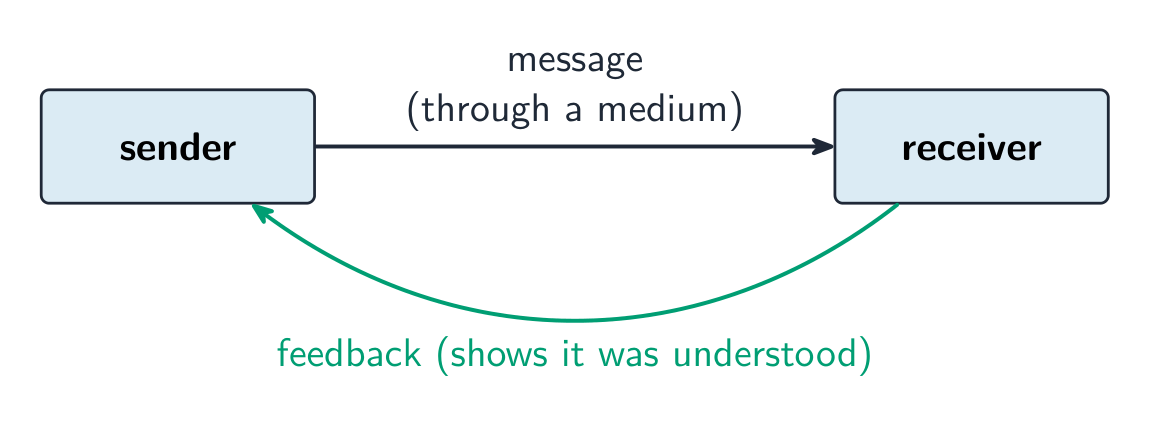
The communication process has five parts: a sender 发送者, a message 信息, a medium 媒介 (the way it is sent), a receiver 接收者, and feedback 反馈 (the receiver's reply, which shows the message was understood).
Types of communication
One-way communication 单向沟通 — information flows in one direction only, with no reply (for example, a public notice).
Two-way communication 双向沟通 — the receiver can reply and give feedback. It is usually better, because it checks understanding.
Internal communication 内部沟通 — between people inside the business.
External communication 外部沟通 — between the business and outside people, like customers 顾客 or suppliers 供应商.
Barriers to communication
A communication barrier 沟通障碍 is anything that stops a message getting through clearly. Common barriers include:
a message that is too long or unclear,
a poor medium, such as a weak phone line,
language differences between sender and receiver,
a receiver who is not paying attention.
To reduce barriers: keep messages short and clear, choose the right medium, and ask for feedback to check the message was understood.
한국어
의사소통이 중요한 이유
좋은 의사소통이란 정보가 올바르게 전달되고, 수신되며, 이해되는 것을 의미합니다. 이는 근로자가 할 일을 알도록 돕고, 실수를 줄이며, 사람들이 자신의 가치가 인정받는다고 느끼게 합니다.
의사소통 과정은 다섯 가지 요소로 구성됩니다: 전달자, 메시지, 매체(전송 방식), 수신자 및 피드백(수신자의 응답으로 메시지가 올바르게 전달되었음을 확인).
메시지는 발신자에서 수신자로 흐르며, 피드백이 이해되었음을 확인합니다
의사소통의 유형
일방적 의사소통 — 정보가 한 방향으로만 흐르며 응답이 없습니다(예: 공시).
양방향 의사소통 — 수신자가 응답하고 피드백을 제공할 수 있습니다. 이해 여부를 확인할 수 있으므로 일반적으로 더 효과적입니다.
내부 의사소통 — 기업 내부 직원 간의 소통입니다.
외부 의사소통 — 기업과 외부 사람, 즉 고객이나 공급업체 간의 소통입니다.
의사소통 장애물
의사소통 장애물은 메시지가 명확하게 전달되는 것을 방해하는 모든 요인을 말합니다. 일반적인 장애물은 다음과 같습니다:
메시지가 너무 길거나 모호함,
약한 전화 회선과 같은 나쁜 매체,
전달자와 수신자 사이의 언어 차이,
주의를 기울이지 않는 수신자.
장애물을 줄이기 위해: 메시지를 짧고 명확하게 유지하고, 적절한 매체를 선택하며, 메시지가 올바르게 전달되었는지 확인하기 위해 피드백을 요청하십시오.
Explore · 탐색하기
Communication route lab · 의사소통 경로 실험실
Watch a message move from sender to feedback and see where noise can enter. · 메시지가 sender에서 feedback으로 이동하는 과정을 Watching하고 노이즈가 유입될 수 있는 지점을 확인하세요.
Link motivation to its benefits: higher productivity, lower absenteeism, and lower labour turnover.
Match each theory: Taylor (pay / piece rate), Maslow (a hierarchy of needs — lower needs before higher), Herzberg (hygiene factors stop unhappiness; motivators drive real effort).
Separate financial methods (wage, piece rate, salary, commission, bonus) from non-financial ones (job rotation, job enlargement, job enrichment, autonomy).
On an organisation chart, know the chain of command (the line orders travel down) and the span of control (how many people report to one manager).
Distinguish redundancy (the job is no longer needed — not the worker's fault) from dismissal (the worker is removed for a reason such as breaking rules).
한국어
동기를 그 혜택에 연결하십시오: 높은 생산성, 낮은 결석률, 그리고 낮은 인력 유출율.
각 이론을 매칭하십시오: 테일러(임금/조립단가제), 마슬로우(필요 계층 구조 — 낮은 수준의 필요보다 높은 수준의 필요 우선), 허츠버그(위생 요인은 불만을 방지하며, 동기 부여 요인은 진정한 노동을 촉진).
explain the role of marketing: identifying and satisfying customer needs, maintaining/increasing sales and market share, building customer loyalty
explain why customers are important and the costs of losing them
distinguish niche and mass markets and explain market segmentation and its benefits
한국어
마케팅의 역할을 설명하시오: 고객 니즈 식별 및 충족, 매출 및 시장 점유율 유지/증가, 고객 충성도 구축
고객이 중요한 이유와 고객을 잃는 비용을 설명하시오
니치 시장과 대량 시장을 구분하고 시장 세분화와 그 이점을 설명하시오
Source: Cambridge International syllabus · 출처: Cambridge International syllabus
Marketing 营销 is the work of finding out what customers 顾客 want, then making, pricing, selling and promoting products to meet those wants at a profit.
Marketing has several roles:
find out and satisfy what customers want,
keep and increase sales 销售额 and market share 市场份额,
build customer loyalty 顾客忠诚度 so buyers come back again.
Why customers matter
Customers bring in the money, so keeping them is vital. Losing customers is costly: the business loses their future spending, and it must spend a lot on advertising 广告 to win new ones. It is usually far cheaper to keep a customer than to find a new one.
Niche and mass markets
A market 市场 is all the buyers and sellers of a product.
A niche market 利基市场 is a small part of a market with special needs, for example left-handed tools.
A mass market 大众市场 is a large market with many similar buyers, for example soft drinks.
Market segmentation
Market segmentation 市场细分 means splitting a market into groups of buyers who share something, such as age, income, gender or location. Its benefits:
the business can design a product to fit each group,
it can aim its advertising at the right people,
it can spot gaps in the market.
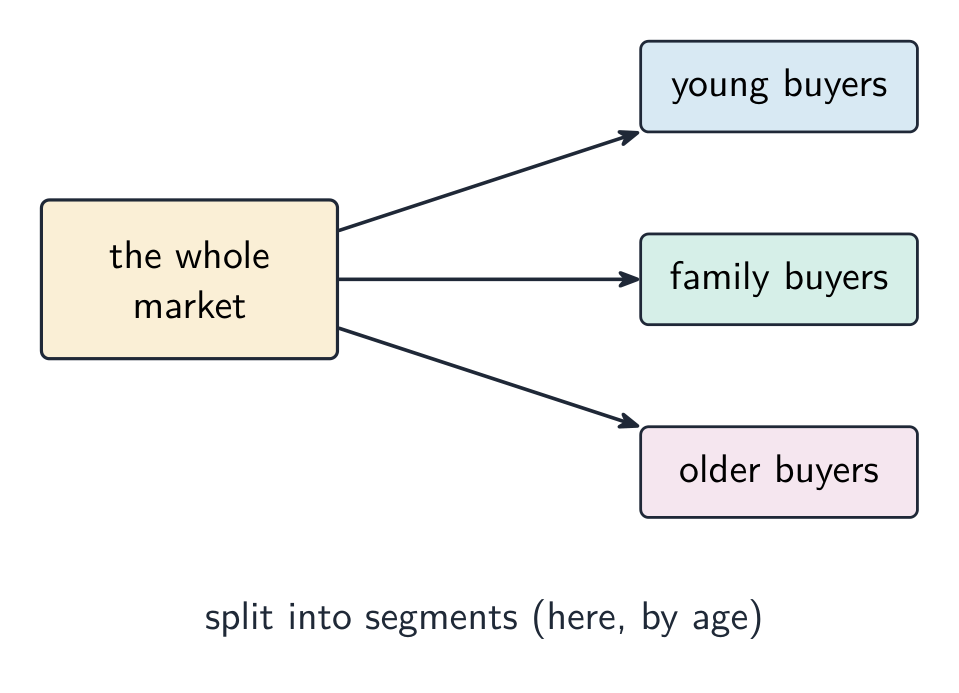
Segmentation splits the whole market into groups of similar buyers
Explore · 탐색하기
Marketing mix lab · 마케팅 믹스 실험실
See which part of the marketing mix changes in each real decision. · 각 실제 의사결정에서 마케팅 믹스의 어떤 부분이 변하는지 확인하세요.
distinguish primary (field) and secondary (desk) market research and their methods
explain sampling and the need for accurate, reliable data
present and interpret market research data (tables, charts, graphs) to support decisions
Source: Cambridge International syllabus · 출처: Cambridge International syllabus
Market research 市场调研 is collecting information about customers, rivals and the market, to help make good decisions.
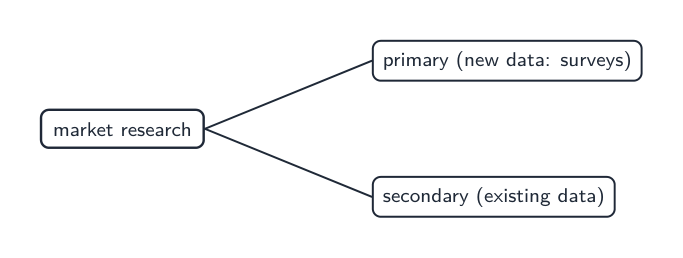
Primary research collects new data; secondary uses existing data
Primary and secondary research
Primary research 一手调研 (also called field research) collects new information directly, for the first time. Methods include questionnaires 问卷, interviews, surveys and tests. It is up to date and fits the exact need, but costs time and money.
Secondary research 二手调研 (also called desk research) uses information that already exists, such as government reports, websites and past sales records. It is cheap and quick, but may be old or may not fit the need.
Sampling and reliable data
A business cannot ask everyone, so it asks a small group, called a sample. Sampling 抽样 must be done with care. If the sample is too small or not typical, the data 数据 will not be reliable, and decisions based on it may be wrong.
Using research data
Research results are shown in tables, charts and graphs. You should be able to read them — for example, find the most popular product, or see how sales change over time — and use them to support a decision.
Explore · 탐색하기
Market research cycle · 시장 조사 사이클
Follow how a business turns customer data into a marketing decision. · 기업이 고객 데이터를 마케팅 의사결정으로 전환하는 과정을 따라보세요.
explain the four elements of the marketing mix (product, price, place, promotion)
product: the product life cycle and extension strategies, branding and packaging
price: pricing methods (cost-plus, penetration, skimming, competitive, promotional, dynamic) and influences on price
place: channels of distribution (wholesaler, retailer, direct, e-commerce)
promotion: advertising, sales promotion and the role of technology (internet, social media) in the marketing mix
한국어
마케팅 믹스의 네 가지 요소(제품, 가격, 유통,促销)를 설명하시오
제품: 제품 수명 주기 및 연장 전략, 브랜드 및 포장
가격: 가격 책정 방법(원가+수익, 침투, 스키밍, 경쟁,促销, 동적 가격)과 가격에 미치는 영향 요인
유통: 유통 채널(도매업자, 소매업자, 직접 판매, 전자상거래)
프로모션: 광고, 세일즈 프로모션 및 마케팅 믹에서의 기술(인터넷, 소셜 미디어)의 역할
Source: Cambridge International syllabus · 출처: Cambridge International syllabus
The product life cycleAdvertising on giant screens — promotion is one of the four Ps of the marketing mix.
The marketing mix 营销组合 is the four main choices a business makes about a product. They are often called the four Ps: product, price, place and promotion.
The marketing mix combines the four Ps
Product
The product 产品 must meet customers' needs. Two ideas matter here.
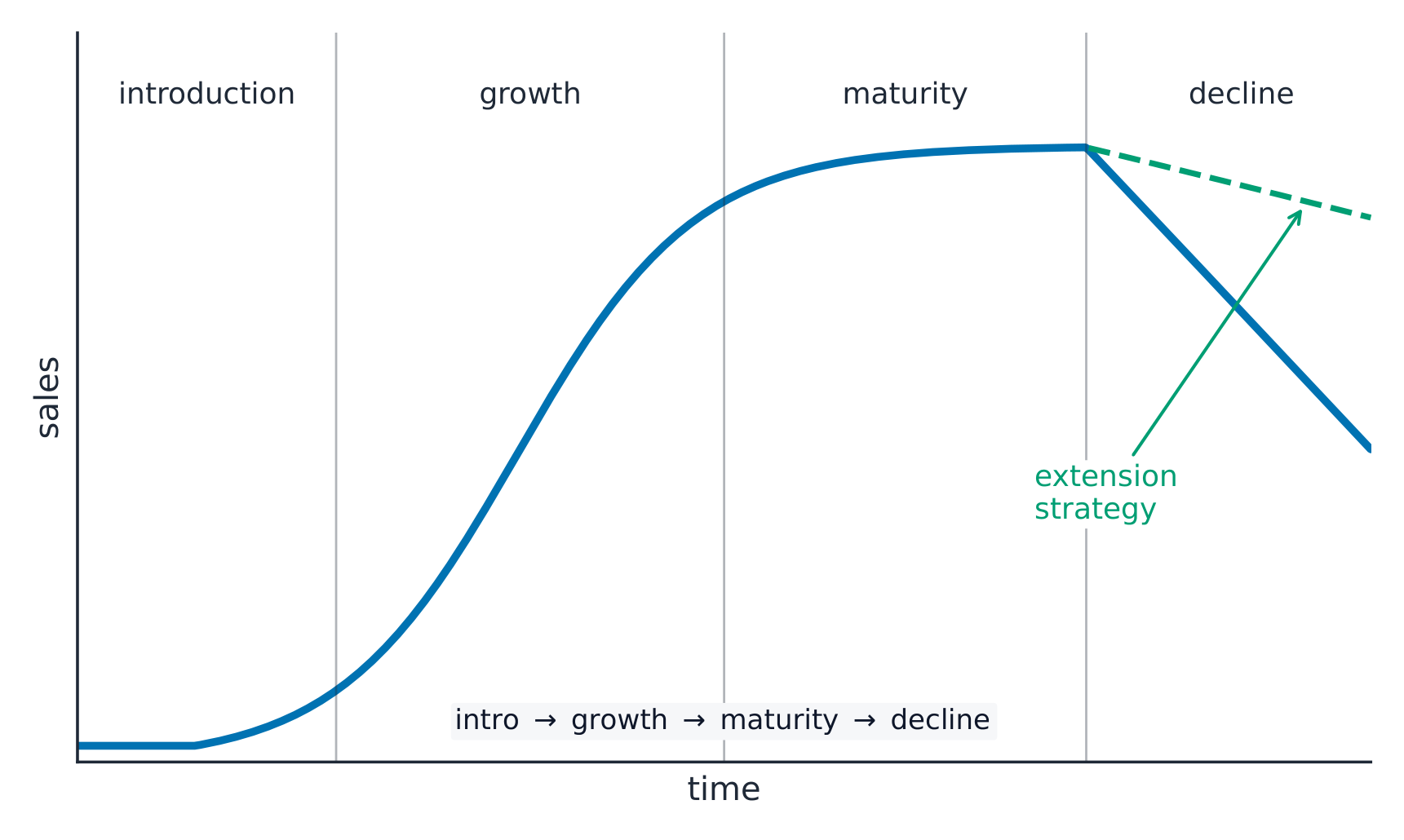
The product life cycle 产品生命周期 describes the sales of a product over time, in four stages: introduction, growth, maturity and decline. When sales begin to fall, a business can use an extension strategy 延长策略 — such as a new design, a new advert, or selling in a new market — to keep the product selling.
Sales of a product over its four life-cycle stages, with an extension strategy in maturity
A strong brand 品牌 (a name, logo and image that customers recognise) and good packaging 包装 (the wrapping that protects the product and attracts buyers) both help a product sell. Building a brand is called branding.
Price
The price 价格 is what the customer pays. A business can choose from several pricing methods.
Method
How it works
cost-plus pricing 成本加成定价
add a fixed share of profit on top of the cost of making the item
penetration pricing 渗透定价
set a low price to enter a market and win customers fast
price skimming 撇脂定价
set a high price at first for a new, special product
competitive pricing 竞争定价
set a price close to rivals' prices
promotional pricing 促销定价
cut the price for a short time to lift sales
dynamic pricing 动态定价
change the price automatically as demand changes, as airlines do
The right price also depends on the cost of making the product, on what customers will pay, on rivals' prices, and on the product's stage in its life cycle.
Worked example. One firm launches a smartphone using technology no rival has. Another enters a crowded soft-drinks market. Which pricing method suits each, and why? The smartphone is new and special with no direct competition, so use price skimming: charge a high price at first to recover the development cost from customers who must have it, then lower it as rivals catch up. The soft drink faces many established rivals, so use penetration pricing: a low price wins customers quickly and buys market share, and it can be raised later. Match the method to the market conditions - a pricing strategy is only right or wrong relative to the competition and the product's stage in its life cycle.
Place
Place 地点 is about how and where the product is sold, so it reaches the customer at the right time. The route a product takes from maker to customer is called a channel of distribution 分销渠道.
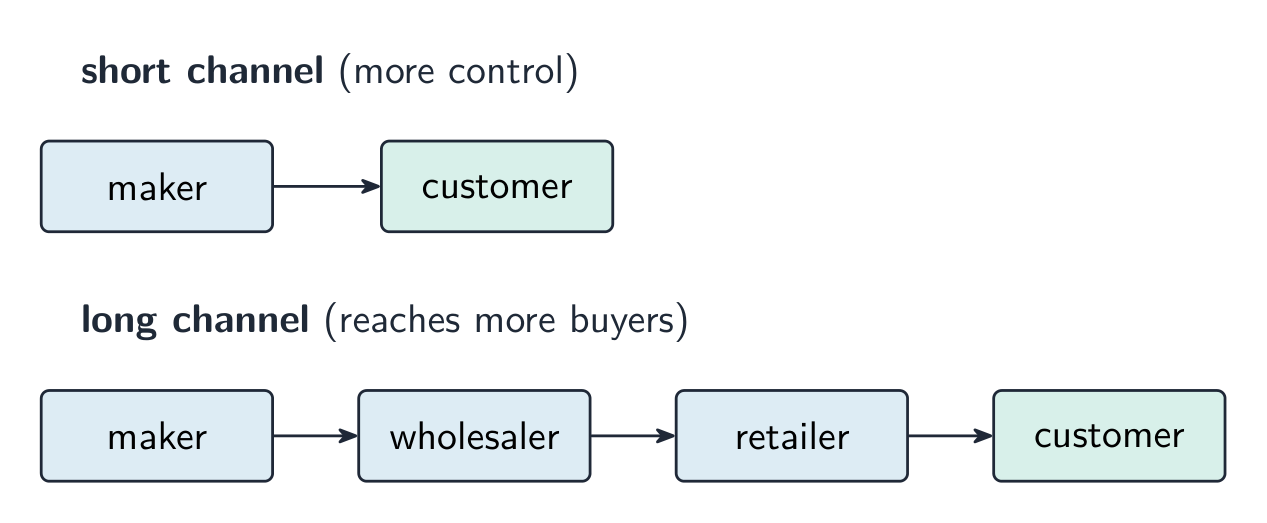
Many channels use a wholesaler 批发商 (buys large amounts from makers and sells smaller amounts to shops) and a retailer 零售商 (a shop that sells to the final customer). A business can also sell directly 直销 to customers, or online through e-commerce 电子商务.
A short channel gives more control; a longer channel reaches more buyers
Promotion
Promotion 推广 means telling customers about a product and persuading them to buy it. It includes:
advertising — paid messages on TV, online, on posters and so on,
sales promotion 促销 — short-term offers like discounts, free gifts, or "buy one get one free".
Technology now plays a big part. The internet 互联网 and social media 社交媒体 let a business reach many people cheaply, target the right customers, and sell all over the world.
Explore · 탐색하기
The marketing mix (4 Ps) · 마케팅 믹스(4P)
The marketing mix is the four decisions a business blends to sell a product well. · 마케팅 믹스는 제품이 잘 판매되도록 기업이 결합하는 네 가지 의사결정입니다.
explain how a marketing mix can be used to achieve marketing objectives
explain legal controls related to marketing (consumer protection, misleading promotion)
explain the opportunities and problems of entering new markets in other countries
한국어
마케팅 믹스를 활용하여 마케팅 목표를 달성하는 방법을 설명하시오
마케팅 관련 법적 통제(소비자 보호, 오해 유발促销)를 설명하시오
다른 국가의 새로운 시장에 진출할 때의 기회와 문제를 설명하시오
Source: Cambridge International syllabus · 출처: Cambridge International syllabus
A branded shop window: branding helps a product stand out from rivals.
A marketing strategy 营销策略 is a plan that uses the four Ps together to reach the business's objectives 目标. The four Ps must fit each other and fit the target customers. For example, a high-price luxury product needs high-quality packaging, expensive shops and image-based adverts.
Legal controls on marketing
Many countries have legal controls 法律管制 that protect buyers:
consumer protection 消费者保护 laws stop the sale of unsafe or faulty goods,
rules ban misleading 误导 promotion — adverts that lie about what a product can do.
Selling in other countries
A business can grow by entering an international market 国际市场 in another country.
Opportunities: many more customers, higher sales, and spreading risk across markets.
Problems: different languages and tastes, higher transport costs, foreign laws and tariffs 关税 (taxes on imports), and strong local competition 竞争.
Explore · 탐색하기
Ansoff strategy lab · 안소프 전략 실험실
Sort growth choices by product and market risk. · 제품 및 시장 위험에 따른 성장 선택을 분류하십시오.
Learn the four Ps of the marketing mix — product, price, place, promotion — and remember they must fit each other and the target customer.
Primary research collects new data (surveys, questionnaires; up to date but costly); secondary research uses existing data (cheap and quick but may be out of date).
Know the product life cycle (introduction, growth, maturity, decline) and that an extension strategy revives falling sales.
Match the pricing methods: penetration (low, to enter a market), skimming (high, for a new product), plus cost-plus, competitive, promotional and dynamic pricing.
A niche market is small and specialised; a mass market is large, with many similar buyers.
describe the methods of production: job, batch and flow production, and their advantages/disadvantages
explain productivity and how it can be increased
explain lean production and just-in-time (JIT) inventory control and the management of inventory
explain how technology has changed production
한국어
생산 방법(조별 생산, 배치 생산, 흐름 생산)과它们的利点及缺点을 서술하시오
생산성과 이를 높이는 방법을 설명하시오
린 생산(JIT) 재고 관리 및 재고 관리를 설명하시오
기술이 생산 방식을 어떻게 변화시켰는지 설명하시오
Source: Cambridge International syllabus · 출처: Cambridge International syllabus
English
Stock control: the sawtooth chart
Production 生产 means turning materials and labour 劳动力 into finished goods and services 服务. There are three main methods.
Method
What it is
Good for
Drawback
job production 单件生产
making one item at a time, to order
special, one-off items: a wedding cake, a ship
slow and costly per item
batch production 批量生产
making a group of the same item, then switching to another group
bakeries, clothes in different sizes
machines stand idle while switching
flow production 流水线生产
making goods non-stop on a moving line
mass-made goods: cars, drinks
costly to set up; work can be boring
Productivity
Productivity 生产率 measures how much each worker or machine produces in a set time. Higher productivity lowers the cost per item. A business can raise productivity by:
training workers,
using better machines and technology 技术,
improving motivation 激励,
organising the work better.
Lean production and just-in-time
Lean production 精益生产 means cutting all waste — wasted time, materials, space and effort — while keeping quality.
One key method is just-in-time 准时制 (JIT). With JIT, materials arrive just as they are needed, and finished goods are sold quickly, so the business holds very little inventory 库存 (its stock of materials and goods). This saves storage cost, but one late delivery can stop production. Good management of inventory keeps enough stock to meet demand, but not so much that money is tied up or goods go out of date.
Technology in production
Technology has changed production. Automation 自动化 (machines and robots doing tasks), computer design and online ordering all make production faster, cheaper and more exact. But machines cost a lot to buy and can replace workers' jobs.
한국어
재고 관리: 톱니바퀴 차트
생산(Production) 은 자재와 노무(labour) 를 완제품 및 서비스로 전환하는 것입니다. 주요 방법은 세 가지입니다.
자동차 조립 라인: 이동하는 라인에서 많은 동일한 제품을 만드는 모습
방법
내용
적합한 경우
단점
조립 생산(job production)
주문에 따라(item) 하나씩 제작
special, one-off items: 결혼 케이크, 선박
느리고 품당 비용 높음
배치 생산(batch production)
동일한 그룹의 제품을 먼저 만들고, 다른 그룹으로 전환
제빵 공장, 다양한 사이즈의 의류
전환 시 기계 가동 중단
연속 생산(flow production)
이동식 라인에서 중단 없이 상품 생산
대량 생산품: 자동차, 음료
설치 비용 높음; 작업이单调할 수 있음
세 가지 생산 방식
생산성
생산성은 일정한 시간당 각 노동자 또는 기계가 생산하는 양을 측정합니다. 생산성이 높아지면 제품당 비용이 낮아집니다. 기업은 다음 방법을 통해 생산성을 높일 수 있습니다:
노동자를 교육하고,
더 나은 기계와 기술을 사용하고,
동기부여를 개선하고,
업무를 더 잘 조직화하는 것입니다.
생산성은 일정한 시간당 노동자별 산출량이며, 이를 높이면 제품당 비용이 낮아집니다
생산 및 Just-in-time
린(Lean) 생산은 품질을 유지하면서 모든 낭비—소모된 시간, 자재, 공간, 노력—를 줄이는 것을 의미합니다.
주요 방법 중 하나는 Just-in-time(JIT)입니다. JIT에서는 자재가 필요한 시점에 정확히 도착하며, 완제품은 빠르게 판매되므로 기업이 보유하는 **재고(자재와 제품의 재고)**가 매우 적습니다. 이는 보관 비용을 절감하지만, 한 번의 배송 지연만으로도 생산이 중단될 수 있습니다. 재고의 적절한 관리는 수요를 충족할 만큼의 재고를 유지하되, 자금이 묶이거나 제품이 유통기한을 넘지 않도록 합니다.
Just-in-time는 빈번한 배송으로 적은 재고를 보유합니다; Just-in-case는 안전 재고를 보유합니다
생산에서의 기술
기술은 생산 방식을 변화시켰습니다. 자동화(기계와 로봇이 작업을 수행), 컴퓨터 설계 및 온라인 주문은 모두 생산을 빠르고 저렴하며 정확하게 만듭니다. 그러나 기계 구매 비용이 많이 들며, 노동자의 일자리를 대체할 수 있습니다.
자동화: 산업용 로봇이 자동차 차체를 용접하고 조립합니다 — 손으로 하는 것보다 빠르고 정확하지만 비용이 많이 들고 일부 노동자의 일자리를 대체합니다
Explore · 탐색하기
Methods of production · 생산 방식(methods of production)
A business picks job, batch or flow production to suit its product and order size. · 기업은 제품과 주문 크기에 맞춰 일인 작업, 배치生産 또는 흐름 생산을 선택합니다.
Worked example. A factory has fixed costs of £8,000 and variable costs of £2 per unit, and makes 1,000 units. Find the total cost and the average cost per unit.
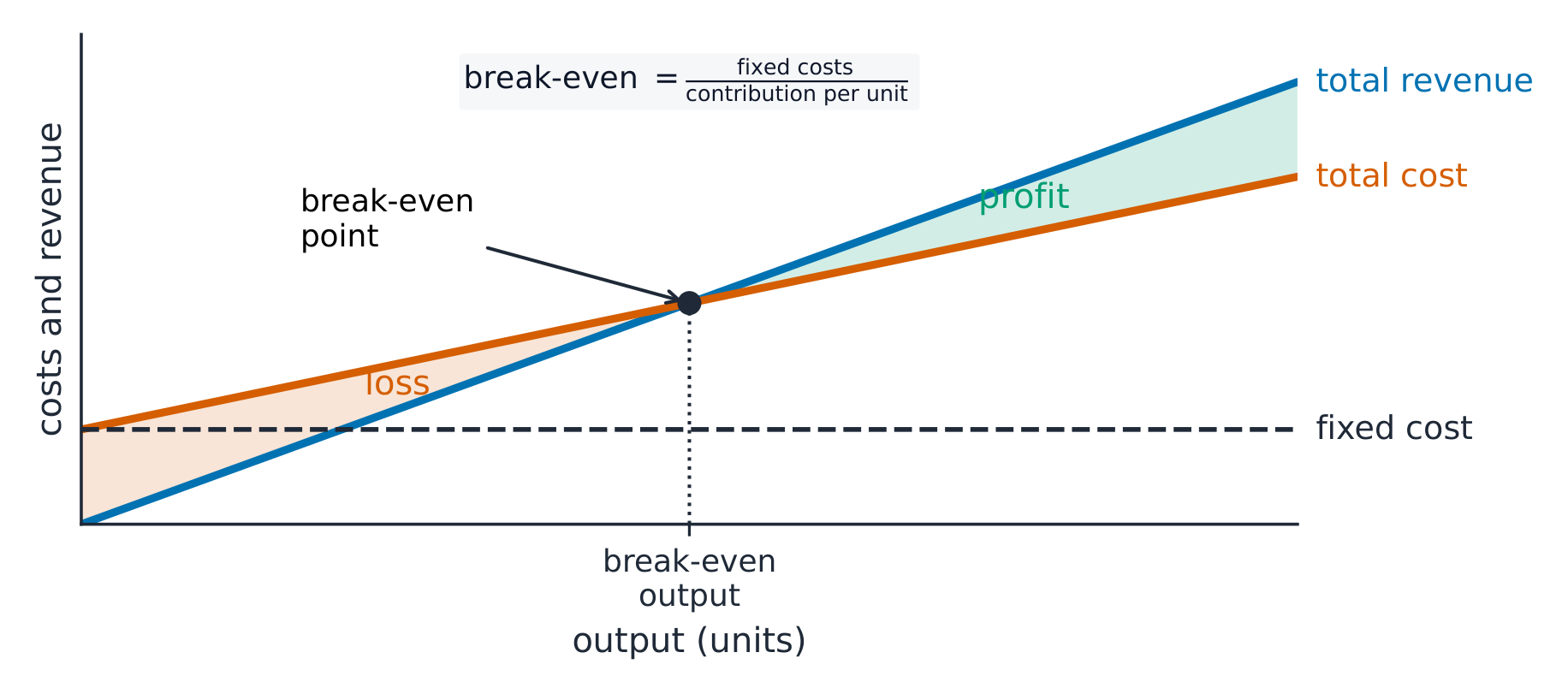
The break-even 盈亏平衡 point is the level of output where total revenue exactly equals total cost: the business makes no profit and no loss. Below it the business makes a loss; above it, a profit.
Each item sold gives an amount towards covering the fixed costs. This amount is the selling price minus the variable cost of one item (sometimes called the contribution 贡献 per unit).
$$\text{break-even output} = \frac{\text{fixed costs}}{\text{selling price per unit} - \text{variable cost per unit}}$$
A break-even chart 盈亏平衡图 plots total cost and total revenue against output. The two lines cross at the break-even point 盈亏平衡点.
The margin of safety 安全边际 is how far the actual output is above the break-even output.
$$\text{margin of safety} = \text{actual output} - \text{break-even output}$$
Worked example. A product sells for £15 with a variable cost of £5 per unit, and the firm's fixed costs are £8,000. Find the break-even output, and the margin of safety if the firm actually makes 1,200 units.
The contribution per unit is $\text{\pounds} 15 - \text{\pounds} 5 = \text{\pounds} 10$, so
A large margin of safety is safer, because sales can fall a long way before the business makes a loss.
Limits of break-even analysis. It assumes that all output is sold, and that the selling price and the costs stay the same at every level of output. In real life these often change, so break-even is only a guide.
한국어
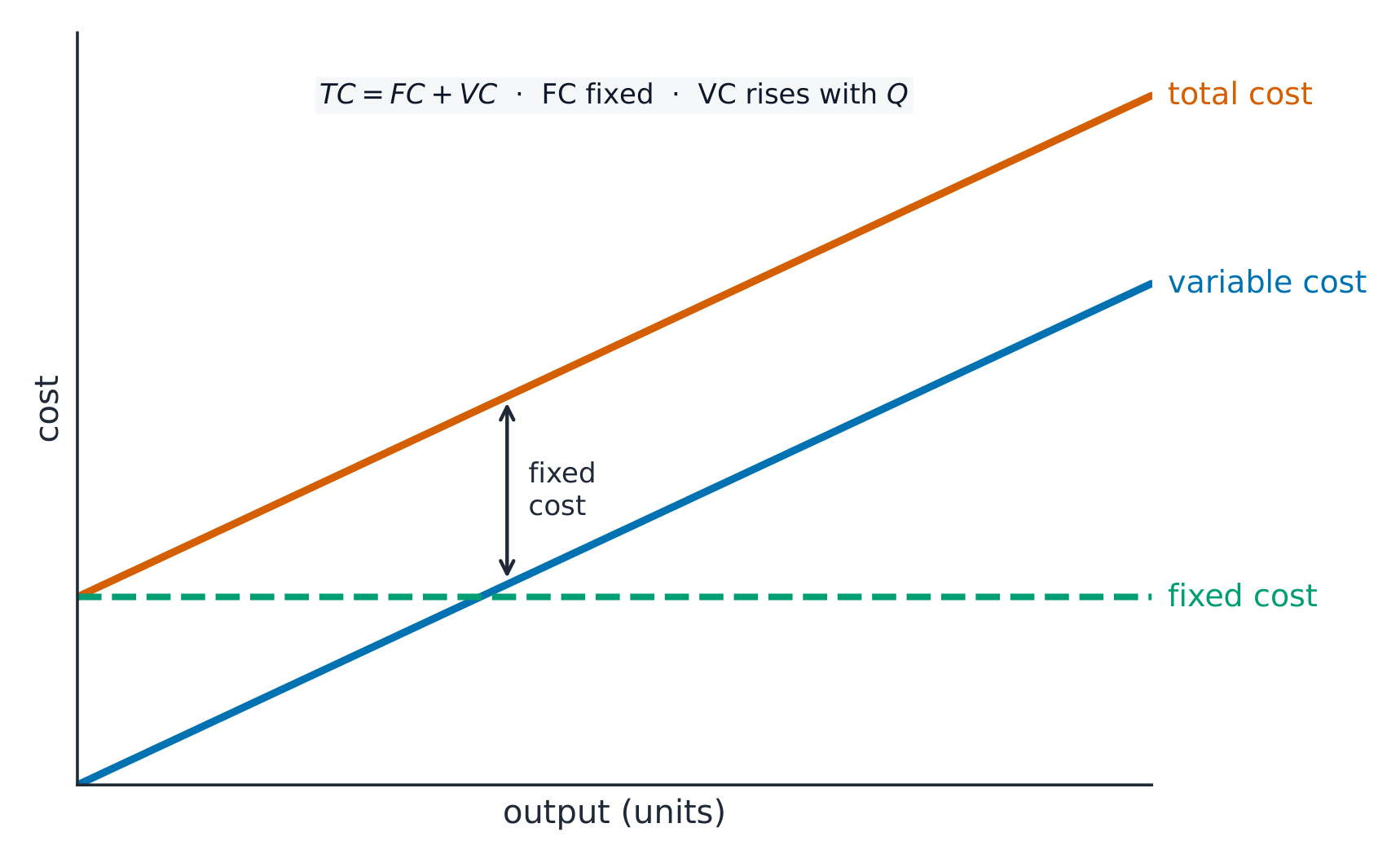
규모의 경제: 평균 비용 감소손익분기점 분석, 선별로 구축됨
비용의 종류
기업에는 다양한 종류의 비용이 있습니다.
고정비는 산출량과 관계없이 변하지 않습니다 — 임대료, 급여, 보험 등. 아무것도 생산하지 않아도 이 비용은 지불해야 합니다.
변동비는 산출량에 따라 변합니다 — 자재비 및 제품당 인건비 등. 산출량이 늘어나면 변동비도 증가합니다.
explain the factors affecting the location decision of a manufacturing business and a service business
explain the factors a business considers when locating in another country and the role of legal controls
한국어
제조 기업 및 서비스 기업의 입지 결정에 영향을 미치는 요인을 설명하시오
기업이 해외로 진출할 때 고려하는 요인과 법적 통제의 역할을 설명하시오
Source: Cambridge International syllabus · 출처: Cambridge International syllabus
English
Locating a business
Where a business sits affects its costs and its sales. A manufacturing 制造业 business (one that makes goods) looks at:
nearness to raw materials 原材料, because heavy or bulky materials cost a lot to move,
nearness to customers and the market 市场,
the cost and size of the land,
a supply of suitable labour,
good transport links,
government grants offered in some areas.
A service business (one that sells services, such as a shop or a hair salon) looks more at being close to customers, passing foot traffic, nearby shops, and the rent.
Locating in another country
A business may produce or sell abroad in order to reach new customers and bigger markets, pay lower wages or rent, get nearer to raw materials, or avoid tariffs 关税 (taxes on imports) by making goods inside the country. But it must then deal with different laws, languages and customs, and follow the legal controls 法律管制 of both countries.
한국어
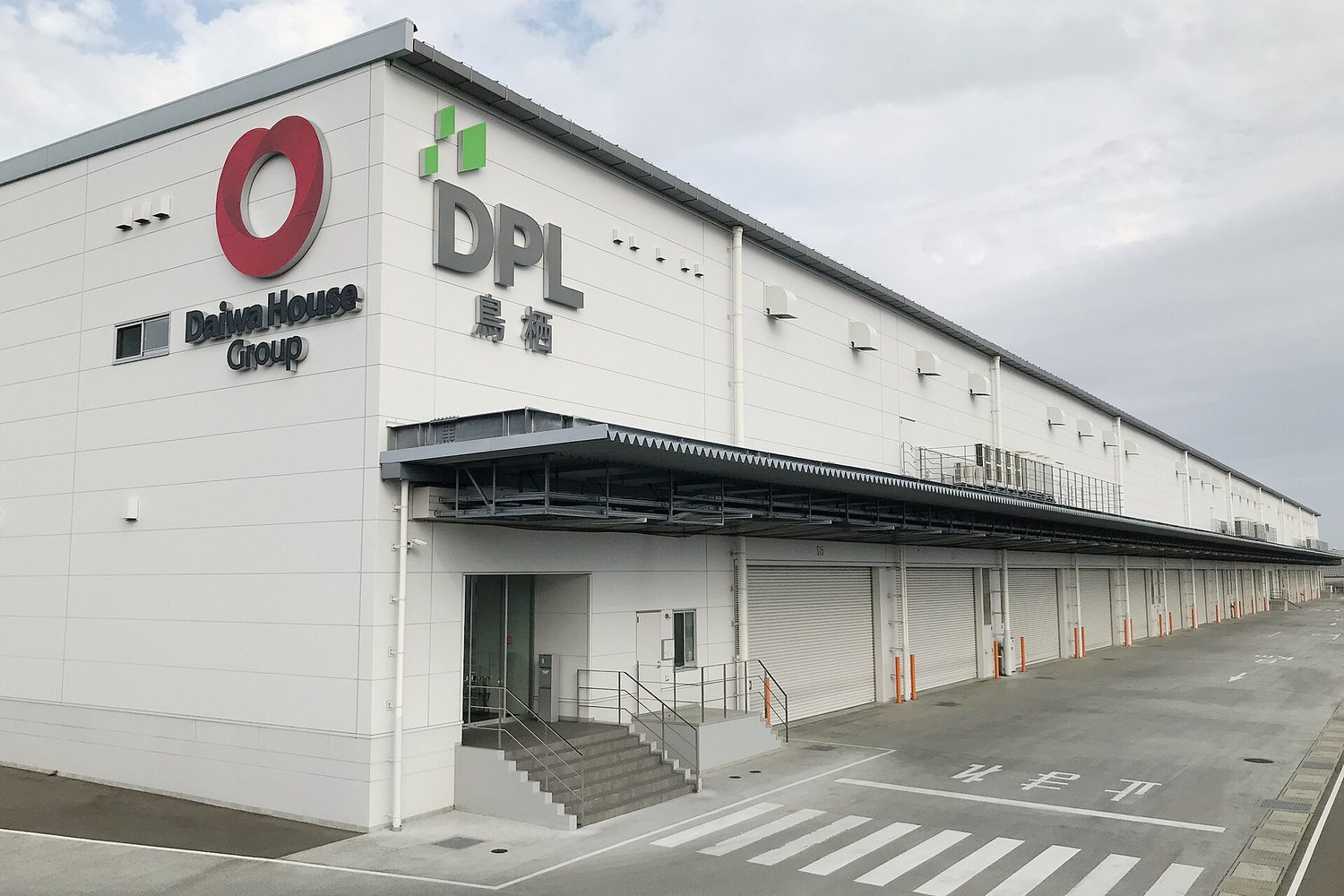
企业的入址——例如本分销中心——会影响其成本和服务水平。
기업의 입지
기업의 위치는 비용과 매출에 영향을 미칩니다. 제조업 기업(제품을 만드는 기업)은 다음 사항을 고려합니다:
원자재와의 근접성 (무겁거나 부피가 큰 자재는 운송비가 많이 들기 때문에),
고객 및 시장과의 근접성,
토지의 비용과 크기,
적합한劳动力의 공급,
우수한 교통망,
특정 지역에서 제공되는 정부 보조금.
서비스 비즈니스(매장이나 이발소 등 서비스를 판매하는 기업)는 고객과의 근접성, 유동 인구, 인근 상권, 임대료 등을 더 중요하게 고려합니다.
해외 입지 선정
비즈니스는 새로운 고객을 확보하고 더 큰 시장을 개척하거나, 임금이나 임대료를 낮추거나, 원자재에更接近하거나, 국내 생산을 통해 관세(수입에 부과되는 세금)를 회피하기 위해 해외에서 생산하거나 판매할 수 있습니다. 하지만 이때는 다른 법제, 언어, 관습에 대응해야 하며, 양국의 법적 규제를 준수해야 합니다.
Explore · 탐색하기
Location factor lab · 위치 요인 실험실
Classify why a business chooses one site over another. · 비즈니스가 한 부지를 다른 곳보다 선호하는 이유를 분류하십시오.
Match the production methods: job (one-off items to order), batch (a group, then switch to another), flow (non-stop mass production on a line).
Learn the formulas: total cost = fixed + variable; average cost = total cost ÷ output; total revenue = price × quantity; profit = total revenue − total cost.
Break-even output = fixed costs ÷ (selling price − variable cost per unit). How far actual output is above break-even is the margin of safety.
Break-even analysis assumes everything made is sold at one fixed price and cost, so it is only a guide.
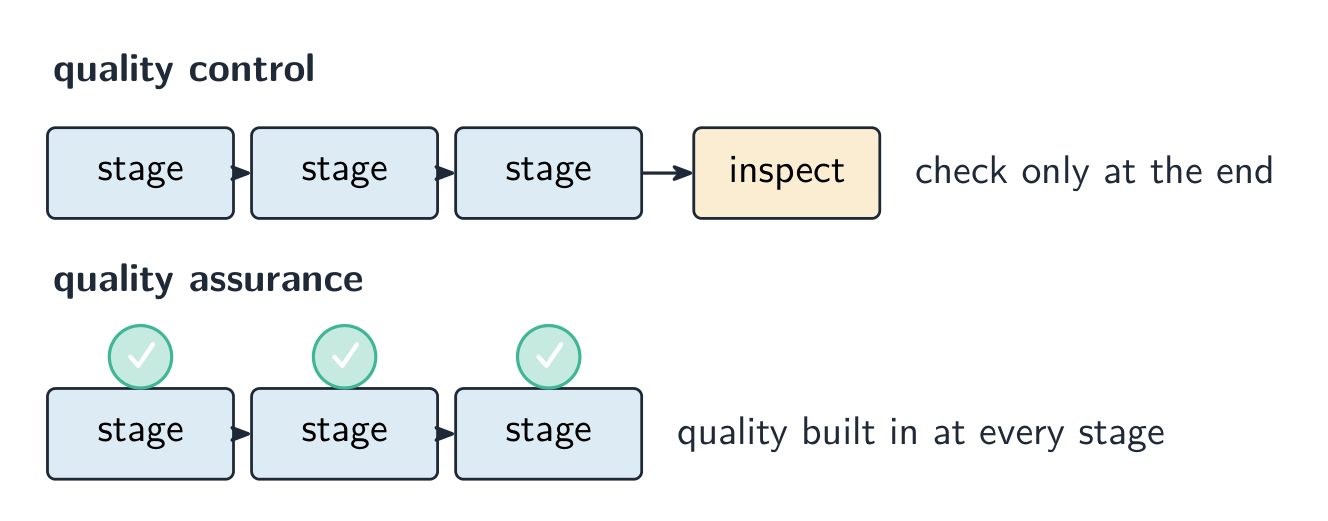
Quality control checks finished goods at the end; quality assurance builds quality in at every stage.
한국어
생산 방식을 매칭하세요: 조별/작업 방식(job) (주문에 따라 일회성 제품), 배치 방식(batch) (일단 한 무리를 만들고 다른 것으로 교체), 연속 흐름 방식(flow) (라인에서 중단 없는 대량 생산).
explain why businesses need finance (start-up capital, expansion, working capital, cash-flow problems)
distinguish short-term and long-term finance and internal and external sources of finance
describe sources of finance (retained profit, sale of assets, owners' savings, bank loan/overdraft, share issue, debentures, leasing, hire purchase, trade credit, microfinance, crowdfunding, government grants)
explain the factors that influence the choice of source of finance
한국어
기업이 자금이 필요한 이유(창업 자금, 확장, 유동 자금, 현금 흐름 문제)를 설명하시오
단기 및 장기 자금, 내부 및 외부 자금 출처를 구분하시오
자금 출처를 서술하시오(잉여금, 자산 매각, 소유자 예금, 은행 대출/신용한도, 주식 발행, 사채, 리스, 유상 구매, 상업 신용, 마이크로파이낸싱, 크라우드펀딩, 정부 보조금)
자금 출처 선택에 영향을 미치는 요인을 설명하시오
Source: Cambridge International syllabus · 출처: Cambridge International syllabus
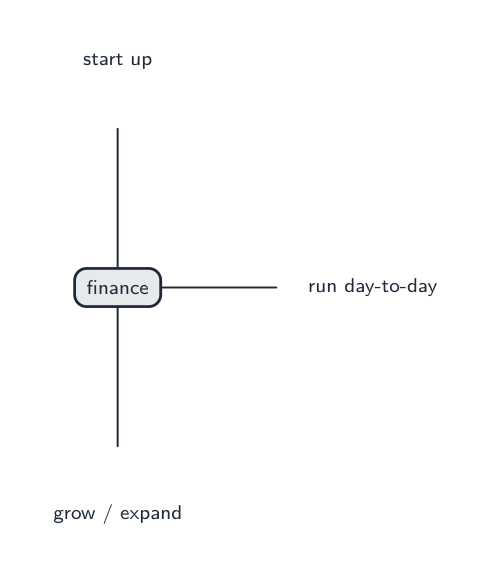
Banks are a key external source of business finance, through loans and overdrafts.Finance is needed to start up, to run day-to-day, and to grow
Finance 资金 means the money a business needs. A business needs finance to:
start up — start-up capital 启动资金 to buy equipment and stock before it earns anything,
grow — money for expansion 扩张, such as new shops or machines,
run day to day — working capital 营运资金 to pay wages and suppliers while waiting for customers to pay,
survive a cash-flow 现金流 problem, when more money is going out than is coming in.
Sources of finance
Finance can be short-term 短期 (paid back within a year) or long-term 长期 (over several years). It can come from inside the business (internal) or from outside (external).
Source
Internal / external
Notes
retained profit 留存利润
internal
profit kept in the business, not paid out
sale of assets 资产
internal
selling things the business no longer needs
owners' savings
internal
the owners' own money
bank loan 贷款
external
borrowed money, repaid with interest 利息 over time
bank overdraft 透支
external
the bank lets the account go below zero, for short-term needs
issuing new shares 股份
external
only for limited companies; raises money but shares out control
debentures 债券
external
long-term loans to a company that pay interest
leasing 租赁
external
renting equipment instead of buying it
hire purchase 分期付款
external
buy now and pay in monthly parts
trade credit 贸易信贷
external
pay suppliers later, for example after 30 days
microfinance 小额信贷
external
small loans for tiny businesses in poorer areas
crowdfunding 众筹
external
many people each give a small amount, often online
government grants 补助金
external
money from the government that need not be repaid
Sources of finance come from inside the business (internal) or outside it (external)
Choosing a source
The best source depends on how much money is needed and for how long, the cost (interest and fees), the size and legal type of the business (only companies can sell shares), and how much risk and control the owners will accept.
Explore · 탐색하기
Sources of finance lab · 자금 조달 실험실
Choose the best type of finance by time, risk and ownership. · 시기, 위험도, 소유권에 따른 가장 적합한 자금 조달 유형을 선택하십시오.
Source: Cambridge International syllabus · 출처: Cambridge International syllabus
Cash-flow forecast
Cash is not the same as profit
Cash 现金 is the money a business can use right now. Profit 利润 is revenue 收入 minus costs over a period. A business can be making a profit yet still run out of cash — for example, if customers have not paid yet. Running out of cash can force even a profitable business to close.
A credit sale earns profit on paper now - the cash arrives much later
The cash-flow forecast
A cash-flow forecast 现金流预测 predicts the money coming in and going out each month. It uses:
inflows 流入 — money coming in (sales, loans),
outflows 流出 — money going out (wages, rent, materials),
net cash flow 净现金流 — inflows minus outflows,
opening balance 期初余额 — the cash held at the start of the month,
closing balance 期末余额 — the cash held at the end of the month.
Worked example. A shop expects inflows of £12,000 and outflows of £9,000 next month, and starts the month with £2,000 in the bank. Find the net cash flow and the closing balance.
A cash-flow forecast tracks the closing balance each month, warning of a shortage early
Working capital
Working capital is the money available for day-to-day running. It is the current assets 流动资产 (cash and things soon turned into cash) minus the current liabilities 流动负债 (debts due within a year).
To overcome cash-flow problems, a business can arrange an overdraft, delay paying suppliers, ask customers to pay sooner, sell spare assets, or cut spending.
Working capital: current assets minus current liabilities
Explore · 탐색하기
Cash-flow forecasting · 현금 흐름 예측
A forecast of cash in and out each month warns a business of a cash shortage before it strikes. · 매월 현금 유입과 유출을 예측하면, 자금 부족이 발생하기 전에 기업을 경고합니다.
Explore · 탐색하기
Cash-flow forecast lab · 현금 흐름 예측 실험실
Drag the monthly cash in, cash out and the one-off oven purchase — does the bakery stay out of the red all six months? · 매월 현금 유입, 현금 유출 및 오븐 단발 구매를 드래그하십시오. 제빵소가 6개월 동안 적자 없이 운영될 수 있습니까?
identify the main features of an income statement: revenue, cost of sales, gross profit, expenses and profit for the year
explain how income statements are used by stakeholders
한국어
손익계산서의 주요 특징(매출, 매출원가, Teaching gross profit, 비용, 당기순이익)을 식별하시오
이해관계자가 손익계산서를 사용하는 방법을 설명하시오
Source: Cambridge International syllabus · 출처: Cambridge International syllabus
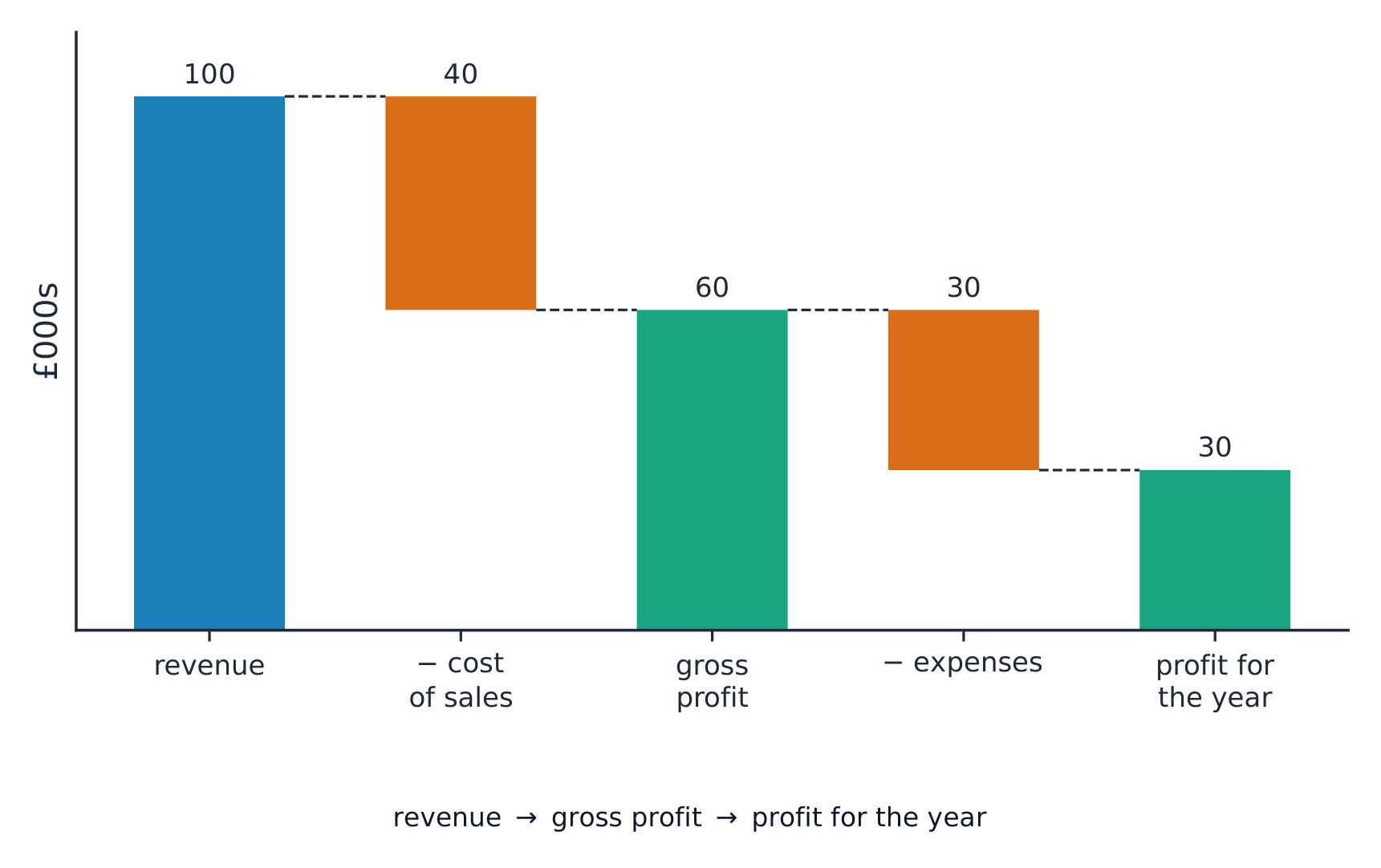
An income statement 损益表 shows how much profit a business made over a period, usually a year.
Line
Meaning
revenue
money from sales
cost of sales 销售成本
the cost of making or buying the goods that were sold
gross profit 毛利润
revenue minus cost of sales
expenses 费用
other running costs: rent, wages, advertising
profit for the year 年度利润
gross profit minus expenses
$$\text{gross profit} = \text{revenue} - \text{cost of sales}$$
$$\text{profit for the year} = \text{gross profit} - \text{expenses}$$
Worked example. A business has revenue of £200,000, cost of sales of £120,000 and expenses of £50,000. Find its gross profit and its profit for the year.
identify the main classifications in a statement of financial position: non-current and current assets, current and non-current liabilities, and owners' equity/capital
explain how the statement of financial position is used
한국어
재무제표의 주요 분류를 식별한다: 비유동 자산과 유동 자산, 유동 부채와 비유동 부채, 그리고 자본(주주지분)
재무제표가 어떻게 활용되는지 설명한다
Source: Cambridge International syllabus · 출처: Cambridge International syllabus
A stock exchange: public limited companies raise finance by selling shares to investors.
A statement of financial position 财务状况表 (also called a balance sheet) shows what a business owns and what it owes (its liabilities 负债) on one day.
non-current assets 非流动资产 — things kept for the long term: buildings, machines.
current assets — short-term items: inventory 库存, money owed by customers, and cash.
current liabilities — debts due within a year: an overdraft, money owed to suppliers.
non-current liabilities 非流动负债 — debts due after more than a year: a long-term loan.
owners' equity 所有者权益 — the money the owners put in, plus profit kept in the business.
It is used to check what the business is worth, how much it owes, and whether it can pay its debts.
The two sides always balance: assets equal liabilities plus equity
Explore · 탐색하기
Financial statements flow · 재무제표 흐름
See how business events become the statements users read. · 비즈니스 이벤트가 사용자들이 읽는 재무제표로 어떻게 연결되는지 확인함.
gross profit margin 毛利率 — gross profit as a percentage of revenue.
profit margin 利润率 — profit for the year as a percentage of revenue.
return on capital employed 资本回报率 (ROCE) — profit as a percentage of the capital employed 所用资本 (money invested). It shows how well the investment is used.
A higher percentage is better for all three.
Worked example. The same business (revenue £200,000, gross profit £80,000, profit for the year £30,000) has capital employed of £150,000. Find its three profitability ratios.
$$\text{acid test ratio} = \frac{\text{current assets} - \text{inventory}}{\text{current liabilities}}$$
the current ratio 流动比率 compares current assets with current liabilities. Around 1.5 to 2 is healthy.
the acid test ratio 速动比率 is stricter: it leaves out inventory, because inventory is not yet sold.
Worked example. A business has current assets of £40,000 (including £10,000 of inventory) and current liabilities of £20,000. Find its current ratio and acid test ratio.
Cash is not profit: a profitable business can still run out of cash if customers pay late. Watch the closing balance on a cash-flow forecast.
Separate internal sources (retained profit, sale of assets, owners' savings) from external ones (bank loan, overdraft, shares, leasing, trade credit).
Key formulas: net cash flow = inflows − outflows; closing balance = opening balance + net cash flow; working capital = current assets − current liabilities.
Profitability ratios (gross margin, profit margin, ROCE) — higher is better. Liquidity: the current ratio (healthy ≈ 1.5–2) and the stricter acid test (which leaves out inventory).
Only limited companies can raise money by issuing shares; a sole trader or partnership cannot.
6
External influences on business activity · 기업 활동에 미치는 외부 영향
Every business is affected by external influences 外部影响 — things outside the business that it cannot control, such as the economy, the law and the environment. A good business watches these and plans for them.
한국어
모든 기업은 외부 영향에 영향을 받습니다: 기업 자체로 통제할 수 없는 경제, 법률, 환경 등입니다. 좋은 기업은 이러한 요인을 감시하고 이에 대비하여 계획합니다。
정부와 법률은 모든 기업을 형성함: 세금, 금리, 규제 등은 외부 영향입니다
6.1
Economic issues · 경제적 이슈
Syllabus
English
explain the business cycle (growth, boom, recession, slump/recovery) and its effects on business
explain government economic objectives and how taxation, interest rates, inflation, unemployment and exchange rates affect business
한국어
사업 사이클(성장, 호황, 침체/회복)과 그에 따른 기업에 미치는 영향을 설명한다
정부의 경제 목표와 과세, 금리, 물가상승, 실업, 환율이 기업에 미치는 영향을 설명한다
Source: Cambridge International syllabus · 출처: Cambridge International syllabus
English
The business cycle
The economy does not grow at a steady pace. It moves in a repeating pattern called the business cycle 经济周期, with these stages.
Stage
What happens
Effect on business
growth 增长
the economy is rising; people spend more
sales and profit rise; firms expand and hire
boom 繁荣
spending is very high
prices and wages rise; shortages appear
recession 衰退
spending falls; the economy shrinks
sales and profit fall; firms cut jobs
slump 萧条
a deep, long recession
many firms close; high unemployment 失业
recovery 复苏
spending starts to rise again
sales slowly improve
In hard times a business may cut costs, lower prices, or sell cheaper products.
Government economic aims and how they affect business
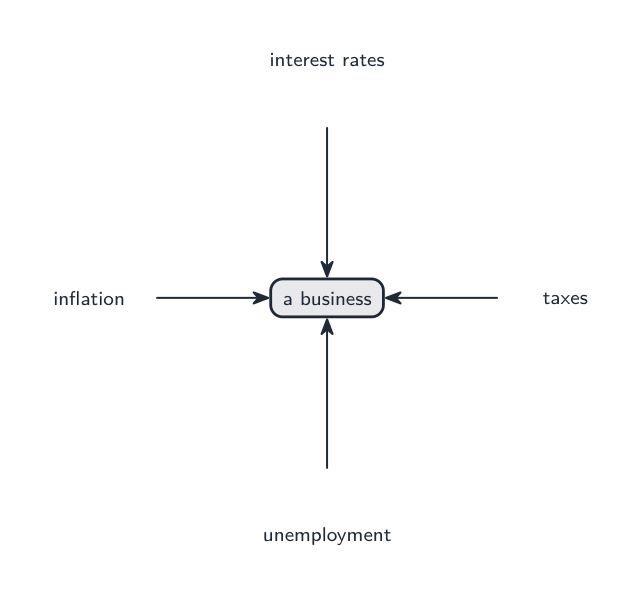
Governments try to keep the economy healthy. Their main aims are stable prices, plenty of jobs, steady growth, and a stable currency. To manage the economy, a government uses or watches several economic factors. Each one affects every business.
Economic factor
What it is
Effect on business
taxation 税收
money the government takes from incomes and sales
higher tax leaves people with less to spend, and cuts business profit
interest rates 利率
the cost of borrowing money
higher rates make loans dearer, so firms borrow and invest less, and customers spend less
inflation 通货膨胀
a general rise in prices
costs rise; if wages chase prices, the country's goods can become too dear
unemployment
the number of people without work
high unemployment lowers sales, but workers are easier to hire
exchange rates 汇率
the price of one currency in another
a change makes imports and exports cheaper or dearer (see below)
한국어
금리, 세금, 실업률 및 인플레이션은 모두 기업에 영향을 미침
경기변동
경제는 일정한 속도로 성장하지 않습니다. 경기변동이라 불리는 반복되는 패턴을 따르며, 다음과 같은 단계를 거칩니다。
단계
내용
기업에 미치는 영향
성장
경기가 상승; 소비 증가
매출과 이익 증가; 기업 확장 및 고용 증가
호황
소비가 매우 높음
가격과 임금 상승; 물자 부족 발생
침체
소비 감소; 경제 위축
매출과 이익 감소; 기업 구조조정 및裁员
대침체
깊은 장기 침체
많은 기업 폐업; 높은 실업률
회복
소비가 다시 증가 시작
매출 서서히 개선
경기변동은 성장, 호황, 침체, 대침체, 회복을 거칩니다
어려운 시기에는 기업이 비용을 절감하거나 가격을 낮추거나 저렴한 제품을 판매할 수 있습니다。
정부의 경제적 목표와 기업에 미치는 영향
정부는 경제의 건전한 상태를 유지하려 노력합니다. 그들의 주요 목표는 물가 안정, 충분한 고용, 안정적인 성장 및 통화 안정입니다. 경제를 관리하기 위해 정부는 여러 경제 요인을 활용하거나 감시하며, 각 요인은 모든 기업에 영향을 미칩니다.
경제 요인
의미
기업에 미치는 영향
과세
정부가 소득과 판매에서 수취하는 금액
세금이 높아지면 소비 가능 금액이 줄어들고 기업의 이익이 감소함
금리
돈을 빌리는 비용
금리가 높아지면 대출 비용이 상승하므로 기업은 fewer borrowing 및 fewer investment을 하고, 고객은 fewer spending을 함
물가상승
가격의 전반적인 상승
비용이 증가하며, 임금이 가격을 따라오면 국가의 상품 가격이 과도하게 높아질 수 있음
실업률
취업하지 못한 사람의 수
높은 실업률은 매출을 낮추지만, 인력 채용이 용이해짐
환율
한 통화를 다른 통화로 환전할 때의 가격
환율 변동은 수입과 수출의 가격低廉化 또는 高昂化를 유발함 (아래 참고)
Explore · 탐색하기
External influences lab · 외부 영향 험실
Classify outside changes by the channel that hits the business. · 기업에 영향을 미치는 채널에 따라 외부 변화를 분류하십시오.
explain external costs and external benefits of business activity and the meaning of sustainable development
explain how business activity can damage or protect the environment and the role of pressure groups
explain ethical business behaviour and the possible conflict between ethics and profit
한국어
사업 활동의 외부 비용과 외부 편익, 지속 가능한 발전의 의미를 설명한다
사업 활동이 환경을 훼손하거나 보호하는 방식과 압력 집단의 역할을 설명한다
윤리적인 사업 행위를 설명하고 윤리와 이익 사이의 잠재적 갈등을 서술한다
Source: Cambridge International syllabus · 출처: Cambridge International syllabus
English
External costs and external benefits
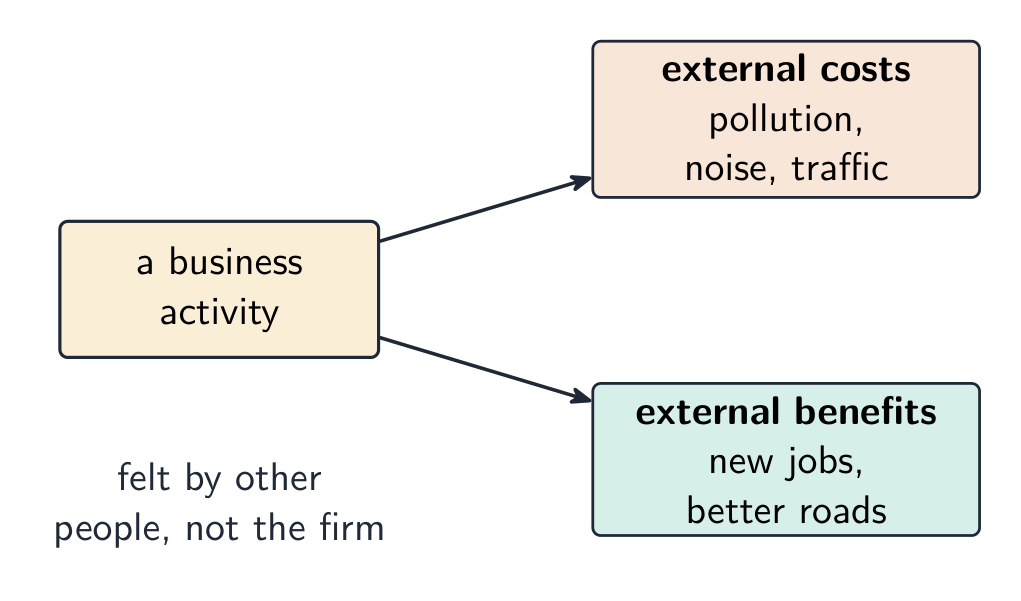
When a business acts, other people can gain or lose.
external costs 外部成本 are costs paid by other people or by society, not by the business — for example pollution 污染, noise and heavy traffic.
external benefits 外部收益 are gains for others — for example new jobs and better roads.
Sustainable development
Sustainable development 可持续发展 means meeting today's needs without harming the ability of future people to meet their own needs. A business can harm the environment 环境 — through waste, pollution, and using up resources — or protect it, through recycling, clean energy and less packaging.
Pressure groups
A pressure group 压力团体 is a group that tries to influence businesses and governments, for example to cut pollution. Pressure groups use the media, protests and boycotts. A business may change its behaviour to avoid bad publicity.
Ethics and profit
Ethical behaviour 道德行为 means doing what is morally right, even when no law forces it — for example fair pay, safe products, and no child labour. Acting ethically can cost more in the short term, so it may conflict 冲突 with profit. But it can also win loyal customers and a good name, which raise profit in the long term.
한국어
기업 활동은 환경을 해칠 수 있으며, 이는 기업과 정부에게 윤리적 의문을 제기함.
외부 비용과 외부 효익
비즈니스가 활동할 때, 다른 사람들은 이익을 얻거나 손실을 입게 됩니다.
외부 비용은 비즈니스가 아닌 다른 사람이나 사회가 부담하는 비용으로, 예로 오염, 소음 및 혼잡한 교통이 있습니다.
외부 편익은 타인에게 돌아가는 이득으로, 예로 신규 일자리 및 개선된 도로가 있습니다.
비즈니스 활동은 타인에게 외부 비용과 외부 편익을 초래할 수 있습니다
지속 가능한 개발
지속 가능한 개발이란 오늘날의 필요를 충족시키면서 미래 세대가 자신의 필요를 충족시킬 능력을 해치지 않는 것을 의미합니다. 기업은 폐기물, 오염, 자원 고갈 등을 통해 환경을 해칠 수 있으며, 재활용, 청정 에너지 사용 및 포장 소재 감소를 통해 이를 보호할 수도 있습니다.
압력 집단
압력 단체는 기업과 정부에 영향을 미치려 하는 집단으로, 예컨대 오염 감축을 위한 활동 등이 포함됩니다. 압력 단체는 언론, 시위 및 보이스코트를 사용합니다. 기업은 나쁜 publicity을 피하기 위해 행동을 바꿀 수 있습니다.
윤리와 수익
윤리적 행동은 법적으로 강제되지 않더라도 도덕적으로 올바른 행위를 의미합니다. 예를 들어 공정한 임금, 안전한 제품, 아동 노동 금지 등이 포함됩니다. 윤리적 행동은 단기적으로는 비용이 더 들 수 있어 수익과 충돌할 수 있습니다. 그러나 장기적으로는 충성 고객 확보 및 평판 향상을 통해 수익을 높일 수도 있습니다.
Explore · 탐색하기
External influences lab · 외부 영향 험실
Classify outside changes by the channel that hits the business. · 기업에 영향을 미치는 채널에 따라 외부 변화를 분류하십시오.
Business and the international economy · 기업과 국제 경제
Syllabus
English
explain globalisation, its importance to business and the reasons for it
explain the role of multinational companies and their benefits and drawbacks to a country
explain how changes in exchange rates affect businesses that import and export
한국어
글로벌화, 기업이 이를 중요하게 생각하는 이유, 그리고 그 원인을 설명한다
다국적 기업의 역할과一个国家에 미치는 장단점을 설명한다
환율 변동이 수입 및 수출 기업에 미치는 영향을 설명한다
Source: Cambridge International syllabus · 출처: Cambridge International syllabus
English
Globalisation
Globalisation 全球化 is the growing trade and movement of goods, money and people between countries, so the world acts more and more like one single market. It has grown because of cheaper transport, better communication, the internet, and fewer trade barriers such as tariffs 关税 (taxes on imports).
Multinational companies
A multinational company 跨国公司 has operations — factories, branches, or offices — in more than one country. (Simply exporting to other countries is not enough; the firm must actually operate there.)
Benefits to a country
Drawbacks to a country
new jobs and training
profits may be sent out of the country
investment and new technology
local firms may be forced out of business
more choice and lower prices
resources may be used up, or the area polluted
more tax paid to the government
a large firm can have too much power
Exchange rates and trade
An exchange rate is the price of one currency in another. A change affects businesses that import 进口 (buy from abroad) and those that export 出口 (sell abroad).
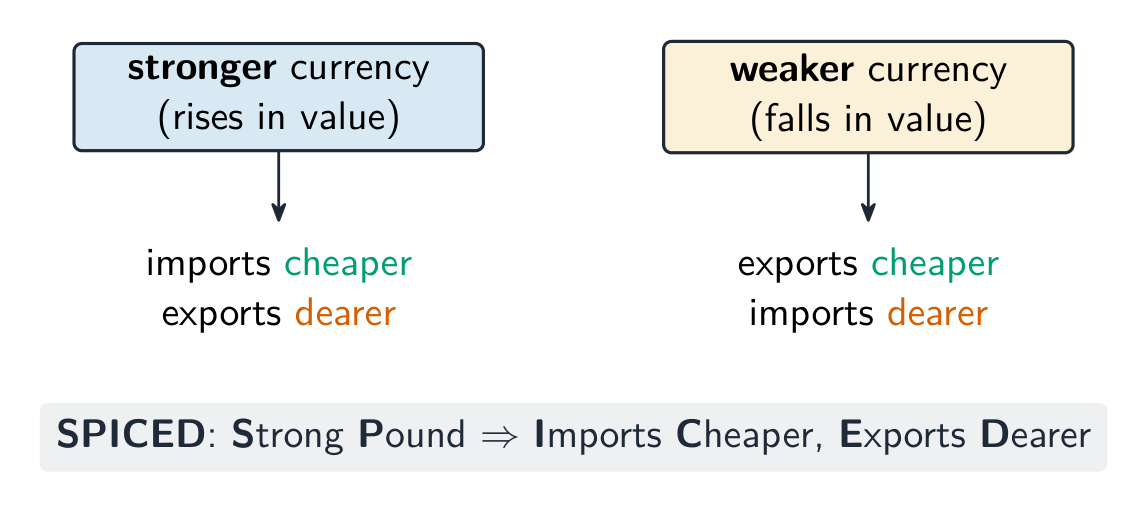
If the currency gets stronger (rises), exports become dearer for foreign buyers, so they sell less, while imports become cheaper.
If the currency gets weaker (falls), exports become cheaper and sell more, while imports become dearer.
A useful memory aid is SPICED: Strong Pound → Imports Cheaper, Exports Dearer.
Worked example. A UK firm exports a machine priced at £20,000. The exchange rate moves from £1 = 1.50 USD to £1 = 1.20 USD. What happens to the price a US buyer pays, and is that good for the exporter? Convert the UK price at each rate: at the old rate 20,000 × 1.50 = 30,000 USD; at the new rate 20,000 × 1.20 = 24,000 USD. The pound has weakened, so the machine is 6,000 USD cheaper abroad and the firm should sell more - good for an exporter. Check it against SPICED: a weak pound is the reverse of it, so exports are cheaper. Convert the actual figures rather than only reciting the mnemonic, and notice that the UK price never changed at £20,000 - it is the foreign price that moves.
한국어
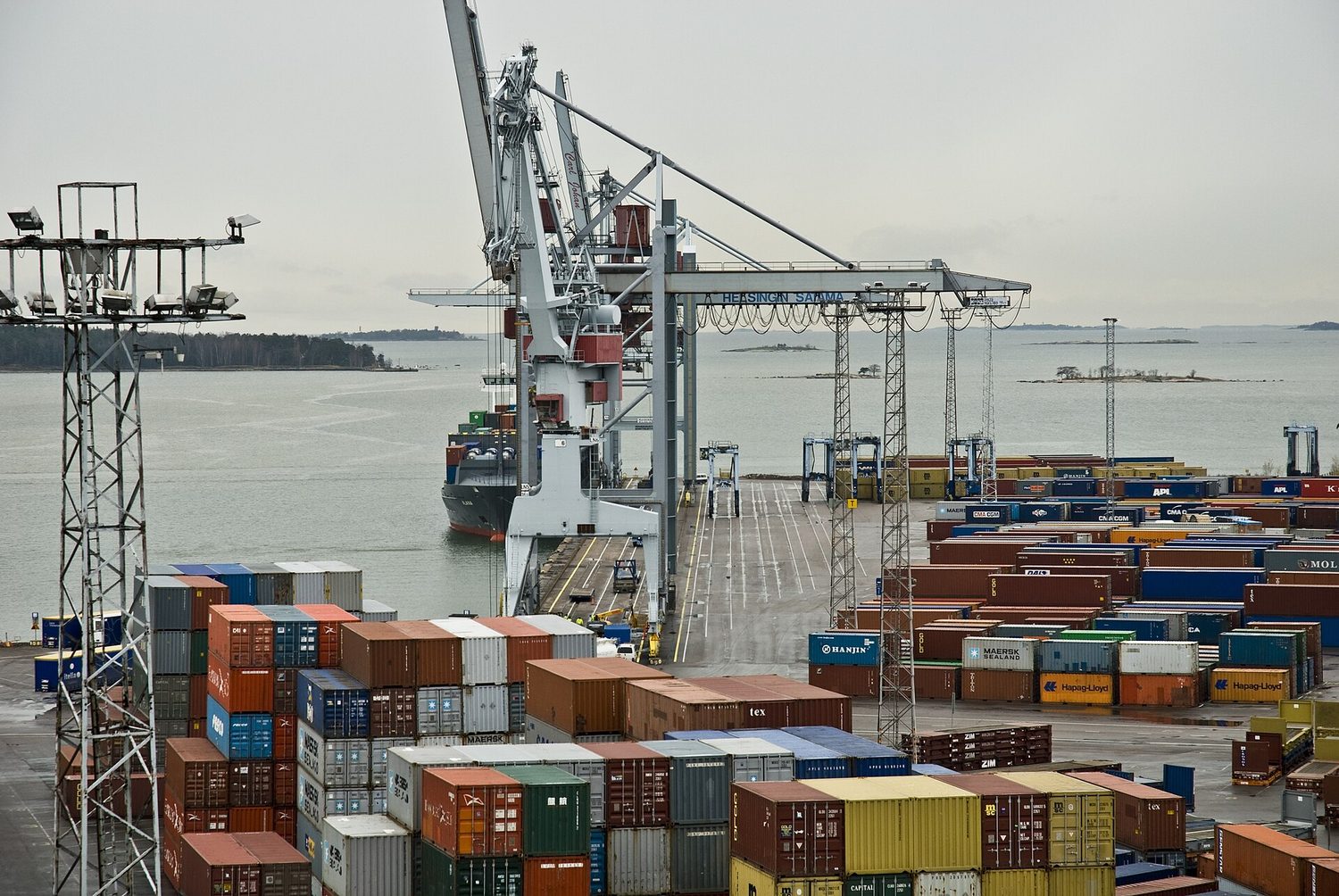
선적 컨테이너: 기업은 더 넓은 국제 경제와 거래함.
글로벌화
글로벌화는 국가 간 상품, 자금 및 인구의 무역 및 이동이 확대되어 세계가 하나의 단일 시장과 같이運作하는 현상입니다. 운송비 절감, 통신 기술 발전, 인터넷 보급 및 관세(수입에 부과되는 세금) 등 무역 장벽 축소 등으로 인해 급속히 성장했습니다.
다국적 기업
다국적 기업은 두 개 이상의 국가에 사업 운영(공장, 지사 또는 사무실)을 가지고 있는 기업을 말합니다. 단순히 타국으로 수출만 하는 것은 충분하지 않으며, 해당 국가 내에서 실제 운영해야 합니다.
국가에 대한 혜택
국가에 대한 단점
신규 일자리 및 교육
이익이 해외로 유출될 수 있음
투자 및 신기술 도입
현지 기업이 경영을 포기할 수 있음
선택의 폭 확대 및 가격 인하
자원이 고갈되거나 지역이 오염될 수 있음
정부에 납부하는 세금 증가
대형 기업이 과도한 권력을 행사할 수 있음
환율과 무역
환율은 한 통화를 다른 통화로 환전할 때의 가격입니다. 환율 변동은 수입(해외로부터 구매) 및 수출(해외로 판매)을 하는 기업에 영향을 미칩니다.
통화가 강세(상승)하면 수출품 가격이 외국인 구매자에게 비싸져 매출이 감소하고, 수입품 가격은 저렴해집니다.
통화가 약세(하락)하면 수출품 가격이 저렴해져 매출이 증가하고, 수입품 가격은 비쌉니다.
기억하기 쉬운 방법 중 하나는 SPICED입니다: Strong Pound → Imports Cheaper, Exports Dearer (강한 파운드 → 수입 저렴, 수출 비쌈).
강한 또는 약한 통화가 수입과 수출 가격에 미치는 영향
해설 예제. 영국 기업이 £20,000에 판매하는 기계기를 수출합니다. 환율이 £1 = 1.50 USD에서 £1 = 1.20 USD로 변동합니다. 미국 구매자가 지불하는 가격은 어떻게 변하며, 이는 수출자에게 유리한가요? 각 환율에서 영국 가격을 환산합니다: 구 환율 기준 20,000 × 1.50 = 30,000 USD; 신 환율 기준 20,000 × 1.20 = 24,000 USD. 파운드가 약세로 전환되었으므로 기기는 해외에서 6,000 USD 저렴해졌으며, 기업은 더 많은 물량을 판매해야 하므로 수출자에게 유리합니다. SPICED로 확인해 봅시다: 약한 파운드는 그 반대의 상황이라 수출품 가격이 저렴해집니다. 실제 수치를 환산해 보고, 암기法만 외우는 것이 아니라 영국 가격£20,000이 변하지 않았음을 주의하세요. 움직이는 것은 해외 가격입니다.
Explore · 탐색하기
International market lab · 국제 시장 실험실
See how access to world markets changes quantity and price pressure. · 세계 시장 접근성이 수량과 가격 압력을 어떻게 바꾸는지 확인하십시오.
Learn the business cycle (growth, boom, recession, slump, recovery) and how each stage changes sales, profit and jobs.
Trace each economic factor to the business: higher interest rates → dearer loans, so less borrowing and spending; higher tax → people have less to spend; inflation → higher costs.
External costs (pollution, noise) fall on other people, not the business; external benefits (new jobs, better roads) help others.
Use SPICED for exchange rates: Strong Pound → Imports Cheaper, Exports Dearer.
Ethical behaviour can cost more in the short term (so it may conflict with profit), but it can win loyal customers and a good name that raise profit later.
한국어
경기 순환(성장, 호황, 침체, 대공황, 회복)을 이해하고 각 단계가 매출, 이익 및 고용에 미치는 변화를 파악하십시오.
각 경제 요인이 기업에 미치는 영향을 추적하십시오: 금리 상승 → 대출 비용 상승 → fewer borrowing 및 fewer spending; 과세 증액 → 소비 가능 금액 감소; 물가상승 → 비용 증가.
외부 비용(오염, 소음)은 기업 자체가 아닌 다른 사람에게 발생하며, 외부 편익(새로운 일자리, 개선된 도로)은 다른 사람들에게 도움이 됩니다.