Skip to content · ⁨본문 바로가기⁩

Political Patterns and Processes

AP Human Geography · ⁨AP 인간지리학⁩ · Topic 4 · ⁨주제 4⁩

Video lesson for this topic · ⁨이 주제용 영상 수업⁩ Open the video page · ⁨영상 페이지 열기⁩
8:12

정치적 패턴과 과정

여기에 울타리가 있다. 열린 땅 위를 종단하여 지평선까지 이어져 있다. 저편에는 도시가 서 있다—같은 건조한 대지, 같은 하늘. 그리고 여기는 홀…

English narration · English + 中文 subtitles burned in · ⁨영어 내레이션 · 영어 + 중국어 자막 burned-in⁩

4.1

Introduction to Political Geography · ⁨정치 지리학Introduction⁩

Syllabus
English

Enduring Understanding (PSO-4): The political organization of space results from historical and current processes, events, and ideas.

Learning Objective PSO-4.A: For world political maps: a. Define the different types of political entities. b. Identify a contemporary example of political entities.

  • PSO-4.A.1 Independent states are the primary building blocks of the world political map.
  • PSO-4.A.2 Types of political entities include nations, nation-states, stateless nations, multinational states, multistate nations, and autonomous and semiautonomous regions, such as American Indian reservations.
한국어

지속적 이해 (PSO-4): 공간의 정치 조직은 역사적 및 현존하는 과정, 사건, 아이디어로부터 비롯된다.

학습 목표 PSO-4.A: 세계 정치 지도에 대해: a. 다양한 종류의 정치 실체를 정의한다. b. 정치 실체의 현대적 예시를 식별한다.

  • PSO-4.A.1 독립국은 세계 정치 지도의 주요 구성 요소이다.
  • PSO-4.A.2 정치 실체의 종류에는 국가(nations), 국가가구(nation-states), 무국적 민족(stateless nations), 다국적 국가(multinational states), 다국적 민족(multistate nations), 그리고 아메리카 원주민 보호구(American Indian reservations)와 같은 자치 및 반자치 regions 등이 포함된다.

Source: College Board AP Course and Exam Description · ⁨출처: College Board AP Course and Exam Description⁩

English

Political geography 政治地理学 studies how humans divide and control space. Its key units:

  • A state 国家 (country) is an area with defined borders, a permanent population, a government, and sovereignty 主权 — full control over its own affairs.
  • A nation 民族 is a group of people with a shared culture and identity; a nation-state 民族国家 is a state whose borders match one nation (Japan is close).
  • A multinational state 多民族国家 contains several nations; a stateless nation 无国家民族 (like the Kurds) has no state of its own.

Worked example (a real AP exam question). "Define the concept of an independent state." (2025) A full-mark answer: "A sovereign country that governs itself and its own territory, is not controlled by any outside power, and is recognised by other states." The command word Define wants a short, precise meaning — one clear sentence is enough. You do not need examples or explanation here; save those for the "Describe" and "Explain" parts.

한국어

정치 지리학은 인간이 공간을 어떻게 구획하고 통제하는지를 연구한다. 주요 개념:

  • 국가(state) 는 명확한 국경, 영구적인 인구, 정부, 주권—자신들의 affairs에 대한 완전한 통제를 의미하는 영역이다.
  • 민족(nation) 은 공통된 문화와 정체성을 가진 사람들의 집단이며, 민족 국가(nation-state) 는 국경선이 하나의 민족과 일치하는 국가(일본이 그 예)이다.
  • 다민족 국가(multinational state) 는 여러 민족을 포함하며, 무국적 민족(stateless nation)(쿠르드족 등) 는 자체적인 국가를 가지고 있지 않다.

작업 예시 (실제 AP 시험 문제). "독립적 국가의 개념을 정의하시오." (2025) 만점 답안: "자신들을 자치하고 자국 영토를 통치하며, 외부 세력의 통제를 받지 않고 다른 국가들로부터 인정받는 주권 국가." 명령어 Define은 짧고 정확한 의미를 요구하므로, 한 문장으로 충분하다. 여기에서 예시나 설명이 필요하지 않다; Those는 "Describe" 및 "Explain" 부분에留给한다.

UN 총회: 국가 간의 주권 및 인정
Vocabulary · ⁨어휘⁩ Train · ⁨연습하기⁩
English 한국어
Political geography/pəˈlɪtɪkl dʒɪˈɒɡrəfi/ 정치 지리학
state/steɪt/ 국가(state)
sovereignty/ˈsɒvərɪnti/ 주권(sovereignty)
nation/ˈneɪʃn/ 민족(nation)
nation-state/ˈneɪʃn steɪt/ 일국일민족 국가(nation-state)
multinational state/ˌmʌltɪˈnæʃənl steɪt/ 다민족 국가
stateless nation/ˈsteɪtləs ˈneɪʃn/ 무국적 민족(stainless nation)
4.2 4.3

Political Power and Territoriality · ⁨정치적 권력과 영토성⁩

Syllabus
English

Enduring Understanding (PSO-4): The political organization of space results from historical and current processes, events, and ideas.

Learning Objective PSO-4.B: Explain the processes that have shaped contemporary political geography.

  • PSO-4.B.1 The concepts of sovereignty, nation- states, and self-determination shape the contemporary world.
  • PSO-4.B.2 Colonialism, imperialism, independence movements, and devolution along national lines have influenced contemporary political boundaries.
한국어

지속적 이해 (PSO-4): 공간의 정치 조직은 역사적 및 현존하는 과정, 사건, 아이디어로부터 비롯된다.

학습 목표 PSO-4.B: 현대 정치 지리학을 형성한 과정들을 설명한다.

  • PSO-4.B.1 주권, 국가가구, 자기결정의 개념은 현대 세상을 형성한다.
  • PSO-4.B.2 식민주의, 제국주의, 독립 운동, 국가 단위의 분권(devolution)은 현대 정치 경계를 ảnh hưởng시켰다.
English

Enduring Understanding (PSO-4): The political organization of space results from historical and current processes, events, and ideas.

Learning Objective PSO-4.C: Describe the concepts of political power and territoriality as used by geographers.

  • PSO-4.C.1 Political power is expressed geographically as control over people, land, and resources, as illustrated by neocolonialism, shatterbelts, and choke points.
  • PSO-4.C.2 Territoriality is the connection of people, their culture, and their economic systems to the land.
한국어

지속적 이해 (PSO-4): 공간의 정치 조직은 역사적 및 현존하는 과정, 사건, 아이디어로부터 비롯된다.

학습 목표 PSO-4.C: 지리학자들이 사용하는 정치적 권력과 영토성의 개념을 서술한다.

  • PSO-4.C.1 정치적 권력은 새식민주의(neocolonialism), 파쇄지(shatterbelts), choke point 등을 통해 사람, 토지, 자원에 대한 통제로서 지리적으로 표현된다.
  • PSO-4.C.2 영토성(territoriality)은 사람, 그들의 문화, 경제적 시스템이 토地与 연결되어 있는 것을 의미한다.

Source: College Board AP Course and Exam Description · ⁨출처: College Board AP Course and Exam Description⁩

English

Territoriality 领域性 is the attempt by a person or group to control people and things by controlling an area. Power is expressed geographically through control of land, people, and resources.

  • Colonialism and imperialism built empires by taking control of distant territory; neocolonialism 新殖民主义 is continued economic control after formal independence.
  • Choke points 咽喉要道 (narrow passages like the Suez Canal or the Strait of Malacca) and shatterbelts 破碎地带 (regions caught between competing powers) show how geography shapes political power.
한국어

영토성(territoriality) 은个人或集団이 지역을 통제함으로써 사람과 사물을 통제하려는 시도이다. 권력은 토지, 사람, 자원을 통제함으로써 지리적으로 표현된다.

  • 식민주의와 제국주의는 원거리 영토를 장악하여 제국을 건설했으며, 신식민주주의(neocolonialism) 는 공식적 독립 이후에도 계속되는 경제적 통제이다.
  • 통로(choke points)(수에즈 운하 말라카 해협 등 좁은 통로) 와 파괴지대(shatterbelts)(경쟁하는 세력 사이에 끼어 있는 지역) 는 지리학이 정치적 권력을 어떻게 형성하는지를 보여준다.
Vocabulary · ⁨어휘⁩ Train · ⁨연습하기⁩
English 한국어
Territoriality/ˌterɪˌtɔːrɪˈælɪti/ 영토성
neocolonialism/ˈniːəʊkɒləʊnɪəlɪzəm/ 신식민주의(neocolonialism)
Choke points/tʃəʊk pɔɪnts/ 통로
shatterbelts/ˈʃætəbelts/ 파괴지대(shatterbelt)
4.4 4.5 4.6

Political Boundaries · ⁨정치적 경계⁩

Syllabus
English

Enduring Understanding (IMP-4): Political boundaries and divisions of governance, between states and within them, reflect balances of power that have been negotiated or imposed.

Learning Objective IMP-4.A: Define types of political boundaries used by geographers.

  • IMP-4.A.1 Types of political boundaries include relic, superimposed, subsequent, antecedent, geometric, and consequent boundaries.
한국어

지속적 이해 (IMP-4): 국가 간 및 국가 내부의 정치적 경계와 통치 분리는 협상되거나 강제된 권력 균형에 반영된다.

학습 목표 IMP-4.A: 지리학에서 사용하는 정치적 경계의 유형을 정의한다.

  • IMP-4.A.1 정치적 경계의 유형에는 잔재 경계, 초임 경계, 후발 경계, 선행 경계, 기하학적 경계, 결과 경계가 포함된다.
English

Enduring Understanding (IMP-4): Political boundaries and divisions of governance, between states and within them, reflect balances of power that have been negotiated or imposed.

Learning Objective IMP-4.B: Explain the nature and function of international and internal boundaries.

  • IMP-4.B.1 Boundaries are defined, delimited, demarcated, and administered to establish limits of sovereignty, but they are often contested.
  • IMP-4.B.2 Political boundaries often coincide with cultural, national, or economic divisions. However, some boundaries are created by demilitarized zones or policy, such as the Berlin Conference.
  • IMP-4.B.3 Land and maritime boundaries and international agreements can influence national or regional identity and encourage or discourage international or internal interactions and disputes over resources.
  • IMP-4.B.4 The United Nations Convention on the Law of the Sea defines the rights and responsibilities of nations in the use of international waters, established territorial seas, and exclusive economic zones.
한국어

지속적 이해 (IMP-4): 국가 간 및 국가 내부의 정치적 경계와 통치 분리는 협상되거나 강제된 권력 균형에 반영된다.

학습 목표 IMP-4.B: 국제 경계 및 내부 경계의 성격과 기능을 설명한다.

  • IMP-4.B.1 경계는 주권 한계를 설정하기 위해 정의되고, 구획되며, 표시되며, 관리되지만, 종종 분쟁의 대상이 된다.
  • IMP-4.B.2 정치적 경계는 문화적, 민족적 또는 경제적 분리와 일치하는 경우가 많다. 그러나 베를린 회의와 같이 비무장 지대나 정책으로 인해 형성되는 경계도 있다.
  • IMP-4.B.3 육지 및 해경과 국제 조약은 국가 또는 지역 정체성에 영향을 미치며, 국제적이거나 내부적 상호작용과 자원 관련 분쟁을 장려하거나 억제할 수 있다.
  • IMP-4.B.4 국제해법협약(UNCLOS)은 국제 해역, 영해 및 독점경제구역의 이용에 대한 국가의 권리 및 책임을 규정한다.
English

Enduring Understanding (IMP-4): Political boundaries and divisions of governance, between states and within them, reflect balances of power that have been negotiated or imposed.

Learning Objective IMP-4.B: Explain the nature and function of international and internal boundaries.

  • IMP-4.B.5 Voting districts, redistricting, and gerrymandering affect election results at various scales.
한국어

지속적 이해 (IMP-4): 국가 간 및 국가 내부의 정치적 경계와 통치 분리는 협상되거나 강제된 권력 균형에 반영된다.

학습 목표 IMP-4.B: 국제 경계 및 내부 경계의 성격과 기능을 설명한다.

  • IMP-4.B.5 투표 구역, 재구획, 게리맨더링은 다양한 규모에서 선거 결과에 영향을 미친다.

Source: College Board AP Course and Exam Description · ⁨출처: College Board AP Course and Exam Description⁩

English

A boundary 边界 is a line that marks the limit of a state's territory. Types by origin:

  • Antecedent 先成边界 (drawn before dense settlement), subsequent 后成边界 (drawn as cultures develop), superimposed 叠加边界 (forced on by an outside power, ignoring local culture), and relic 残余边界 (no longer a border but still visible, like the Berlin Wall).
  • Definition, delimitation, and demarcation are the steps of setting a boundary: agreeing wording, drawing it on a map, then marking it on the ground.
  • At sea, the UN Convention on the Law of the Sea (UNCLOS) 联合国海洋法公约 sets each coastal state's territorial sea and an exclusive economic zone (EEZ) 专属经济区, defining rights to fishing and seabed resources.
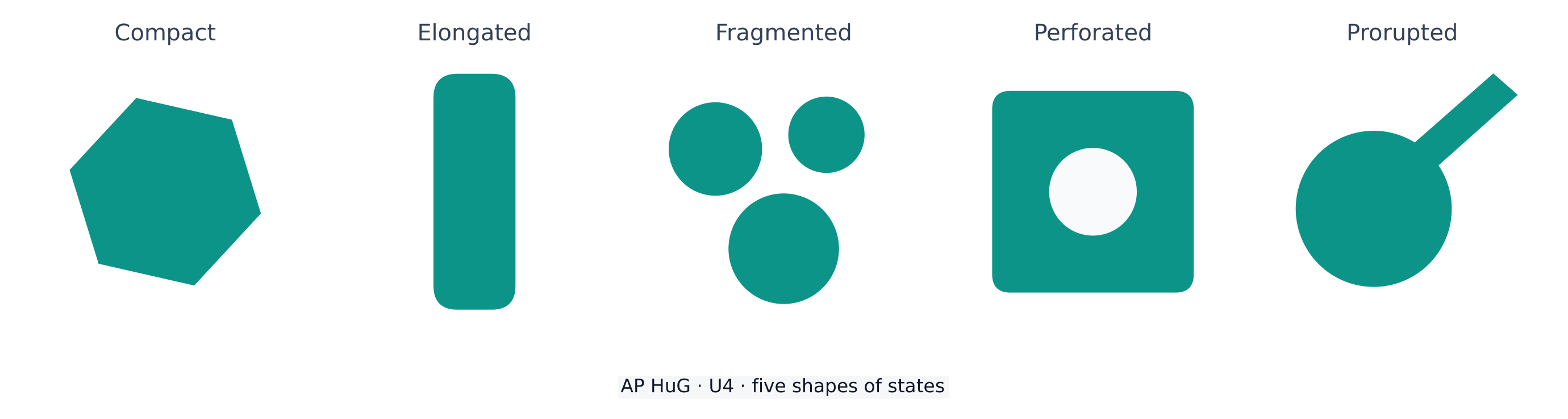
  • The shape of a state matters: compact states are easy to govern; elongated, fragmented, perforated, and prorupted shapes create governing challenges.
한국어
선명한 경관: 정치적 경계와 토지 통제가 자원 사용에 미치는 영향

경계(boundary) 는 국가의 영토 경계를 표시하는 선이다. 기원에 따른 종류:

경계가 형성되는 과정과 국가의 형태
각기 다른 형태를 띠는 국가; 각 형태는 국가가 통치하기 쉬운 정도에 영향을 미친다
  • 선행적(alimentary)(밀집 정착 전 그려진 것), 후행적(subsequent)(문화가 발달함에 따라 그려진 것), 외부적(superimposed)(외부 세력에 의해 강제로 부과되며, 현지의 문화를 무시한 것), 그리고 잔재적(relic)(더 이상 국경이 아니지만 여전히 보임, 베를린 장벽 등).
  • 정의, 경계 설정, 경계 marking 은 경계를 설정하는 단계이다: 용어 합의, 지도에 그리기, 그리고 현장에 marking하기.
  • 바다에서는 UN 해양법 협약(UNCLOS) 이 각 연안국의 영해와 배경경제구역(EEZ) 을 설정하여 어업 및 해저資源의 권리를 정의한다.
  • 国家의 형태는 중요하다: 단일형(compact) 인 국가는 통치가 쉬우며, 세로형(elongated), 분열형(fragmented), 천공형(perforated), 연장형(prorupted) 인 형태는 통치에 과제를 creation한다.
Vocabulary · ⁨어휘⁩ Train · ⁨연습하기⁩
English 한국어
boundary/ˈbaʊndəri/ boundary
Antecedent/ˌæntɪˈsiːdənt/ 선재(al antecedent)
subsequent/ˈsʌbsɪkwənt/ 후위(subsequent)
superimposed/ˌsuːpərɪmˈpəʊzd/ 초월(superimposed)
relic/ˈrelɪk/ 유물
UN Convention on the Law of the Sea (UNCLOS) UN 해양법 협약 (UNCLOS)
exclusive economic zone (EEZ)/eksˈkluːsɪv ˌiːkəˈnɒmɪk zəʊn/ 고유 경제 구역 (EEZ)
4.7

Forms of Governance · ⁨통치 형태⁩

Syllabus
English

Enduring Understanding (IMP-4): Political boundaries and divisions of governance, between states and within them, reflect balances of power that have been negotiated or imposed.

Learning Objective IMP-4.C: Define federal and unitary states.

  • IMP-4.C.1 Forms of governance include unitary states and federal states.

Learning Objective IMP-4.D: Explain how federal and unitary states affect spatial organization.

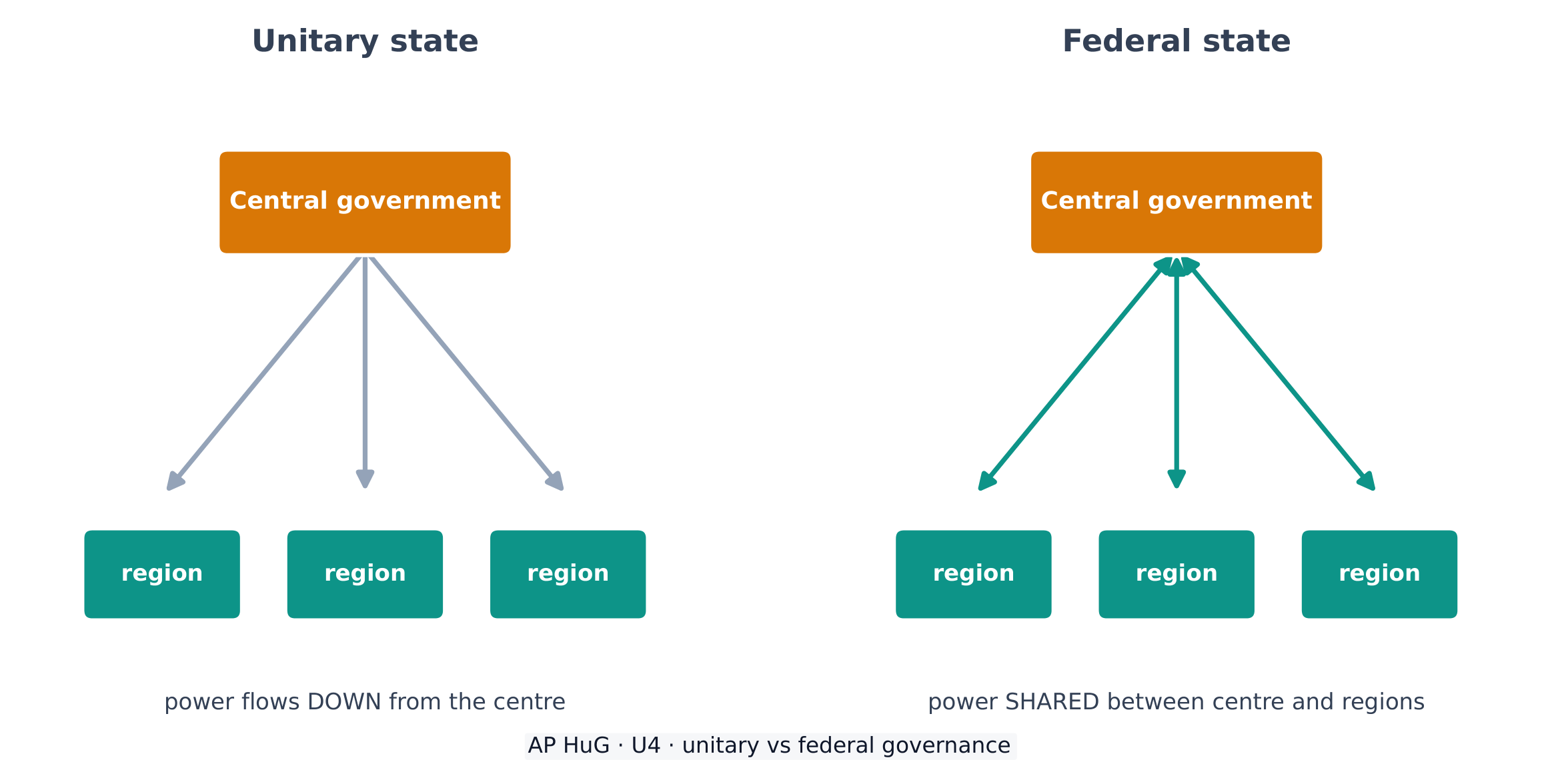
  • IMP-4.D.1 Unitary states tend to have a more top-down, centralized form of governance, while federal states have more locally based, dispersed power centers. SUGGESTED SKILLS Spatial Relationships Describe spatial patterns, networks, and relationships.
한국어

지속적 이해 (IMP-4): 국가 간 및 국가 내부의 정치적 경계와 통치 분리는 협상되거나 강제된 권력 균형에 반영된다.

학습 목표 IMP-4.C: 연방제 국가와 단위제 국가를 정의한다.

  • IMP-4.C.1 통치의 형태에는 단위제 국가와 연방제 국가가 포함된다.

학습 목표 IMP-4.D: 연방제 국가와 단위제 국가가 공간 조직에 미치는 영향을 설명한다.

  • IMP-4.D.1 단위제 국가는 일반적으로 상향식·집중화된 통치 형태를 띠는 반면, 연방제 국가는 현지 기반의 분산된 권력 중심지를 가진다. 권장 기술: 공간 관계 - 공간 양상, 네트워크 및 관계를 설명한다.

Source: College Board AP Course and Exam Description · ⁨출처: College Board AP Course and Exam Description⁩

English

States organise power between the centre and the regions in two main ways:

  • A unitary state 单一制国家 keeps most power in the central government (France). It works best in small or culturally uniform countries.
  • A federal state 联邦制国家 shares power between the centre and regional governments (USA, India). It suits large or diverse countries.
  • Gerrymandering 选区划分不公 is redrawing voting district boundaries to favour one group — a political use of geography.
한국어
의사당 건물: 정치 지리학은权力的 how to organize over territory를 연구함

국가는 중앙과 지방 간 quyền을 두 가지 주요 방식으로 조직한다:

단일형 국가는 권력을 중앙에 집중하고;連邦制 국가는 지방과 공유함
단일형 국가는 권력을 중앙에 유지하며;连邦制 국가는 지방 정부와 권력을 공유한다
  • 단일형 국가(unitary state) 는 대부분의 권한을 중앙 정부에 보유한다(프랑스). 작은 국가나 문화적 동질성이 높은 국가에서 가장 잘 작동한다.
  • 连邦制 국가(federal state) 는 중앙과 지방 정부间权力를 공유한다(미국, 인도). 큰 국가나 다양한 국가에 적합하다.
  • 지명 변경(gerrymandering) 은 특정 집단에 유리하도록 선거구 경계를 재도입하는 것으로, 지리학의 정치적 활용이다.
Vocabulary · ⁨어휘⁩ Train · ⁨연습하기⁩
English 한국어
unitary state/ˈjuːnɪtəri steɪt/ 단위국(unitary state)
federal state/ˈfedərəl steɪt/ 연방 국가(federal state)
Gerrymandering/ˈdʒerɪmændərɪŋ/ Gerrymandering
4.8 4.9

Devolution and Challenges to Sovereignty · ⁨분권과 주권의 도전⁩

Syllabus
English

Enduring Understanding (SPS-4): Political, economic, cultural, or technological changes can challenge state sovereignty.

Learning Objective SPS-4.A: Define factors that lead to the devolution of states.

  • SPS-4.A.1 Factors that can lead to the devolution of states include the division of groups by physical geography, ethnic separatism, ethnic cleansing, terrorism, economic and social problems, and irredentism.
한국어

지속적 이해 (SPS-4): 정치, 경제, 문화, 기술적 변화는 국가 주권을 위협할 수 있다.

학습 목표 SPS-4.A: 국가의 분권화를 유발하는 요인을 정의한다.

  • SPS-4.A.1 국가의 분권화를 유발할 수 있는 요인에는 물리적 지리에 따른 집단 분리, 민족 분리주의, 민족 정화, 테러, 경제 및 사회 문제, 부활주의 등이 포함된다.
English

Enduring Understanding (SPS-4): Political, economic, cultural, or technological changes can challenge state sovereignty.

Learning Objective SPS-4.B: Explain how political, economic, cultural, and technological changes challenge state sovereignty.

  • SPS-4.B.1 Devolution occurs when states fragment into autonomous regions; subnational political- territorial units, such as those within Spain, Belgium, Canada, and Nigeria; or when states disintegrate, as happened in Sudan and the former Soviet Union.
  • SPS-4.B.2 Advances in communication technology have facilitated devolution, supranationalism, and democratization.
  • SPS-4.B.3 Global efforts to address transnational and environmental challenges and to create economies of scale, trade agreements, and military alliances help to further supranationalism.
  • SPS-4.B.4 Supranational organizations—including the United Nations (UN), North Atlantic Treaty Organization (NATO), European Union (EU), Association of Southeast Asian Nations (ASEAN), Arctic Council, and African Union— can challenge state sovereignty by limiting the economic or political actions of member states.
한국어

지속적 이해 (SPS-4): 정치, 경제, 문화, 기술적 변화는 국가 주권을 위협할 수 있다.

학습 목표 SPS-4.B: 정치, 경제, 문화, 기술적 변화가 국가 주권을 어떻게 위협하는지 설명한다.

  • SPS-4.B.1 분권화는 국가가 자치 지역으로 파편화될 때, 스페인, 벨기에, 캐나다, 나이지리아 내의 하급 정치·영토 단위와 같이 발생할 수 있으며, 수단과 전 소련과 같이 국가가 붕괴될 때에도 발생한다.
  • SPS-4.B.2 통신 기술의 발전은 분권화, 초국가주의 및 민주화를 촉진했다.
  • SPS-4.B.3 초국적 환경 문제 대응, 경제의 규모 경제 달성, 무역协定 및 군사 동맹 창립을 위한 글로벌 노력은 초국가주의를 더욱 진전시킨다.
  • SPS-4.B.4 유엔(UN), 북대서양조약기구(NATO), 유럽연합(EU), 동남아시아 국가연맹(ASEAN), 북극 Council, 아프리카연합 등 초국가 기구는 회원국의 경제 또는 정치적 행위를 제한함으로써 국가 주권에 도전할 수 있다.

Source: College Board AP Course and Exam Description · ⁨출처: College Board AP Course and Exam Description⁩

English

Devolution 权力下放 is the transfer of power from a central government down to regional governments. It is driven by devolutionary factors: ethnic or religious differences, physical geography (islands, mountains), and economic inequality.

  • Strong differences can lead to autonomy 自治 for a region, or even a movement for full independence.
  • Sovereignty is also challenged from outside by supranational organisations 超国家组织 (the EU, UN), by globalisation, and by the internet, which crosses borders freely.
한국어

분권(devolution) 은 권력이 중앙 정부에서 지방정부로 이전되는 것이다. 이는 분권적 요인: 민족이나 종교적 차이, 물리적 지리학(섬, 산맥), 경제 격차에 의해推动된다.

  • 강력한 차이는 자치 autonomy 또는 완전한 독립 movement로 이어질 수 있다.
  • 주권 또한 초국적 기관(supranational organisations)(EU, UN), 글로벌화, 국경을 자유롭게 Crossing하는 인터넷으로부터 외부의 도전을 받는다.
강한 국경과 분쟁 지역: 현지의 주권 문제
Vocabulary · ⁨어휘⁩ Train · ⁨연습하기⁩
English 한국어
Devolution/dɪvəˈluːʃn/ 분권
autonomy/ɔːˈtɒnəmi/ 자치권
supranational organisations/ˌsuːprəˈnæʃənl ˌɔːɡənaɪˈzeɪʃnz/ 초国家组织
Centrifugal forces/ˌsentrɪˈfjuːɡl ˈfɔːsɪz/ 분산력
failed states/feɪld steɪts/ 실패한 국가
Centripetal forces/senˈtrɪpɪtl ˈfɔːsɪz/ 집중력
ethnonationalism/ˌeθnəˈneɪʃənəlɪzəm/ 민족주의
4.10

Centrifugal and Centripetal Forces · ⁨이심력과 심력⁩

Syllabus
English

Enduring Understanding (SPS-4): Political, economic, cultural, or technological changes can challenge state sovereignty.

Learning Objective SPS-4.C: Explain how the concepts of centrifugal and centripetal forces apply at the state scale.

  • SPS-4.C.1 Centrifugal forces may lead to failed states, uneven development, stateless nations, and ethnic nationalist movements.
  • SPS-4.C.2 Centripetal forces can lead to ethnonationalism, more equitable infrastructure development, and increased cultural cohesion.
한국어

지속적 이해 (SPS-4): 정치, 경제, 문화, 기술적 변화는 국가 주권을 위협할 수 있다.

학습 목표 SPS-4.C: 이심력과 중심력의 개념이 국가 규모에서 어떻게 적용되는지 설명한다.

  • SPS-4.C.1 이심력은 실패 국가(failed states), 불균형 발전, 무국적 민족, 민족주의 운동으로 이어질 수 있다.
  • SPS-4.C.2 중심력은 민족국가주의(ethnonationalism), 더 공정한 인프라 개발, 문화적 결속력 강화로 이어질 수 있다.

Source: College Board AP Course and Exam Description · ⁨출처: College Board AP Course and Exam Description⁩

English

Two opposing forces act on every state:

  • Centrifugal forces 离心力 pull a state apart — ethnic conflict, uneven development, and weak identity can lead to failed states 失败国家 and separatist movements.
  • Centripetal forces 向心力 hold a state together — a shared language, national symbols, fair infrastructure, and a strong national identity (ethnonationalism 族裔民族主义 when tied to one ethnic group).

Governments strengthen centripetal forces (national holidays, a common language) to keep the state unified. Balancing these forces is the central task of political geography.

한국어

모든 국가에는 두 가지 상반된 힘이 작용합니다:

  • 이심력은 국가를 분리시키는 힘입니다 — 민족 갈등, 불균형 발전, 약화된 정체성 등이 실패 국가와 분리주의 운동으로 이어질 수 있습니다.
  • 심력은 국가를 결속시키는 힘입니다 — 공통 언어, 국가 상징, 공정한 인프라, 강력한 국가 정체성(특정 민족과 결합될 경우 민족국가주의)을 포함합니다.

정부는 국가의 통합을 유지하기 위해 심력(국가 공휴일, 공통 언어 등)을 강화합니다. 이러한 힘들의 균형을 맞추는 것이 정치지리학의 핵심 과제입니다.

도시는 영토 전반에 걸쳐 정치적·경제적 권력을 집중시킵니다
Explore · ⁨탐색하기⁩

Centrifugal or centripetal force? · ⁨원심력인지 원심력( approchietic force )인가?⁩

A centrifugal force pulls a state apart; a centripetal force holds it together. · ⁨원심력은 국가를 분리시키는 힘을, **원심력( approchietic force )**은 국가를 결속시키는 힘이다.⁩

4.10

Exam tips · ⁨시험 팁⁩

English
  • Keep state (territory + sovereignty), nation (a people), and nation-state clearly separate.
  • Classify a boundary by history (antecedent / subsequent / superimposed / relict) and by stage (defined to administered).
  • Name the boundary-dispute type: definitional, locational, operational, or allocational.
  • Compare unitary and federal governance, and link the choice to managing diversity.
  • Explain instability through centrifugal and centripetal forces and devolution; use neutral examples.
한국어
  • 국가(state) (영토 + 주권), 민족(nation) (인구 집단), 민족국가(nation-state) 를 명확히 구분하십시오.
  • 경계를 역사적 유형(전조형 / 후발형 / 전가형 / 유산형)과 단계(정의 → 관리)에 따라 분류하십시오.
  • 경계 분쟁의 유형을 명명하십시오: 정의형, 위치형, 운영형, 또는 할당형.
  • 단일제와 연방제 통치를 비교하고, 다양성 관리를 위한 선택과 연결하여 설명하십시오.
  • 이심력과 심력, 그리고 권한 위임(devolution) 을 통해 불안정을 설명하십시오. 중립적인 예시를 사용하십시오.

Interactive lessons on this topic · ⁨이 주제에 대한 인터랙티브 수업⁩

Work through it step by step, with instant-check exercises. · ⁨즉시 체크 기능 exercises를 통해 단계별로 진행하세요.⁩

Past Papers · ⁨과거 시험지⁩

More topics in AP Human Geography · ⁨AP 인간지리학⁩ · ⁨AP Human Geography · ⁨AP 인간지리학⁩ 내 추가 주제⁩

Log in or create account · ⁨로그인 또는 계정 만들기⁩

IGCSE, A-Level & AP