아무도 원자 내부에 들어간 적이 없습니다. 크기가 너무 작기 때문입니다 — 단일 원자는 인간 머리카락보다 약 백만 배 더 가늘게 습니다. 그럼에도 우리는 정확히 어떻게…을 알고 있습니다.
English narration · English + 中文 subtitles burned in · 영어 내레이션 · 영어 + 중국어 자막 burned-in
1.1
What an atom is made of · 원자의 구성
Syllabus
English
understand that atoms are mostly empty space surrounding a very small, dense nucleus that contains protons and neutrons; electrons are found in shells in the empty space around the nucleus
identify and describe protons, neutrons and electrons in terms of their relative charges and relative masses
understand the terms atomic and proton number; mass and nucleon number
describe the distribution of mass and charge within an atom
describe the behaviour of beams of protons, neutrons and electrons moving at the same velocity in an electric field
determine the numbers of protons, neutrons and electrons present in both atoms and ions given atomic or proton number, mass or nucleon number and charge
state and explain qualitatively the variations in atomic radius and ionic radius across a period and down a group
한국어
원자는 매우 작고 밀도가 높은 핵을 중심으로 대부분 빈 공간으로 이루어져 있으며, 양성자와 중성자가contains; 전자는 핵 주위의 빈 공간에 있는 껍질에 존재함을 이해하시오
양성자, 중성자, 전자를 상대 전하 및 상대 질량 관점에서 식별하고 서술하시오
원자 번호 및 양성자 수; 질량 수 및 핵자 수의 용어를 이해하시오
원자 내 질량과 전하의 분포를 서술하시오
전기장에서 동일한 속도로 이동하는 양성자, 중성자, 전자 빔의 거동을 서술하시오
원자 번호 또는 양성자 수, 질량수 또는 핵자수, 전하를 주어 원자와 이온에 포함된 양성자, 중성자, 전자의 수를 구하시오
원자 반경 및 이온 반경이 주기 내에서와 족 내에서 변하는 경향을 서술하고 설명하시오
Source: Cambridge International syllabus · 출처: Cambridge International syllabus
English
Everything is made of atoms 原子. An atom is mostly empty space. At its centre is a tiny, heavy nucleus 原子核. The nucleus holds two kinds of particle: protons 质子 and neutrons 中子. Around the nucleus, in the empty space, move the electrons 电子. The electrons stay in shells 壳层 — layers at set distances from the nucleus.
The nucleus is very small but holds almost all the mass. The electrons take up almost all the space but have almost no mass.
Relative charge and relative mass
We compare the three particles using relative charge 相对电荷 and relative mass 相对质量. These are simple numbers, not real units.
Particle
Relative charge
Relative mass
proton
$+1$
$1$
neutron
$0$
$1$
electron
$-1$
$\tfrac{1}{1836}$ (about $0$)
A proton and a neutron have almost the same mass. An electron is about 1836 times lighter. The proton is positive, the electron is negative, and the neutron has no charge — it is neutral 中性.
Proton number and nucleon number
Two numbers describe the nucleus:
the proton number 质子数 (also called the atomic number 原子序数), symbol $Z$ — the number of protons.
the nucleon number 核子数 (also called the mass number 质量数), symbol $A$ — the total number of protons and neutrons. Protons and neutrons are both nucleons 核子.
So the number of neutrons is $A - Z$.
Counting particles in an atom or ion
For a neutral atom, the number of electrons equals the number of protons, which equals $Z$.
An ion 离子 is an atom that has lost or gained electrons, so it has a charge:
a positive ion has fewer electrons than protons.
a negative ion has more electrons than protons.
Example: $^{27}_{13}\text{Al}^{3+}$ has $13$ protons, $27 - 13 = 14$ neutrons, and $13 - 3 = 10$ electrons (it lost 3 electrons to become $3+$).
How mass and charge are spread out
Almost all the mass sits in the nucleus, because protons and neutrons are heavy and electrons are very light. All the positive charge is in the nucleus (the protons). The negative charge is spread out in the shells (the electrons).
Beams of particles in an electric field
Imagine beams of protons, neutrons and electrons moving at the same speed into an electric field 电场 between two charged plates:
the proton beam bends towards the negative plate (protons are positive).
the electron beam bends the other way, towards the positive plate. It bends much more, because the electron is far lighter — the same force gives a bigger deflection 偏转 to a smaller mass.
the neutron beam goes straight through. It has no charge, so the field gives it no force.
Atomic radius and ionic radius
The atomic radius 原子半径 is the size of an atom. The ionic radius 离子半径 is the size of an ion.
Across a period 周期 (left to right), the atomic radius gets smaller. The nuclear charge 核电荷 (the pull from the protons) rises, but the electrons go into the same outer shell, so the shielding 屏蔽 by inner shells stays about the same. The stronger pull draws the outer shell inwards.
Down a group 族 (top to bottom), the atomic radius gets larger. Each step down adds a new shell, so the outer electrons are further out and feel more shielding from the nucleus.
For ions:
a positive ion (cation 阳离子) is smaller than its atom. It has lost its outer shell, and the electrons that remain feel a stronger pull each.
a negative ion (anion 阴离子) is larger than its atom. It has gained electrons, so there is more repulsion 排斥 between the electrons.
among ions that have the same number of electrons, the one with more protons is smaller.
한국어
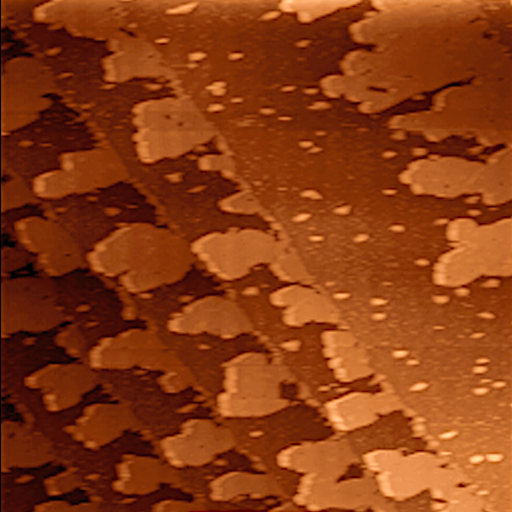
스캐닝 터널링 현미경은 개별 원자를 이미징할 수 있습니다.
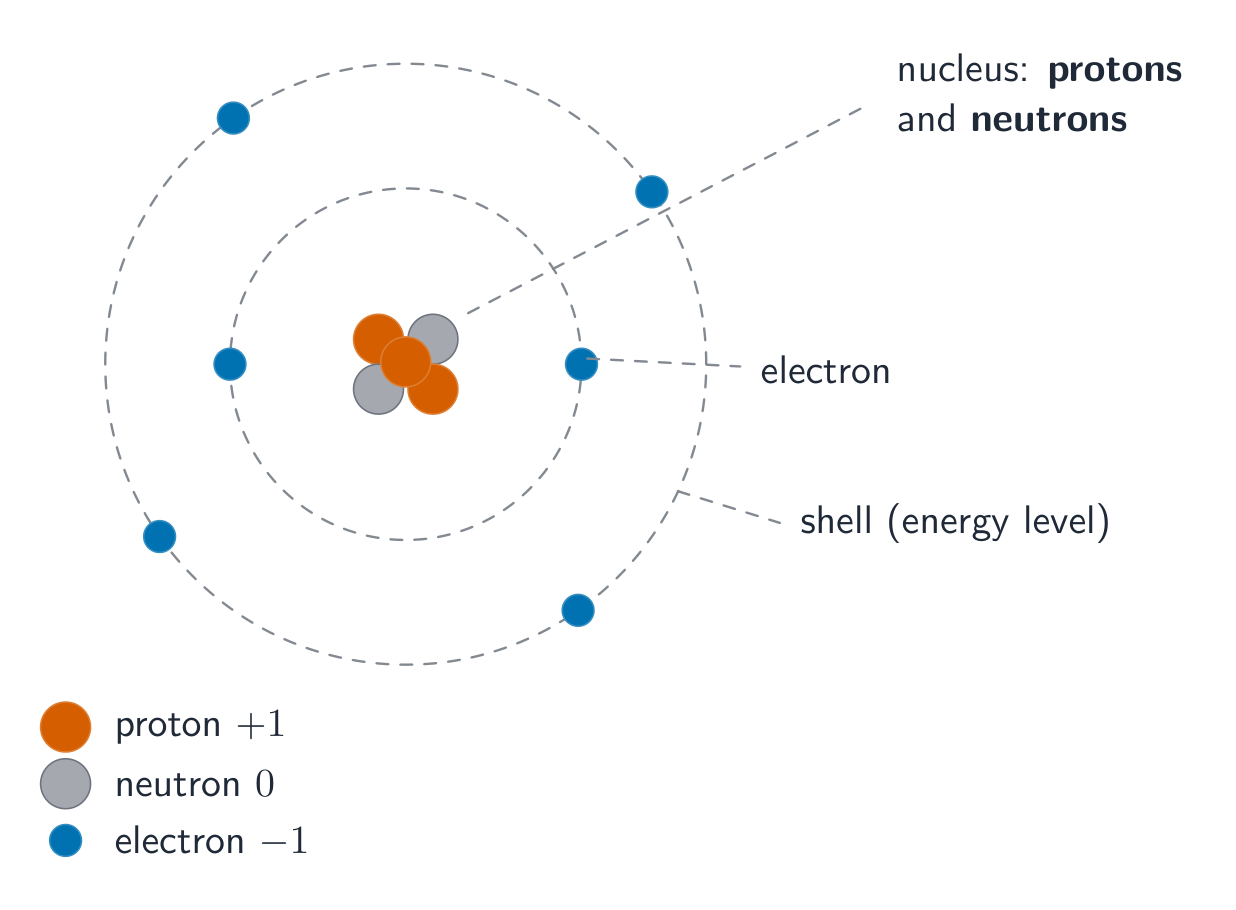
모든 것은 원자로 구성되어 있습니다. 원자는 대부분 빈 공간입니다. 중심에는 작고 무거운 **핵(nucleus)**이 있습니다. 핵은 두 종류의 입자를 포함합니다: **양성자(protons)**와 중성자(neutrons). 핵 주변의 빈 공간에서는 **전자(electrons)**가 움직입니다. 전자는 껍질(shells) 안에 머무르는데, 이는 핵으로부터 특정 거리에 있는 층입니다.
핵은 매우 작지만 질량의 거의 대부분을 차지합니다. 전자는 거의 모든 공간을 차지하지만 질량은 거의 없습니다.
원자는 대부분 빈 공간입니다: 양성자와 중성자는 작은 중앙 핵에 위치하며, 전자는 주변을 돌며 껍질을 형성함
상대 전하 및 상대 질량
우리는 세 입자를 상대 전하와 상대 질량을 통해 비교합니다. 이들은 실제 단위라기보다는 단순한 숫자입니다.
입자
상대 전하
상대 질량
양성자
$+1$
$1$
중성자
$0$
$1$
전자
$-1$
$\tfrac{1}{1836}$ (약 $0$)
양성자와 중성자는 거의 동일한 질량을 가집니다. 전자는 약 1836배 더 가볍습니다. 양성자는 양전하를, 전자는 음전하를 가지며, 중성자는 전하가 없어 **중성(neutral)**입니다.
원자 번호 및 핵자 번호
두 가지 숫자가 핵을 설명합니다:
원자 번호(또는 원자番号), 기호 $Z$ — 양성자의 개수입니다.
핵자 번호(또는 질량 번호), 기호 $A$ — 양성자와 중성자의 총개수입니다. 양성자와 중성자는 모두 **핵자(nucleons)**입니다.
따라서 중성자의 개수는 $A - Z$입니다.
원자 또는 이온의 입자 세기
중성 원자의 경우, 전자 수는 양성자 수와 같으며, 이는 $Z$과 같습니다.
**이온(ion)**은 전자를 잃거나 얻은 원자로, 전하를 띱니다:
양이온은 양성자보다 전자가 적습니다.
음이온은 양성자보다 전자가 많습니다.
예시: $^{27}_{13}\text{Al}^{3+}$은 $13$개의 양성자, $27 - 13 = 14$개의 중성자, 그리고 $13 - 3 = 10$개의 전자를 가집니다(이것은 $3+$가 되기 위해 전자 3개를 잃었습니다).
질량과 전하의 분포
양성자와 중성자는 무겁고 전자는 매우 가벼우므로, 거의 모든 질량은 핵에 집중되어 있습니다. 모든 양전하는 핵(양성자)에 있으며, 음전하는 껍질(전자)에 퍼져 있습니다.
전기장에서의 입자 빔
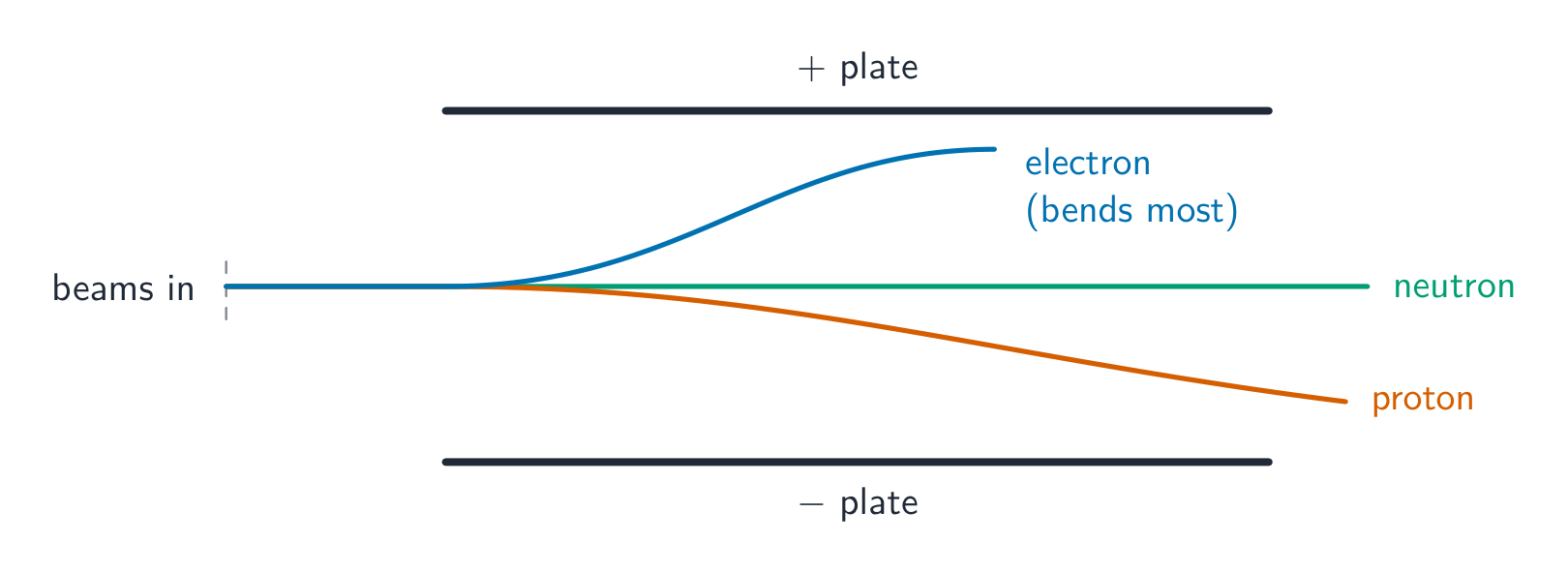
두 개의 충전된 판 사이의 전기장으로 동일한 속도로 이동하는 양성자, 중성자, 전자의 빔을 상상해 보십시오:
양성자 빔은 음전하 판 쪽으로 굽습니다(양성자는 양전하).
전자 빔은 반대 방향, 즉 양전하 판 쪽으로 굽습니다. 훨씬 더 크게 굽는데, 전자가 훨씬 가벼우기 때문입니다. 동일한 힘은 더 작은 질량에 더 큰 **편향(deflection)**을 유발합니다.
중성자 빔은 곧게 통과합니다. 전하가 없으므로 전기장에서 힘을 받지 않습니다.
전기장에서 양성자는 $-$ 판 쪽으로 굽고, 전자는 반대 방향으로 훨씬 더 많이 습니다(훨씬 가벼우므로); 중성자는 곧게 통과함
원자 반경 및 이온 반경
원자 반경은 원자의 크기를 뜻합니다. 이온 반경은 이온의 크기를 뜻합니다.
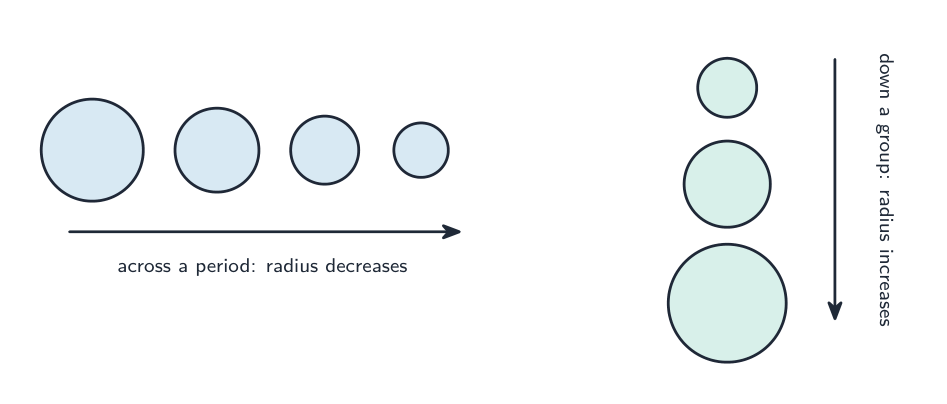
주期(period) 전체를 거칠 때(왼쪽에서 오른쪽으로), 원자 반경은 작아집니다. 핵전하(양성자에 의한 인력)는 증가하지만, 전자는 같은 바깥 껍질에 들어오므로 안쪽 껍질의 **차폐效应(shielding)**는 거의 일정합니다. 강한 인력은 바깥 껍질을 안쪽으로 당겨요.
족 (위에서 아래로) 이동할수록 원자 반지름은 커집니다. 아래로 내려갈 때마다 새로운 전자껍질이 추가되어 가장바깥쪽 전자가 핵으로부터 더 멀어지고, 핵의 정전하에 의한 차폐 효과를 더 많이 받기 때문입니다.
한 주기에서는 원자가 작아진다(같은 바깥껍질에 대한 핵의 인력이 강해지기 때문); 한 족에서는 원자가 커진다(매 단계마다 껍질이 하나씩 추가되기 때문)
이온에 대해:
양이온(양이온, cation)은 해당 원자보다 작다. 바깥껍질을 잃었으므로 남은 전자들은 각자 핵으로부터 더 강한 인력을 받는다.
음이온(음이온, anion)은 해당 원자보다 크다. 전자를 얻었으므로 전자들 사이에서 반발력이 더 커진다.
동일한 수의 전자를 가진 이온들 중에서는 양성자가 더 많은 쪽이 작다.
Explore · 탐색하기
Explore the atom · 원자 탐구
Tap each part. A tiny dense nucleus of protons and neutrons holds the mass; light electrons orbit it in shells. · 각 부분을 탭하십시오. 양성자와 중성자로 구성된 작고 밀도 높은 핵이 질량을 유지하며, 가벼운 전자들이 껍질에서 이를 돌고 있습니다.
Explore · 탐색하기
Atomic and ionic radius trends · 원자 반지름 및 이온 반지름의 경향
Atomic radius falls across a period (rising nuclear charge pulls the same shell in) and rises down a group (an extra shell each time). Step across Period 3 to see it. · 주기에 걸쳐 원자 반지름은 감소한다(상승하는 핵전하가 같은 껍질을 안쪽으로 당기기 때문에)하고, 족을 따라 내려갈수록 증가한다(매번 추가된 껍질 때문이다). 주기 3을 가로지르며 확인해 보라.
define the term isotope in terms of numbers of protons and neutrons
understand the notation $_y^x\text{A}$ for isotopes, where $x$ is the mass or nucleon number and $y$ is the atomic or proton number
state that and explain why isotopes of the same element have the same chemical properties
state that and explain why isotopes of the same element have different physical properties, limited to mass and density
한국어
동위원소의 정의를 양성자 및 중성자의 수를 통해 제시하시오
동위원소의 표기 $_y^x\text{A}$를 이해하시오. 여기서 $x$는 질량수 또는 핵자수이며, $y$는 원자수 또는 양성자수이다
같은 원소의 동위원소가 동일한 화학적 성질을 가지는 이유를 서술하고 설명하시오
같은 원소의 동위원소가 질량과 밀도에 제한된 물리적 성질이 다른 이유를 서술하고 설명하시오
Source: Cambridge International syllabus · 출처: Cambridge International syllabus
English
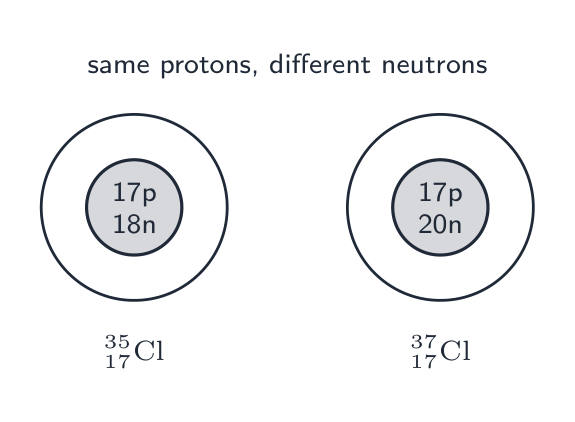
Isotopes 同位素 are atoms of the same element with the same number of protons but a different number of neutrons. So isotopes have the same proton number $Z$ but a different nucleon number $A$.
We write an isotope as $^{A}_{Z}\text{X}$: the nucleon number $A$ on top, the proton number $Z$ below. For example, chlorine has two main isotopes, $^{35}_{17}\text{Cl}$ and $^{37}_{17}\text{Cl}$.
Same chemical properties
Chemical properties 化学性质 depend on the electrons, especially the outer electrons. Isotopes of one element have the same number of electrons arranged in the same way. So they react in exactly the same way — they have the same chemical properties.
Different physical properties
Some physical properties 物理性质 depend on mass, so they differ between isotopes. A heavier isotope has more neutrons, so more mass, and therefore a higher density 密度. (The syllabus limits this difference to mass and density.)
한국어
동위원소는 같은 원소이면서 양성자 수는 같지만 중성자 수가 다른 원자들이다. 따라서 동위원소는 동일한 양성자 번호 $Z$를 가지지만, 다른 질량수 $A$를 가진다.
두 개의 염소 동위원소: 양성자는 같지만 중성자는 다름
동위원소를 $^{A}_{Z}\text{X}$: 형태로 표기한다. 위에는 질량수 $A$, 아래에는 양성자 번호 $Z$를 적는다. 예를 들어 염소에는 두 가지 주요 동위원소가 있으며,它们是$^{35}_{17}\text{Cl}$와 $^{37}_{17}\text{Cl}$이다.
동일한 화학적 성질
화학적 성질은 전자, 특히 바깥전자에 의해 결정된다. 하나의 원소의 동위원소들은 동일한 수의 전자를 가지고same 방식으로 배열되어 있다. 따라서 그들은 정확히 동일한 방식으로 반응하며, 동일한 화학적 성질을 가진다.
다른 물리적 성질
일부 물리적 성질은 질량에 의존하므로 동위원소之间 differs. 무거운 동위원소는 중성자가 더 많아 질량이 크므로, 따라서 더 높은 밀도를 가진다. (교과과정은 이 차이를 질량과 밀도에만 한정한다.)
Explore · 탐색하기
Isotope lab · 동위원소 실험실
Classify isotope facts by what changes and what stays the same. · 무엇이 변하고 무엇이 그대로 유지되는지에 따라 동위원소 사실을 분류하시오.
Electrons, energy levels and orbitals · 전자, 에너지 준위 및 오비탈
Syllabus
English
understand the terms: shells, sub-shells and orbitals; principal quantum number (n); ground state, limited to electronic configuration
describe the number of orbitals making up s, p and d sub-shells, and the number of electrons that can fill s, p and d sub-shells
describe the order of increasing energy of the sub-shells within the first three shells and the 4s and 4p sub-shells
describe the electronic configurations to include the number of electrons in each shell, sub-shell and orbital
explain the electronic configurations in terms of energy of the electrons and inter-electron repulsion
determine the electronic configuration of atoms and ions given the atomic or proton number and charge, using either of the following conventions: e.g. for Fe: $1\text{s}^2 2\text{s}^2 2\text{p}^6 3\text{s}^2 3\text{p}^6 3\text{d}^6 4\text{s}^2$ (full electronic configuration) or [Ar] $3\text{d}^6 4\text{s}^2$ (shorthand electronic configuration)
understand and use the electrons in boxes notation
describe and sketch the shapes of s and p orbitals
describe a free radical as a species with one or more unpaired electrons
한국어
용어 이해: 껍질, 하위 껍질 및 궤도함; 주 양자수(n); 기저 상태(전자 배치에 한정)
s, p, d 하위 껍질을 구성하는 궤도함의 수와 각 하위 껍질이 채울 수 있는 전자의 수를 설명
첫 세 개의 껍질 내 하위 껍질의 에너지 증가 순서 및 4s와 4p 하위 껍질의 에너지를 설명
각 껍질, 하위 껍질 및 궤도함에 있는 전자의 수를 포함하는 전자 배치를 서술
전자 에너지 및 전자-전자 반발에 근거하여 전자 배치를 설명
원자 번호 또는 양성자 번호와 전하를 주어 원자와 이온의 전자 배치를 결정. 다음 두 방식 중 하나 사용: 예시 Fe: $1\text{s}^2 2\text{s}^2 2\text{p}^6 3\text{s}^2 3\text{p}^6 3\text{d}^6 4\text{s}^2$ (전체 전자 배치) 또는 [Ar] $3\text{d}^6 4\text{s}^2$ (축약 전자 배치)
상자 속 전자 표기법을 이해하고 활용
s 및 p 궤도함의 모양을 서술하고 도식화
자유 라디칼을 한 개 이상의 짝지워지지 않은 전자를 가진 입자로 정의
Source: Cambridge International syllabus · 출처: Cambridge International syllabus
English
Electrons are arranged in shells, sub-shells and orbitals.
Shells and the principal quantum number
Each shell is labelled by the principal quantum number 主量子数$n = 1, 2, 3, \dots$ A larger $n$ means a shell that is further from the nucleus and higher in energy.
Sub-shells and orbitals
Each shell is split into sub-shells 亚层, named s, p and d. Each sub-shell is built from orbitals 轨道. An orbital is a small region that can hold up to two electrons.
Sub-shell
Number of orbitals
Maximum electrons
s
1
2
p
3
6
d
5
10
So an s sub-shell holds 2 electrons, a p sub-shell holds 6, and a d sub-shell holds 10.
Order of increasing energy
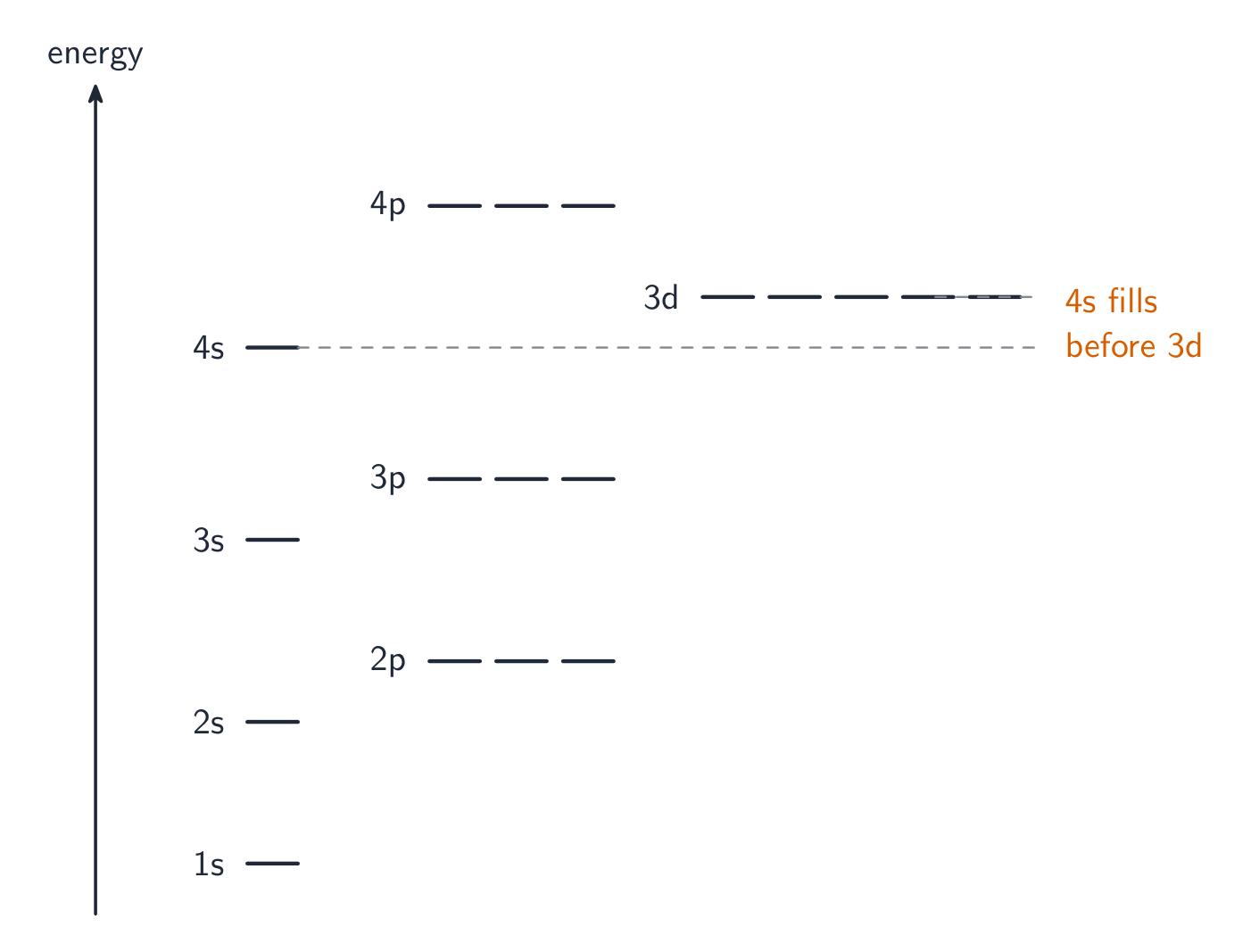
Electrons fill the lowest-energy sub-shell first. For the first three shells, plus 4s and 4p, the order of rising energy is:
You can write a shorthand using the nearest noble gas 稀有气体 in square brackets:
$$[\text{Ar}]\,3\text{d}^6\,4\text{s}^2$$
Here $[\text{Ar}]$ stands for the full configuration of argon.
For ions, you add or remove electrons. One key rule: when a transition metal forms a positive ion, it loses its 4s electrons before its 3d electrons. So $\text{Fe}^{3+}$ is $[\text{Ar}]\,3\text{d}^5$.
Electrons in boxes
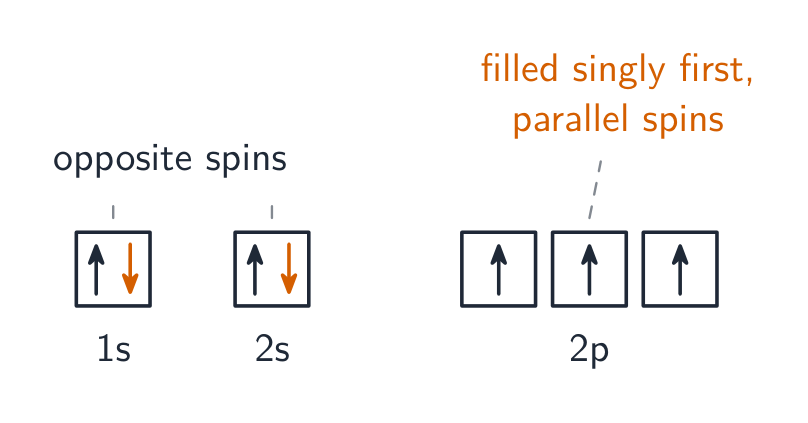
The electrons in boxes notation draws each orbital as a box and each electron as an arrow. Two electrons in the same orbital must point opposite ways, because each electron has a property called spin 自旋, and a shared orbital needs opposite spins.
Within a sub-shell, electrons fill empty orbitals one at a time, with parallel arrows, before any orbital gets a second electron. Spreading out like this keeps the electrons apart and lowers the repulsion between them.
Why the configuration takes this shape
Electrons fill from low energy to high energy because that gives the most stable (lowest-energy) atom. Within a sub-shell they spread out singly first to reduce the repulsion between the negative electrons.
Shapes of s and p orbitals
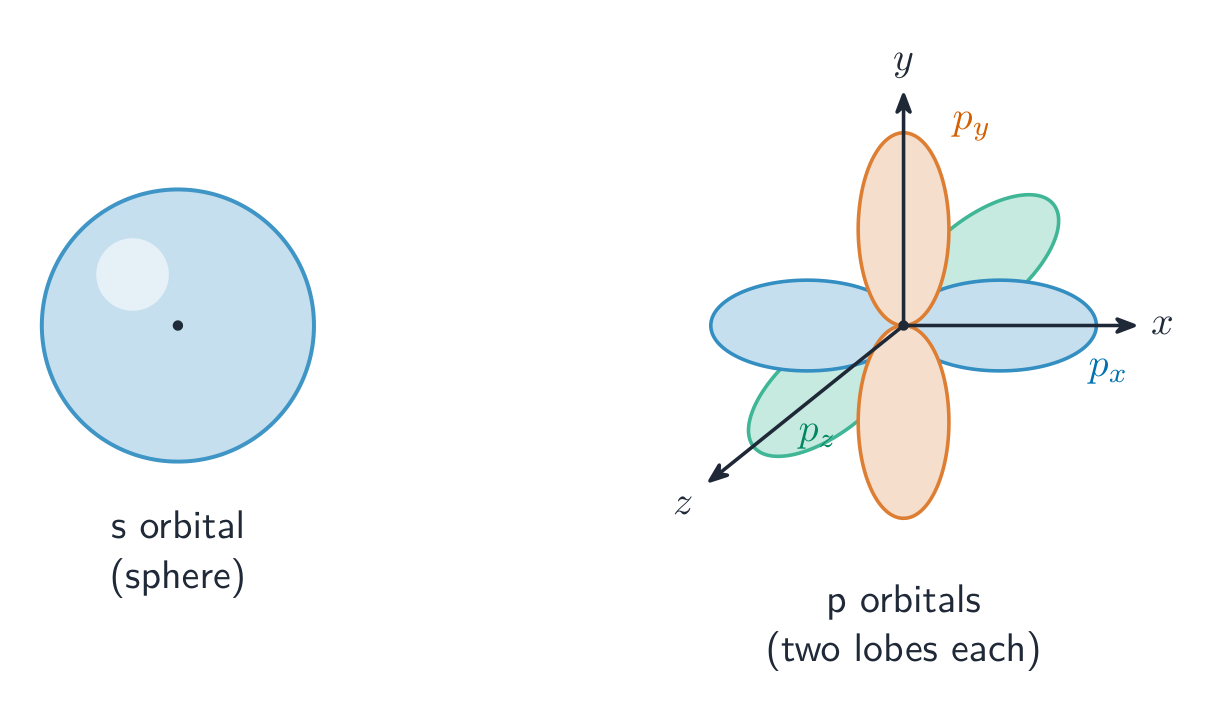
an s orbital is a sphere 球形 centred on the nucleus.
a p orbital has two lobes, like a dumbbell, pointing along one axis. The three p orbitals point along three directions at right angles (the $x$, $y$ and $z$ axes).
Free radicals
A free radical 自由基 is a species with one or more unpaired electrons 未成对电子. Free radicals are very reactive.
한국어
수소는 특정 파장에서만 빛을 방출한다 — 이를 선형 방출 스펙트럼이라 한다.
전자들은 껍질, 서브껍질, 오비탈에 배열된다.
껍질과 주양자수
각 껍질은 주양자수$n = 1, 2, 3, \dots$로 명명된다. 더 큰 $n$는 핵으로부터 더 멀고 에너지가 높은 껍질을 의미한다.
서브껍질과 오비탈
각 껍질은 s, p, d로 이름 붙여진 서브껍질로 나뉜다. 각 서브껍질은 오비탈로 구성된다. 오비탈은 최대 2개의 전자를 수용할 수 있는 작은 영역이다.
서브껍질
오비탈 수
최대 전자 수
s
1
2
p
3
6
d
5
10
따라서 s 서브껍질은 전자 2개를, p 서브껍질은 6개를, d 서브껍질은 10개를 수용한다.
에너지 증가 순서
전자는 가장 낮은 에너지의 서브껍질부터 채워진다. 첫 세 개의 껍질과 4s, 4p에 대해 에너지가 상승하는 순서는 다음과 같다:
이온의 경우 전자를 추가하거나 제거한다. 중요한 규칙 하나: 전이금속이 양이온을 형성할 때, 4s 전자를 3d 전자 앞에 잃는다. 따라서 $\text{Fe}^{3+}$은 $[\text{Ar}]\,3\text{d}^5$이다.
상자 속 전자
상자 속 전자 표기는 각 오비탈을 상자로, 각 전자를 화살표로 그린다. 같은 오비탈의 두 전자는 서로 반대 방향을 향해야 하는데, 이는 각 전자가 스핀이라는 성질을 가지며, 하나의 오비탈은 서로 다른 스핀을 가져야 하기 때문이다.
서브껍질 내에서 전자는 어떤 오비탈에도 두 번째 전자가 들어가기 전에 비어 있는 오비탈을 하나씩 채우며, 이때 평행 화살표를 사용한다. 이렇게 퍼져 있음으로써 전자들이 서로 멀리 떨어져 있고, 전자 간의 반발력을 낮춘다.
질소에 대한 상자 속 전자($1\text{s}^2\,2\text{s}^2\,2\text{p}^3$): 짝을 이루는 전자는 반대 방향을 향하고, 2p 오비탈은 단일 전자를 채우며 평행 스핀을 가진다
전자배치가 이러한 형태를 띠는 이유
전자는 가장 안정된(최저 에너지) 원자가 되려면 낮은 에너지에서 높은 에너지로 채워진다. 서브껍질 내에서는 음전하를 가진 전자 간의 반발력을 줄이기 위해 먼저 단일 전자로 퍼져 배치된다.
s 및 p 오비탈의 모양
s 오비탈은 핵을 중심으로 하는 구체이다.
p 오비탈은 한 축을 따라 향하는 아령 모양으로 두 개의 엽(lobe)을 가진다. 세 개의 p 오비탈은 서로 직각인 세 방향($x$, $y$ 및 $z$ 축)을 따라 향한다.
s 오비탈은 구체이며, 각 p 오비탈은 아령 모양이고, 세 개의 p 오비탈은 $x$, $y$ 및 $z$ 축을 따라 향한다
자유 라디칼
자유 라디칼은 하나 이상의 **짝을 이루지 않은 전자(unpaired electrons)**를 가진 종이다. 자유 라디칼은 매우 반응성이 크다.
Explore · 탐색하기
Filling the electron shells · 전자 껍질 채우기
Change the atomic number Z and watch the electrons fill the shells (2, 8, 8, …) — the pattern that builds the Periodic Table. · 원자 번호 Z를 변경하면 전자들이 껍질을 채우는 과정(2, 8, 8, …)을 볼 수 있습니다—이는 주기율표를 구성하는 패턴입니다.
define and use the term first ionisation energy, IE
construct equations to represent first, second and subsequent ionisation energies
identify and explain the trends in ionisation energies across a period and down a group of the Periodic Table
identify and explain the variation in successive ionisation energies of an element
understand that ionisation energies are due to the attraction between the nucleus and the outer electron
explain the factors influencing the ionisation energies of elements in terms of nuclear charge, atomic/ionic radius, shielding by inner shells and sub-shells and spin-pair repulsion
deduce the electronic configurations of elements using successive ionisation energy data
deduce the position of an element in the Periodic Table using successive ionisation energy data
한국어
용어 첫 번째 이온화 에너지, IE를 정의하고 활용
첫 번째, 두 번째 및 이후 이온화 에너지를 나타내는 화학 방정식을 작성
주기율표에서 주기와 족에 따른 이온화 에너지의 경향을 식별하고 설명
특정 원소의 연속적인 이온화 에너지 변화가 나타나는 이유를 식별하고 설명
이온화 에너지는 핵과 바깥쪽 전자 사이의 인력에 기인함을 이해
핵 전하, 원자/이온 반지름, 내부 껍질 및 하위 껍질의 차폐 효과 및 스핀 쌍 반발에 영향을 미치는 요인을 고려하여 원소들의 이온화 에너지를 설명
연속적인 이온화 에너지 데이터를 사용하여 원소의 전자 배치를 유추
연속적인 이온화 에너지 데이터를 사용하여 원소가 주기율표에 위치하는 곳을 유추
Source: Cambridge International syllabus · 출처: Cambridge International syllabus
English
First ionisation energy
The first ionisation energy 第一电离能 (IE) is the energy needed to remove one electron from each atom in one mole of gaseous atoms, forming one mole of gaseous $+1$ ions.
We use gaseous atoms so there are no forces between the particles. The unit is $\text{kJ mol}^{-1}$. As an equation, for an element X:
You can keep going. These are the successive ionisation energies 逐级电离能. Each is larger than the one before, because every electron is pulled away from a more positive ion.
What ionisation energy depends on
Ionisation energy comes from the attraction between the positive nucleus and the outer electron. Three main factors set how strong that attraction is:
nuclear charge: more protons pull the electrons more strongly, so the ionisation energy is higher.
atomic radius: the further the outer electron sits from the nucleus, the weaker the pull, so the ionisation energy is lower.
shielding: inner shells block some of the pull on the outer electron. More inner shells mean more shielding and a lower ionisation energy.
There is a smaller effect too — spin-pair repulsion 自旋成对排斥. When two electrons share one orbital, they push each other a little, so one is easier to remove.
Trends in first ionisation energy
Across a period, the first ionisation energy generally rises. The nuclear charge grows while shielding stays about the same, so the outer electrons are held more tightly.
Down a group, the first ionisation energy falls. Lower elements have more shells, so more shielding and a larger radius, and the outer electron is easier to remove.
The dips are evidence for sub-shells
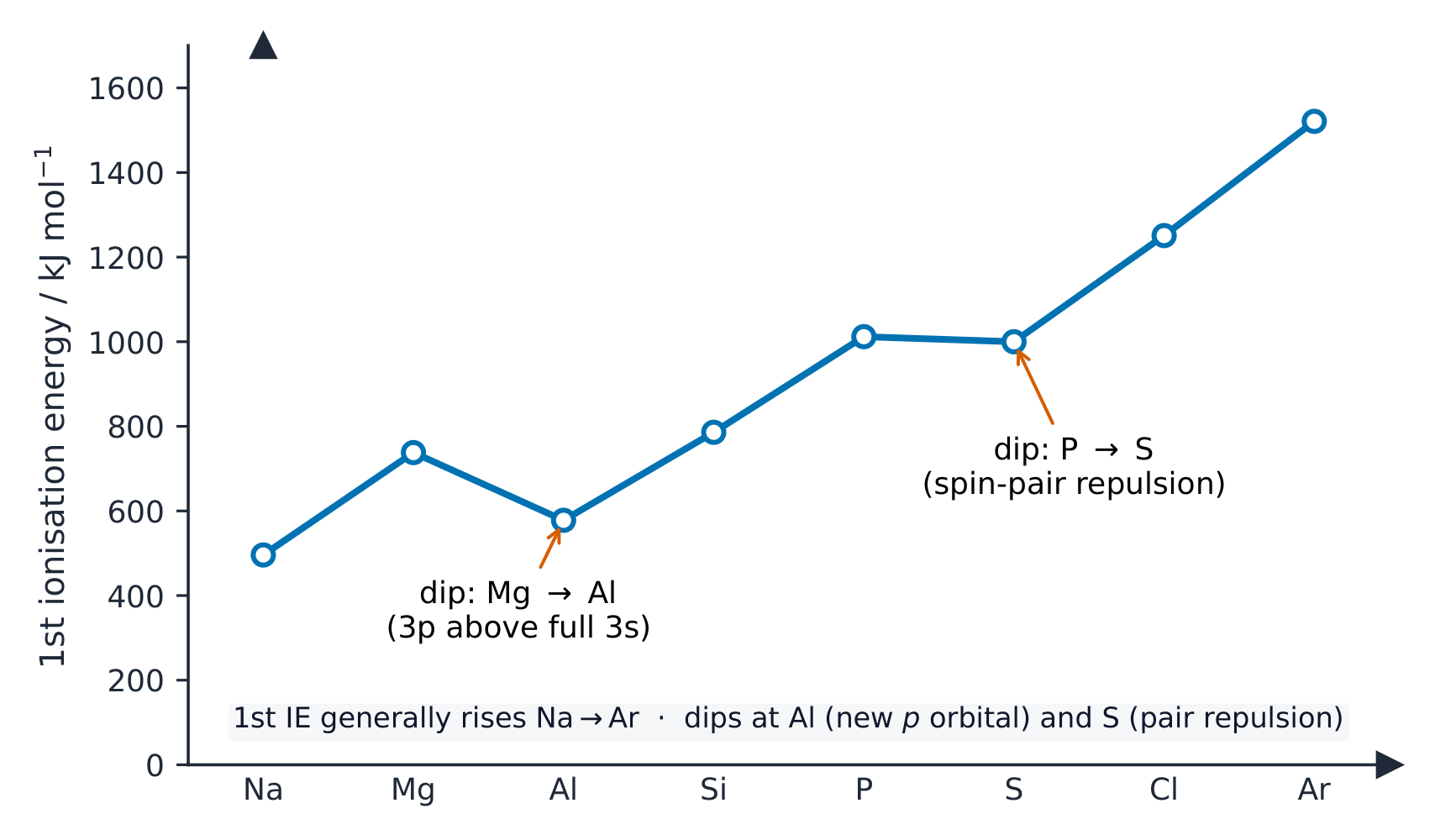
The rise across a period is not smooth. Two small dips appear, and you should be able to explain both:
Group 2 to Group 13 (for example Mg to Al): the electron removed from Al comes from a 3p sub-shell, which is higher in energy than the full 3s sub-shell in Mg. A 3p electron is easier to remove, so the value dips.
Group 15 to Group 16 (for example P to S): in S, one 3p orbital now holds a pair of electrons. Spin-pair repulsion makes one of them easier to remove, so the value dips.
These dips are evidence that sub-shells exist.
Successive ionisation energies are evidence for shells
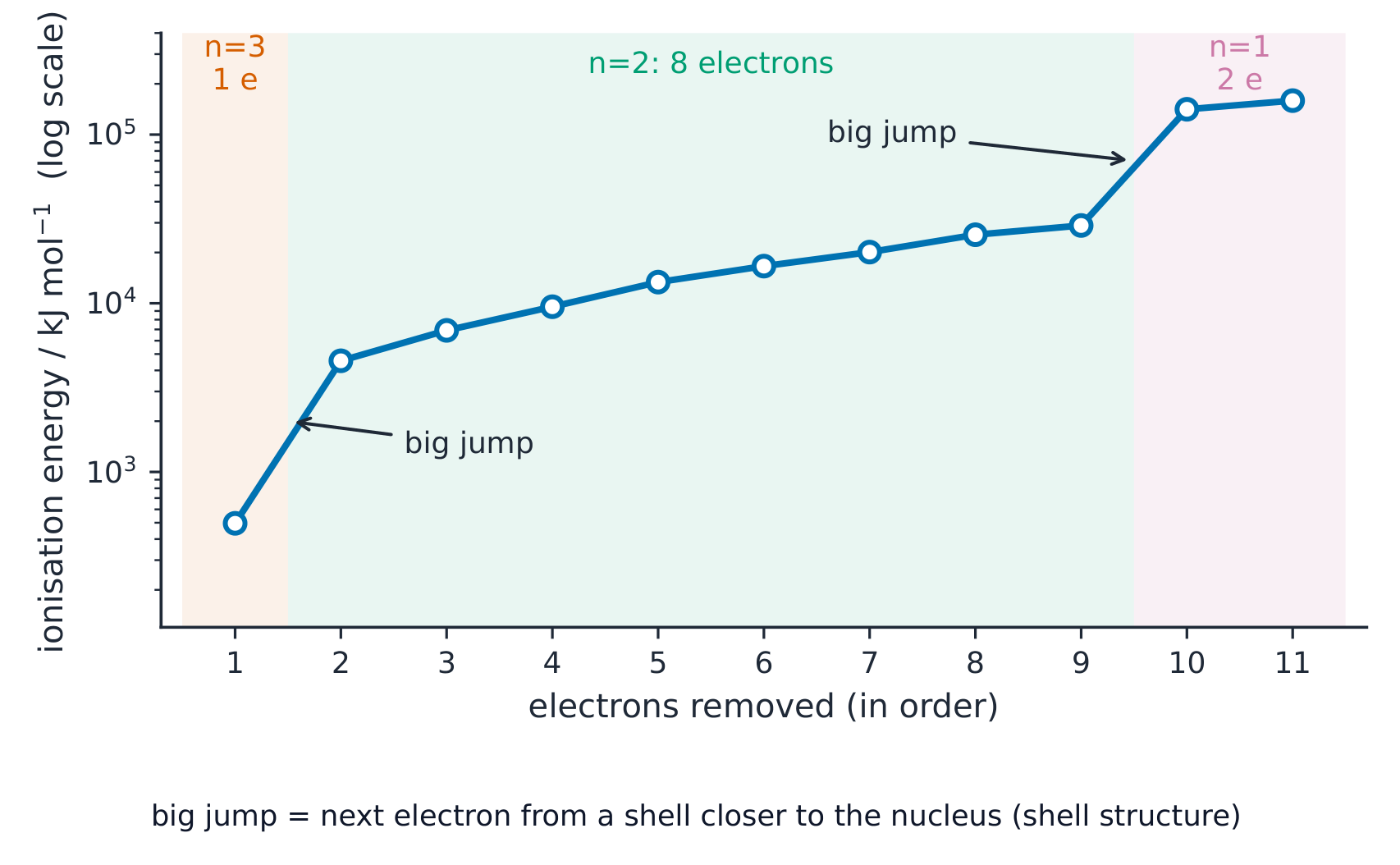
If you plot the successive ionisation energies of one element, the values rise, with big jumps at certain points. A big jump happens when the next electron must come from a shell closer to the nucleus.
Count how many electrons come off easily before the first big jump — that is the number of electrons in the outer shell, which tells you the group the element is in. You can also use the pattern to work out the electronic configuration and the position of the element in the Periodic Table.
Electrons removed before the first big jump
Group
1
Group 1
2
Group 2
3
Group 13
Worked example. The first five successive ionisation energies of an element are $590$, $1150$, $4940$, $6480$ and $8120\ \text{kJ}\,\text{mol}^{-1}$. Which group is it in? Look for the big jump, not the biggest number. From the 1st to the 2nd the value roughly doubles, which is a normal rise. From the 2nd ($1150$) to the 3rd ($4940$) it more than quadruples: that is the jump. So two electrons come off easily before it, the outer shell holds 2 electrons, and the element is in Group 2. Count the electrons removed before the jump, and explain the jump properly: the next electron is being pulled from a shell closer to the nucleus, not from a different element.
한국어
첫 전이 에너지
제1이온화 에너지(IE)는 기체 원자 1몰의 각 원자에서 전자 하나를 제거하여 기체 $+1$ 이온 1몰을 생성하는 데 필요한 에너지입니다.
기체 원자를 사용하므로 입자 간에는 힘 작용이 없습니다. 단위는 $\text{kJ mol}^{-1}$입니다. 수식으로 표현하면, 원소 X에 대해 다음과 같습니다:
계속 진행할 수 있습니다. 이것이 바로 연속 이온화 에너지입니다. 모든 전자가 더 양전하가 많은 이온으로부터 끌어당겨지므로, 값은 매번 이전보다 커집니다.
이온화 에너지를 결정하는 요인
이온화 에너지는 양의 핵과 바깥쪽 전자 사이의 인력에서 비롯됩니다. 그 인력의 세기를 결정하는 주요 요인은 다음 세 가지입니다:
원자핵의 전하: 양성자가 많을수록 전자를 더 강하게 끌어당기므로 이온화 에너지가 높습니다.
원자 반경: 바깥쪽 전자가 핵에서 멀어질수록 인력이 약해지므로 이온화 에너지는 낮아집니다.
차폐 효과: 안쪽 껍질이 바깥쪽 전자로 가는 인력을 일부 차단합니다. 안쪽 껍질의 수가 많아질수록 차폐 효과가 커지고, 이는 이온화 에너지를 낮춥니다.
더 작은 영향도 존재하는데, 그것이 바로 스핀 짝 반발입니다. 두 전자가 하나의 오비탈을 공유할 때 서로 약간 밀어내므로,其中一个 전자는 쉽게 제거됩니다.
첫 번째 이온화 에너지의 경향
주기가横跨(横: across)할 때, 첫 번째 이온화 에너지는 일반적으로 상승합니다. 원자핵의 전하가 증가하지만 차폐 효과는 거의 변하지 않으므로 바깥쪽 전자가 더 단단히 묶여 있습니다.
족이 아래로 내려갈 때, 첫 번째 이온화 에너지는 하락합니다. 아래쪽 원소는 껍질의 수가 많아 차폐 효과가 커지고 원자 반경이 커지며, 바깥쪽 전자가 더 쉽게 제거됩니다.
물결 모양의 감소는 아오비탈 존재의 증거입니다
주기에 따른 상승은 매끄럽게 이루어지지 않습니다. 두 개의 작은 감소가 나타나며, 이를 모두 설명할 수 있어야 합니다:
2족에서 13족으로 (예: Mg에서 Al): Al에서 제거되는 전자는 3p 아오비탈에서 come(나옴), 이는 Mg의 채워진 3s 아오비탈보다 에너지가 높습니다. 3p 전자는 제거하기 쉬우므로 값이 떨어집니다.
15족에서 16족으로 (예: P에서 S): S에서는 한 개의 3p 오비탈에 이제 전자 쌍이 들어갑니다. 스핀 짝 반발로 인해其中一个 전자는 제거하기 쉬워지므로 값이 떨어집니다.
이러한 감소는 아오비탈이 존재한다는 증거입니다.
첫 번째 이온화 에너지는 제3주기에 걸쳐 상승하지만 Al과 S에서 감소함 — 아오비탈 존재의 증거
연속 이온화 에너지는 껍질 존재의 증거입니다
한 원소의 연속 이온화 에너리를 그래프로 그려보면, 값은 상승하며 특정 지점에서 큰 점프가 발생합니다. 큰 점프는 다음 전자가 핵에 더 가까운 껍질에서要来(나옴)해야 할 때 발생합니다.
첫 번째 큰 점프 전에 쉽게 제거되는 전자의 개수를 세면, 그것은 바깥 껍질의 전자 수이며, 이는 해당 원소가 속한 족을 알려줍니다. 또한 이 패턴을 통해 전자 배치를 구하고 주기율표에서의 위치를 파악할 수도 있습니다.
나트륨의 연속 이온화 에너지(로그 스케일): 큰 점프가 $2,8,1$ 껍질 구조를 드러낸다
첫 번째 큰 점프 전에 제거된 전자 수
족
1
1족
2
2족
3
13족
풀이 예시. 한 원소의 첫 다섯 번 연속 이온화 에너지가 $590$, $1150$, $4940$, $6480$, $8120\ \text{kJ}\,\text{mol}^{-1}$일 때, 이 원소는 어떤族에 속합니까? 가장 큰 숫자가 아니라 큰 점프를 찾으십시오. 1번째에서 2번째로 넘어갈 때 값이 대략 두 배가 되는데, 이는 정상적인 상승입니다. 그러나 2번째($1150$)에서 3번째($4940$)로 넘어갈 때는 네 배 이상 증가합니다: 이것이 점프입니다. 따라서 점프 전에 두 전자가 쉽게 제거되고, 바깥 질에는 2개의 전자가 있으며, 해당 원소는 2족에 속합니다. 점프 before에 제거된 전자를 세고, 점프를 적절히 설명하십시오: 다음 전자는 다른 원소에서가 아니라 핵에 더 가까운 껍질에서 끌어당겨지는 것입니다.
Explore · 탐색하기
The ionisation-energy trend — and its dips · 이온화 에너지의 경향과 그 감소점
First ionisation energy generally rises across a period, but DIPS where a new p sub-shell starts and where a p-orbital pair first forms. Step across to find the two tell-tale dips. · 첫 번째 이온화 에너지는 일반적으로 주기에 걸쳐 증가하지만, 새로운 p 아날트가 시작되고 p 오비탈 쌍이 처음 형성되는 지점에서 감소를 보입니다. 두 가지 특징적인 감소점을 찾아보려면 주기를 넘어가십시오.
Define isotopes in full: atoms of the same element with the same number of protons but a different number of neutrons — the mark scheme wants both halves.
4s fills before 3d, but electrons are removed from 4s first when forming ions, so $\text{Fe}^{3+}$ is $[\text{Ar}]3\text{d}^5$ (not $[\text{Ar}]3\text{d}^3 4\text{s}^2$).
In successive ionisation energies, a big jump marks the start of a new (inner) shell — use the jumps to place the element in its group.
Explain every ionisation-energy trend with the same three factors: nuclear charge, distance and shielding, plus sub-shell effects for the small dips.
Learn the exact reason first ionisation energy of oxygen is below nitrogen: oxygen's paired 2p electrons repel, so one is easier to remove.
한국어
동위원소를 정확히 정의하시오: 같은 원소이지만 양성자 수는 같으나 중성자 수가 다른 원자 — 평가 기준은 두 부분 모두 포함합니다.
4은 3보다 먼저 채워지지만, 이온 형성 시 전자는 4s에서 먼저 제거되므로 $\text{Fe}^{3+}$은 $[\text{Ar}]3\text{d}^5$($[\text{Ar}]3\text{d}^3 4\text{s}^2$가 아님)입니다.
연속 이온화 에너지에서 큰 점프는 새로운(안쪽) 껍질의 시작을 표시하므로, 점프를 활용하여 원소를 족에 배치하십시오.
모든 이온화 에너지 경향을 동일한 세 가지 요인인 원자핵의 전하, 거리, 차폐 효과로 설명하되, 작은 감소에 대해서는 아오비탈 효과를 추가하십시오.
산소의 첫 번째 이온화 에너지가 질소보다 낮은 정확한 이유를 먼저 암기하십시오: 산소의 짝지어진 2p 전자들이 반발하므로其中一个 전자는 제거하기 쉽습니다.
Interactive lessons on this topic · 이 주제에 대한 인터랙티브 수업
Work through it step by step, with instant-check exercises. · 즉시 체크 기능 exercises를 통해 단계별로 진행하세요.