
Nuclear physics
The nucleus is about a hundred-thousandth of the atom's width yet holds nearly all its mass — and unstable nuclei pour out energy as radiation, fission fragments, or the fusion that lights the stars. OxfordAQA's seventh topic covers the nuclear model, the three radiations, half-life, contamination versus irradiation, reactors and (P) fusion.
OxfordAQA International GCSE Physics 9203, topic 3.7 (Version 5.1). Statements marked (P) are Paper-2-only.
Atomic structure
An atom is about 10⁻¹⁰ m across: a tiny positive nucleus (protons and neutrons, nearly all the mass) with electrons around it — Rutherford's alpha-scattering evidence for the concentrated nucleus. Proton mass 1 charge +1; neutron mass 1 charge 0; electron charge −1, negligible mass. A neutral atom has equal protons and electrons; atoms lose or gain electrons to become ions.
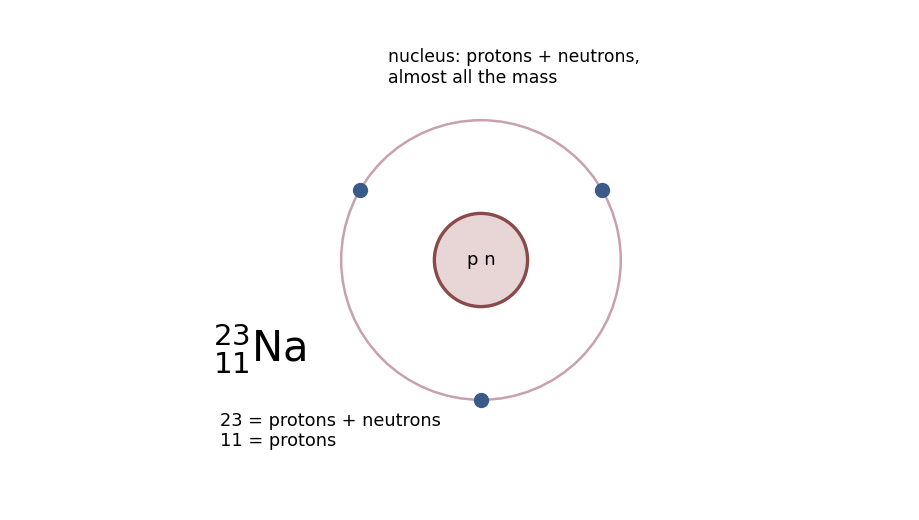
${}^{A}_{Z}X$: A = mass number (protons + neutrons), Z = proton number; isotopes share Z and differ in neutrons.
Ionising radiation from the nucleus
Unstable nuclei decay randomly, unaffected by chemistry or physics, emitting:
| Radiation | Nature | Ionising | Range in air |
|---|---|---|---|
| alpha | 2p + 2n (helium nucleus) | strongest | a few cm |
| beta-minus | fast electron (neutron → proton) | medium | tens of cm |
| gamma | electromagnetic wave | weakest | metres |
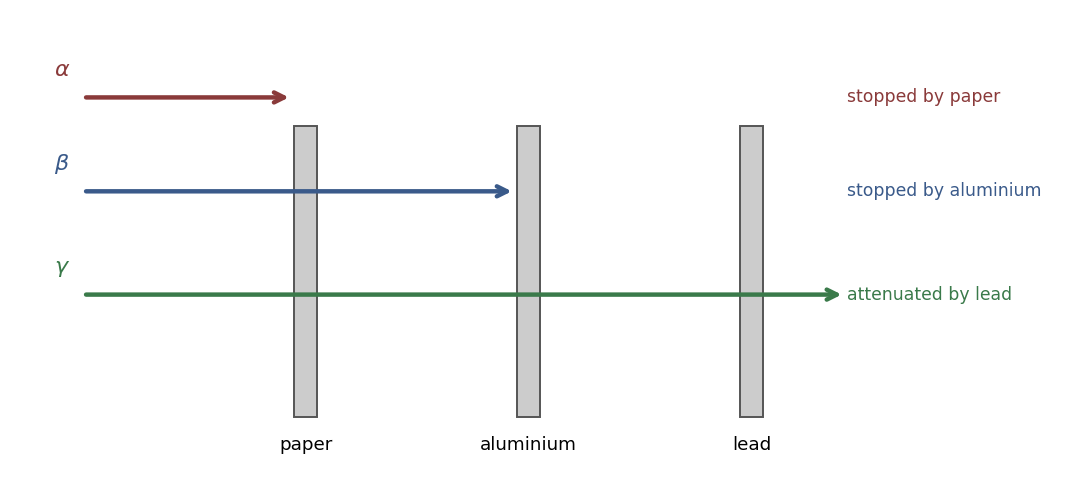
Nuclear equations conserve mass number and charge: ${}^{238}_{92}U \rightarrow\, {}^{234}_{90}Th +\, {}^{4}_{2}He$ (alpha); ${}^{14}_{6}C \rightarrow\, {}^{14}_{7}N +\, {}^{0}_{-1}e$ (beta). Background radiation comes from rocks, space, food and medical devices. (P) The half-life 半衰期 is the time for the expected undecayed population or source activity to halve. With fixed detector geometry and efficiency, the background-corrected count rate halves on average over the same time; half-lives span a very wide range. Contamination 沾污 means unwanted radioactive material on or inside an object or person; the hazard can remain until it is removed, cleared or decayed. Irradiation 照射 means exposure to radiation without transferring radioactive material in these source-exposure examples. Dangers: mutations, cell and tissue damage.
Worked example (filling the gaps). Polonium-210 emits an alpha particle: $^{210}_{84}\text{Po} \rightarrow {}^{A}_{Z}\text{Pb} + {}^{4}_{2}\text{He}$. Top numbers: $210 = A + 4$, so $A = 206$. Bottom numbers: $84 = Z + 2$, so $Z = 82$. The product is $^{206}_{82}$Pb.
Worked example (P) (half-life). A sample's count rate falls from 1200 to 150 counts per minute in 15 hours (background already subtracted). $1200 \to 600 \to 300 \to 150$ is three half-lives, so the half-life is $15 \div 3 = 5.0$ hours. After one more half-life, 75 counts per minute are left; after four half-lives in total, $\tfrac{1}{16}$ of the original activity.

Nuclear fission and (P) fusion
Fission 裂变 splits a large unstable nucleus: U-235 or Pu-239 absorbs a neutron, splits into two smaller nuclei with 2–3 neutrons and far more energy than any chemical reaction. Neutrons striking further nuclei give a chain reaction; in a reactor control rods absorb neutrons so that, on average, only one neutron from each fission goes on to cause another fission.

Radioactive waste stays dangerous for times set by its half-life — a managed-disposal cost of nuclear power. (P) Fusion 聚变 joins two light nuclei into a heavier one, converting mass to energy: it powers the stars, but positive nuclei repel, so it needs extreme temperature and pressure.
Common mistakes
- Saying a beta particle comes from the electron shells. It is made in the nucleus as a neutron turns into a proton, so Z goes up by 1.
- Changing the mass number in beta or gamma decay. Only alpha decay changes it (down by 4).
- (P) Thinking two half-lives remove the whole sample. After two half-lives a quarter is left.
- Forgetting to subtract the background count before finding a half-life.
- Saying gamma is the most dangerous inside the body. Alpha is the most ionising, so it does the most damage inside the body; outside, it cannot pass the skin.
- Thinking an irradiated object becomes radioactive. Only contamination leaves radioactive atoms behind.
- Saying control rods slow neutrons down. They absorb neutrons to control the rate of the chain reaction.
Check yourself
- Give the relative masses and charges of the proton, neutron and electron.
- In ${}^{19}_{9}F$, how many protons and neutrons?
- What did alpha scattering reveal about the atom?
- Name the three radiations and their natures.
- Which radiation is stopped by paper, and which penetrates aluminium?
- Balance the alpha decay of ${}^{226}_{88}Ra$.
- (P) Define half-life.
- (P) Explain the difference between contamination and irradiation.
- What do control rods do in a reactor?
- (P) Why does fusion need extreme temperatures?
Answers: 1 proton 1, +1; neutron 1, 0; electron ~0, −1; 2 9 protons, 10 neutrons; 3 mass and charge sit in a tiny nucleus — most alphas pass, a few bounce; 4 alpha = He nucleus; beta = fast electron; gamma = EM wave; 5 alpha; gamma (thick lead); 6 ${}^{226}_{88}Ra \rightarrow\, {}^{222}_{86}Rn +\, {}^{4}_{2}He$; 7 (P) the time for the expected undecayed population or source activity to halve; a fixed detector has the same half-life for its background-corrected count rate; 8 (P) contamination — unwanted radioactive material on or inside you, which can remain until removed, cleared or decayed; irradiation — exposure without material transfer in these examples, ending when the source is removed or shielded; 9 absorb neutrons, so that on average one neutron from each fission causes one further fission and the chain reaction stays steady; 10 (P) positive nuclei repel, so they must collide very fast.