
Forces and their effects
Every push, pull and hold in the world is a force — and OxfordAQA's first topic organises them: contact and non-contact interactions, scalars against vectors, Newton's three laws, vehicle safety, and the P-extension ideas of momentum, terminal velocity, centre of mass and moments.
OxfordAQA International GCSE Physics 9203, topic 3.1 (Version 5.1, exams 2018 onwards). Statements marked (P) are Paper-2-only; paper details are in the specification's scheme of assessment. The specimen components on file are 9203-92031 and 9203-92032 — specimen practice in this package is always labelled as such.
Forces and their interactions
Objects interact by non-contact field forces (gravity, electrostatics, magnetism) and contact forces (friction, air resistance, tension, normal contact force). Friction 摩擦 acts between two surfaces, impedes motion and may heat them; air resistance is friction with a fluid.
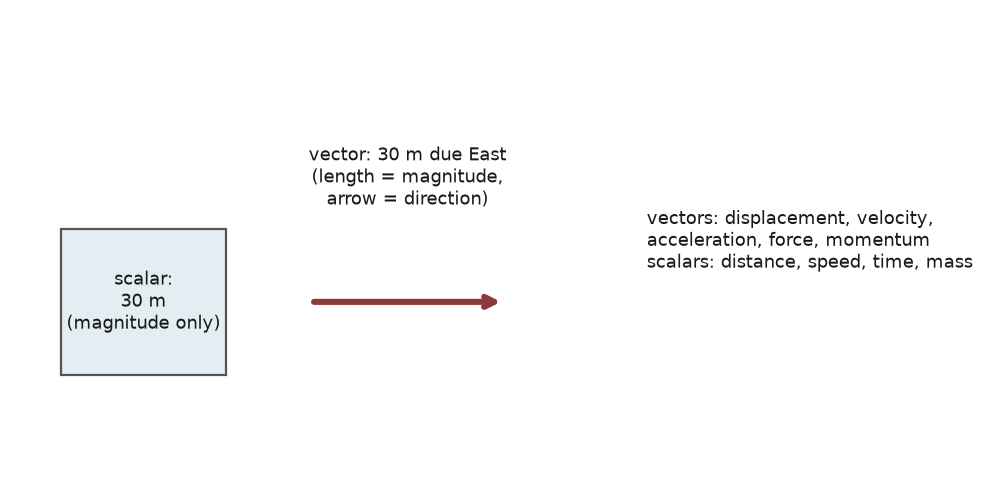
Scalars 标量 have magnitude only (distance, speed, time); vectors 矢量 add direction (displacement, velocity, acceleration, force, momentum) and can be drawn as arrows. Weight is the force of gravity: $W = m \times g$.
Forces can change shape — stretching, bending, compressing. Elastic distortions recover; inelastic ones do not (P). A stretched spring stores elastic potential energy, and below the limit of proportionality:
Required practical: investigate force against extension for a spring (hang masses, plot the line, gradient = k).
Worked example (spring constant). A spring is 12.0 cm long with no load and 15.0 cm long with a 3.0 N load. The extension is $15.0 - 12.0 = 3.0$ cm $= 0.030$ m, so $k = F/e = 3.0 \div 0.030 = 100$ N/m. With a 5.0 N load (still below the limit of proportionality) $e = 5.0 \div 100 = 0.050$ m, so the spring is $12.0 + 5.0 = 17.0$ cm long.
Motion and Newton's laws
Speed is the gradient of a distance–time graph; velocity adds direction: $v = s/t$ (usable for average speeds too). Acceleration is the rate of change of velocity: $a = \Delta v/t$ — from the gradient of a velocity–time graph, whose area gives distance travelled. Changing direction at constant speed is still acceleration.
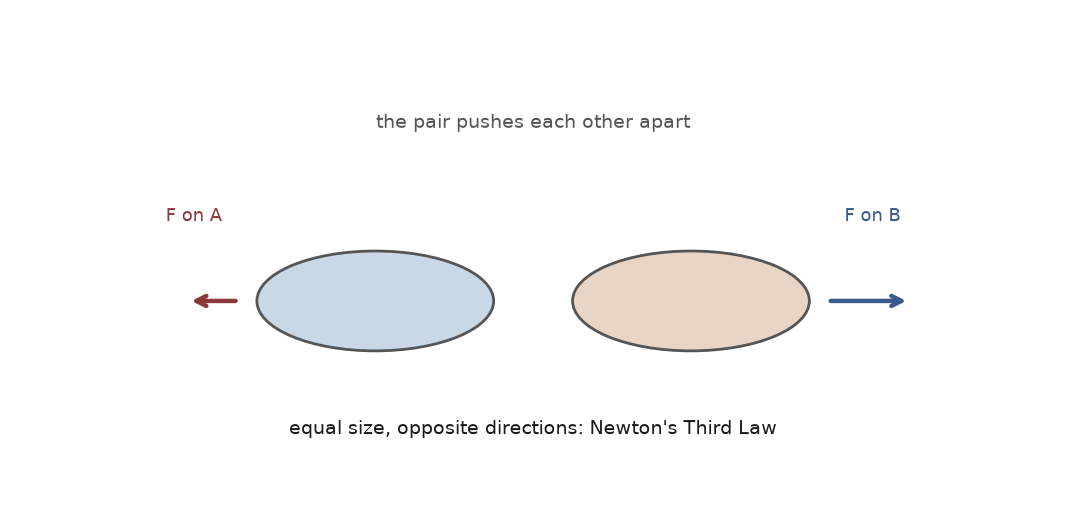
- Newton's First Law: zero resultant force → rest stays rest, motion keeps its velocity.
- Newton's Second Law: $F = m \times a$ in the direction of the resultant.
- Newton's Third Law: interacting objects exert equal, opposite forces on each other.
Resultants: opposite or parallel forces add along a line; two coplanar forces combine by scale drawing (drawn to scale, head to tail).
Worked example (resultant force and $F = ma$). A 1200 kg car has a driving force of 3000 N forwards and resistive forces of 600 N backwards. Draw the two arrows on the car first. The resultant is $3000 - 600 = 2400$ N forwards, so $a = F/m = 2400 \div 1200 = 2.0$ m/s². Later the car moves at a steady speed with the same driving force: the resistive forces must now be 3000 N, because the resultant is zero.
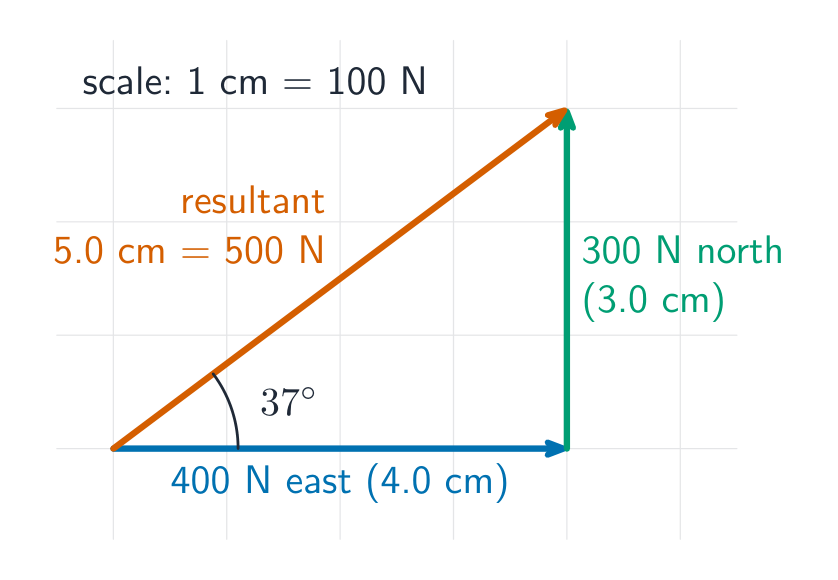
Worked example (scale drawing). A boat's engine pushes it east with 400 N while the wind pushes it north with 300 N. With a scale of 1 cm = 100 N, draw 4.0 cm east, then 3.0 cm north from the head of the first arrow. The resultant arrow measures 5.0 cm, so it is 500 N; a protractor gives 37° north of east.
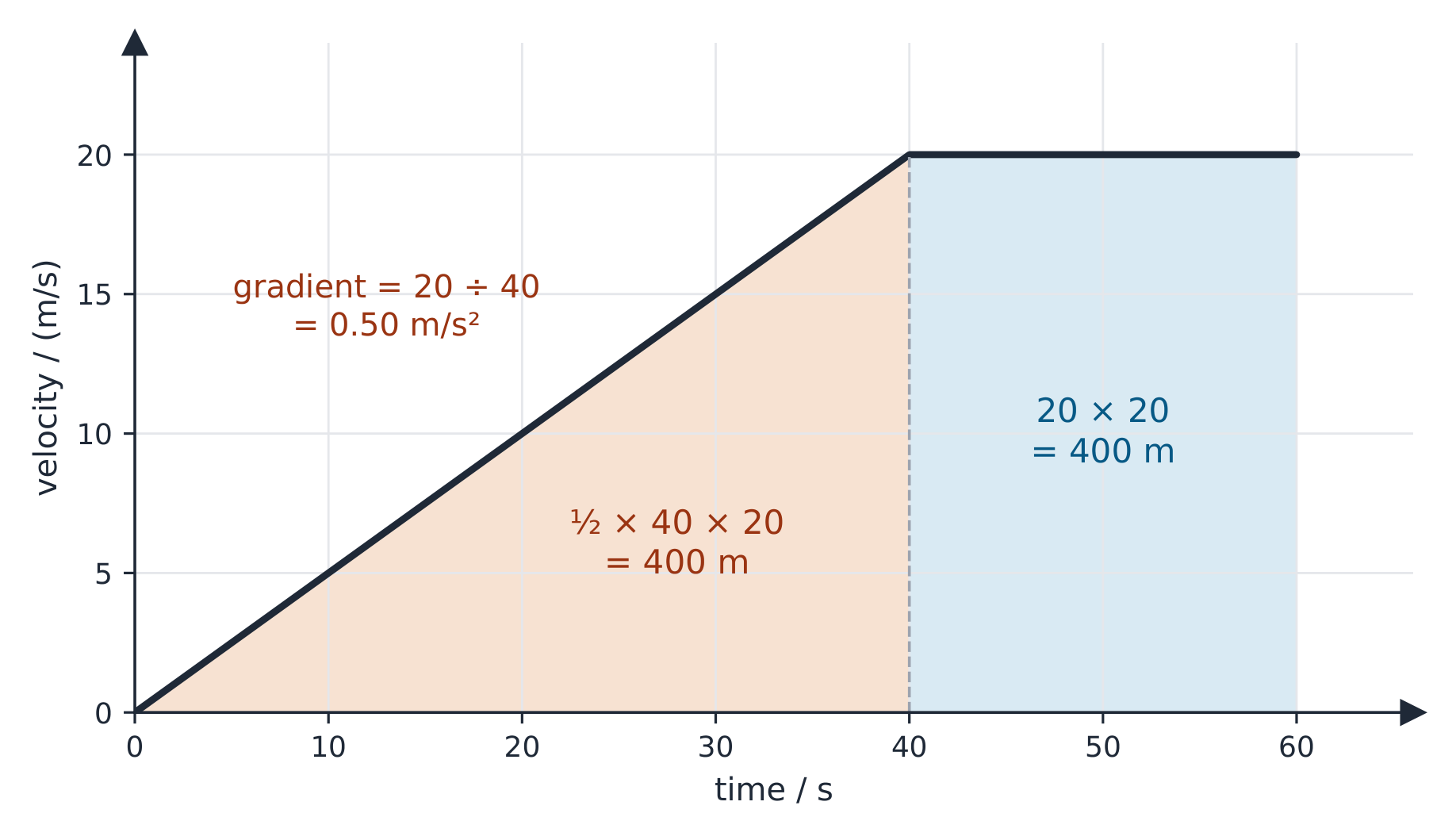
Worked example (reading a velocity–time graph). A train speeds up steadily from rest to 20 m/s in 40 s, then runs at 20 m/s for 20 s. Acceleration = gradient = $20 \div 40 = 0.50$ m/s². Distance = area: the triangle gives $\tfrac12 \times 40 \times 20 = 400$ m and the rectangle $20 \times 20 = 400$ m, so 800 m in 60 s, an average speed of $800 \div 60 = 13$ m/s.
(P) Momentum, safety and terminal velocity
Momentum 动量 is conserved when the chosen system has zero resultant external force; negligible external impulse during a short collision or explosion gives an approximately fixed total. Car safety: airbags, seat belts, side-impact bars, crumple zones, crash mats, cushioned playground surfaces and cycle helmets all lengthen the time of impact, so for the same momentum change the force is smaller.
Worked example (P) (an explosion). Two skaters, 60 kg and 40 kg, stand still and push apart. The total momentum is zero before, so it is zero after. If the 40 kg skater moves off at 3.0 m/s, the 60 kg skater must have momentum $40 \times 3.0 = 120$ kg m/s the other way: $v = 120 \div 60 = 2.0$ m/s, in the opposite direction.
Worked example (P) (force from momentum change). A 0.40 kg football at rest is kicked to 25 m/s; the boot touches it for 0.010 s. $\Delta p = 0.40 \times 25 - 0 = 10$ kg m/s, so $F = \Delta p/t = 10 \div 0.010 = 1000$ N.
At a steady speed the driving force balances resistive forces. Stopping distance = thinking + braking distance; reaction time grows with tiredness, distraction, drugs and alcohol; braking force must grow with speed, and large decelerations overheat brakes. Braking converts the vehicle's kinetic energy into heating the brakes (friction work); braking distance lengthens on wet or icy roads and with worn brakes or tyres.
An object falling through a fluid reaches terminal velocity 终末速度 when drag plus upthrust balances weight; ignoring upthrust gives drag = weight; parachutes raise drag to cut the terminal velocity, and streamlining (a shark's shape, a car's design) reduces drag to raise the maximum speed.

(P) Centre of mass and moments
The centre of mass 质心 is where an object's mass may be thought concentrated; a freely suspended object rests with it below the suspension point, and a symmetrical object's centre of mass lies on the axis of symmetry. Find it for an irregular lamina by suspending it from two points and drawing plumb lines.
A balanced object has equal total clockwise and anticlockwise moments 力矩; levers are force multipliers. If the weight's line of action falls outside the base, the resultant moment topples the object (vehicles, balancing toys).
Worked example (P) (balancing a seesaw). A child weighing 300 N sits 2.0 m to the left of the pivot: anticlockwise moment $= 300 \times 2.0 = 600$ N m. A 400 N child balances it at a distance $d = 600 \div 400 = 1.5$ m to the right. The heavier child sits closer to the pivot.

Common mistakes
- Using the length of the spring instead of the extension in $F = ke$. Subtract the original length, and change cm to m.
- Using one force in $F = ma$ when several act. Find the resultant force first.
- Saying a moving object must have a resultant force on it. At a steady velocity the forces are balanced (Newton's First Law).
- Thinking the two forces in Newton's Third Law cancel. They act on different objects, so they never cancel each other.
- Adding two perpendicular forces as numbers (400 N + 300 N = 700 N). Use a scale drawing; the resultant is 500 N.
- (P) Forgetting that momentum has direction. Objects moving the opposite way have negative momentum.
- (P) Measuring a moment's distance from the end of the beam. Measure from the pivot, perpendicular to the force.
Check yourself
- Give one example each of a contact and a non-contact force.
- Which of these are vectors: speed, displacement, time, force?
- State the spring equation and the name of its constant.
- State Newton's three laws in one sentence each.
- A 900 kg car accelerates at 2 m/s². Calculate the resultant force.
- Name two factors that lengthen thinking distance and two that lengthen braking distance.
- (P) Explain how a crumple zone protects passengers, using F = Δp/t.
- (P) Why does a parachutist reach a lower terminal velocity after opening the parachute?
- (P) Where is the centre of mass of a symmetrical object?
- (P) A 250 N force acts 0.4 m from a pivot. Calculate its moment.
Answers: 1 contact — friction/tension/air resistance/normal; non-contact — gravity/electrostatic/magnetic; 2 displacement and force; 3 $F = ke$, the spring constant (N/m); 4 first — no resultant force, no change in velocity; second — $F = ma$ along the resultant; third — interaction forces are equal and opposite; 5 $F = 900 \times 2 = 1800$ N; 6 thinking — tiredness, distractions, drugs/alcohol; braking — wet/icy roads, worn brakes or tyres (any two each); 7 (P) a longer collision time, so for the same $\Delta p$ the force $F = \Delta p/t$ is smaller; 8 (P) much more drag, so drag balances weight at a lower speed; 9 (P) on its axis of symmetry; 10 (P) $M = 250 \times 0.4 = 100$ N m.