| Core | Supplement |
|---|---|
| 1 Name appropriate apparatus for the measurement of time, temperature, mass and volume, including: (a) stop-watches (b) thermometers (c) balances (d) burettes (e) volumetric pipettes (f) measuring cylinders (g) gas syringes | |
| 2 Suggest advantages and disadvantages of experimental methods and apparatus | |
| 3 Describe a: (a) solvent as a substance that dissolves a solute (b) solute as a substance that is dissolved in a solvent (c) solution as a mixture of one or more solutes dissolved in a solvent (d) saturated solution as a solution containing the maximum concentration of a solute dissolved in the solvent at a specified temperature (e) residue as a substance that remains after evaporation, distillation, filtration or any similar process (f) filtrate as a liquid or solution that has passed through a filter |
Experimental techniques and chemical analysis
IGCSE Chemistry · Topic 12
 13:26
Experimental Techniques
You are handed an unknown white powder and a colourless solution. No labels. How do you find out what they are? Chemistry gives you a detective's toolkit: add…
English narration · English + 中文 subtitles burned in
12.1
Experimental design
Syllabus
Source: Cambridge International syllabus
Apparatus
You should know which piece of apparatus to use for each measurement:
| Measurement | Apparatus |
|---|---|
| time | stop-watch 秒表 |
| temperature | thermometer 温度计 |
| mass | balance 天平 |
| volume (accurate) | burette 滴定管 or volumetric pipette 移液管 |
| volume (rough) | measuring cylinder 量筒 |
| volume of a gas | gas syringe 注射器 |
When you choose apparatus, think about accuracy: a burette (read to the nearest 0.05 cm³) or a volumetric pipette is far more accurate than a measuring cylinder; a balance that reads to 0.01 g is better than one that reads to 0.1 g for small masses. A gas can also be collected over water in an upturned measuring cylinder, but not if it dissolves in water (such as ammonia or hydrogen chloride).
Planning an experiment. Change only one variable (the independent variable), measure the effect on one other (the dependent variable), and keep everything else the same (the control variables). For example, to find how the temperature of an acid affects how fast magnesium reacts with it: change the temperature; measure the time for the magnesium to disappear, or the volume of hydrogen made each minute; keep the same volume and concentration of acid and the same mass and size of magnesium. Repeat each experiment and find the mean.
Key words
These words are used throughout practical chemistry:
- A solvent 溶剂 is a substance that dissolves a solute.
- A solute 溶质 is the substance that dissolves in the solvent.
- A solution 溶液 is a mixture of one or more solutes dissolved in a solvent.
- A saturated solution 饱和溶液 holds the maximum amount of solute that will dissolve at a given temperature.
- A residue 残渣 is the substance left behind after evaporation, distillation or filtration.
- A filtrate 滤液 is the liquid that has passed through a filter.
Explore
Experiment design route
Follow a fair test from question to reliable conclusion.
Vocabulary
Train
| English |
|---|
| stop-watch/stɒp wɒtʃ/ |
| thermometer/θɜːˈmɒmɪtə/ |
| balance/ˈbæləns/ |
| burette/bjʊəˈret/ |
| volumetric pipette/ˌvɒljuːˈmetrɪk pɪˈpet/ |
| measuring cylinder/ˈmeʒərɪŋ ˈsɪlɪndə/ |
| gas syringe/ɡæs sɪˈrɪndʒ/ |
| solvent/ˈsɒlvənt/ |
| solute/ˈsɒljuːt/ |
| solution/səˈluːʃn/ |
| saturated solution/ˈsætʃəreɪtɪd səˈluːʃn/ |
| residue/ˈresɪdjuː/ |
| filtrate/ˈfɪltreɪt/ |
12.2
Acid–base titrations
Syllabus
| Core | Supplement |
|---|---|
| 1 Describe an acid–base titration to include the use of a: (a) burette (b) volumetric pipette (c) suitable indicator | |
| 2 Describe how to identify the end-point of a titration using an indicator |
Source: Cambridge International syllabus
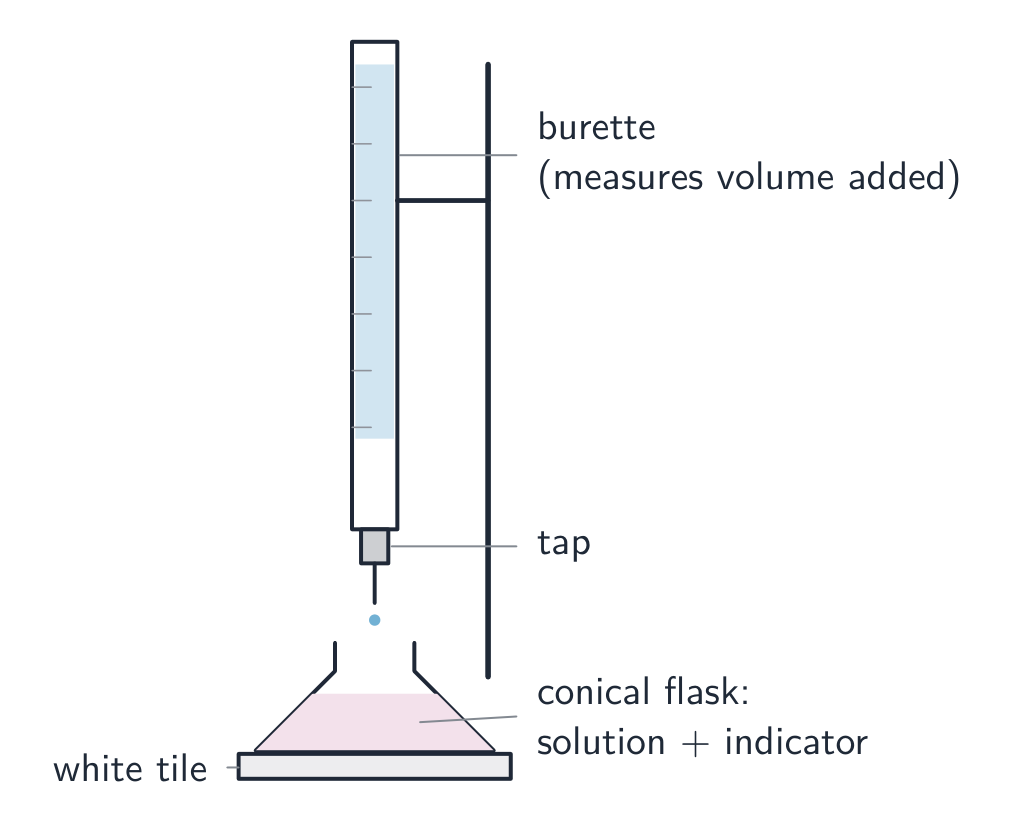
A titration 滴定 measures the volume of one solution needed to react with a measured amount of another.
- Use a volumetric pipette to measure a fixed volume of one solution into a flask.
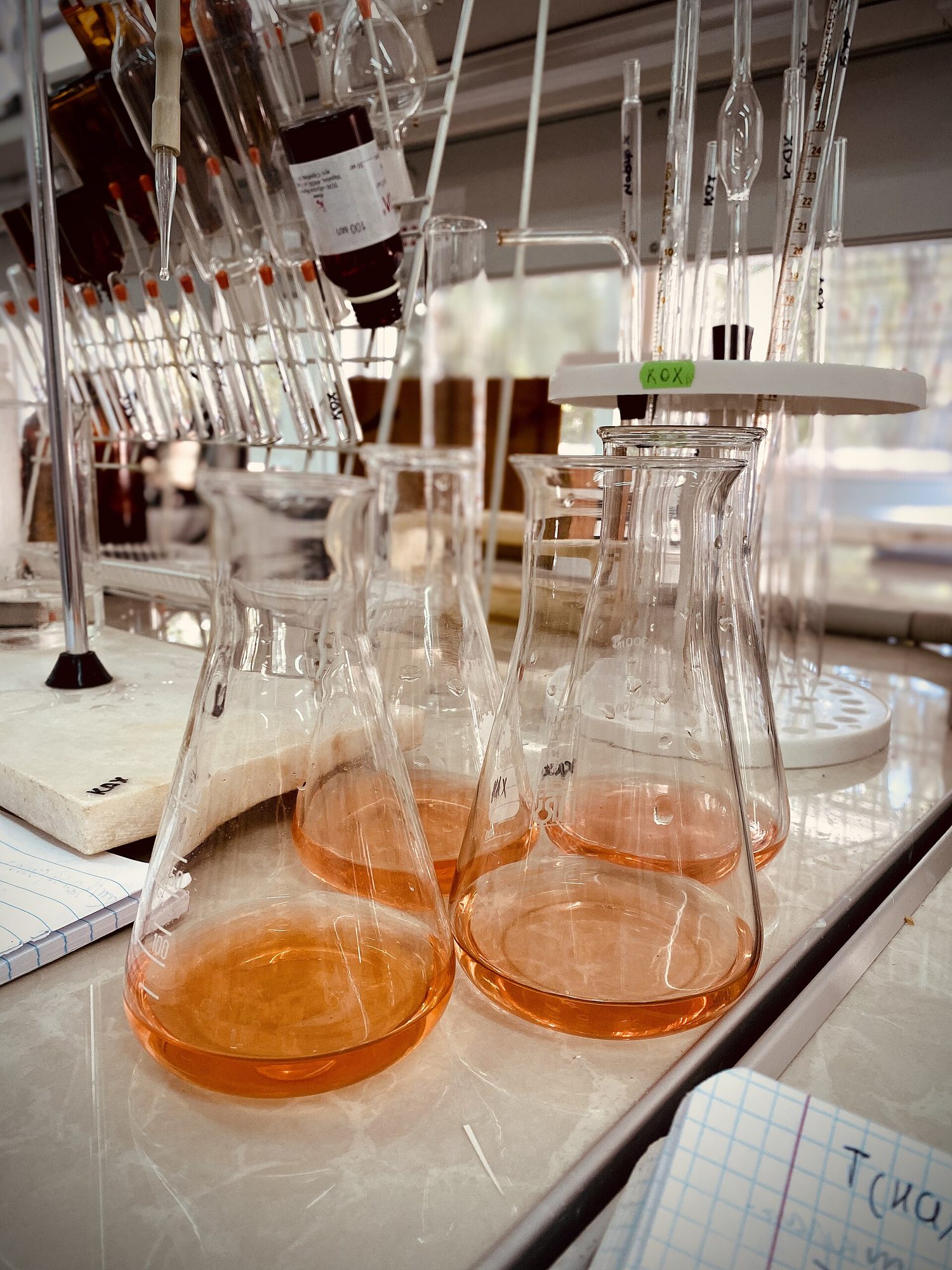
- Add a few drops of a suitable indicator 指示剂.
- Add the other solution from a burette, slowly, until the colour just changes.
The end-point 终点 is the observed indicator colour change. Choose a suitable indicator so this occurs close to the equivalence point, where the reactants have combined in the required ratio. The two points need not be exactly identical. Read the burette to find the volume added.
| Indicator | Colour in acid | Colour in alkali |
|---|---|---|
| methyl orange 甲基橙 | red | yellow (orange at the end-point) |
| thymolphthalein 百里酚酞 | colourless | blue |
| litmus | red | blue |
Litmus is not used for titrations, because its colour change is gradual, not sharp. Universal indicator is not used either, because it shows many colours.
Doing a titration accurately.
- Rinse the burette with a little of the solution it will hold, and the pipette with its solution (rinsing with water would dilute them). Rinse the conical flask with distilled water only.
- Fill the burette, open the tap briefly to fill the tip below the tap, and read the starting volume at the bottom of the meniscus, with your eye level with it.
- Add the solution from the burette while swirling the flask, standing on a white tile so the colour change is easy to see. Near the end-point, add it drop by drop.
- Read the final volume. The volume added is the titre 滴定量 = final reading − starting reading.
- The first titration is a rough one. Repeat until two titres are concordant (within 0.10 cm³ of each other), and find the mean of the concordant titres only.
Worked example. Titres: rough 25.40 cm³, then 24.85, 24.90 and 25.20 cm³. The concordant titres are 24.85 and 24.90 (within 0.10 cm³); 25.20 is left out. Mean titre $= (24.85 + 24.90)/2 = 24.875$, given as 24.88 cm³.
A titration can also be used to prepare a soluble salt: find the volume of acid that exactly neutralises a measured volume of alkali, then repeat with the same volumes but no indicator, so the salt solution is pure. Evaporate some of the water and crystallise the salt.
Explore
Acid–base titrations
pH jumps at the equivalence point
Track the pH as base is added — it leaps through neutral at the equivalence point.
Vocabulary
Train
| English |
|---|
| titration/taɪˈtreɪʃn/ |
| indicator/ˈɪndɪkeɪtə/ |
| end-point/end pɔɪnt/ |
| methyl orange/ˈmiːθaɪl ˈɒrɪndʒ/ |
| thymolphthalein/ˈθaɪməlfθæliːn/ |
| titre/ˈtɪtə/ |
12.3
Chromatography
Syllabus
| Core | Supplement |
|---|---|
| 1 Describe how paper chromatography is used to separate mixtures of soluble coloured substances, using a suitable solvent | 3 Describe how paper chromatography is used to separate mixtures of soluble colourless substances, using a suitable solvent and a locating agent Knowledge of specific locating agents is not required |
| 2 Interpret simple chromatograms to identify: (a) unknown substances by comparison with known substances (b) pure and impure substances | 4 State and use the equation for $R_{\text{f}}$: $$R_{\text{f}} = \frac{\text{distance travelled by substance}}{\text{distance travelled by solvent}}$$ |
Source: Cambridge International syllabus
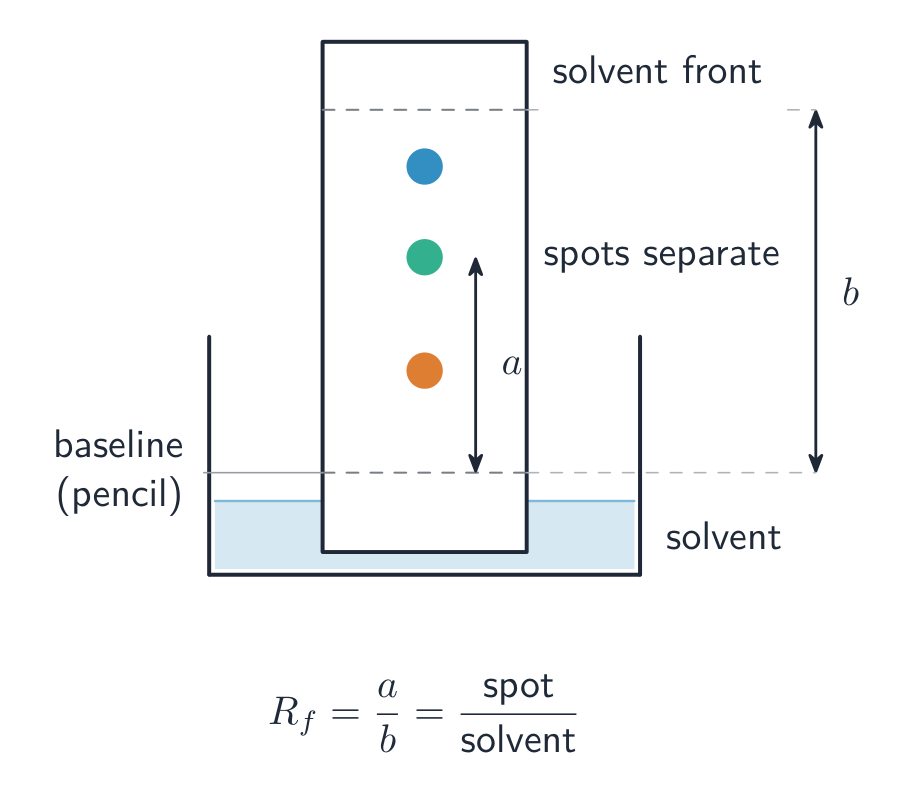
Paper chromatography 纸色谱法 separates a mixture of soluble substances. You put a spot of the mixture near the bottom of the paper, then stand the paper in a solvent. As the solvent rises up the paper, the substances move different distances, so they separate.
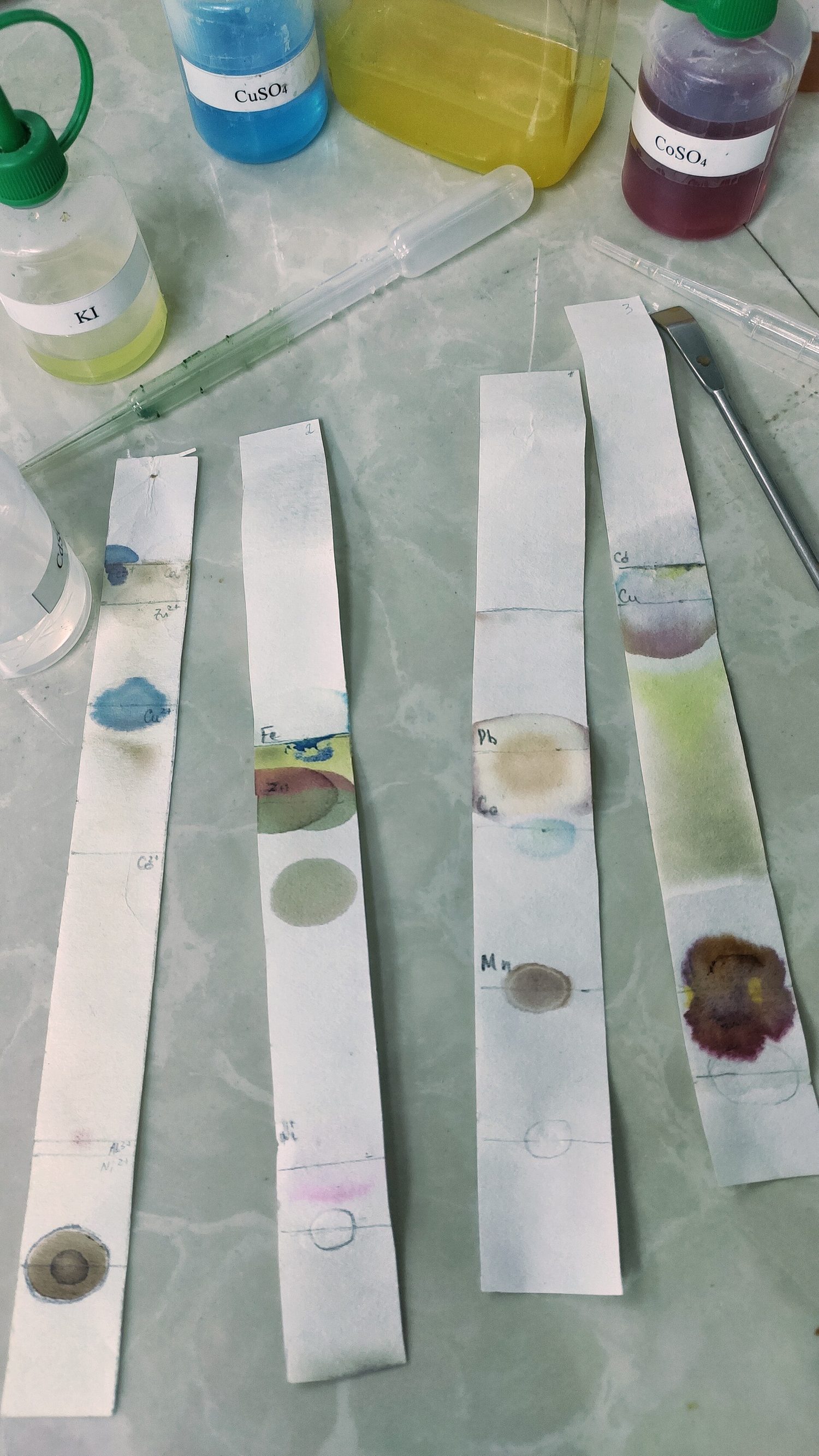
- For coloured substances you can see the spots directly.
- For colourless substances you must spray a locating agent 显色剂 to make the spots show up.
The finished paper is a chromatogram 色谱图. You can use it to:
- identify an unknown substance by comparing it with known substances;
- tell if a substance is pure (a pure substance gives only one spot).
You can also calculate the $R_{\text{f}}$ value of a spot:
$$R_{\text{f}} = \frac{\text{distance moved by the substance}}{\text{distance moved by the solvent}}$$
Worked example. On a chromatogram the solvent front has risen 8.0 cm from the baseline, and a spot has moved 6.0 cm. Find its $R_{\text{f}}$ value.
$$R_{\text{f}} = \frac{6.0}{8.0} = 0.75$$
Both distances are measured from the baseline (the pencil line), and the spot's distance is taken to the centre of the spot. An $R_{\text{f}}$ has no unit, and it is always less than 1, because a spot can never travel further than the solvent carrying it - an answer above 1 means the two distances have been divided the wrong way round.
Explore
Chromatography route
Watch a mixture separate as the solvent front moves.
Vocabulary
Train
| English |
|---|
| paper chromatography/ˈpeɪpə krəʊməˈtɒɡrəfi/ |
| locating agent/ləʊˈkeɪtɪŋ ˈeɪdʒənt/ |
| chromatogram/krəʊˈmætəɡræm/ |
12.4
Separation and purification

Syllabus
| Core | Supplement |
|---|---|
| 1 Describe and explain methods of separation and purification using: (a) a suitable solvent (b) filtration (c) crystallisation (d) simple distillation (e) fractional distillation | |
| 2 Suggest suitable separation and purification techniques, given information about the substances involved | |
| 3 Identify substances and assess their purity using melting point and boiling point information |
Source: Cambridge International syllabus
You choose a method based on the mixture:
| Method | Used to separate |
|---|---|
| dissolving in a suitable solvent, then filtration 过滤 | an insoluble solid from a liquid |
| crystallisation 结晶 | a soluble solid from its solution |
| simple distillation 蒸馏 | a solvent (the liquid) from a solution |
| fractional distillation 分馏 | two or more liquids with different boiling points |
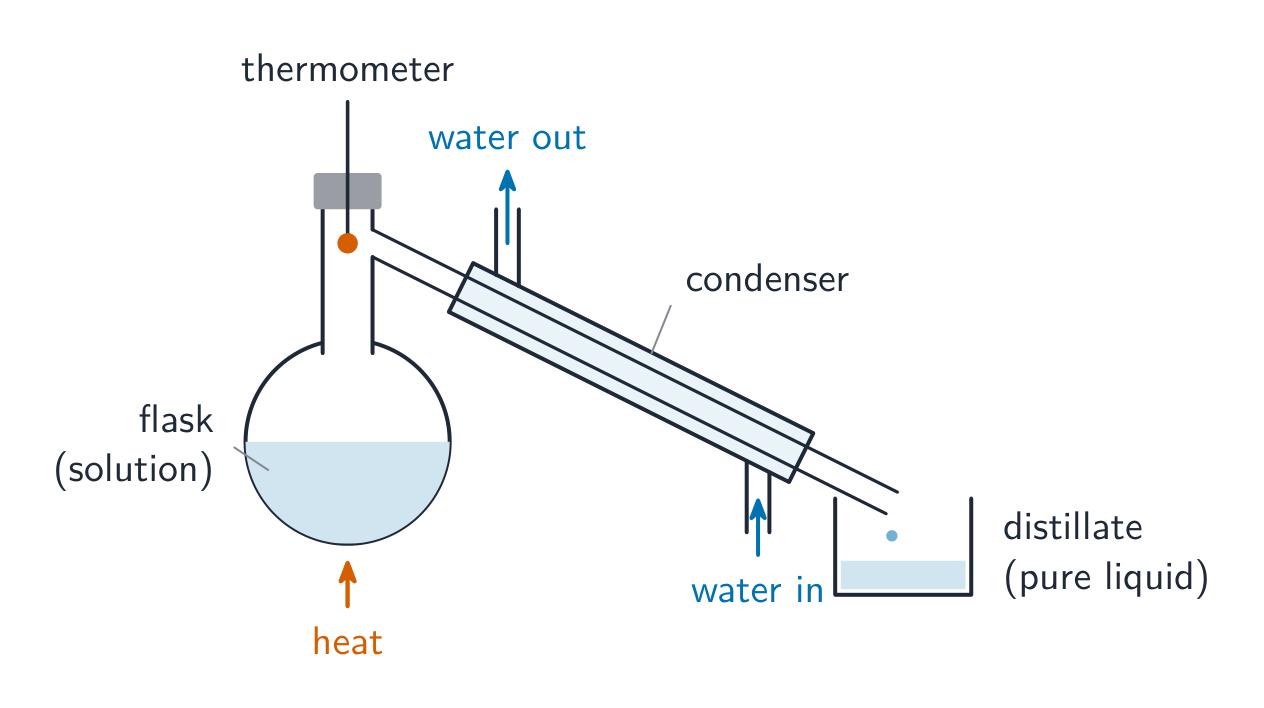
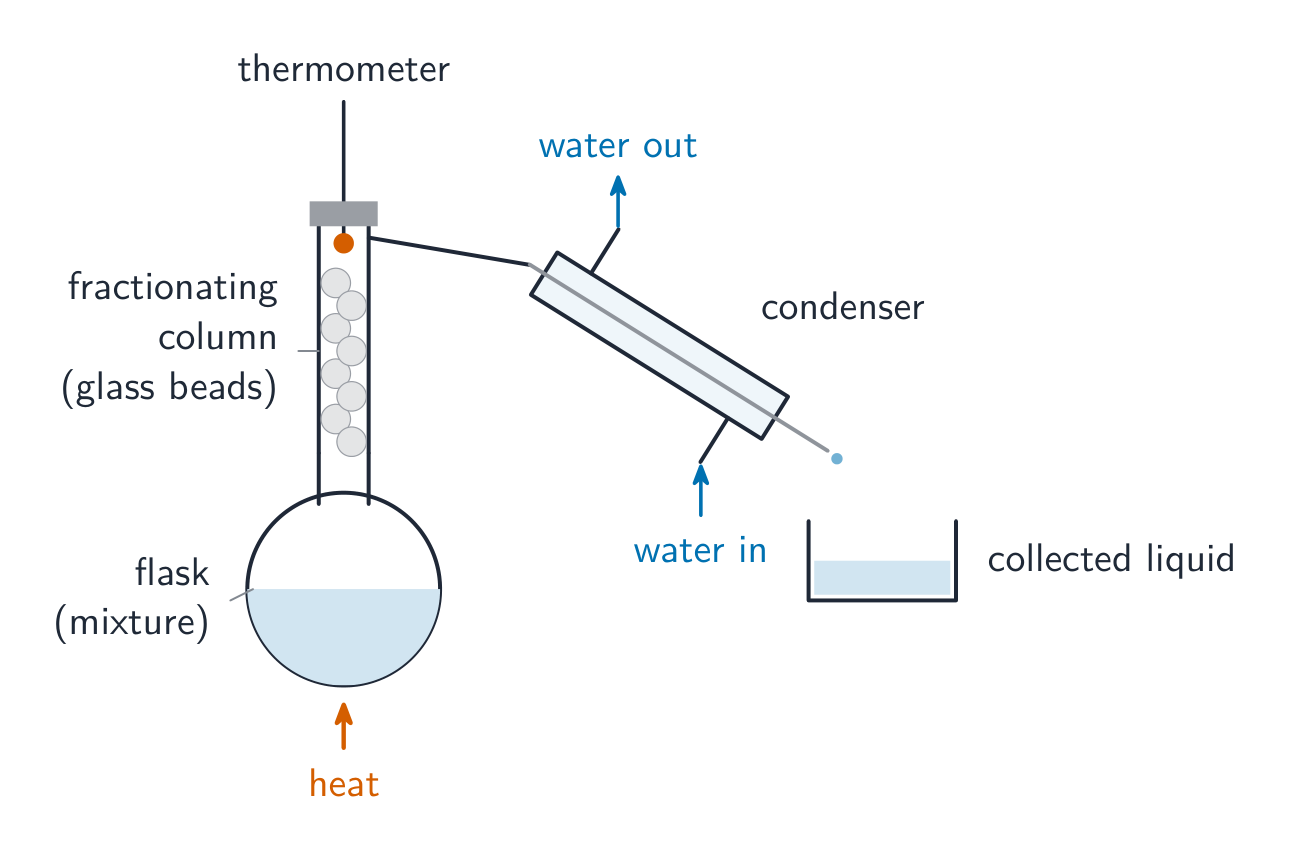
Crystallisation, step by step. Heat the solution in an evaporating basin to boil off some of the water, until the solution is saturated: test this by dipping in a cold glass rod — if crystals form on it, stop heating. Leave the solution to cool: the solid is less soluble in cold water, so crystals form. Filter off the crystals, wash them with a little cold distilled water, and dry them between filter papers or in a warm oven. Do not heat the solution to dryness if the salt contains water of crystallisation (such as hydrated copper(II) sulfate), or the crystals will break down.
Simple distillation, in detail. The bulb of the thermometer is level with the side arm, so it measures the temperature of the vapour going into the condenser. Cold water enters the condenser at the bottom and leaves at the top, so the condenser stays full of cold water. Anti-bumping granules make the liquid boil smoothly. In fractional distillation, for example of ethanol (boiling point 78 °C) and water (100 °C), the column has a range of temperatures, hot at the bottom and cooler at the top. The liquid with the lower boiling point reaches the top first and distils over while the thermometer reads 78 °C; when the reading rises, the next fraction is collected in a fresh container. Fractional distillation is used to separate crude oil and liquid air.
Choosing a method. Use the information you are given:
| Mixture | Method |
|---|---|
| sand and salt | add water and stir (salt dissolves, sand does not); filter; evaporate the filtrate and crystallise the salt |
| water from sea water | simple distillation |
| ethanol and water | fractional distillation (different boiling points) |
| the dyes in an ink | paper chromatography |
| iron filings and sulfur | use a magnet (iron is magnetic) |
| two solids that both dissolve in water, but only one dissolves in ethanol | add ethanol, filter, then evaporate the ethanol |
You can check the purity of a substance using its melting point 熔点 and boiling point 沸点: a pure substance melts and boils at sharp, fixed temperatures, while impurities lower the melting point and raise the boiling point. Pure substances matter in everyday life: medicines and food must not contain harmful impurities, even in small amounts.
Tests for water. Water turns white anhydrous copper(II) sulfate blue, and blue anhydrous cobalt(II) chloride paper pink. These show that water is present, but not that it is pure. To show that water is pure, check that it boils at exactly 100 °C and freezes at exactly 0 °C. Distilled water is used in practical work instead of tap water, because tap water contains dissolved ions that could react with the chemicals or give false test results.
Explore
Separation method lab
Choose the method that matches the mixture.
Vocabulary
Train
| English |
|---|
| filtration/fɪlˈtreɪʃn/ |
| crystallisation/ˌkrɪstəlaɪˈzeɪʃn/ |
| simple distillation/ˈsɪmpl dɪstɪˈleɪʃn/ |
| fractional distillation/ˈfrækʃənl dɪstɪˈleɪʃn/ |
| melting point/ˈmeltɪŋ pɔɪnt/ |
| boiling point/ˈbɔɪlɪŋ pɔɪnt/ |
| copper/ˈkɒpə/ |
| iron/ˈaɪən/ |
12.5
Identifying ions and gases

Syllabus
| Core | Supplement |
|---|---|
| 1 Describe tests to identify the anions: (a) carbonate, $\text{CO}_3^{2-}$, by reaction with dilute acid and then testing for carbon dioxide gas (b) chloride, $\text{Cl}^-$, bromide, $\text{Br}^-$, and iodide, $\text{I}^-$, by acidifying with dilute nitric acid then adding aqueous silver nitrate (c) nitrate, $\text{NO}_3^-$, reduction with aluminium foil and aqueous sodium hydroxide and then testing for ammonia gas (d) sulfate, $\text{SO}_4^{2-}$, by acidifying with dilute nitric acid and then adding aqueous barium nitrate (e) sulfite, $\text{SO}_3^{2-}$, by reaction with acidified aqueous potassium manganate(VII) | |
| 2 Describe tests using aqueous sodium hydroxide and aqueous ammonia to identify the aqueous cations: (a) aluminium, $Al^{3+}$ (b) ammonium, $NH_4^+$ (c) calcium, $Ca^{2+}$ (d) chromium(III), $Cr^{3+}$ (e) copper(II), $Cu^{2+}$ (f) iron(II), $Fe^{2+}$ (g) iron(III), $Fe^{3+}$ (h) zinc, $Zn^{2+}$ | |
| 3 Describe tests to identify the gases: (a) ammonia, $NH_3$, using damp red litmus paper (b) carbon dioxide, $CO_2$, using limewater (c) chlorine, $Cl_2$, using damp litmus paper (d) hydrogen, $H_2$, using a lighted splint (e) oxygen, $O_2$, using a glowing splint (f) sulfur dioxide, $SO_2$, using acidified aqueous potassium manganate(VII) | |
| 4 Describe the use of a flame test to identify the cations: (a) lithium, $Li^+$ (b) sodium, $Na^+$ (c) potassium, $K^+$ (d) calcium, $Ca^{2+}$ (e) barium, $Ba^{2+}$ (f) copper(II), $Cu^{2+}$ |
Source: Cambridge International syllabus
Tests for anions
An anion 阴离子 is a negative ion.
| Anion | Test | Result |
|---|---|---|
| carbonate 碳酸根离子 ($\text{CO}_3^{2-}$) | add dilute acid | fizzes; the gas turns limewater milky (carbon dioxide 二氧化碳) |
| chloride 氯离子 ($\text{Cl}^-$) | add dilute nitric acid 硝酸, then silver nitrate 硝酸银 | white precipitate |
| bromide 溴离子 ($\text{Br}^-$) | add dilute nitric acid, then silver nitrate | cream precipitate |
| iodide 碘离子 ($\text{I}^-$) | add dilute nitric acid, then silver nitrate | yellow precipitate |
| nitrate 硝酸根离子 ($\text{NO}_3^-$) | add aluminium 铝 foil and sodium hydroxide 氢氧化钠, warm | ammonia 氨气 gas given off |
| sulfate 硫酸根离子 ($\text{SO}_4^{2-}$) | add dilute nitric acid, then barium nitrate 硝酸钡 | white precipitate |
| sulfite 亚硫酸根离子 ($\text{SO}_3^{2-}$) | add acidified potassium manganate(VII) 高锰酸钾 | purple colour fades |
Tests for cations
A cation 阳离子 is a positive ion. Add aqueous sodium hydroxide, or aqueous ammonia, and look at the precipitate 沉淀 formed.
| Cation | With sodium hydroxide | With aqueous ammonia |
|---|---|---|
| aluminium ($\text{Al}^{3+}$) | white, dissolves in excess | white, stays |
| ammonium 铵 ($\text{NH}_4^+$) | ammonia gas when warmed | — |
| calcium 钙 ($\text{Ca}^{2+}$) | white, stays | no precipitate |
| chromium(III) 铬 ($\text{Cr}^{3+}$) | green, dissolves in excess | green, stays |
| copper(II) 铜 ($\text{Cu}^{2+}$) | light blue, stays | light blue, dissolves to deep blue |
| iron(II) 铁 ($\text{Fe}^{2+}$) | green, stays | green, stays |
| iron(III) ($\text{Fe}^{3+}$) | red-brown, stays | red-brown, stays |
| zinc 锌 ($\text{Zn}^{2+}$) | white, dissolves in excess | white, dissolves in excess |
Tests for gases
| Gas | Test | Result |
|---|---|---|
| ammonia ($\text{NH}_3$) | damp red litmus 石蕊 paper | turns blue |
| carbon dioxide ($\text{CO}_2$) | bubble through limewater 石灰水 | turns milky |
| chlorine 氯气 ($\text{Cl}_2$) | damp litmus paper | bleached white |
| hydrogen 氢气 ($\text{H}_2$) | a lighted splint | burns with a squeaky pop |
| oxygen 氧气 ($\text{O}_2$) | a glowing splint | relights |
| sulfur dioxide ($\text{SO}_2$) | acidified potassium manganate(VII) | purple colour fades |

Flame tests
A flame test 焰色试验 identifies some metal cations by the colour they give to a flame:

| Cation | Flame colour |
|---|---|
| lithium 锂 ($\text{Li}^+$) | red |
| sodium 钠 ($\text{Na}^+$) | yellow |
| potassium 钾 ($\text{K}^+$) | lilac (purple) |
| calcium ($\text{Ca}^{2+}$) | orange-red |
| barium 钡 ($\text{Ba}^{2+}$) | light green |
| copper(II) ($\text{Cu}^{2+}$) | blue-green |
Identifying a compound
Worked example. A white solid X dissolves in water. (1) Aqueous sodium hydroxide gives a white precipitate that dissolves in excess; aqueous ammonia gives a white precipitate that also dissolves in excess. (2) Dilute nitric acid and aqueous barium nitrate give a white precipitate. Identify X. Test 1: a white precipitate that dissolves in excess of both sodium hydroxide and ammonia is the zinc ion, $\text{Zn}^{2+}$ (aluminium's precipitate does not dissolve in excess ammonia; calcium's does not dissolve in excess sodium hydroxide). Test 2: a white precipitate with barium nitrate shows sulfate, $\text{SO}_4^{2-}$. So X is zinc sulfate, $\text{ZnSO}_4$.
Nitric acid is added first in the halide and sulfate tests to remove any carbonate ions, which would also give a precipitate. Do not use hydrochloric acid in the halide test (it adds chloride ions), or sulfuric acid in the sulfate test (it adds sulfate ions).
Explore
Ion and gas test lab
Match test observations to the ion or gas present.
Vocabulary
Train
| English |
|---|
| anion/ˈænaɪən/ |
| carbonate/ˈkɑːbəneɪt/ |
| carbon dioxide/ˈkɑːbən daɪˈɒksaɪd/ |
| chloride/ˈklɔːraɪd/ |
| nitric acid/ˈnaɪtrɪk ˈæsɪd/ |
| silver nitrate/ˈsɪlvə ˈnaɪtreɪt/ |
| bromide/ˈbrəʊmaɪd/ |
| iodide/ˈaɪədaɪd/ |
| nitrate/ˈnaɪtreɪt/ |
| aluminium/ˌæljʊˈmɪnɪəm/ |
| sodium hydroxide/ˈsəʊdɪəm haɪˈdrɒksaɪd/ |
| ammonia/æˈməʊnɪə/ |
| sulfate/ˈsʌlfeɪt/ |
| barium nitrate/ˈbeərɪəm ˈnaɪtreɪt/ |
| sulfite/ˈsʌlfaɪt/ |
| potassium manganate(VII)/pəˈtæsɪəm ˈmæŋɡəneɪt/ |
| cation/ˈkætaɪən/ |
| precipitate/prɪˈsɪpɪteɪt/ |
| ammonium/æˈməʊnɪəm/ |
| calcium/ˈkælsɪəm/ |
| chromium/ˈkrəʊmɪəm/ |
| zinc/zɪŋk/ |
| litmus/ˈlɪtməs/ |
| limewater/ˈlaɪmwɔːtə/ |
| chlorine/ˈklɔːriːn/ |
| hydrogen/ˈhaɪdrədʒn/ |
| oxygen/ˈɒksɪdʒn/ |
| flame test/fleɪm test/ |
| lithium/ˈlɪθɪəm/ |
| sodium/ˈsəʊdɪəm/ |
| potassium/pəˈtæsɪəm/ |
| barium/ˈbeərɪəm/ |
12.5
Exam tips
- Pick apparatus by the measurement: a burette or pipette for accurate volumes, a measuring cylinder for a rough volume, a gas syringe for a gas volume, a balance for mass.
- $R_f = \dfrac{\text{distance moved by the substance}}{\text{distance moved by the solvent}}$, so it is always less than 1. A pure substance gives a single spot.
- Learn the anion tests: a carbonate fizzes and the gas turns limewater milky; halides with silver nitrate give a chloride white, bromide cream, iodide yellow precipitate; a sulfate gives a white precipitate with barium nitrate.
- Learn the gas tests: hydrogen gives a squeaky pop, oxygen relights a glowing splint, carbon dioxide turns limewater milky, chlorine bleaches damp litmus, ammonia turns damp red litmus blue.
- For cations, add sodium hydroxide and read the precipitate colour: copper(II) light blue, iron(II) green, iron(III) red-brown.
- Titration: use methyl orange or thymolphthalein, not litmus; read the bottom of the meniscus; average only concordant titres (within 0.10 cm³).
- Crystallisation: heat to the point of crystallisation (test with a glass rod), cool, filter, wash, dry.
- Water turns anhydrous copper(II) sulfate from white to blue; pure water boils at 100 °C.
Interactive lessons on this topic
Work through it step by step, with instant-check exercises.