| Core | Supplement |
|---|---|
| 1 State the uses of energy in living organisms, including: muscle contraction, protein synthesis, cell division, active transport, growth, the passage of nerve impulses and the maintenance of a constant body temperature | |
| 2 Investigate and describe the effect of temperature on respiration in yeast |
Respiration
IGCSE Biology · Topic 12
 5:00
Respiration
Here is the single most common mix-up in IGCSE Biology. Respiration is not breathing. Breathing is moving air in and out of your lungs — a physical action…
English narration · English + 中文 subtitles burned in
12.1
Respiration and energy

Syllabus
Source: Cambridge International syllabus
Respiration 呼吸作用 is the release of energy 能量 from food, and it happens in every living cell, all the time. (It is not the same as breathing.) Cells use this energy for many jobs:
- muscle 肌肉 contraction (movement).
- protein synthesis 蛋白质合成 (building proteins).
- cell division 分裂 (making new cells).
- active transport 主动运输.
- growth.
- the passage of nerve impulses 神经冲动.
- keeping a constant body temperature 温度.
Investigating the effect of temperature on yeast
Yeast 酵母 is a single-celled fungus. When it respires, it gives off carbon dioxide 二氧化碳, so we can count the gas bubbles to see how fast it is respiring.

- Mix yeast with glucose solution in a boiling tube and fit a bung with a delivery tube.
- Stand the tube in a water bath 水浴 at one temperature, for example $20\,°\text{C}$. Wait 5 minutes so the yeast reaches that temperature.
- Count the bubbles that come out of the delivery tube in 1 minute. Repeat the count and find the mean.
- Repeat at other temperatures, such as $10$, $30$, $40$, $50$ and $60\,°\text{C}$.
Keep the other variables 变量 the same: the mass of yeast, the volume and concentration of the glucose solution, and the counting time.
The reactions of respiration are controlled by enzymes 酶. So the results follow the same pattern as enzyme activity:
- from cold to warm, the rate goes up: molecules move faster and collide more often.
- the rate is fastest at the optimum 最适 temperature.
- above it, the rate falls quickly, because the enzymes are denatured 变性.

Worked example. A student's results are in the graph above. (a) At which temperature did the yeast respire fastest? (b) Explain the result at $60\,°\text{C}$. (c) Suggest one way to make the results more accurate. (a) $40\,°\text{C}$: it gave the most bubbles per minute (26). (b) Only 1 bubble per minute, because at $60\,°\text{C}$ the yeast's enzymes are denatured, so respiration almost stops. (c) Collect the gas in a gas syringe and measure its volume, because bubbles can be different sizes; or repeat each temperature three times and take a mean.
Explore
Respiration releases energy
Every living cell respires to release energy from glucose for its life processes.
Vocabulary
Train
| English |
|---|
| respiration/ˌrespɪˈreɪʃn/ |
| energy/ˈenədʒi/ |
| muscle/ˈmʌsl/ |
| protein synthesis/ˈprəʊtiːn ˈsɪnθəsɪs/ |
| division/dɪˈvɪʒn/ |
| active transport/ˈæktɪv ˈtrænspɔːt/ |
| nerve impulses/nɜːv ˈɪmpʌlsɪz/ |
| temperature/ˈtemprɪtʃə/ |
| yeast/jiːst/ |
| carbon dioxide/ˈkɑːbən daɪˈɒksaɪd/ |
| water bath |
| variables/ˈveərɪəblz/ |
| enzymes/ˈenzaɪmz/ |
| optimum/ˈɒptɪməm/ |
| denatured/ˈdenətʃəd/ |
12.2
Aerobic respiration

Syllabus
| Core | Supplement |
|---|---|
| 1 Describe aerobic respiration as the chemical reactions in cells that use oxygen to break down nutrient molecules to release energy | |
| 2 State the word equation for aerobic respiration as: glucose + oxygen → carbon dioxide + water | 3 State the balanced chemical equation for aerobic respiration as: $\text{C}_6\text{H}_{12}\text{O}_6 + 6\text{O}_2 \rightarrow 6\text{CO}_2 + 6\text{H}_2\text{O}$ |
Source: Cambridge International syllabus
Aerobic respiration 有氧呼吸 uses oxygen 氧气 to break down nutrient molecules 营养物质 (mainly glucose 葡萄糖) and release energy.
Word equation:
$$\text{glucose} + \text{oxygen} \rightarrow \text{carbon dioxide} + \text{water}$$
(Supplement) Balanced chemical equation:
$$\text{C}_6\text{H}_{12}\text{O}_6 + 6\text{O}_2 \rightarrow 6\text{CO}_2 + 6\text{H}_2\text{O}$$
Aerobic respiration releases a lot of energy from each glucose molecule.
Explore
Aerobic respiration
Aerobic respiration releases a LOT of energy from glucose using oxygen.
Vocabulary
Train
| English |
|---|
| aerobic respiration/eəˈrəʊbɪk ˌrespɪˈreɪʃn/ |
| oxygen/ˈɒksɪdʒn/ |
| nutrient molecules/ˈnjuːtrɪənt ˈmɒlɪkjuːlz/ |
| glucose/ˈɡluːkəʊs/ |
12.3
Anaerobic respiration
Syllabus
| Core | Supplement |
|---|---|
| 1 Describe anaerobic respiration as the chemical reactions in cells that break down nutrient molecules to release energy without using oxygen | |
| 2 State that anaerobic respiration releases much less energy per glucose molecule than aerobic respiration | |
| 3 State the word equation for anaerobic respiration in yeast as: glucose → alcohol + carbon dioxide | 5 State the balanced chemical equation for anaerobic respiration in yeast as: $\text{C}_6\text{H}_{12}\text{O}_6 \rightarrow 2\text{C}_2\text{H}_5\text{OH} + 2\text{CO}_2$ |
| 4 State the word equation for anaerobic respiration in muscles during vigorous exercise as: glucose → lactic acid | |
| 6 State that lactic acid builds up in muscles and blood during vigorous exercise causing an oxygen debt | |
| 7 Outline how the oxygen debt is removed after exercise, limited to: (a) continuation of fast heart rate to transport lactic acid in the blood from the muscles to the liver (b) continuation of deeper and faster breathing to supply oxygen for aerobic respiration of lactic acid (c) aerobic respiration of lactic acid in the liver |
Source: Cambridge International syllabus
Anaerobic respiration 无氧呼吸 breaks down glucose to release energy without oxygen. It releases much less energy from each glucose molecule than aerobic respiration, because the glucose is not fully broken down.

In yeast
$$\text{glucose} \rightarrow \text{alcohol} + \text{carbon dioxide}$$
(Supplement) Balanced chemical equation:
$$\text{C}_6\text{H}_{12}\text{O}_6 \rightarrow 2\text{C}_2\text{H}_5\text{OH} + 2\text{CO}_2$$
The alcohol is ethanol 乙醇, $\text{C}_2\text{H}_5\text{OH}$.
The carbon dioxide made by yeast makes bread rise, and the alcohol 酒精 is used to brew drinks (in baking it evaporates in the oven).
In muscles (Supplement)
During hard exercise your muscles cannot get enough oxygen, so they respire anaerobically:
$$\text{glucose} \rightarrow \text{lactic acid}$$
The lactic acid 乳酸 builds up in the muscles and the blood. This creates an oxygen debt 氧债 — the extra oxygen the body will need later to break that lactic acid down.
After you stop exercising, the oxygen debt is repaid:
- your heart rate 心率 stays high, carrying the lactic acid in the blood from the muscles to the liver 肝脏.
- you keep breathing deeply and quickly, taking in extra oxygen.
- the liver uses this oxygen to break the lactic acid down by aerobic respiration.
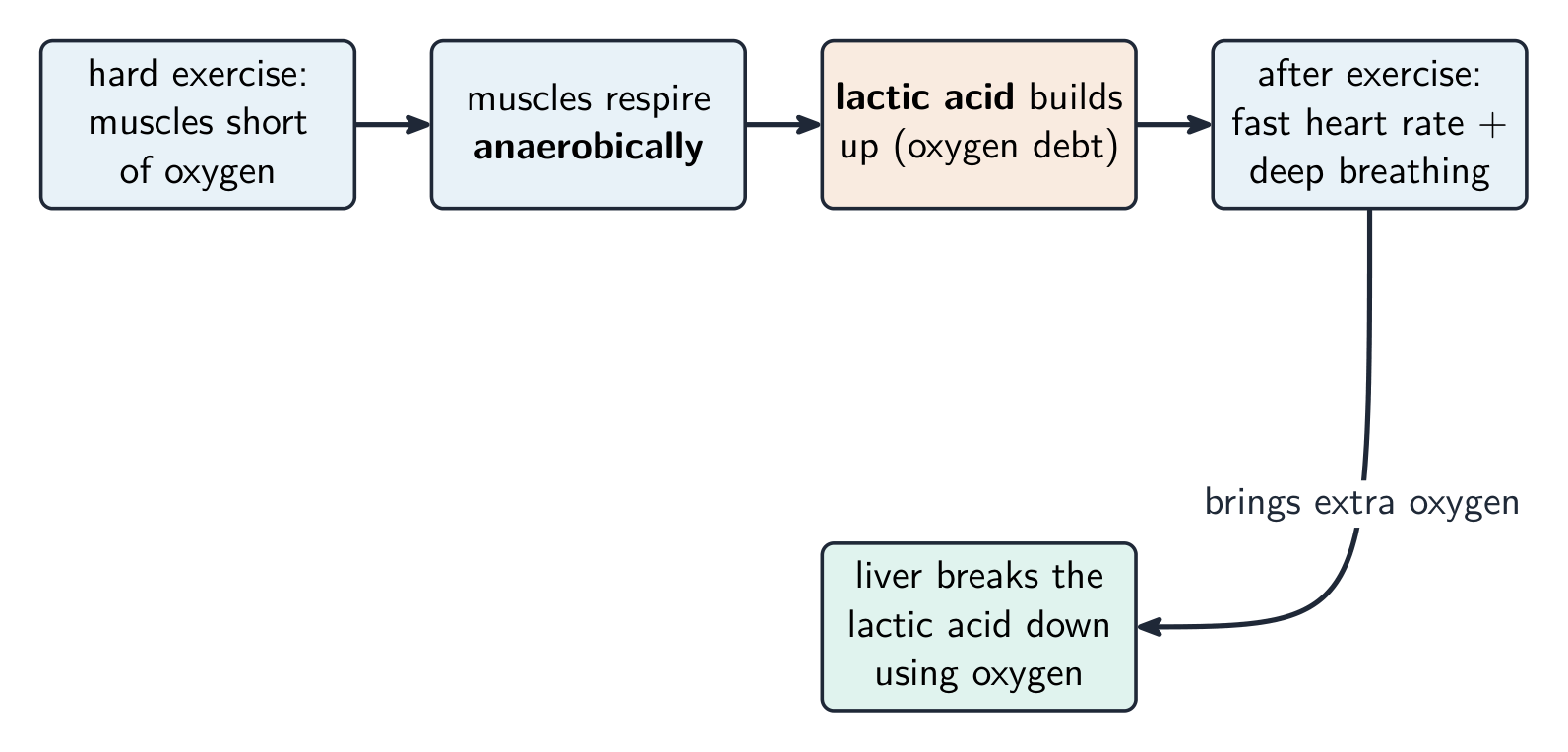
Worked example. A runner sprints hard for 20 seconds, then breathes deeply for several minutes after stopping. Explain why. During the sprint the muscles cannot get oxygen fast enough, so they respire anaerobically and lactic acid builds up, creating an oxygen debt. The deep breathing afterwards takes in the extra oxygen the liver needs to break that lactic acid down by aerobic respiration, while a high heart rate carries the acid from the muscles to the liver. The breathing repays a debt built up during the sprint - it is not simply "because the muscles are still working".
Explore
Anaerobic respiration
Without oxygen, glucose is only partly broken down — far less energy, and a different waste product.
Vocabulary
Train
| English |
|---|
| anaerobic respiration/ˌæneəˈrəʊbɪk ˌrespɪˈreɪʃn/ |
| ethanol/ˈeθənɒl/ |
| alcohol/ˈælkəhɒl/ |
| lactic acid/ˈlæktɪk ˈæsɪd/ |
| oxygen debt/ˈɒksɪdʒn det/ |
| heart rate/hɑːt reɪt/ |
| liver/ˈlɪvə/ |
12.3
Common mistakes
- "Respiration is breathing." Breathing moves air in and out of the lungs. Respiration is a set of chemical reactions in every cell.
- "Plants photosynthesise instead of respiring." Plants respire all the time, day and night. In the light they also photosynthesise.
- "Respiration makes energy." Energy cannot be made. Respiration releases the energy stored in glucose.
- "Anaerobic respiration in muscles makes carbon dioxide." In muscles it makes only lactic acid. Yeast makes alcohol and carbon dioxide.
12.3
Exam tips
- Respiration releases energy in all living cells, all the time — it is not breathing.
- Aerobic: glucose + oxygen → carbon dioxide + water, and it gives a lot of energy. Learn the balanced equation too.
- Anaerobic (no oxygen) gives much less energy. In yeast: glucose → alcohol + carbon dioxide ($\text{C}_6\text{H}_{12}\text{O}_6 \rightarrow 2\text{C}_2\text{H}_5\text{OH} + 2\text{CO}_2$). In muscles: glucose → lactic acid.
- In the yeast experiment, the rate rises to an optimum temperature and then falls, because respiration depends on enzymes.
- Lactic acid causes an oxygen debt, repaid by a fast heart rate and deep breathing, with the liver breaking the lactic acid down.
Interactive lessons on this topic
Work through it step by step, with instant-check exercises.