Skip to content

Research methods · Class practicals and the research proposal

International Baccalaureate · IB Diploma · Psychology · SL · Topic 3

Video lesson for this topic Open the video page
8:46

Research methods and the research proposal

In 2015, 270 researchers tried to repeat 100 published psychology studies. Only about a third, 36 percent, found a significant result again. Some of the…

English narration · English + 中文 subtitles burned in

3.1

Research methods, class practicals and the research proposal

IB Diploma Programme Psychology SL (the course first assessed in 2027). This topic covers how psychologists collect evidence. You need it for three parts of the assessment. In your class practicals 课堂实践 you carry out at least four small studies, one with each of four methods: an experiment, an interview or focus group, an observation, and a questionnaire. Paper 2 Section A asks four questions about one of your practicals, and Section B asks you to discuss an unseen study using the concepts. The internal assessment 内部评估 is a research proposal 研究计划书: you plan a study for a population of interest 目标人群 but do not carry it out.

In 2015, 270 researchers tried to repeat 100 published psychology studies. Only about a third (36%) found a significant result again. Some of the original studies had small samples, flexible analyses or biased designs. Research methods are not a list to memorise; they decide which findings you can trust.

Must-know for this topic:

Idea Key content
methods experiment, questionnaire, interview and focus group, observation; also correlational study and case study
experiments IV, DV, hypotheses, designs, controls, types of experiment
sampling random, opportunity, self-selected, purposive, snowball
quality bias, validity, reliability, credibility, generalisability
ethics consent, withdrawal, deception, debriefing, harm, confidentiality
assessment Paper 2 Sections A and B; the research proposal
Vocabulary Train
English
class practicals
internal assessment
research proposal/rɪˈsɜːtʃ prəˈpəʊzl/
population of interest
3.2

Six research methods

A map placing six methods by researcher control and by kind of data: experiment high control and numbers; interview and focus group words; observation, case study, correlational study and questionnaire between

Six methods placed by control and by kind of data; the four ringed ones are used in class practicals

Method What it does Strength Limit
experiment changes one variable and measures another can show cause often artificial
questionnaire many people answer the same questions quick, large samples people may not answer honestly
interview / focus group people talk about their experience rich, detailed data hard to compare; small samples
observation records what people actually do real behaviour observer bias; no cause
correlational study measures how two variables move together shows relationships no cause
case study studies one person or group in depth rare cases, rich detail may not apply to others

Quantitative data 定量数据 are numbers; qualitative data 定性数据 are words, pictures or descriptions. Experiments and questionnaires mostly produce quantitative data; interviews mostly qualitative data.

Vocabulary Train
English
quantitative data/ˈkwɒntɪteɪtɪv ˈdeɪtə/
qualitative data/ˈkwɒlɪteɪtɪv ˈdeɪtə/
3.3

Experiments

An experiment 实验 changes the independent variable 自变量 (IV) and measures the effect on the dependent variable 因变量 (DV), while keeping other variables the same. A variable that changes with the IV and also affects the DV is a confounding variable 混淆变量.

Hypotheses must be precise. For a study on music and memory:

  • Research hypothesis 研究假设: students who learn 20 words in silence will recall more words than students who learn them with music playing.
  • Null hypothesis 零假设: there will be no difference in recall, or any difference will be due to chance.

There are three experimental designs 实验设计:

Design Meaning Strength Problem and fix
independent samples different people in each condition no order effects group differences; fix: random allocation
repeated measures the same people do both conditions no group differences order effects; fix: counterbalancing 平衡抵消
matched pairs similar people paired, one in each condition fewer group differences slow to match
A target population with ten people chosen into a sample, then split by random allocation into condition A and condition B

Sampling chooses who takes part; allocation decides which condition each person does

A laboratory experiment 实验室实验 has high control but may not feel real (low ecological validity 生态效度). A field experiment 现场实验 happens in a real setting. In a natural experiment 自然实验 the researcher does not choose the IV (for example, a new school timetable), and in a quasi-experiment 准实验 the IV is a fixed trait such as age or gender, so participants cannot be randomly allocated.

Vocabulary Train
English
experiment/ekˈsperɪmənt/
independent variable/ˌɪndɪˈpendənt ˈveərɪəbl/
dependent variable/dɪˈpendənt ˈveərɪəbl/
confounding variable/kənˈfaʊndɪŋ ˈveərɪəbl/
research hypothesis
null hypothesis/nʌl haɪˈpɒθəsɪs/
experimental designs
counterbalancing/ˈkaʊntəbælənsɪŋ/
laboratory experiment
ecological validity
field experiment
natural experiment
quasi-experiment
3.4

Sampling

Technique How Main problem
random sampling 随机抽样 everyone has an equal chance needs a full list of the population
opportunity sampling 方便抽样 whoever is available may not represent the population
self-selected sampling 自愿抽样 volunteers answer an advert volunteers may be different
purposive sampling 目的抽样 people chosen for a feature the researcher's choice may be biased
snowball sampling 滚雪球抽样 participants recruit others people know each other, so they are alike

Purposive and snowball sampling are common for interviews, when the researcher needs people with a special experience.

Vocabulary Train
English
random sampling/ˈrændəm ˈsæmplɪŋ/
opportunity sampling
self-selected sampling
purposive sampling/pɜːˈpəʊsɪv ˈsæmplɪŋ/
snowball sampling/ˈsnəʊbɔːl ˈsæmplɪŋ/
3.5

Questionnaires, interviews and observations

A questionnaire 问卷 can use closed questions (yes/no, or a Likert scale 李克特量表 from 1 "strongly disagree" to 5 "strongly agree") or open questions. Closed answers are easy to count; open answers give reasons. People may give the answer that sounds good: social desirability bias 社会期望偏差. Anonymous questionnaires reduce it.

An interview 访谈 can be structured (fixed questions), semi-structured (an interview guide, with follow-up questions) or unstructured. A focus group 焦点小组 is an interview with about 6 to 10 people at once, where people's answers spark each other's ideas, but a strong speaker can lead the group. Interviews are recorded, transcribed and analysed by finding themes.

An observation 观察 can be naturalistic (a real setting) or controlled, overt (people know) or covert (they do not), and participant or non-participant. Observers use a behaviour checklist 行为清单 with clear categories, for example "hits", "shares a toy", "helps". Two observers record the same sessions, and high agreement shows inter-rater reliability 评分者间信度.

Vocabulary Train
English
questionnaire
Likert scale
social desirability bias
interview/ˈɪntəvjuː/
focus group/ˈfəʊkəs ɡruːp/
observation/ɒbzəˈveɪʃn/
behaviour checklist
inter-rater reliability/ˈɪntə ˈreɪtə rɪˌlaɪəˈbɪlɪti/
3.6

Judging quality

Issue Meaning Example and fix
participant bias 参与者偏差 participants change their behaviour demand characteristics 需求特征: they guess the aim; fix: hide the aim, debrief later
researcher bias 研究者偏差 the researcher's expectations affect results fix: a double-blind 双盲 design or a second coder
generalisability 可推广性 results apply to the population a random, large sample helps
credibility 可信度 qualitative findings reflect what participants meant fix: triangulation 三角验证 (several methods or researchers)
transferability 可迁移性 qualitative findings apply to other settings fix: describe the setting in detail
Vocabulary Train
English
participant bias
demand characteristics/dɪˈmænd ˌkærɪktəˈrɪstɪks/
researcher bias
double-blind/ˈdʌbl blaɪnd/
generalisability
credibility/ˌkredɪˈbɪlɪti/
triangulation
transferability/trænsˌfɜːrəˈbɪlɪti/
3.7

Ethics

Every study must follow ethical rules. The main ones are informed consent 知情同意 (people know what they agree to; parents consent for children under 16), the right to withdraw 退出权 at any time, no deception 欺骗 unless it is necessary and harmless, debriefing 事后说明 (telling participants the true aim afterwards), protection from harm 免受伤害 and confidentiality 保密 (no names in the report). Responsibility, one of the six concepts, asks you to apply these rules to a particular study.

Vocabulary Train
English
informed consent/ɪnˈfɔːmd kənˈsent/
right to withdraw
deception
debriefing
protection from harm
confidentiality/ˌkɒnfɪˌdenʃiˈæləti/
3.8

Paper 2

Section A asks four questions about one class practical: describe what you did (4 marks), explain a concept in relation to it (4 marks), compare it with another method (6 marks) and design a study with a different method on the same topic (6 marks).

Worked example. Describe how you used an interview or focus group in your class practical. (4 marks)

Our aim was to find out how IB students experience stress before mock exams. We used purposive sampling to choose four DP2 students who had just taken mocks. Each gave informed consent. We ran semi-structured interviews of about 15 minutes with six open questions, such as "What did you do the evening before your first exam?", and recorded them. We transcribed the recordings and coded them, and two themes appeared: lack of sleep and comparing scores with friends.

Section B (15 marks) gives you an unseen study. You discuss it with two or more of four concepts: bias, causality, measurement and responsibility. For each concept: point to a detail in the study, explain its effect on the conclusion, and suggest a better design.

3.9

The research proposal (internal assessment)

The internal assessment is a research proposal of 24 marks. You choose a topic and a population of interest (for example, international students in their first year in China), and plan a study with one of the four class-practical methods. You argue for every choice, but you do not collect data.

Four cards in sequence: introduction, research methodology, data collection and discussion, with what each contains

The four parts of the research proposal

Example plan: How do first-year international students in Ningbo experience making friends? Method: semi-structured interviews, because the question is about experience and needs rich data. Sample: purposive sampling of eight students, through the university's international office. Ethics: informed consent, a right to withdraw, no names, and information about counselling services. Discussion: the researcher's own views could shape the questions (bias), so a second researcher codes the transcripts; eight students from one university may not transfer to other cities.

3.10

Checklist

  • The six methods, with a strength and a limit of each; quantitative and qualitative data.
  • IV, DV, confounding variables; research and null hypotheses; the three designs, counterbalancing and random allocation; types of experiment.
  • Five sampling techniques with their problems.
  • Questionnaires (Likert, social desirability), interviews and focus groups, observations (checklists, inter-rater reliability).
  • Participant and researcher bias; generalisability, credibility, transferability, triangulation.
  • The ethical rules, and how responsibility applies them.
  • Paper 2 Section A (4, 4, 6, 6 marks) and Section B (15 marks, two or more concepts).
  • The research proposal: four parts, one class-practical method, planned but not carried out.
Additional notes PDF
Supported preparation: Experimental preparation and data

Scope and prerequisites

IB Psychology, the course first assessed in 2027. This supplement goes with Topic 3: research methods, the class practicals (an experiment, an interview or focus group, an observation and a questionnaire) and the research proposal, which plans a study but does not carry it out.

Mapped preparation outcomes: ib_psychology_sl.3.1, ib_psychology_sl.3.2. Read the matching native lesson first. Actual approved choices, evidence and final learner work remain separate.

Source vocabulary

independent variable 自变量; dependent variable 因变量.

Explanation and worked method

Specify the independent variable, dependent measure, allocation, controls and consent before analysis. Standardization reduces avoidable variation; random assignment differs from random sampling. In a class practical, keep your real data; never replace them with illustrative numbers.

Original classroom evidence panel for Experimental preparation and data

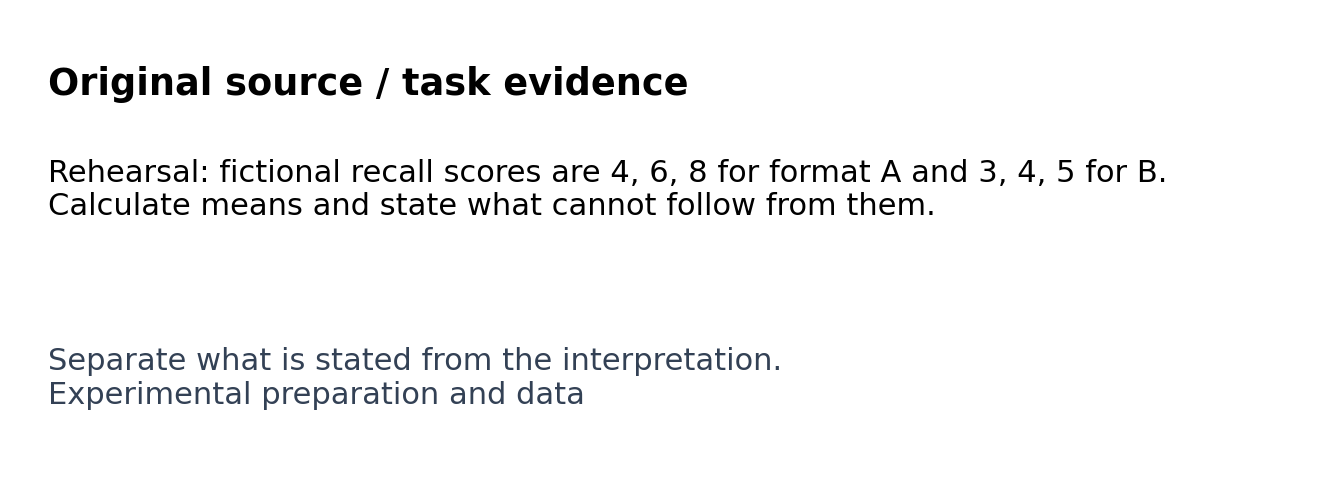
Rehearsal: fictional recall scores are 4, 6, 8 for format A and 3, 4, 5 for B. Calculate means and state what cannot follow from them.

Mean A=(4+6+8)/3=6 items; mean B=(3+4+5)/3=4 items; difference=2 items. These means alone do not establish statistical significance, a population effect or a causal design. Inspect variability, allocation and assumptions before choosing analysis.

Independent transfer

The same pupils complete both recall formats. What changes in design and analysis?

Attempt independently before reading the model.

Checked original model

Scores are paired within pupils, so analyse within-person differences with an appropriate paired method and assumptions. Randomize or counterbalance order to reduce sequence effects and use comparable material. Paired design is not random sampling and does not ensure generalization.

These are authored formative expectations, not official IB descriptors. Accept other justified arguments with evidence and material limits.

Source and task holds

This supplement teaches the method for this part of the course. The full assessment criteria and any texts your school chooses come from your teacher.

Interactive lessons on this topic

Work through it step by step, with instant-check exercises.

More topics in International Baccalaureate · IB Diploma · Psychology · SL

Log in or create account

IGCSE, A-Level & AP