Skip to content

Optional themes; prescribed text · Ethical reasoning and textual interpretation

International Baccalaureate · IB Diploma · Philosophy · SL · Topic 2

Video lesson for this topic Open the video page
4:55

Optional themes and the prescribed text

A runaway train is heading towards five workers on the track. You can pull a lever and send it onto a side track, where it will kill one worker instead. Should…

English narration · English + 中文 subtitles burned in

2.1

Optional themes and the prescribed text

IB Diploma Programme Philosophy SL (the guide first assessed in 2024). Besides the core theme, schools choose optional themes 选修主题 from seven: aesthetics, epistemology, ethics, philosophy of religion, philosophy of science, political philosophy and social philosophy. SL students study one theme and HL students two. You write one essay on each theme in Section B of Paper 1. Every student also studies one prescribed text 指定文本 from the IB's list, examined in Paper 2 (1 hour; 25% at SL, 20% at HL).

A runaway train is heading towards five workers on the track. You can pull a lever and send it onto a side track, where it will kill one worker instead. Should you pull it? Most people say yes. Now imagine you are on a bridge, and the only way to stop the train is to push a large man onto the track. Most people say no, although the numbers are the same. The philosopher Philippa Foot described the first version in 1967, and it has been argued about ever since. Why do our answers change? Each ethical theory gives a different explanation.

Must-know for the themes and the text:

Area Key content
ethics consequentialism, deontology, virtue ethics; applied cases
epistemology knowledge as justified true belief; Gettier; rationalism and empiricism; scepticism
other themes the key question and two positions for each
prescribed text context, claims, arguments, critique
papers Paper 1 Section B essays on the themes; Paper 2 on the text
Vocabulary Train
English
optional theme
prescribed text
2.2

Ethics

Theory What it judges Key idea Main problem
consequentialism 结果主义 the results of an act utilitarianism 功利主义 (Bentham, Mill): do what produces the most happiness for the most people it can allow harming one innocent person to help many
deontology 义务论 the act itself and its rule Kant's categorical imperative 绝对命令: act only on a rule you could want everyone to follow; treat people never only as a means duties can conflict; Kant says you must not lie, even to a murderer asking where your friend is
virtue ethics 德性伦理学 the person's character Aristotle: become honest, brave and fair through practice; do what a wise person would do it gives little clear guidance in hard cases
Three panels: consequentialism judges outcomes, deontology judges duty, virtue ethics judges the agent, each with its burden
Each theory judges something different, and each carries a classic burden; run applied debates all three ways.

The trolley cases three ways. A utilitarian pulls the lever and pushes the man: five lives outweigh one. A Kantian may pull the lever (the death is a side effect) but not push (that uses the man only as a means). A virtue ethicist asks what a good person could live with, and may say that pushing someone to his death is something a decent person would not do. An essay that compares all three, and then judges which explains our intuitions best, shows the analysis examiners reward.

Vocabulary Train
English
consequentialism/ˌkɒnsɪˈkwenʃɪəlɪzəm/
utilitarianism
deontology/diːənˈtɒlədʒi/
categorical imperative
virtue ethics/ˈvɜːtʃuː ˈeθɪks/
2.3

Epistemology

Epistemology 认识论 asks what knowledge is and how we get it. A traditional answer: knowledge 知识 is justified true belief 有理由的真信念. In 1963 Edmund Gettier showed cases where a person has a justified true belief that is true only by luck. A simple example (from Bertrand Russell): you look at a clock that says 3:00 and believe it is 3:00. It is 3:00, but the clock stopped exactly twelve hours ago. Your belief is true and justified, but is it knowledge?

Question Position Claim
where does knowledge come from? rationalism 唯理论 (Descartes) some knowledge comes from reason alone
empiricism 经验论 (Locke, Hume) all knowledge comes from experience
can we know anything at all? scepticism 怀疑论 Descartes's evil demon: perhaps everything I see is an illusion
Vocabulary Train
English
epistemology
knowledge/ˈnɒlɪdʒ/
justified true belief
rationalism/ˈræʃənəlɪzəm/
empiricism/emˈpɪrɪsɪzəm/
scepticism/ˈskeptɪsɪzəm/
2.4

The other themes

Theme Key question Two positions
aesthetics what is art? art as imitation; art as whatever the art world accepts (the institutional theory)
philosophy of religion can God's existence be proved? the design argument; the problem of evil against it
philosophy of science how does science reach truth? induction (Hume's problem); falsification (Popper)
political philosophy what makes a state legitimate, and what is justice? Rawls's veil of ignorance; Nozick's entitlement theory
social philosophy how do societies shape who we are? Marx on alienation; Simone de Beauvoir on women as "the Other"
2.5

Writing a theme essay

A Section B essay discusses one question in depth:

  1. Define the key terms and state your answer.
  2. Explain two or three positions with named philosophers.
  3. Test each with an example or thought experiment, and give the strongest objection.
  4. Reach a conclusion that weighs the positions.
2.6

The prescribed text

Read your text as an argument, not a story. Use four steps:

Step Question
context what problem was the author trying to solve, and when?
claims what does the text say, in its own terms?
arguments what reasons does it give? (premises, conclusion, hidden premises)
critique what is the strongest objection, and how might the author reply?

Worked example: John Stuart Mill, On Liberty (1859). If your school studies a different text, use the same four steps.

  • Context: Victorian Britain; Mill feared that public opinion, not only governments, could crush individual freedom.
  • Claim: the harm principle 伤害原则: "the only purpose for which power can be rightfully exercised over any member of a civilised community, against his will, is to prevent harm to others."
  • Argument: free discussion helps us find the truth, because even a wrong opinion may contain part of the truth and forces us to defend our beliefs.
  • Critique: what counts as "harm"? Offence, or harm to oneself (such as drug use), may also affect others. Mill can reply that he means clear harm to others' interests, but where to draw the line remains debated.
Vocabulary Train
English
harm principle
2.7

Paper 2 questions

Each Paper 2 question has two parts: (a) explain an idea from the text (10 marks), then (b) evaluate or discuss it (15 marks). The IB's own examples include Plato's Republic and the Tao Te Ching 道德经.

Worked plan. A sample question from the IB: (a) Explain the view of the state found in the Tao Te Ching. (b) Evaluate the claim that the view of the state found in the Tao Te Ching assumes an overly positive view of human nature.

  • (a) The best ruler acts through non-action 无为: he interferes as little as possible, so that people hardly notice him (chapter 17). More laws create more crime (chapter 57), and governing a large state is like cooking a small fish: stir it too much and it falls apart (chapter 60).
  • (b) For the claim: the text seems to trust that people left alone will live simply and peacefully; Hobbes, who thought life without a strong state would be "nasty, brutish, and short", would disagree. Against the claim: the text does not say people are good, only that heavy government creates the desires and conflicts it then tries to control. Judgement: the view is less naive than it looks, but it fits small, simple communities better than large modern states.
Vocabulary Train
English
non-action
Tao Te Ching
2.8

Checklist

  • The seven optional themes; one at SL, two at HL; Paper 1 Section B.
  • Ethics: the three theories with their problems; the trolley cases three ways.
  • Epistemology: justified true belief; Gettier; the stopped clock; rationalism, empiricism, scepticism.
  • The key question and two positions for each other theme.
  • The theme essay plan.
  • The prescribed text: context, claims, arguments, critique; Mill's harm principle as a worked example.
  • Paper 2: (a) explain, 10 marks; (b) evaluate, 15 marks; the worked Tao Te Ching plan.
Additional notes PDF
Supported preparation: Options and prescribed text preparation

Scope and prerequisites

IB philosophy first assessment 2025. Core Being human; one optional theme at SL, two at HL; one school-selected prescribed text. HL extension is Philosophy and contemporary issues. No unverified prescribed text is chosen by default.

Mapped preparation outcomes: ib_philosophy_sl.2.1, ib_philosophy_sl.2.2. Read the matching native lesson first. Actual approved choices, evidence and final learner work remain separate.

Source vocabulary

obligation 义务; consequentialism 后果主义.

Explanation and worked method

Reconstruct an argument in its strongest defensible form before objecting. Separate a textual claim from your inference, cite a precise passage in the actual selected work and examine a relevant objection. The school's option and prescribed text cannot be chosen by a generic worksheet.

Original classroom evidence panel for Options and prescribed text preparation

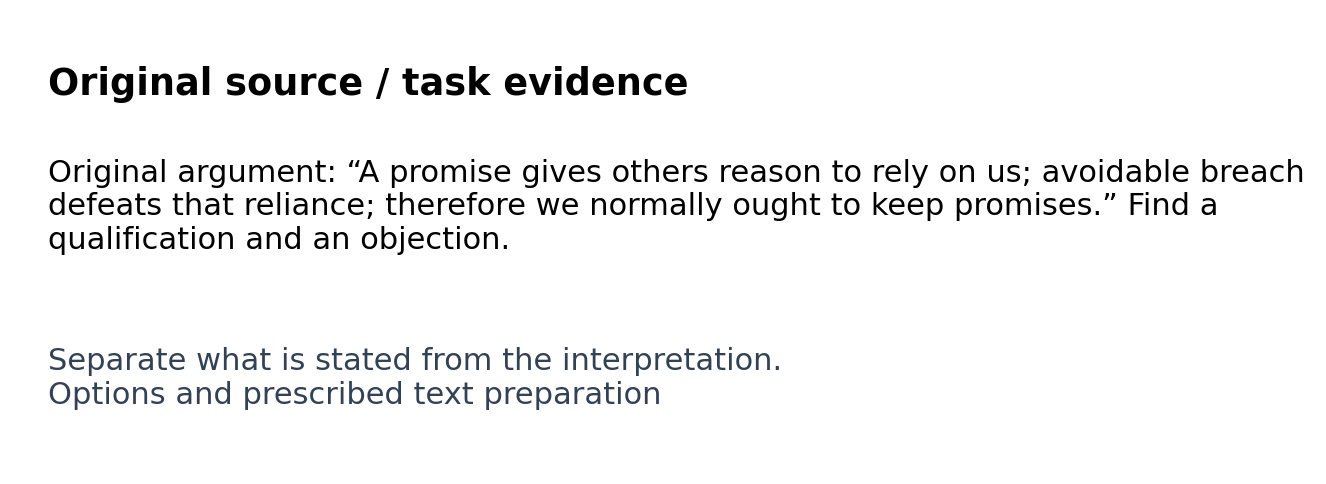
Original argument: “A promise gives others reason to rely on us; avoidable breach defeats that reliance; therefore we normally ought to keep promises.” Find a qualification and an objection.

Normally allows exceptions. A harmful promise or conflicting obligation challenges an unconditional duty, but not necessarily the qualified claim. Explain whether the justification is reliance, consequences or another principle.

Independent transfer

A promise conflicts with preventing serious harm. Revise the original argument without abandoning reasons.

Attempt independently before reading the model.

Checked original model

A qualified duty can hold when keeping the promise does not conflict with a weightier justified obligation. Explain why reliance still matters and how harm is assessed, then address whether the exception is too broad. A qualification needs a principle, not permission to break any inconvenient promise.

These are authored formative expectations, not official IB descriptors. Accept other justified arguments with evidence and material limits.

Source and task holds

This supplement teaches the method for this part of the course. The full assessment criteria and any texts your school chooses come from your teacher.

Interactive lessons on this topic

Work through it step by step, with instant-check exercises.

Log in or create account

IGCSE, A-Level & AP