Skip to content

Being human · Arguments, identity and personhood

International Baccalaureate · IB Diploma · Philosophy · SL · Topic 1

Video lesson for this topic Open the video page
5:16

Being human

In 1848 an explosion drove an iron rod through the head of Phineas Gage, a railway worker in Vermont. He survived, and could walk and talk. But his friends…

English narration · English + 中文 subtitles burned in

1.1

Being human

IB Diploma Programme Philosophy SL (the guide first assessed in 2024). This topic covers the core theme 核心主题, being human, which every SL and HL student studies. It is examined in Section A of Paper 1, where you answer one question on a stimulus 材料 (a short text or an image) by finding a philosophical issue in it and discussing it. Paper 1 lasts 1 hour 45 minutes at SL (50%) and 2 hours 30 minutes at HL (40%); the rest of the paper is essays on the optional themes (topic 02). The core theme's ideas (identity, personhood, freedom, mind) appear in every other part of the course.

In September 1848 an explosion drove an iron rod through the head of Phineas Gage, a railway worker in Vermont. Amazingly, he survived and could walk and talk. But his doctor reported that his friends said he was "no longer Gage": the polite, careful worker had become rude and unreliable. Was he still the same person? If his character changed because his brain changed, is a person just a brain? Could he be blamed for his new behaviour? These are the questions of being human.

Must-know for the core theme:

Area Key content
arguments premises and conclusion; valid and sound; deduction and induction; fallacies; thought experiments
identity what makes you the same person over time: body, memory, psychological continuity
personhood what makes a being a person; who is included
freedom hard determinism, libertarianism, compatibilism; moral responsibility
mind dualism and physicalism; the knowledge argument
Paper 1 Section A find the issue in the stimulus; argue; answer objections; conclude
Vocabulary Train
English
core theme
stimulus/ˈstɪmjʊləs/
1.2

Arguments: the philosopher's tool

Philosophy 哲学 works by argument 论证: reasons, called premises 前提, that support a conclusion 结论.

  • An argument is valid 有效的 if the conclusion must be true when the premises are true. Validity is about form only.
  • An argument is sound 可靠的 if it is valid and its premises are actually true.
  • Deductive 演绎的 arguments aim at certainty; inductive 归纳的 arguments move from many cases to a probable conclusion.

Common fallacies 谬误 (errors in reasoning):

Fallacy What it does Example
begging the question assumes the conclusion in a premise "God exists because the Bible says so, and the Bible is true because it is God's word."
straw man attacks a weaker version of the other view "Determinists say we are robots, but we are not robots."
false dilemma offers only two options when there are more "Either we have total free will or none at all."
appeal to authority uses a famous name instead of a reason "Einstein believed it, so it must be true."

Philosophers also use thought experiments 思想实验: imagined cases that test a concept. Read each one twice: once for what it shows, and once for what it assumes.

Worked example. "Every event has a cause. My choices are events. So I am not free." The argument needs a hidden premise: "caused choices are not free". That premise is exactly what compatibilists deny, so the argument does not prove its conclusion against them.

An argument map: P1 every event has a cause leads to C1 my choices have causes; C1 together with a dashed, suppressed premise P2, caused choices are not free, leads to C2 I am not free; the compatibilist denies P2

The inference to 'not free' needs a hidden premise, and that premise is what is in dispute

Vocabulary Train
English
philosophy/fɪˈlɒsəfi/
argument/ˈɑːɡjuːmənt/
premise/ˈpremɪs/
conclusion/kənˈkluːʒn/
valid
sound/saʊnd/
deductive/dɪˈdʌktɪv/
inductive/ɪnˈdʌktɪv/
fallacy
thought experiment/θɔːt ekˈsperɪmənt/
1.3

Personal identity

Personal identity 人格同一性 asks what makes you the same person as the child in your old photographs.

Theory Answer Problem case
body theory 身体理论 the same living body the ship of Theseus: replace every plank over time; is it the same ship?
memory theory 记忆理论 (John Locke) the same memories and consciousness Thomas Reid's brave officer: the old general remembers being the young officer, who remembers being a boy, but the general has forgotten the boy
psychological continuity 心理连续性 (Derek Parfit) overlapping chains of memories, beliefs and character a teleporter that makes two copies of you: which one is you?

Reid's case shows that memory alone fails: identity must carry over (if A = B and B = C, then A = C), but memory does not. Parfit answers that what matters is not strict identity but continuity, which can come in degrees, as Phineas Gage's story suggests.

Vocabulary Train
English
personal identity/ˈpɜːsənl aɪˈdentɪti/
body theory/ˈbɒdi ˈθɪəri/
memory theory/ˈmeməri ˈθɪəri/
psychological continuity
1.4

Personhood

Personhood 人格 is a moral idea, not a biological one. A human 人类 is a member of our species; a person 人 is a being with certain abilities: consciousness, reason, self-awareness, communication, moral responsibility. The two groups may not match exactly. Some philosophers argue that great apes or future AI might be persons; others ask whether newborn babies or people in a coma meet the criteria. This is why personhood matters in debates on abortion, the end of life, animal rights and artificial intelligence.

Vocabulary Train
English
personhood/ˈpɜːsənhʊd/
human
person/ˈpɜːsn/
1.5

Freedom

The free will 自由意志 problem: if every event has a cause, can any choice be free?

A two-by-two grid: the columns ask whether determinism is true, the rows ask whether free will is compatible with determinism; hard determinism (true, incompatible, so no free will), libertarianism (false, incompatible, so free will), and compatibilism (true, compatible, so free will)

The three positions answer two different questions: is determinism true, and could free will exist if it were?

Position Claim Main problem
hard determinism 强决定论 every choice is caused, so there is no free will and no real moral responsibility punishment and praise seem unfair, yet we cannot stop using them
libertarianism 自由意志论 some choices are not fully caused; the agent starts them an uncaused choice looks random, not controlled
compatibilism 相容论 a free act is one caused by your own desires and reasons, without force if your desires were themselves caused (by genes, upbringing), are they really "yours"?

Harry Frankfurt's "unwilling addict" helps the compatibilist: the addict takes the drug, but wishes he did not want it. He is unfree not because his act was caused, but because he acts on a desire he rejects. Freedom, on this view, means acting on desires you accept.

Vocabulary Train
English
free will/friː wɪl/
hard determinism
libertarianism
compatibilism
1.6

Mind and body

Dualism 二元论 (associated with René Descartes) says the mind is different from the body: thoughts and feelings are not physical things. Physicalism 物理主义 says everything, including the mind, is physical: a thought is a brain process.

  • The knowledge argument 知识论证 (Frank Jackson): Mary is a scientist who knows every physical fact about colour but has lived all her life in a black-and-white room. When she first sees red, does she learn something new? If yes, not all facts are physical.
  • Phineas Gage supports physicalism: damage to the brain changed the person.
Vocabulary Train
English
dualism/ˈdjuːəlɪzəm/
physicalism/ˈfɪzɪkəlɪzəm/
knowledge argument
1.7

Answering a Section A question

  1. Identify the philosophical issue 哲学问题 in the stimulus and link it to the core theme ("the stimulus raises the question of whether ...").
  2. Explain two or three positions with named philosophers.
  3. Evaluate: give the strongest objection to each and a reply.
  4. Reach a clear conclusion that follows from your arguments.

Worked plan. Stimulus: a news report about a person whose personality changed after a brain injury.

  • Issue: does personal identity depend on psychological continuity?
  • Positions: the body theory (same person, same body); Parfit's psychological continuity (identity weakens as character changes).
  • Objections: the body theory ignores what we care about in a person; Parfit's view makes identity vague.
  • Conclusion: the case supports Parfit; the person is partly, not wholly, the same, and we should judge their new behaviour with care.
Vocabulary Train
English
philosophical issue
1.8

Checklist

  • Arguments: premises and conclusion; valid and sound; deduction and induction; four fallacies; thought experiments; hidden premises.
  • Identity: body, memory and psychological continuity theories with their problem cases (Theseus, Reid's officer, the teleporter).
  • Personhood: human versus person; why the idea matters ethically.
  • Freedom: hard determinism, libertarianism, compatibilism, and Frankfurt's unwilling addict.
  • Mind: dualism, physicalism, Jackson's knowledge argument.
  • Section A: issue, positions, objections, conclusion.
Additional notes PDF
Supported preparation: Premises and personhood

Scope and prerequisites

IB philosophy first assessment 2025. Core Being human; one optional theme at SL, two at HL; one school-selected prescribed text. HL extension is Philosophy and contemporary issues. No unverified prescribed text is chosen by default.

Mapped preparation outcomes: ib_philosophy_sl.1.1, ib_philosophy_sl.1.2. Read the matching native lesson first. Actual approved choices, evidence and final learner work remain separate.

Source vocabulary

premise 前提; validity 有效性.

Explanation and worked method

A premise gives a reason; a conclusion is the claim those reasons aim to support. Validity concerns whether true premises would guarantee the conclusion. Soundness also requires true premises. A definition of personhood must be argued for and tested, not assumed from everyday wording.

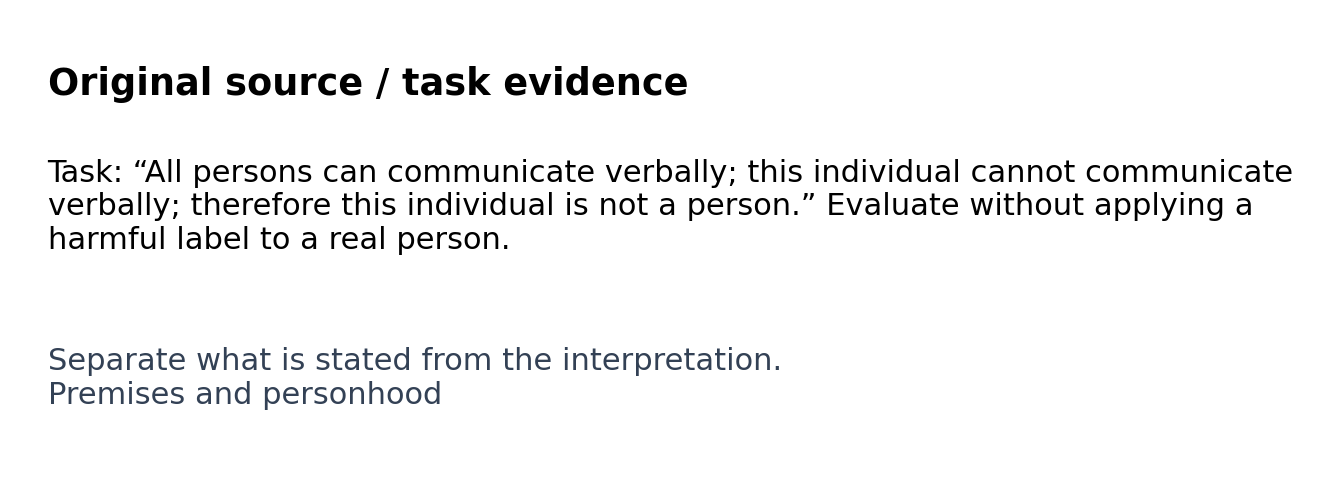
Original classroom evidence panel for Premises and personhood

Task: “All persons can communicate verbally; this individual cannot communicate verbally; therefore this individual is not a person.” Evaluate without applying a harmful label to a real person.

The argument has the valid denying-the-consequent form if the first premise is accepted. The premise is highly contestable: temporary inability to speak is a counterexample to using verbal performance as a necessary condition. A valid form does not establish soundness.

Independent transfer

Propose consciousness as a personhood criterion and identify a difficulty in applying it.

Attempt independently before reading the model.

Checked original model

A consciousness criterion can link personhood to experience, but its necessity, sufficiency and meaning need argument. Temporary unconsciousness challenges a momentary test, and other minds raise evidential problems. Distinguish the concept from a performance proxy and consider a defensible revision.

These are authored formative expectations, not official IB descriptors. Accept other justified arguments with evidence and material limits.

Source and task holds

This supplement teaches the method for this part of the course. The full assessment criteria and any texts your school chooses come from your teacher.

Interactive lessons on this topic

Work through it step by step, with instant-check exercises.

More topics in International Baccalaureate · IB Diploma · Philosophy · SL

Log in or create account

IGCSE, A-Level & AP