Skip to content

HL extension · Philosophy and contemporary issues

International Baccalaureate · IB Diploma · Philosophy · HL · Topic 4

Video lesson for this topic Open the video page
3:39

Philosophy and contemporary issues

In 1950 Alan Turing asked: can machines think? He replaced the question with a test: if a judge talking by text cannot tell a machine from a human, we should…

English narration · English + 中文 subtitles burned in

4.1

Philosophy and contemporary issues

IB Diploma Programme Philosophy HL (the guide first assessed in 2024). This topic is the HL extension 高级程度拓展, philosophy and contemporary issues, which only HL students study. It asks two kinds of question: what philosophy can say about today's problems (artificial intelligence, the environment, technology and society), and what philosophy itself is: its nature, function, meaning and methodology 方法论. Paper 3 (1 hour 15 minutes, 20% of HL) gives you an unseen text of about 800 words in which a writer discusses a contemporary issue, and asks you to respond to it as a philosopher.

In 1950 the mathematician Alan Turing asked: "Can machines think?" He replaced the question with a test: if a judge talking by text cannot tell a machine from a human, we should say the machine thinks. Seventy years later, people talk every day with AI systems that pass versions of his test. Has science answered Turing's question, or has it only shown that the question was never purely scientific? Paper 3 asks you to see what philosophy, and only philosophy, can add.

Must-know for the HL extension:

Area Key content
Paper 3 an unseen 800-word text on a contemporary issue; 1 hour 15 minutes; 20% of HL
what philosophy is conceptual analysis, argument, thought experiments and intuitions
philosophy and science which parts of a question are conceptual and which are empirical
contemporary issues AI and minds; obligations to future generations and animals; technology and freedom
method identify the issue; analyse the text's method; evaluate; reflect on philosophy's role
Vocabulary Train
English
HL extension
methodology
4.2

What is philosophy doing?

  • Conceptual analysis 概念分析: making clear what our concepts mean (what counts as "thinking", "a person", "harm").
  • Argument: testing reasons with the tools of topic 01 (premises, validity, hidden premises).
  • Thought experiments 思想实验 and intuitions 直觉: imagined cases that test our concepts. But intuitions can differ between cultures and people, so how much should they count?

Science tells us what is the case; much of philosophy asks what our concepts mean and what should be the case. Many contemporary questions mix the two.

The question whether a machine can think splitting into a conceptual part for philosophy and an empirical part for science
Philosophy keeps the conceptual and empirical parts of the question apart.
Vocabulary Train
English
conceptual analysis/kənˈseptʃuːəl əˈnæləsɪs/
thought experiment/θɔːt ekˈsperɪmənt/
intuition/ɪntjuːˈɪʃn/
4.3

Contemporary issues

Artificial intelligence and minds

Position Claim
the Turing test 图灵测试 (1950) if a machine's conversation cannot be told apart from a human's, call it thinking
the Chinese room 中文屋 (John Searle, 1980) a person who follows a rule book to answer Chinese messages, without understanding Chinese, could pass the test; so following rules is not understanding
functionalism a mind is defined by what it does, not what it is made of, so a machine could have one

The debate connects to personhood (topic 01): if an AI had a mind, would it have rights? And to responsibility: when an AI system causes harm, who is to blame?

The environment and future people

Derek Parfit's non-identity problem 非同一性问题: our policies today change which people will be born in the future. If a careless policy leads to different people being born, none of them is worse off than they would otherwise have been, because otherwise they would not exist. So whom have we harmed? Most people still feel that leaving a damaged planet is wrong, which suggests that "harm to a particular person" cannot be the whole of ethics. Other questions: do animals have moral status because they can suffer (Peter Singer)? Does nature have value in itself?

Technology and freedom

Recommendation algorithms choose what we see and suggest what we buy. If your choice was shaped by a system designed to keep you watching, is it still free? A compatibilist (topic 01) might say yes, if you act on desires you accept; a critic replies that the system shapes the desires themselves.

Vocabulary Train
English
Turing test
Chinese room
non-identity problem
4.4

Answering Paper 3

  1. Identify the issue and the writer's main claim.
  2. Analyse the method: is the writer analysing a concept, using a thought experiment, relying on intuitions or on scientific evidence?
  3. Evaluate: the strengths and weaknesses of the argument; other positions.
  4. Reflect on philosophy itself: what does this text show about what philosophy can and cannot do on this issue?

Worked plan. An unseen text argues that because AI chatbots can now pass the Turing test, the question whether machines think has been settled by science.

  • Issue and claim: whether passing the Turing test settles the question of machine thought.
  • Method: the writer treats a conceptual question (what is thinking?) as if it were empirical (what can the system do?).
  • Evaluation: Searle's Chinese room shows that behaviour and understanding can come apart; but a functionalist would reply that understanding just is the right kind of behaviour.
  • Reflection: science can tell us what the systems do; philosophy must decide what would count as thinking. The text shows why philosophy remains necessary even when the technology advances.
4.5

Checklist

  • Paper 3: an unseen 800-word text; 1 hour 15 minutes; 20% of HL.
  • What philosophy is: conceptual analysis, argument, thought experiments and intuitions; conceptual and empirical questions.
  • AI: the Turing test, the Chinese room, functionalism; rights and responsibility.
  • Environment: Parfit's non-identity problem; animals; the value of nature.
  • Technology and freedom: algorithms and compatibilism.
  • The four steps for Paper 3 and the worked plan.
Additional notes PDF
Supported preparation: HL unseen text and normative bridges

Scope and prerequisites

IB philosophy first assessment 2025. Core Being human; one optional theme at SL, two at HL; one school-selected prescribed text. HL extension is Philosophy and contemporary issues. No unverified prescribed text is chosen by default.

Mapped preparation outcomes: ib_philosophy_hl.4.1, ib_philosophy_hl.4.2. Read the matching native lesson first. Actual approved choices, evidence and final learner work remain separate.

Source vocabulary

accountability 问责性; normative claim 规范性主张.

Explanation and worked method

For an unseen text, identify its question, premises, conclusion and method, then evaluate what it is doing philosophically. Descriptive accuracy does not automatically establish a normative decision rule.

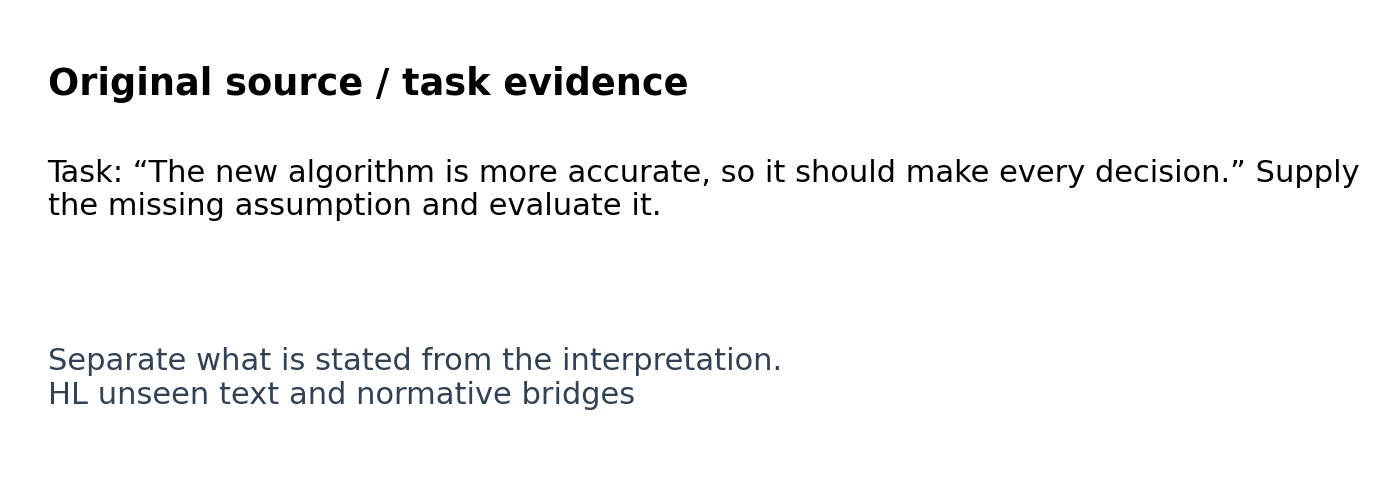
Original classroom evidence panel for HL unseen text and normative bridges

Task: “The new algorithm is more accurate, so it should make every decision.” Supply the missing assumption and evaluate it.

The argument assumes accuracy always outweighs accountability, rights and other values. Challenge that priority with a case where explanation or appeal matters; acknowledge that accuracy can still have substantial value.

Independent transfer

Rewrite the algorithm conclusion to incorporate accountability without ignoring accuracy.

Attempt independently before reading the model.

Checked original model

Use the system for a specified decision class only where relevant validation, explanation, appeal and human accountability meet justified standards. Accuracy can support this conditional recommendation but cannot by itself override every right or value. Test the revised premises and exceptions.

These are authored formative expectations, not official IB descriptors. Accept other justified arguments with evidence and material limits.

Source and task holds

This supplement teaches the method for this part of the course. The full assessment criteria and any texts your school chooses come from your teacher.

Interactive lessons on this topic

Work through it step by step, with instant-check exercises.

More topics in International Baccalaureate · IB Diploma · Philosophy · HL

Log in or create account

IGCSE, A-Level & AP