Skip to content
Subjects

International Baccalaureate · IB Diploma · Language B · HL

  • 1

    Productive skills; five themes · English audience, register and purposeful writing

    Learning program coming soon

    Handout

    Scope and prerequisites

    IB Language B first assessment 2020; English B focus. This supplemental reference covers only the listed preparation outcomes. School selections, full-guide procedures and required live or recorded performance are separate.

    • Choose an appropriate text type and register 语域
    • Organize an English response that addresses purpose, audience and required content

    Prerequisites: Clear paragraphs; audience; purpose; present and future expressions.

    Explain and choose the method

    A proposal 提案 usually states a need, a practical plan and expected benefits. A friendly message can use a more personal tone.

    Grammar and vocabulary should serve the message; a memorized opening cannot compensate for missing task content.

    A proposal identifies a need, a practical plan and expected benefits. Use polite recommendations for a principal; a friendly message can address a peer directly. A complete response must meet every task cue. Word count 字数 does not compensate for missing content. The companion supplies separate original SL and HL models with counted final words and a cue checklist.
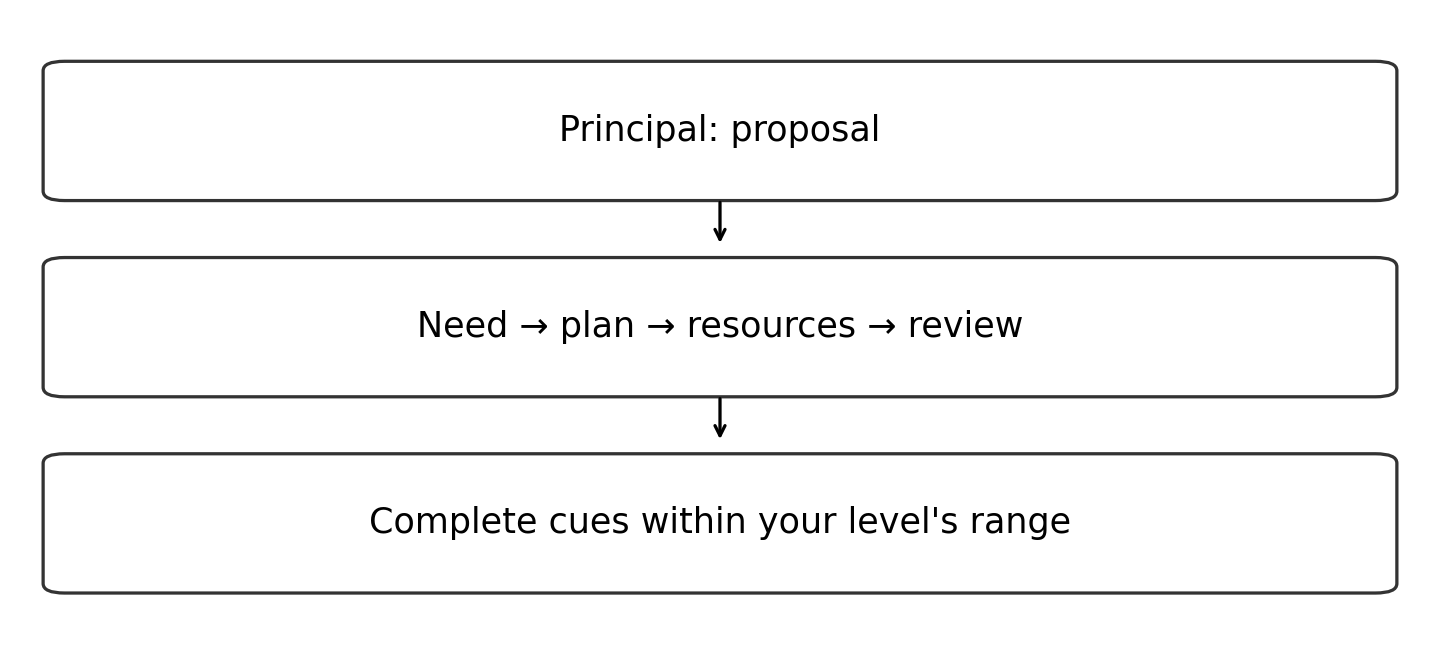
    Original diagram of the worked relationship; read the full wording and qualifications.
    Original diagram of the worked relationship; read the full wording and qualifications.

    Existing worked example: For a proposal about a reading club, identify the purpose, meeting schedule, supervision and expected benefit. Use polite, specific recommendations. We recommend a supervised Thursday meeting is clearer than we must have a great club soon.

    Complete original context

    Original task: Write a proposal to your school principal for a weekly reading-and-repair club. Explain the need, meeting arrangements, supervision and resources, expected benefits, and how you would judge the first month's success. Address one practical concern and ask for a clear decision. Use the current course's level-appropriate word range: SL 250–400; HL 450–600. This is original teaching practice, not an official specimen task.

    Independent practice and checked reasoning

    Transfer 1

    Choose a suitable text type and register. Plan all required content before writing.

    Reasoning: A proposal with a title, purpose, short sections and polite recommendation suits the principal. Include need; weekly time/place; supervision/resources; benefits; first-month review; practical concern/response; requested approval. A casual chat with unexplained abbreviations would not fit this formal audience.

    Transfer 2

    Write the complete response within your level's word range. Compare it with the separate model, checking cues and relevant detail 细节 rather than memorising its opening.

    Reasoning: Use the companion's complete SL or HL model as one possible response. Alternatives should meet the same audience, purpose, arrangements, supervision, benefits, review, concern and decision cues. Check actual final words and coherent language; classroom guidance is not an official criterion score.

    Purpose and need

    I propose a weekly reading-and-repair club that would help students use English instructions for a practical purpose. In ordinary reading lessons, we can sometimes identify vocabulary without checking whether we could carry out the process described. A club would make that gap visible. Students would need to explain a sequence, recognise a warning and ask for clarification before attempting a task. The aim would be careful communication, not the largest possible number of repaired objects.

    Meeting arrangements

    We recommend a one-month trial on Thursdays from four to five in the library meeting room. The first group should contain no more than twelve students, working in pairs. A teacher would supervise each meeting, with advice from a qualified repairer when tasks are selected. The library desk could maintain one sign-up list. Students could register online or on paper, so access would not depend on having a suitable device or understanding an unfamiliar form.

    Resources and activities

    The club would need short instruction texts, pencils, simple hand tools, spare screws and a labelled storage box. Before a session, the teacher would check that its task is suitable for the group and available equipment. Students should not bring mains-powered appliances or damaged batteries. Items requiring specialist safety checks would be referred to a professional. A clear refusal to attempt an unsafe repair would count as a responsible decision, rather than a failure of the club.

    A typical meeting would begin with students reading an instruction sheet independently. Pairs would compare the required materials and order the steps. They would then identify one point where guessing could cause a problem and practise asking a precise question. Only after the teacher checks their understanding would they attempt a permitted task, such as replacing a loose handle screw. At the end, students would explain what they changed, what they could not establish and what should happen next.

    Expected benefits and concerns

    This process would connect reading, discussion and action. Students who are reluctant to speak may find a concrete task easier to discuss than an abstract topic. They would also practise describing faults and distinguishing evidence 证据 from assumptions. These are expected benefits that the trial should investigate, not guaranteed improvements for every participant.

    Supervision is the main practical concern. A busy meeting could draw attention away from a student who needs help. We therefore propose the small group limit, one shared task per session and a clear rule that work stops when the teacher is assisting another pair. If the room becomes noisy or supervision is difficult, we should reduce the task range before adding places.

    Review and decision

    After four meetings, we would review attendance, students' explanations of the instructions, requests for clarification and the teacher's supervision notes. A short anonymous comment form could reveal obstacles that confident speakers overlook. We would then recommend whether to continue, revise or stop the trial. Please approve the meeting room and a planning discussion with the librarian and supervising teacher. No equipment should be purchased until that discussion confirms the tasks and available resources.

    Classroom model: 509 words. Complete need and audience; weekly arrangement; supervision and resource detail; expected benefits qualified; practical concern and response; four-meeting evidence review; explicit decision and purchasing condition.

    Transfer 3

    Change the audience to a friend inviting them to join the club. Rewrite two opening sentences and explain the register change.

    Reasoning: “Hi Mei, would you like to join our new reading-and-repair club on Thursdays? We could read short instructions together and learn a few safe repairs.” Direct address and a friendly invitation fit a peer. The time and activity stay clear; a formal request for the principal's approval would answer the wrong purpose.

    Limits and next use

    English B is language acquisition, not Language A literary criticism. Follow the SL or HL word range and task choice; do not pad the response with unrelated memorized phrases.

    All tasks here are public original practice with authored guidance. They are not official questions or fresh diagnostics. Existing protected tests and mocks remain separate.
    Vocabulary
    English
    word count
    evidence/ˈevɪdəns/
    proposal/prəˈpəʊzl/
    register/ˈredʒɪstə/
    detail/ˈdiːteɪl/
  • 2

    Receptive skills · English listening and reading inference

    Learning program coming soon

    Handout

    Scope and prerequisites

    IB Language B first assessment 2020; English B focus. This supplemental reference covers only the listed preparation outcomes. School selections, full-guide procedures and required live or recorded performance are separate.

    • Identify stated details, speaker purpose and supported inference 推断
    • Use context to resolve unfamiliar vocabulary and distinguish fact from opinion

    Prerequisites: Stated detail 细节 versus opinion; contrast markers; contextual vocabulary.

    Explain and choose the method

    Read or listen for the whole message before isolating a word. Contrast markers such as but can change the interpretation of a sentence.

    An inference must be supported by the text; plausible outside knowledge is not enough.

    Read for the whole message before selecting a detail. A contrast marker 转折标记 can qualify a positive evaluation. Teacher-read rehearsal 排练 教师朗读演练 : close the script while a teacher reads it twice. Then answer from listening before inspecting the transcript. This provides a complete script, but no verified recording or listening-delivery claim.

    Original diagram of the worked relationship; read the full wording and qualifications.
    Original diagram of the worked relationship; read the full wording and qualifications.

    Existing worked example: Longer than expected signals an inconvenience. Made it worthwhile then gives a positive overall evaluation of the view. A suitable answer preserves both parts rather than selecting only the negative clause.

    Complete original context

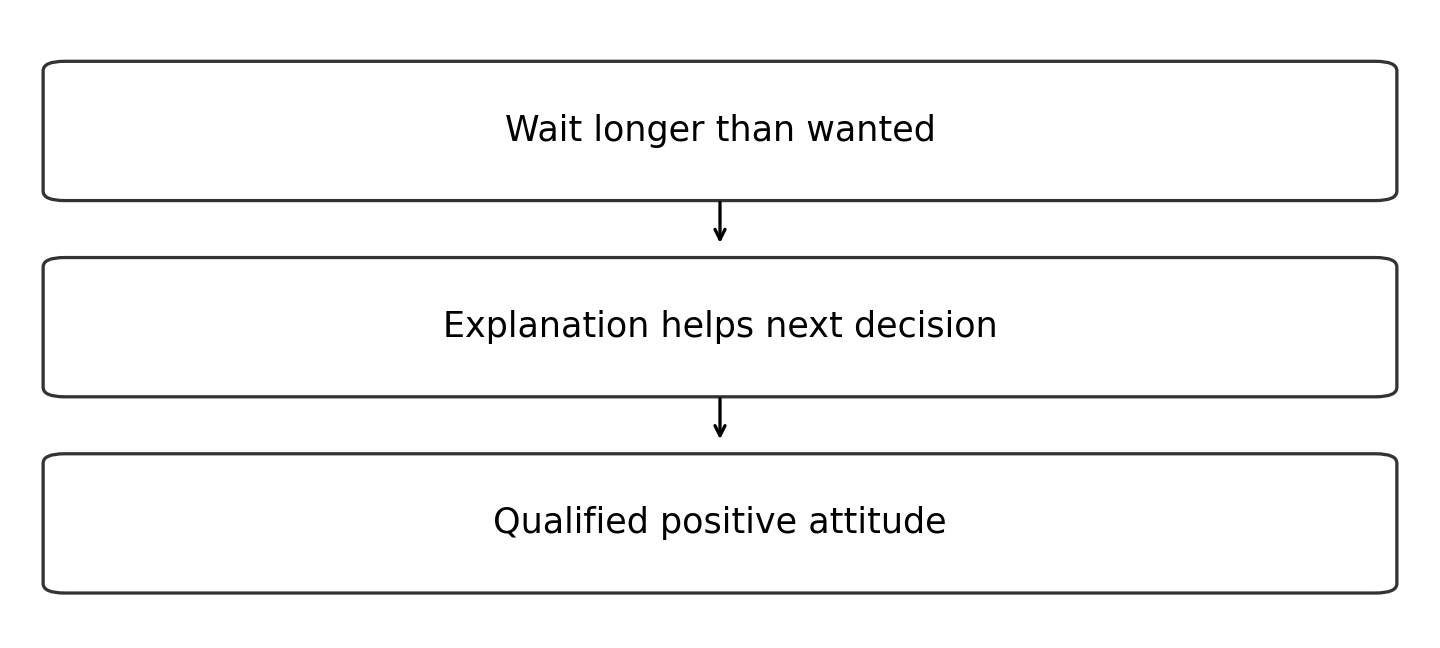
    Original teacher-read script — Sana's library visit: “I expected the new repair session to be noisy, but the meeting room was calmer than I imagined. I took a battery-powered clock, not my old electric kettle, because the notice excluded mains-powered items. A volunteer checked the clock while I stayed at the table. She found a loose part, but could not promise that replacing it would solve every problem. I thought her explanation was reassuring: it helped me understand what to do next. I waited twenty minutes, which was longer than I wanted. Even so, I would attend again because I learned how to describe the fault clearly. Next month I plan to book an earlier arrival window.”

    Independent practice and checked reasoning

    Transfer 1

    What did Sana bring, why did she not bring the kettle, and how long did she wait?

    Reasoning: A battery-powered clock; the notice excluded mains-powered items such as the kettle; twenty minutes. The script does not say the kettle was repaired or that the wait was short.

    Transfer 2

    Explain reassuring in context and distinguish two stated observations from Sana's opinions.

    Reasoning: Reassuring means reducing concern by clarifying the next step; the following explanation supplies the clue. Bringing the clock and waiting twenty minutes are reported events. Calling the explanation reassuring and wanting a shorter wait are personal evaluations. The calmer room is Sana's comparison with her expectation, not a measured noise study.

    Transfer 3

    State Sana's overall attitude, preserving both positive and negative evidence 证据. What can typed answers certify about listening or pronunciation?

    Reasoning: Qualified positive: the wait was unwelcome, but the explanation and learning make another visit worthwhile. She plans to book earlier. Typed answers can show textual understanding; they do not certify that the learner heard the audio unaided or performed pronunciation. Recording and delivery remain pending.

    Limits and next use

    A transcript is useful for analysis but does not replace listening practice with real audio. This package needs school-recorded or licensed listening material before receptive-skill parity can be claimed.

    All tasks here are public original practice with authored guidance. They are not official questions or fresh diagnostics. Existing protected tests and mocks remain separate.
    Vocabulary
    English
    teacher-read rehearsal
    contrast marker/ˈkɒntræst ˈmɑːkə/
    inference/ˈɪnfərəns/
    rehearsal/rɪˈhɜːsl/
    evidence/ˈevɪdəns/
    detail/ˈdiːteɪl/
  • 3

    Interactive skills · English oral communication and follow-up

    Learning program coming soon

    Handout

    Scope and prerequisites

    IB Language B first assessment 2020; English B focus. This supplemental reference covers only the listed preparation outcomes. School selections, full-guide procedures and required live or recorded performance are separate.

    • Describe and interpret a stimulus 提示材料 with a cultural connection 文化联系
    • Respond to questions and develop an interaction 互动 in English

    Prerequisites: Describe visible facts; qualify cultural links; answer follow-ups with reasons.

    Explain and choose the method

    At SL, the oral uses a visual stimulus linked to course themes. At HL, it begins with a literary extract from a studied work.

    Present clearly, then respond to the teacher's questions with relevant detail 细节, reasons and examples.

    At SL, use the supplied original repair notice image for a thematic rehearsal 排练 about community access; it is not an official oral picture. At HL, begin an extract rehearsal from the original literary text on sheet 4; do not substitute an SL picture for HL literature. Describe or interpret the actual stimulus, give a reasoned theme connection, then respond to a follow-up. A cultural connection needs a specific practice you have studied; no image proves nationality or a whole culture's habits.

    Original diagram of the worked relationship; read the full wording and qualifications.
    Original diagram of the worked relationship; read the full wording and qualifications.

    Existing worked example: For a visual, describe people sharing dishes, link this to a particular cultural practice you have studied and qualify the comparison. If asked about differences, explain one specific experience rather than listing stereotypes.

    Complete original context

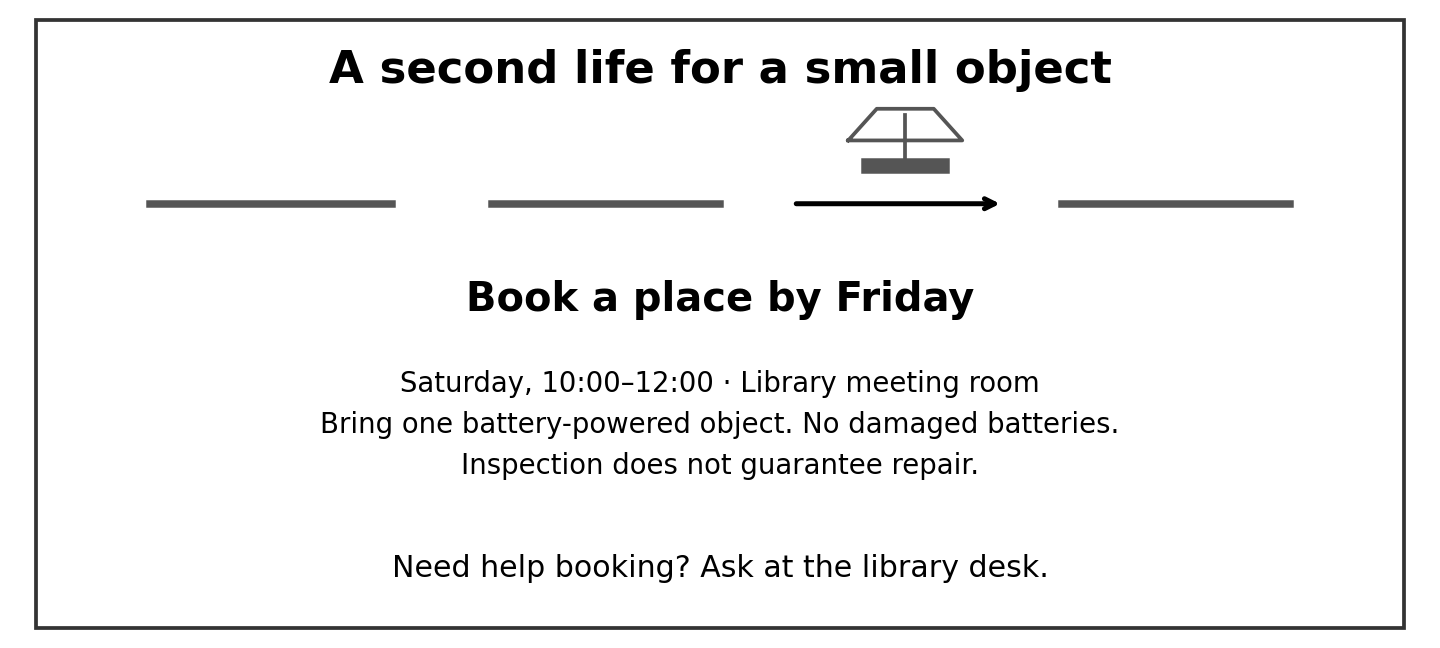
    Original non-literary stimulus — Library repair session notice. Use the actual supplied notice image with this text.

    Large heading: “A second life for a small object”. Main visual: a broken line becomes an unbroken line beside a lamp symbol. Prominent instruction: “Book a place by Friday”. Smaller text: “Saturday, 10:00–12:00. Library meeting room. Bring one battery-powered object. No damaged batteries. Inspection does not guarantee repair.” Footer: “Need help booking? Ask at the library desk.”

    The notice is an original classroom design, not a real event announcement. Its audience is local library users who may have a small broken object. Its purpose is to encourage a booking while communicating limits. A reader's actual response has not been measured.

    Independent practice and checked reasoning

    Transfer 1

    SL — describe two visible choices in the notice and connect them to community access. HL — use the literary extract on sheet 4 to explain the character's situation. Label your route clearly.

    Reasoning: SL model: “The notice has a large repair heading and a smaller offer of booking help at the desk. This could make a community activity accessible to people who need assistance, although the small footer may be less noticeable.” HL model: “Leila does the shop work, but visitors still thank her father's name. Her new card asks them to recognise her without removing the old plate.” These are stimulus-grounded rehearsals, not assessed oral certification.

    Transfer 2

    Answer “What would you change, and why?” Then answer “What is one limit on your suggestion?”

    Reasoning: SL: “I would make the desk-help line more prominent because readers may need that route. I would test whether readers notice it, because prominence alone does not guarantee use.” HL: “I would ask how visitors respond later to Leila's card. The short extract does not reveal every future response, so I cannot assume permanent recognition.” Other relevant answers with reasons and limits are valid.

    Transfer 3

    Add a connection to a specific studied English-speaking community practice. What must be supplied before you can make that connection responsibly?

    Reasoning: Name the actual practice and place from reliable class material, explain one evidenced similarity 相似 or difference, and avoid claiming everyone participates. The current original stimuli provide no verified national setting, so a specific cultural factual claim remains pending that source. Live teacher interaction and recording remain separate requirements.

    Limits and next use

    HL requires two literary works and extract-based discussion; an SL picture lesson alone does not cover that requirement. The teacher conducts and records the actual oral; self-written answers cannot substitute for interaction.

    All tasks here are public original practice with authored guidance. They are not official questions or fresh diagnostics. Existing protected tests and mocks remain separate.

    Vocabulary
    English
    cultural connection
    interaction/ˌɪntəˈrækʃn/
    similarity/ˌsɪmɪˈlærɪti/
    rehearsal/rɪˈhɜːsl/
    stimulus/ˈstɪmjʊləs/
    detail/ˈdiːteɪl/
  • 4

    HL literature · English literary extract and oral development

    Learning program coming soon

    Handout

    Scope and prerequisites

    IB Language B first assessment 2020; English B focus. This supplemental reference covers only the listed preparation outcomes. School selections, full-guide procedures and required live or recorded performance are separate.

    • Interpret an extract from one of two studied literary works
    • Connect character, voice and situation to sustained English discussion

    Prerequisites: Stated facts; supported inference 推断; communicative explanation in English.

    Explain and choose the method

    Use the extract's language and situation to interpret the character, then explain the reading in clear English.

    HL English B assesses communicative command as well as understanding of the extract; it is not a Language A technique catalogue.

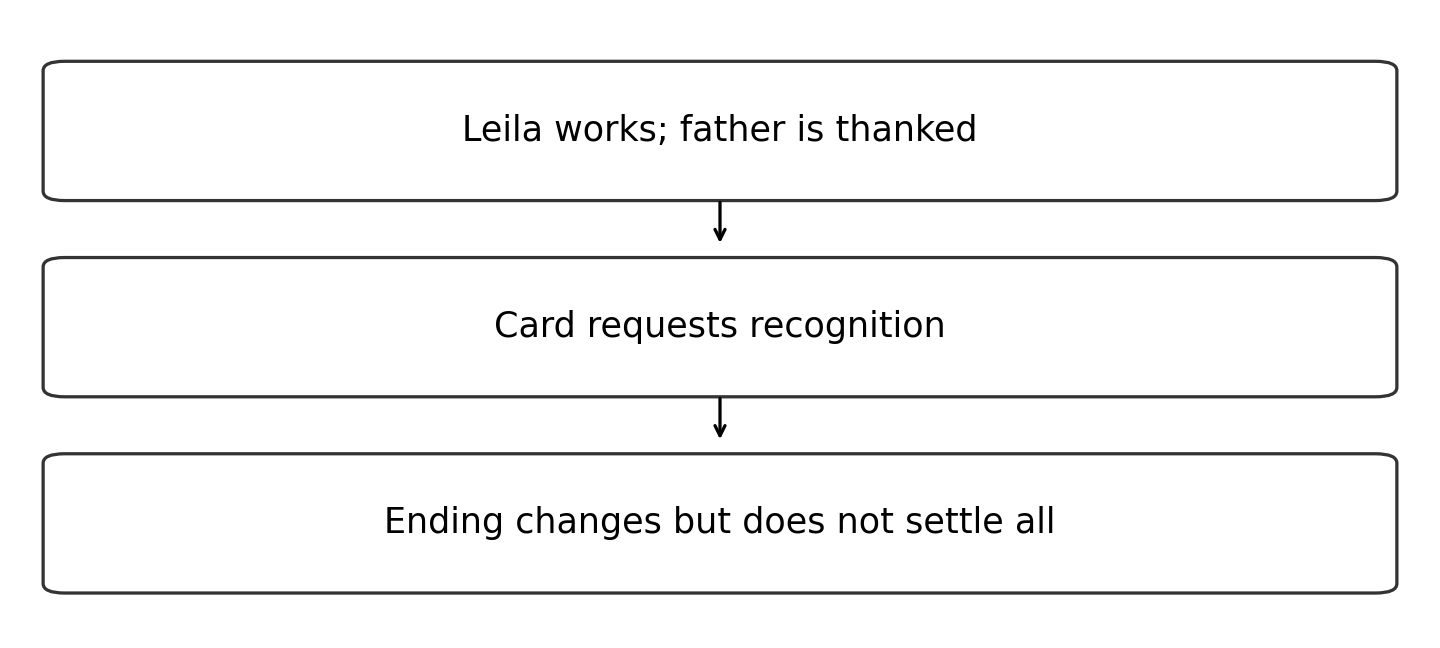
    HL English B extract work uses clear language to explain character, voice and situation. In Text A, the first-person speaker carries out the work while visitors credit her father's name. The new card supports an inference that she wants recognition. Keeping the plate complicates a simple rejection of her father. This original extract is practice only; actual HL study needs two eligible school-selected literary works.

    Original diagram of the worked relationship; read the full wording and qualifications.
    Original diagram of the worked relationship; read the full wording and qualifications.

    Existing worked example: In the original classroom vignette, the mismatch between words and behaviour may suggest unease. Explain this as a possibility supported by both details. For assessment, replace the vignette with an extract from the school's studied work and connect it to that work.

    Complete original context

    Original classroom texts, written for this supplement. They are not school-selected assessed works.

    Text A — The label Every morning I polished the brass plate beside the door. It carried my father's name, and visitors asked for him even after I took charge of the shop. I answered their questions, found the parts, and wrapped each purchase. Still, at the door, they thanked the name on the plate. One afternoon I put a small card below it: “Ask for Leila.” The next visitor read the card aloud, hesitated, and then asked me where the hinges were. I left the brass plate shining. The card stayed too.

    Text B — A space on the shelf (original poem) I cleared a place beside the cup, not where the cup had been. The shelf kept its old circle; the new wood still looked clean. By evening, two rings darkened it. I did not rub them out.

    Context supplied for this exercise: both texts are contemporary original classroom writing in English. No author biography, translation 翻译 history or evidence 证据 about a real society is supplied. Compare what the wording permits; do not invent historical facts. A real course comparison must use the school's eligible studied works.

    Independent practice and checked reasoning

    Transfer 1

    Explain Leila's situation and one supported feeling or motive, using two details. Do not list techniques without meaning.

    Reasoning: Leila has taken charge and serves visitors, but they still thank the name on her father's plate. Her “Ask for Leila” card suggests a wish to be recognised. Keeping the polished plate may show respect or continuing influence, so anger or total rejection cannot be asserted as the only motive.

    Transfer 2

    Give a sustained spoken-rehearsal 排练 response to “Does the ending solve Leila's problem?” Include evidence on both sides.

    Reasoning: “The ending shows a small change because a visitor reads Leila's name and asks her for help. However, the visitor hesitates and the old plate stays. I think the story presents recognition beginning rather than a complete solution. Keeping both labels could allow continuity, but it may also leave the father's authority visible.” Extend with relevant details and respond to a teacher; typed rehearsal does not certify delivery.

    Transfer 3

    Explain how to connect an approved extract to its whole studied work and what this short original text cannot establish.

    Reasoning: Refer to an earlier or later episode, recurring voice or changing relationship in the actual work, with accurate evidence. This short original text cannot establish study of either required literary work, the official extract procedure or live oral ability. School selection and supervised performance remain held.

    Limits and next use

    Do not claim an invented vignette satisfies the two-literary-work requirement. Teacher selects eligible works and verifies the oral procedure and timing; no generic literature lesson covers every language.

    All tasks here are public original practice with authored guidance. They are not official questions or fresh diagnostics. Existing protected tests and mocks remain separate.

    Vocabulary
    English
    translation/trænˈsleɪʃn/
    inference/ˈɪnfərəns/
    rehearsal/rɪˈhɜːsl/
    evidence/ˈevɪdəns/

Log in or create account

IGCSE, A-Level & AP