Skip to content

HL regional depth/P3 · Regional arguments and historiography

International Baccalaureate · IB Diploma · History · HL · Topic 4

Video lesson for this topic Open the video page
5:18

Regional depth: the HL option

In 1853 four American warships sailed into Edo Bay and demanded that Japan open its ports. Fifty years later Japan had a constitution, railways and a modern…

English narration · English + 中文 subtitles burned in

4.1

Regional depth: the HL option

IB Diploma Programme History HL (the guide first assessed in 2017). This topic prepares Paper 3, which only HL students sit. Schools choose one of four regions 地区: Africa and the Middle East, the Americas, Asia and Oceania, or Europe. Each region has 18 sections, and schools usually teach three of them in depth. In the exam you write three essays 论文 in 2 hours 30 minutes, each marked out of 15 (45 marks, 35% of the HL grade). The essays are marked like Paper 2, but examiners expect more precise regional detail and knowledge of how historians 历史学家 disagree.

In 1853 four American warships sailed into Edo Bay and demanded that Japan open its ports. Fifty years later Japan had a constitution, railways, a modern army and navy, and had defeated China (1895) and Russia (1905). China had faced the same Western pressure, and had also tried to reform, but in 1912 its last emperor gave up the throne. Why did two neighbours respond so differently? That is a typical Paper 3 question: it needs deep knowledge of one region and an understanding of how historians have answered it.

Must-know for Paper 3:

Area Key content
the paper three essays in 2 hours 30 minutes; 45 marks; HL only
regions Africa and the Middle East; the Americas; Asia and Oceania; Europe
depth precise detail: names, laws, dates, places, numbers
historiography named historians or schools, their arguments, and why they disagree
worked depth modernisation in Japan and China, 1860–1912
Vocabulary Train
English
region/ˈriːdʒn/
essay/ˈeseɪ/
historian
4.2

What "depth" means

Paper 2 asks about the world; Paper 3 asks about one region in more detail. Compare two answers about Japan's reforms:

General (Paper 2 level) Precise (Paper 3 level)
Japan modernised its army. The 1873 conscription law replaced the samurai class with an army of ordinary men who served for three years.
Japan got a constitution. The 1889 Meiji Constitution created an elected lower house but kept the army under the emperor, not the cabinet.

Use the same essay plan as Paper 2: a thesis, three argued paragraphs with evidence, a counter-argument and a judgement. Spend about 45 minutes on each essay, with 5 minutes to plan. Choose the questions where your knowledge is deepest, not the ones that look shortest.

4.3

Historiography

Historiography 史学史 is the study of how historians have written about the past. Historians disagree because they use different sources, ask different questions, and write at different times. In a Paper 3 essay:

  1. Name the historian or school of thought 学派 ("Fairbank argued ...", "Marxist historians ...").
  2. State their interpretation 解释 in one sentence.
  3. Explain why it differs from others (sources, time, approach).
  4. Use evidence to decide which view is more convincing.
Three schools on empire leading to the questions an essay asks and a judgement
Name the schools, explain why they disagree, then judge on the evidence.

Historiography supports your argument; it does not replace it. A list of historians' names without your own judgement earns few marks.

Vocabulary Train
English
historiography/ˌhɪstɔːrɪˈɒɡrəfi/
school of thought
interpretation/ɪnˌtɜːprɪˈteɪʃn/
4.4

The four regions

Region Commonly taught sections
Africa and the Middle East European imperialism and the partition of Africa; independence movements; the Arab–Israeli conflict; post-independence politics
the Americas the US Civil War 内战; the Mexican Revolution; the Great Depression and the New Deal; the Cold War in the Americas; civil rights
Asia and Oceania early modernisation and imperial decline in East Asia (1860–1912); China and Korea (1910–1950); Japan in the 20th century; independence in South and Southeast Asia
Europe the French Revolution and Napoleon; the unification of Italy and Germany; imperial Russia and the revolutions of 1917; interwar Germany and Italy; the Second World War; the Soviet Union and Eastern Europe after 1945
Vocabulary Train
English
civil war/ˈsɪvl wɔː/
4.5

Worked depth: Japan and China, 1860–1912

Japan: the Meiji Restoration

Date Event
1853–54 US warships under Commodore Perry force Japan to open ports
1868 the Meiji Restoration 明治维新: the shogun's rule ends; power returns to the emperor; the Charter Oath promises reform
1871 the old domains are abolished and replaced with prefectures
1871–73 the Iwakura Mission studies the US and Europe
1872–73 a national school system; the conscription law; a new land tax
1889 the Meiji Constitution
1894–95 victory over China; the Treaty of Shimonoseki gives Japan Taiwan
1902 the Anglo-Japanese Alliance
1904–05 victory over Russia
1910 Japan annexes Korea

China: reform from within the Qing

Date Event
1861–95 the Self-Strengthening Movement 洋务运动: arsenals, shipyards, a modern navy, translation schools
1895 defeat by Japan; the navy is destroyed
1898 the Hundred Days' Reform 戊戌变法: the Guangxu Emperor, advised by Kang Youwei, orders changes to exams, schools and the army; after 103 days, Empress Dowager Cixi stops them
1899–1901 the Boxer Uprising; foreign armies take Beijing; a large payment, the Boxer Indemnity
1901–11 the late Qing reforms: the civil service exams are abolished (1905); plans for a constitution
1911–12 the Xinhai Revolution 辛亥革命; the last emperor, Puyi, abdicates in February 1912

Why the difference?

Factor Japan China
political power a new group of young leaders took control of the state reform depended on officials and on the court, where Cixi held power
scale a small, compact country a huge empire with weak central control of the provinces
aims of reform change the whole state: law, army, schools, tax at first, add Western technology to keep traditional institutions ("Chinese learning as the base, Western learning for use")
outside pressure unequal treaties, but no foreign invasion foreign wars, a huge rebellion (Taiping, 1850–64) and indemnities drained money

How historians have explained it

  • The "impact–response" model. John K. Fairbank and others in the 1950s and 1960s saw China's history after 1840 mainly as a response to the Western impact. China responded slowly because its traditional institutions and ideas resisted change; Japan responded fast.
  • The China-centred approach. Paul Cohen (Discovering History in China, 1984) argued that this model made China passive. Many changes came from inside China (population growth, local reformers, the provinces) and were not just reactions to the West.
  • Modernisation theory and its critics on Japan. Some historians writing in the US in the 1960s presented Meiji Japan as a model of successful modernisation. Marxist historians in Japan (the Kōza school, from the 1930s) saw the Restoration as an incomplete revolution that created an authoritarian state and led to militarism. Later historians stressed that Tokugawa Japan already had high literacy and strong markets before 1868.

Worked essay plan. "To what extent was the failure of reform in late Qing China caused by the Qing court itself?"

  1. Thesis: to a large extent, but the court acted within limits set by China's size, rebellions and foreign pressure.
  2. The court: Cixi ended the Hundred Days' Reform in 1898, and Self-Strengthening was never allowed to change institutions.
  3. Structural limits: provincial officials such as Li Hongzhang controlled the new industries and armies; the Taiping war and indemnities left little money.
  4. Counter-argument: the post-1901 reforms were real (exams abolished in 1905), and Cohen's approach shows change coming from below; the reforms came too late to save the dynasty, not because the court did nothing.
  5. Judgement: the court's choices before 1900 were decisive; after 1901 it reformed, but by then reform raised expectations that it could not meet.
Vocabulary Train
English
Meiji Restoration
Self-Strengthening Movement
Hundred Days' Reform
Xinhai Revolution
4.6

Checklist

  • The format: three essays in 2 hours 30 minutes, 45 marks, 35% of HL.
  • Depth: precise names, laws, dates and numbers, not general statements.
  • Historiography: name the historian or school, state the view, explain the disagreement, judge with evidence.
  • The four regions and their commonly taught sections.
  • Japan 1853–1910 and China 1861–1912: the key dates; the factors that explain the different results.
  • Fairbank's impact–response model and Cohen's China-centred approach; modernisation theory and the Kōza school.
Additional notes PDF
Supported preparation: HL regional argument and historiography

Scope and prerequisites

IB history first assessment 2017; 2028 course recorded separately. School selects one of five prescribed subjects (both cases), two of twelve world-history topics; HL selects one region with three sections. No selection is silently implied. Future 2028 focused/thematic studies are a different course.

Mapped preparation outcomes: ib_history_hl.4.1, ib_history_hl.4.2. Read the matching native lesson first. Actual approved choices, evidence and final learner work remain separate.

Source vocabulary

historiography 史学史; chronology 年代顺序.

Explanation and worked method

An interpretation joins evidence to an explanatory claim. Compare historians by scope, source selection, assumptions and mechanism; a named authority is not proof. Detailed regional teaching still needs the school's three selected sections under the recorded 2017 course.

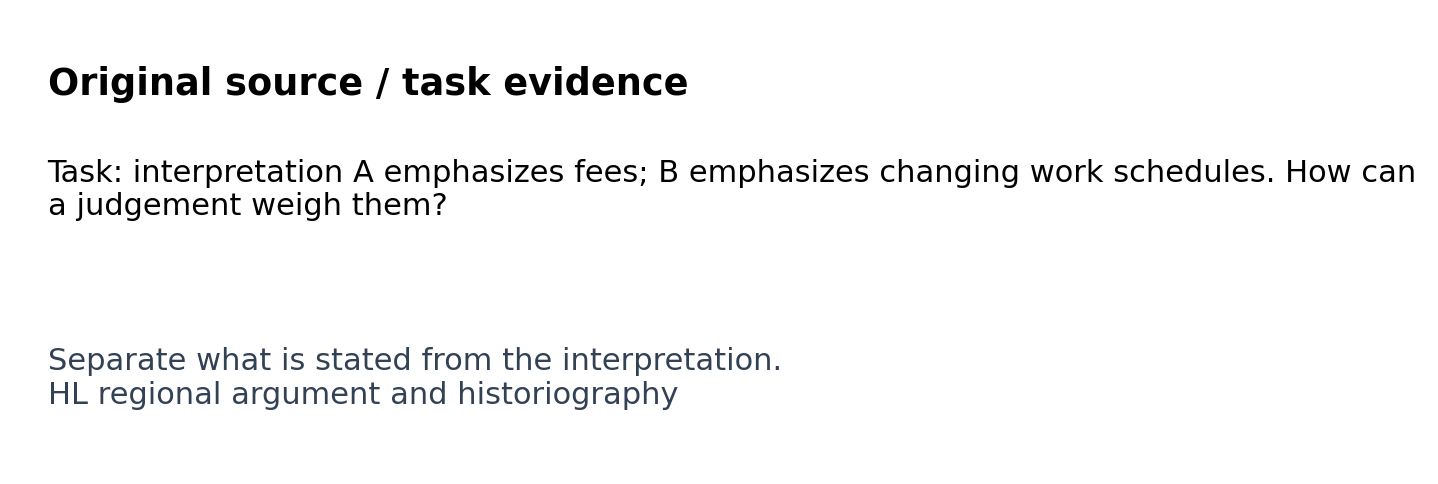
Original classroom evidence panel for HL regional argument and historiography

Task: interpretation A emphasizes fees; B emphasizes changing work schedules. How can a judgement weigh them?

Compare dated changes, attendance patterns across affected groups and alternative opportunities. Both may contribute, but explain which better accounts for timing and variation, and where evidence is thin.

Independent transfer

Work schedules explain decline among members exempt from fees. What follows for competing interpretations?

Attempt independently before reading the model.

Checked original model

This strengthens the schedule mechanism for a group whose decline fees cannot directly explain. Fees may still affect other groups or later stages. Compare timing and scope, then weigh each explanation against the variation it accounts for.

These are authored formative expectations, not official IB descriptors. Accept other justified arguments with evidence and material limits.

Source and task holds

This supplement teaches the method for this part of the course. The full assessment criteria and any texts your school chooses come from your teacher.

Interactive lessons on this topic

Work through it step by step, with instant-check exercises.

More topics in International Baccalaureate · IB Diploma · History · HL

Log in or create account

IGCSE, A-Level & AP