IB Diploma Programme History HL (the guide first assessed in 2017, examined until the 2028 course replaces it). The internal assessment is the historical investigation 历史探究: a piece of your own historical research on a topic you choose. It has a limit of 2,200 words, and the bibliography does not count towards it. It is worth 20% of the HL grade. Your teacher marks it out of 25, and the IB moderates the marks.
On 30 June 1936 the Emperor of Ethiopia, Haile Selassie, stood in front of the League of Nations in Geneva. Italy had invaded his country in October 1935, using aircraft and poison gas. The League had called Italy the aggressor and voted for sanctions 制裁, but not on oil, which Italy's army needed most. In December 1935 the British and French foreign ministers, Samuel Hoare and Pierre Laval, had secretly agreed a plan to give Italy large parts of Ethiopia. The plan leaked to French newspapers, there was public anger in Britain, and Hoare resigned. By May 1936 Italian troops were in Addis Ababa. "It is us today," the Emperor is reported to have said. "It will be you tomorrow." A textbook tells this story in a paragraph. An investigation asks one sharp question about it, and answers that question from evidence.
Must-know for the historical investigation:
| Area | Key content |
|---|---|
| the format | at most 2,200 words; three sections; 25 marks; 20% of HL |
| section 1 (A, 6 marks) | the question; two sources, their relevance, value and limitations |
| section 2 (B, 15 marks) | an organised, critical argument from a range of evidence; a reasoned conclusion |
| section 3 (C, 4 marks) | reflection on historians' methods and their problems, tied to your work |
| the question | narrow, answerable, debatable; at least ten years in the past |
| integrity | cite every source where you use it; a full bibliography |
The investigation has three sections, and each section has its own criterion:
| Section | Criterion | Marks | Suggested length | What it rewards |
|---|---|---|---|---|
| 1 | A: identification and evaluation of sources | 6 | about 500 words | a clear question; two sources explained and analysed for value and limitations |
| 2 | B: investigation | 15 | about 1,300 words | an organised, critical argument from a range of evidence, with a reasoned conclusion |
| 3 | C: reflection | 4 | about 400 words | what the work showed you about historians' methods and their difficulties |
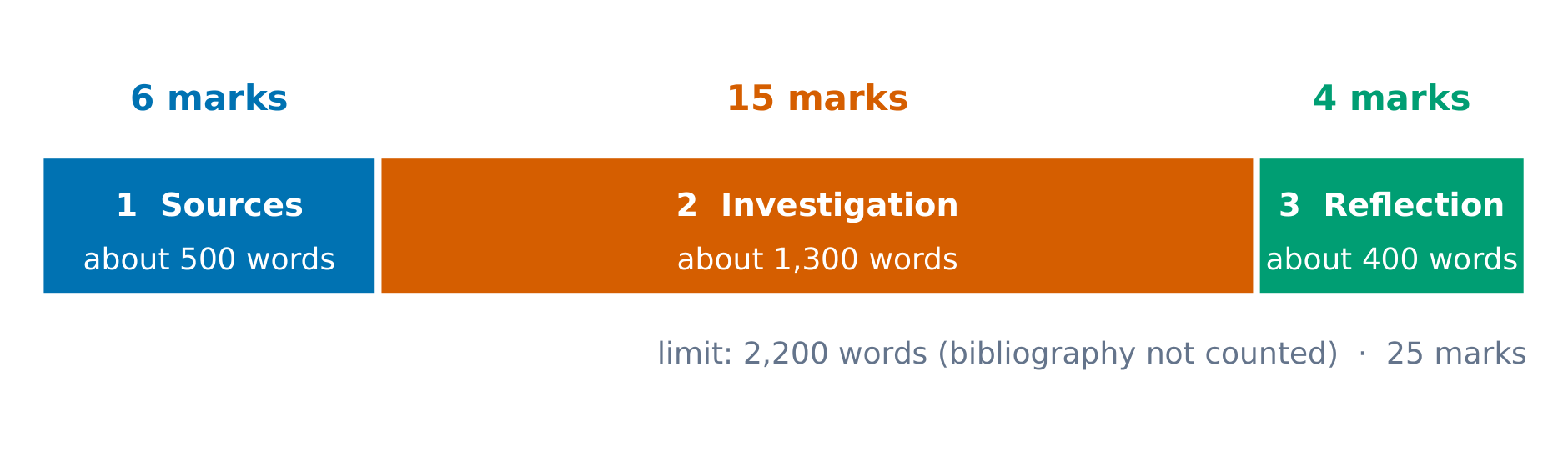
Section 2 carries 15 of the 25 marks, so it gets most of the words. A long section 1 takes words from it.