Skip to content

HL extension · Global challenges and case synthesis

International Baccalaureate · IB Diploma · Global Politics · HL · Topic 4

Video lesson for this topic Open the video page
5:44

Global political challenges

In August 2022 heavy monsoon rain and melting glaciers put about one third of Pakistan under water. More than seventeen hundred people died. The floods spread…

English narration · English + 中文 subtitles burned in

4.1

Global political challenges

IB Diploma Programme Global Politics HL (the guide first assessed in 2026). This topic covers the HL extension 高级程度拓展, which only HL students study. It looks at global political challenges 全球性政治挑战: problems such as climate change, pandemics and forced migration 移民, which cross borders and which no state can solve alone. You research real, recent cases of these challenges. Paper 3 (1 hour 30 minutes, 30% of the HL grade) gives you stimulus 材料 material and asks you to analyse the challenges using the cases you have researched.

In August 2022 heavy monsoon rain and melting glaciers put about one third of Pakistan under water. More than 1,700 people died and about 33 million were affected. The floods destroyed crops and homes, spread disease, and pushed millions of people into poverty. Pakistan produces less than 1% of the world's greenhouse gases, yet it suffered some of the worst effects. One event joined four challenges: environment, health, poverty and equality. Paper 3 asks you to see links like these.

Must-know for the HL extension:

Area Key content
the challenges borders, environment, equality, health, identity, poverty, security, technology
method define the challenge; levels; actors and interests; governance; evaluation
cases recent, real cases that you research yourself
links how one challenge makes others worse or better
Paper 3 1 hour 30 minutes; stimulus-based; 30% of HL
Vocabulary Train
English
HL extension
global political challenge/ˈɡləʊbl pəˈlɪtɪkl ˈtʃælɪndʒ/
stimulus/ˈstɪmjʊləs/
migration/maɪˈɡreɪʃn/
4.2

How to analyse a challenge

A global political challenge crosses borders, affects many actors and causes political disagreement about who should act and who should pay. Analyse each case in five steps.

Five steps: define, levels as nested circles, actors, governance, evaluate
The Paper 3 scaffold: work through the first four steps before you evaluate any response.
  1. Define the challenge in one sentence.
  2. Levels 层面: how it appears locally, nationally and globally, and how the levels affect each other.
  3. Actors 行为体 and their interests 利益: states, IGOs, NGOs, companies, movements, and the people affected.
  4. Governance 治理: which institutions and rules deal with it, and whether they can enforce decisions.
  5. Evaluate the responses, using the key concepts: power, sovereignty, legitimacy and interdependence.
Vocabulary Train
English
level
actor
interest/ˈɪntrest/
governance/ˈɡʌvənəns/
4.3

Four challenges and their cases

Environment: climate change

Climate change 气候变化 is a global problem, but emissions are controlled by sovereign states.

Agreement Year How it works
UN Framework Convention on Climate Change 1992 sets up yearly negotiations; "common but differentiated responsibilities"
Kyoto Protocol 1997 binding cuts for richer countries only
Paris Agreement 巴黎协定 2015 every country sets its own target, a nationally determined contribution 国家自主贡献 (NDC), and reports progress; the goal is well below 2 °C, aiming for 1.5 °C

Paris has almost universal membership because no target is forced on anyone. The same design is its weakness: there is no punishment for missing a target, and the total of all NDCs is not enough to meet the goal. Each state has a reason to let others pay, a collective action problem 集体行动困境.

Health: COVID-19

The World Health Organization 世界卫生组织 (WHO) gives advice, sets standards and coordinates, but it cannot force states to act. In 2020 states closed borders and competed for medical supplies and vaccines. COVAX, a programme to share vaccines with poorer countries, delivered nearly 2 billion doses, but these arrived much later than doses in rich countries. The case shows the limits of sovereignty (a virus ignores borders) and of IGOs without enforcement power.

Borders: forced migration

The 1951 Refugee Convention 难民公约 defines a refugee 难民 as a person who has left their country because of a well-founded fear of persecution, and says they must not be sent back to danger. People leaving because of poverty or climate change are not covered by this definition. By 2024 the UN refugee agency, UNHCR, counted more than 120 million people forced from their homes worldwide. States control their borders (sovereignty), but refugees have rights under international law.

Technology: artificial intelligence

Artificial intelligence is developed mainly by a few large companies in a few countries, but it affects jobs, elections and security everywhere. The European Union's AI Act (2024) is the first broad law on AI; other states prefer voluntary rules or their own national laws. The case asks who has power over a technology that crosses borders instantly, and whether companies or states should set the rules.

Vocabulary Train
English
climate change/ˈklaɪmət tʃeɪndʒ/
Paris Agreement
nationally determined contribution
collective action problem/kəˈlektɪv ˈækʃn ˈprɒbləm/
World Health Organization
Refugee Convention
refugee/ˈrefjuːdʒiː/
4.4

Links between challenges

Paper 3 often asks how challenges connect. Use a chain:

Starting point Leads to Then to
climate change: floods and droughts crops fail; people leave rural areas (poverty, borders) pressure on cities and on neighbouring states (security, identity)
a pandemic schools and businesses close (poverty, equality) trust in government falls (security, legitimacy)

Worked plan. A sample question from the IB: "With reference to two of the cases you have researched, examine the links between multiple global political challenges."

  1. Thesis: the challenges are linked mainly through poverty and equality, which make every other challenge hit the poorest hardest.
  2. Case 1, the 2022 Pakistan floods: environment → health (disease after the floods) → poverty (crops and homes lost) → equality (a low-emitting country paying for others' emissions; this led to demands for a "loss and damage" fund, agreed at the COP27 climate conference in 2022).
  3. Case 2, COVID-19: health → poverty (lost jobs and school time) → equality (late vaccines for poorer countries).
  4. Counter-argument: some links reduce challenges: technology spread information and vaccines quickly; the pandemic increased cooperation in some areas.
  5. Judgement: the links are strongest where governance is weakest; global institutions handle one challenge at a time, but the problems arrive together.
4.5

Checklist

  • The HL extension: Paper 3, 1 hour 30 minutes, stimulus-based, 30% of HL; cases you research yourself.
  • The challenges: borders, environment, equality, health, identity, poverty, security, technology.
  • The five steps: define, levels, actors and interests, governance, evaluate.
  • Climate change: UNFCCC 1992, Kyoto 1997, Paris 2015 and NDCs; the collective action problem.
  • COVID-19: the WHO's limits; COVAX.
  • Forced migration: the 1951 Refugee Convention; sovereignty and rights.
  • Artificial intelligence: the EU AI Act 2024; companies and states.
  • Links between challenges, with the Pakistan floods and COVID-19.
Additional notes PDF
Supported preparation: HL stimulus synthesis

Scope and prerequisites

IB global politics first assessment 2026. Use the 2026 core/thematic model and HL stimulus paper, not the retired 2017 HL presentation. School approves a safe, non-partisan engagement and bounded case selection.

Mapped preparation outcomes: ib_global_politics_hl.4.1, ib_global_politics_hl.4.2. Read the matching native lesson first. Actual approved choices, evidence and final learner work remain separate.

Source vocabulary

cooperation 合作; sovereignty 主权.

Explanation and worked method

Use the current 2026 stimulus model. Compare mechanisms, institutions, scale and constraints across researched cases; a generic memorized example cannot substitute for stimulus evidence.

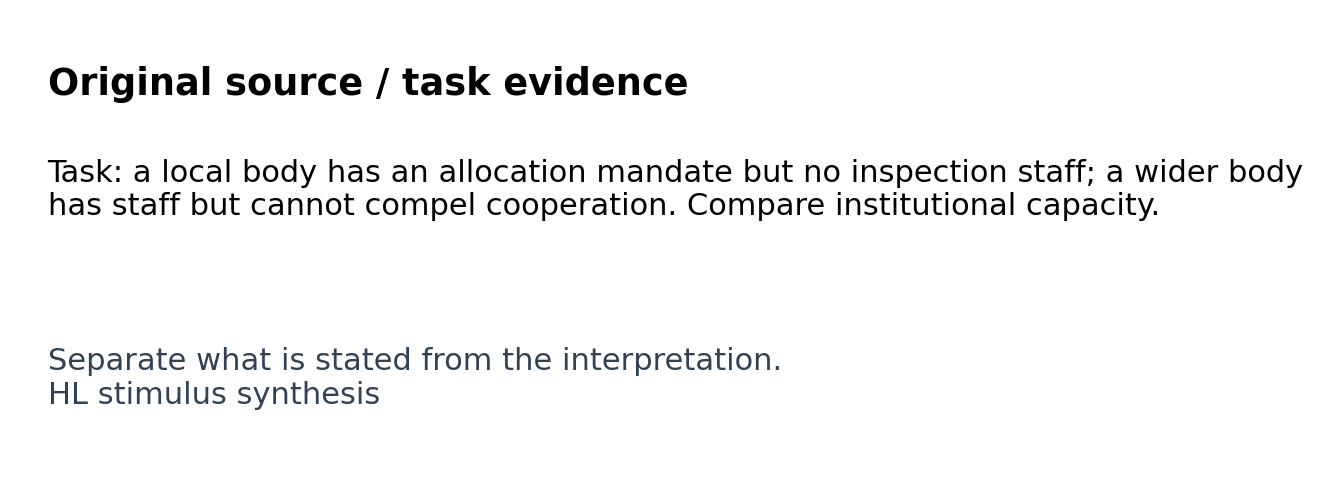
Original classroom evidence panel for HL stimulus synthesis

Task: a local body has an allocation mandate but no inspection staff; a wider body has staff but cannot compel cooperation. Compare institutional capacity.

Formal authority and implementation capacity differ. Local enforcement may fail for lack of resources; wider monitoring may fail without agreement. A joint response might combine capacities, subject to legitimacy, information and funding.

Independent transfer

New evidence shows the wider body can fund local inspectors. How does this change the institutional comparison?

Attempt independently before reading the model.

Checked original model

Funding could connect local mandate with implementation resources, improving feasibility. Cooperation, accountability, information and sustained financing still need review. Explain the specific mechanism changed rather than assuming the institution now guarantees success.

These are authored formative expectations, not official IB descriptors. Accept other justified arguments with evidence and material limits.

Source and task holds

This supplement teaches the method for this part of the course. The full assessment criteria and any texts your school chooses come from your teacher.

Interactive lessons on this topic

Work through it step by step, with instant-check exercises.

More topics in International Baccalaureate · IB Diploma · Global Politics · HL

Log in or create account

IGCSE, A-Level & AP