Skip to content

Engagement project · Engagement and reflective research

International Baccalaureate · IB Diploma · Global Politics · HL · Topic 3

Video lesson for this topic Open the video page
4:18

The engagement project

Every evening in Chinese cities, millions of food-delivery riders race the clock. An app sets their routes, their time limits and their pay. Who decided those…

English narration · English + 中文 subtitles burned in

3.1

The engagement project

IB Diploma Programme Global Politics HL (the guide first assessed in 2026). The internal assessment is the engagement project 参与式项目, which SL and HL students both do. You choose a political issue 政治议题, engage 参与 with it outside the classroom (for example by interviewing people, volunteering or observing meetings), research it, and write a report 报告 of up to 2,000 words. It is worth 30% at SL and 20% at HL. HL students also write a separate, evidence-based recommendation 建议 (up to about 400 words) on how the issue could be addressed.

Every evening in Chinese cities, millions of food-delivery riders race against the clock. An app sets their routes, their time limits and their pay. Who decided those rules, and who can change them? Is a rider an employee with rights, or an independent worker? The same questions are argued in courts and parliaments from London to California. A local scene like this, connected to a global debate, is exactly what an engagement project studies.

Must-know for the engagement project:

Area Key content
format report of up to 2,000 words; 30% SL, 20% HL; HL adds a recommendation
issue political, debatable, connected to a global debate, possible to engage with
engagement first-hand, purposeful, recorded, ethical
research published sources and different perspectives, compared and evaluated
report issue, research, engagement, analysis with key concepts, reflection
Vocabulary Train
English
engagement project/enˈɡeɪdʒmənt ˈprɒdʒekt/
political issue
engage/enˈɡeɪdʒ/
report/rɪˈpɔːt/
recommendation/ˌrekəmenˈdeɪʃn/
3.2

Choosing the issue

An issue is political 政治的 when it is about power: who decides, who benefits and who pays. "Plastic in the ocean" is a topic; "who should pay to clean plastic from our coast: the city, the companies that make plastic, or the people who buy it?" is a political issue.

A good issue is:

  • debatable 有争议的: different groups really disagree;
  • globally connected 与全球相关的: a local example of a global debate, or a global debate felt locally;
  • engageable 可参与的: you can actually meet people, visit places or join activities connected to it.

Turn the issue into a question that uses one or two key concepts from the core:

Weak Strong
Are delivery apps good? How do delivery platforms use power over riders in my city, and how far do recent rules protect riders' rights?
Is pollution bad? How far has the river clean-up programme in my district gained legitimacy with local residents?
Vocabulary Train
English
political/pəˈlɪtɪkl/
debatable
globally connected
engageable
3.3

Engagement and research

Engagement is first-hand experience of the issue. It must be purposeful (chosen to answer your question) and recorded (notes, interview transcripts, a diary, photographs where allowed). Follow basic research ethics 研究伦理: ask for informed consent 知情同意 before an interview, keep people anonymous if they ask, and never put anyone at risk.

Research adds published sources: official documents, statistics, news reports and academic studies. Compare different perspectives 视角 (the government, a company, the people affected, independent experts), and evaluate them: whose view has evidence, whose view serves its own interests, and whose voice is missing?

Issue box splitting into engagement and research streams that meet in analysis, then reflection
Engagement and research are weighed against each other in the analysis; reflection names what was learned and its limits.
Vocabulary Train
English
research ethics/rɪˈsɜːtʃ ˈeθɪks/
informed consent/ɪnˈfɔːmd kənˈsent/
perspective/pəˈspektɪv/
3.4

Writing the report

  1. The issue: the question, why it is political, and how it links to a global debate.
  2. Research: what the published sources and perspectives show.
  3. Engagement: what you did, saw and heard.
  4. Analysis: apply the key concepts (power, sovereignty, legitimacy, interdependence, and ideas such as rights or development) to your evidence. Compare what people told you with what the documents say.
  5. Reflection 反思: what the engagement showed that reading alone could not; the limits of your evidence; what you would do differently; how your own position (age, background, language) affected what you learned.

Worked example. Question: How do delivery platforms use power over riders in my city, and how far do recent rules protect riders' rights?

  • Engagement: interviews with six riders at a rest station (with consent; names not used); a conversation with a staff member at a community service centre for riders; two hours observing pick-ups at a busy shopping centre.
  • Research: national guidelines on delivery riders' rights issued in 2021; platform statements on how delivery times are set; news reports; a study of platform work in another country.
  • Analysis: the app's algorithm sets the agenda (a hidden face of power): riders cannot negotiate times, only accept or refuse orders. The guidelines gained legitimacy with riders when they produced visible changes (longer time limits), but riders said that pay per order still depends on the platform alone. Interdependence: platforms need riders, but each rider depends far more on the platform (asymmetric).
  • Reflection: six riders at one station are not all riders; riders may not speak freely to a student; the platforms did not agree to an interview, so their perspective comes only from public statements.
  • HL recommendation: an evidence-based proposal, such as publishing how delivery times are calculated, with the reasons from the evidence and the likely objections.
Vocabulary Train
English
reflection/rɪˈflekʃn/
3.5

Checklist

  • The format: up to 2,000 words; 30% SL, 20% HL; the HL recommendation.
  • A political, debatable, globally connected, engageable issue, framed as a question with key concepts.
  • Engagement: first-hand, purposeful, recorded, ethical (consent, anonymity, safety).
  • Research: sources and perspectives compared and evaluated.
  • The report's five parts, with analysis through key concepts and an honest reflection.
Additional notes PDF
Supported preparation: Engagement preparation and reflection

Scope and prerequisites

IB global politics first assessment 2026. Use the 2026 core/thematic model and HL stimulus paper, not the retired 2017 HL presentation. School approves a safe, non-partisan engagement and bounded case selection.

Mapped preparation outcomes: ib_global_politics_hl.3.1, ib_global_politics_hl.3.2. Read the matching native lesson first. Actual approved choices, evidence and final learner work remain separate.

Source vocabulary

engagement 参与; perspective 视角.

Explanation and worked method

A focused political issue identifies a contested allocation or relationship, actors and setting. Engagement informs inquiry but needs research and other perspectives. Keep consent, safe school approval and genuine evidence separate from classroom rehearsal.

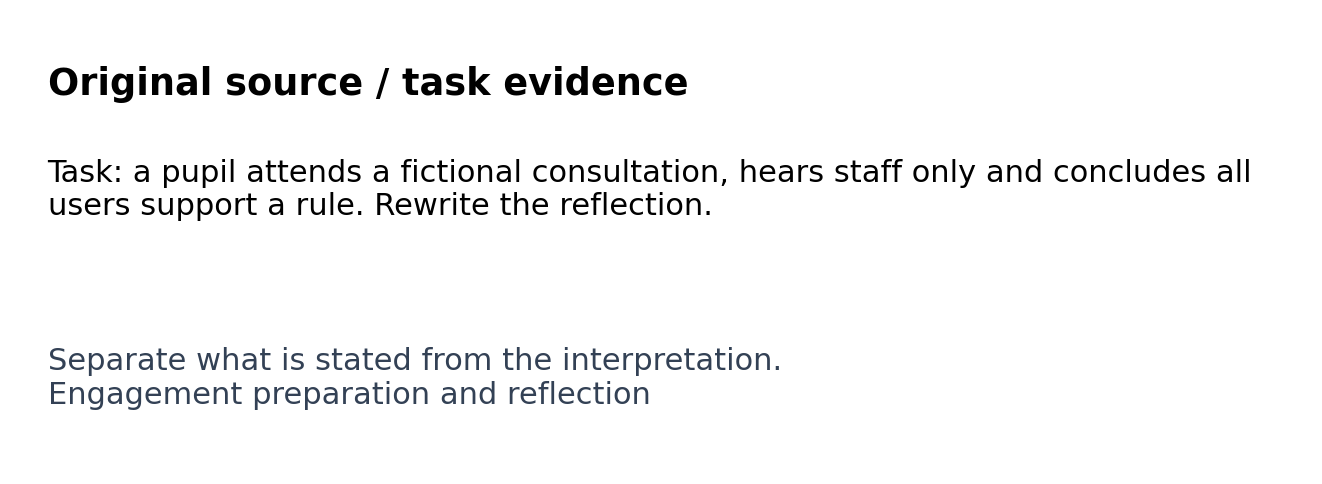
Original classroom evidence panel for Engagement preparation and reflection

Task: a pupil attends a fictional consultation, hears staff only and concludes all users support a rule. Rewrite the reflection.

Staff accounts clarify institutional aims but do not establish users' experiences. The pupil's invited role affected access. Compare documents and approved voluntary accounts from affected groups, explain missing voices and limit the conclusion.

Independent transfer

A user challenges the pupil's staff-only account. What should critical reflection do?

Attempt independently before reading the model.

Checked original model

Check the account's context and evidence, identify the original access limitation and revise the question or conclusion where justified. Compare rather than merely append perspectives. An unexpected account is not automatically representative, but can expose a material missing experience.

These are authored formative expectations, not official IB descriptors. Accept other justified arguments with evidence and material limits.

Source and task holds

This supplement teaches the method for this part of the course. The full assessment criteria and any texts your school chooses come from your teacher.

Interactive lessons on this topic

Work through it step by step, with instant-check exercises.

More topics in International Baccalaureate · IB Diploma · Global Politics · HL

Log in or create account

IGCSE, A-Level & AP