Skip to content

Inquiry groups 1–3 · Reading and comparing ethnographies

International Baccalaureate · IB Diploma · Social and Cultural Anthropology · HL · Topic 2

Video lesson for this topic Open the video page
4:24

Engaging with ethnography

In the Trobriand Islands, Malinowski watched men sail for days across open sea, risking storms, to give away necklaces of red shell. Months later they received…

English narration · English + 中文 subtitles burned in

2.1

Engaging with ethnography

IB Diploma Programme Social and Cultural Anthropology HL (first assessed in 2019; 2017 guide). This topic covers the areas of inquiry 探究领域 and how to read and use ethnographic material 民族志材料: the books and articles anthropologists write after fieldwork. It is examined in Paper 2 (2 hours 30 minutes, 45% at HL; 1 hour 30 minutes, 40% at SL).

In the Trobriand Islands, Malinowski watched men sail for days across open sea in canoes, risking storms, to give away necklaces made of red shell. In return, months later, they received armbands of white shell. Nobody kept the objects: after a time, each one was passed on to the next partner. To a European economist this looked mad. Why risk your life for an object you cannot keep or use? Malinowski's answer, in Argonauts of the Western Pacific (1922), was that the kula 库拉 exchange is not about the objects. It builds partnerships between islands, and a man becomes famous by having held famous shells and giving them away generously.

Must-know for engaging with ethnography:

Area Key content
areas of inquiry nine areas in three groups; SL studies three, HL four
ethnographic material who, where, when, how, with which concepts
exchange the kula ring; Mauss's gift; Yan's Chinese village
comparison similar practices, different meanings
Paper 2 Section A: concept + area of inquiry + real-world issue; Section B: SL one question, HL two
Vocabulary Train
English
area of inquiry
ethnographic material/ˌeθnəˈɡræfɪk məˈtɪərɪəl/
kula
2.2

The nine areas of inquiry

The course groups its nine areas of inquiry in three groups. SL students study one area from each group; HL students study a fourth from any group.

Three groups of three areas of inquiry, with belonging and production, exchange and consumption highlighted
SL takes one area from each group; HL adds a fourth.

For each area you need ethnographic material from at least one real study, with the details that make it real: the anthropologist, the place, the time and the methods.

2.3

Reading ethnographic material

Ask five questions of every ethnography:

Question Example: Yunxiang Yan, The Flow of Gifts (1996)
who is the anthropologist, and what is their position? Yan grew up in China and had lived in the village as a young man, so he was partly an insider
where and when? Xiajia, a village in Heilongjiang, north-east China; fieldwork in 1989 and 1991
how? (methods) participant observation; interviews; families' own gift lists, which record who gave what at weddings and other events
what does it show? gifts build and keep guanxi; many gifts flow upwards, from villagers to cadres, without being returned
which concepts? social relations, power, materiality

Yan's material is useful because it can test a theory. The French scholar Marcel Mauss argued in The Gift (1925) that a gift creates three duties: to give, to receive and to reciprocate 回报 (give back). The giver gains prestige 声望, and the receiver is in debt 债务. Yan found that in Xiajia, gifts to people of higher rank often went one way: the receiver did not give back and did not lose status. Here gifts followed hierarchy 等级 instead of creating it.

Vocabulary Train
English
reciprocate
prestige
debt/det/
hierarchy/ˈhaɪərɑːki/
2.4

Exchange compared

Exchange 交换 is part of the area production, exchange and consumption. Compare two ethnographies:

The kula ring: islands in a circle, with red shell necklaces travelling clockwise and white shell armbands travelling anticlockwise
In the kula ring, necklaces and armbands travel in opposite directions; partners never keep them.
Kula, Trobriand Islands (Malinowski) Gifts in Xiajia (Yan)
what is given shell necklaces and armbands money and goods at weddings, births and funerals
who gives trading partners on different islands relatives, friends, neighbours, villagers to cadres
what it does builds lasting partnerships and fame keeps guanxi; shows and builds rank
concept symbolism (the shells' histories) social relations and power

Same: in both places, giving creates relationships that last. Different: what counts as a proper return, and who is expected to give to whom.

A third area, health, illness and healing: Nancy Scheper-Hughes, in Death Without Weeping (1992), studied mothers in a very poor town in north-east Brazil, where many babies died. She found that some mothers did not grieve 哀悼 openly for babies who died young. She linked this to poverty and hunger, not to a lack of love: a way of surviving in a place where many children did not live.

Vocabulary Train
English
exchange/eksˈtʃeɪndʒ/
grieve
2.5

Answering Paper 2

Section A asks you to connect a key concept, an area of inquiry and a real-world issue. The IB's sample: With reference to ethnographic material from one area of inquiry you have studied, discuss how either symbolism or materiality or society helps you to understand one of the following issues that is grounded in a contemporary, real-world example: inequality, violence, poverty, mobility, environment.

Section B asks about the other areas of inquiry (SL one question, HL two), for example: Discuss how the body is constructed through either symbolism or social relations.

Worked plan (Section A). Concept: materiality. Area: production, exchange and consumption. Issue: inequality.

  • Real-world example: the rising cost of wedding gifts in rural China, which many families report as a burden.
  • Ethnography: Yan's gift lists show that gifts are material evidence of relationships, and that poorer families must still give to keep their place in the network.
  • Comparison: the kula shows exchange creating equal partnerships; Xiajia shows exchange that can follow and widen inequality.
  • Evaluation: Yan was partly an insider, which gave him trust and access, but may have made some habits seem normal to him.
2.6

Checklist

  • The nine areas in three groups; SL three, HL four.
  • Five questions for any ethnography: who, where and when, how, what, which concepts.
  • The kula ring (Malinowski, 1922); Mauss's three duties; Yan's Xiajia gifts flowing upwards.
  • Scheper-Hughes on health and poverty in Brazil.
  • Paper 2: HL 2 hours 30 minutes, 45%; SL 1 hour 30 minutes, 40%; Sections A and B; the worked plan.
Additional notes PDF
Supported preparation: Comparison through a concept

Scope and prerequisites

IB social and cultural anthropology first assessment 2019. Select one inquiry area from each of three groups at SL; HL adds a fourth and theory extension. Teacher selects real ethnographies; classroom vignettes below are original teaching cases, not ethnographic publications.

Mapped preparation outcomes: ib_anthropology_hl.2.1, ib_anthropology_hl.2.2. Read the matching native lesson first. Actual approved choices, evidence and final learner work remain separate.

Source vocabulary

ethnography 民族志; reciprocity 互惠.

Explanation and worked method

Use a concept to explain a relationship, then compare its operation across contexts. Do not equate similar objects with identical social functions. A classroom comparison rehearses the method; the school's selected ethnographies supply the authentic evidence.

Original classroom evidence panel for Comparison through a concept

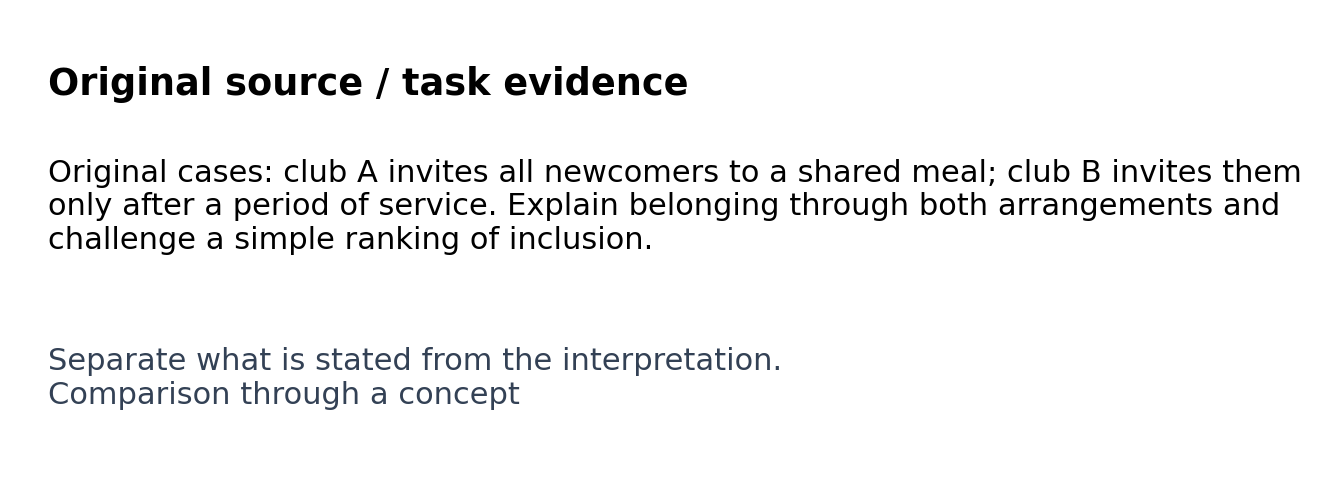
Original cases: club A invites all newcomers to a shared meal; club B invites them only after a period of service. Explain belonging through both arrangements and challenge a simple ranking of inclusion.

A may establish membership through immediate sharing; B may recognize membership through demonstrated contribution. Invitation timing provides a contrast, but does not show how welcomed members feel. Examine refusal, obligations and participants' interpretations. Immediate access could still involve unequal duties; delayed access could be experienced differently by different members. Transfer check: explain what an interview with only committee members would miss, then specify a contrasting consenting sample.

Independent transfer

Committee-only interviews support a claim that the invitation rule creates belonging. What is missing and how should the claim change?

Attempt independently before reading the model.

Checked original model

Those excluded, new members and members who left may experience the rule differently. Restrict the claim to committee accounts, then seek approved contrasting recruitment and actual participation evidence. A large number of committee interviews does not remove this selection limit.

These are authored formative expectations, not official IB descriptors. Accept other justified arguments with evidence and material limits.

Source and task holds

This supplement teaches the method for this part of the course. The full assessment criteria and any texts your school chooses come from your teacher.

Interactive lessons on this topic

Work through it step by step, with instant-check exercises.

More topics in International Baccalaureate · IB Diploma · Social and Cultural Anthropology · HL

Log in or create account

IGCSE, A-Level & AP