Skip to content

Engaging with anthropology · Concepts, culture and reflexivity

International Baccalaureate · IB Diploma · Social and Cultural Anthropology · HL · Topic 1

Video lesson for this topic Open the video page
5:04

Engaging with anthropology

In 1956 the anthropologist Horace Miner described a people called the Nacirema. Every house has a shrine with a magic box, people perform daily mouth rites…

English narration · English + 中文 subtitles burned in

1.1

Engaging with anthropology

IB Diploma Programme Social and Cultural Anthropology HL (first assessed in 2019; 2017 guide). Anthropology 人类学 studies how people live together: what they believe, how they make a living, how they organise families and power, and how all this changes. This topic covers the language, the practice and the way of thinking of the discipline. It is examined in Paper 1 (2 hours, 30% at HL; 1 hour 30 minutes, 40% at SL): three questions on an unseen text, the last one on one of the course's "big questions" 大问题. HL students also answer a question on anthropological ethics 伦理 (topic 04).

In 1956 the anthropologist Horace Miner published a strange report on the Nacirema, a people with unusual body rituals. Every house has a shrine, he wrote, where people look into a magic box and perform daily mouth rites with hog hairs and magical powders. They visit "holy-mouth men" who dig holes in their teeth. Readers were shocked by such odd customs, until they noticed that "Nacirema" is "American" spelled backwards: the shrine is a bathroom, the rite is brushing teeth and the holy-mouth man is a dentist. Miner's joke makes a serious point. Our own habits look natural to us only because we are inside them. Anthropology tries to make the strange familiar, and the familiar strange.

Must-know for engaging with anthropology:

Area Key content
key concepts belief and knowledge, change, culture, identity, materiality, power, social relations, society, symbolism
method participant observation; ethnography; emic and etic views
thinking ethnocentrism, cultural relativism, reflexivity, comparison
example Fei Xiaotong's ripples: social relations in rural China
Paper 1 three questions on an unseen text; a big question; HL ethics question
Vocabulary Train
English
anthropology
ethics/ˈeθɪks/
big question
1.2

The nine key concepts

The course uses nine key concepts 核心概念. Each is a question you can ask of any social situation:

Concept Question it asks Example
belief and knowledge what do people take to be true, and how? ideas about what causes illness
change what is changing, and why? young villagers moving to cities for work
culture 文化 what ways of life are learned and shared? table manners, ways of greeting
identity 身份认同 how do people see themselves and others? being a "local" or an "outsider" in a city
materiality 物质性 how do objects shape and carry meaning? a red envelope (hongbao) with money at New Year
power 权力 who can make others do things, and how? who speaks first at a family meal
social relations 社会关系 how are people connected, and with what duties? the obligations between friends and relatives
society 社会 how is a group organised as a whole? a village, a school, a nation
symbolism 象征 what do things stand for? white clothes for mourning in China, black in Europe

An answer never names a concept alone: it uses the concept to explain real material (the passage, or an ethnography you have studied).

Vocabulary Train
English
key concept
culture/ˈkʌltʃə/
identity/aɪˈdentɪti/
materiality
power/ˈpaʊə/
social relations
society
symbolism/ˈsɪmbəlɪzəm/
1.3

Participant observation and ethnography

Anthropologists are known for participant observation 参与观察: living with a group for a long time, often a year or more, joining in its everyday life while watching and asking questions. Bronisław Malinowski made this the core of the discipline: from 1915 to 1918 he lived in the Trobriand Islands, off the coast of New Guinea, learned the language and pitched his tent in the village.

A line from complete observer to complete participant, with four positions and what each means in a school canteen
Participant observation runs from watching to taking part (Gold, 1958).

The written result is an ethnography 民族志: a detailed account of the life of one group, based on fieldwork. Anthropologists try to give two views:

  • the emic 主位 view: how members of the group understand their own world, in their own words;
  • the etic 客位 view: the outsider's analysis, which compares the group with others.
Vocabulary Train
English
participant observation/pɑːˈtɪsɪpənt ɒbzəˈveɪʃn/
ethnography/eθˈnɒɡrəfi/
emic/ˈemɪk/
etic
1.4

Thinking like an anthropologist

  • Ethnocentrism 民族中心主义: judging other cultures by the standards of your own, as Miner's readers did before they saw the joke.
  • Cultural relativism 文化相对主义: trying to understand a practice within its own cultural context before you judge it. (Understanding is not the same as approving.)
  • Reflexivity 反身性: thinking about how your own background (age, gender, nationality, class) shapes what you see and what people tell you.
  • Comparison 比较研究: anthropology compares many societies, so that assumptions that seem natural in one place become visible.

A Chinese example. Fei Xiaotong 费孝通, a student of Malinowski, became China's best-known anthropologist. In From the Soil (1947) he compared social relations in rural China and the West. In a Chinese village, he wrote, each person stands at the centre of circles of relationships, like the ripples that spread when a stone is thrown into water: close family first, then relatives, then neighbours, with duties growing weaker further out. In Western societies, he argued, people belong to groups with clear edges, like bundles of straw, and all members of a group have the same rights. The comparison helps explain why personal connections (guanxi 关系) matter so much in Chinese life.

Fei Xiaotong's two patterns: ripples of self, family, relatives, villagers and strangers, beside separate bundles of straw for club, church and company
Fei Xiaotong's comparison: relations spread out like ripples, or are bundled into groups with clear edges.
Vocabulary Train
English
ethnocentrism/ˈeθnəsentrɪzəm/
cultural relativism/ˈkʌltʃərəl ˈrelətɪvɪzəm/
reflexivity/ˌriːflekˈsɪvɪti/
Fei Xiaotong
guanxi
comparison/kəmˈpærɪsn/
1.5

Answering Paper 1

Paper 1 gives you an unseen text: an extract from an ethnography. The first questions ask you to identify and explain what the text shows; the last asks one of the course's big questions, such as the IB's sample: How are we the same as and different from each other? Discuss with references to at least two sources of ethnographic material and examples from the passage.

  1. Read the passage for the scene: who does what, where, and why.
  2. Mark what surprises you: a surprise often shows one of your own assumptions.
  3. Name the concept that explains it (power, symbolism, social relations ...).
  4. Bring in ethnography you have studied that shows the same concept in another place.

Worked plan. A passage describes gift-giving at a wedding in a village. Same: in every society studied, gifts create relationships and duties (Marcel Mauss, The Gift, 1925; topic 02). Different: what is given, by whom, and what is expected back. In Fei Xiaotong's rural China, a gift's size depends on how close the giver is to the centre of the ripples. Conclusion: people share the need to build relationships, but the forms are learned, local and changing.

1.6

Checklist

  • Paper 1: HL 2 hours, 30%; SL 1 hour 30 minutes, 40%; three questions on an unseen text; HL ethics question.
  • The nine key concepts as questions, with examples.
  • Participant observation (Malinowski, Gold's four roles); ethnography; emic and etic.
  • Ethnocentrism, cultural relativism, reflexivity, comparison; the Nacirema.
  • Fei Xiaotong's ripples and bundles; guanxi.
  • The four steps and the worked plan for a big question.
Additional notes PDF
Supported preparation: Meaning and researcher position

Scope and prerequisites

IB social and cultural anthropology first assessment 2019. Select one inquiry area from each of three groups at SL; HL adds a fourth and theory extension. Teacher selects real ethnographies; classroom vignettes below are original teaching cases, not ethnographic publications.

Mapped preparation outcomes: ib_anthropology_hl.1.1, ib_anthropology_hl.1.2. Read the matching native lesson first. Actual approved choices, evidence and final learner work remain separate.

Source vocabulary

emic 主位的; reflexivity 反思性.

Explanation and worked method

An emic account 内部视角 describes participants' meanings; an etic account 外部分析 uses an analyst's categories. Start by distinguishing an observed action, a participant's statement and your interpretation. Then test which account the evidence supports. Reflexivity asks how your access, language and expectations shape that evidence.

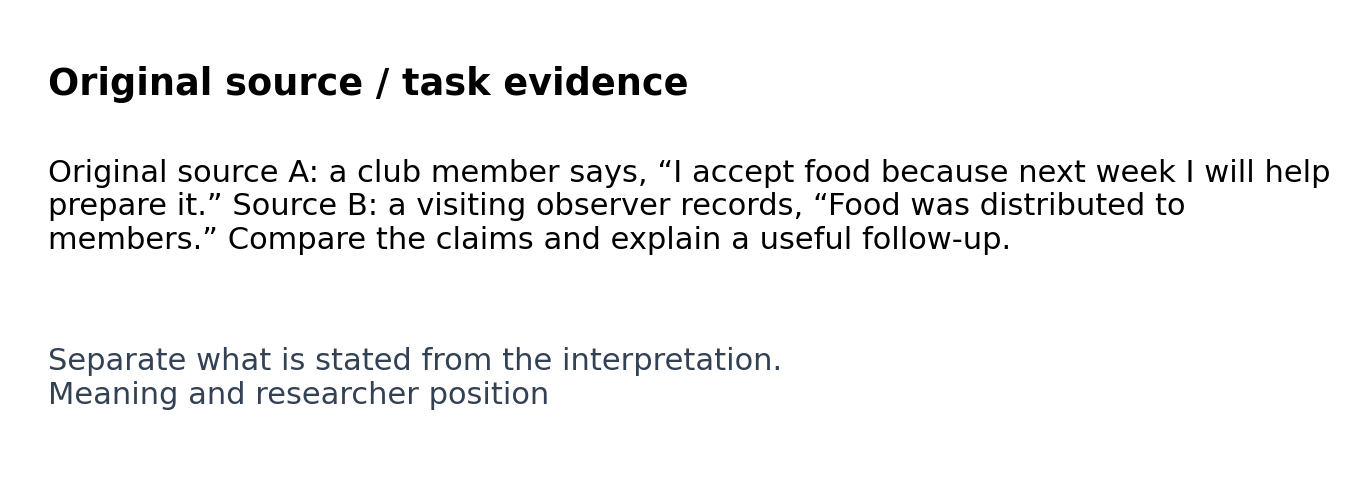
Original classroom evidence panel for Meaning and researcher position

Original source A: a club member says, “I accept food because next week I will help prepare it.” Source B: a visiting observer records, “Food was distributed to members.” Compare the claims and explain a useful follow-up.

A links acceptance to reciprocal obligation; B records distribution without establishing its meaning. They need not contradict each other. The statement is one member's account, not a community-wide rule. Ask consenting members about differing experiences and compare what actually happens later. A visitor may miss relationships that a member takes for granted; a member may also present an idealized account. Neither position is automatically superior.

Independent transfer

A club officer says everybody welcomes the meal obligation, but a newcomer reports feeling unable to refuse. Explain how to use both accounts.

Attempt independently before reading the model.

Checked original model

The officer may describe a public ideal while the newcomer describes an experienced constraint. Compare roles, context and voluntary accounts rather than averaging them or treating one as the whole community. Observe how refusal is handled where approved. Explain how the researcher's access might favour officeholders.

These are authored formative expectations, not official IB descriptors. Accept other justified arguments with evidence and material limits.

Source and task holds

This supplement teaches the method for this part of the course. The full assessment criteria and any texts your school chooses come from your teacher.

Interactive lessons on this topic

Work through it step by step, with instant-check exercises.

More topics in International Baccalaureate · IB Diploma · Social and Cultural Anthropology · HL

Log in or create account

IGCSE, A-Level & AP