Encoding depth and retrieval routes
Scope and prerequisites
Supported GRE topic 24 (ME.2). Use the overview measurement lesson VI when interpreting research evidence. Existing official questions are traced in bank_review_form.yaml; original tasks below are not ETS items.
Concepts and method
levels of processing 加工水平: The account in which memory strength follows the depth of encoding analysis. transfer-appropriate processing 迁移适宜性加工: Encoding helps most when its form matches the retrieval test.
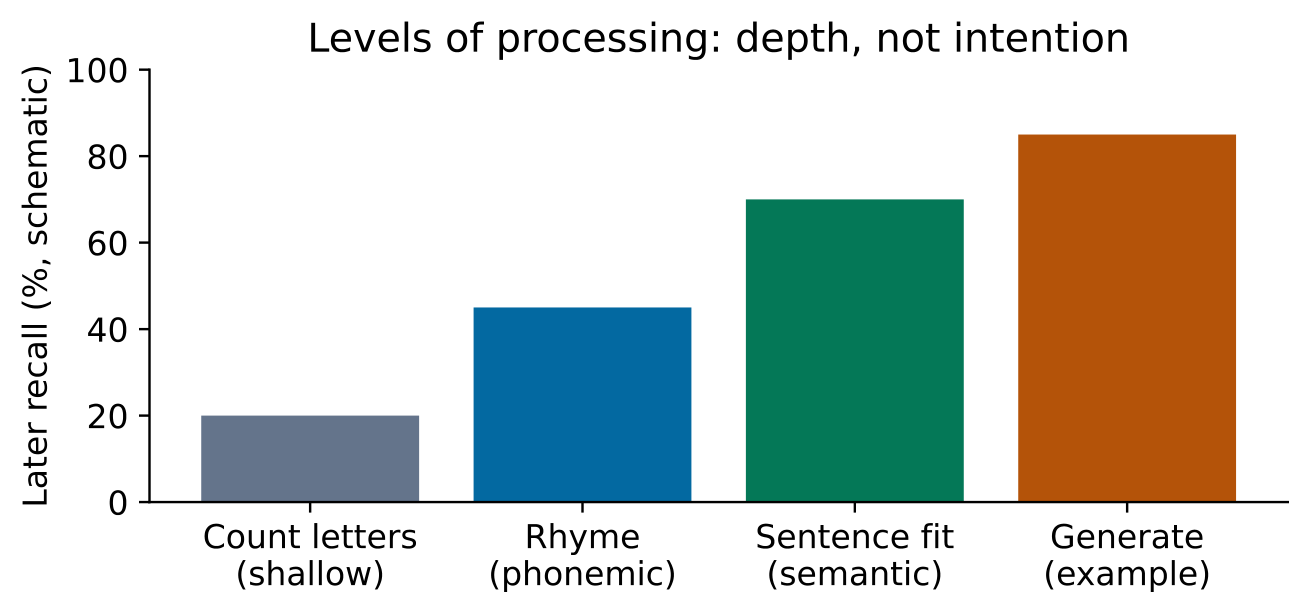
Levels of processing (Craik and Lockhart) hold that memory strength follows the depth of encoding, not the intention to learn. Shallow tasks (is the word in capitals?) give weak traces; phonemic tasks (does it rhyme?) are intermediate; semantic tasks (does it fit the sentence?) are deepest. Incidental learners doing deep tasks can out-remember intentional learners doing shallow ones.
Maintenance rehearsal repeats material without change and holds it briefly; elaborative rehearsal links it to meaning, images and prior knowledge, producing durable traces. The generation effect — better memory for answers you produce than words you read — is elaboration at work.
Transfer-appropriate processing adds the retrieval side: encoding helps most when it matches the test. Semantic encoding suits semantic tests; phonemic encoding can beat it on rhyme-recognition tests. Depth usually wins because most tests probe meaning, but the match, not depth alone, decides.
Encoding specificity applies the same match principle to context: recall improves when the retrieval environment or state matches encoding. These effects sit beside the interference mechanisms from the earlier memory unit: depth builds the trace, match retrieves it.
Semantic elaboration often supports later meaning-based recall because it creates useful relationships and retrieval routes. Maintenance repetition can keep information active without the same elaboration. Transfer-appropriate processing asks whether encoding operations fit the later test. Therefore depth is not an unconditional ranking of all possible tasks. Context match can provide cues; it is one influence among many, not a guarantee of recall.
Worked reasoning
Answering "does it fit the sentence" beats "is it in capitals" on later recall, even with no warning of a test. Generating the missing word in a list beats reading it. Rhyme-encoding can beat meaning-encoding on a rhyme test — transfer-appropriate processing. Divers remembering word lists better underwater (where they learned them) show encoding specificity.
One group judges meaning and another judges rhyme. On a rhyme-recognition test, the rhyme group performs better. Does this disprove every benefit of semantic encoding?
No. The result is consistent with an encoding–test match. It qualifies a claim that deeper meaning processing always wins. Compare both groups on meaning-based and rhyme-based tests to examine the interaction between encoding and retrieval demand. Keep exposure and time comparable.
Independent transfer
Design a two-by-two classroom study that distinguishes an encoding advantage from a matching advantage, then predict the informative pattern.
Attempt independently, then use the matching skill sheet solution.
Review and source limits
Avoid this error: Equating repetition with learning: maintenance rehearsal holds material briefly but builds weak traces, and intention to learn without a deep task adds little. Teaching scope comes from teaching.yaml and the source/key/crop review in bank_review_form.yaml. Detailed current diagnostic criteria require an authenticated manual; neither historical ETS practice nor this educational reference certifies them.