Evolutionary and comparative perspectives
Scope and prerequisites
Supported GRE topic 23 (EX.1). Use the overview measurement lesson VI when interpreting research evidence. Existing official questions are traced in bank_review_form.yaml; original tasks below are not ETS items.
Concepts and method
inclusive fitness 广义适合度: Reproductive success counting both direct offspring and the reproduction of relatives weighted by relatedness. fixed action pattern 固定行为模式: An invariant species-typical sequence released by a specific sign stimulus.
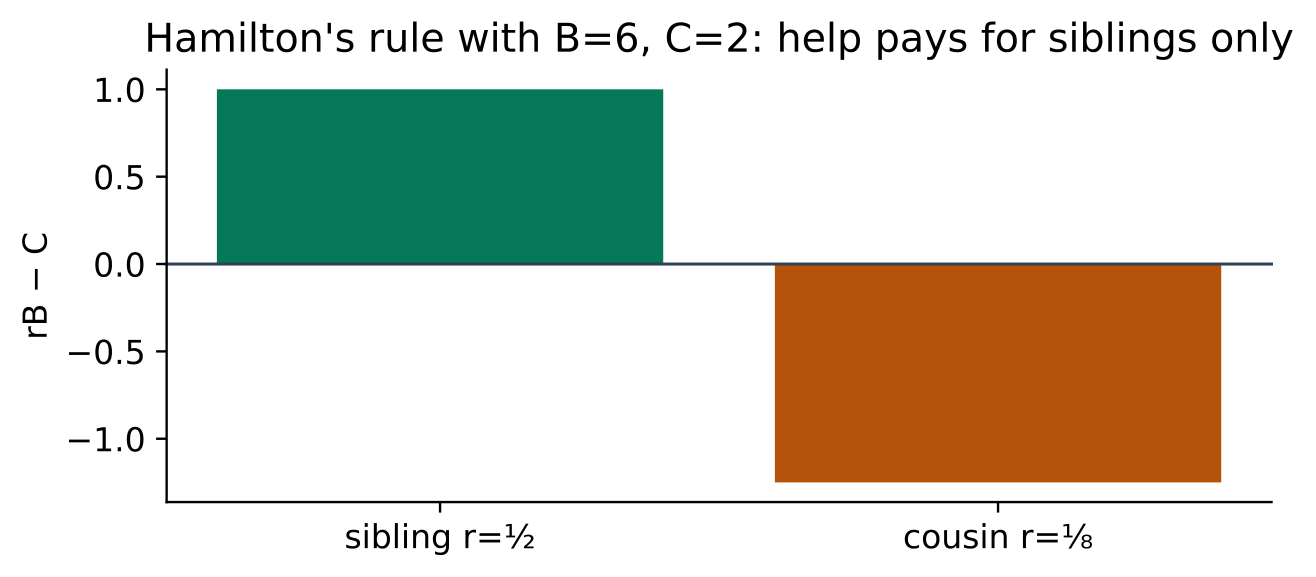
Kin selection explains helping by inclusive fitness: a gene spreads by aiding relatives who share it. Hamilton's rule says helping pays when rB>C — benefit to the recipient weighted by relatedness exceeds cost to the helper. With benefits and costs held equal, closer relatedness makes the inequality more likely to hold: compare siblings (r=.5) with first cousins (r=.125). The rule predicts direction and rough ordering, not exact human behaviour.
Ethology studies species-typical behaviour. A fixed action pattern is an invariant sequence released by a specific sign stimulus and run to completion, as in classic egg-retrieval or mating displays. Because it is triggered rather than assembled, a fixed action pattern can be hijacked by supernormal stimuli — models with exaggerated features.
Evolutionary explanations ask about function: how a behaviour raised reproductive success in ancestral environments. They compete or combine with learning accounts; prepared learning (fast acquisition of evolutionarily relevant fears like snakes) shows both at once. An evolutionary story is a hypothesis about history, and needs comparative or experimental evidence, not plausibility alone.
Comparative caution cuts both ways: do not read human motives into animal behaviour (anthropomorphism), and do not assume a human behaviour is learned when cross-species patterns suggest otherwise. The examinable skill is matching each explanation to its evidence type.
Hamilton's inequality is a model of selection under stated costs, benefits and relatedness, not an instruction about human duty. Inclusive fitness concerns effects on genetic representation through self and relatives. Fixed action patterns describe characteristic sequences in classic ethological models; real behaviour can vary with state and context. Evolutionary function and immediate learning mechanisms can complement each other. A plausible adaptive story requires evidence that distinguishes it from alternatives.
Worked reasoning
Helping a sibling before a cousin fits rB>C ordering. A goose retrieving a doorknob as if it were an egg shows a fixed action pattern released by an exaggerated sign stimulus. Acquiring a fear of snakes after one bad experience, but not of flowers, illustrates prepared learning.
In a fictional fitness model, B=8, C=3 and r=.5. Test the inequality. Repeat for r=.125.
rB>C. For r=.5, rB=.5×8=4>3, so the stated condition holds. For r=.125, rB=.125×8=1<3, so it does not. Benefits and costs must use compatible fitness measures. Relatedness alone cannot rank helping when B or C differs across cases.
Independent transfer
An animal quickly learns one fear association. Explain why this can be compatible with both learning and an evolutionary account, and what evidence is needed.
Attempt independently, then use the matching skill sheet solution.
Review and source limits
Avoid this error: Treating Hamilton's rule as a precise human calculator, or explaining any observed behaviour as adaptive after the fact; an evolutionary claim needs evidence, not a plausible story. Teaching scope comes from teaching.yaml and the source/key/crop review in bank_review_form.yaml. Detailed current diagnostic criteria require an authenticated manual; neither historical ETS practice nor this educational reference certifies them.