Theorists, schools and their claims
Scope and prerequisites
Supported GRE topic 15 (HT.1). Use the overview measurement lesson VI when interpreting research evidence. Existing official questions are traced in bank_review_form.yaml; original tasks below are not ETS items.
Concepts and method
structuralism 结构主义: Titchener's school analysing experience into basic elements by introspection. cognitive revolution 认知革命: The 1950s restoration of mental processes as lawful objects of study, displacing strict behaviourism.
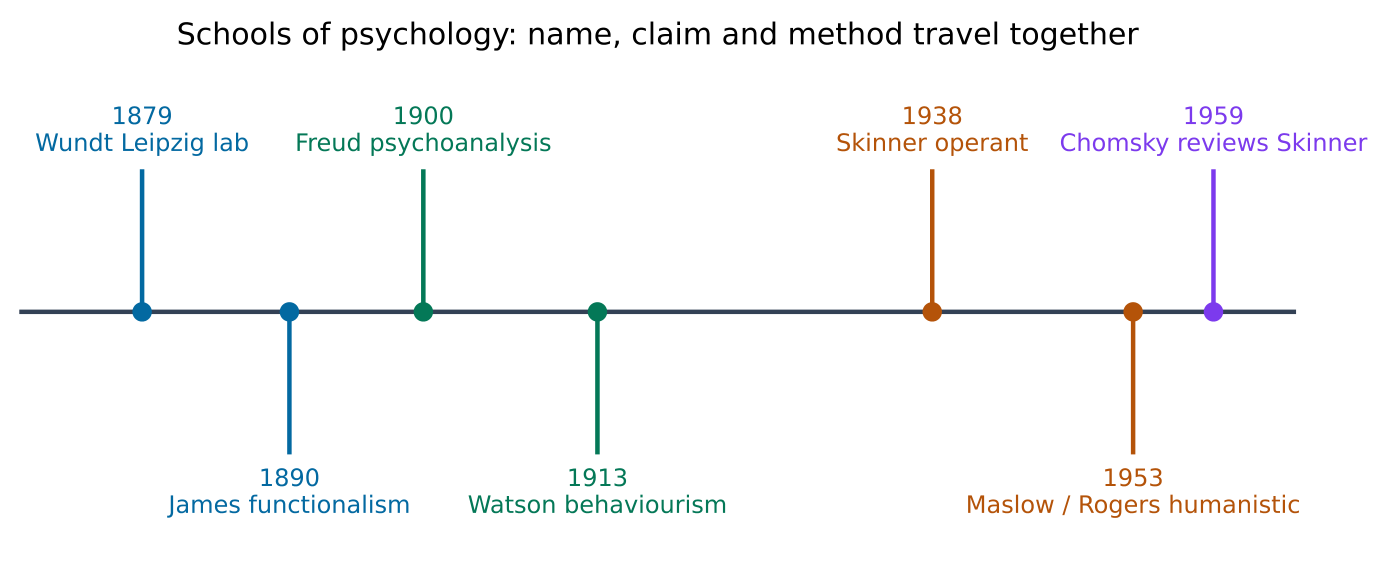
Psychology's laboratories began in the 1870s: Wilhelm Wundt at Leipzig (1879) and William James's Harvard laboratory work. Wundt's student Titchener carried structuralism, analysing experience into elements by introspection; James's functionalism instead asked what mental processes are for, shaped by evolution. Gestalt psychologists (Wertheimer, Köhler, Koffka) rejected element analysis, arguing that organised wholes precede parts in perception.
Freud's psychoanalysis centred on unconscious conflict and early experience, with defence mechanisms and stages of psychosexual development; its claims are debated as science but shaped clinical practice. Watson's 1913 behaviourism rejected introspection for observable behaviour, and Skinner's radical behaviourism explained action by operant consequences. Horney analysed coping as moving toward, away from or against people.
The humanistic third force (Maslow's hierarchy of needs, Rogers's person-centred approach) stressed growth and self-actualisation against both psychoanalysis and behaviourism. The cognitive revolution of the 1950s restored mind as a lawful object: Miller's working-memory limits, Neisser's cognitive synthesis, and Chomsky's 1959 review arguing that Skinner's verbal-behaviour account cannot explain language acquisition.
Later traditions built on these: Bandura's social learning (the Bobo doll studies) added observation and modelling to conditioning; Beck's cognitive therapy treats distorted thinking in depression; Eysenck described personality on broad dimensions such as extraversion and neuroticism. Match each name to a claim and method, not merely to a famous phrase.
Classify an explanation by its proposed mechanism and method. Structuralist analysis of experience differs from functional questions about adaptation. Behaviourist accounts study relations among environment and observable action; cognitive accounts use representations and processing. Gestalt accounts emphasize organization rather than reducing every percept to isolated sensations. A historical label is useful only when it identifies a claim that could guide evidence collection.
Worked reasoning
Wundt's Leipzig laboratory and James's Harvard work mark the 1870s founding; Titchener turned introspection into structuralism while James asked functional questions. Chomsky's review of Verbal Behavior is a landmark of the cognitive turn against Skinner. A therapist targeting distorted automatic thoughts works in Beck's cognitive tradition.
One account studies reinforcement schedules; another models a temporary information store; a third studies the purpose a behaviour serves. Match each emphasis.
Reinforcement schedules fit a behavioural emphasis. A temporary information store fits a cognitive information-processing emphasis. Adaptive purpose fits functionalism's characteristic question. These are explanatory emphases, not a claim that a modern researcher must belong exclusively to one school.
Independent transfer
An answer names a famous theorist but gives no account of the observation. Rewrite it as an explanation that could be checked, using the reinforcement case.
Attempt independently, then use the matching skill sheet solution.
Review and source limits
Avoid this error: Crediting one founder with founding alone, or treating psychoanalytic claims and tested cognitive findings as the same kind of evidence. Teaching scope comes from teaching.yaml and the source/key/crop review in bank_review_form.yaml. Detailed current diagnostic criteria require an authenticated manual; neither historical ETS practice nor this educational reference certifies them.