- Order and calculate with positives, negatives, decimals and fractions; the four operations with formal written methods.
- Primes, factors, HCF/LCM by prime decomposition; indices, roots, surds 根式 (H) and standard form 标准形式.
- Fractions ↔ decimals ↔ percentages as operators; rounding, estimation and bounds (H).
Number
AQA · GCSE · Mathematics · Topic 1
1.1
Number: the foundations everything else stands on
Vocabulary
Train
| English |
|---|
| standard form/ˈstændəd fɔːm/ |
| surds |
1.1
Arithmetic, factors, multiples and primes (N1–N5)
Syllabus
Arithmetic, factors, multiples and primes (AQA 8463-style N1-N5 rules for 8300).
- Order integers, decimals and fractions; use the six inequality and equality symbols.
- Apply the four operations with formal written methods to integers, decimals, fractions and mixed numbers, in context including household finance.
- Use inverse operations and the priority of operations (BIDMAS).
- Use primes, factors, multiples, HCF and LCM via prime factorisation; (H) systematic listing and the product rule for counting.
Source: Cambridge International syllabus
Ordering and symbols: order positive and negative integers, decimals and fractions on a number line; use =, ≠, <, >, ≤, ≥.
The four operations (N2): formal written methods for integers, decimals, proper and improper fractions and mixed numbers, all signs — set in context including household finance: profit, loss, cost price, selling price, debit, credit, balance, income tax, VAT, interest rate.
Inverse operations and priority (N3): cancellation to simplify; BIDMAS 运算顺序 — brackets, indices/powers, roots, division/multiplication, addition/subtraction.
Primes and structure (N4): prime numbers, factors, multiples, common factors, common multiples, HCF, LCM; prime factorisation 质因数分解 in index form (product notation; unique factorisation). Worked pattern:
- 200 = 2³ × 5²
- HCF = product of the lowest powers of common primes; LCM = product of the highest powers of all primes.
(N5) systematic listing and the product rule for counting (H).
Vocabulary
Train
| English |
|---|
| prime factorisation/praɪm ˌfæktəraɪˈzeɪʃn/ |
| BIDMAS |
1.3
Indices, surds, standard form and bounds (N7–N9, N14–N16)
Syllabus
Indices, surds, standard form and bounds (AQA 8300 rules N7-N9, N14-N16).
- Use index laws with integer and (H) fractional indices; calculate with roots.
- (H) Simplify surds and rationalise denominators.
- Calculate with standard form A x 10^n and interpret calculator displays.
- Estimate answers by rounding to one significant figure; round to dp and sf.
- (H) Write error intervals in inequality notation and apply upper and lower bounds through calculations.
Source: Cambridge International syllabus
Indices (N7): laws — a^m × a^n = a^(m+n), a^m ÷ a^n = a^(m-n), (a^m)^n = a^(mn), a^(-n) = 1/a^n, a^(1/2) = √a; (H) fractional indices a^(m/n) = the n-th root of a^m.
Surds (N8, H): √12 = √(4 × 3) = 2√3 — simplify; rationalise denominators (multiply by the conjugate: 1/(3+√2) × (3−√2)/(3−√2) = (3−√2)/7).
Standard form (N9): A × 10ⁿ, 1 ≤ A < 10, n an integer — add/subtract (match powers), multiply (multiply coefficients and add exponents), or divide (divide coefficients and subtract exponents); interpret calculator displays.
Estimation (N14): round each value to 1 significant figure, compute, decide over- or under-estimate; check calculations by approximation.
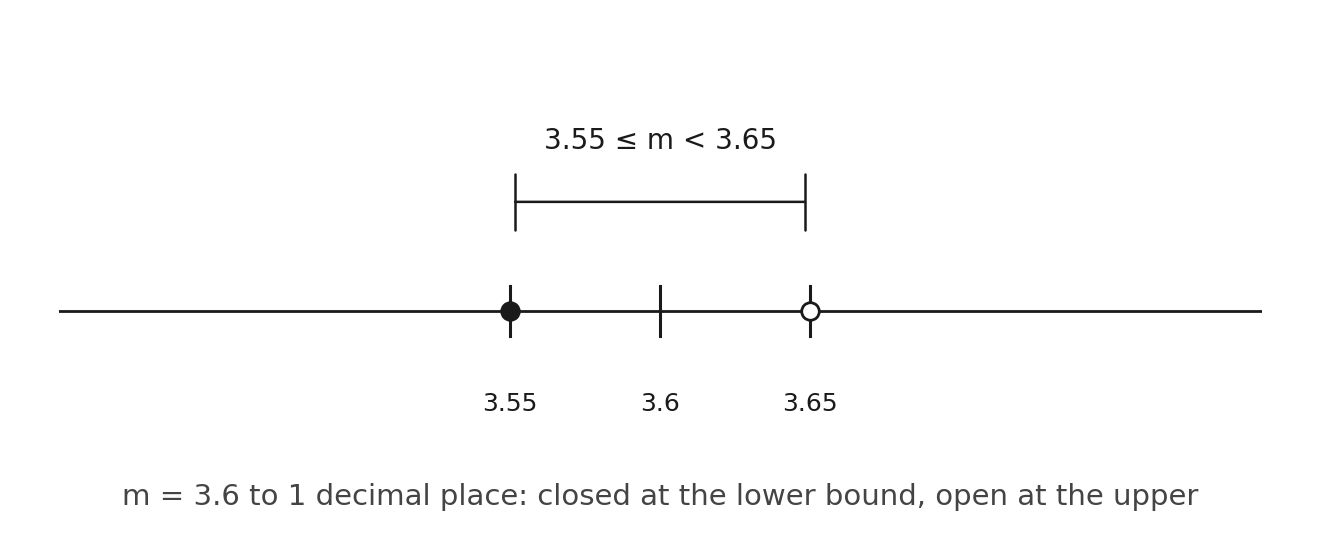
Rounding and error intervals 误差区间 (N15): to decimal places and significant figures (know not to round mid-calculation); (H) inequality notation for error intervals — 3.6 kg to 1 d.p. means 3.55 ≤ m < 3.65; truncation gives 3.6 ≤ m < 3.7.
Bounds (N16, H): upper bound 上界 of a length 9 m to the nearest metre is 9.5; in calculations, for positive inputs, an upper product bound uses upper input bounds and an upper quotient bound uses upper numerator divided by lower denominator. Check signs first; these shortcuts need not hold for negative inputs. Track strict endpoints; give the answer to an appropriate degree of accuracy (often the bound width decides).
Vocabulary
Train
| English |
|---|
| error interval |
| upper bound/ˈʌpə baʊnd/ |
| lower bound/ˈləʊə baʊnd/ |
1.2
Fractions, decimals and percentages (N10–N13, R9 links)
Syllabus
Fractions, decimals and percentages (AQA 8300 rules N10-N13).
- Convert between terminating decimals and fractions; (H) recurring decimals to fractions.
- Interpret fractions and percentages as operators, using multipliers including reverse percentages.
- Use standard units of mass, length, time and money with decimal quantities.
Source: Cambridge International syllabus
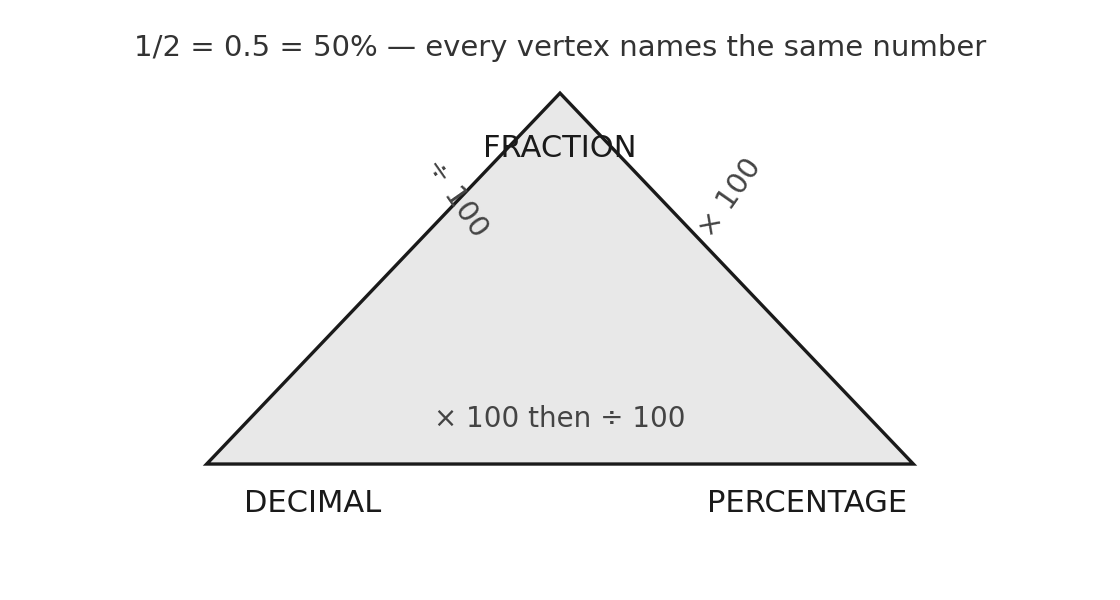
Conversions (N10): 3.5 = 7/2, 0.375 = 3/8; (H) recurring decimal 循环小数s ↔ fractions: 0.6̄ = 6/9 = 2/3; 0.4̄5̄ (pair) → 45/99 = 5/11. Method: x = 0.6̄, 10x = 6.6̄, 9x = 6.
Fractions as operators (N12): "3/5 of 40" = 40 × 3/5 = 24; percentage as multiplier 乘数 — increase by 15% = × 1.15; decrease by 20% = × 0.8; reverse percentage: find the original before the change by dividing by the multiplier.
Units (N13): metric conversions for length, area, volume, capacity; compound measures (speed, density, pressure) link to topic 3.
Vocabulary
Train
| English |
|---|
| recurring decimal/rɪˈkɜːrɪŋ ˈdesɪml/ |
| multiplier/ˌmʌltɪˈplaɪə/ |
1.2
Checklist before you call this topic done
- Four operations on fractions/mixed numbers and negatives without a calculator; BIDMAS traps.
- Prime decomposition → HCF/LCM; product rule for counting (H).
- Index laws including negative and fractional; simplify and rationalise surds (H).
- Standard form arithmetic; rounding and error intervals; upper/lower bounds through a formula (H).
- FDP conversions including recurring decimals (H); percentage multipliers and reverse percentages.
Supported teaching and tier boundary
8300: Number. Version: Version 1.0, 12 September 2014; first examination 2017.
Foundation teaching and Higher additions are labelled below. This reference packages the existing native-lesson crosswalk. It does not certify unreviewed specification rows or a whole qualification. Original diagnostics are separate and are not reproduced.
Exact arithmetic and estimation · Foundation
Prime factors reveal shared structure. Use the smallest common prime powers for the HCF and the largest for the LCM. Estimate before calculating; use brackets to preserve the order of operations.
$$72=2^3\times3^2,\quad90=2\times3^2\times5,\quad\mathrm{HCF}=18$$
72=2^3×3^2 and 90=2×3^2×5. Their HCF is 2×9=18. Make 18 bags with 4 pencils and 5 pens each. Their LCM is 2^3×3^2×5=360. A prime integer is greater than 1 and has exactly two positive factors. The number 1 is not prime; a composite positive integer greater than 1 has more than two positive factors. Every integer greater than 1 has a unique product of prime factors apart from their order. For example, 60=2²×3×5. A factor divides a number; a multiple is the result of multiplying it by an integer. HCF uses common smallest powers, while LCM uses largest powers.
The HCF divides both numbers; the LCM is a multiple of both. They answer different questions. A decimal estimate is not an exact fraction.
For a non-calculator paper, keep fractions exact and show cancellation. For a calculator paper, enter the full expression and compare with your estimate.
Exact arithmetic and estimation · Higher
Prime factors reveal shared structure. Use the smallest common prime powers for the HCF and the largest for the LCM. Estimate before calculating; use brackets to preserve the order of operations.
$$a=\prod p_i^{\alpha_i},\quad b=\prod p_i^{\beta_i},\quad \operatorname{HCF}(a,b)=\prod p_i^{\min(\alpha_i,\beta_i)}$$
72=2^3×3^2 and 90=2×3^2×5. Their HCF is 2×9=18. Make 18 bags with 4 pencils and 5 pens each. Their LCM is 2^3×3^2×5=360. A prime integer is greater than 1 and has exactly two positive factors. The number 1 is not prime; a composite positive integer greater than 1 has more than two positive factors. Every integer greater than 1 has a unique product of prime factors apart from their order. For example, 60=2²×3×5. A factor divides a number; a multiple is the result of multiplying it by an integer. HCF uses common smallest powers, while LCM uses largest powers.
The HCF divides both numbers; the LCM is a multiple of both. They answer different questions. A decimal estimate is not an exact fraction.
For a non-calculator paper, keep fractions exact and show cancellation. For a calculator paper, enter the full expression and compare with your estimate.

Integer indices and standard form · Foundation
Use integer powers, square and cube roots and standard form with 1≤a<10. In multiplying powers with the same base, add indices; in division, subtract them.
$$a^m a^n=a^{m+n}$$
0.000072=7.2×10^(-5). Also 2³×2⁴=2⁷=128. The square root of 81 is 9. Check a standard-form answer by writing it out as a decimal. Useful powers include 3³=27, 4³=64, 5³=125, 15²=225 and 10⁶=1,000,000. Integer laws give 2⁰=1, 2^(-3)=1/8 and (2³)²=2⁶=64. For standard-form multiplication, (3×10⁵)(4×10^(-3))=12×10²=1.2×10³. Division gives (6×10⁵)/(2×10²)=3×10³. For addition, first align exponents: 3×10⁴+2×10³=3.2×10⁴.
Index laws do not turn a sum into a single power: 2^3+2^4=24, not 2^7. Do not round a surd when an exact answer is requested.
This Foundation/Core lesson excludes fractional powers and surd rationalisation. Estimate a result before using a calculator and retain the required precision.
Indices, surds and standard form · Higher
For the same positive base, multiplication adds indices and division subtracts them. A negative index means reciprocal; a fractional index represents a root. Standard form has 1≤a<10.
$$a^m a^n=a^{m+n},\quad a^{-n}=\frac1{a^n},\quad a^{m/n}=\left(\sqrt[n]{a}\right)^m$$
0.000072=7.2×10^(-5). Also 16^(3/4)=(16^(1/4))^3=2^3=8. Simplify √72=6√2, then rationalise 1/√2=√2/2. Useful powers include 3³=27, 4³=64, 5³=125, 15²=225 and 10⁶=1,000,000. Integer laws give 2⁰=1, 2^(-3)=1/8 and (2³)²=2⁶=64. For standard-form multiplication, (3×10⁵)(4×10^(-3))=12×10²=1.2×10³. Division gives (6×10⁵)/(2×10²)=3×10³. For addition, first align exponents: 3×10⁴+2×10³=3.2×10⁴. For a positive base, a^(m/n)=(the nth root of a)^m. Thus 27^(2/3)=3²=9 and 16^(-1/2)=1/4. To estimate √20 without a calculator, 4²<20<5² gives 4<√20<5; testing 4.5²=20.25 shows √20 is just below 4.5. Do not use a rough estimate as an exact surd answer.
Index laws do not turn a sum into a single power: 2^3+2^4=24, not 2^7. Do not round a surd when an exact answer is requested.
Check powers of ten against the original quantity. Use surds for exact geometry, and round only the final length when the question asks for a decimal.

Accuracy, bounds and compound measures · Higher
A value rounded to the nearest unit u lies from stated value-u/2 up to, but usually not including, stated value+u/2. For positive quantities, combine extremes according to the operation.
$$A=LW,\qquad v=\frac{d}{t}$$
The lengths satisfy 7.95≤L<8.05 and 4.95≤W<5.05. Since A=LW, 39.3525≤A<40.6525. For speed d/t, the largest speed uses the largest distance and smallest positive time.
An upper bound is not automatically achieved. Dividing upper distance by upper time does not give the largest speed. Keep enough digits in intermediate calculations.
Distinguish measurement uncertainty from arithmetic rounding. A sensible reported precision cannot be finer than the measurements justify.

Signed numbers, place value and operation order · Foundation
Larger numbers lie farther right on the number line. Adding a negative moves left; subtracting a negative moves right. Multiply or divide signs first, then magnitudes. Evaluate brackets, powers and roots before multiplication/division, then addition/subtraction, working left to right within equal priority.
$$-12+35-9=14,\quad18\div3\times2=12$$
The balance is -12+35-9=14 yuan. Also -4-(-7)=3 and (-6)×(-3)=18. The reciprocal of -4 is -1/4, since their product is 1. For 18÷3×2, work left to right to obtain 12. In 3.047, the 4 means four hundredths and the 7 means seven thousandths. For decimal multiplication, first calculate 24×35: 24×30+24×5=720+120=840. The original 2.4×0.35 has three decimal places in total, giving 0.840. For 5.04÷0.12 multiply both numbers by 100 to get 504÷12; 12×40=480 leaves 24, so the answer is 42. To order negative fractions, -3/4=-0.75 and -4/5=-0.8, hence -4/5<-3/4. The symbols ≤ and ≥ include equality; ≠ means unequal.
Subtraction is not commutative: 3-8 and 8-3 differ. A negative sign outside a square is not inside its base: -3²=-9, but (-3)²=9. Zero has no reciprocal.
Use a signed starting balance, a positive credit and a negative debit. A shop buying for 48 yuan and selling for 60 makes 12 yuan profit; reversing the prices gives a 12-yuan loss. Estimate the sign before calculating.

Exact fractions and mixed-number operations · Foundation
Convert mixed numbers to improper fractions. Add or subtract using a common denominator; multiply numerators and denominators; divide by a nonzero fraction by multiplying its reciprocal. Cancel common factors, not added terms. These rules also apply to negative fractions.
$$\frac34\div\frac58=\frac34\times\frac85=\frac65$$
1½-¾=6/4-3/4=3/4. Also (-2/3)×(9/4)=-18/12=-3/2 and (3/4)÷(5/8)=(3/4)×(8/5)=6/5. A common denominator gives 5/6+3/4=10/12+9/12=19/12. Check division by multiplying 6/5 by 5/8 to recover 3/4. Exact multiples of π follow ordinary arithmetic: 3π+2π=5π and 6π/3=2π. Leave an answer such as 5π exact when requested; π≈3.14 would introduce approximation. For subtraction, 5/6-3/4=10/12-9/12=1/12; for a negative mixed number, -1½ means -(1+1/2)=-3/2.
Adding denominators does not preserve the unit size: 1/2+1/3 is not 2/5. Cancel only factors of a whole numerator and denominator. A division by zero is undefined.
For a non-calculator question show the common denominator or reciprocal step. Convert 19/12 to 1 7/12 if a mixed number is requested; round only when the question explicitly needs a decimal.

Systematic lists and possibility grids · Foundation
Fix one first choice and list every allowed second choice before moving to the next first choice. Use a table to check that no outcome is missing or duplicated. If combinations are forbidden, remove those entries from the list.
$$\{TA,TB,TM,JA,JB,JM\}$$
List tea-apple, tea-banana, tea-melon, juice-apple, juice-banana, juice-melon: six choices. Removing tea-melon leaves five. The codes using 1,2,3 once each are 123,132,213,231,312,321: six. These answers follow from complete lists.
State whether order matters and whether repetition is allowed. Choosing A then B can be different from B then A for a code, but not for an unordered two-person team. A restriction can make a simple product invalid.
Foundation should justify answers with a complete ordered list or grid. Higher may compress a verified structure using the product rule, but must still check restrictions.
Systematic lists and the product rule · Higher
Fix one first choice and list every permitted second choice before moving to the next first choice. A table gives the same structure. When every one of m first choices allows n second choices, the Higher product rule gives mn outcomes. If restrictions change the options, count the allowed rows separately.
$$\{TA,TB,TM,JA,JB,JM\}$$
The list is tea-apple, tea-banana, tea-melon, juice-apple, juice-banana, juice-melon: six outcomes. If tea-melon is unavailable, five remain. For a three-digit code with digits 1,2,3 and no repeats, choose 3 then 2 then 1 possibilities, giving six codes: 123,132,213,231,312,321.
State whether order matters and whether repetition is allowed. Choosing A then B can be different from B then A for a code, but not for an unordered two-person team. A restriction can make a simple product invalid.
Foundation should justify answers with a complete ordered list or grid. Higher may compress a verified structure using the product rule, but must still check restrictions.

Exact surds and rationalising denominators · Higher
Extract square factors: √(a²b)=a√b for a≥0,b≥0. Add only matching root parts. Multiply roots with nonnegative radicands. To rationalise a denominator, multiply numerator and denominator by the same suitable root or conjugate.
$$\sqrt{12}+\sqrt{27}=5\sqrt3,\quad\frac6{\sqrt3}=2\sqrt3$$
The side is √12=√(4×3)=2√3 cm. Thus √12+√27=2√3+3√3=5√3. Also 6/√3=6√3/3=2√3. For 1/(2+√3), multiply by (2-√3)/(2-√3): the denominator becomes 4-3=1, giving 2-√3. A circle of radius 3 has exact area 9π; a decimal is an approximation.
√(a+b) generally differs from √a+√b. Match the radicand before collecting terms. Rationalising changes the form, not the value; multiplying only the denominator changes the value.
AQA N8 Higher requires exact surds and rationalisation. Foundation retains exact fractions and multiples of π; do not assign this surd lesson to Foundation.

Terminating decimals and fractions · Foundation
Use the place value of the last digit to write a power-of-ten denominator, then simplify. Compare numbers using matching decimal places or a common denominator.
$$0.375=\frac{375}{1000}=\frac38$$
0.375=375/1000=3/8. Also 3.5=35/10=7/2 and 0.06=6/100=3/50. To order 3/8 and 0.4, write 0.375 and 0.400; therefore 3/8<0.4.
Keep the place value: 0.06 is six hundredths, not six tenths. A fraction may exceed 1. Simplify the entire numerator and denominator by the same common factor.
AQA N10 Foundation covers terminating decimals and fractions, including ordering. Recurring-decimal conversion is reserved for the Higher lesson.
Terminating and recurring decimal conversions · Higher
A finite decimal uses a power-of-ten denominator before simplifying. For a recurring decimal, multiply by powers of ten so the repeated tails align, then subtract. Use matching decimal places to compare numbers. A displayed rounded decimal need not be the exact fraction.
$$100x-x=27,\quad x=\frac{27}{99}=\frac3{11}$$
0.375=375/1000=3/8. For x=0.272727..., 100x=27.272727..., so 99x=27 and x=27/99=3/11. For y=0.16666..., 100y-10y=16.666...-1.666...=15, so y=15/90=1/6. In a reduced fraction, a denominator containing only factors 2 and 5 gives a terminating decimal.
Align the recurring tails before subtracting. 0.333333 is finite and differs from 0.333333... . A non-recurring prefix needs a second power of ten; blindly dividing every digit block by 99 fails.
AQA N10 Higher includes recurring conversion. Both tiers convert and order terminating decimals and fractions. Check a conversion by long division; 3 divided by 8 gives 0.375.

Metric and compound-unit conversions · Foundation
Convert each dimension. Since 1 m=100 cm, 1 m²=10,000 cm² and 1 m³=1,000,000 cm³. Also 1 litre=1000 cm³, 1 kg=1000 g and 1 hour=3600 seconds. For a compound unit convert numerator and denominator, keeping the physical quantity unchanged.
$$1\text{ m}^2=100^2\text{ cm}^2,\quad72\frac{\text{km}}{\text{h}}=20\frac{\text{m}}{\text{s}}$$
0.4 m=40 cm, so the tile area is 40×40=1600 cm², agreeing with 0.16×10,000. A 0.002 m³ container holds 2000 cm³=2 litres. A speed of 72 km/h is 72,000/3600=20 m/s. Write the units at each stage so the conversion can be checked.
The area multiplier is the square of the length multiplier; the volume multiplier is its cube. An hour is 60 minutes, not 100. Converting only the numerator of a speed gives an inconsistent unit.
AQA N13 and R1 include metric length, area, volume, capacity and compound measures. Use given conversion factors for unfamiliar imperial units; do not guess them.

Estimation, rounding and simple error intervals · Foundation
For a rough check use easy nearby numbers: 50×20÷10=100. Decimal places count digits after the point; significant figures start at the first nonzero digit. Round only the final result. Nearest-unit rounding has an interval extending half a unit either way; positive truncation keeps values from the stated value up to the next unit.
$$7.95\le L<8.05$$
The calculation is about 96.18, consistent with the estimate 100. The number 0.004786 rounds to 0.0048 at 2 significant figures, but to 0.005 at 3 decimal places. If length L rounds to 8.0 cm at 1 decimal place, 7.95≤L<8.05. If a positive value is truncated to 8.0 at 1 decimal place, 8.0≤L<8.1 instead. Reported precision must fit the question. Seventeen items packed six per box need three whole boxes, since two boxes hold only twelve items. Rounding 17/6 to two boxes would fail the physical requirement. For a nearest-0.1 reading of 8.0, each possible value differs from the report by at most 0.05; a claim of 8.08 lies outside the interval. Carry full calculator precision until a final money, length or accuracy requirement is applied.
Zeros before the first nonzero digit do not count as significant figures. Rounding and truncation give different intervals. Do not turn an approximate check into an exact answer, or round every intermediate result.
AQA N14–N16 require accuracy interpretation at both tiers. Foundation uses simple intervals and limits of accuracy. Higher combines upper and lower bounds for calculated quantities in the separate bounds lesson.

Ratio shares and fraction operators · Foundation
Add the ratio parts to find the whole: 2:5 has 7 equal parts. Divide the total by 7, then multiply by the required part count. A fraction acts as a multiplier; a percentage p acts as p/100. Keep part-to-part and part-to-whole comparisons separate.
$$84\times\frac2{2+5}=24$$
Each part is 84/7=12 yuan, giving shares 24 and 60. The first team has 2/7 of the whole, while its share is 2/5 of the other share. A 3/4 portion of 28 is 21. A 120% amount of 35 is 1.2×35=42, so percentages may exceed 100.
A ratio 2:5 does not give the first share as 2/5 of the total. The total has 7 parts. A multiplier over 1 increases a positive quantity; it does not automatically mean a probability.
AQA N11/N12 and R3–R8 link ratio parts to fractions and operators. Check the shares add to the stated total and simplify a ratio by dividing every part by the same positive factor.

Original independent transfer
Foundation
A supplier has 84 pencils and 126 pens. Find the greatest number of identical packs using everything. State each pack's contents. A delivery charge of 18.60 CNY is shared equally among six buyers; find each share without rounding intermediate values.
Foundation worked solution
$84=2^2\cdot3\cdot7$ and $126=2\cdot3^2\cdot7$, so the HCF is 42. Each of 42 packs has $84/42=2$ pencils and $126/42=3$ pens. This is maximal because any pack count must divide both totals. Each delivery share is $s=C/n=(18.60\ \mathrm{CNY})/6=3.10\ \mathrm{CNY}$; six shares return the original charge.
Higher
A positive rectangle has recorded length 8.0 cm and width 3.0 cm, each to the nearest 0.1 cm. Give tight lower and upper bounds for area and for length divided by width. State endpoint inclusion.
Higher worked solution
$7.95\le l<8.05$ and $2.95\le w<3.05$, in cm. Positivity makes product and quotient monotonic in the needed directions. Thus $23.4525\le A<24.5525$ in square centimetres. For the dimensionless quotient, $7.95/3.05
Terms
prime factor 质因数.
index 指数.
lower bound 下界.
reciprocal 倒数.
improper fraction 假分数.
systematic list 系统列表.
surd 根式.
terminating decimal 有限小数.
recurring decimal 循环小数.
conversion factor 换算因子.
significant figure 有效数字.
ratio 比.
Interactive lessons on this topic
Work through it step by step, with instant-check exercises.
- Exact arithmetic and estimation · Foundation
- Exact arithmetic and estimation · Higher
- Integer indices and standard form · Foundation
- Indices, surds and standard form · Higher
- Accuracy, bounds and compound measures · Higher
- Signed numbers, place value and operation order · Foundation
- Signed numbers, place value and operation order · Higher
- Exact fractions and mixed-number operations · Foundation
- Exact fractions and mixed-number operations · Higher
- Systematic lists and possibility grids · Foundation
- Systematic lists and the product rule · Higher
- Exact surds and rationalising denominators · Higher
- Terminating decimals and fractions · Foundation
- Terminating and recurring decimal conversions · Higher
- Metric and compound-unit conversions · Foundation
- Metric and compound-unit conversions · Higher
- Estimation, rounding and simple error intervals · Foundation
- Estimation, rounding and simple error intervals · Higher
- Ratio shares and fraction operators · Foundation
- Ratio shares and fraction operators · Higher