- Order and calculate with positives, negatives, decimals and fractions; the four operations with formal written methods.
- Primes, factors, HCF/LCM by prime decomposition; indices, roots, surds 根式 (H) and standard form 标准形式.
- Fractions ↔ decimals ↔ percentages as operators; rounding, estimation and bounds (H).
-
1
Number
1.1
Number: the foundations everything else stands on
Vocabulary TrainEnglish standard form/ˈstændəd fɔːm/ surds 1.1
Arithmetic, factors, multiples and primes (N1–N5)
Syllabus
Arithmetic, factors, multiples and primes (AQA 8463-style N1-N5 rules for 8300).
- Order integers, decimals and fractions; use the six inequality and equality symbols.
- Apply the four operations with formal written methods to integers, decimals, fractions and mixed numbers, in context including household finance.
- Use inverse operations and the priority of operations (BIDMAS).
- Use primes, factors, multiples, HCF and LCM via prime factorisation; (H) systematic listing and the product rule for counting.
Source: Cambridge International syllabus
Ordering and symbols: order positive and negative integers, decimals and fractions on a number line; use =, ≠, <, >, ≤, ≥.
The four operations (N2): formal written methods for integers, decimals, proper and improper fractions and mixed numbers, all signs — set in context including household finance: profit, loss, cost price, selling price, debit, credit, balance, income tax, VAT, interest rate.
Inverse operations and priority (N3): cancellation to simplify; BIDMAS 运算顺序 — brackets, indices/powers, roots, division/multiplication, addition/subtraction.
Primes and structure (N4): prime numbers, factors, multiples, common factors, common multiples, HCF, LCM; prime factorisation 质因数分解 in index form (product notation; unique factorisation). Worked pattern:
- 200 = 2³ × 5²
- HCF = product of the lowest powers of common primes; LCM = product of the highest powers of all primes.
(N5) systematic listing and the product rule for counting (H).
Vocabulary TrainEnglish prime factorisation/praɪm ˌfæktəraɪˈzeɪʃn/ BIDMAS 1.3
Indices, surds, standard form and bounds (N7–N9, N14–N16)
Syllabus
Indices, surds, standard form and bounds (AQA 8300 rules N7-N9, N14-N16).
- Use index laws with integer and (H) fractional indices; calculate with roots.
- (H) Simplify surds and rationalise denominators.
- Calculate with standard form A x 10^n and interpret calculator displays.
- Estimate answers by rounding to one significant figure; round to dp and sf.
- (H) Write error intervals in inequality notation and apply upper and lower bounds through calculations.
Source: Cambridge International syllabus
Indices (N7): laws — a^m × a^n = a^(m+n), a^m ÷ a^n = a^(m-n), (a^m)^n = a^(mn), a^(-n) = 1/a^n, a^(1/2) = √a; (H) fractional indices a^(m/n) = the n-th root of a^m.
Surds (N8, H): √12 = √(4 × 3) = 2√3 — simplify; rationalise denominators (multiply by the conjugate: 1/(3+√2) × (3−√2)/(3−√2) = (3−√2)/7).
Standard form (N9): A × 10ⁿ, 1 ≤ A < 10, n an integer — add/subtract (match powers), multiply (multiply coefficients and add exponents), or divide (divide coefficients and subtract exponents); interpret calculator displays.
Estimation (N14): round each value to 1 significant figure, compute, decide over- or under-estimate; check calculations by approximation.
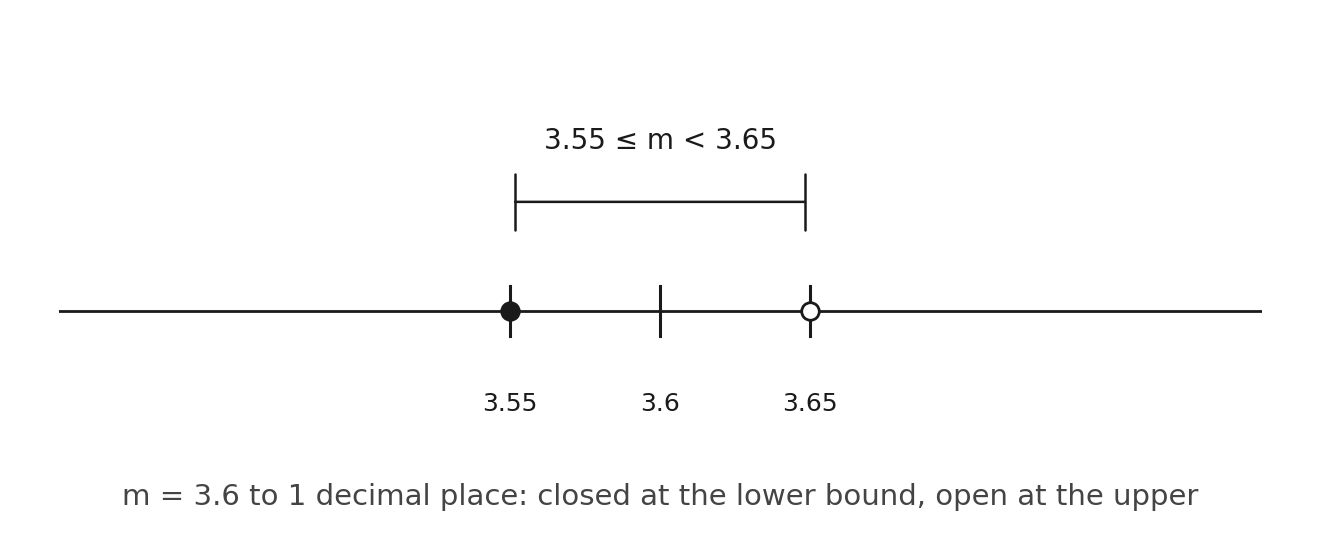
Rounding and error intervals 误差区间 (N15): to decimal places and significant figures (know not to round mid-calculation); (H) inequality notation for error intervals — 3.6 kg to 1 d.p. means 3.55 ≤ m < 3.65; truncation gives 3.6 ≤ m < 3.7.
Bounds (N16, H): upper bound 上界 of a length 9 m to the nearest metre is 9.5; in calculations, for positive inputs, an upper product bound uses upper input bounds and an upper quotient bound uses upper numerator divided by lower denominator. Check signs first; these shortcuts need not hold for negative inputs. Track strict endpoints; give the answer to an appropriate degree of accuracy (often the bound width decides).
Vocabulary TrainEnglish error interval upper bound/ˈʌpə baʊnd/ lower bound/ˈləʊə baʊnd/ 1.2
Fractions, decimals and percentages (N10–N13, R9 links)
Syllabus
Fractions, decimals and percentages (AQA 8300 rules N10-N13).
- Convert between terminating decimals and fractions; (H) recurring decimals to fractions.
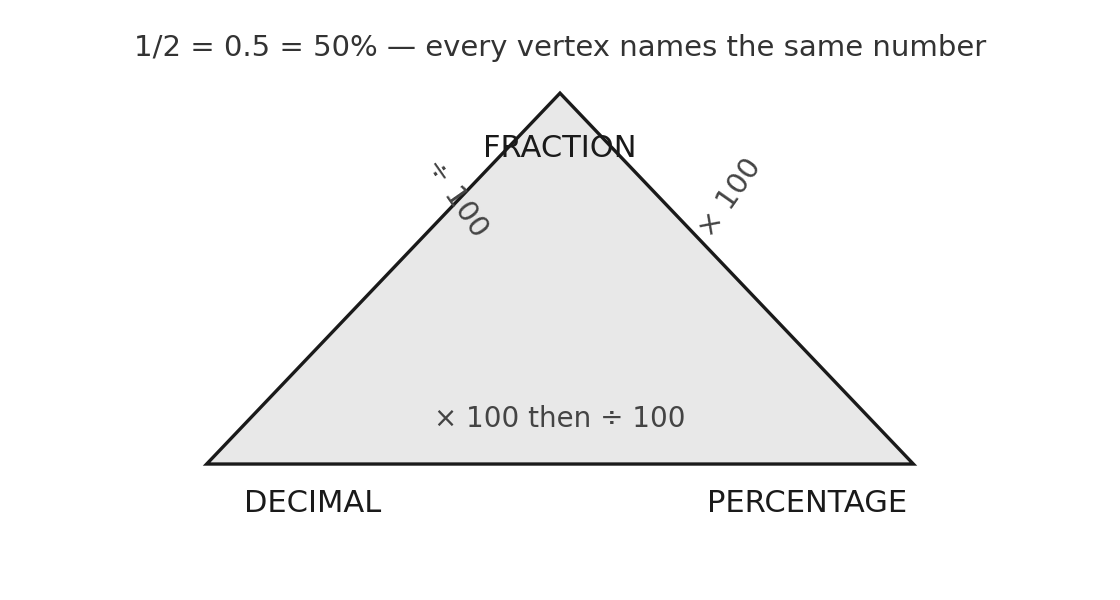
- Interpret fractions and percentages as operators, using multipliers including reverse percentages.
- Use standard units of mass, length, time and money with decimal quantities.
Source: Cambridge International syllabus
Conversions (N10): 3.5 = 7/2, 0.375 = 3/8; (H) recurring decimal 循环小数s ↔ fractions: 0.6̄ = 6/9 = 2/3; 0.4̄5̄ (pair) → 45/99 = 5/11. Method: x = 0.6̄, 10x = 6.6̄, 9x = 6.
Fractions as operators (N12): "3/5 of 40" = 40 × 3/5 = 24; percentage as multiplier 乘数 — increase by 15% = × 1.15; decrease by 20% = × 0.8; reverse percentage: find the original before the change by dividing by the multiplier.
Units (N13): metric conversions for length, area, volume, capacity; compound measures (speed, density, pressure) link to topic 3.
Vocabulary TrainEnglish recurring decimal/rɪˈkɜːrɪŋ ˈdesɪml/ multiplier/ˌmʌltɪˈplaɪə/ 1.2
Checklist before you call this topic done
- Four operations on fractions/mixed numbers and negatives without a calculator; BIDMAS traps.
- Prime decomposition → HCF/LCM; product rule for counting (H).
- Index laws including negative and fractional; simplify and rationalise surds (H).
- Standard form arithmetic; rounding and error intervals; upper/lower bounds through a formula (H).
- FDP conversions including recurring decimals (H); percentage multipliers and reverse percentages.
Supported teaching and tier boundary
8300: Number. Version: Version 1.0, 12 September 2014; first examination 2017.
Foundation teaching and Higher additions are labelled below. This reference packages the existing native-lesson crosswalk. It does not certify unreviewed specification rows or a whole qualification. Original diagnostics are separate and are not reproduced.
Exact arithmetic and estimation · Foundation
Prime factors reveal shared structure. Use the smallest common prime powers for the HCF and the largest for the LCM. Estimate before calculating; use brackets to preserve the order of operations.
$$72=2^3\times3^2,\quad90=2\times3^2\times5,\quad\mathrm{HCF}=18$$72=2^3×3^2 and 90=2×3^2×5. Their HCF is 2×9=18. Make 18 bags with 4 pencils and 5 pens each. Their LCM is 2^3×3^2×5=360. A prime integer is greater than 1 and has exactly two positive factors. The number 1 is not prime; a composite positive integer greater than 1 has more than two positive factors. Every integer greater than 1 has a unique product of prime factors apart from their order. For example, 60=2²×3×5. A factor divides a number; a multiple is the result of multiplying it by an integer. HCF uses common smallest powers, while LCM uses largest powers.
The HCF divides both numbers; the LCM is a multiple of both. They answer different questions. A decimal estimate is not an exact fraction.
For a non-calculator paper, keep fractions exact and show cancellation. For a calculator paper, enter the full expression and compare with your estimate.
Exact arithmetic and estimation · Higher
Prime factors reveal shared structure. Use the smallest common prime powers for the HCF and the largest for the LCM. Estimate before calculating; use brackets to preserve the order of operations.
$$a=\prod p_i^{\alpha_i},\quad b=\prod p_i^{\beta_i},\quad \operatorname{HCF}(a,b)=\prod p_i^{\min(\alpha_i,\beta_i)}$$72=2^3×3^2 and 90=2×3^2×5. Their HCF is 2×9=18. Make 18 bags with 4 pencils and 5 pens each. Their LCM is 2^3×3^2×5=360. A prime integer is greater than 1 and has exactly two positive factors. The number 1 is not prime; a composite positive integer greater than 1 has more than two positive factors. Every integer greater than 1 has a unique product of prime factors apart from their order. For example, 60=2²×3×5. A factor divides a number; a multiple is the result of multiplying it by an integer. HCF uses common smallest powers, while LCM uses largest powers.
The HCF divides both numbers; the LCM is a multiple of both. They answer different questions. A decimal estimate is not an exact fraction.
For a non-calculator paper, keep fractions exact and show cancellation. For a calculator paper, enter the full expression and compare with your estimate.

Original native-lesson illustration; labels belong to its worked example. Integer indices and standard form · Foundation
Use integer powers, square and cube roots and standard form with 1≤a<10. In multiplying powers with the same base, add indices; in division, subtract them.
$$a^m a^n=a^{m+n}$$0.000072=7.2×10^(-5). Also 2³×2⁴=2⁷=128. The square root of 81 is 9. Check a standard-form answer by writing it out as a decimal. Useful powers include 3³=27, 4³=64, 5³=125, 15²=225 and 10⁶=1,000,000. Integer laws give 2⁰=1, 2^(-3)=1/8 and (2³)²=2⁶=64. For standard-form multiplication, (3×10⁵)(4×10^(-3))=12×10²=1.2×10³. Division gives (6×10⁵)/(2×10²)=3×10³. For addition, first align exponents: 3×10⁴+2×10³=3.2×10⁴.
Index laws do not turn a sum into a single power: 2^3+2^4=24, not 2^7. Do not round a surd when an exact answer is requested.
This Foundation/Core lesson excludes fractional powers and surd rationalisation. Estimate a result before using a calculator and retain the required precision.
Indices, surds and standard form · Higher
For the same positive base, multiplication adds indices and division subtracts them. A negative index means reciprocal; a fractional index represents a root. Standard form has 1≤a<10.
$$a^m a^n=a^{m+n},\quad a^{-n}=\frac1{a^n},\quad a^{m/n}=\left(\sqrt[n]{a}\right)^m$$0.000072=7.2×10^(-5). Also 16^(3/4)=(16^(1/4))^3=2^3=8. Simplify √72=6√2, then rationalise 1/√2=√2/2. Useful powers include 3³=27, 4³=64, 5³=125, 15²=225 and 10⁶=1,000,000. Integer laws give 2⁰=1, 2^(-3)=1/8 and (2³)²=2⁶=64. For standard-form multiplication, (3×10⁵)(4×10^(-3))=12×10²=1.2×10³. Division gives (6×10⁵)/(2×10²)=3×10³. For addition, first align exponents: 3×10⁴+2×10³=3.2×10⁴. For a positive base, a^(m/n)=(the nth root of a)^m. Thus 27^(2/3)=3²=9 and 16^(-1/2)=1/4. To estimate √20 without a calculator, 4²<20<5² gives 4<√20<5; testing 4.5²=20.25 shows √20 is just below 4.5. Do not use a rough estimate as an exact surd answer.
Index laws do not turn a sum into a single power: 2^3+2^4=24, not 2^7. Do not round a surd when an exact answer is requested.
Check powers of ten against the original quantity. Use surds for exact geometry, and round only the final length when the question asks for a decimal.

Original native-lesson illustration; labels belong to its worked example. Accuracy, bounds and compound measures · Higher
A value rounded to the nearest unit u lies from stated value-u/2 up to, but usually not including, stated value+u/2. For positive quantities, combine extremes according to the operation.
$$A=LW,\qquad v=\frac{d}{t}$$The lengths satisfy 7.95≤L<8.05 and 4.95≤W<5.05. Since A=LW, 39.3525≤A<40.6525. For speed d/t, the largest speed uses the largest distance and smallest positive time.
An upper bound is not automatically achieved. Dividing upper distance by upper time does not give the largest speed. Keep enough digits in intermediate calculations.
Distinguish measurement uncertainty from arithmetic rounding. A sensible reported precision cannot be finer than the measurements justify.

Original native-lesson illustration; labels belong to its worked example. Signed numbers, place value and operation order · Foundation
Larger numbers lie farther right on the number line. Adding a negative moves left; subtracting a negative moves right. Multiply or divide signs first, then magnitudes. Evaluate brackets, powers and roots before multiplication/division, then addition/subtraction, working left to right within equal priority.
$$-12+35-9=14,\quad18\div3\times2=12$$The balance is -12+35-9=14 yuan. Also -4-(-7)=3 and (-6)×(-3)=18. The reciprocal of -4 is -1/4, since their product is 1. For 18÷3×2, work left to right to obtain 12. In 3.047, the 4 means four hundredths and the 7 means seven thousandths. For decimal multiplication, first calculate 24×35: 24×30+24×5=720+120=840. The original 2.4×0.35 has three decimal places in total, giving 0.840. For 5.04÷0.12 multiply both numbers by 100 to get 504÷12; 12×40=480 leaves 24, so the answer is 42. To order negative fractions, -3/4=-0.75 and -4/5=-0.8, hence -4/5<-3/4. The symbols ≤ and ≥ include equality; ≠ means unequal.
Subtraction is not commutative: 3-8 and 8-3 differ. A negative sign outside a square is not inside its base: -3²=-9, but (-3)²=9. Zero has no reciprocal.
Use a signed starting balance, a positive credit and a negative debit. A shop buying for 48 yuan and selling for 60 makes 12 yuan profit; reversing the prices gives a 12-yuan loss. Estimate the sign before calculating.

Original native-lesson illustration; labels belong to its worked example. Exact fractions and mixed-number operations · Foundation
Convert mixed numbers to improper fractions. Add or subtract using a common denominator; multiply numerators and denominators; divide by a nonzero fraction by multiplying its reciprocal. Cancel common factors, not added terms. These rules also apply to negative fractions.
$$\frac34\div\frac58=\frac34\times\frac85=\frac65$$1½-¾=6/4-3/4=3/4. Also (-2/3)×(9/4)=-18/12=-3/2 and (3/4)÷(5/8)=(3/4)×(8/5)=6/5. A common denominator gives 5/6+3/4=10/12+9/12=19/12. Check division by multiplying 6/5 by 5/8 to recover 3/4. Exact multiples of π follow ordinary arithmetic: 3π+2π=5π and 6π/3=2π. Leave an answer such as 5π exact when requested; π≈3.14 would introduce approximation. For subtraction, 5/6-3/4=10/12-9/12=1/12; for a negative mixed number, -1½ means -(1+1/2)=-3/2.
Adding denominators does not preserve the unit size: 1/2+1/3 is not 2/5. Cancel only factors of a whole numerator and denominator. A division by zero is undefined.
For a non-calculator question show the common denominator or reciprocal step. Convert 19/12 to 1 7/12 if a mixed number is requested; round only when the question explicitly needs a decimal.

Original native-lesson illustration; labels belong to its worked example. Systematic lists and possibility grids · Foundation
Fix one first choice and list every allowed second choice before moving to the next first choice. Use a table to check that no outcome is missing or duplicated. If combinations are forbidden, remove those entries from the list.
$$\{TA,TB,TM,JA,JB,JM\}$$List tea-apple, tea-banana, tea-melon, juice-apple, juice-banana, juice-melon: six choices. Removing tea-melon leaves five. The codes using 1,2,3 once each are 123,132,213,231,312,321: six. These answers follow from complete lists.
State whether order matters and whether repetition is allowed. Choosing A then B can be different from B then A for a code, but not for an unordered two-person team. A restriction can make a simple product invalid.
Foundation should justify answers with a complete ordered list or grid. Higher may compress a verified structure using the product rule, but must still check restrictions.
Systematic lists and the product rule · Higher
Fix one first choice and list every permitted second choice before moving to the next first choice. A table gives the same structure. When every one of m first choices allows n second choices, the Higher product rule gives mn outcomes. If restrictions change the options, count the allowed rows separately.
$$\{TA,TB,TM,JA,JB,JM\}$$The list is tea-apple, tea-banana, tea-melon, juice-apple, juice-banana, juice-melon: six outcomes. If tea-melon is unavailable, five remain. For a three-digit code with digits 1,2,3 and no repeats, choose 3 then 2 then 1 possibilities, giving six codes: 123,132,213,231,312,321.
State whether order matters and whether repetition is allowed. Choosing A then B can be different from B then A for a code, but not for an unordered two-person team. A restriction can make a simple product invalid.
Foundation should justify answers with a complete ordered list or grid. Higher may compress a verified structure using the product rule, but must still check restrictions.

Original native-lesson illustration; labels belong to its worked example. Exact surds and rationalising denominators · Higher
Extract square factors: √(a²b)=a√b for a≥0,b≥0. Add only matching root parts. Multiply roots with nonnegative radicands. To rationalise a denominator, multiply numerator and denominator by the same suitable root or conjugate.
$$\sqrt{12}+\sqrt{27}=5\sqrt3,\quad\frac6{\sqrt3}=2\sqrt3$$The side is √12=√(4×3)=2√3 cm. Thus √12+√27=2√3+3√3=5√3. Also 6/√3=6√3/3=2√3. For 1/(2+√3), multiply by (2-√3)/(2-√3): the denominator becomes 4-3=1, giving 2-√3. A circle of radius 3 has exact area 9π; a decimal is an approximation.
√(a+b) generally differs from √a+√b. Match the radicand before collecting terms. Rationalising changes the form, not the value; multiplying only the denominator changes the value.
AQA N8 Higher requires exact surds and rationalisation. Foundation retains exact fractions and multiples of π; do not assign this surd lesson to Foundation.

Original native-lesson illustration; labels belong to its worked example. Terminating decimals and fractions · Foundation
Use the place value of the last digit to write a power-of-ten denominator, then simplify. Compare numbers using matching decimal places or a common denominator.
$$0.375=\frac{375}{1000}=\frac38$$0.375=375/1000=3/8. Also 3.5=35/10=7/2 and 0.06=6/100=3/50. To order 3/8 and 0.4, write 0.375 and 0.400; therefore 3/8<0.4.
Keep the place value: 0.06 is six hundredths, not six tenths. A fraction may exceed 1. Simplify the entire numerator and denominator by the same common factor.
AQA N10 Foundation covers terminating decimals and fractions, including ordering. Recurring-decimal conversion is reserved for the Higher lesson.
Terminating and recurring decimal conversions · Higher
A finite decimal uses a power-of-ten denominator before simplifying. For a recurring decimal, multiply by powers of ten so the repeated tails align, then subtract. Use matching decimal places to compare numbers. A displayed rounded decimal need not be the exact fraction.
$$100x-x=27,\quad x=\frac{27}{99}=\frac3{11}$$0.375=375/1000=3/8. For x=0.272727..., 100x=27.272727..., so 99x=27 and x=27/99=3/11. For y=0.16666..., 100y-10y=16.666...-1.666...=15, so y=15/90=1/6. In a reduced fraction, a denominator containing only factors 2 and 5 gives a terminating decimal.
Align the recurring tails before subtracting. 0.333333 is finite and differs from 0.333333... . A non-recurring prefix needs a second power of ten; blindly dividing every digit block by 99 fails.
AQA N10 Higher includes recurring conversion. Both tiers convert and order terminating decimals and fractions. Check a conversion by long division; 3 divided by 8 gives 0.375.

Original native-lesson illustration; labels belong to its worked example. Metric and compound-unit conversions · Foundation
Convert each dimension. Since 1 m=100 cm, 1 m²=10,000 cm² and 1 m³=1,000,000 cm³. Also 1 litre=1000 cm³, 1 kg=1000 g and 1 hour=3600 seconds. For a compound unit convert numerator and denominator, keeping the physical quantity unchanged.
$$1\text{ m}^2=100^2\text{ cm}^2,\quad72\frac{\text{km}}{\text{h}}=20\frac{\text{m}}{\text{s}}$$0.4 m=40 cm, so the tile area is 40×40=1600 cm², agreeing with 0.16×10,000. A 0.002 m³ container holds 2000 cm³=2 litres. A speed of 72 km/h is 72,000/3600=20 m/s. Write the units at each stage so the conversion can be checked.
The area multiplier is the square of the length multiplier; the volume multiplier is its cube. An hour is 60 minutes, not 100. Converting only the numerator of a speed gives an inconsistent unit.
AQA N13 and R1 include metric length, area, volume, capacity and compound measures. Use given conversion factors for unfamiliar imperial units; do not guess them.

Original native-lesson illustration; labels belong to its worked example. Estimation, rounding and simple error intervals · Foundation
For a rough check use easy nearby numbers: 50×20÷10=100. Decimal places count digits after the point; significant figures start at the first nonzero digit. Round only the final result. Nearest-unit rounding has an interval extending half a unit either way; positive truncation keeps values from the stated value up to the next unit.
$$7.95\le L<8.05$$The calculation is about 96.18, consistent with the estimate 100. The number 0.004786 rounds to 0.0048 at 2 significant figures, but to 0.005 at 3 decimal places. If length L rounds to 8.0 cm at 1 decimal place, 7.95≤L<8.05. If a positive value is truncated to 8.0 at 1 decimal place, 8.0≤L<8.1 instead. Reported precision must fit the question. Seventeen items packed six per box need three whole boxes, since two boxes hold only twelve items. Rounding 17/6 to two boxes would fail the physical requirement. For a nearest-0.1 reading of 8.0, each possible value differs from the report by at most 0.05; a claim of 8.08 lies outside the interval. Carry full calculator precision until a final money, length or accuracy requirement is applied.
Zeros before the first nonzero digit do not count as significant figures. Rounding and truncation give different intervals. Do not turn an approximate check into an exact answer, or round every intermediate result.
AQA N14–N16 require accuracy interpretation at both tiers. Foundation uses simple intervals and limits of accuracy. Higher combines upper and lower bounds for calculated quantities in the separate bounds lesson.

Original native-lesson illustration; labels belong to its worked example. Ratio shares and fraction operators · Foundation
Add the ratio parts to find the whole: 2:5 has 7 equal parts. Divide the total by 7, then multiply by the required part count. A fraction acts as a multiplier; a percentage p acts as p/100. Keep part-to-part and part-to-whole comparisons separate.
$$84\times\frac2{2+5}=24$$Each part is 84/7=12 yuan, giving shares 24 and 60. The first team has 2/7 of the whole, while its share is 2/5 of the other share. A 3/4 portion of 28 is 21. A 120% amount of 35 is 1.2×35=42, so percentages may exceed 100.
A ratio 2:5 does not give the first share as 2/5 of the total. The total has 7 parts. A multiplier over 1 increases a positive quantity; it does not automatically mean a probability.
AQA N11/N12 and R3–R8 link ratio parts to fractions and operators. Check the shares add to the stated total and simplify a ratio by dividing every part by the same positive factor.

Original native-lesson illustration; labels belong to its worked example. Original independent transfer
Foundation
A supplier has 84 pencils and 126 pens. Find the greatest number of identical packs using everything. State each pack's contents. A delivery charge of 18.60 CNY is shared equally among six buyers; find each share without rounding intermediate values.
Foundation worked solution
$84=2^2\cdot3\cdot7$ and $126=2\cdot3^2\cdot7$, so the HCF is 42. Each of 42 packs has $84/42=2$ pencils and $126/42=3$ pens. This is maximal because any pack count must divide both totals. Each delivery share is $s=C/n=(18.60\ \mathrm{CNY})/6=3.10\ \mathrm{CNY}$; six shares return the original charge.
Higher
A positive rectangle has recorded length 8.0 cm and width 3.0 cm, each to the nearest 0.1 cm. Give tight lower and upper bounds for area and for length divided by width. State endpoint inclusion.
Higher worked solution
$7.95\le l<8.05$ and $2.95\le w<3.05$, in cm. Positivity makes product and quotient monotonic in the needed directions. Thus $23.4525\le A<24.5525$ in square centimetres. For the dimensionless quotient, $7.95/3.05
, or $159/61 . Neither quotient endpoint is attained, since each requires one excluded upper measurement bound. The area lower bound is attained, since both lower bounds are allowed. Blindly using “upper over lower” without sign and endpoint checks is insufficient. Terms
prime factor 质因数.
index 指数.
lower bound 下界.
reciprocal 倒数.
improper fraction 假分数.
systematic list 系统列表.
surd 根式.
terminating decimal 有限小数.
recurring decimal 循环小数.
conversion factor 换算因子.
significant figure 有效数字.
ratio 比.
-
2
Algebra
2.1
Supported teaching and tier boundary

8300: Algebra. Version: Version 1.0, 12 September 2014; first examination 2017.
Foundation teaching and Higher additions are labelled below. This reference packages the existing native-lesson crosswalk. It does not certify unreviewed specification rows or a whole qualification. Original diagnostics are separate and are not reproduced.
Equations, identities and rearrangement · Foundation
An equation asks which inputs satisfy an equality; an identity holds for all allowed inputs. Preserve equality by applying the same operation to both sides. State restrictions before dividing by a variable.
$$C_1=20+3x,\qquad C_2=44+x,\qquad C_1=C_2$$20+3x=44+x gives 2x=24 and x=12. Both plans then cost 56. In A=πr², divide by π and take the positive square root to obtain r=√(A/π), because r is a length.
Cancelling a term is not the same as cancelling a factor. In (x²+2x)/x, factor the numerator and retain x≠0. Check a rearrangement by substitution.
Define the unknown and set up a linear equation. Check the answer by substitution. Restrict this Foundation/Core lesson to simple expressions and equations.
Equations, identities and rearrangement · Higher
An equation asks which inputs satisfy an equality; an identity holds for all allowed inputs. Preserve equality by applying the same operation to both sides. State restrictions before dividing by a variable.
$$C_1=20+3x,\qquad C_2=44+x,\qquad C_1=C_2$$20+3x=44+x gives 2x=24 and x=12. Both plans then cost 56. In A=πr², divide by π and take the positive square root to obtain r=√(A/π), because r is a length.
Cancelling a term is not the same as cancelling a factor. In (x²+2x)/x, factor the numerator and retain x≠0. Check a rearrangement by substitution.
Set up the equation from units and the meaning of the unknown. A negative or fractional solution may be algebraically correct but impossible for a count.
Original native-lesson illustration; labels belong to its worked example. Factorising and solving simple quadratics · Foundation
Expand brackets and factorise simple quadratics. Solve by setting each factor equal to zero, and use a graph to interpret the roots.
$$(x-3)(x-7)=0$$x²-10x+21=(x-3)(x-7). Hence the equation x²-10x+21=0 has roots 3 and 7. Check each root by substitution and mark both intercepts on the graph.
Multiplying an inequality by a negative number reverses its direction. A sketch must show which side of each root satisfies the inequality. Geometry may restrict x further.
This Foundation/Core lesson uses factorisation and graphical roots; the discriminant, quadratic formula and quadratic inequalities are reserved for the advanced tier.
Quadratics and inequalities · Higher
Factor where possible; otherwise complete the square or use the quadratic formula. A quadratic inequality needs the sign on intervals, not only the roots. The discriminant identifies repeated or missing real roots.
$$ax^2+bx+c=0,\qquad \Delta=b^2-4ac$$The equation x²-10x+21=0 factorises as (x-3)(x-7)=0, giving roots 3 and 7. Complete the square: x²-10x+21=(x-5)²-4, giving turning point (5,-4) and symmetry line x=5. The formula x=[-b±√(b²-4ac)]/(2a) also gives (10±4)/2=3,7. For 2x²+5x-3=0, the discriminant is 49 and roots are (-5±7)/4=1/2,-3. A graph gives approximate roots when exact factorisation is inconvenient. For an enclosure with area A=x(10-x), complete the square to get A=25-(x-5)². The greatest area is 25 at x=5, within 0<x<10.
Multiplying an inequality by a negative number reverses its direction. A sketch must show which side of each root satisfies the inequality. Geometry may restrict x further.
AQA A11/A18 Higher interprets roots, intercepts and turning points, completes the square and uses the quadratic formula, including equations needing rearrangement. Factorisation and substitution check each result.

Original native-lesson illustration; labels belong to its worked example. 
Original native-lesson illustration; labels belong to its worked example. Two linear simultaneous equations · Foundation
Multiply equations to make a variable cancel, or substitute an expression from one equation into the other. Solve the remaining linear equation and recover the second variable. The intersection is a point satisfying both original equations.
$$x+y=12,\qquad 3x+2y=31$$For x+y=12 and 3x+2y=31, subtract twice the first equation from the second: x=7. Then y=5. Check both 7+5=12 and 3×7+2×5=31. The two straight-line graphs meet at (7,5).
Check the ordered pair in both original equations. Multiplying an equation means multiplying every term, including the constant. Parallel distinct lines have no common solution.
AQA A19 Foundation solves two linear equations by elimination or substitution and interprets the graph intersection. Linear/quadratic systems belong to Higher.
Linear and linear/quadratic simultaneous equations · Higher
For two linear equations, use elimination or substitution and check both equations. For a line and a quadratic, substitute the linear relation first; then solve the resulting quadratic. For inequalities, shade the region satisfying every condition.
$$x+y=12,\qquad 3x+2y=31$$For x+y=12 and 3x+2y=31, subtract twice the first equation to obtain x=7,y=5. For y=x+2 and y=x², equate outputs: x²-x-2=0, hence x=2 or -1. The intersections are (2,4) and (-1,1), and both satisfy the line and parabola.
One equation checked is not enough. A line can meet a quadratic twice, so retain both solutions unless the context removes one. Inequality boundaries may be included or excluded according to the sign.
AQA A19 Higher includes two linear equations and linear/quadratic systems. Elimination suits linear pairs; substitution reduces a line/curve pair to a quadratic. Retain every solution and check both original equations.

Original native-lesson illustration; labels belong to its worked example. Straight lines and gradients · Foundation
Gradient is change in y divided by change in x. A straight line has y=mx+c, where c is its y-intercept. Parallel lines have equal gradients.
$$y=mx+c$$Through (2,5) with gradient 3, substitute to get 5=3×2+c, so c=-1 and y=3x-1. Points (1,2) and (4,8) give gradient (8-2)/(4-1)=2.
A vertical line has no finite gradient; do not force it into y=mx+c. Read the signs of a circle's centre carefully. The radius to a tangent is perpendicular to the tangent.
Plot a straight line using two checked points and label its intercept. Perpendicular-gradient formulae and circle equations are not part of this Foundation/Core lesson.
Coordinate geometry and tangents · Higher
A line through (x₁,y₁) with gradient m has y-y₁=m(x-x₁). Parallel lines have equal gradients. Finite perpendicular gradients multiply to -1. A circle has (x-a)²+(y-b)²=r².
$$y-y_1=m(x-x_1),\qquad (x-a)^2+(y-b)^2=r^2$$Through (2,5) with gradient 3, y-5=3(x-2), so y=3x-1. A perpendicular through the same point has y-5=-(x-2)/3. The circle (x-2)²+(y+1)²=25 has centre (2,-1) and radius 5.
A vertical line has no finite gradient; do not force it into y=mx+c. Read the signs of a circle's centre carefully. The radius to a tangent is perpendicular to the tangent.
Before solving a line-circle intersection, predict whether there are zero, one or two intersections. Substitution produces a quadratic whose discriminant checks the prediction.

Original native-lesson illustration; labels belong to its worked example. Arithmetic sequences and nth terms · Foundation
Find a constant difference for an arithmetic sequence. Its nth term is a+(n-1)d. A term-to-term rule describes how to reach the next term; a position-to-term rule gives a term directly.
$$u_n=a+(n-1)d$$For 5,8,11,14,... the common difference is 3. The nth term is 5+3(n-1)=3n+2. At n=8, u₈=26. To find the position of 62, solve 3n+2=62, giving n=20.
The first term has index 1, so the exponent is n-1. A sequence is a list; a series is a sum. A geometric sequence can alternate in sign and still converge.
Generate several terms and check a proposed nth-term rule. Infinite geometric series and advanced sum formulae are excluded from this Foundation/Core lesson.
Arithmetic and finite geometric sequences · Higher
An arithmetic sequence adds a constant difference and has nth term a+(n-1)d. A geometric sequence multiplies by a constant ratio and has nth term ar^(n-1). Check the starting position and keep a surd ratio exact when one is supplied.
$$u_n=a+(n-1)d,\quad v_n=ar^{n-1}$$For 5,8,11,... the nth term is 3n+2, so u₈=26. For 2,6,18,... the common ratio is 3 and u_n=2×3^(n-1), giving u₄=54. The geometric sequence 1,√2,2,2√2,... has ratio √2. These are finite-term calculations; no infinite-series sum is used.
A geometric ratio is not a common difference. The exponent is n-1 when a is the first term at position 1. A finite pattern does not itself justify an infinite-sum formula.
AQA A23–A25 Higher uses arithmetic rules, geometric progression patterns and quadratic nth terms. Arithmetic-series formulae and infinite-series sums are excluded from this GCSE lesson.

Original native-lesson illustration; labels belong to its worked example. Algebraic notation, substitution and vocabulary · Foundation
A term is a part joined by addition or subtraction. In 4+3d, 4 is a constant and 3 is the coefficient of d. The expression has no equality sign; 4+3d=19 is an equation. A formula connects named quantities. In ab, multiplication is understood; a²b means a×a×b, not a×b×b.
$$a^2b=(-2)^2\times3=12$$For d=5, the charge is 4+3×5=19 yuan. For a=-2,b=3, a²b=(-2)²×3=12. The fraction coefficient in (3/4)x gives 6 when x=8. An inequality 4+3d≤19 describes all permitted distances, while an identity such as 2(x+3)=2x+6 is true for every x.
Put a negative substituted number in brackets before squaring. A coefficient is not an exponent. An expression can be evaluated but cannot be solved unless a condition or equation is supplied.
AQA A1–A3 require precise notation and vocabulary, including formulae from other subjects. Identify the inputs and units before substitution; keep fraction coefficients exact.

Original native-lesson illustration; labels belong to its worked example. Collecting, expanding and factorising expressions · Foundation
Collect like terms, distribute over brackets and reverse expansion by factorising. Take out a common factor first. Expand products of two binomials and factorise simple monic quadratics and differences of squares.
$$(x+2)(x+3)=x^2+5x+6$$3x+4x=7x; 3x+4y cannot be combined. Expand 2(x+3)=2x+6 and (x+2)(x+3)=x²+5x+6. Reverse the last identity to factorise x²+5x+6. Difference of squares gives x²-9=(x-3)(x+3). The same expansion rule works with given roots: (√2+1)(√2-1)=2-1=1.
x² and x are unlike terms. A factor multiplies a whole expression; it is not a separate added term. Check a proposed factorisation by expanding it.
AQA A4 Foundation includes collecting, single brackets, common factors, two-binomial expansion and monic quadratic factorisation. Higher adds non-monic factorisation, more binomials, surds and algebraic fractions.
Collecting, expanding and factorising expressions · Higher
Collect only like terms. Distribute multiplication over every term in a bracket, including signs. Factorising reverses expansion. Use common factors first; then pairs for a quadratic. Algebraic fractions may cancel common factors, with forbidden denominator values stated.
$$(x+2)(x+3)=x^2+5x+6$$3x+4x=7x, but 3x+4y cannot be combined. Expand 2(x+3)=2x+6 and (x+2)(x+3)=x²+5x+6. Reverse the last result to factorise x²+5x+6. Difference of squares gives x²-9=(x-3)(x+3). For Higher, 2x²+5x+2=(2x+1)(x+2), and (x²-9)/(x-3)=x+3 only when x≠3. Also (x+1)(x+2)(x+3)=x³+6x²+11x+6.
x² and x are unlike terms. Cancelling across a sum is invalid; factor the whole expression first. A simplified fraction must retain values excluded by its original denominator.
AQA A4 Foundation includes collecting, single brackets, common factors, two-binomial expansion and monic quadratic factorisation. Higher adds non-monic factorisation, more binomials, surds and algebraic fractions.

Original native-lesson illustration; labels belong to its worked example. Rearranging formulae and checking the subject · Foundation
Undo operations on both sides in reverse order. In A=bh/2, multiply both sides by 2 then divide by nonzero h to obtain b=2A/h. When the desired variable occurs twice, collect it before dividing. State restrictions introduced by division.
$$A=\frac{bh}{2}\iff b=\frac{2A}{h}\quad(h\ne0)$$For A=24,h=6 in A=bh/2, b=2×24/6=8. From v=u+at, a=(v-u)/t; v=19,u=4,t=5 gives a=3. From y=3x+2, x=(y-2)/3. From p=qx+r, x=(p-r)/q for q≠0. Substitute the result into the original equation to check it.
Doing an operation to only one side breaks the equality. The subject is a variable, not a numerical answer. Check the rearranged result by putting the found value into the original formula.
AQA A5 includes standard and given formulae from other subjects, in words and symbols. Choose a valid unit conversion before substituting; a rearrangement does not itself change units.
Rearranging formulae and checking the subject · Higher
Undo operations on both sides in reverse order. In A=bh/2, multiply both sides by 2 then divide by nonzero h to obtain b=2A/h. When the desired variable occurs twice, collect it before dividing. State restrictions introduced by division.
$$A=\frac{bh}{2}\iff b=\frac{2A}{h}\quad(h\ne0)$$For A=24,h=6, b=2×24/6=8. From v=u+at, a=(v-u)/t; for v=19,u=4,t=5 this gives a=3. From y=3x+2, x=(y-2)/3. From p=qx+r, x=(p-r)/q for q≠0. Higher may factor repeated subjects: y=3x+px gives x=y/(3+p) when p≠-3.
Doing an operation to only one side breaks the equality. The subject is a variable, not a numerical answer. Check the rearranged result by putting the found value into the original formula.
AQA A5 includes standard and given formulae from other subjects, in words and symbols. Choose a valid unit conversion before substituting; a rearrangement does not itself change units.

Original native-lesson illustration; labels belong to its worked example. Identities, equivalence and algebraic arguments · Foundation
An equation may hold only for some values, while an identity holds for every allowed input. Establish equivalent expressions by valid expansion or factorisation. A few matching inputs are checks rather than a general argument.
$$3(x+2)-x=2x+6$$Expand 3(x+2)-x=3x+6-x=2x+6. This chain of valid steps shows the expressions agree for every x. However, x²=x holds only when x=0 or x=1; at x=2, 4≠2. Evaluating (2n+1)² at n=3 gives 49, but this one calculation does not establish an all-integers claim.
Start from an expression or the assumptions, not from the conclusion as though it were already true. An example can disprove an all-values claim, but one confirming example cannot prove it.
AQA A3/A6 Foundation distinguishes expression, equation and identity and argues equivalence using algebra. General parity and divisibility proofs belong to the Higher variant.
Identities, equivalence and algebraic arguments · Higher
An equation may be true only at certain values. An identity is true at every allowed value. Establish equivalence by valid expansion or factorisation; testing a few inputs is only a check. Higher proofs use a general integer or algebraic variable and a conclusion tied to its definition.
$$3(x+2)-x=2x+6$$Expanding 3(x+2)-x gives 3x+6-x=2x+6, proving equivalence for every x. But x²=x holds only for x=0 or 1. A counterexample x=2 rejects an all-values claim. For Higher, an odd integer is 2n+1; its square is 4n²+4n+1=2(2n²+2n)+1, so it is odd for every integer n.
Start from an expression or the assumptions, not from the conclusion as though it were already true. An example can disprove an all-values claim, but one confirming example cannot prove it.
AQA A6 Foundation distinguishes equation/identity and argues equivalence. Higher extends this to algebraic proofs. State integer restrictions when using parity or consecutive integers.

Original native-lesson illustration; labels belong to its worked example. Function machines and reversing operations · Foundation
Follow the operations in their stated order. To recover a starting input, undo the final operation first. A table pairs each input with its output. The same starting input must have only one output for the rule to be a function.
$$x\longmapsto2x+3$$Input 4 gives 2×4+3=11. To find the unknown input for output 11, subtract 3 to get 8 then divide by 2 to get 4. Inputs -1,0,1 give outputs 1,3,5. A table lists each input beside its output; the operations are always performed in the same order.
Reversing the rule does not mean repeating it. The last forward step is the first reverse step. Different operation orders can produce different outputs.
AQA A7 Foundation interprets simple functions as input-output rules. Higher also uses formal inverse and composite function notation in the separate function lesson.
Function machines and reversing operations · Higher
Follow the operations in their stated order. To recover a starting input, undo the final operation first. A table pairs each input with its output. The same starting input must have only one output for the rule to be a function.
$$x\longmapsto2x+3$$Input 4 gives 2×4+3=11. To reverse output 11, subtract 3 to get 8 then divide by 2 to get 4. Inputs -1,0,1 give outputs 1,3,5. If a second machine squares its input, passing 4 through the first then the second gives 11²=121; reversing their order gives 2×16+3=35.
Reversing the rule does not mean repeating it. The last forward step is the first reverse step. Different operation orders can produce different outputs.
AQA A7 Foundation interprets simple functions as input-output rules. Higher also uses formal inverse and composite function notation in the separate function lesson.

Original native-lesson illustration; labels belong to its worked example. Domains, inverses and composition · Higher
State the domain and range. For an inverse, first ensure the function is one-to-one on its domain. Composition fg means apply g first, then f; the intermediate output must be an allowed input to f.
$$f(g(x))=(f\circ g)(x),\qquad f^{-1}(f(x))=x$$For f(x)=√(x-2), x≥2 and the range is y≥0. From y=√(x-2), x=y²+2. Thus f inverse(x)=x²+2 with x≥0. For g(x)=x+3, fg(1)=f(4)=√2.
Squaring can introduce extraneous solutions. Restricting a parabola's domain is essential before claiming an inverse. A horizontal translation inside f has the opposite sign to the graph's movement.
Check f(f inverse(x))=x on the inverse domain. Use a sketch to test whether a horizontal line meets the original graph more than once.

Original native-lesson illustration; labels belong to its worked example. Coordinate quadrants and basic graph families · Foundation
Coordinates are ordered (x,y). Signs identify the four quadrants. Use a value table, intercepts and symmetry to sketch a line, quadratic, cubic or reciprocal. For y=1/x, zero is excluded and the axes are asymptotes. Approximate intersections give graphical solutions.
$$y=x^3,\quad y=\frac1x\ (x\ne0)$$For y=x³, inputs -2,-1,0,1,2 give -8,-1,0,1,8. For y=1/x, inputs -2,-1,1,2 give -1/2,-1,1,1/2; never substitute zero. The point (-2,3) is in quadrant II. The graphs y=x² and y=4 meet at x=-2 and x=2. A quadratic y=(x-3)(x-7) has roots 3,7 and symmetry line x=5.
Join a reciprocal branch smoothly on its own side of zero; never draw a segment through the excluded input. A graph table needs enough points to reveal a turning point or shape.
AQA A8/A11/A12 Foundation includes all quadrants, lines, quadratics, simple cubics and reciprocals. Higher exponential and degree-based trigonometric families are treated separately.

Original native-lesson illustration; labels belong to its worked example. Exponential and degree-based trigonometric graphs · Higher
For y=k^x with k>0,k≠1, the y-intercept is 1; k>1 gives growth and 0<k<1 gives decay. In degrees, sine and cosine repeat every 360° with range [-1,1]; tangent repeats every 180° and is undefined at 90°+180°n. Label axes in degrees.
$$\sin270^\circ=-1,\quad\tan45^\circ=1$$For y=2^x, x=-1,0,1,3 give 1/2,1,2,8. Sine has values 0,1,0,-1,0 at 0°,90°,180°,270°,360°. Cosine starts at 1; cos180°=-1. Tangent has tan45°=1 but no finite value at 90°. For k=1/2, increasing x produces decay, never a negative output.
Degrees and radians are different units. A steep tangent branch is not a finite point at its asymptote. Exponential growth is not repeated addition of a constant amount.
AQA A12 Higher requires exponential functions with positive bases and sine/cosine/tangent for angles of any size in degrees. No differentiation or radian sector formula is introduced here.

Original native-lesson illustration; labels belong to its worked example. Translations and reflections of function graphs · Higher
y=f(x)+a shifts the output up by a. y=f(x-a) shifts the graph right by a. y=-f(x) reflects in the x-axis; y=f(-x) reflects in the y-axis. Transform the points as well as the formula, checking a known feature.
$$y=(x-3)^2+2$$With f(x)=x², y=f(x-3)+2=(x-3)²+2 has vertex (3,2). The point (1,1) on f moves to (4,3). At x=4 the new output is 3. The reflection y=-x² turns the minimum at the origin into a maximum. For a nonsymmetric graph, f(-x) mirrors each x-coordinate, not each y-coordinate.
A positive number added inside the input, f(x+3), moves the graph left, not right. A reflection in the y-axis changes x; a reflection in the x-axis changes y.
AQA A13 Higher covers translations and reflections of a given function. Use features and transformed points to justify the sketch; do not substitute a geometric enlargement for this graph transformation.

Original native-lesson illustration; labels belong to its worked example. Distance-time graphs and contextual intersections · Foundation
Read the axis quantities and units before interpreting shape. On a distance-time graph, slope is speed for a segment with increasing distance; a horizontal segment means no distance change. An intersection of two charge graphs gives equal costs. A curved section requires a local rather than one fixed slope.
$$v=\frac{\Delta d}{\Delta t}$$The distance points (0,0),(2,6),(5,6),(7,10), in seconds and metres, give speed 6/2=3 m/s for the first section, a 3-second stop, then speed (10-6)/(7-5)=2 m/s. Average speed for the full interval is 10/7 m/s, including the stop. Charges 20+3x and 44+x meet at x=12, at cost 56. If speed increases from 0 to 10 m/s over 5 seconds, its average acceleration is 10/5=2 m/s²; a speed-time graph measures this through its slope.
A horizontal distance graph does not mean fast motion. A graph height gives distance, while slope gives its rate. Average speed includes every elapsed interval, including waiting.
AQA A14 uses real contexts and graphical solutions. Foundation can interpret a plotted non-standard function; Higher also interprets exponential models and nonlinear graph estimates in the next lesson.

Original native-lesson illustration; labels belong to its worked example. Graphical gradients and area estimates · Higher
A chord gives an average rate between two inputs; a tangent estimates the local rate. Read two well-separated points on the drawn tangent to reduce measurement error. On a velocity-time graph, area represents displacement. Split it into triangles/trapezia or estimate curved area using narrow strips.
$$\frac{9-1}{3-1}=4,\quad A=\frac{2+6}{2}\times3=12$$For a distance curve d=t², the chord from (1,1) to (3,9) has gradient (9-1)/(3-1)=4. A tangent at (2,4) passes through (1,0) and (3,8), giving gradient 4 without calculus. A velocity-time trapezium with endpoint velocities 2 and 6 m/s over 3 s has area (2+6)×3/2=12 m. Smaller strips can improve a curved-area estimate; curvature affects over/underestimation. A cost-versus-quantity tangent through (2,12) and (6,28) gives a local rate (28-12)/(6-2)=4 yuan per extra item, linking graph slope to a financial interpretation.
Tangent estimates and curve chords use different pairs of points. Area under a distance-time graph is not distance travelled. A strip estimate is approximate unless the graph is linear on each strip.
AQA A15 and R15 Higher require graph-based rates and area interpretation. This lesson uses graphical reasoning and geometric areas, not symbolic differentiation/integration.

Original native-lesson illustration; labels belong to its worked example. Origin-centred circles and tangent equations · Higher
For an origin-centred circle, x²+y²=r². A point is on the circle if its squared coordinates sum to r². A tangent is perpendicular to the radius there. Use a negative reciprocal gradient when both gradients are finite; handle horizontal/vertical cases directly.
$$x^2+y^2=25,\quad3x+4y=25$$At (3,4), r²=3²+4²=25, so x²+y²=25. The radius gradient is 4/3, hence tangent gradient -3/4. Its equation y-4=(-3/4)(x-3) simplifies to 3x+4y=25. At (5,0) the radius is horizontal and the tangent is the vertical line x=5.
The radius and tangent share a point but different directions. Do not use the negative reciprocal of zero; a horizontal radius has a vertical tangent. Check the tangent passes through its contact point.
AQA A16 Higher concerns circles centred at the origin. Offset-centre circle formulae and circle calculus are not needed for this lesson.

Original native-lesson illustration; labels belong to its worked example. Numerical iteration for equation roots · Higher
Rearrange an equation as x=g(x), choose x₀ and use x_(n+1)=g(x_n). Record sufficient working precision. A stable-looking sequence must still be checked in the original equation; not every rearrangement converges. A sign change across continuous inputs can check a rounded root.
$$x_{n+1}=\sqrt{x_n+2},\quad x_0=1$$For x²-x-2=0, use x next=√(x+2) with x₀=1: x₁=√3≈1.73205, x₂≈1.93185, x₃≈1.98289. The positive fixed point is 2 because 2=√4 and 2²-2-2=0. The rearrangement only seeks a nonnegative root; the original equation also has root -1. Using x next=x²-2 from 3 instead gives 7 then 47, so a different rearrangement can diverge.
Use the previous iterate, not the starting value every time. Keep more digits than the final answer. A sign change needs continuity; a jump across a vertical asymptote does not guarantee a root.
AQA A20 Higher uses numerical iteration and suffix notation. Use the calculator to follow the stated rule, then report the requested rounding with a check. Newton derivatives are outside this GCSE lesson.

Original native-lesson illustration; labels belong to its worked example. Linear inequalities and number-line solutions · Foundation
Solve a linear inequality using the same balance operations as an equation. Multiplying or dividing by a negative reverses its direction. Use a closed endpoint for ≤ or ≥ and an open endpoint for < or >. Intersect restrictions to find their common permitted inputs.
$$3x+5\le17\iff x\le4$$3x+5≤17 gives x≤4. For nonnegative whole items, the permitted values are 0,1,2,3,4. Also -2x<6 gives x>-3 after division by -2. The combined restriction -3<x≤4 has an open circle at -3 and a closed circle at 4. A value x=5 fails the original budget because 3×5+5=20.
A reversed sign is needed only when multiplying or dividing by a negative, not when adding a negative. Include the physical domain: negative or fractional item counts may be meaningless.
AQA A22 Foundation requires one-variable linear inequalities and number lines. Higher quadratic and two-variable regions are in a separate lesson; avoid replacing the inequality with a single boundary value.

Original native-lesson illustration; labels belong to its worked example. Quadratic inequalities and two-variable regions · Higher
For a quadratic inequality, locate roots and test the sign in each interval. For a two-variable inequality, draw its equality boundary; use a dashed line if equality is excluded and a solid line if included. Test a point on each side and intersect the allowed regions. Write the domain or set notation clearly.
$$(x-3)(x-7)\le0\iff x\in[3,7]$$(x-3)(x-7)≤0 holds on 3≤x≤7, since the factors have opposite signs between the roots and the endpoints give zero. For y≥x+1 and y<5, shade on/above the solid line y=x+1 and below the dashed line y=5. Their meeting input is x=4, but (4,5) is excluded by y<5. The point (1,3) satisfies both inequalities.
For an upward-opening quadratic, positive values lie outside the roots, not between them. A boundary intersection is not necessarily included. Use a test point not on the boundary itself.
AQA A22 Higher includes quadratic inequalities in one variable and linear inequalities in two variables. The graphical overlap is the solution region, not one selected point.

Original native-lesson illustration; labels belong to its worked example. Figurate, geometric and Fibonacci-type sequences · Foundation
Record positions and terms separately. Triangular numbers add 1,2,3,...; square and cube numbers use n² and n³. A geometric sequence multiplies by a common positive ratio. A Fibonacci-type sequence starts with stated terms and then adds its two predecessors. A supplied recursive rule must include enough initial values.
$$u_n=2\times3^{n-1}$$Triangular terms are 1,3,6,10,15; square terms 1,4,9,16,25; cube terms 1,8,27,64,125. The geometric sequence 2,6,18,54,... has ratio 3 and nth term 2×3^(n-1). Starting 2,3 and adding the previous two gives 2,3,5,8,13. For u next=2u+1 from u₁=1, the next terms are 3,7,15.
A nonconstant first difference does not mean a pattern is random. A geometric ratio is not a common difference. Check the starting index when writing a position rule.
AQA A23/A24 Foundation includes these patterns and positive rational geometric ratios. Higher also permits surd ratios and derives quadratic nth terms in the next lesson. Infinite-series sums are not part of this GCSE lesson.

Original native-lesson illustration; labels belong to its worked example. Quadratic nth terms and surd-ratio progressions · Higher
A constant second difference signals a quadratic rule an²+bn+c. Its value is 2a. Subtract an² from the terms; fit the remaining linear rule and test at several positions. A geometric sequence with a surd ratio still multiplies by the same exact factor; keep root values exact.
$$u_n=n^2+2n,\quad\Delta^2u_n=2$$For 3,8,15,24, first differences are 5,7,9 and second difference 2, so $a=1$. Subtract n² at n=1,2,3,4 to get 2,4,6,8=2n. Thus u_n=n²+2n and u₅=35. For 1,√2,2,2√2,... the ratio is √2 and u_n=(√2)^(n-1). Check u₃=2 rather than rounding the root repeatedly.
The second difference equals 2a, not a. A quadratic rule must be checked against the first terms; there can be a nonzero constant c. A finite pattern alone does not prove a unique rule without the stated sequence family.
AQA A25 Higher derives quadratic nth terms; A24 permits surd-ratio sequences. Foundation recognises and generates quadratic patterns without this general derivation.

Original native-lesson illustration; labels belong to its worked example. Algebraic fractions and excluded values · Higher
Factor every numerator and denominator before cancelling a common factor. A term joined by addition is not a cancellable factor. Record exclusions from the original expression first. For addition or subtraction use a common denominator, retaining brackets around the entire numerator. Multiply factored numerators and denominators. To divide, multiply by the reciprocal and exclude inputs making the divisor zero as well as inputs making any original fraction undefined.
$$\frac{x^2-9}{x-3}=x+3\quad(x\ne3)$$For F(x)=(x²-9)/(x-3), factor x²-9=(x-3)(x+3). Thus F(x)=x+3 for x≠3; F(5)=8, but F(3) is undefined, not 6. For addition, 1/(x-1)+2/(x+1)=[(x+1)+2(x-1)]/[(x-1)(x+1)]=(3x-1)/(x²-1), with x≠±1. At x=3, both forms give1. For subtraction, the numerator is (x+1)-2(x-1)=3-x, so the minus sign acts on both terms. Multiplication [(x-1)/(x+2)]×[(x+2)/(x+1)] gives(x-1)/(x+1), but the original excludes x=-2 and x=-1. Division [(x²-1)/(x²+3x+2)]÷[(x-1)/(x+2)] gives1, yet x=-2,-1,1 are excluded: x=1 makes the divisor zero. Finally F(x)=6 reduces to x+3=6. Its only candidate x=3 is forbidden, so this equation has no solution. Check candidates in the original equation before reporting them.
Never cancel the x in (x+2)/x. A simplified denominator does not show all original restrictions. In a division task, check when the divisor is zero. Cross-multiplication can produce an excluded candidate; a formal root is not automatically a solution.
AQA A4 Higher includes algebraic fractions and valid cancellation. The equation example checks whether a candidate is inside the original domain. Explain each factor cancellation, retain original restrictions and check every equation candidate. These operations extend the existing manipulation example into a complete worked arithmetic sequence.

Original native-lesson illustration; labels belong to its worked example. 2.2
Original independent transfer
Foundation
A taxi charges a fixed 8 CNY plus 3 CNY per kilometre. Form a cost equation. A trip costs 35 CNY; find its distance and check. Then solve the simultaneous equations $2x+y=11$, $x-y=1$.
Foundation worked solution
For distance d in kilometres and cost C in CNY, $C=8+3d$. Rearranging gives $d=(C-8)/3=(35-8)/3=9\ \mathrm{km}$. Substitution gives $8+3(9)=35$ CNY. Adding the simultaneous equations gives $3x=12$, so x=4 and y=3. Both equations check: $2(4)+3=11$, $4-3=1$. The cost intercept represents the charge at zero distance, not the distance for zero cost.
Higher
Solve $(x^2-9)/(x-3)=x^2-5$ on its original real domain. Then solve $x^2-4x-5\le0$ completely. State the turning point and roots of $y=x^2-4x-5$.
Higher worked solution
The equation excludes x=3. Cancellation gives $x+3=x^2-5$, hence $x^2-x-8=0$ and $x=(1\pm\sqrt{33})/2$. Neither is 3, so both remain. For the separate inequality, $(x-5)(x+1)\le0$ gives $-1\le x\le5$, including both zero endpoints. Completing the square gives $y=(x-2)^2-9$; its turning point is (2,-9), a minimum, with roots -1 and 5. Do not confuse the two different quadratics.
2.3
Terms
identity 恒等式.
root 零点.
discriminant 判别式.
elimination 消元法.
gradient 斜率.
common difference 公差.
common ratio 公比.
coefficient 系数.
factorise 因式分解.
subject 公式主项.
equivalent expression 等价表达式.
input 输入值.
domain 定义域.
asymptote 渐近线.
period 周期.
graph translation 图像平移.
stationary 静止的.
tangent gradient 切线斜率.
radius gradient 半径斜率.
iteration 迭代.
solution set 解集.
boundary line 边界线.
recursive rule 递推规则.
second difference 二阶差分.
excluded value 排除值.
Vocabulary TrainEnglish identity/aɪˈdentɪti/ root/ruːt/ discriminant/dɪˈskrɪmɪnənt/ elimination/ɪˌlɪmɪˈneɪʃn/ gradient/ˈɡreɪdɪənt/ common difference/ˈkɒmən ˈdɪfrəns/ common ratio/ˈkɒmən ˈreɪʃɪəʊ/ coefficient/ˌkəʊɪˈfɪʃənt/ factorise/ˈfæktəraɪz/ subject/ˈsʌbdʒekt/ equivalent expression/ɪˈkwɪvələnt ekˈspreʃn/ input/ˈɪnpʊt/ domain/dəˈmeɪn/ asymptote/ˈæsɪmptəʊt/ period/ˈpɪərɪəd/ graph translation/ɡræf trænˈsleɪʃn/ stationary/ˈsteɪʃənəri/ tangent gradient/ˈtændʒənt ˈɡreɪdɪənt/ radius gradient/ˈreɪdɪəs ˈɡreɪdɪənt/ iteration/ˌɪtəˈreɪʃn/ solution set/səˈluːʃn set/ boundary line/ˈbaʊndəri laɪn/ recursive rule/rɪˈkɜːsɪv ruːl/ second difference/ˈsekənd ˈdɪfrəns/ excluded value/eksˈkluːdɪd ˈvæljuː/ -
3
Ratio, proportion and rates of change
3.1
Supported teaching and tier boundary

8300: Ratio, proportion and rates of change. Version: Version 1.0, 12 September 2014; first examination 2017.
Foundation teaching and Higher additions are labelled below. This reference packages the existing native-lesson crosswalk. It does not certify unreviewed specification rows or a whole qualification. Original diagnostics are separate and are not reproduced.
Percentages, ratio and proportional reasoning · Foundation
A p% increase has multiplier 1+p/100; a decrease has multiplier 1-p/100. Reverse a percentage by dividing by the multiplier. In a ratio, first find the total number of parts.
$$P_{\mathrm{new}}=P_{\mathrm{old}}\left(1+\frac{r}{100}\right)$$Let the original price be P. The model is sale price=0.8P. Hence P=240/0.8=300. A later 20% increase gives 240×1.2=288, so the two changes do not cancel.
A percentage uses a stated base. Subtracting the percentages loses that base. For compound change, multiply the multipliers; do not add the percentages.
Use percentage multipliers and divide a total into ratio parts. This Foundation/Core lesson uses linear proportional contexts, not the advanced regression methods.
Percentages, ratio and proportional reasoning · Higher
A p% increase has multiplier 1+p/100; a decrease has multiplier 1-p/100. Reverse a percentage by dividing by the multiplier. In a ratio, first find the total number of parts.
$$P_{\mathrm{new}}=P_{\mathrm{old}}\left(1+\frac{r}{100}\right)$$Let the original price be P. The model is sale price=0.8P. Hence P=240/0.8=300. A later 20% increase gives 240×1.2=288, so the two changes do not cancel.
A percentage uses a stated base. Subtracting the percentages loses that base. For compound change, multiply the multipliers; do not add the percentages.
For direct proportion use y=kx; for inverse proportion use y=k/x. Calculate k from a known pair before using a new value. State what you held constant.
Original native-lesson illustration; labels belong to its worked example. Ratios, equivalent proportions and mixtures · Foundation
Put quantities in the same units before simplifying a ratio. Divide every part by the same nonzero factor. For a:b the whole has a+b parts; the first share is a/(a+b) of the whole but a/b of the other share. Equivalent ratios have the same multiplicative relationship: a/b=c/d gives ad=bc when denominators are nonzero.
$$\frac{a}{b}=\frac{c}{d}\iff ad=bc,\qquad C=\frac{2}{7}V,\quad W=\frac52C$$For 700 ml at 2:5, each part is 100 ml: concentrate 200 ml and water 500 ml. Concentrate:whole=2:7, while concentrate/water=2/5. Water/concentrate=5/2, a fraction greater than 1. Doubling both gives 400:1000=2:5. If concentrate is x and water y, the recipe requires y=(5/2)x, a straight line through the origin. For 300 ml concentrate, water is 750 ml and the total is 1050 ml. A batch with 200 ml concentrate and 600 ml water has ratio 1:3 and is weaker. To simplify 1.5 litres:500 ml, first write 1500:500=3:1.
Adding the same amount to both shares generally changes the ratio. Do not divide by 2+7 when the stated ratio is already part:whole 2:7; the whole is seven parts. A concentration fraction uses total volume as denominator.
AQA R3–R8 connects ratio notation, fractions, equivalent proportions and linear functions. Check that both shares sum to the stated total, and name which quantity is compared with which. Use a ratio table to scale a mixture without assuming a fixed additive difference.

Original native-lesson illustration; labels belong to its worked example. Scale drawings and maps · Foundation
In a scale 1:n, one drawing unit represents n of the same real unit. Multiply a drawing length by n to obtain the real length; divide a real length by n to draw it. Then convert the unit. Measure only when the diagram explicitly supplies an accurate scale.
$$L_{\mathrm{real}}=nL_{\mathrm{drawing}}$$At 1:25,000, 4 cm represents 100,000 cm=1000 m=1 km. A real 1.5 km path is 150,000 cm, so it measures 150,000/25,000=6 cm on the map. A room 6 m by 4 m drawn at 1:100 becomes 6 cm by 4 cm because each metre is 100 cm. Its drawing diagonal is √(6²+4²)≈7.21 cm and the real diagonal is about 7.21 m. Enlarging the printed map changes its numerical scale: doubling drawing lengths halves the scale denominator. A scale bar printed with the map enlarges with it.
A ratio compares matching units. Never measure a diagram marked not to scale. A photocopied numerical scale can become invalid even though its scale bar still works.
AQA R2 includes maps, scale factors and geometric problems. Label drawing and real dimensions separately; reverse the calculation to verify the scale. Use an exact ratio until the context asks for rounding.

Original native-lesson illustration; labels belong to its worked example. Direct and inverse proportional relationships · Foundation
Direct proportion y=kx preserves y/x for nonzero x and gives a straight line through the origin. Inverse proportion y=k/x preserves xy and gives a reciprocal curve, with x=0 excluded. State the fixed assumptions: a start-up charge breaks direct proportion, while changing productivity can break inverse proportion. Higher constructs the equation from a known pair; Foundation interprets and uses a given equation.
$$y=kx\quad\text{or}\quad y=\frac{k}{x},\qquad x\ne0$$For a given fabric cost C=3L, lengths 2,4,6 m cost 6,12,18 yuan: C/L=3. A 5-yuan fixed fee instead gives C=5+3L, which is linear but not directly proportional. For a given fixed-job model t=24/w, workers 2,4,6 need 12,6,4 hours, and wt=24 worker-hours. Doubling workers halves time. The inverse model assumes equally productive workers on one fixed job.
An increasing graph need not be direct proportion. An inverse relationship is proportional to 1/x, not to -x. Keep a product constant for inverse proportion and a quotient constant for direct proportion.
AQA R10/R13/R14 covers numerical, algebraic and graphical direct/inverse proportion. Interpret the units of k and the gradient. In Foundation use the supplied equations; Higher also constructs and interprets them from the context.
Direct and inverse proportional relationships · Higher
Direct proportion y=kx preserves y/x for nonzero x and gives a straight line through the origin. Inverse proportion y=k/x preserves xy and gives a reciprocal curve, with x=0 excluded. State the fixed assumptions: a start-up charge breaks direct proportion, while changing productivity can break inverse proportion. Higher constructs the equation from a known pair; Foundation interprets and uses a given equation.
$$y=kx\quad\text{or}\quad y=\frac{k}{x},\qquad x\ne0$$For a given fabric cost C=3L, lengths 2,4,6 m cost 6,12,18 yuan: C/L=3. A 5-yuan fixed fee instead gives C=5+3L, which is linear but not directly proportional. For a given fixed-job model t=24/w, workers 2,4,6 need 12,6,4 hours, and wt=24 worker-hours. Doubling workers halves time. Higher construction: if y is directly proportional to x and y=18 at x=6, k=18/6=3, hence y=3x. If t is inversely proportional to w and t=6 at w=4, k=tw=24, hence t=24/w. These models assume a constant rate and exclude impossible negative worker counts.
An increasing graph need not be direct proportion. An inverse relationship is proportional to 1/x, not to -x. Keep a product constant for inverse proportion and a quotient constant for direct proportion.
AQA R10/R13/R14 covers numerical, algebraic and graphical direct/inverse proportion. Interpret the units of k and the gradient. In Foundation use the supplied equations; Higher also constructs and interprets them from the context.

Original native-lesson illustration; labels belong to its worked example. Rates, unit prices, density and pressure · Foundation
A compound rate divides one quantity by another: speed=d/t, pay=earnings/time, unit price=cost/amount, density=mass/volume and pressure=force/area. Rearrange these equations before substituting. Convert each dimension separately; converting cm² to m² uses a squared length factor. Comparisons must use the same units and conditions.
$$\rho=\frac{m}{V},\qquad p=\frac{F}{A},\qquad m=\rho V$$A 750 g pack costing 18 yuan has unit price 18/0.75=24 yuan/kg. A 1.2 kg pack at 30 yuan costs 25 yuan/kg, so the first is better value if quality and waste are equal. A block of mass 540 g and volume 200 cm³ has density 2.7 g/cm³; a 50 cm³ piece of that material has mass 135 g. Since 1 g=0.001 kg and 1 cm³=0.000001 m³, 2.7 g/cm³=2700 kg/m³. A 120 N force over 0.03 m² gives pressure 4000 N/m²=4000 Pa. At fixed force, halving the area doubles pressure. An hourly pay rate of 48 yuan/hour gives 120 yuan for 2.5 hours.
Volume conversions cube the length factor and area conversions square it. A density of 2.7 g/cm³ is not 2.7 kg/m³. A cheaper package may cost more per kilogram; include only comparable products.
AQA R1/R11 includes speed, pay, pricing, density and pressure in numerical and algebraic contexts. Show the rearrangement with named quantities and carry units through the answer; use an inverse check such as density×volume=mass.

Original native-lesson illustration; labels belong to its worked example. Length, area and volume scale factors · Foundation
For similar shapes with corresponding length factor k, area factor is k² and volume factor is k³. Name the direction of the comparison: model to real or real to model. Recover k from an area ratio by a square root and from a volume ratio by a cube root. A change in only one dimension does not create similar solids. Higher links corresponding sides to equal trigonometric ratios.
$$\frac{A_2}{A_1}=k^2,\qquad \frac{V_2}{V_1}=k^3$$Enlarging a box from 2×3×4 to 6×9×12 multiplies lengths by 3. Its volume changes from 24 to 648, a factor of 27; a 2×3 face changes area from 6 to 54, a factor of 9. Length ratio 2:5 corresponds to area ratio 4:25 and volume ratio 8:125. If similar shapes have areas 20 and 80 cm², the larger-to-smaller length factor is √(80/20)=2. If similar solids have volumes 16 and 128 cm³, k=∛8=2.
Areas do not scale by k, and volumes do not scale by k². Similarity needs every corresponding length to share the same factor. Reversing a ratio requires the reciprocal factor.
AQA R12 Foundation includes ratios and scale factors for lengths, areas and volumes. Higher adds links to similarity including trigonometric ratios. Check dimensions and compare a simple box or rectangle before applying the general factor.
Length, area and volume scale factors · Higher
For similar shapes with corresponding length factor k, area factor is k² and volume factor is k³. Name the direction of the comparison: model to real or real to model. Recover k from an area ratio by a square root and from a volume ratio by a cube root. A change in only one dimension does not create similar solids. Higher links corresponding sides to equal trigonometric ratios.
$$\frac{A_2}{A_1}=k^2,\qquad \frac{V_2}{V_1}=k^3$$Enlarging a box from 2×3×4 to 6×9×12 multiplies lengths by 3. Its volume changes from 24 to 648, a factor of 27; a 2×3 face changes area from 6 to 54, a factor of 9. Length ratio 2:5 corresponds to area ratio 4:25 and volume ratio 8:125. If similar shapes have areas 20 and 80 cm², the larger-to-smaller length factor is √(80/20)=2. If similar solids have volumes 16 and 128 cm³, k=∛8=2. Higher: triangles with the same acute angle have equal opposite/hypotenuse ratios; doubling both lengths leaves sinθ unchanged.
Areas do not scale by k, and volumes do not scale by k². Similarity needs every corresponding length to share the same factor. Reversing a ratio requires the reciprocal factor.
AQA R12 Foundation includes ratios and scale factors for lengths, areas and volumes. Higher adds links to similarity including trigonometric ratios. Check dimensions and compare a simple box or rectangle before applying the general factor.

Original native-lesson illustration; labels belong to its worked example. Simple interest, compound growth and decay · Foundation
A percentage r corresponds to decimal r/100; increases use multiplier 1+r/100 and decreases 1-r/100. Simple interest on principal P for n periods at rate r is Prn/100, giving balance P(1+rn/100). Compound balance is P(1+r/100)^n. Decay uses the corresponding decreasing multiplier. Use matching rate and period units, and divide by the multiplier to recover an original value.
$$B_n=P\left(1+\frac{r}{100}\right)^n$$At 10% per year, 1000 yuan earns simple interest 100 per year: after two years interest is 200 and balance is 1200. Compound balances are 1100 after year one and 1210 after year two. A machine worth 800 yuan losing 20% each year becomes 640 then 512, not 480: the second loss is 20% of 640. An 800-yuan sale price after a 20% reduction corresponds to original price 800/0.8=1000. Growth from 50 to 65 is (65-50)/50×100=30%; 65 is 130% of 50. If a compound balance must first exceed 1300 at 10%, year two gives 1210 and year three 1331, so three whole years are needed.
Use the original value as the denominator for percentage change. Repeated 20% decreases do not subtract 40% of the initial amount. A rate per year cannot be treated as a rate per month without a specified conversion.
AQA R9/R16 includes percentage comparisons, original values, simple interest and repeated growth/decay. State whether the task asks for interest alone or total balance, and interpret whole-period threshold answers.

Original native-lesson illustration; labels belong to its worked example. Iterative processes with repeated deposits · Higher
Write an update rule and an initial value. Apply the operations in their stated order, using the previous output as the next input. A recurrence B next=1.1B+50 differs from 1.1(B+50). Tables can locate a first whole-period threshold; verify both the preceding and crossing values. Iteration can model growth, decay or other repeated processes, not just solve equations.
$$B_{n+1}=1.1B_n+50,\qquad B_0=1000$$With B₀=1000 and Bₙ₊₁=1.1Bₙ+50, B₁=1150, B₂=1315 and B₃=1496.5. The balance first exceeds 1400 after three years because 1315≤1400<1496.5. If the deposit preceded interest, B₁=1.1×1050=1155, five yuan greater. A decay-and-top-up rule V next=0.8V+20, starting at 200, gives 180 then 164. A fixed point satisfies V=0.8V+20, hence V=100; values above 100 decrease toward it. A fixed point is a value preserved by the update, not a claim that every finite step reaches it exactly.
Preserve operation order and use the updated value each time. Do not round early or confuse the initial value with the first updated value. A continuous fractional-period estimate does not answer a whole-period question by itself.
AQA R16 Higher extends growth/decay to general iterative processes. State the model assumptions, initial value, recurrence and threshold interpretation. Use substitution to check a proposed fixed point without calculus.

Original native-lesson illustration; labels belong to its worked example. 3.2
Original independent transfer
Foundation
A 1:25000 map shows a road as 6.4 cm. Find its real length in kilometres. A cyclist travels it in eight minutes. Find average speed in kilometres per hour, showing the unit conversion.
Foundation worked solution
Real length $L=kl=25000(6.4\ \mathrm{cm})=160000\ \mathrm{cm}=1.6\ \mathrm{km}$. Time $t=8/60\ \mathrm h=2/15\ \mathrm h$. Average speed $v=L/t=(1.6\ \mathrm{km})/(2/15\ \mathrm h)=12\ \mathrm{km/h}$. The map ratio compares like units before conversion. The average does not assert constant instantaneous speed.
Higher
A savings account starts at 1000 CNY. Each year it receives 5% interest, then a 100 CNY deposit. Write a recurrence and find the balance after two years. Compare with depositing before interest each year, explaining the difference.
Higher worked solution
Interest then deposit gives $B_{n+1}=1.05B_n+100$, with $B_0=1000$. Thus $B_1=1150$ and $B_2=1307.50$ CNY. Deposit first gives $C_{n+1}=1.05(C_n+100)$, so $C_1=1155$ and $C_2=1317.75$ CNY. The difference is 10.25 CNY: the first early deposit earns five CNY an extra year and that advantage earns 5% in year two, while the second early deposit adds another five CNY. Operation order is part of the model.
3.3
Terms
multiplier 乘数.
part-to-whole ratio 部分与整体的比.
scale 比例尺.
constant of proportionality 比例常数.
density 密度.
area scale factor 面积比例因子.
compound interest 复利.
recurrence relation 递推关系.
Vocabulary TrainEnglish multiplier/ˌmʌltɪˈplaɪə/ part-to-whole ratio/pɑːt tə həʊl ˈreɪʃɪəʊ/ scale/skeɪl/ constant of proportionality/ˈkɒnstənt ɒv prəˌpɔːʃəˈnælɪti/ density/ˈdensɪti/ area scale factor/ˈeərɪə skeɪl ˈfæktə/ compound interest/ˈkɒmpaʊnd ˈɪntrest/ recurrence relation/rɪˈkʌrəns rɪˈleɪʃn/ -
4
Geometry and measures
4.1
Supported teaching and tier boundary

8300: Geometry and measures. Version: Version 1.0, 12 September 2014; first examination 2017.
Foundation teaching and Higher additions are labelled below. This reference packages the existing native-lesson crosswalk. It does not certify unreviewed specification rows or a whole qualification. Original diagnostics are separate and are not reproduced.
Angles, lengths and area · Foundation
Use angle facts with a stated reason. Similar shapes have equal corresponding angles and proportional corresponding lengths. Areas of rectangles and triangles come from their dimensions; compound shapes can be split into simpler parts.
$$A_{\mathrm{rectangle}}=LW,\quad A_{\mathrm{triangle}}=\frac12 bh$$A rectangle of length 8 cm and width 5 cm has area A=LW=40 cm². A triangle on the same base and height has area A=bh/2=20 cm². For a pentagon, the interior-angle sum is (5-2)×180=540°.
Equal angles alone establish similarity, not equal size. Use corresponding lengths in the same order. Convert linear units before calculating area or volume, or square/cube the conversion factor correctly.
Use a labelled sketch and appropriate units. This Foundation/Core lesson does not test area/volume scale factors or advanced circle-theorem proofs.
Angle reasoning, similarity and mensuration · Higher
For similar shapes with length scale factor k, areas scale by k² and volumes by k³. State angle reasons explicitly. A circle's tangent is perpendicular to the radius at the contact point.
$$\frac{A_2}{A_1}=k^2,\qquad \frac{V_2}{V_1}=k^3$$If model-to-real length factor is 3, a model area of 12 cm² gives 12×3²=108 cm² and a model volume of 8 cm³ gives 8×3³=216 cm³. A cylinder with r=3,h=5 has volume πr²h=45π.
Equal angles alone establish similarity, not equal size. Use corresponding lengths in the same order. Convert linear units before calculating area or volume, or square/cube the conversion factor correctly.
A geometric proof should name the relevant theorem, identify the equal angle or ratio, and draw the conclusion. A scale drawing is evidence only when the task permits measurement.
Original native-lesson illustration; labels belong to its worked example. 
Original native-lesson illustration; labels belong to its worked example. Right-angled triangles in two dimensions · Foundation
Use Pythagoras in a right triangle and use sine, cosine or tangent with the sides labelled relative to the chosen angle.
$$a^2+b^2=c^2,\qquad \tan\theta=\frac{\mathrm{opposite}}{\mathrm{adjacent}}$$The ladder length is c=√(3²+4²)=5 m. Its angle to the ground satisfies tanθ=4/3, so θ≈53.1°. A right triangle with legs 6 and 8 has area 6×8/2=24.
Label sides relative to the chosen angle. Pythagoras needs a right angle. A calculator angle mode error can produce a plausible but wrong result. Keep unrounded values for later steps.
This Foundation/Core lesson uses right-angled triangles only. Sine and cosine rules for non-right triangles belong to the advanced-tier lesson.
Right triangles and non-right triangles · Higher
In a right triangle a²+b²=c²; sinθ=opposite/hypotenuse, cosθ=adjacent/hypotenuse and tanθ=opposite/adjacent. For other triangles, use the sine or cosine rule, or area=ab sin C/2.
$$a^2+b^2=c^2,\qquad \tan\theta=\frac{\mathrm{opposite}}{\mathrm{adjacent}}$$The ladder length is c=√(3²+4²)=5 m. Its angle to the ground satisfies tanθ=4/3, so θ≈53.1°. With two sides 6 and 8 enclosing 60°, c²=6²+8²-2×6×8 cos60°=52.
Label sides relative to the chosen angle. Pythagoras needs a right angle. A calculator angle mode error can produce a plausible but wrong result. Keep unrounded values for later steps.
Use a plan or elevation for a three-dimensional problem before applying a triangle rule. Explain why the chosen triangle contains the required length or angle.

Original native-lesson illustration; labels belong to its worked example. Vectors and transformation geometry · Foundation
Add corresponding vector components and subtract position vectors to find a displacement. A translation moves every point by the same vector; a scalar multiple changes length and possibly direction.
$$\begin{pmatrix}4\\1\end{pmatrix}+\begin{pmatrix}1\\3\end{pmatrix}=\begin{pmatrix}5\\4\end{pmatrix}$$With a=(4,1) and b=(1,3), a+b=(5,4) and 2a-b=(7,-1). From A=(1,2) to B=(5,5), AB=(4,3) and its length is 5. Write each 2D vector as a column with the horizontal component above the vertical component: the translation AB has top entry 4 and bottom entry 3. A negative horizontal entry moves left; a negative vertical entry moves down. Drawing b from the head of a gives the head-to-tail diagram for a+b. Subtracting b adds its opposite -b.
The order of subtraction matters: BA=-AB. Proving parallelism needs a scalar-multiple relation; a sketch alone is insufficient. Negative enlargement reverses position about its centre.
Draw arrows with direction and identify the starting and ending points. Scalar products, spatial line equations and advanced angle calculations are excluded from this Foundation/Core lesson.

Original native-lesson illustration; labels belong to its worked example. Reflections, rotations and enlargements · Foundation
A translation adds a vector. A reflection reverses signed perpendicular distance from a mirror line. A rotation needs a centre, angle and direction. For enlargement from C, use new P=C+k(P-C).
$$\mathbf p_{\mathrm{image}}=\mathbf c+k(\mathbf p-\mathbf c)$$For centre C=(1,1), point P=(3,2) and factor 2, the image is (5,3). At factor 1/2 the image is C+(1/2)(P-C)=(2,1.5), halfway from C to P. Reflecting (3,2) in the y-axis gives (-3,2). Rotating it 90° anticlockwise about the origin gives (-2,3). Translation by (2,-1) gives (5,1). State the centre, line or vector as appropriate.
Specify a reflection line, rotation centre/angle/direction or enlargement centre/factor. Fractional positive enlargement factors reduce a shape without reversing its position about the centre.
AQA G7 Foundation includes single reflections, rotations, translations and enlargements with positive integer/fractional factors. Negative factors and combinations of isometries belong to separate Higher teaching.
Reflections, rotations and enlargements · Higher
A translation adds a vector. A reflection reverses signed perpendicular distance from a mirror line. A rotation needs a centre, angle and direction. For enlargement from C, use new P=C+k(P-C).
$$\mathbf p_{\mathrm{image}}=\mathbf c+k(\mathbf p-\mathbf c)$$For C=(1,1),P=(3,2),k=2, the image is C+2(P-C)=(5,3). With k=1/2 it is (2,1.5); with k=-2 it is (-3,-1), on the opposite side of the centre. Reflecting (3,2) in the y-axis gives (-3,2), and a 90° anticlockwise rotation about the origin gives (-2,3). Identify centre, factor, line, angle and direction as applicable.
A rotation needs its centre and direction, not just an angle. A negative enlargement factor places the image on the opposite side of the centre. A translation does not change orientation or size.
Describe a transformation completely before constructing the image. Check corresponding distances and angles. For combined transformations, apply them in the stated order; they usually do not commute.

Original native-lesson illustration; labels belong to its worked example. Constructions, loci and geometric conditions · Foundation
Points equally distant from A and B lie on the perpendicular bisector of AB. Points at fixed distance r from C lie on a circle. Points equally distant from two intersecting lines lie on their angle bisectors.
$$PA=PB,\qquad h^2+3^2=5^2$$For endpoints A and B 6 cm apart, draw equal-radius arcs above and below AB, with compass opening greater than 3 cm. Join the arc intersections to obtain the perpendicular bisector, crossing AB at its midpoint 3 cm from each end. To construct a perpendicular from P to a line, use a circle centred at P to mark two line points, then bisect their segment. For a perpendicular at P on the line, mark equal distances on each side of P and use equal arcs. For an angle bisector, draw one vertex-centred arc meeting both arms, then equal arcs from those two points; join their intersection to the vertex. Equal-radius circles centred at the endpoints of a segment construct an equilateral triangle and hence a 60° angle. For a point equally distant from A and B and 5 cm from A, intersect the bisector with a 5 cm circle centred at A. Each intersection is 4 cm perpendicular to AB by a 3–4–5 triangle. The shortest point-to-line distance follows a perpendicular, since any slanted route is a longer hypotenuse.
The perpendicular bisector concerns distance to two points; the angle bisector concerns distance to two lines. A sketch is not a ruler-and-compass construction: preserve arcs as evidence of the method.
AQA G2 uses ruler-and-compass constructions, including a 60° angle, perpendiculars, bisectors and intersections of loci. Preserve construction arcs and justify the equidistance condition.

Original native-lesson illustration; labels belong to its worked example. Circle theorems and reasoned proofs · Higher
The angle at the centre is twice the angle at the circumference on the same arc. Angles in the same segment are equal. Opposite angles of a cyclic quadrilateral sum to 180°. A radius is perpendicular to a tangent at contact.
$$\theta_{\mathrm{centre}}=2\theta_{\mathrm{circumference}}$$If a central angle is 100°, the corresponding angle at the circumference is 50°. In a cyclic quadrilateral with one angle 112°, its opposite angle is 180-112=68°. A radius meeting a tangent gives 90°, even if the drawing looks oblique.
Identify the same chord and the correct arc before using a theorem. Two visible right angles do not prove a quadrilateral cyclic without a valid converse argument. A diagram need not be to scale.
Write one reason alongside each angle calculation. For the alternate-segment theorem, name the tangent and chord, then identify the angle in the opposite segment. Use auxiliary radii only when they help the proof.

Original native-lesson illustration; labels belong to its worked example. Shape vocabulary, properties and symmetry · Foundation
A point marks a position; a line extends in both directions and a segment has two endpoints. A plane is a flat two-dimensional surface. A vertex is a corner; an edge is a boundary segment where solid faces meet. A polygon is a closed plane shape made of straight sides; regular means all sides and all interior angles are equal. Points label vertices; AB names a side and angle ABC has vertex B. Parallel lines have the same direction; perpendicular lines meet at 90°. Reflection symmetry uses a mirror line; rotational symmetry counts matches during one full turn, including 360°.
$$\mathrm{order}=\frac{360^\circ}{\text{smallest matching rotation}}$$A square has four equal sides, four right angles, four reflection axes and rotational order 4. A non-square rectangle has opposite sides equal, four right angles, two axes and order 2. A non-square rhombus has four equal sides, opposite angles equal, two diagonal axes and order 2. A parallelogram has two parallel side pairs and opposite angles equal; a general one has no reflection axis. A kite has two pairs of adjacent equal sides; a trapezium has a pair of parallel sides. An equilateral triangle has three equal sides/angles and three reflection axes; an isosceles triangle has two equal sides and equal base angles; scalene means no equal sides. Acute, right and obtuse classify triangles by their largest angle. Pentagons, hexagons, octagons and decagons have 5,6,8,10 sides. A rectangle has equal diagonals that bisect each other. A rhombus has perpendicular bisecting diagonals; a square has both properties. For a parallelogram, a diagonal splits it into triangles: alternate angles on the two parallel side pairs agree and the diagonal is shared, so ASA establishes congruence and opposite sides are equal. Opposite-angle equality also follows from parallel-line angle facts.
Equal-looking lengths need stated equal-length marks or a deduction. Regular does not mean equal sides alone. An axis of symmetry is a full line, not just an internal diagonal.
AQA G1/G4 requires conventional names, notation and derived shape properties. State the property that justifies a classification and allow overlapping classes, such as square and rectangle.

Original native-lesson illustration; labels belong to its worked example. Angle facts and polygon reasoning · Foundation
Angles around one point sum to 360°; angles on a straight line sum to 180°; vertically opposite angles are equal. When the crossed lines are parallel, corresponding and alternate angles are equal and co-interior angles sum to 180°. A triangle has angle sum 180°. Split an n-sided polygon into n-2 triangles to derive its interior sum (n-2)×180°.
$$S_n=(n-2)180^\circ,\qquad E_{\mathrm{regular}}=\frac{360^\circ}{n}$$If a straight-line angle is 68°, its neighbour is 112°; its vertically opposite angle is 68°. A parallel-line corresponding angle is also 68°, with the reason named. Drawing a line through a triangle vertex parallel to the opposite side transfers its two base angles by alternate-angle equality; the three angles then form a straight line and sum to 180°. A pentagon splits into three triangles, giving 540°. A regular hexagon has total 720°, each interior angle 120° and each exterior turn 60°. Exterior turns of a convex polygon sum to one full turn, 360°; a regular polygon with turn 45° has eight sides.
Corresponding/alternate equalities require parallel lines. Name the theorem rather than using informal letter-shape labels. An interior angle is not the same as an exterior turning angle.
AQA G3/G6 expects reasons and derivations. Mark the given parallelism, identify the angle positions and build a chain of justified equalities rather than reading angles from a sketch.

Original native-lesson illustration; labels belong to its worked example. Triangle congruence and geometric proof · Foundation
Use SSS (three sides), SAS (two sides and their included angle), ASA (two angles and the corresponding side), or RHS (right angle, hypotenuse and one other side). Match vertices in the same order. AAA establishes similarity, not congruence. SSA generally permits more than one triangle. A proof needs a given fact, a valid criterion and a matching-part conclusion.
$$(a+b)^2=4\frac{ab}{2}+c^2\;\Longrightarrow\;a^2+b^2=c^2$$For an isosceles triangle ABC with AB=AC, let D be the midpoint of BC. Triangles ABD and ACD have AB=AC, BD=DC and shared AD, so SSS gives congruence. Matching base angles ABC and BCA are therefore equal; the two angles at D are equal and form 180°, so each is 90°. To derive Pythagoras, arrange four congruent right triangles with legs a,b around a tilted square of side c inside a square of side a+b. Area gives (a+b)²=4(ab/2)+c², hence a²+b²=c². For a=3,b=4, c²=9+16=25, so c=5. These arguments establish results independently of a scale drawing.
The SAS angle must lie between the named sides. RHS uses the hypotenuse, not two arbitrary sides. A proof diagram supports the argument; it cannot establish equality just by appearance.
AQA G5/G6 uses basic congruence criteria and simple geometric proofs, including isosceles base angles and Pythagoras. State every matching pair and explain which criterion applies.

Original native-lesson illustration; labels belong to its worked example. Circle parts and geometric definitions · Foundation
A circle consists of points a fixed radius from its centre. A diameter is a chord through the centre and has length 2r. A chord joins two circumference points; an arc is part of the circumference. A sector lies between two radii and an arc. A segment lies between a chord and an arc. A tangent touches at one point and is perpendicular to the radius there.
$$d=2r,\qquad \left(\frac{c}{2}\right)^2+h^2=r^2$$For centre O and radius 5 cm, every circumference point is 5 cm from O and the diameter is 10 cm. A chord 3 cm from O has half-length √(5²-3²)=4 cm, so its whole length is 8 cm. The perpendicular from O meets the chord at its midpoint. Joining the two chord endpoints to O creates a sector; the smaller region between chord and arc is a segment. At the rightmost circumference point, the vertical touching line is tangent and the horizontal radius is perpendicular to it. The circumference is a length, 2πr=10π cm, rather than an area.
A chord need not pass through the centre; only a diameter must. Sector and segment have different straight boundaries. Do not confuse circumference length with the shaded area inside a circle.
AQA G9 includes all named circle parts at Foundation. Use the given radius and position labels to identify the part; Higher circle-theorem proofs are developed separately.

Original native-lesson illustration; labels belong to its worked example. Geometric reasoning on coordinate axes · Foundation
Find horizontal or vertical length by subtracting coordinates; use Pythagoras for a diagonal. Midpoint coordinates are averages of the endpoints. Equal coordinate changes identify translations. To prove a quadrilateral property, justify side directions and lengths, rather than naming a shape from its appearance.
$$M=\left(\frac{x_1+x_2}{2},\frac{y_1+y_2}{2}\right)$$For A=(1,2), B=(5,2), C=(5,5), D=(1,5), AB=4 and BC=3. AB is horizontal, BC vertical, so they are perpendicular; opposite sides have matching directions and lengths, establishing a rectangle. Diagonal AC has length √(4²+3²)=5. Its midpoint is ((1+5)/2,(2+5)/2)=(3,3.5). Diagonal BD has the same midpoint, confirming that the diagonals bisect each other. A translation by (2,-1) sends A to (3,1) and C to (7,4), preserving the diagonal length. A square would additionally need adjacent side lengths equal; these lengths 4 and 3 exclude it.
A coordinate difference can be negative even though a length is nonnegative. The diagonal is not the sum of the two edge lengths. One pair of equal sides alone does not establish a rectangle.
AQA G11 solves geometric problems on axes. Keep point labels, coordinate arithmetic and geometric reasons linked in the written argument; use the diagram to choose a method, then verify it numerically.

Original native-lesson illustration; labels belong to its worked example. Solid properties, plans and elevations · Foundation
A face is a flat boundary polygon; curved surfaces must be named separately. Edges join faces and vertices are corners. A prism has two congruent parallel end faces and a constant cross-section. A pyramid joins one polygon base to an apex. Plan is the view from above; front and side elevations are direct views without perspective. Give the viewing direction and align corresponding widths, depths and heights.
$$A_{\mathrm{plan}}=wd,\qquad A_{\mathrm{front}}=wh$$A cube or cuboid has 6 faces, 12 edges and 8 vertices. A triangular prism has 5 faces, 9 edges and 6 vertices; a square pyramid has 5 faces, 8 edges and 5 vertices. A cylinder has two circular flat faces and one curved surface, with no vertices. A cone has one flat circular face, one curved surface and one apex; a sphere has only a curved surface. For a cuboid of width 4, depth 3 and height 2 units, the plan is 4 by 3, front elevation 4 by 2 and side elevation 3 by 2. A stack with front-row column heights 1 and 3, and back-row heights 2 and 1, occupies four cells. The front elevation has column maxima 2 and 3; the side elevation has depth-row maxima 3 and 2. These views do not determine every hidden cube uniquely.
Do not draw perspective diagonals in an orthographic elevation. A plan alone cannot give height. Different hidden arrangements can share the same plan and elevations; do not claim a unique reconstruction without enough information.
AQA G12/G13 covers the named solids and construction/interpretation of views. Label dimensions and directions, preserve alignment between views and explain any hidden-space ambiguity.

Original native-lesson illustration; labels belong to its worked example. Measuring angles and three-figure bearings · Foundation
Draw a north line at the starting point, then measure clockwise to the route. Write three digits: east 090°, south 180°, west 270°, north 000°. NE, SE, SW and NW are 045°,135°,225°,315°. For the reverse bearing add 180° and reduce modulo 360°. Use a ruler for a stated-scale length and the correct protractor scale for a stated angle.
$$b_{\mathrm{reverse}}=(b+180^\circ)\bmod360^\circ$$From A to B the bearing 070° is 70° clockwise from north. From B to A it is 070+180=250°. A bearing of 320° reverses to 500-360=140°. East is 090°, not 90 without its three-digit form. A route bearing 120° points southeast of the starting point, making 30° below east. On a 1:10000 map, a 3 cm route represents 300 m; to construct bearing 120°, place the protractor centre at the route start, align its zero with north and measure clockwise. Keep the ruler scale and angular direction as separate decisions.
A bearing is measured at the departure point, not the destination. Read clockwise from north rather than the acute angle to the nearest compass axis. The back bearing differs by 180°, even when the diagram is oblique.
AQA G15 includes measured lengths/angles, maps, the eight compass directions and three-figure bearings. State which point supplies north and distinguish a numerical bearing from a measured scale distance.

Original native-lesson illustration; labels belong to its worked example. Combined isometries and invariants · Higher
Apply each transformation to the current image in the stated order. Rotations, reflections and translations preserve lengths and angles, so their combinations also preserve them. Reflections reverse orientation; rotations and translations preserve it. Two reflections in parallel lines give a translation; in intersecting lines they give a rotation through twice the directed angle between the mirrors.
$$T\circ R\ne R\circ T\quad\text{in general}$$Start with P=(3,2). Reflect in the y-axis to get (-3,2), then translate by (2,1) to get (-1,3). Reversing the order gives (5,3) then (-5,3), a different point. Reflecting in x=0 followed by x=2 maps (3,2) to (-3,2) then (7,2), equivalent to translation by (4,0). Two reflections reverse orientation twice, restoring it. Reflecting in the x-axis then y-axis sends (3,2) to (-3,-2), a 180° rotation about the origin. Every pairwise length and angle is unchanged, but position generally changes.
Preserved length does not mean every point stays fixed. Do not commute transformations unless a checked argument permits it. A single reflection reverses orientation, while two reflections restore it.
AQA G8 Higher requires changes and invariance under combinations of rigid transformations. Describe the resulting map completely and test it on more than one point before making a whole-shape claim.

Original native-lesson illustration; labels belong to its worked example. Circle angles and proof chains · Higher
The central angle on an arc is twice a circumference angle standing on that same arc. A diameter therefore gives a 90° circumference angle. Angles in the same segment are equal. Opposite angles of a cyclic quadrilateral sum to 180°. State the chord, arc and segment before applying a theorem.
$$\angle AOB=2\angle ACB,\qquad \angle A+\angle C=180^\circ$$Let A,B,C lie on the circle and let O be the centre inside angle ACB. Put α=angle ACO and β=angle OCB. Equal radii make triangles AOC and BOC isosceles. Thus angle AOC=180-2α and angle COB=180-2β. Angles around O give the remaining angle AOB=360-(180-2α)-(180-2β)=2(α+β)=2 angle ACB. Other centre positions need the corresponding subtraction of isosceles angles, with the same result for the chosen arc. If AB is a diameter, angle AOB=180°, so angle ACB=90°. Two circumference angles on the same chord in the same segment each equal half the same central angle, so they agree. For opposite cyclic angles, their arcs together make 360°; half-arc angles therefore sum to 180°. A central angle 100° gives 50° at the circumference; an angle opposite 112° in a cyclic quadrilateral is 68°.
Distinguish the reflex central angle from the smaller one and identify which arc does not contain the circumference vertex. Opposite segments can give supplementary rather than equal angles. A theorem must be tied to named points.
AQA G10 Higher requires application and proof. Draw auxiliary radii, use isosceles base angles and point sums, then extend the proof to the intended configuration rather than inferring equality from the drawing.

Original native-lesson illustration; labels belong to its worked example. Tangents, chords and the alternate segment · Higher
A tangent is perpendicular to its contact radius. Tangents from one external point are equal. The perpendicular from the centre to a chord bisects it. The tangent–chord angle equals the angle on that chord in the alternate segment. Use equal radii, right triangles and the central-angle theorem to prove these relationships.
$$PA=PB,\qquad OM\perp AB\Longrightarrow AM=MB$$At contact T, the radius OT is perpendicular to the tangent: a non-perpendicular line through T would have a smaller centre-to-line distance than the radius and cut the circle twice. For tangents PA and PB, OA=OB, OP is shared and both contact angles are 90°. RHS makes OAP and OBP congruent, so PA=PB. For a centre perpendicular OM to chord AB, OA=OB and OM is shared; RHS gives AM=MB. If OA=5 and OM=3, AM=4, hence AB=8. For a chord AB with minor central angle φ, triangle OAB has base angle (180-φ)/2. The adjacent tangent–chord angle is 90-(180-φ)/2=φ/2, equal to the circumference angle in the alternate segment. Thus a tangent–chord angle of 35° gives 35° in that segment. Reflex/supplementary configurations require the matching arc and angle.
A tangent–chord angle and a radius–chord angle are different. Equal tangent lengths refer to one external point. The chord is bisected by a perpendicular from the centre, not by any line that happens to cross it.
AQA G10 Higher includes these theorem proofs and related results. Give the congruence criterion or angle chain explicitly and identify the relevant chord, contact point and alternate segment.

Original native-lesson illustration; labels belong to its worked example. Areas, perimeters and composite plane shapes · Foundation
Triangle area is bh/2, parallelogram area bh and trapezium area (a+b)h/2 for parallel sides a,b. Heights are perpendicular to the selected base. Perimeter adds only the outside boundary. Split a composite shape into non-overlapping parts, or subtract a missing region from a containing shape.
$$A_{\triangle}=\frac12bh,\quad A_{\mathrm{trap}}=\frac12(a+b)h$$A triangle with base 8 cm and height 5 cm has area 20 cm²; a parallelogram with the same base/height has area 40 cm². A trapezium with parallel sides 6 and 10 cm and height 4 cm has area (6+10)×4/2=32 cm². A rectangular 8 by 6 cm sheet with a 3 by 2 cm corner removed has area 48-6=42 cm². Its perimeter is still 28 cm: the two removed outside segments total 5 cm and the two new notch edges also total 5 cm. This perimeter equality depends on a corner rectangular cut; an internal hole adds a separate boundary. Rearranging triangle area gives h=2A/b.
Use perpendicular height rather than a sloping side. A shared internal division line is not part of the perimeter. An area answer has squared units; a perimeter answer has length units.
AQA G16/G17 includes triangle/parallelogram/trapezium area and composite perimeter/area. Mark the parallel bases, perpendicular height and counted outside edges before calculating.

Original native-lesson illustration; labels belong to its worked example. Prism volume and cylinder measurement · Foundation
For a right prism, volume is constant cross-sectional area times perpendicular length. Cuboid volume is lwh. A cylinder is a circular prism: V=πr²h. Total closed-cylinder surface area includes two circular ends and the curved surface 2πrh. Open containers omit the specified faces.
$$V=A_{\mathrm{cross}}L,\quad V_{\mathrm{cylinder}}=\pi r^2h$$A triangular prism with end base 6 cm, end height 4 cm and length 10 cm has cross-section 12 cm² and volume 120 cm³. A cylinder of radius 3 cm and height 5 cm has volume 45π cm³. Its curved surface unwraps to a rectangle of width 2πr=6π and height 5, so curved area is 30π cm². Adding two ends gives total area 30π+18π=48π cm². An open-top tank of those dimensions has surface area 39π cm² because it keeps only one end. If a prism has volume 180 cm³ and cross-section 15 cm², its length is 12 cm. Convert 2000 cm³ to 2 litres, keeping volume conversion separate from surface area.
Use cross-sectional area, not perimeter, in the volume formula. Distinguish cylinder radius from diameter and identify whether end faces are present. A length times an area gives cubic units.
AQA G16/G17 includes cuboids, right prisms and cylinders. Draw the constant end shape, calculate it first and label the extrusion length. Preserve exact multiples of pi when asked.

Original native-lesson illustration; labels belong to its worked example. Circle lengths, areas and composite boundaries · Foundation
Circle circumference is 2πr=πd and area is πr². A semicircle has half the circle area, but its complete perimeter includes the diameter as well as half the circumference. For composite shapes count every exposed boundary once, and separate straight edges from arcs.
$$C=2\pi r,\quad A=\pi r^2,\quad P_{\mathrm{semi}}=\pi r+2r$$For radius 4 cm, circumference is 8π cm and area 16π cm². A semicircle of that radius has area 8π cm² and perimeter 4π+8 cm. A rectangular 8 by 3 cm window topped by this semicircle has area 24+8π cm². Its perimeter is the bottom 8, two vertical sides totalling 6 and the curved top 4π: 14+4π cm. The diameter across the join is internal and is not counted. An annulus with outer radius 5 and inner radius 3 has area π(25-9)=16π cm². Its two circular boundaries together have length 10π+6π=16π cm, despite this accidental equality of coefficients; length and area still have different units.
Radius must be halved from a given diameter before squaring. Half a circle’s circumference is only its arc, not the complete semicircle perimeter. An internal join is not exposed boundary.
AQA G17 includes exact pi answers and composite circle perimeters/areas. Give both the exact expression and the required final rounded value, keeping the meaning and units clear.

Original native-lesson illustration; labels belong to its worked example. Spheres, cones, pyramids and frustums · Foundation
Pyramid and cone volumes are one third of base area times perpendicular height. A sphere has volume 4πr³/3 and area 4πr². A cone’s curved area is πrl using slant height l; its volume uses perpendicular height h. For a frustum subtract the removed similar solid. Composite surface area counts only exposed faces; joined faces are hidden.
$$V_{\mathrm{cone}}=\frac13\pi r^2h,\quad V_{\mathrm{sphere}}=\frac43\pi r^3$$A cone with radius 3 cm and perpendicular height 4 cm has slant height 5 cm. Volume is 12π cm³, curved area 15π cm² and total closed area 24π cm². A sphere of radius 3 has volume 36π cm³ and area 36π cm², with different units. A square pyramid of base side 6 and height 4 has volume 6²×4/3=48 cm³; each triangular face has slant height √(4²+3²)=5, so lateral area is 4×(6×5/2)=60 cm² and total area 96 cm². A large cone r=6,h=8 loses a similar top cone r=3,h=4: frustum volume is 96π-12π=84π cm³. Its slant height is 10-5=5; curved area is 60π-15π=45π, and two circular ends add 36π+9π for total 90π cm².
Perpendicular height and slant height are not interchangeable. A frustum is not a full cone of the leftover height. Shared composite faces do not contribute exposed area.
AQA G17 additional Foundation includes spheres, pyramids, cones, composite solids and frustums. Use similarity to find missing removed dimensions, then subtract volumes or exposed areas with matching units.

Original native-lesson illustration; labels belong to its worked example. Arcs, sectors and reverse angle calculations · Foundation
For an angle θ in degrees, fraction of a turn is θ/360. Arc length is this fraction of 2πr and sector area is this fraction of πr². Sector perimeter adds the two radii. Rearrange the same fraction to recover an angle from an arc or an area. Keep degree and length units separate.
$$s=\frac{\theta}{360^\circ}2\pi r,\quad A=\frac{\theta}{360^\circ}\pi r^2$$At r=6 cm and θ=120°, the fraction is 1/3: arc is 4π cm, area is 12π cm² and perimeter is 4π+12 cm. If another r=6 sector has area 9π cm², its fraction is 9π/36π=1/4 and angle is 90°. If its arc instead measures 3π cm, its fraction is 3π/12π=1/4, giving the same angle. A full 360° sector has the whole circle area, while the circle boundary has no extra radii. A 60° sector of radius 3 has area (1/6)×9π=1.5π cm².
An arc length is not a sector perimeter. Use the angle as a fraction of 360°, not 180°. Radius is squared only for area, not arc length.
AQA G18 includes arc lengths, sector angles and areas in degree-based geometry. Show the full-circle quantity and fraction before multiplying, then check that the result fits the angle.

Original native-lesson illustration; labels belong to its worked example. Exact trigonometric values from special triangles · Foundation
Bisect an equilateral triangle of side 2 to obtain a 30–60–90 triangle with sides 1,√3,2. A right isosceles triangle has sides 1,1,√2. Apply opposite/hypotenuse, adjacent/hypotenuse and opposite/adjacent to derive sine, cosine and tangent. Use degree angles and retain surds exactly; tan90° is undefined.
$$\sin30^\circ=\frac12,\quad \cos45^\circ=\frac{\sqrt2}{2},\quad \tan60^\circ=\sqrt3$$For angles 0°,30°,45°,60°,90°, sine values are 0,1/2,√2/2,√3/2,1; cosine values are 1,√3/2,√2/2,1/2,0. For 0°,30°,45°,60°, tangent values are 0,1/√3,1,√3. The side 1 opposite 30° in the bisected equilateral triangle gives sin30°=1/2; the adjacent √3 gives cos30°=√3/2 and tan30°=1/√3. In the isosceles right triangle, sin45°=cos45°=1/√2=√2/2. A right triangle with hypotenuse 10 and angle 30° has opposite side 5 and adjacent side 5√3. Since sin90°=1 and cos90°=0, tangent at 90° would divide by zero.
Sine and cosine interchange when the chosen acute angle changes to its complement. Do not turn √3 into a rounded decimal when an exact answer is required. Tangent at 90° is not zero.
AQA G21 is additional Foundation and includes the listed exact values. Derive them from labelled special triangles, then use them in G20 right-triangle calculations.

Original native-lesson illustration; labels belong to its worked example. Sine rule, cosine rule and triangle area · Higher
Sine rule pairs opposite sides/angles: a/sinA=b/sinB=c/sinC. Cosine rule a²=b²+c²-2bc cosA uses the angle opposite a. Area is ab sinC/2 when C lies between a and b. Choose the rule from the known information. An inverse sine may give an acute angle and an obtuse supplement; check the angle sum and supplied sides before accepting either.
$$a^2=b^2+c^2-2bc\cos A,\quad A_{\triangle}=\frac12ab\sin C$$With sides 6 and 8 enclosing 60°, c²=36+64-96×(1/2)=52, hence c=2√13. Its area is (1/2)×6×8×sin60°=12√3. For a=4 opposite A=30° and B=45°, b=4 sin45°/sin30°=4√2. If sides a=7,b=5,c=6, cosA=(25+36-49)/(2×5×6)=1/5, so A≈78.5°. To find an angle from area 12 with enclosing sides 6 and 8, sinC=24/48=1/2; C could be 30° or 150° until the remaining data selects a shape. Label opposite pairs and check triangle inequalities to reject impossible side combinations.
Do not pair a side with its adjacent angle in the sine rule. The area angle must be included. A calculator’s first inverse-sine answer need not be the only possible triangle.
AQA G22/G23 Higher includes unknown sides/angles and areas of general triangles. Write the chosen rule before substitution and state any second possible configuration.

Original native-lesson illustration; labels belong to its worked example. Right triangles in three-dimensional shapes · Higher
Identify a plane containing the wanted length or angle. Calculate a base diagonal first, then combine it with the perpendicular height. For an angle between a line and a plane, use the angle between the line and its orthogonal projection onto that plane. Mark right angles; general-triangle rules are used only when the selected triangle is not right-angled.
$$d=\sqrt{l^2+w^2+h^2},\quad \tan\alpha=\frac{h}{\sqrt{l^2+w^2}}$$A cuboid of width 3, depth 4 and height 12 has base diagonal √(9+16)=5 and space diagonal √(25+144)=13. The angle α of the space diagonal to the horizontal base satisfies tanα=12/5, giving about 67.4°. Its sine is 12/13; its cosine is 5/13. In a square-based pyramid of side 6 and vertical height 4, the base centre-to-side-midpoint distance is 3, giving face slant height 5. The centre-to-corner distance is 3√2, giving edge length √(18+16)=√34. The face slant and edge lengths differ because their base projections differ.
Do not combine unrelated lengths as if they met at a right angle. The angle to a plane uses the base projection, not an arbitrary base edge. A pyramid’s face slant is different from its sloping edge.
AQA G20 Higher extends right-triangle and, where possible, general-triangle reasoning into 3D. Draw the relevant section triangle separately and name which spatial points it represents.

Original native-lesson illustration; labels belong to its worked example. Vector geometry and midpoint arguments · Higher
Add/subtract components and multiply a vector by a scalar. Position vectors locate points from one origin; displacement AB=b-a joins two points. A scalar multiple gives parallel directions; to establish collinearity, also connect the displacements to a common point. Midpoints average position vectors. Give a chain of vector equalities with clear start and end points.
$$\overrightarrow{MN}=\frac12(\mathbf b-\mathbf a)=\frac12\overrightarrow{AB}$$Let OA=a and OB=b, with M midpoint of OA and N midpoint of OB. Then OM=a/2 and ON=b/2, so MN=b/2-a/2=(b-a)/2=AB/2. Thus MN is parallel to AB and half as long. For a=(4,2),b=(2,6), M=(2,1),N=(1,3), AB=(-2,4) and MN=(-1,2), verifying the general result. In parallelogram OACB with OC=a+b, the midpoint of OC is (a+b)/2; the midpoint of AB is the same, so the diagonals bisect each other. If AP=3AB/2, P lies on line AB beyond B; if AP=AB/2, P is its midpoint. A parallel vector at another location alone does not prove three specified points collinear.
Keep AB=b-a, not a-b. Parallelism alone does not locate a line. A numerical example can check the algebra but cannot replace the general midpoint proof.
AQA G25 Higher uses vectors for geometric arguments/proofs, while G24 and the basic G25 operations also belong to Foundation. This proof lesson avoids scalar products and spatial line equations.

Original native-lesson illustration; labels belong to its worked example. 4.2
Original independent transfer
Foundation
A cylindrical container has internal radius 3 cm and height 10 cm. Find its capacity in cubic centimetres and litres. A rectangular face is 6 cm by 8 cm; find its diagonal, naming the condition for your method.
Foundation worked solution
Cylinder volume $V=\pi r^2h=\pi(3\ \mathrm{cm})^2(10\ \mathrm{cm})=90\pi\ \mathrm{cm^3}$. Since 1000 cubic centimetres is one litre, capacity is $0.09\pi\ \mathrm L$, about 0.283 L. A rectangular face has perpendicular sides. Pythagoras gives $d=\sqrt{a^2+b^2}=\sqrt{(6\ \mathrm{cm})^2+(8\ \mathrm{cm})^2}=10\ \mathrm{cm}$. A diagonal is not an extra edge of the rectangle's perimeter.
Higher
In a circle, AB is a diameter and C lies elsewhere on the circumference. Angle CAB is 32 degrees. Find angles ACB and ABC. Find the acute angle between the tangent at A and AC, explaining the circle theorem and which side of the tangent you mean.
Higher worked solution
Angle ACB is 90 degrees because an angle in a semicircle is a right angle. Triangle angles give $\angle ABC=180-90-32=58$ degrees. By the alternate segment theorem, the angle between chord AC and the appropriate tangent ray equals angle ABC, 58 degrees. The other angle on the tangent's straight line is 122 degrees. Naming the acute angle selects 58; the drawing's apparent scale is unnecessary. The diameter and tangent facts are required hypotheses.
4.3
Terms
scale factor 相似比.
hypotenuse 斜边.
resultant 合向量.
centre of enlargement 位似中心.
locus 轨迹.
cyclic quadrilateral 圆内接四边形.
line of symmetry 对称轴.
corresponding angles 同位角.
congruence 全等.
segment 弓形.
midpoint 中点.
elevation 立面图.
bearing 方位角.
invariant 不变量.
angle at the centre 圆心角.
alternate segment theorem 弦切角定理.
perpendicular height 垂直高度.
cross-section 横截面.
circumference 圆周长.
frustum 截锥体.
sector 扇形.
exact value 精确值.
included angle 夹角.
projection 投影.
collinear 共线.
Vocabulary TrainEnglish scale factor/skeɪl ˈfæktə/ hypotenuse/haɪˈpɒtənjuːs/ resultant/rɪˈzʌltənt/ centre of enlargement/ˈsentə ɒv enˈlɑːdʒmənt/ locus/ˈləʊkəs/ cyclic quadrilateral/ˈsaɪklɪk ˌkwɒdrɪˈlætərəl/ line of symmetry/laɪn ɒv ˈsɪmətri/ corresponding angles/ˌkɒrɪˈspɒndɪŋ ˈæŋɡlz/ congruence/ˈkɒŋɡruːəns/ segment/ˈseɡmənt/ midpoint/ˈmɪdpɔɪnt/ elevation/ˌelɪˈveɪʃn/ bearing/ˈbeərɪŋ/ invariant/ɪnˈveərɪənt/ angle at the centre/ˈæŋɡl æt ðə ˈsentə/ alternate segment theorem/ɔːlˈtɜːnət ˈseɡmənt ˈθɪərəm/ perpendicular height/ˌpɜːpənˈdɪkjʊlə haɪt/ cross-section/krɒs ˈsekʃn/ circumference/sɜːˈkʌmfrəns/ frustum/ˈfrʌstəm/ sector/ˈsektə/ exact value/eɡˈzækt ˈvæljuː/ included angle/ɪnˈkluːdɪd ˈæŋɡl/ projection/prəˈdʒekʃn/ collinear/ˈkɒlɪnɪə/ -
5
Probability
5.1
Supported teaching and tier boundary

8300: Probability. Version: Version 1.0, 12 September 2014; first examination 2017.
Foundation teaching and Higher additions are labelled below. This reference packages the existing native-lesson crosswalk. It does not certify unreviewed specification rows or a whole qualification. Original diagnostics are separate and are not reproduced.
Probability trees and outcomes · Foundation
A probability lies between 0 and 1. Exhaustive, mutually exclusive outcomes have probabilities summing to 1. Multiply successive branch probabilities and add separate routes to an outcome.
$$P(RR)=P(R_1)P(R_2\mid R_1)$$A bag contains 3 red and 2 blue counters. With replacement, P(two red)=3/5×3/5=9/25=0.36. Without replacement, the red-red branch is 3/5×2/4=0.3. Label each branch before multiplying.
Mutually exclusive means no overlap; independent means that knowing one event does not change the other's probability. Two disjoint events with positive probability are not independent.
Use a frequency table or a simple tree before calculating. Formal conditional probability formulae are outside this Foundation/Core support lesson.
Probability, trees and conditional reasoning · Higher
Multiply along a tree branch and add disjoint branches. With replacement, the composition stays fixed. Conditional probability is P(A given B)=P(A∩B)/P(B), for P(B)>0.
$$P(A\mid B)=\frac{P(A\cap B)}{P(B)},\qquad P(B)>0$$Without replacement, P(two red)=3/5×2/4=3/10. P(one of each)=3/5×2/4+2/5×3/4=3/5. If P(A∩B)=0.12 and P(B)=0.3, P(A given B)=0.4.
Mutually exclusive means no overlap; independent means that knowing one event does not change the other's probability. Two disjoint events with positive probability are not independent.
A two-way table makes the restricted denominator visible. Before using a product P(A)P(B), justify independence from the context or the supplied information.
Original native-lesson illustration; labels belong to its worked example. Experimental probability, fairness and expected outcomes · Foundation
Record each trial consistently and total the counts. Relative frequency estimates probability as outcome frequency/trials. For a stated probability p, expected count in n future trials is np; it is a long-run average, not a guarantee. Unbiased trials with larger samples usually give more stable estimates, but cannot force exact agreement with theory. Probabilities lie from 0 to 1 and a mutually exclusive exhaustive list sums to 1.
$$\widehat p=\frac{f}{n},\qquad E=np$$A spinner lands red 18 times in 60 spins, giving estimated P(red)=18/60=0.3=30%. Using this estimate predicts 0.3×200=60 red results in 200 future spins. If red, blue and green are exhaustive with probabilities 0.3,0.45 and p, then p=1-0.75=0.25. A fair coin has theoretical P(head)=0.5; 100 tosses give expected heads 50, but 48 or 54 is possible. An experiment with 6 heads in 10 tosses estimates 0.6; one with 502 heads in 1000 estimates 0.502. These illustrative runs are not proof that error falls at every stage. Spin using the same method and record all results rather than stopping when a favourite outcome appears.
A larger biased sample can still be misleading. Expected does not mean certain. Mutually exclusive events cannot happen together; if categories overlap, do not simply add their probabilities as separate outcomes.
AQA P1–P5 uses frequency tables/trees, randomness/fairness, expected counts, the probability scale and empirical/theoretical comparison. State whether a value is observed, estimated or theoretical.

Original native-lesson illustration; labels belong to its worked example. Systematic possibilities and equally likely outcomes · Foundation
List outcomes systematically using a grid, table or tree. For equally likely outcomes, probability is favourable outcomes/total outcomes. Keep ordered outcomes distinct when the experiments have labelled first and second stages. A grid shows completeness and prevents duplicate counting; unequal probabilities need weights rather than a simple count.
$$P(E)=\frac{\text{favourable equally likely outcomes}}{\text{all equally likely outcomes}}$$A coin and a fair die have 12 equally likely ordered outcomes: H1 to H6 and T1 to T6. Heads with an even die result has three outcomes, so probability is 3/12=1/4. Two dice have 36 ordered pairs. Total seven arises from (1,6),(2,5),(3,4),(4,3),(5,2),(6,1), so probability is 6/36=1/6. A double has six outcomes and probability 1/6. Total at least eleven occurs in (5,6),(6,5),(6,6), giving 1/12. With a spinner divided into unequal sectors, the named colours are not automatically equally likely; use the sector proportions or a justified experimental estimate.
Counting totals rather than equally likely dice pairs gives wrong weights. State whether order matters. A possibility table lists outcomes; its entries are not automatically equiprobable.
AQA P6/P7 uses tables, grids and trees to enumerate theoretical possibilities. Explain why the selected elementary outcomes have equal probability before dividing counts.

Original native-lesson illustration; labels belong to its worked example. Venn diagrams, unions and two-way counts · Foundation
Place the overlap in a Venn diagram first, then fill the only-regions and neither-region. Union means at least one named set; intersection means both; complement means outside a named set in the stated universal group. Two-way tables classify every observation by one category from each of two variables. Check row, column and grand totals.
$$n(A\cup B)=n(A)+n(B)-n(A\cap B)$$In a class of 30, 18 cycle, 12 swim and 7 do both. Cycling only is 11 and swimming only 5; at least one is 11+7+5=23, leaving 7 neither. A random student has probability 7/30 of both and 23/30 of at least one. The two-way table has cycle-and-swim 7, cycle-not-swim 11, not-cycle-swim 5 and neither 7. The cycle row totals 18, swim column totals 12 and grand total 30. The outcomes both, cycling only, swimming only and neither are mutually exclusive and exhaustive, so their probabilities sum to 1. A frequency tree starts at 30, branches to cycle 18 and not-cycle 12, then to swim/not-swim counts 7/11 and 5/7. Each pair of terminal counts sums back to its parent.
Do not add the overlap twice. Neither is outside both circles, not just outside their overlap. A universal group must be stated before taking a complement.
AQA P4/P6 uses exhaustive events, systematic sets and Venn/table representations. Translate the words both, either/at least one, only and neither into the correct counted regions.

Original native-lesson illustration; labels belong to its worked example. Conditional probability with tables and expected frequencies · Higher
Conditioning restricts the denominator to the given group. In a table, divide the intersection count by the condition’s row/column total. P(A given B)=P(A and B)/P(B) when P(B)>0. Reversing the condition usually changes the denominator. Expected-frequency trees help interpret percentages without treating the two conditions as interchangeable.
$$P(A\mid B)=\frac{P(A\cap B)}{P(B)},\quad P(B)>0$$Using a class of 30 with 18 cyclists, 12 swimmers and 7 doing both, P(swim given cycle)=7/18, while P(cycle given swim)=7/12. The unconditional swim probability is 12/30=0.4. For an expected cohort of 1000, suppose 20% have a condition; a test is positive for 90% with it and 10% without it. Expected positive counts are 180 from 200 with the condition and 80 from 800 without it. Of 260 positive tests, the conditional proportion with the condition is 180/260=9/13≈0.6923, not 90%. These are stated illustrative model rates, not claims about a real diagnostic test.
Given positive and positive given condition are different questions. Use the conditioned group total, not the grand total. A rare starting category can make false-positive counts significant even when the detection rate is high.
AQA P9 Higher requires conditional calculations and interpretation using two-way tables, trees and Venn diagrams. Name the restricted group and retain expected counts until the final ratio.

Original native-lesson illustration; labels belong to its worked example. 5.2
Original independent transfer
Foundation
A bag has three red and two blue counters. Two are drawn without replacement. Make a complete possibility tree and find the probability of different colours. Explain how the second-stage denominators change.
Foundation worked solution
First probabilities are R:3/5, B:2/5. After R, the second probabilities are R:2/4, B:2/4. After B they are R:3/4, B:1/4. Terminal probabilities RR,RB,BR,BB are 6/20,6/20,6/20,2/20 and sum to one. Different colours are the disjoint RB and BR paths, so probability is $6/20+6/20=3/5$. Multiplying stages follows a path; adding combines mutually exclusive paths. Replacement would change the model.
Higher
In 50 students, 30 study art, 25 study music and 15 study both. Find music given art and art given music. Are the events independent? Reconcile the counts using a two-way table.
Higher worked solution
Both=15, art only=15, music only=10 and neither=10; their sum is 50. $P(M\mid A)=15/30=1/2$ while $P(A\mid M)=15/25=3/5$. The intersection probability is $15/50=3/10$, equal to $(30/50)(25/50)=3/10$, so these events are independent in this finite model. Their unequal conditional probabilities do not contradict independence, since independence compares each condition with the matching unconditional probability: $P(M)=1/2$ and $P(A)=3/5$.
5.3
Terms
conditional probability 条件概率.
relative frequency 相对频率.
sample space 样本空间.
intersection 交集.
Vocabulary TrainEnglish conditional probability/kənˈdɪʃənl ˌprɒbəˈbɪlɪti/ relative frequency/ˈrelətɪv ˈfriːkwənsi/ sample space/ˈsæmpl speɪs/ intersection/ˌɪntəˈsekʃn/ -
6
Statistics
6.1
Supported teaching and tier boundary

8300: Statistics. Version: Version 1.0, 12 September 2014; first examination 2017.
Foundation teaching and Higher additions are labelled below. This reference packages the existing native-lesson crosswalk. It does not certify unreviewed specification rows or a whole qualification. Original diagnostics are separate and are not reproduced.
Centre, spread and data displays · Foundation
The mean is total divided by count. The median is the central value after sorting. The range is maximum minus minimum. Use frequency tables, bar charts and suitable comparisons.
$$\overline x=\frac{\sum x_i}{n}$$For 2,4,4,6,9, total=25 and count=5, so mean=5. The central value is 4, so median=4. The range is 9-2=7. Explain both a typical value and the spread.
The tallest histogram bar need not contain the most observations. A grouped mean is an estimate. Correlation does not prove causation, and extrapolation extends beyond the observed range.
A bar chart uses separate bars for categories. Unequal-class-width histograms and formal density calculations are outside this Foundation/Core lesson.
Data summaries, histograms and interpretation · Higher
Compare an appropriate average and spread in context. A histogram uses area for frequency, so height=frequency/class width. Grouped estimates assume representative values within intervals.
$$\overline x=\frac{\sum x_i}{n},\qquad \mathrm{density}=\frac{\mathrm{frequency}}{\mathrm{class\ width}}$$A class from 10 to 20 with frequency 30 has density 30/10=3. A class from 20 to 40 with frequency 20 has density 20/20=1. Its wider bar must not be mistaken for a larger density. For values 2,4,4,6,9, the median is 4 and mean is 5.
The tallest histogram bar need not contain the most observations. A grouped mean is an estimate. Correlation does not prove causation, and extrapolation extends beyond the observed range.
Choose a display that fits the data type. Give both a numerical comparison and what it means for the population; do not infer more precision than the sample supports.
Original native-lesson illustration; labels belong to its worked example. Cumulative frequency and box plots · Higher
A cumulative frequency counts observations below successive class boundaries. Read quartiles at one quarter, one half and three quarters of the total frequency. A box plot represents minimum, lower quartile, median, upper quartile and maximum.
$$\mathrm{IQR}=Q_3-Q_1$$For 80 observations, read Q1 at cumulative frequency 20, median at 40 and Q3 at 60. If Q1=12,Q3=21, then IQR=9. Compare the medians for typical journey time and the IQRs for consistency.
Plot against class boundaries rather than midpoints. Grouped quartiles are estimates. The range is sensitive to extremes; the IQR describes only the middle half.
Explain a comparison in the context of the measured quantity. An outlier rule may use Q1-1.5IQR and Q3+1.5IQR; use the rule specified in the task rather than assuming every graph follows it.

Original native-lesson illustration; labels belong to its worked example. Samples, populations and justified comparisons · Foundation
Define the target population and variables before sampling. A sample is a subset; a census includes the whole population. Random selection reduces systematic selection bias but does not eliminate sampling variability or non-response. Primary data is collected for the present investigation; secondary data was collected by another source or purpose. Discrete data is counted; continuous data is measured.
$$\widehat N=N\frac{f}{n}$$In a random sample of 80 students, 24 walk to school, so the observed proportion is 24/80=0.3. Applied to a school of 600 it suggests about 180 walkers, with sampling uncertainty: it is an estimate rather than an exact count. A sports-club convenience sample may overrepresent active students. A voluntary online poll can miss people who do not respond; adding responses does not necessarily remove that bias. A study should record who could be selected, missing responses and the question wording. Number of siblings is discrete; travel time is continuous even if recorded to whole minutes. A school’s published attendance records are secondary data for a new project; measuring new travel times produces primary data.
Sample size alone cannot fix biased selection. A precise calculated estimate need not be accurate for the target population. Recording continuous measurements as integers does not change the underlying variable type.
AQA S1/S4/S5 uses samples to describe populations and recognises limitations/data types. State what the sample supports and what might make extrapolating to the whole population unreliable.

Original native-lesson illustration; labels belong to its worked example. Choosing displays, pie charts and time series · Foundation
Use separate bars for categories, vertical line charts for discrete numerical values and time-ordered lines for a time series. Pie-chart sector angle is frequency/total×360°. A pictogram needs a stated key and honest fractional symbols. Label axes/units and choose a scale that does not conceal the relevant variation. Continuous grouped distributions need histograms rather than categorical bars.
$$\theta=\frac{f}{n}360^\circ$$Of 40 students, 10 walk, 15 take the bus and 15 cycle. Pie angles are 90°,135°,135°, summing to 360°. With one pictogram symbol representing five students, the groups use 2,3,3 symbols. If one symbol instead means four students, ten walkers need 2.5 symbols. A daily attendance time series 32,35,33,36,34 can be joined in weekday order; the largest count is 36 and its range is 4. A frequency table for number of siblings 0,1,2,3 uses those numbers as positions on a vertical line chart, rather than treating widths as probabilities.
A pie chart must represent a complete total with non-overlapping categories. Pictogram keys control the count, not decorative icon size. A truncated axis may exaggerate a small difference; read the scale before comparing.
AQA S2 covers tables, categorical bars/pies/pictograms, discrete vertical lines and time-series tables/graphs. Explain why the representation fits the variable and the question.

Original native-lesson illustration; labels belong to its worked example. Frequency summaries and grouped estimates · Foundation
For exact value frequencies, mean is sum(value×frequency)/total frequency. Locate the median using cumulative counts. For interval data, use class midpoints to estimate a mean; the exact values are unknown. The modal class has greatest frequency, which need not be the tallest unequal-width histogram bar. Compare a suitable average and spread, in context, and state the limitations of grouping or outliers.
$$\overline x\approx\frac{\sum fm}{\sum f}$$Values 1,2,3 with frequencies 2,5,3 give total 10 and weighted sum 2+10+9=21, so mean is 2.1. The fifth and sixth observations are both 2, giving median 2 and mode 2. For continuous classes 0≤x<10,10≤x<20,20≤x<30 with frequencies 2,5,3, midpoints 5,15,25 give estimated sum 10+75+75=160 and estimated mean 16. The modal class is 10≤x<20. The range of individual observations cannot be recovered exactly from these intervals. For values 2,4,4,6,24, mean is 8 and median 4; the unusually large value raises the mean. Comparing two groups should describe both a typical value and variation, rather than selecting whichever summary favours a claim.
The grouped mean is an estimate because all members are represented by a midpoint. A median is not found by averaging the class labels. Outliers can alter the mean/range substantially.
AQA S4/S5 Foundation includes appropriate mean/median/mode/modal class and range, with grouped data and outlier awareness. Higher quartiles/box plots are taught separately.

Original native-lesson illustration; labels belong to its worked example. Scatter graphs, correlation and cautious predictions · Foundation
Plot paired observations as points, with one variable on each axis. Positive correlation rises, negative falls and no correlation has no clear trend. Strong/weak describes how tightly points follow a trend, not its steepness. Draw an estimated line of best fit through the middle of the pattern, balancing points around it; it need not pass through the origin. Interpolation stays within observed inputs; extrapolation goes outside them.
$$\widehat y=40+4.5x$$Observed study hours 1,2,3,4,5 with scores 44,49,53,58,61 show a positive trend. An estimated line y=40+4.5x predicts 53.5 at x=3 and 56.2 at x=3.6. These inputs are inside 1–5, so the predictions interpolate. At x=10 the line gives 85, but this extrapolation may fail if gains flatten or the group differs. Sleep hours and tiredness may show a negative correlation; an almost horizontal cloud with no ordered pattern may show little correlation. A shared cause such as prior preparation can affect both study time and score; the plot alone does not establish causation.
Do not join scatter points in observation order as though they formed a time series. A steep line need not imply strong correlation. An extrapolated formula value is a prediction whose assumptions need scrutiny.
AQA S6 Foundation includes correlation, estimated best-fit lines, predictions and dangers of extrapolation. State the observed input range, association direction/strength and the limits of a causal claim.

Original native-lesson illustration; labels belong to its worked example. Histogram density and cumulative-frequency construction · Higher
Use continuous adjoining class boundaries on the horizontal axis. Density=frequency/class width, so bar area recovers frequency. Unequal widths require this adjustment. A cumulative-frequency graph plots each upper class boundary against the running total, beginning at the first lower boundary with zero. Read percentiles at fractions of the total; values within classes are estimates.
$$d=\frac{f}{w},\quad f=dw$$For classes 0≤x<10,10≤x<20,20≤x<40 with frequencies 20,30,20, widths are 10,10,20 and densities 2,3,1. The last two bars have different heights but areas 30 and 20. Cumulative points are (0,0),(10,20),(20,50),(40,70). The median is at cumulative count 35; a straight-line estimate in the second class gives 10+(35-20)/30×10=15. Q1 is at 17.5 and Q3 at 52.5, giving corresponding interpolated estimates 8.75 and 22.5. Class midpoints 5,15,30 give estimated mean (100+450+600)/70≈16.43. A sketch that joins upper boundaries with a smooth curve can give slightly different readings, so use the stated precision and graph.
A histogram uses density on its vertical axis when widths differ. Plot cumulative totals at boundaries, not midpoints. Grouped percentiles depend on interpolation assumptions and are not exact individual measurements.
AQA S3 Higher includes equal/unequal-class histograms and cumulative-frequency graphs, with suitable interpretation. Explain why bar area represents frequency and label the graph axes/units.

Original native-lesson illustration; labels belong to its worked example. Quartiles, box plots and distribution comparisons · Higher
A box plot marks minimum, lower quartile Q1, median, upper quartile Q3 and maximum, or identifies separately shown outliers according to the stated convention. IQR=Q3-Q1 describes the middle half. Compare median and IQR in context; a smaller IQR suggests less middle-half variation, not necessarily a smaller full range. Quartile conventions vary for a finite raw list, so follow the task or supplied summaries.
$$\mathrm{IQR}=Q_3-Q_1$$Group A has summary 2,5,8,11,18 and group B has 1,6,8,10,20. Both medians are 8. A has IQR=6 and range=16; B has IQR=4 and range=19. B’s middle half is more consistent although its full range is larger. Under a stated 1.5×IQR outlier rule, A’s fences are 5-9=-4 and 11+9=20; a new value 23 lies above the upper fence. This rule is a specified convention, not a compulsory rule for every box plot. When using cumulative frequency, read Q1 at N/4 and Q3 at 3N/4, then subtract; small reading errors affect the estimated IQR.
The median line need not be halfway along the box. Equal medians do not mean identical distributions. Whisker meanings depend on whether outliers are drawn separately; read the stated convention.
AQA S4 Higher adds box plots, quartiles and IQR to distribution comparisons. Name both centre and spread, with units and context, and avoid claims about all observations from just the box.

Original native-lesson illustration; labels belong to its worked example. 6.2
Original independent transfer
Foundation
A sample contains ten values with mean 6 and fifteen values with mean 10. Find the combined mean. A voluntary online survey suggests 70% of respondents cycle; explain why a much larger voluntary response need not establish that 70% of the whole school cycles.
Foundation worked solution
The totals are 60 and 150, so combined mean is $\overline x=(10\cdot6+15\cdot10)/(10+15)=210/25=8.4$. Weight each group mean by its size. A voluntary survey can overrepresent people interested in cycling and miss nonrespondents. More responses reduce some random variation but do not automatically remove selection bias. State the target population and how students could be selected before generalising.
Higher
Grouped continuous data have classes $0\le t<10$, $10\le t<30$, $30\le t<35$, with frequencies 8,12,10. Give histogram heights, cumulative frequencies and an estimated mean. Explain why the estimates cannot recover every original observation.
Higher worked solution
Class widths are 10,20,5. Frequency density is frequency divided by width, giving 0.8,0.6,2; bar areas return 8,12,10. Cumulative frequencies at upper class boundaries 10,30,35 are 8,20,30, starting from (0,0). Midpoints 5,20,32.5 give estimated total $8(5)+12(20)+10(32.5)=605$, hence estimated mean $605/30=121/6$, about 20.17. Within-class positions are unknown; the midpoint model estimates their total. Height alone is not frequency when widths differ, and a cumulative curve depends on an interpolation assumption between boundaries.
6.3
Terms
range 极差.
frequency density 频率密度.
interquartile range 四分位距.
population 总体.
time series 时间序列.
modal class 众数组.
correlation 相关性.
Vocabulary TrainEnglish range/reɪndʒ/ frequency density/ˈfriːkwənsi ˈdensɪti/ interquartile range/ˌɪntəˈkwɔːtaɪl reɪndʒ/ population/ˌpɒpjʊˈleɪʃn/ time series/taɪm ˈsɪəriːz/ modal class/ˈməʊdl klæs/ correlation/ˌkɒrɪˈleɪʃn/