8.1 Contextualizing Period 8
| Learning Objective | Preview: Unit 8 Key Concepts |
|---|---|
Unit 8.A |
|
8.2 The Cold War from 1945 to 1980
| Thematic Focus | Learning Objective | Historical Developments |
|---|---|---|
WOR | Unit 8.B |
|
AP United States History · Topic 8
 6:46
Period 8: 1945 to 1980
Two arguments dominate this period, and they look unrelated until you see what they share. How far should the United States go to contain communism abroad? And…
English narration · English + 中文 subtitles burned in

| Learning Objective | Preview: Unit 8 Key Concepts |
|---|---|
Unit 8.A |
|
| Thematic Focus | Learning Objective | Historical Developments |
|---|---|---|
WOR | Unit 8.B |
|
Source: College Board AP Course and Exam Description
Period 8 runs from 1945 to 1980. Two arguments dominate it: how far the United States should go to contain communism abroad, and how far the federal government should go to guarantee rights and welfare at home. They are connected, because both are arguments about the reach of national power.
The Cold War 冷战 began as wartime cooperation collapsed into rivalry with the Soviet Union. American policy settled on containment 遏制 - preventing the spread of communism rather than attempting to remove it - expressed through the Truman Doctrine 杜鲁门主义, the Marshall Plan 马歇尔计划, and NATO 北约.
Containment then produced commitments the country had not anticipated: the Korean War 朝鲜战争, a permanent peacetime military establishment, an arms race 军备竞赛, and the space race 太空竞赛.
Containment is a policy; the Truman Doctrine, Marshall Plan, NATO and Korea are four kinds of instrument.
| English |
|---|
| Cold War/kəʊld wɔː/ |
| containment/kənˈteɪnmənt/ |
| Truman Doctrine/ˈtruːmən ˈdɒktrɪn/ |
| Marshall Plan/ˈmɑːʃl plæn/ |
| NATO/ˈneɪtəʊ/ |
| Korean War/kəˈriːən wɔː/ |
| arms race/ɑːmz reɪs/ |
| space race/speɪs reɪs/ |
| Thematic Focus | Learning Objective | Historical Developments |
|---|---|---|
NAT | Unit 8.C |
|
Source: College Board AP Course and Exam Description
Fear of communism reshaped domestic politics. Loyalty programmes 忠诚审查, congressional investigations, and McCarthyism 麦卡锡主义 targeted suspected communists in government, universities, unions, and the entertainment industry.
The examinable point is the cost to civil liberties 公民自由的代价: accusation often functioned as proof, and the fear narrowed the range of acceptable political debate for a decade.
| English |
|---|
| Loyalty programmes/ˈlɔɪəlti ˈprəʊɡræmz/ |
| McCarthyism/mə ˈkɑːðiɪzəm/ |
| cost to civil liberties/kɒst tə ˈsɪvl ˈlɪbətiz/ |
| Thematic Focus | Learning Objective | Historical Developments |
|---|---|---|
WXT | Unit 8.D |
|
Unit 8.E |
|
| Thematic Focus | Learning Objective | Historical Developments |
|---|---|---|
ARC | Unit 8.F |
|
Source: College Board AP Course and Exam Description
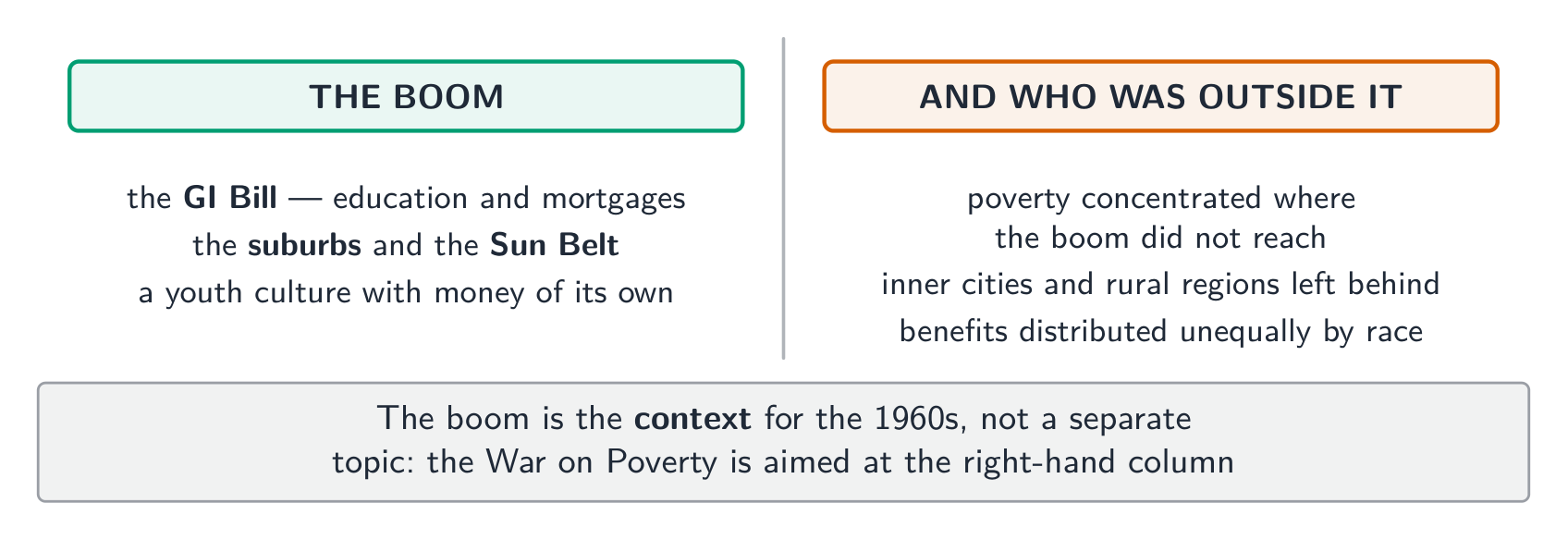
The postwar economy grew strongly. Federal spending on defence, highways, and the GI Bill 退伍军人权利法 supported home ownership and higher education, and the population moved to the suburbs 郊区 and to the Sun Belt 阳光地带.
Culture changed with it: mass consumption, television, and a distinct youth culture 青年文化 with its own music and markets.
Prosperity was uneven. Suburban growth was frequently closed to African Americans by law and practice, cities lost tax base and jobs, and poverty 贫困 persisted in ways the decade's self-image obscured - which is what later reform movements responded to.
| English |
|---|
| GI Bill/ˌdʒiː ˈaɪ bɪl/ |
| suburbs/ˈsʌbɜːbz/ |
| Sun Belt/sʌn belt/ |
| youth culture/juːθ ˈkʌltʃə/ |
| poverty/ˈpɒvəti/ |
| Thematic Focus | Learning Objective | Historical Developments |
|---|---|---|
SOC | Unit 8.G |
|
| Thematic Focus | Learning Objective | Historical Developments |
|---|---|---|
PCE | Unit 8.L |
|
Unit 8.M |
|
| Thematic Focus | Learning Objective | Historical Developments |
|---|---|---|
SOC | Unit 8.L |
|
Source: College Board AP Course and Exam Description
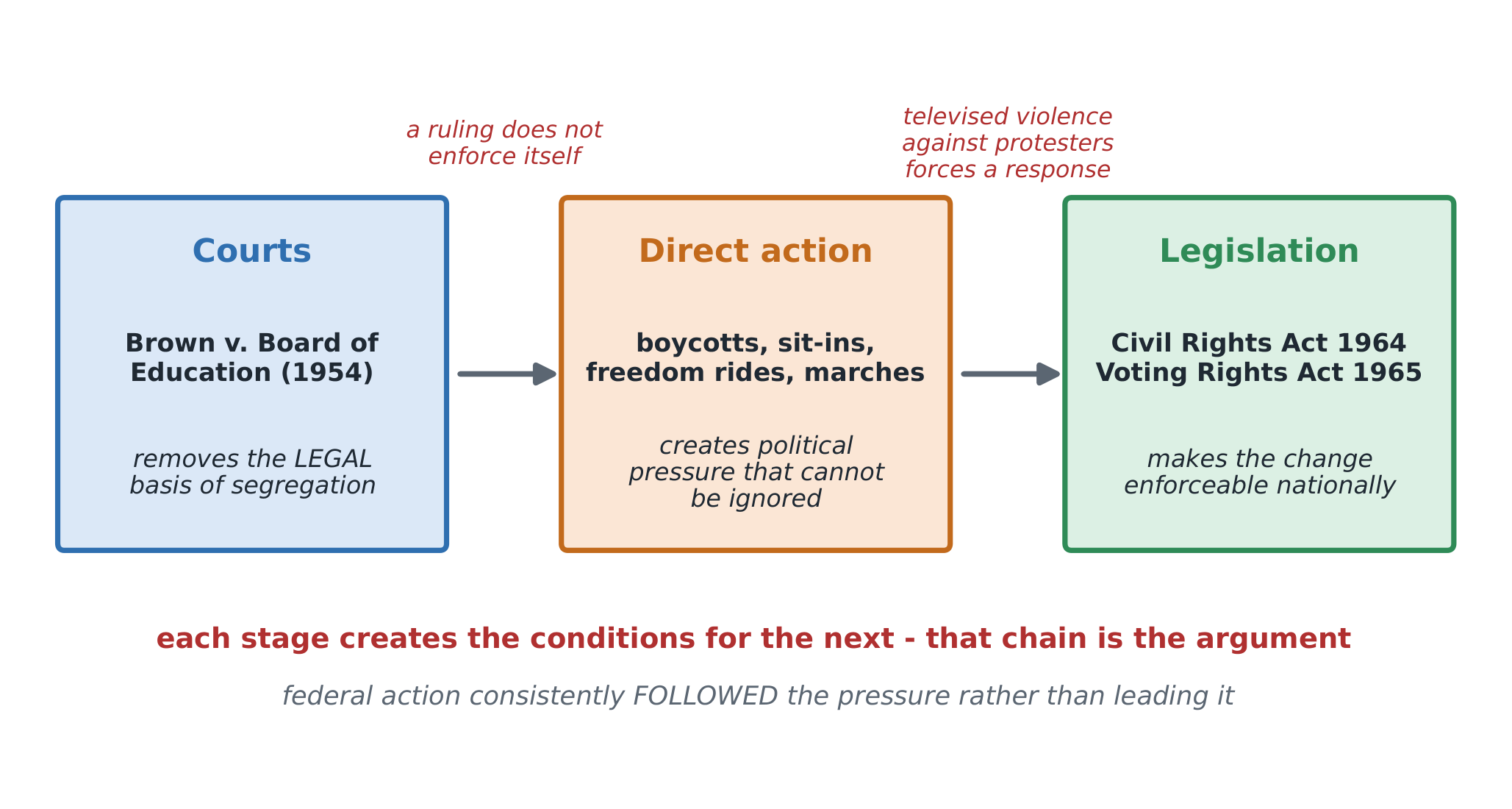
Early steps in the 1940s and 1950s worked mainly through the courts 法院. Legal strategy produced Brown v. Board of Education, which held segregated schooling unconstitutional and stripped away the legal basis of segregation.
Court victories did not enforce themselves, so the movement turned to direct action 直接行动: the Montgomery bus boycott, sit-ins, freedom rides, and mass marches, organised through churches and student groups and grounded in nonviolent protest 非暴力抗议.
Sustained pressure and televised violence against protesters produced legislation 立法: the Civil Rights Act of 1964 1964年民权法 and the Voting Rights Act of 1965 1965年选举权法.
The movement then expanded 扩展: later activists raised questions of economic inequality, housing, and policing, and some rejected nonviolence and integration in favour of Black Power 黑人权力. Its example also shaped movements by women, Latinos, American Indians, and others.
Courts, direct action and legislation are three arenas, and each converts pressure into the next.
| English |
|---|
| courts/kɔːts/ |
| direct action/daɪˈrekt ˈækʃn/ |
| nonviolent protest/ˌnɒnˈvaɪələnt ˈprəʊtest/ |
| legislation/ˌledʒɪˈsleɪʃn/ |
| Civil Rights Act of 1964/ˈsɪvl raɪts ækt ɒv ˈnaɪntiːnhʌndrɪdn ˈsɪksti fɔː/ |
| Voting Rights Act of 1965/ˈvəʊtɪŋ raɪts ækt ɒv ˈnaɪntiːnhʌndrɪdn ˈsɪksti faɪv/ |
| expanded/ekˈspændɪd/ |
| Black Power/blæk ˈpaʊə/ |

| Thematic Focus | Learning Objective | Historical Developments |
|---|---|---|
WOR | Unit 8.H |
|
| Thematic Focus | Learning Objective | Historical Developments |
|---|---|---|
WOR | Unit 8.I |
|
| Thematic Focus | Learning Objective | Historical Developments |
|---|---|---|
MIG | Unit 8.J |
|
Unit 8.K |
|
Source: College Board AP Course and Exam Description
The Great Society 伟大社会 extended federal responsibility furthest since the New Deal: Medicare and Medicaid, federal aid to education, and the War on Poverty 向贫困宣战.
The Vietnam War 越南战争 grew out of containment and consumed the same presidency. Escalation without decisive results produced a large antiwar movement 反战运动, deep political division, and a credibility gap 信任鸿沟 between government statements and reported reality. Defeat abroad and disillusion at home weakened confidence in federal power just as its domestic role peaked.

| English |
|---|
| Great Society/ɡreɪt səˈsaɪəti/ |
| War on Poverty/wɔː ɒn ˈpɒvəti/ |
| Vietnam War/ˌviːətˈnɑːm wɔː/ |
| antiwar movement/ˌæntɪˈwɔː ˈmuːvmənt/ |
| credibility gap/ˌkredɪˈbɪlɪti ɡæp/ |
| Thematic Focus | Learning Objective | Historical Developments |
|---|---|---|
SOC | Unit 8.L |
|
| Thematic Focus | Learning Objective | Historical Developments |
|---|---|---|
ARC | Unit 8.N |
|
| Thematic Focus | Learning Objective | Historical Developments |
|---|---|---|
GEO | Unit 8.O |
|
| Thematic Focus | Learning Objective | Historical Developments |
|---|---|---|
ARC | Unit 8.J |
|
Unit 8.P |
|
Source: College Board AP Course and Exam Description
The later part of the period is defined by movements and by limits.
Try it — aim, response and outcome. Teacher-written cases grounded in CED Topics 8.11 and 8.13: A, feminist activists demanded legal, economic and social equality. Congress proposed the ERA in 1972, but enough states had not ratified it by 1980. B, growing concern about pollution helped prompt federal environmental action, including the EPA in 1970. Identify each aim and response. Which case shows that national approval did not complete the proposed change?
Worked comparison. A constitutional amendment required state ratification as well as congressional action. The ERA campaign had not secured that change within this period. The EPA was an operating federal agency bringing environmental responsibilities together. Its creation was a change in government, but not proof pollution had ended. Distinguish aims, responses and outcomes.
Try it — explain a connection. Improve this claim: “People worried about pollution. The EPA opened in 1970.” Explain how concern could lead to action and identify evidence needed to judge success.
Worked explanation. Pollution problems and accidents helped build public concern and pressure for protection. Officials responded partly by bringing federal responsibilities together in the EPA in 1970. To judge effectiveness, investigate enforcement and changes in pollution. Timing alone does not establish cause; no single accident explains all environmental policy.
Economic trouble sharpened everything: inflation 通货膨胀, oil shocks, and industrial decline ended the postwar boom.
| English |
|---|
| women's movement/ˈwɪmɪnz ˈmuːvmənt/ |
| Equal Rights Amendment/ˈiːkwl raɪts əˈmendmənt/ |
| Environmental/enˌvaɪrənˈmentl/ |
| Conservatism/kənˈsɜːvətɪzəm/ |
| inflation/ɪnˈfleɪʃn/ |
| Learning Objective | Review: Unit 8 Key Concepts |
|---|---|
Unit 8.Q |
|
Source: College Board AP Course and Exam Description
One useful reasoning process is continuity and change. Rights expanded enormously in law; economic inequality and residential segregation persisted, and both statements belong in a strong answer.
Exam transfer — 2023 AP US History, Set 2, long essay Q4, paraphrased. Evaluate how far civil rights activism contributed to government action from 1940 to 1980. Use the ERA campaign to connect activism with a response and a limit, then contrast another relevant example such as litigation and Brown v. Board of Education. Environmental policy alone would not answer this civil-rights prompt.
Teacher-written model passage. Women's rights organisations such as NOW pressed for the ERA. Congress proposed it in 1972, showing a national government response to demands for equality. Yet too few states had ratified it by 1980, so the campaign had not secured the proposed constitutional change within the essay's dates.
Why it fits. The official scheme accepts the ERA campaign as evidence of activism meeting limits at state level. This is one developed example, not a complete essay or official sample. A full essay needs an argument and further developed evidence. A limiting phrase alone does not establish complex understanding or guarantee credit.
Each part needs only one or two sentences: answer the question, cite one specific piece of evidence, and explain how it supports the answer.
Answer (a), (b) and (c).
(a) Briefly describe ONE way the United States tried to contain communism after 1945.
(b) Briefly describe ONE achievement of the civil rights movement.
(c) Briefly explain ONE reason for growing opposition to the Vietnam War.
Model answer.
Vocabulary card meanings
containment: The policy of stopping Soviet power from spreading further. Truman Doctrine: The 1947 pledge to support countries resisting communist pressure. Marshall Plan: Large US economic aid to rebuild Western Europe after the Second World War. Korean War: The 1950-53 war in which the United States fought to stop a communist takeover of the South. arms race: Competition with the Soviet Union to build more nuclear weapons. space race: Competition to achieve firsts in rockets and human spaceflight. Loyalty programmes: Checks that aimed to remove suspected communists from government jobs. McCarthyism: Accusations of disloyalty, often with little evidence, in the early 1950s. cost to civil liberties: The freedoms restricted in the name of anti-communist security. GI Bill: The law that funded education and housing for returning veterans. suburbs: Residential districts built at the edge of cities. Sun Belt: The southern and western states that gained people and jobs after mid-century. youth culture: Styles and music identified with teenagers in the postwar decades. courts: The judicial bodies whose rulings advanced civil rights. direct action: Protests such as sit-ins that confront injustice in person. nonviolent protest: Resistance that refuses to answer force with force. legislation: Statutes passed by Congress, including civil-rights laws. Civil Rights Act of 1964: The law that banned discrimination in public accommodations and employment. Voting Rights Act of 1965: The law that outlawed barriers used to stop Black citizens voting. expanded: Grew to include more people or more programmes. Black Power: A movement stressing racial pride, self-determination, and, for some, separatism. Great Society: Johnson's set of programmes on poverty, education, and health care. War on Poverty: Federal programmes of the 1960s aimed at reducing economic hardship. Vietnam War: The long war in which the United States tried to stop a communist victory in Vietnam. antiwar movement: Public opposition to US fighting in Vietnam. credibility gap: The distance between official claims about the war and what people believed. women's movement: The renewed campaign, from the 1960s, for equality in work, law, and family. Equal Rights Amendment: A proposed constitutional rule against denying rights on account of sex. The 1982 deadline closed without enough state approvals, and later approvals were not certified. Environmental: Concerned with pollution, conservation, and the health of natural systems. Conservatism: A politics of tradition, limited federal programmes, and strong defence.
Work through it step by step, with instant-check exercises.
Loading subjects…