Scope and prerequisites
ACT framework, February 2026 revision. Original classroom cases are not an official form; preserve the scored/field-test boundaries of each source form.
- Represent each model’s assumptions and predictions separately
- Select observations that discriminate between competing explanations
- Evaluate a model or design without claiming more than the evidence 证据 warrants
Prerequisites: Explicit model predictions; comparison conditions; uncertainty.
Explain and choose the method
Conflicting Viewpoints passages present alternative explanations of the same observation. Label each model’s mechanism, assumptions and predicted behaviour before answering. A model may agree about the observation while disagreeing about the cause. Keep track of whether the stem asks what a model predicts or what the observed data actually establish.
A useful discriminating test 鉴别性检验 places models where their predictions differ. Evidence consistent with both supports neither uniquely. Contradiction can weaken a model on its stated assumptions; it need not prove that a competing model is the only possible explanation. Identify conditions that could invalidate the comparison, including an unstated change in measurement method.
When extending a model, apply its stated relationship consistently to the new situation. Do not import a familiar scientific law if the passage defines a different hypothetical mechanism. Compare predictions numerically where possible, and mark the assumptions needed for a causal inference 推断. Results can lead to a revised model rather than a simple winning viewpoint.
Engineering design 工程设计 thinking weighs evidence against a target and considers a modification’s trade-offs. Explain why a change might address the observed failure and what new test would verify it. A design recommendation should use the passage’s criteria and acknowledge competing effects, rather than assume that the strongest material, highest speed or lowest price is always optimal.
Discriminating evidence 区分性证据 is a result the competing models predict differently. If both predict cooling with greater thickness, observing that trend cannot select one. Hold thickness fixed and vary material to test their stated disagreement.
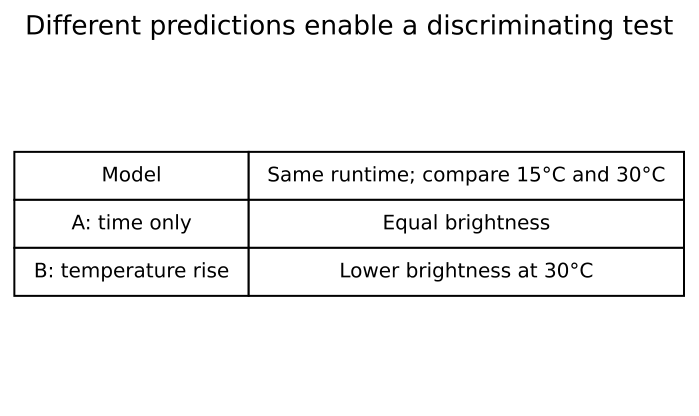
Existing worked example: Original hypothetical study: a device’s indicator dims during repeated use. Model A says dimming depends only on elapsed running time: after 10 minutes it predicts the same brightness at all room temperatures. Model B says dimming is caused by an internal temperature rise: after 10 minutes it predicts lower brightness in a warmer room, provided the starting devices are identical. Test matched devices at 15°C and 30°C for ten minutes, controlling initial charge and measurement method. Equal brightness is consistent with A but does not decisively reject B unless temperature differences and sensitivity are verified. Much lower brightness at 30°C conflicts with A’s “time only” assumption and supports B’s predicted direction. A cooling modification should also be tested for cost and power consumption before recommending it.
Complete original context
Original hypothetical research summary — A cooling sleeve
A laboratory team tests sleeves intended to reduce a small sensor's temperature during operation. All sensors start at 22°C. Temperature is measured after ten minutes of use with the same power setting, room conditions and measuring instrument. Sleeve A costs 4 units, B costs 7 units, and an unsleeved sensor is the control. The design brief requires a cost no greater than 5 units and a final temperature no greater than 35°C. Lower temperature alone is not the only design criterion.
Experiment 1 uses identical sensors and records three independent trials per sleeve. Final temperatures in °C are: control 41,42,43; A 33,34,35; B 30,31,32. The team resets the starting temperature and checks the sensor charge before each trial. They report the means and the full observed ranges. The ranges describe these trials, not every future result. The team has not yet measured sleeve durability.
Experiment 2 investigates thickness for material A. Each sleeve has the same length and fit; thicknesses are 1,2,3 mm. Mean final temperatures are 38,34,32°C respectively. All other stated conditions match Experiment 1. Changing thickness also changes material quantity, so a future design review must measure costs instead of assuming they stay at 4 units. A student proposes testing a 3-mm sleeve in material B against a 1-mm sleeve in material A to identify thickness's effect. This comparison would change two factors at once.
Two original models explain the observed temperature pattern. Model P says final temperature depends only on thickness, regardless of material. Model Q says both thickness and material matter; at equal thickness it predicts that material B produces a lower final temperature than A under the same conditions. Both models predict lower final temperatures as thickness rises over the tested 1–3 mm interval. A decreasing trend alone therefore cannot separate them.
Experiment 3 tests new A and B sleeves, each 2 mm thick, in matched conditions. Mean final temperatures are A 34°C and B 31°C. The measuring instrument's stated resolution is 0.1°C, and the team checks its calibration with a reference. Repeated trials would still be needed to characterise variability and rule out other differences in manufacture. The result conflicts with P's material-independence prediction and is consistent with Q's direction; it is not proof that Q is the only possible explanation.
A separate time series for one sensor with sleeve A records temperatures 22,28,32,34°C at 0,2,4,6 minutes. These observations show warming with successively smaller two-minute increases. No measurements beyond six minutes are supplied in this series. A proposal 提案 to continue the first interval's slope to twelve minutes is a model assumption 模型假设 that later measurements may contradict, not a reading from the table.
Independent practice and checked reasoning
Transfer 1
State P's and Q's predictions for equal-thickness A and B sleeves. Explain how Experiment 3 bears on each.
Reasoning: P predicts the same final temperature because it says material is irrelevant. Q predicts B lower than A. The observed 31°C versus 34°C conflicts with P under matched conditions and agrees with Q's direction. Calibration supports a meaningful difference, but variability and manufacture still require investigation.
Transfer 2
Does Experiment 2's downward trend alone support Q over P? Propose a comparison that would separate them and name two controls.
Reasoning: No; both predict the trend. Compare A and B of equal thickness while holding starting temperature, runtime, power, fit and room conditions constant. Repeated matched trials should measure uncertainty. The separating variable is material, not the names of the models.
Transfer 3
A redesigned B sleeve now costs 5 units and ends at 33°C in repeated matched tests. Does this establish P, Q, or only a design decision under the brief?
Reasoning: It satisfies cost≤5 and final temperature≤35 in the stated tests. Without a matched A result it does not itself separate P and Q, and design feasibility is distinct from explaining the mechanism. Further durability and variation checks remain appropriate.
Limits and next use
A directionally supportive result is not unique proof. Check that the competing predictions truly differ under the test conditions.
All tasks here are public original practice with authored guidance. They are not official questions or fresh diagnostics. Existing protected tests and mocks remain separate.