Scope and prerequisites
ACT framework, February 2026 revision. Original classroom cases are not an official form; preserve the scored/field-test boundaries of each source form.
- Distinguish arithmetic difference from geometric ratio
- Find a term or finite sum while keeping indexing consistent
- Convert logarithmic equations to exponential form on the valid domain
Prerequisites: Index notation; exponent rules; finite sequences.
Explain and choose the method
An arithmetic sequence 等差数列 has constant difference d: aₙ=a₁+(n-1)d. Its finite sum is n(a₁+aₙ)/2. A geometric sequence 等比数列 has constant ratio r: aₙ=a₁r^(n-1). For r≠1, a finite sum is a₁(1-rⁿ)/(1-r); when r=1 it is simply n a₁. Match the requested term or total.
An exponential model A b^t represents multiplication by b per stated time unit. A percentage growth r uses factor 1+r; repeated changes multiply factors rather than adding percentages. If doubling takes several time units, divide t by that interval in the exponent.
For base b>0 with b≠1, log_b(a)=c means b^c=a and requires a>0. Solve a logarithmic equation by translating it to an exponential relationship, then check the argument 论证. Logarithms of products add under valid positive arguments; logarithms do not distribute over addition.
Use exact powers when available. ACT may test a simple logarithmic relationship without requiring numerical logarithm 对数 tables. A calculated approximation must still respect the question’s representation and domain. Keep a sequence’s index, an exponential model’s time and a logarithm’s argument conceptually separate.
Arithmetic sequence : $a_n=a_1+(n-1)d$. Its sum is $S_n=n(a_1+a_n)/2$. Geometric sequence : $a_n=a_1r^{n-1}$ and $S_n=a_1(1-r^n)/(1-r)$ for $r\ne1$. A logarithm reverses exponentiation: $\log_b a=c$ means $b^c=a$, with $a>0$, $b>0$, $b\ne1$.
Existing worked example: Arithmetic 4,7,10,… has a₅=16 and sum of first five=5(4+16)/2=50. Geometric 3,6,12,24 has four-term sum 45. log₂(x-1)=4 gives x-1=16, so x=17, which satisfies x>1. A population 50·2^(t/3) reaches 200 after six time units.
Complete original context
Every transfer question states all data it needs.
Independent practice and checked reasoning
Transfer 1
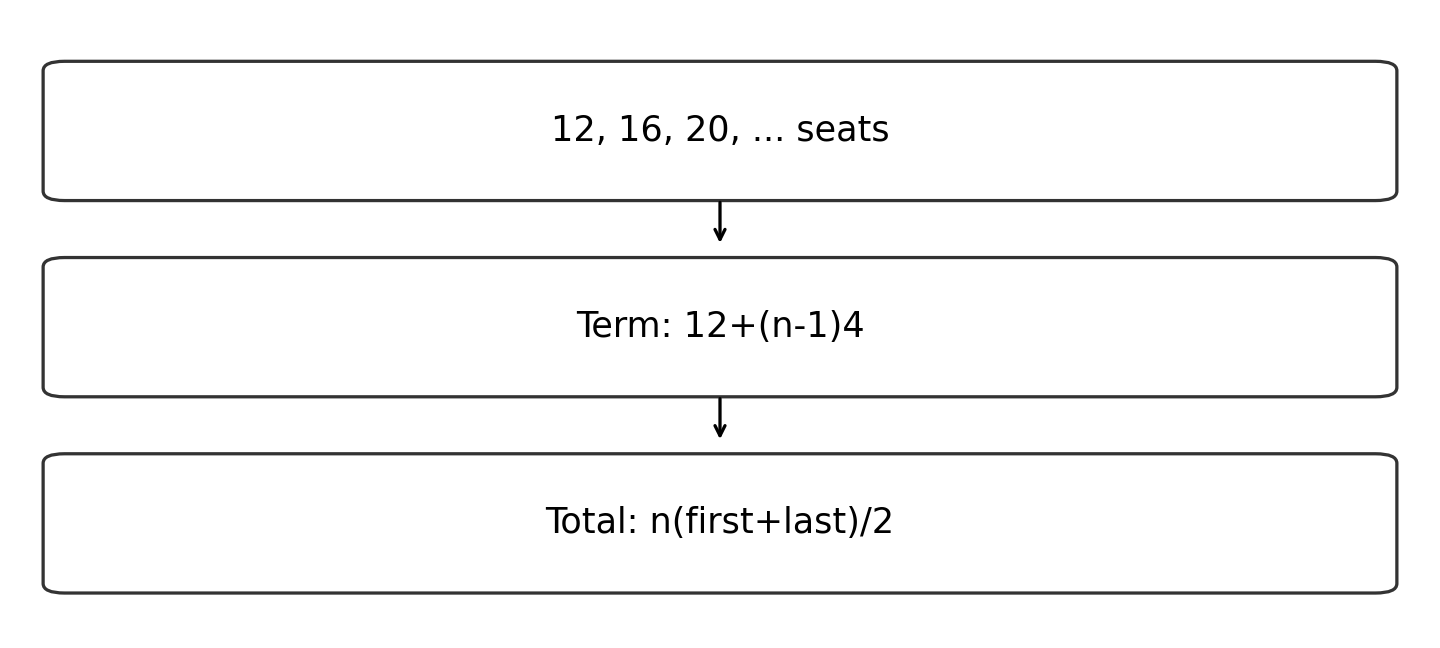
Seats in successive rows number 12,16,20,… . Find the eighth row and the total in the first eight rows. State the model assumption.
Reasoning: Constant difference is 4 seats per row. $a_8=a_1+7d=12+7(4)=40$ seats. $S_8=8(a_1+a_8)/2=8(12+40)/2=208$ seats. This assumes the same four-seat increment through all eight rows.
Transfer 2
A geometric sequence starts 5,15,45,… . Find its fifth term and sum of the first five terms. Explain what changes if the ratio is 1.
Reasoning: $a_5=a_1r^4=5(3)^4=405$. $S_5=a_1(1-r^5)/(1-r)=5(1-243)/(1-3)=605$. When $r=1$, the fraction has zero denominator and the correct sum is $na_1$, here 25 for five identical terms.
Transfer 3
Solve $\log_2(x-3)=5$ and explain why $\log_2(x+3)$ cannot generally be split into $\log_2x+\log_23$.
Reasoning: The domain requires $x>3$. Exponential form gives $x-3=32$, so $x=35$ and the argument is positive. The sum of logs corresponds to the product $3x$, not $x+3$; at $x=1$, the proposed equality would equate 2 with $\log_23$.
Transfer 4
A culture model starts with 120 cells and grows by a factor of 1.5 every two hours. Write $N(t)$ for hours $t$, find $N(4)$, and distinguish factor from percentage growth.
Reasoning: $N(t)=120(1.5)^{t/2}$ cells. $N(4)=120(1.5)^2=270$ cells. The growth is 50% per two hours, not 150%; the four-hour factor is 2.25. The hourly factor would be $\sqrt{1.5}$.
Limits and next use
Do not use n rather than n-1 for the nth term, confuse a finite sum with its last term, or expand log(a+b) as log a + log b.
All tasks here are public original practice with authored guidance. They are not official questions or fresh diagnostics. Existing protected tests and mocks remain separate.