- describe, and write equations for, the reactions of the elements with oxygen, water and dilute hydrochloric and sulfuric acids
- describe, and write equations for, the reactions of the oxides, hydroxides and carbonates with water and dilute hydrochloric and sulfuric acids
- describe, and write equations for, the thermal decomposition of the nitrates and carbonates, to include the trend in thermal stabilities
- describe, and make predictions from, the trends in physical and chemical properties of the elements involved in the reactions in 10.1.1 and the compounds involved in 10.1.2, 10.1.3 and 10.1.5
- state the variation in the solubilities of the hydroxides and sulfates
Group 2
A-Level Chemistry · Topic 10
 8:01
Group 2
Before a stomach X-ray, the patient is asked to drink a thick white liquid. It is full of barium — and barium ions are poisonous. Swallow a soluble barium salt…
English narration · English + 中文 subtitles burned in
10.1
The Group 2 metals

Syllabus
Source: Cambridge International syllabus
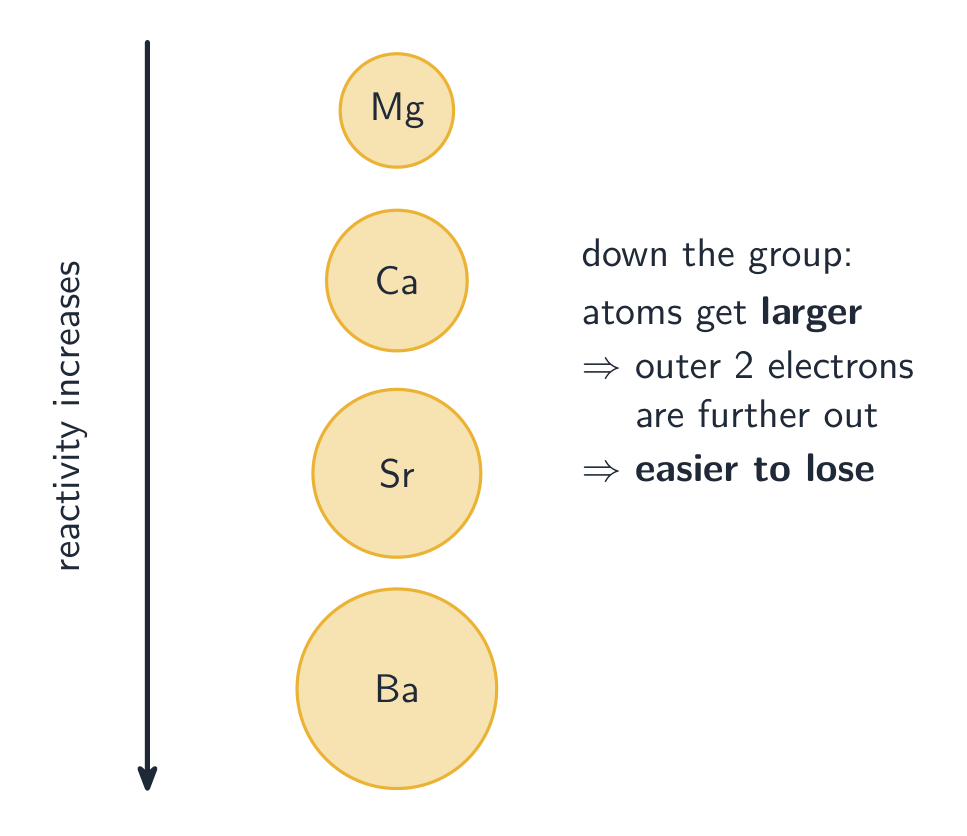
Group 族 2 holds the metals magnesium, calcium, strontium and barium. They all have two outer electrons, which they lose to form $2+$ ions. Going down the group, the atoms get larger and the outer electrons are easier to lose, so the metals get more reactive — their reactivity 反应活性 increases down the group.
Reactions of the elements
With oxygen, they burn to form an oxide:
$$2\text{Mg} + \text{O}_2 \rightarrow 2\text{MgO}$$
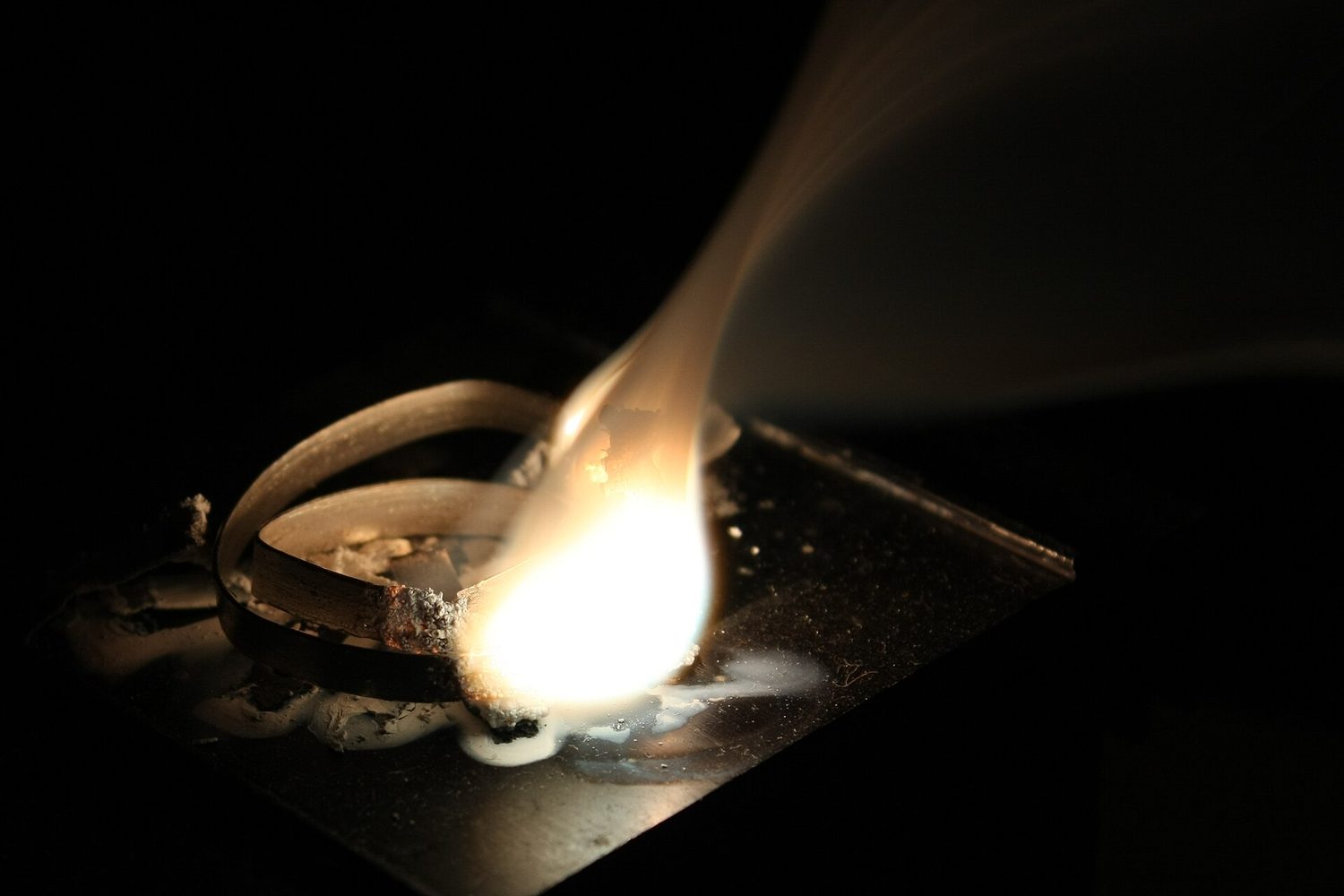
With water, they form a hydroxide and hydrogen. The reaction gets faster down the group:
$$\text{Ca} + 2\text{H}_2\text{O} \rightarrow \text{Ca(OH)}_2 + \text{H}_2$$
Magnesium is slow with cold water but reacts fast with steam, giving $\text{MgO}$ and $\text{H}_2$.
With dilute hydrochloric or sulfuric acid, they form a salt and hydrogen:
$$\text{Mg} + 2\text{HCl} \rightarrow \text{MgCl}_2 + \text{H}_2 \qquad \text{Mg} + \text{H}_2\text{SO}_4 \rightarrow \text{MgSO}_4 + \text{H}_2$$
With sulfuric acid the reaction slows down the group, because the sulfates 硫酸盐 formed (such as $\text{BaSO}_4$) are insoluble and coat the metal.
Reactions of the compounds
The oxides 氧化物 and hydroxides 氢氧化物 are basic. They react with water and with dilute acids:
$$\text{MgO} + \text{H}_2\text{O} \rightarrow \text{Mg(OH)}_2 \qquad \text{Mg(OH)}_2 + 2\text{HCl} \rightarrow \text{MgCl}_2 + 2\text{H}_2\text{O}$$
The carbonates 碳酸盐 react with dilute acids to give a salt, water and carbon dioxide:
$$\text{CaCO}_3 + 2\text{HCl} \rightarrow \text{CaCl}_2 + \text{H}_2\text{O} + \text{CO}_2$$
Thermal decomposition
Thermal decomposition 热分解 means breaking a compound apart by heating it.
- the carbonates break into the oxide and carbon dioxide:
$$\text{CaCO}_3 \rightarrow \text{CaO} + \text{CO}_2$$
- the nitrates 硝酸盐 break into the oxide, brown nitrogen dioxide gas and oxygen:
$$2\text{Ca(NO}_3)_2 \rightarrow 2\text{CaO} + 4\text{NO}_2 + \text{O}_2$$
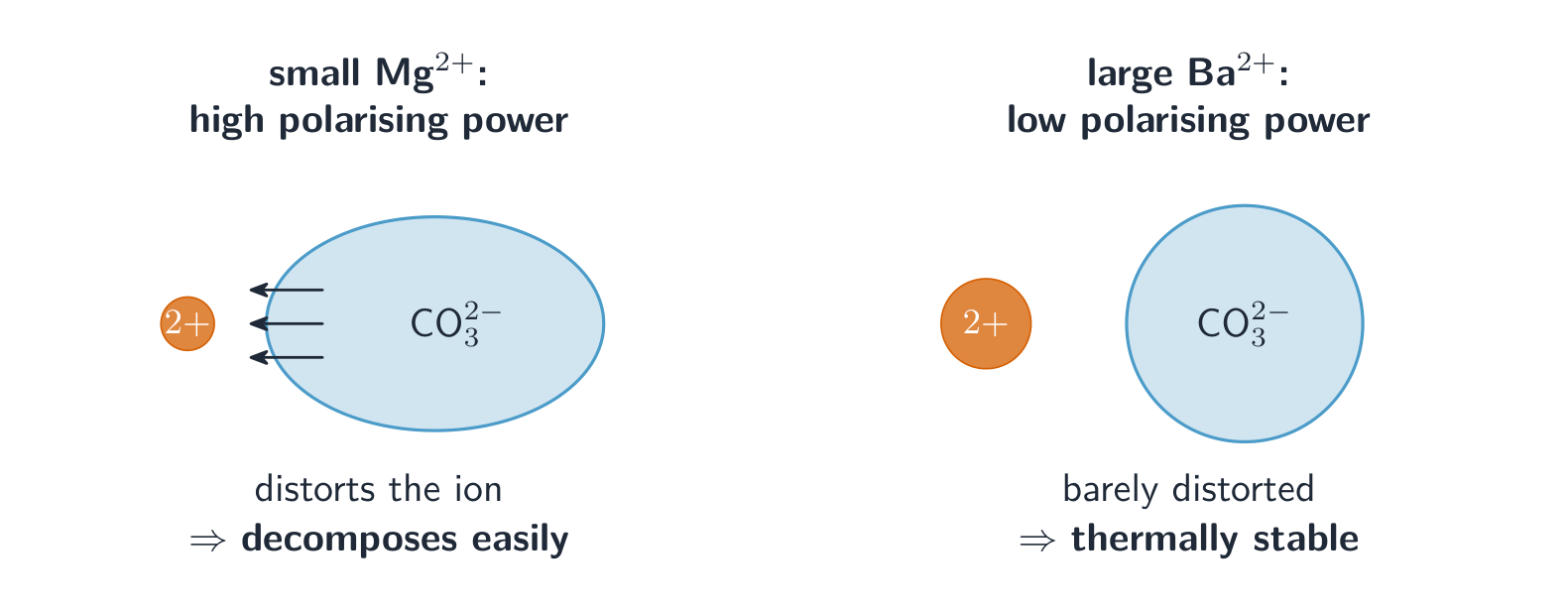
The thermal stability 热稳定性 of both the carbonates and the nitrates increases down the group. A larger metal ion pulls less on the carbonate or nitrate ion, so the compound is harder to break apart — it needs a higher temperature. So magnesium carbonate decomposes most easily, and barium carbonate is the hardest.
Trends in solubility
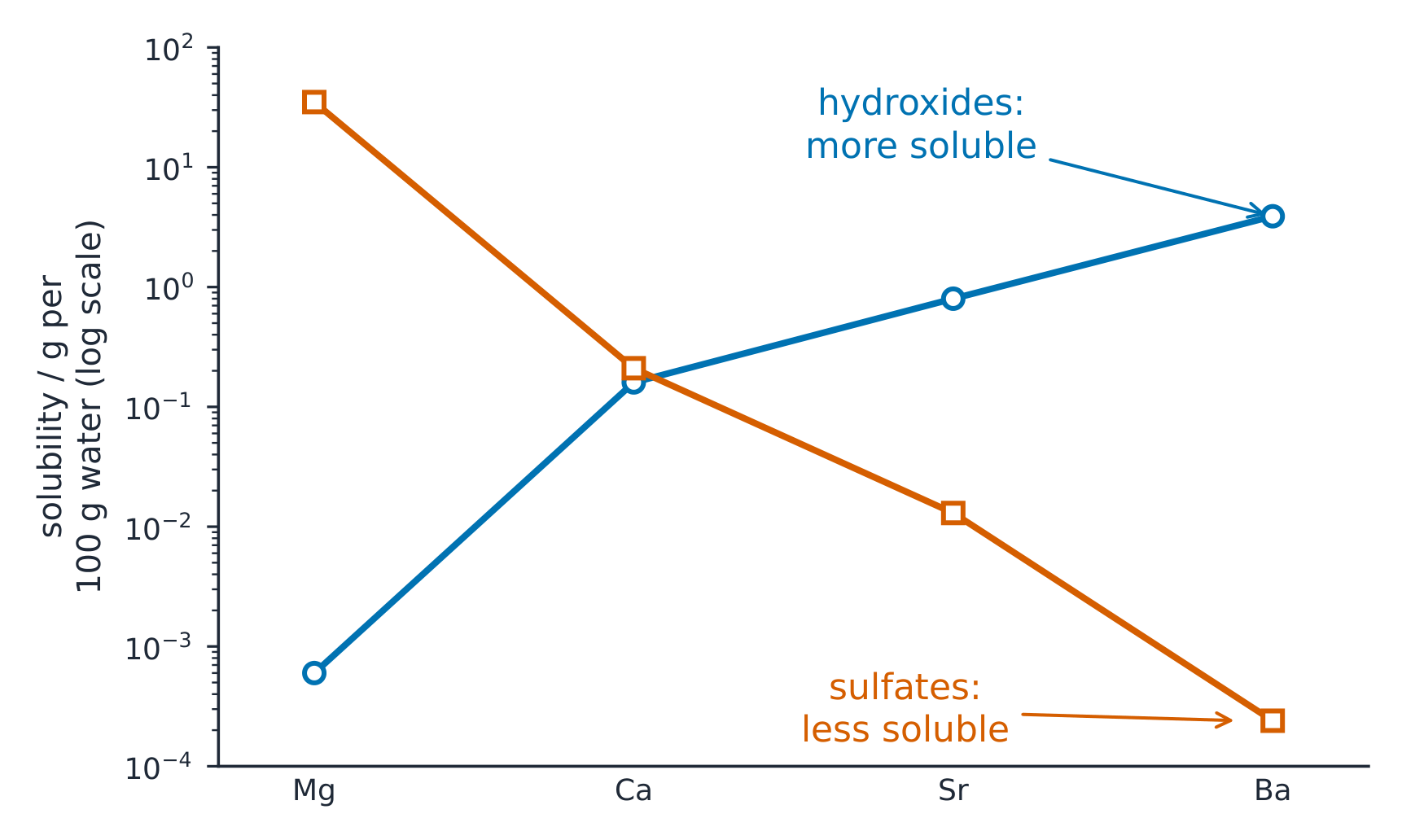
| Compound | Trend in solubility 溶解度 down the group |
|---|---|
| hydroxides | increase (Mg(OH)$_2$ almost insoluble; Ba(OH)$_2$ soluble) |
| sulfates | decrease (MgSO$_4$ soluble; BaSO$_4$ insoluble) |
From these trends you can predict the properties of the next element down, radium, and of its compounds.
Worked example. $\text{MgCO}_3$ decomposes at about $540\ °\text{C}$ and $\text{BaCO}_3$ at about $1360\ °\text{C}$. Explain the trend and predict where $\text{CaCO}_3$ sits. Going down Group 2 the cation gets larger, so its charge is spread over a bigger surface and its polarising power falls. A less polarising cation distorts the carbonate ion less, so the $\text{C-O}$ bond is weakened less and more heat is needed to break it. Thermal stability therefore increases down the group, and $\text{CaCO}_3$, lying between Mg and Ba, decomposes at an intermediate temperature of about $900\ °\text{C}$. Argue the whole chain - cation size, then polarising power, then distortion of the anion; "it is more reactive" explains nothing here.
Common mistakes.
- Saying magnesium and steam give $\text{Mg(OH)}_2$. With steam magnesium gives the oxide: $\text{Mg} + \text{H}_2\text{O} \rightarrow \text{MgO} + \text{H}_2$; the hydroxide forms only with cold water.
- Explaining the rise in reactivity by "more electrons". The outer electrons are further from the nucleus and better shielded, so the first and second ionisation energies fall and the electrons are lost more easily.
- Saying barium reacts more slowly with sulfuric acid because it is less reactive. Barium is more reactive; the reaction slows because insoluble $\text{BaSO}_4$ coats the metal.
- Writing Group 2 formulas with a $1+$ ion, such as $\text{CaOH}$ or $\text{MgNO}_3$. The ion is $2+$: $\text{Ca(OH)}_2$, $\text{Mg(NO}_3)_2$.
- Writing "a gas is given off" as an observation. Say what you see: fizzing (effervescence), the metal getting smaller, a white solid forming.
Explore
Group 2 reactivity ladder
Move down Group 2 and see why reactions become more vigorous.
Explore
Group 2 trend lab
Compare thermal stability and solubility trends down Group 2.
Vocabulary
Train
| English |
|---|
| group/ɡruːp/ |
| reactivity/rɪəkˈtɪvɪti/ |
| sulfate/ˈsʌlfeɪt/ |
| oxide/ˈɒksaɪd/ |
| hydroxide/haɪˈdrɒksaɪd/ |
| carbonate/ˈkɑːbəneɪt/ |
| thermal decomposition/ˈθɜːml ˌdiːkɒmpəˈzɪʃn/ |
| nitrate/ˈnaɪtreɪt/ |
| thermal stability/ˈθɜːml stəˈbɪlɪti/ |
| solubility/ˌsɒljuːˈbɪlɪti/ |
10.1
Exam tips
- Reactivity increases down Group 2: ionisation energy falls as atoms get larger, so electrons are lost more easily.
- Reactions with water become more vigorous down the group; Mg reacts slowly with cold water but fast with steam (→ MgO).
- Hydroxides get more soluble down the group; sulfates get less soluble ($\text{BaSO}_4$ insoluble — the basis of the sulfate test).
- Write equations with the correct $+2$ ion and state the observations (fizzing, dissolving).
Interactive lessons on this topic
Work through it step by step, with instant-check exercises.