English narration · English + 中文 subtitles burned in · 英語ナレーション・英語+中文字幕 burning-in
2.1
States of matter 物态 · 状態
Syllabus · シラバス
English
2.1.1 States of matter
Core
Supplement
1 Know the distinguishing properties of solids, liquids and gases
2 Know the terms for the changes in state between solids, liquids and gases (gas to solid and solid to gas transfers are not required)
2.1.2 Particle model
Core
Supplement
1 Describe the particle structure of solids, liquids and gases in terms of the arrangement, separation and motion of the particles and represent these states using simple particle diagrams
6 Know that the forces and distances between particles (atoms, molecules, ions and electrons) and the motion of the particles affects the properties of solids, liquids and gases
2 Describe the relationship between the motion of particles and temperature, including the idea that there is a lowest possible temperature ($-273\,{}^{\circ}\text{C}$), known as absolute zero, where the particles have least kinetic energy
3 Describe the pressure and the changes in pressure of a gas in terms of the motion of its particles and their collisions with a surface
7 Describe the pressure and the changes in pressure of a gas in terms of the forces exerted by particles colliding with surfaces, creating a force per unit area
4 Know that the random motion of microscopic particles in a suspension is evidence for the kinetic particle model of matter
8 Know that microscopic particles may be moved by collisions with light fast-moving molecules and correctly use the terms atoms or molecules as distinct from microscopic particles
5 Describe and explain this motion (sometimes known as Brownian motion) in terms of random collisions between the microscopic particles in a suspension and the particles of the gas or liquid
2.1.3 Gases and the absolute scale of temperature
Core
Supplement
1 Describe qualitatively, in terms of particles, the effect on the pressure of a fixed mass of gas of: (a) a change of temperature at constant volume (b) a change of volume at constant temperature
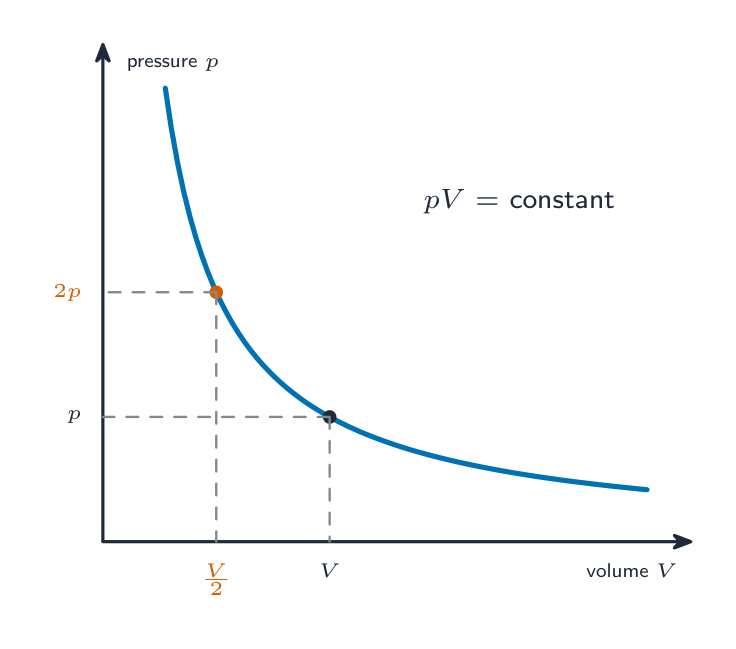
3 Recall and use the equation $pV = \text{constant}$ for a fixed mass of gas at constant temperature, including a graphical representation of this relationship
2 Convert temperatures between kelvin and degrees Celsius; recall and use the equation $T\text{ (in K)} = \theta\text{ (in }^{\circ}\text{C)} + 273$
2 ケルビンと摂氏の間の温度変換を行い、式$T\text{ (in K)} = \theta\text{ (in }^{\circ}\text{C)} + 273$を記憶して適用すること
Source: Cambridge International syllabus · 出典: Cambridge International シラバス
English
Kinetic theory: gas pressure
Matter exists in three states: solid 固体, liquid 液体 and gas 气体.
State
Shape
Volume
Particles
Solid
fixed
fixed
close together, in a regular pattern, vibrating
Liquid
takes the shape of the container
fixed
close together, no pattern, can move past each other
Gas
fills the container
changes
far apart, fast, random motion
The changes of state are: melting (solid → liquid), boiling/evaporating (liquid → gas), condensation 凝结 (gas → liquid) and solidification 凝固 (liquid → solid). In condensation the gas particles slow down and come close together to form a liquid. In solidification the liquid particles lose energy and settle into fixed positions.
All matter is made of tiny particles 粒子 that are always moving. This is the kinetic particle model.
In a solid the particles only vibrate 振动 about fixed positions.
In a liquid they are still close but can slide past each other.
In a gas they are far apart and move quickly in random directions.
Temperature and particle energy
When you heat a substance, its particles move faster, so they have more kinetic energy 动能. Temperature 温度 is a measure of the average kinetic energy of the particles.
The lowest possible temperature is absolute zero 绝对零度, $-273\,{}^{\circ}\text{C}$. At this point the particles have the least possible energy.
Gas pressure
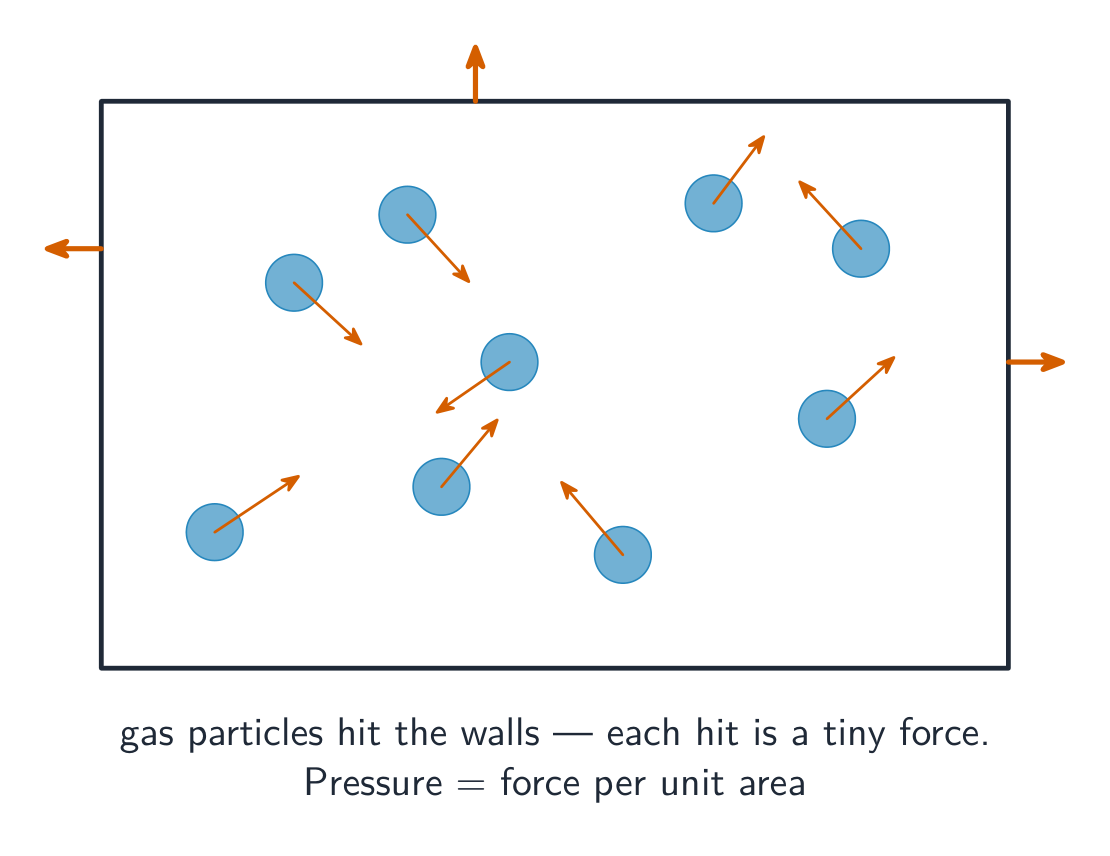
Gas particles hit the walls of their container. Each hit is a tiny push. The pressure 压强 of the gas is the total force of these hits per unit area.
Heating a gas (at constant volume) makes particles move faster and hit harder and more often, so the pressure rises.
Squeezing a gas into a smaller volume (at constant temperature) means more hits per second on each unit of area, so the pressure rises.
For a fixed mass of gas at constant temperature:
$$pV = \text{constant}$$
So if the volume halves, the pressure doubles.
Worked example. A gas has a volume of $200\ \text{cm}^3$ at a pressure of $100\ \text{kPa}$. It is squeezed to $50\ \text{cm}^3$ at constant temperature. Find the new pressure.
If you look at smoke in air under a microscope, you see tiny specks moving in a jerky, random way. This is Brownian motion 布朗运动. The specks are pushed by fast, invisible air particles hitting them. It is strong evidence for the kinetic particle model.
The kelvin scale
Scientists often use the kelvin 开尔文 (K) temperature scale, which starts at absolute zero. To convert:
$$T\text{ (in K)} = \theta\text{ (in }^{\circ}\text{C}) + 273$$
So $0\,{}^{\circ}\text{C} = 273\ \text{K}$.
Worked example. Convert $25\,{}^{\circ}\text{C}$ to kelvin, and $200\ \text{K}$ to degrees Celsius.
Slide the piston in to shrink the volume. The same particles get crammed into less space, so they hit the walls more often and the pressure climbs — while pressure × volume stays constant. · ピストンを奥へ滑らせて体積を小さくすると、同じ数の粒子がより狭い空間に詰まるため、壁への衝突回数が増え圧力が上昇する。このとき、圧力×体積は一定に保たれる。
transfer of thermal energy/ˈtrænsfɜː ɒv ˈθɜːml ˈenədʒi/
熱エネルギーの移動
2.2
Thermal expansion 热膨胀 · 熱膨張
Syllabus · シラバス
English
2.2.1 Thermal expansion of solids, liquids and gases
Core
Supplement
1 Describe, qualitatively, the thermal expansion of solids, liquids and gases at constant pressure
3 Explain, in terms of the motion and arrangement of particles, the relative order of magnitudes of the expansion of solids, liquids and gases as their temperatures rise
2 Describe some of the everyday applications and consequences of thermal expansion
2.2.2 Specific heat capacity
Core
Supplement
1 Know that a rise in the temperature of an object increases its internal energy
2 Describe an increase in temperature of an object in terms of an increase in the average kinetic energies of all of the particles in the object
3 Define specific heat capacity as the energy required per unit mass per unit temperature increase; recall and use the equation
$$c = \frac{\Delta E}{m\Delta\theta}$$
4 Describe experiments to measure the specific heat capacity of a solid and a liquid
2.2.3 Melting, boiling and evaporation
Core
Supplement
1 Describe melting and boiling in terms of energy input without a change in temperature
6 Describe the differences between boiling and evaporation
2 Know the melting and boiling temperatures for water at standard atmospheric pressure
3 Describe condensation and solidification in terms of particles
4 Describe evaporation in terms of the escape of more-energetic particles from the surface of a liquid
7 Describe how temperature, surface area and air movement over a surface affect evaporation
5 Know that evaporation causes cooling of a liquid
8 Explain the cooling of an object in contact with an evaporating liquid
Source: Cambridge International syllabus · 出典: Cambridge International シラバス
English
When matter is heated, its particles move more and take up more space, so the material expands. Gases expand the most, then liquids, then solids. This order comes from the forces between the particles: in a solid the particles are held tightly in a lattice 晶格 (a fixed pattern), so they can only vibrate a little more; in a liquid they are held less strongly; in a gas the forces are very weak, so the particles spread out much more.
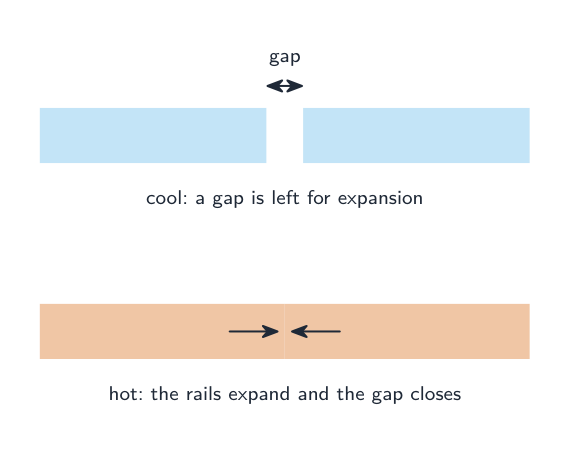
Everyday examples: gaps are left between railway lines; bridges sit on rollers; a tight metal lid loosens when heated.
Internal energy and specific heat capacity · 内部エネルギーと比熱容量
English
The internal energy 内能 of an object is the total energy of all its particles. Heating an object raises its internal energy and usually its temperature.
The specific heat capacity 比热容 is the energy needed to raise the temperature of 1 kg of a material by 1 °C.
$$c = \frac{\Delta E}{m\,\Delta\theta}$$
A material with a high specific heat capacity (like water) needs a lot of energy to warm up and cools down slowly.
Worked example. How much energy is needed to heat $2.0\ \text{kg}$ of water from $20\,{}^{\circ}\text{C}$ to $70\,{}^{\circ}\text{C}$? The specific heat capacity of water is $4200\ \text{J/(kg}\,{}^{\circ}\text{C)}$.
Rearranging $c = \frac{\Delta E}{m\,\Delta\theta}$ gives $\Delta E = mc\,\Delta\theta$, with $\Delta\theta = 70 - 20 = 50\,{}^{\circ}\text{C}$:
Measuring specific heat capacity. For a solid, use a metal block with two holes: one for an electric heater 加热器 and one for a thermometer 温度计. Measure the mass $m$ of the block. Switch on the heater for a measured time $t$ and record the current $I$ and the voltage $V$, so the energy supplied is $E = IVt$ (or read the energy from a joulemeter). Record the temperature rise $\Delta\theta$. Then $c = \dfrac{E}{m\,\Delta\theta}$. For a liquid, heat a measured mass of the liquid in a container and stir it, so the temperature is the same all through. Wrap the block or the container in insulating material 隔热材料, so less energy escapes to the air.
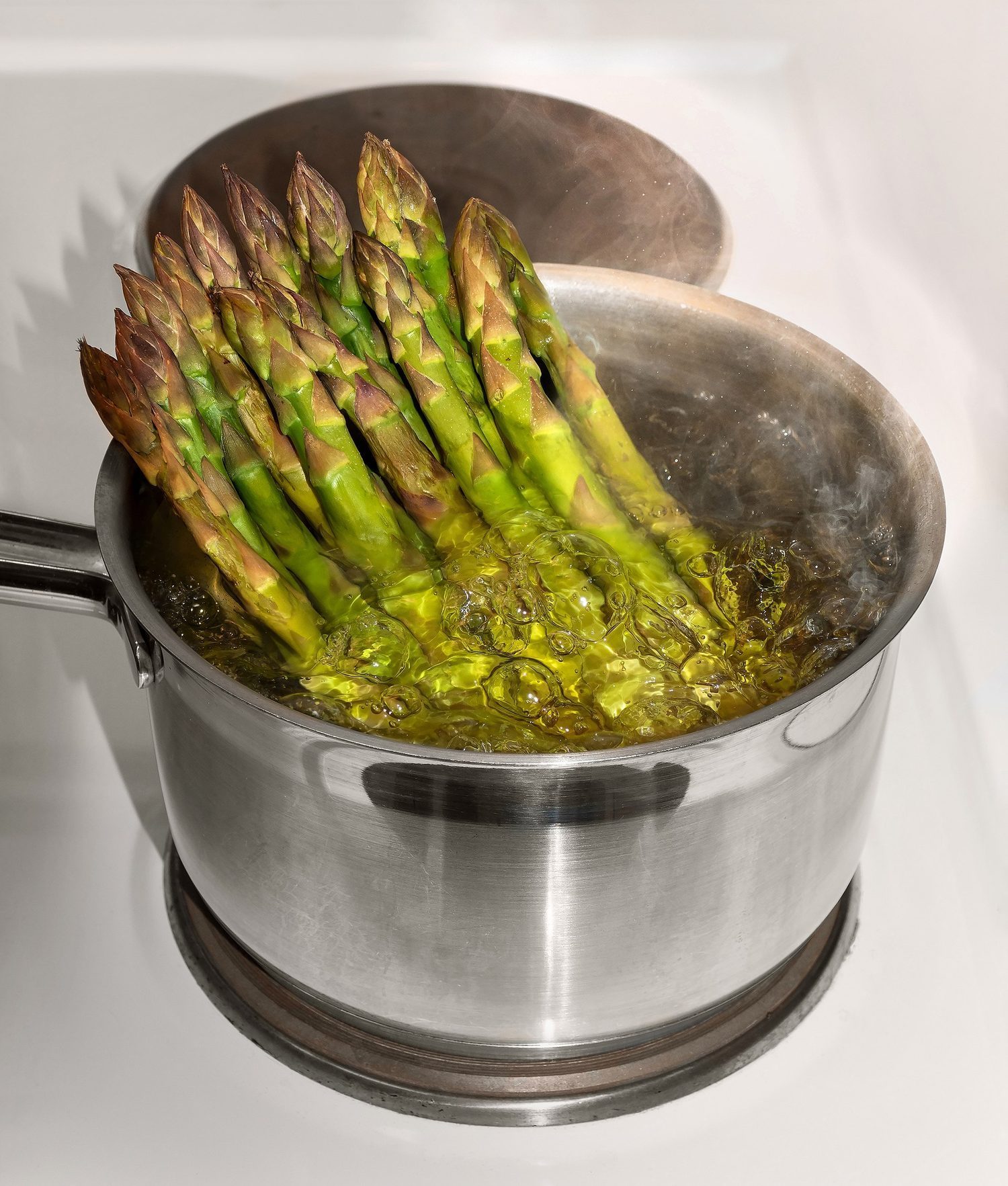
Melting 熔化 and boiling 沸腾 need energy, but the temperature stays the same while the state changes. This energy breaks the forces between particles. For water at normal air pressure, melting is at $0\,{}^{\circ}\text{C}$ and boiling at $100\,{}^{\circ}\text{C}$.
Evaporation 蒸发 is when a liquid changes to a gas at its surface, below the boiling point. The fastest particles escape from the surface. Because the fastest (most energetic) particles leave, the average energy of those left behind falls, so the liquid cools down 冷却. An object touching an evaporating liquid also cools, because the liquid takes energy from it: this is why sweat cools your skin.
Evaporation is faster when the temperature is higher, the surface area is larger, and there is more air movement over the surface.
The heating curve — watch the temperature pause · 加熱曲線 — 温度が一時的に止まる様子を見る
While the substance is melting or boiling the temperature stays flat, even though heat is still going in — the energy breaks bonds instead of warming it. · 物質が融解または沸騰中であっても、熱が入り続けるため温度は一定(平坦)に留まる — エネルギーは分子間の結合を切断するために使われ、温度を上昇させるわけではない。
2.3
Transfer of thermal energy 热能传递 · 熱エネルギーの移動
Syllabus · シラバス
English
2.3.1 Conduction
Core
Supplement
1 Describe experiments to demonstrate the properties of good thermal conductors and bad thermal conductors (thermal insulators)
2 Describe thermal conduction in all solids in terms of atomic or molecular lattice vibrations and also in terms of the movement of free (delocalised) electrons in metallic conductors
3 Describe, in terms of particles, why thermal conduction is bad in gases and most liquids
4 Know that there are many solids that conduct thermal energy better than thermal insulators but do so less well than good thermal conductors
2.3.2 Convection
Core
Supplement
1 Know that convection is an important method of thermal energy transfer in liquids and gases
2 Explain convection in liquids and gases in terms of density changes and describe experiments to illustrate convection
2.3.3 Radiation
Core
Supplement
1 Know that thermal radiation is infrared radiation and that all objects emit this radiation
2 Know that thermal energy transfer by thermal radiation does not require a medium
4 Know that for an object to be at a constant temperature it needs to transfer energy away from the object at the same rate that it receives energy
3 Describe the effect of surface colour (black or white) and texture (dull or shiny) on the emission, absorption and reflection of infrared radiation
5 Know what happens to an object if the rate at which it receives energy is less or more than the rate at which it transfers energy away from the object
6 Know how the temperature of the Earth is affected by factors controlling the balance between incoming radiation and radiation emitted from the Earth’s surface
7 Describe experiments to distinguish between good and bad emitters of infrared radiation
8 Describe experiments to distinguish between good and bad absorbers of infrared radiation
9 Describe how the rate of emission of radiation depends on the surface temperature and surface area of an object
2.3.4 Consequences of thermal energy transfer
Core
Supplement
1 Explain some of the basic everyday applications and consequences of conduction, convection and radiation, including: (a) heating objects such as kitchen pans (b) heating a room by convection
2 Explain some of the complex applications and consequences of conduction, convection and radiation where more than one type of thermal energy transfer is significant, including: (a) a fire burning wood or coal (b) a radiator in a car
Source: Cambridge International syllabus · 出典: Cambridge International シラバス
English
Thermal energy moves from hotter places to colder places in three ways.
Conduction
Conduction 热传导 is the transfer of thermal energy through a material without the material moving. The particles in a solid sit in a lattice. Heated particles vibrate more and pass the energy to their neighbours. In metals, free electrons (delocalised electrons 自由电子) carry energy quickly, so metals are good thermal conductors 热导体.
Materials that conduct badly (like air, wood and plastic) are thermal insulators 热绝缘体.
Testing conductors. Fix a drawing pin with a little wax to one end of rods of copper, iron, glass and wood, and heat the other ends equally. The pin drops first from the copper rod, then from the iron rod, and last (or never) from the glass and the wood: metals are the best conductors. A metal rod held in a flame soon feels hot; a wooden rod does not.
Gases and most liquids are bad conductors because their particles are far apart and only pass on energy when they happen to collide. There is no lattice and there are no free electrons.
Convection
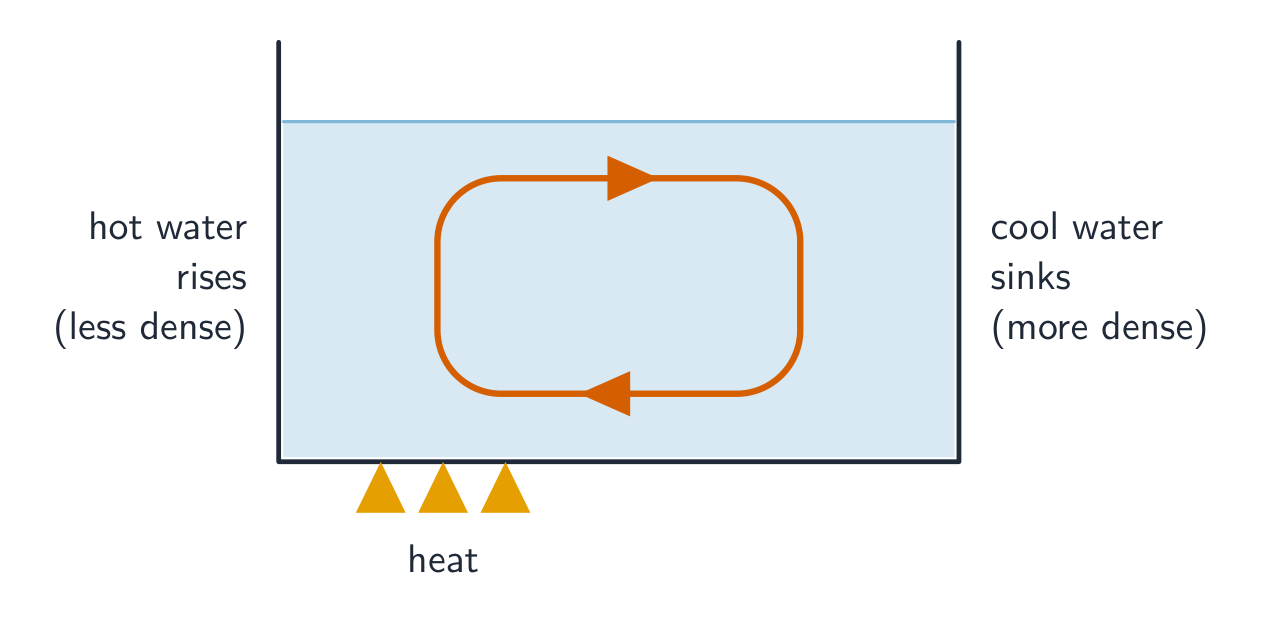
Convection 对流 happens in liquids and gases. When a fluid is heated it expands, becomes less dense, and rises. Cooler, denser fluid sinks to take its place. This circle of moving fluid is a convection current.
Showing convection. Drop a crystal of purple potassium permanganate 高锰酸钾 into a beaker of water and heat the beaker gently under the crystal. A coloured stream rises above the heat, spreads across the top and sinks at the sides. In air, a lit candle under one chimney of a smoke box pulls smoke down the other chimney and up above the flame.
Convection cannot happen in a solid because the particles cannot move from place to place.
Radiation
Thermal radiation 热辐射 is energy carried by infrared 红外线 waves. All objects emit it, and it needs no material to travel through — it can cross empty space (this is how energy reaches us from the Sun).
A surface that is dull 暗淡 and black is a good emitter 发射体 and a good absorber 吸收体 of infrared. A surface that is shiny and white is a poor emitter and a good reflector 反射体.
Comparing surfaces. Fill two cans, one dull black and one shiny silver, with hot water at the same temperature, and put a thermometer in each. The black can cools faster, so it is the better emitter. Then put the same two cans, full of cold water, at equal distances from a heater. The black can warms faster, so it is the better absorber. A Leslie cube 莱斯利立方体 (a metal box with one side of each finish) shows the same thing.
An object stays at a constant temperature when it emits energy at the same rate as it absorbs energy. The rate of emission is greater when the surface is hotter and larger. If an object absorbs energy faster than it emits it, its temperature rises; if it emits faster than it absorbs, its temperature falls.
The Earth's temperature. The Earth absorbs radiation from the Sun and emits infrared radiation back into space. Its average temperature stays constant only when the two rates are equal. Anything that changes this balance changes the temperature. Gases in the atmosphere 大气 such as carbon dioxide absorb some of the emitted infrared and send part of it back down, so more of these gases warms the Earth. Clouds and ice reflect incoming sunlight, so less ice means more energy is absorbed, and the Earth warms further.
Everyday examples
A kitchen pan has a metal base that conducts energy quickly to the food, and a plastic or wooden handle that is an insulator, so you can hold it.
A radiator 散热器 heats a room by convection: the air next to it warms, rises, and cooler air flows in to take its place, so the whole room warms.
Sitting near a fire you feel its radiation on your face at once; the air between you and the fire is a poor conductor.
A vacuum flask 保温瓶 keeps a drink hot by stopping all three transfers: the vacuum between its double walls stops conduction and convection, and its shiny silver surfaces stop radiation.
In the kinetic particle model, heating a gas makes its particles move faster and hit the walls harder and more often, so the pressure rises. The particles themselves do not get bigger.
Evaporation happens only at the surface and at any temperature; boiling happens throughout the liquid at one fixed temperature. Evaporation cools the liquid left behind, because the fastest particles escape.
During melting and boiling the temperature stays constant even though energy is still being supplied — that energy breaks the forces between particles.
For specific heat capacity use $\Delta E = mc\,\Delta\theta$, where $\Delta\theta$ is the change in temperature, not the final temperature.
Dull black surfaces are the best emitters and absorbers of infrared; shiny, light surfaces are the best reflectors. Convection needs a fluid to flow, so it cannot happen in a solid.
Type to search notes, lessons, code, vocabulary and past-paper questions across every subject. · すべての科目でノートImplemented、Implemented、コード、語彙、過去問問題を検索するために入力してください。