Skip to content · ⁨コンテンツへスキップ⁩

Poetry II · ⁨詩歌 II⁩

AP English Literature and Composition · ⁨AP 英語文学と作文⁩ · Topic 5 · ⁨トピック 5⁩

View Slides · ⁨查看幻灯片⁩ Train · ⁨練習する⁩
Video lesson for this topic · ⁨このトピックのビデオレッスン⁩ Open the video page · ⁨動画ページを開く⁩
9:03

単元5: 詩 II

単元5は二番目の詩単元であり、二つのことを行います:詩がとりうる形式を名指しし、比喩的表現のツールキットを完成させます。閉鎖的形式には…が含まれます。

English narration · English + 中文 subtitles burned in · ⁨英語ナレーション・英語+中文字幕 burning-in⁩

5.1

The Function of Structure in a Text

Syllabus · ⁨シラバス⁩
English

Enduring Understanding (STR-1): The arrangement of the parts and sections of a text, the relationship of the parts to each other, and the sequence in which the text reveals information are all structural choices made by a writer that contribute to the reader’s interpretation of a text.

Learning Objective 3.C: Explain the function of structure in a text.

  • STR-1.U Closed forms of poetry include predictable patterns in the structure of lines, stanzas, meter, and rhyme, which develop relationships among ideas in the poem. Note: The AP Exam will not require students to label or identify specific rhyme schemes, metrical patterns, or forms of poetry.
  • STR-1.V Open forms of poetry may not follow expected or predictable patterns in the structure of their lines or stanzas, but they may still have structures that develop relationships between ideas in the poem.
  • STR-1.W Structures combine in texts to emphasize certain ideas and concepts.
日本語

永続的理解 (STR-1): テキストの構成部分とセクションの配置、各部分同士の関係、そしてテキストが情報を開示する順序は、すべて作家による構造的選択であり、これらは読者によるテキストの解釈に寄与する。

学習目標 3.C: テキストにおける構造の機能を説明する。

  • STR-1.U 閉じた詩の形式には、行、連、リズム、韻の構造における予測可能なパターンが含まれており、これらは詩内の考え間の関係を発展させる。注:AP試験では、学生は特定の韻律、リズムのパターン、または詩の形式を特定または命名することを要求されない。
  • STR-1.V 開いた詩の形式は、行や連の構造における予想されるまたは予測可能なパターンに従わないかもしれないが、詩内の考え間の関係を発展させる構造を持つことはあり得る。
  • STR-1.W 構造はテキスト内で組み合わさり、特定の考えや概念を強調するために用いられる。

Source: College Board AP Course and Exam Description · ⁨出典: College Board AP コースおよび試験説明書⁩

English

Unit 5 is the second poetry unit, and it does two things: it names the forms a poem can take, and it completes the figurative toolkit.

  • Closed forms 格律诗体 include predictable patterns in lines, stanzas, metre, and rhyme.
  • Open forms 自由诗体 may not follow expected or predictable patterns.
  • Structures combine in texts to emphasise certain ideas.

The examinable question is never "which form is this?" but what the form does. In a closed form, the interesting moment is the departure - the line that runs long, the rhyme that fails to arrive. In an open form, the interesting moment is the imposition - the sudden regularity in a poem that has refused it.

日本語

ユニット5は二番目の詩の単位であり、二つのことを行う:それは詩が取れうる**形式(forms)**を命名し、比喩的ツールのセットを完成させる。

  • 閉鎖的形式(Closed forms)は、行、詩節、メトローム、韻において予測可能なパターンを含む。
  • **開放的形式(Open forms)**は、予想されるまたは予測可能なパターンに従わないことがある。
  • 構造はテキスト内で組み合わさり、特定のアイデアを強調する。

受験問題は「これはどのような形式か?」ではなく、形式が何をするかである。閉鎖的形式では、興味深い瞬間は逸脱 - 長い行、失敗した韻 - である。開放的形式では、興味深い瞬間は強制 - 拒絶を続けてきた诗中での突然の整然とした規則性 - である。

Vocabulary · ⁨語彙⁩ Train · ⁨練習する⁩
English 日本語
Closed forms/kləʊzd fɔːmz/ 閉じた形式
Open forms/ˈəʊpən fɔːmz/ 開いた形式
5.2

Literal and Figurative Meaning · ⁨字義的および比喩的意味⁩

Syllabus · ⁨シラバス⁩
English

Enduring Understanding (FIG-1): Comparisons, representations, and associations shift meaning from the literal to the figurative and invite readers to interpret a text.

Learning Objective 5.A: Distinguish between the literal and figurative meanings of words and phrases.

  • FIG-1.L Words with multiple meanings or connotations add nuance or complexity that can contribute to interpretations of a text.
日本語

持続的理解(FIG-1): 比較、表現、連想は意味を字義から比喩へと移行させ、読者にテキストの解釈を促す。

学習目標 5.A: 言葉や句の文字通りの意味と比喩的意味を区別する。

  • FIG-1.L 複数の意味や連想を持つ言葉は、解釈にニュアンスや複雑さを加えることができる。

Source: College Board AP Course and Exam Description · ⁨出典: College Board AP コースおよび試験説明書⁩

English

Words with multiple meanings or connotations add nuance or complexity that can contribute to interpretation.

In poetry, a word that could mean two things frequently means both. Resist choosing.

日本語

複数の意味や連想を持つ言葉は、解釈に寄与しうる微妙さや複雑さを加える。

詩において、二つの意味を取りうる言葉はしばしば両方を意味する。どちらかを選ぶことへの抵抗を示せ。

5.3

The Function of Specific Words and Phrases

Syllabus · ⁨シラバス⁩
English

Enduring Understanding (FIG-1): Comparisons, representations, and associations shift meaning from the literal to the figurative and invite readers to interpret a text.

Learning Objective 5.B: Explain the function of specific words and phrases in a text.

  • FIG-1.M Descriptive words, such as adjectives and adverbs, qualify or modify the things they describe and affect readers’ interaction with the text.
  • FIG-1.N Hyperbole exaggerates while understatement minimizes. Exaggerating or minimizing an aspect of an object focuses attention on that trait and conveys a perspective about the object.
日本語

持続的理解(FIG-1): 比較、表現、連想は意味を字義から比喩へと移行させ、読者にテキストの解釈を促す。

学習目標 5.B: テキスト内の特定の単語や句の機能を説明する。

  • FIG-1.M 形容詞や副詞などの修飾語は、説明対象を限定したり修正したりし、読者がテキストと関わる際に影響を与える。
  • FIG-1.N 誇張は強調し、過小評価は縮小させる。ある側面を誇張または縮小することで、その特徴への注意を集中させ、対象に対する見解を伝える。

Source: College Board AP Course and Exam Description · ⁨出典: College Board AP コースおよび試験説明書⁩

English
  • Descriptive words qualify or modify what they describe and affect how the reader perceives it.
  • Hyperbole 夸张 exaggerates while understatement 低调陈述 minimises. Exaggerating or minimising an aspect of a thing has an effect on how it is understood.

Understatement is the more powerful of the pair and the more often missed by second-language readers. A poem that describes a catastrophe as inconvenient is not being calm; the gap between the event and the word is the poem's whole comment on it.

日本語
  • 形容詞的な言葉は、描写対象を限定・修飾するとともに、読者がそれを如何に知覚するかにも影響を与える。
  • **夸张(Hyperbole)**は誇張する一方、**低调陈述(understatement)**は最小限に留める。ある側面を誇張したり最小限に留めたりすることは、それがどのように理解されるかに効果をもたらす。

低调陈述はペアの中でより強力であり、第二言語読者に最も見逃されやすい。災害をinconvenient(不便な)として記述する詩は冷静であるわけではなく、出来事と言葉との間のギャップこそが、詩全体の評論である。

Vocabulary · ⁨語彙⁩ Train · ⁨練習する⁩
English 日本語
Hyperbole/haɪˈpɜːbəli/ 誇張法(Hyperbole)
understatement/ˌʌndəˈsteɪtmənt/ understatement(控えめな表現)
contribute to sensory imagery/kənˈtrɪbjuːt tə ˈsensəri ˈɪmɪdʒri/ 感覚的イメージに寄与する
extended metaphor/ekˈstendɪd ˈmetəfɔː/ 拡張されたメタファー
5.4

The Function of an Image or Imagery · ⁨映像やイメージの機能⁩

Syllabus · ⁨シラバス⁩
English

Enduring Understanding (FIG-1): Comparisons, representations, and associations shift meaning from the literal to the figurative and invite readers to interpret a text.

Learning Objective 5.D: Identify and explain the function of an image or imagery.

  • FIG-1.O Descriptive words, such as adjectives and adverbs, contribute to sensory imagery.
  • FIG-1.P An image can be literal or it can be a form of a comparison that represents something in a text through associations with the senses.
  • FIG-1.Q A collection of images, known as imagery, may emphasize ideas in parts of or throughout a text.
日本語

持続的理解(FIG-1): 比較、表現、連想は意味を字義から比喩へと移行させ、読者にテキストの解釈を促す。

学習目標 5.D: 画像やイメージの機能を特定し説明する。

  • FIG-1.O 形容詞や副詞などの修飾語は、感覚的なイメージの形成に寄与する。
  • FIG-1.P 画像は文字通りのものであることもあれば、感覚との関連性を通じてテキスト内の何かを表す比較の一種であることもある。
  • FIG-1.Q イメージという一連の画像は、テキストの一部全体における理念の強調に寄与することがある。

Source: College Board AP Course and Exam Description · ⁨出典: College Board AP コースおよび試験説明書⁩

English
  • Descriptive words contribute to sensory imagery 感官意象.
  • An image can be literal, or a form of comparison representing something through another thing.
  • A collection of images - imagery - may emphasise ideas in parts of, or throughout, a text.

The plural matters. A single image is a detail; a pattern of images running through a poem is a claim the poem is making without stating it.

日本語
Poetry IIの技法 - それぞれが読者に何をするか順に分類
技法の名前を述べるだけでは何の価値もない。それが読者に何をするかを述べるのが分析である
  • 形容詞的な言葉は**感覚的イメージ(sensory imagery)**に寄与する。
  • イメージ(image)は字義的也可以是、別の事物を通じて何かを表す比較の一種也可以是。
  • イメージの集まり(イマジェリー)は、テキストの一部や全体において概念を強調することができる。

単数形と複数形の区別が重要である。一つのイメージは「ディテール」に過ぎないが、詩全体を通じて反復されるイメージのパターンは、詩が明示せずとも主張していることとなる。

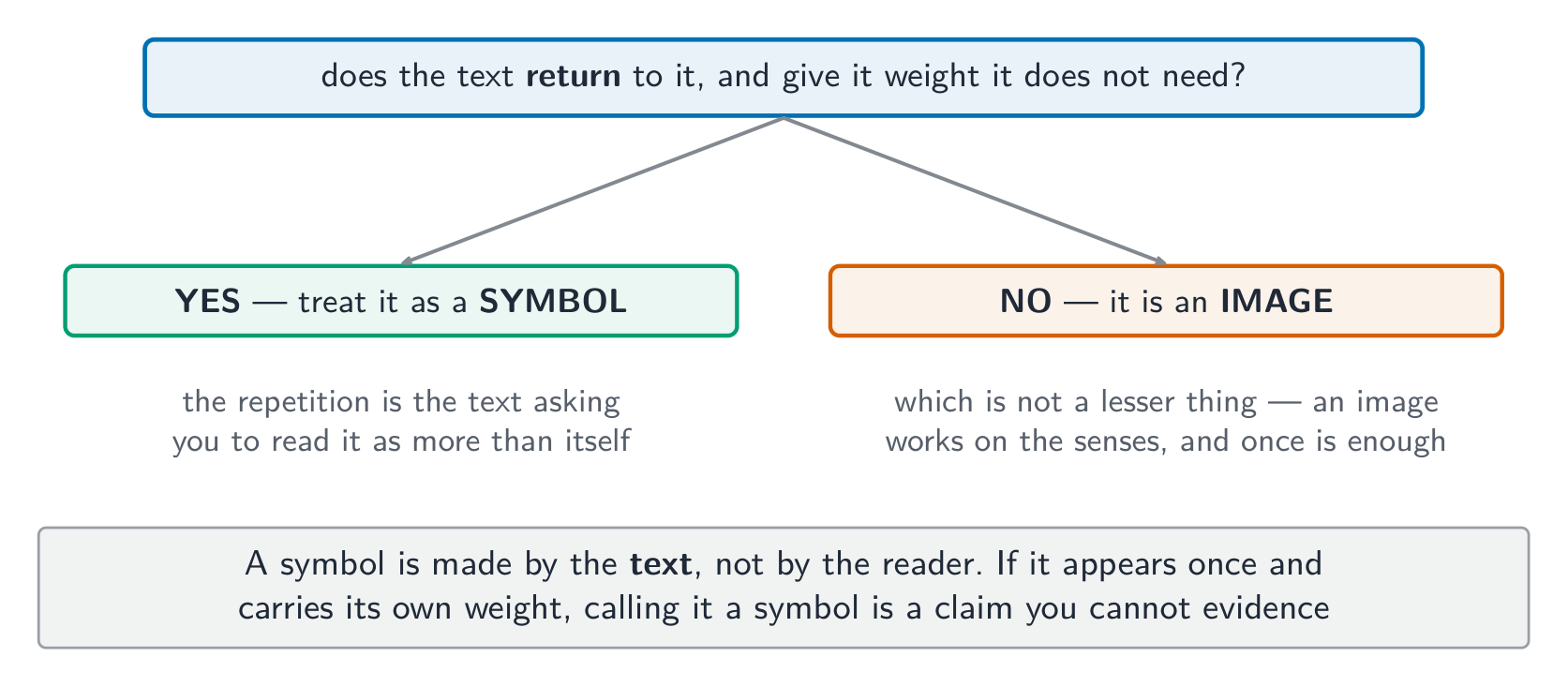
象徴は読者によって作られるのではなく、テキストによって作られる
Explore · ⁨探索⁩

Image or symbol? Apply the test · ⁨イメージか象徴か? テストを適用せよ⁩

A symbol is made by the text, not by the reader: the test is whether the text returns to it and gives it weight it does not need. · ⁨象徴は読者によって作られるのではなくテキストによって作られる: テストとは、テキストがそれを再び取り上げ、必要以上の重みを与えているかどうかである。⁩

5.5

The Function of a Metaphor

Syllabus · ⁨シラバス⁩
English

Enduring Understanding (FIG-1): Comparisons, representations, and associations shift meaning from the literal to the figurative and invite readers to interpret a text.

Learning Objective 6.B: Identify and explain the function of a metaphor.

  • FIG-1.R Metaphorical comparisons do not focus solely on the objects being compared; they focus on the particular traits, qualities, or characteristics of the things being compared.
  • FIG-1.S Comparisons not only communicate literal meaning but may also convey figurative meaning or transmit a perspective.
  • FIG-1.T An extended metaphor is created when the comparison of a main subject and comparison subject persists through parts of or an entire text, and when the comparison is expanded through additional details, similes, and images.
  • FIG-1.U Interpretation of an extended metaphor may depend on the context of its use; that is, what is happening in a text may determine what is transferred in the comparison.
日本語

持続的理解(FIG-1): 比較、表現、連想は意味を字義から比喩へと移行させ、読者にテキストの解釈を促す。

学習目標 6.B: 隠喩の機能を特定し説明する。

  • FIG-1.R 隠喩による比較は、単に比較対象となる物体に焦点を当てるのではなく、比較されるものの特定の性質、特性、特徴に焦点を当てる。
  • FIG-1.S 比較は文字通りの意味を伝達するだけでなく、比喩的意味を伝えたり、見解を共有したりすることもある。
  • FIG-1.T 主要な主題と比較対象の比較が、テキストの一部全体にわたって持続し、追加の詳細、明喻、およびイメージによって拡張される場合、延長された隠喩が生成される。
  • FIG-1.U 延長された隠喩の解釈は使用文脈に依存することがあります。つまり、テキスト内で何が起こっているかが、比較で転送される内容を決めることがある。

Source: College Board AP Course and Exam Description · ⁨出典: College Board AP コースおよび試験説明書⁩

English
  • Metaphorical comparisons do not focus solely on the objects compared; they focus on the particular qualities the comparison brings out.
  • Comparisons communicate literal meaning and may also convey figurative meaning.
  • An extended metaphor 延伸隐喻 is created when the comparison of a main subject and comparison subject persists across a passage or a whole text.
  • Interpretation of an extended metaphor may depend on the context of its use.

An extended metaphor is the most rewarding thing to find in an unseen poem, because it gives you structure and meaning at once: you can trace how the comparison develops, and a comparison that changes as it extends is the poem's argument in motion.

日本語
  • 比喩的な比較は、比較対象となる物体そのものにのみ焦点を当てるわけではない。それは、比較によって浮き彫りにされた特定の性質に焦点を当てるものである。
  • 比較は文字通りの意味を伝達し、同時に比喩的な意味も伝えることがある。
  • 延長比喩は、主要な主題と比較対象との関係が一節や作品全体にわたって継続するときに成立する。
  • 延長比喩の解釈は、その使用文脈に依存することがある。

延長比喩は未読の詩で発見できる最も価値のある要素の一つである。なぜなら、構造と意味を同時に提供してくれるからである:比較が発展していく様を追跡でき、変化する延長比喩こそが、詩の論理が動き出している状態そのものだからだ。

5.6

The Function of Personification · ⁨擬人化の機能⁩

Syllabus · ⁨シラバス⁩
English

Enduring Understanding (FIG-1): Comparisons, representations, and associations shift meaning from the literal to the figurative and invite readers to interpret a text.

Learning Objective 6.C: Identify and explain the function of personification.

  • FIG-1.V Personification is a type of comparison that assigns a human trait or quality to a nonhuman object, entity, or idea, thus characterizing that object, entity, or idea.
日本語

持続的理解(FIG-1): 比較、表現、連想は意味を字義から比喩へと移行させ、読者にテキストの解釈を促す。

学習目標 6.C: 擬人化の機能を特定し説明する。

  • FIG-1.V 擬人化とは、非人間のもの、実体、概念に人間の特性や属性を与え、それらを人物化する比較の一種である。

Source: College Board AP Course and Exam Description · ⁨出典: College Board AP コースおよび試験説明書⁩

English

Personification 拟人 is a type of comparison that assigns a human trait or quality to a nonhuman object, animal, or idea.

Treat it as a comparison with the same parts as any other: the main subject is the nonhuman thing, the comparison subject is a person, and the transferred quality is the human trait. Then ask the useful question - what does granting this thing agency do? A wind that decides is not the same claim as a wind that blows.

日本語

擬人化とは、非人間の物体、動物、あるいは抽象的概念に人間特有の属性や性質を割り当てる比較の一種である。

他のどの比較と同じように、この手法も同じ構成要素を持つとみなす:主要な主題は非人間のもののことであり、比較対象は人間であり、移転された性質は人間特有の属性である。そして、有益な質問を投げかける——この主体性(能動性)を与えることは何をもたらすか? 決断する風と、単に吹く風では、示唆する内容が全く異なる。

'物体に命を与えている'という定義——第三列は解説である
Vocabulary · ⁨語彙⁩ Train · ⁨練習する⁩
English 日本語
Personification/pɜːˈsɒnɪfɪkeɪʃn/ 擬人法(Personification)
Allusions/əˈluːʒnz/ 典拠
5.7

The Function of an Allusion · ⁨典故の機能⁩

Syllabus · ⁨シラバス⁩
English

Enduring Understanding (FIG-1): Comparisons, representations, and associations shift meaning from the literal to the figurative and invite readers to interpret a text.

Learning Objective 6.D: Identify and explain the function of an allusion.

  • FIG-1.W Allusions in a text can reference literary works including myths and sacred texts; other works of art including paintings and music; or people, places, or events outside the text.
日本語

持続的理解(FIG-1): 比較、表現、連想は意味を字義から比喩へと移行させ、読者にテキストの解釈を促す。

学習目標 6.D: 典拠の機能を特定し説明する。

  • FIG-1.W テキスト中の典拠は、神話や聖書などの文学作品、絵画や音楽などの芸術作品、あるいはテキスト外の人物、場所、出来事などを参照することができる。

Source: College Board AP Course and Exam Description · ⁨出典: College Board AP コースおよび試験説明書⁩

English

Allusions 典故 may reference literary works including myths and sacred texts, other works of art, and historical events.

An allusion imports meaning the poem has not written. That is its efficiency and its risk: it works only for readers who recognise it. When you meet one you do not know, say what the poem does with it structurally - where it is placed, what it interrupts - rather than pretending to a recognition you lack.

日本語

典故は、神話や聖典を含む文学作品、その他の芸術作品、歴史的出来事などを参照することがある。

典故は、詩自体が書き記していない意味を作品に持ち込む。これがその効率さであり、かつリスクでもある:これはそれを認識した読者に対してのみ機能する。もし自分には分からない典故に出会ったら、自分の認識を偽るのではなく、構造的にどのような役割を果たしているかを述べる——どこに配置されているか、何を中断しているか——这样。

典故は状況と判断を持ち込み、また代償も伴う)
Explore · ⁨探索⁩

Take an allusion past the source · ⁨出典を超えて暗示を解釈する⁩

Naming the source is not the analysis. An allusion imports a situation and a judgement, and it costs something as well. · ⁨出典を名指すことは分析ではない。暗示は状況と判断を持ち込み、また何らかのコストも伴う。⁩

5.8

Developing a Literary Thesis Statement · ⁨文学的テーゼステートメントの構築⁩

Syllabus · ⁨シラバス⁩
English

Enduring Understanding (LAN-1): Readers establish and communicate their interpretations of literature through arguments supported by textual evidence.

Learning Objective 7.B: Develop a thesis statement that conveys a defensible claim about an interpretation of literature and that may establish a line of reasoning.

  • LAN-1.D A thesis statement expresses an interpretation of a literary text, and requires a defense, through use of textual evidence and a line of reasoning, both of which are explained in an essay through commentary.
  • LAN-1.E A thesis statement may preview the development or line of reasoning of an interpretation. This is not to say that a thesis statement must list the points of an interpretation, literary elements to be analyzed, or specific evidence to be used in the argument.
日本語

持続的理解(LAN-1): 読者は、テキストの証拠で裏付けられた議論を通じて、文学作品の解釈を確立し伝達する。

学習目標 7.B: 文学の解釈に対する正当な主張を伝え、かつ論理の道筋を確立する可能性のあるテーゼステートメントを作成する。

  • LAN-1.D テーゼ文は文学作品の解釈を表し、エッセイの中で解説によって説明文と推論の系によって守られる必要がある。
  • LAN-1.E テーゼステートメントは、解釈の展開や論理の道筋を予見することがあります。これは、テーゼステートメントが解釈のポイント、分析されるべき文学的要素、または議論で用いられる具体的な証拠をリストアップしなければならないという意味ではありません。

Source: College Board AP Course and Exam Description · ⁨出典: College Board AP コースおよび試験説明書⁩

English

Unchanged: an interpretation requiring textual defence, which may preview the line of reasoning.

日本語

変更なし:テキストによる裏付けが必要な解釈であり、推論の方向性を予期させることが可能である。

5.9

Developing Commentary · ⁨commentary の発展⁩

Syllabus · ⁨シラバス⁩
English

Enduring Understanding (LAN-1): Readers establish and communicate their interpretations of literature through arguments supported by textual evidence.

Learning Objective 7.C: Develop commentary that establishes and explains relationships among textual evidence, the line of reasoning, and the thesis.

  • LAN-1.F A line of reasoning is the logical sequence of claims that work together to defend the overarching thesis statement.
  • LAN-1.G A line of reasoning is communicated through commentary that explains the logical relationship between the overarching thesis statement and the claims/evidence within the body of an essay.
日本語

持続的理解(LAN-1): 読者は、テキストの証拠で裏付けられた議論を通じて、文学作品の解釈を確立し伝達する。

学習目標 7.C: テキストの証拠、論理の道筋、およびテーゼとの間の関係を確立して説明する解説を作成する。

  • LAN-1.F 論理の道筋とは、包括的なテーゼステートメントを防御するために協力して機能する主張の論理的な順序です。
  • LAN-1.G 論理の道筋は、包括的なテーゼステートメントとエッセイの本文に含まれる主張/証拠との間の論理的関係を説明する解説を通じて伝達されます。

Source: College Board AP Course and Exam Description · ⁨出典: College Board AP コースおよび試験説明書⁩

English

A line of reasoning is the logical sequence of claims defending the thesis, communicated through commentary explaining the relationship between evidence and claim.

日本語

推論の道筋とは、提言を防御するための論理的な主張の系列であり、証拠と主張の間の関係を説明する解説を通じて伝達される。

5.10

Selecting Relevant and Sufficient Evidence · ⁨関連性があり十分である証拠の選定⁩

Syllabus · ⁨シラバス⁩
English

Enduring Understanding (LAN-1): Readers establish and communicate their interpretations of literature through arguments supported by textual evidence.

Learning Objective 7.D: Select and use relevant and sufficient evidence to both develop and support a line of reasoning.

  • LAN-1.H Writers use evidence strategically and purposefully to illustrate, clarify, exemplify, associate, amplify, or qualify a point.
  • LAN-1.I Evidence is effective when the writer of the essay uses commentary to explain a logical relationship between the evidence and the claim.
  • LAN-1.J Evidence is sufficient when its quantity and quality provide apt support for the line of reasoning.
  • LAN-1.K Developing and supporting an interpretation of a text is a recursive process; an interpretation can emerge from analyzing evidence and then forming a line of reasoning, or the interpretation can emerge from forming a line of reasoning and then identifying relevant evidence to support that line of reasoning.
日本語

持続的理解(LAN-1): 読者は、テキストの証拠で裏付けられた議論を通じて、文学作品の解釈を確立し伝達する。

学習目標 7.D: 論理の道筋を展開し支援するために、関連して十分十分な証拠を選定して使用する。

  • LAN-1.H 作家は、点を示し、明瞭にし、例示し、関連付け、拡大し、または限定するために、戦略的かつ意図的に証拠を使用します。
  • LAN-1.I エッセイの著者が解説を用いて証拠と主張との間の論理的関係を説明する場合、証拠は効果的です。
  • LAN-1.J 証拠の量と質が論理の道筋に対して適切な支援を提供する場合、それは十分です。
  • LAN-1.K テキストの解釈を展開し支援することは反復的プロセスです。解釈は、証拠を分析してから論理の道筋を形成することから生まれる也可能れば、論理の道筋を形成してからそれを支持するための関連する証拠を特定することから生まれることもあります。

Source: College Board AP Course and Exam Description · ⁨出典: College Board AP コースおよび試験説明書⁩

English

Evidence used strategically, effective with commentary, sufficient in quantity and quality, and interpretation as a recursive process.

日本語

戦略的に用いられ、解説と共に効果的であり、量と質において十分である証拠、および再帰的プロセスとしての解釈。

5.11

Control Over the Elements of Composition · ⁨作文要素への統制⁩

Syllabus · ⁨シラバス⁩
English

Enduring Understanding (LAN-1): Readers establish and communicate their interpretations of literature through arguments supported by textual evidence.

Learning Objective 7.E: Demonstrate control over the elements of composition to communicate clearly.

  • LAN-1.Q Transitional elements are words or other elements (phrases, clauses, sentences, or paragraphs) that assist in creating coherence between sentences and paragraphs by showing relationships between ideas.
日本語

持続的理解(LAN-1): 読者は、テキストの証拠で裏付けられた議論を通じて、文学作品の解釈を確立し伝達する。

学習目標 7.E: 構成要素を統制することで、明確にコミュニケーションを行うことを示す。

  • LAN-1.Q 接続語は、文と文、段落と段落の間の関係性を示すことで、文章全体の整合性を生み出すための言葉や他の要素(句、節、文、段落など)である。

Source: College Board AP Course and Exam Description · ⁨出典: College Board AP コースおよび試験説明書⁩

English

Transitional elements - words, phrases, clauses, sentences, or paragraphs - assist in creating coherence.

Worked example (a real AP exam task). A poetry-analysis prompt asks how the poet's use of figurative language conveys the speaker's attitude. A weak answer catalogues: "The poet uses personification, imagery, and a metaphor." A scoring answer traces one device developing: "The extended comparison of the tide to a creditor runs the length of the poem, but the terms change: in the first stanza it 'asks', by the third it 'takes what was always owed'. The comparison subject stays constant while the speaker's account of the relationship hardens - so the attitude the poem conveys is not fear of loss but the recognition that the loss was never hers to prevent." One device, traced, with the attitude it produces.

日本語

接続的要素——言葉、句、節、文、段落など——は、整合性の構築を助ける。

** worked example (実際のAP試験タスク)。** 詩の分析プロンプトとして、比喩表現の使い方が語り手の態度をどのように伝えるかを問う問題がある。弱い回答は以下のようにリストアップする:「詩人は擬人化、イメージ、および比喩を使用している。」 高得点の回答は、一つの技法が発展していく様を追跡する:「潮を債権者に例えた延長比較は詩の長さ全体に渡っているが、用語は変わる。最初の四行では『頼む』が、三番目の四行では『常に借金を返す』となる。比較対象は一定のままだが、語り手が関係性を描写する語気が硬直していく——したがって、詩が伝える態度は喪失への恐怖ではなく、喪失は本来防ぐことのできるものではなかったという認識である。」 一つの技法を追跡し、そこから生まれる態度を示す。

5.11

Exam tips · ⁨試験対策⁩

English
  • Never ask "which form is this?" Ask what the form does - and look for the departure or the imposition.
  • A word with two meanings often means both. Do not choose prematurely.
  • Understatement is the more powerful half of the pair, and the more often missed. The gap is the comment.
  • A pattern of images is a claim the poem makes without stating it. A single image is only a detail.
  • An extended metaphor that changes as it extends is the poem's argument in motion. Trace it.
  • Cataloguing devices earns nothing. One device traced beats four devices named.
日本語
  • 「これはどのような形式か?」と聞くのは避けるべきである。その形式が何をするのかを問い、逸脱や強制の兆候を探すべきである。
  • 二重の意味を持つ言葉は、両方の意味を含んでいることが多い。安易に片方だけを選ぶべきではない。
  • 謙譲法( understatement ) は対のより強力な側面であり、かつ見逃されやすい。そのギャップこそが評論である。
  • イメージのパターンは、詩が明示せずとも主張することである。一つのイメージは単なるディテールに過ぎない。
  • 変化する延長比喩こそが、詩の論理が動き出している状態である。それを追跡せよ。
  • 技法を羅列しても評価は上がらない。一つ追跡された技法は、四つ名指しされた技法よりも優れている。

Interactive lessons on this topic · ⁨このトピックのインタラクティブ授業⁩

Work through it step by step, with instant-check exercises. · ⁨一歩ずつ進め、即時チェック付きの問題で学習します。⁩

Past Papers · ⁨過去問⁩

More topics in AP English Literature and Composition · ⁨AP 英語文学と作文⁩ · ⁨AP English Literature and Composition · ⁨AP 英語文学と作文⁩ の他のトピック⁩

Log in or create account · ⁨ログインまたはアカウント作成⁩

IGCSE, A-Level & AP