Skip to content · ⁨コンテンツへスキップ⁩

Halogen compounds · ⁨ハロゲン化合物⁩

A-Level Chemistry · ⁨A-Level 化学⁩ · Topic 15 · ⁨トピック 15⁩

View Slides · ⁨查看幻灯片⁩ Train · ⁨練習する⁩
Video lesson for this topic · ⁨このトピックのビデオレッスン⁩ Open the video page · ⁨動画ページを開く⁩
7:31

ハロゲン化合物

冷凍スプレー缶のボタンを押すと、肌が冷たさで麻痺します。中にはハロゲンアルカンが入っています:炭化水素中的一个の炭素-水素結合がハロゲン原子に置き換わったものです。…

English narration · English + 中文 subtitles burned in · ⁨英語ナレーション・英語+中文字幕 burning-in⁩

15.1

Halogenoalkanes · ⁨ハロゲンアルカン⁩

Syllabus · ⁨シラバス⁩
English
  1. recall the reactions (reagents and conditions) by which halogenoalkanes can be produced: (a) the free-radical substitution of alkanes by $\text{Cl}_2$ or $\text{Br}_2$ in the presence of ultraviolet light, as exemplified by the reactions of ethane (b) electrophilic addition of an alkene with a halogen, $\text{X}_2$, or hydrogen halide, $\text{HX(g)}$, at room temperature (c) substitution of an alcohol, e.g. by reaction with $\text{HX(g)}$; or with $\text{KCl}$ and concentrated $\text{H}_2\text{SO}_4$ or concentrated $\text{H}_3\text{PO}_4$; or with $\text{PCl}_3$ and heat; or with $\text{PCl}_5$; or with $\text{SOCl}_2$
  2. classify halogenoalkanes into primary, secondary and tertiary
  3. describe the following nucleophilic substitution reactions: (a) the reaction with $\text{NaOH(aq)}$ and heat to produce an alcohol (b) the reaction with $\text{KCN}$ in ethanol and heat to produce a nitrile (c) the reaction with $\text{NH}_3$ in ethanol heated under pressure to produce an amine (d) the reaction with aqueous silver nitrate in ethanol as a method of identifying the halogen present as exemplified by bromoethane
  4. describe the elimination reaction with $\text{NaOH}$ in ethanol and heat to produce an alkene as exemplified by bromoethane
  5. describe the $\text{S}_\text{N}1$ and $\text{S}_\text{N}2$ mechanisms of nucleophilic substitution in halogenoalkanes including the inductive effects of alkyl groups
  6. recall that primary halogenoalkanes tend to react via the $\text{S}_\text{N}2$ mechanism; tertiary halogenoalkanes via the $\text{S}_\text{N}1$ mechanism; and secondary halogenoalkanes by a mixture of the two, depending on structure
  7. describe and explain the different reactivities of halogenoalkanes (with particular reference to the relative strengths of the C–X bonds as exemplified by the reactions of halogenoalkanes with aqueous silver nitrates)
日本語
  1. ハロゲン化アルキルが生成される反応(試薬および条件)を思い出す:(a) 紫外線存在下でのアルカンの自由ラジカル置換反応である$\text{Cl}_2$または$\text{Br}_2$によるもの。エタンの反応を例に示す。(b) 常温におけるアルケンのハロゲン、$\text{X}_2$、または水素ハライド、$\text{HX(g)}$との求電子付加反応。(c) アルコールの置換反応。例えば、$\text{HX(g)}$との反応、または$\text{KCl}$と濃硫酸、$\text{H}_2\text{SO}_4$、あるいは濃硝酸、$\text{H}_3\text{PO}_4$との反応、$\text{PCl}_3$と加熱、$\text{PCl}_5$、または$\text{SOCl}_2$との反応によるもの
  2. ハロゲン化アルキルを一次、二次、三次に分類する
  3. 以下の求核置換反応を説明する:(a) $\text{NaOH(aq)}$ と加熱による反応でアルコールを生成する (b) エタノール中、$\text{KCN}$ と加熱による反応でシアノ化合物(ニトリル)を生成する (c) 加圧下で加熱したエタノール中、$\text{NH}_3$ との反応でアミンを生成する (d) 水溶液硝酸銀とエタノールを用いる反応は、ハロゲン化アルカンの一種であるブロモエタンの例のように、存在するハロゲンの同定法として用いられる
  4. 脱離反応を説明する。$\text{NaOH}$ をエタノール中で加熱すると、ブロモエタンの例のようにアルケンを生成する
  5. ハロゲン化アルカンにおける求核置換反応の$\text{S}_\text{N}1$ および$\text{S}_\text{N}2$ 機構を説明し、アルキル基の誘起効果を含む
  6. 第一級ハロゲン化アルカンは主に$\text{S}_\text{N}2$ 機構で反応し、第三級ハロゲン化アルカンは$\text{S}_\text{N}1$ 機構で反応し、第二級ハロゲン化アルカンは構造に応じて両方の機構の混合物で反応することを思い出す
  7. ハロゲン化アルカンの異なる反応性を説明・解説する(C–X結合の相対的な強さに特に言及し、ハロゲン化アルカンの水溶液硝酸銀との反応がその例となる)
Source: Cambridge International syllabus · ⁨出典: Cambridge International シラバス⁩

English

A halogenoalkane 卤代烷 is an alkane with one or more halogen atoms in place of hydrogen (a C–X bond, where X is a halogen).

Making halogenoalkanes

  • free-radical substitution 自由基取代 of an alkane with $\text{Cl}_2$ or $\text{Br}_2$ in ultraviolet light.
  • electrophilic addition 亲电加成 of an alkene with a halogen $\text{X}_2$ or a hydrogen halide $\text{HX}$.
  • substitution of an alcohol 醇, for example by $\text{HX}$, by $\text{PCl}_5$, by $\text{PCl}_3$ with heat, or by $\text{SOCl}_2$.

Three classes

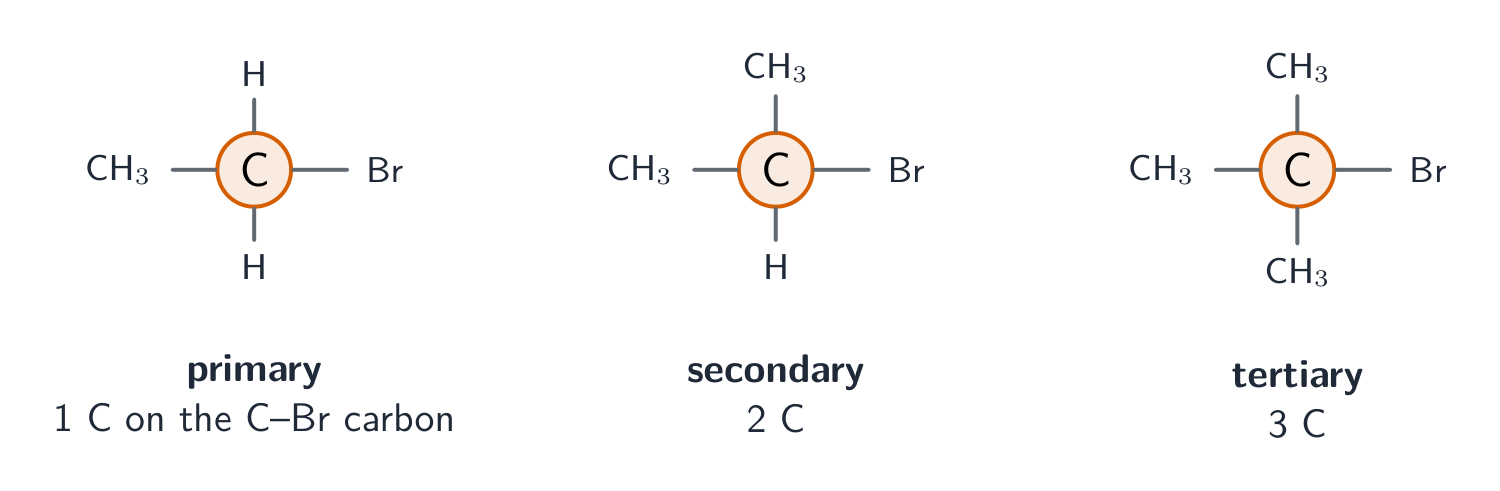
A halogenoalkane is primary 伯, secondary 仲 or tertiary 叔, depending on how many carbon atoms are joined to the carbon that holds the halogen (one, two or three).

日本語

ハロゲンアルカンとは、アルカンの水素原子の一つまたは複数ハロゲン原子に置き換わった化合物である(C–X 結合、X はハロゲン)。

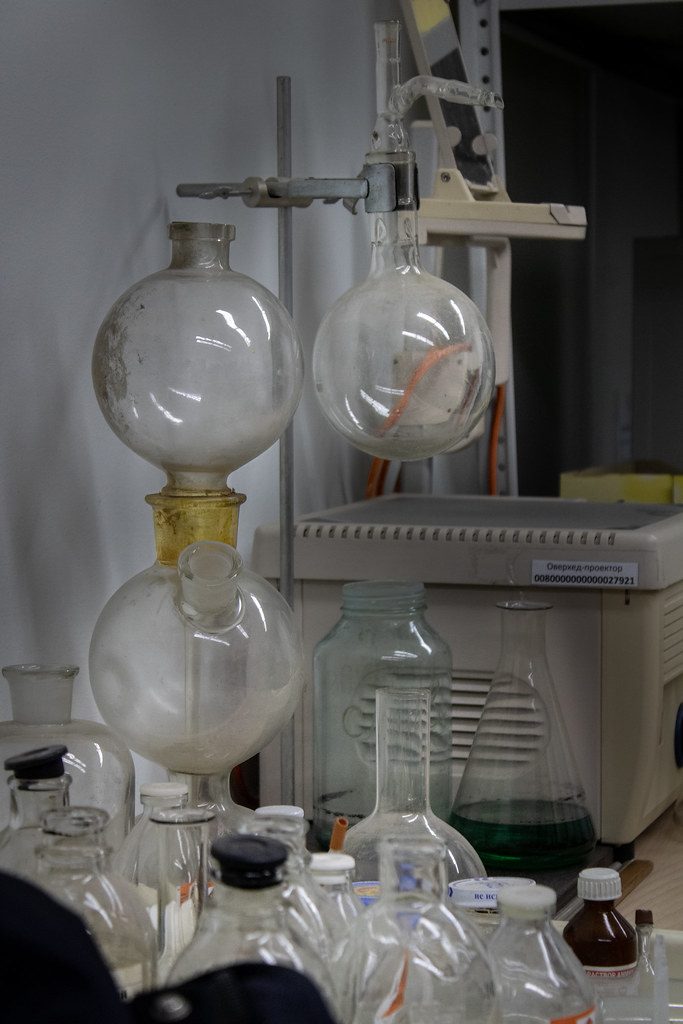
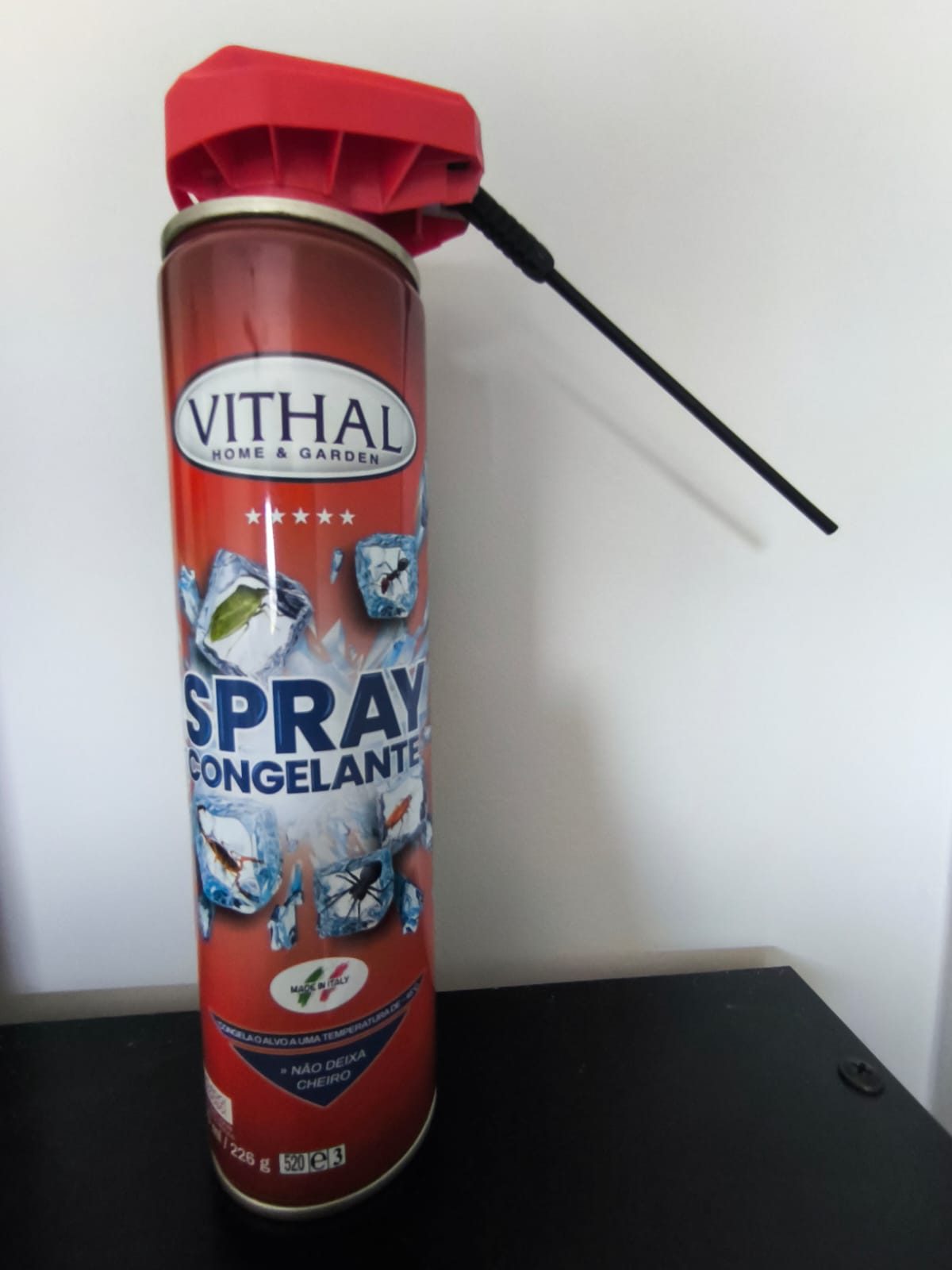
フリーザースプレー缶から冷たいハロゲンアルカンの蒸気が出ている様子
揮発性のハロゲンアルカンはかつて冷媒やエアゾール噴射剤として広く用いられていた

ハロゲンアルカンの合成

  • 自由ラジカル置換反応: アルカンを紫外線下で $\text{Cl}_2$ または $\text{Br}_2$ と反応させる。
  • 求電子付加反応: アルケンをハロゲン $\text{X}_2$ または水素ハロゲン化物 $\text{HX}$ と反応させる。
  • アルコールの置換反応: 例えば $\text{HX}$ で、$\text{PCl}_5$ で、$\text{PCl}_3$ で加熱、あるいは $\text{SOCl}_2$ で反応させる。

3つの分類

ハロゲンアルカンは、ハロゲンを保持する炭素に結合している炭素原子の数(1個、2個、3個)に応じて、一次、二次、または三次と分類される。

臭素を含む炭素を強調した3つの構造:一次(炭素1つ)、二次(炭素2つ)、三次(炭素3つ)
ハロゲンを保持する炭素に結合している炭素の数によって区別される、一次・二次・三次ハロゲンアルカン
Vocabulary · ⁨語彙⁩ Train · ⁨練習する⁩
English 日本語
halogenoalkane/ˈheɪləʊdʒnəʊlkeɪn/ ハロゲン化アルキル
free-radical substitution/friː ˈrædɪkl ˌsʌbstɪˈtjuːʃn/ 自由ラジカル置換
electrophilic addition/ɪˌlektrəʊˈfɪlɪk əˈdɪʃn/ 求電付加
alcohol/ˈælkəhɒl/ アルコール
primary/ˈpraɪməri/ 第一級
secondary/ˈsekəndəri/ 第二級
tertiary/ˈtɜːʃjəri/ 第三級
nucleophilic substitution/ˌnjuːklɪəˈfɪlɪk ˌsʌbstɪˈtjuːʃn/ 求核置換
nucleophile/ˈnjuːklɪɒfaɪl/ 求核剤
nitrile/ˈnaɪtraɪl/ ニトリル
amine/ˈæmaɪn/ アミン
silver nitrate/ˈsɪlvə ˈnaɪtreɪt/ 硝酸銀
precipitate/prɪˈsɪpɪteɪt/ 沈殿物
15.1

Nucleophilic substitution · ⁨求核置換反応⁩

English

The C–X bond is polar, so the carbon is slightly positive. A nucleophilic substitution 亲核取代 happens when a nucleophile 亲核试剂 (a lone-pair species) attacks that carbon and replaces the halogen.

Reagent and conditions Product
$\text{NaOH(aq)}$, heat an alcohol
$\text{KCN}$ in ethanol, heat a nitrile 腈 (adds one carbon to the chain)
$\text{NH}_3$ in ethanol, heated under pressure an amine 胺

To identify the halogen, warm the halogenoalkane with silver nitrate 硝酸银 in ethanol. A silver halide precipitate 沉淀 forms, and its colour shows which halogen is present (white $\text{AgCl}$, cream $\text{AgBr}$, yellow $\text{AgI}$).

日本語

C–X 結合は極性を持つため、炭素はわずかに正電荷を帯びる。求核置換反応では、求核試薬(非共有電子対を持つ種)がその炭素を攻撃し、ハロゲンに置き換わる。

沸騰液が入った丸底フラスコに垂直コンデンサーを取り付け、蒸気を還流させている様子
多くのハロゲンアルカンの反応は、還流条件下で混合物を加熱して行われる
試薬および条件 生成物
$\text{NaOH(aq)}$、加熱 アルコール
エタノール中の $\text{KCN}$、加熱 ニトリル(鎖に炭素が1つ増える)
加圧下でエタノール中の $\text{NH}_3$、加熱 アミン
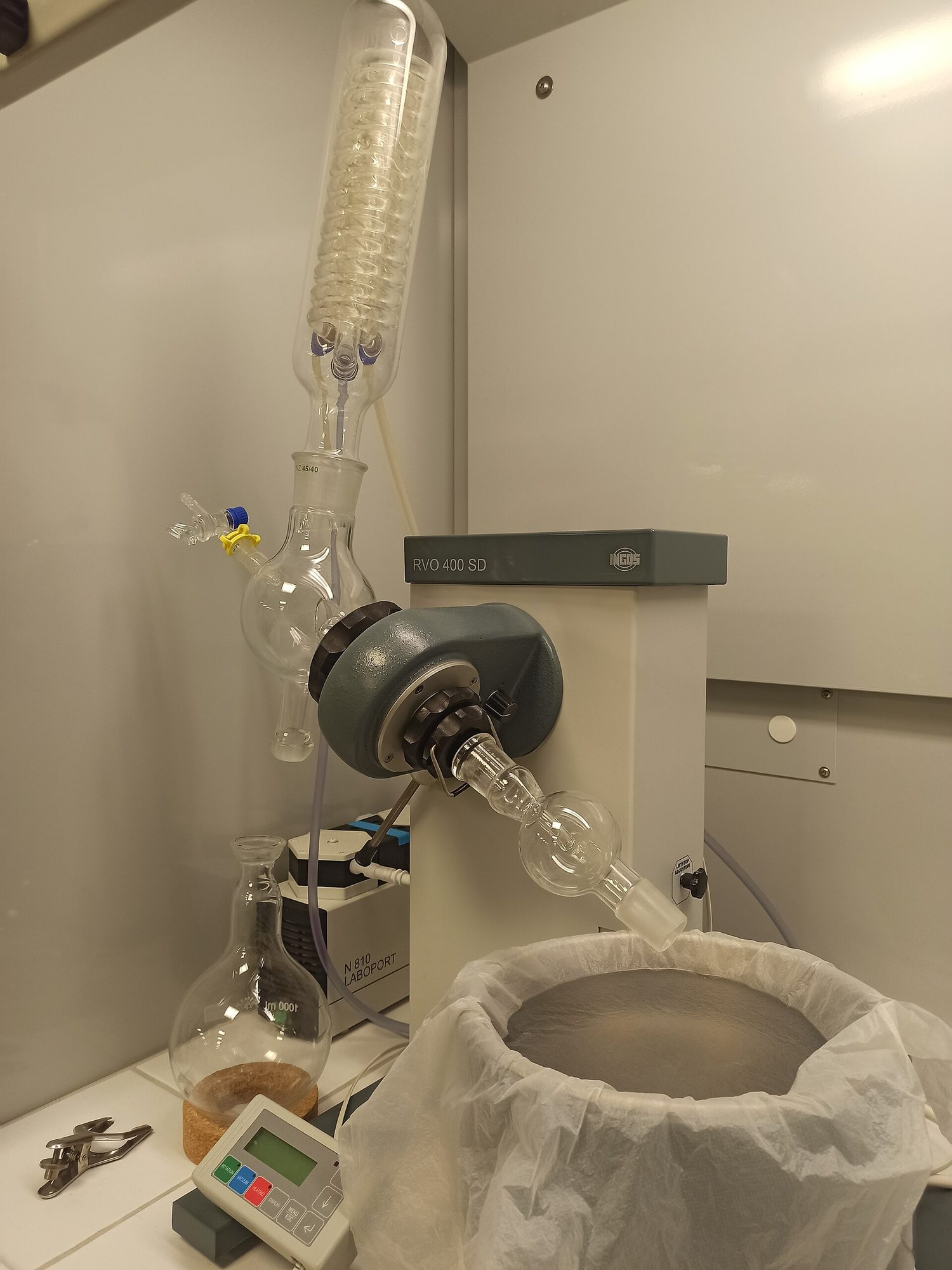
ロータリーエバポレーター:温水浴の中で回転する溶液入りフラスコ、溶媒蒸気が別の受容フラスコで凝縮されている様子
ロータリーエバポレーターは減圧下で溶媒を除去する装置であり、反応後の工程である

ハロゲンの同定のため、ハロゲンアルカンをエタノール中の硝酸銀と温める。ハロゲン化銀の沈殿ができ、その色が存在するハロゲンを示す(白色 $\text{AgCl}$、クリーム色 $\text{AgBr}$、黄色 $\text{AgI}$)。

Explore · ⁨探索⁩

Nucleophilic substitution · ⁨求核置換反応⁩

A nucleophile swaps in for the leaving group on a halogenoalkane. · ⁨求核試薬がハロゲン化アルキンの脱離基に替わります。⁩

15.1

Elimination · ⁨脱離反応⁩

English

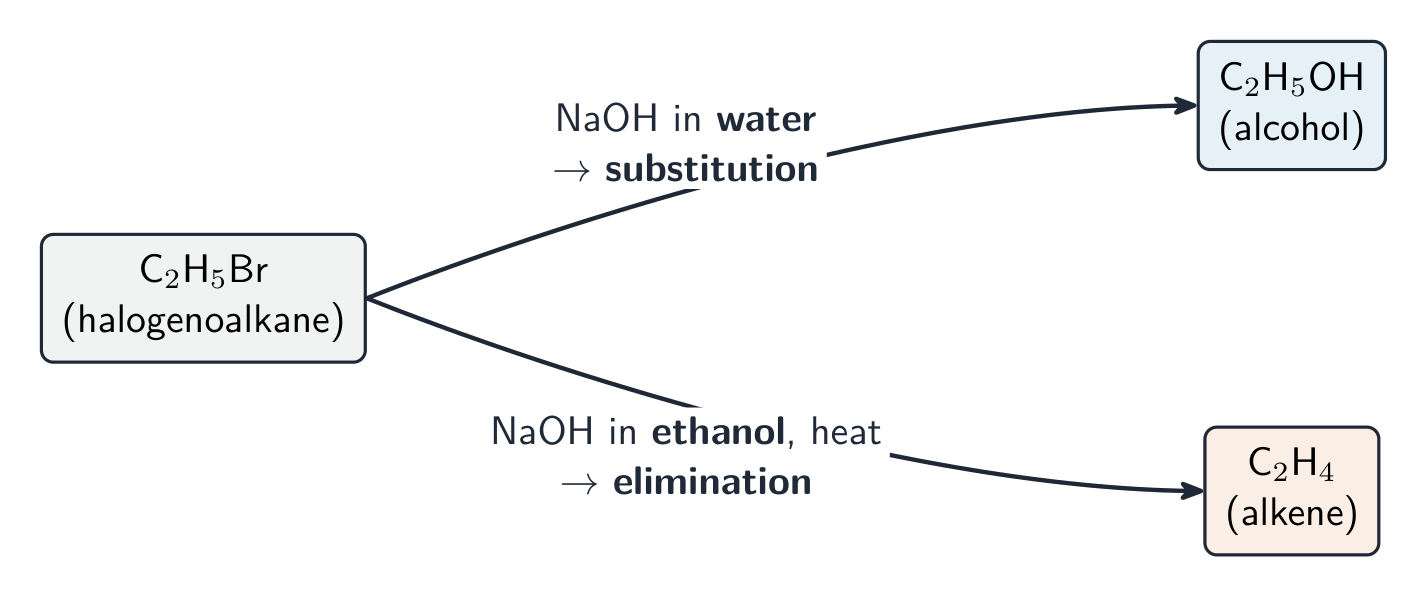
The same halogenoalkane can instead undergo elimination 消去 to form an alkene 烯烃. The conditions decide which reaction wins:

  • $\text{NaOH}$ in water → nucleophilic substitution → an alcohol.
  • $\text{NaOH}$ in ethanol, heated → elimination → an alkene.
$$\text{C}_2\text{H}_5\text{Br} + \text{NaOH} \rightarrow \text{C}_2\text{H}_4 + \text{NaBr} + \text{H}_2\text{O}$$
日本語

同じハロゲンアルカンは代わりに脱離反応を起こしてアルケンを生成する場合もある。反応条件によりどちらの反応が優先されるかが決まる:

  • $\text{NaOH}$ を水中では → 求核置換反応 → アルコール。
  • $\text{NaOH}$ をエタノール中で加熱すると → 脱離反応 → アルケン。
$$\text{C}_2\text{H}_5\text{Br} + \text{NaOH} \rightarrow \text{C}_2\text{H}_4 + \text{NaBr} + \text{H}_2\text{O}$$
枝分かれ図:臭素エタンに水酸化ナトリウム水溶液を使うと置換反応でアルコールになるが、エタノール中での水酸化ナトリウム(加熱)では脱離反応でアルケンになる
同じハロゲンアルカン:水中の NaOH では置換反応でアルコールとなり、エタノール中の NaOH(加熱)では脱離反応でアルケンとなる
Vocabulary · ⁨語彙⁩ Train · ⁨練習する⁩
English 日本語
elimination/ɪˌlɪmɪˈneɪʃn/ 脱離反応
alkene/ˈælkiːn/ アルケン
transition state/trænˈsɪʃn steɪt/ 制限因子
carbocation/ˌkɑːbəˈkeɪʃn/ カルボカチオン
inductive effect/ɪnˈdʌktɪv ɪˈfekt/ 誘導効果
bond energy/bɒnd ˈenədʒi/ 結合エネルギー
15.1

The S$_\text{N}$1 and S$_\text{N}$2 mechanisms · ⁨S$_\text{N}$1およびS$_\text{N}$2機構⁩

English

Nucleophilic substitution can follow two routes:

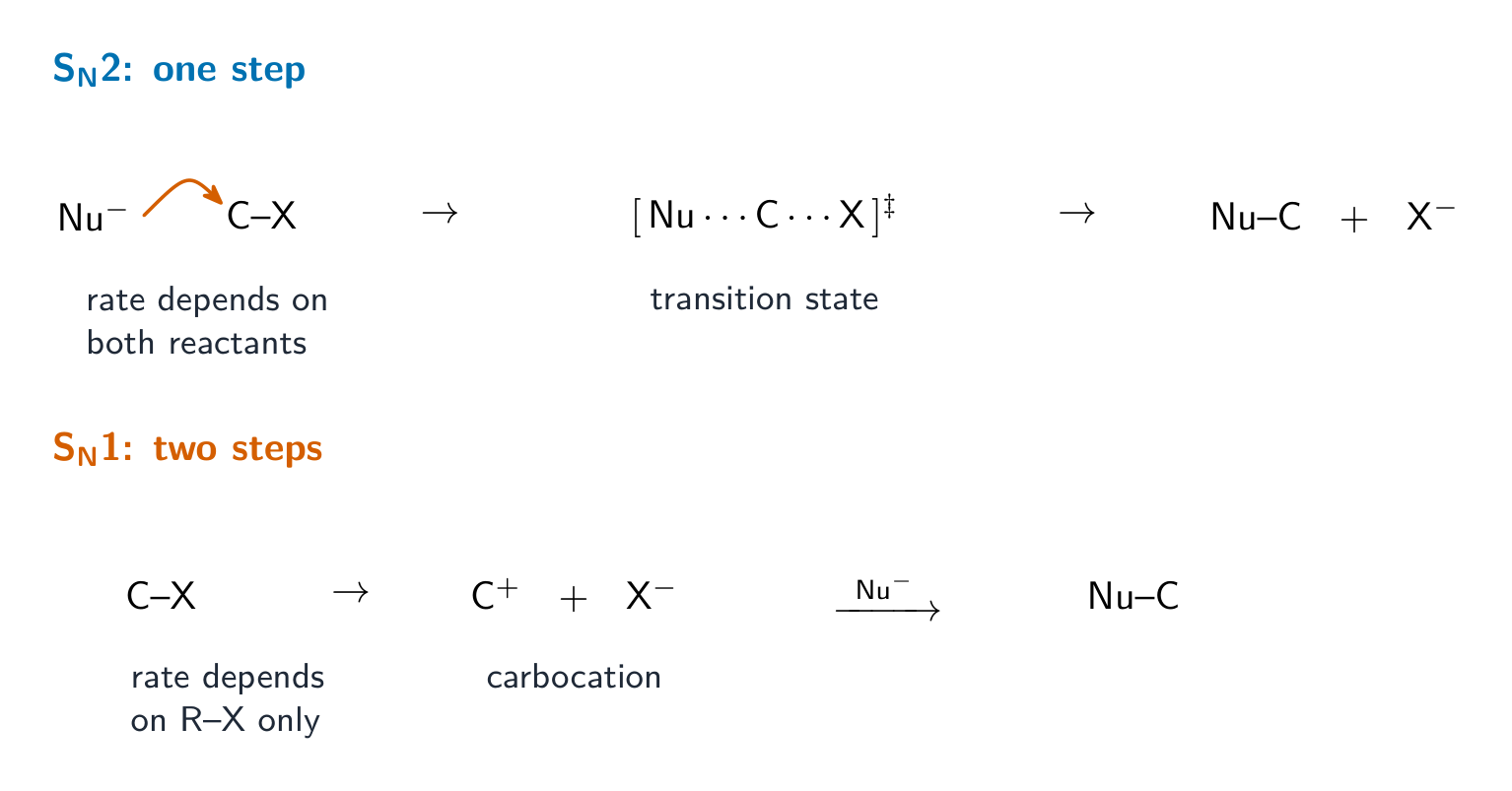
  • S$_\text{N}$2: one step. The nucleophile attacks at the same time as the halogen leaves, passing through a crowded transition state 过渡态 where both are half-bonded. The rate depends on both the halogenoalkane and the nucleophile.
  • S$_\text{N}$1: two steps. First the C–X bond breaks to give a carbocation 碳正离子; then the nucleophile attacks it. The rate depends only on the halogenoalkane.

Alkyl groups push electrons towards the positive carbon (the inductive effect 诱导效应), so they stabilise the carbocation. This is why:

  • primary halogenoalkanes mostly react by S$_\text{N}$2.
  • tertiary halogenoalkanes mostly react by S$_\text{N}$1 (their carbocation is well stabilised).
  • secondary halogenoalkanes use a mixture of the two.
日本語

求核置換反応には2つの経路がある:

  • S$_\text{N}$2:1段階。求核試薬の攻撃とハロゲン离去が同時に起こり、両方が部分的に結合している混雑した遷移状態を通過します。速度はハロゲン化アルキルと求核試薬の両方に依存します。
  • S$_\text{N}$1: 二歩反応。まず C–X 結合が切断されて炭素陽イオンが生じ、次に求核試薬がそれを攻撃する。速度はハロゲンアルカンのみに依存する。
S N 2 が一歩反応で求核試薬が攻撃しつつハロゲンが離脱する遷移状態を示し、S N 1 が二歩反応で炭素陽イオンを介する様子
S$_\text{N}$2 は混雑した遷移状態を通る単一歩反応;S$_\text{N}$1 は炭素陽イオンを介する二歩反応

アルキル基は正電荷を持つ炭素へ電子を押し込む(誘起効果)ため、炭素陽イオンを安定化する。そのため:

  • 一次ハロゲンアルカンは主に S$_\text{N}$2 で反応する。
  • 三次ハロゲンアルカンは主に S$_\text{N}$1 で反応する(炭素陽イオンが十分に安定化されているため)。
  • 二次ハロゲンアルカンは両方の経路の混合を用いる。
Explore · ⁨探索⁩

The SN2 mechanism, step by step · ⁨SN2机理,逐步解析⁩

Step through nucleophilic substitution. The nucleophile attacks from behind as the halide leaves — all in one smooth step, flipping the molecule inside-out. · ⁨通过求核置换反应进行解析。亲核试剂从背面进攻,同时卤离子离去——整个过程一步完成,分子构型发生翻转。⁩

15.1

Different reactivities · ⁨異なる反応性⁩

English

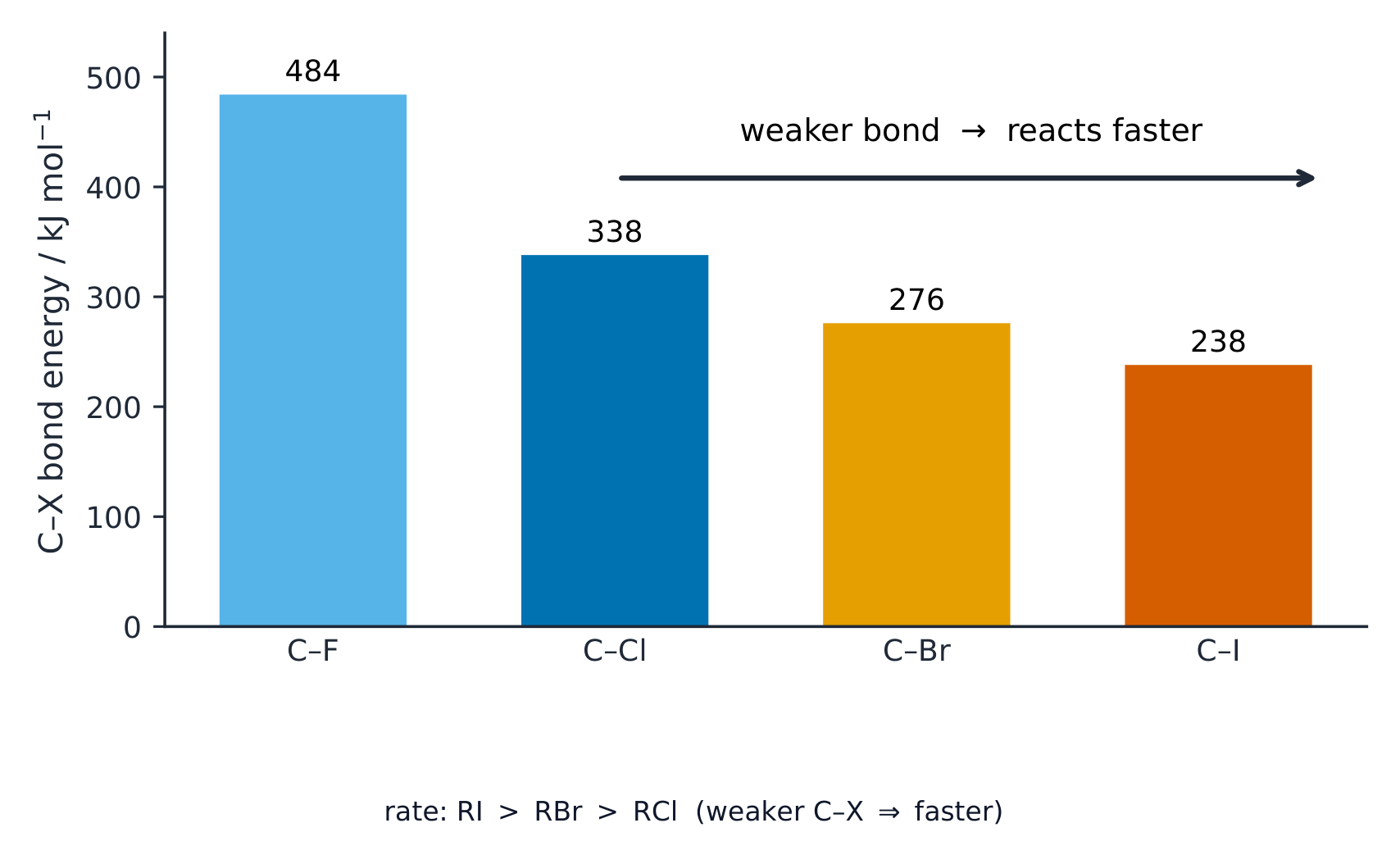
How fast a halogenoalkane reacts depends on the strength of the C–X bond, measured by its bond energy 键能. The C–I bond is the weakest, so iodoalkanes react fastest; the C–Cl bond is the strongest of the three, so chloroalkanes react slowest. So when tested with silver nitrate, an iodoalkane gives its precipitate first — its higher reactivity 反应活性 comes from the weaker C–X bond.

Worked example. Predict the mechanism for the hydrolysis of 1-bromobutane and of 2-bromo-2-methylpropane. Classify the halogenoalkane first. 1-bromobutane is primary: the carbon carrying the $\text{Br}$ is barely shielded, so the nucleophile can attack the back of it and the mechanism is $\text{S}_\text{N}2$ - one step, with the rate depending on both the halogenoalkane and the nucleophile. 2-bromo-2-methylpropane is tertiary: three bulky methyl groups block that attack, but they also stabilise the carbocation formed once the $\text{Br}$ leaves, so it goes $\text{S}_\text{N}1$ - two steps, with the rate depending on the halogenoalkane only. Decide from the class (primary → $\text{S}_\text{N}2$, tertiary → $\text{S}_\text{N}1$), and note that the tertiary one hydrolyses faster despite being the more crowded.

日本語

ハロゲンアルカンの反応速度は C–X 結合の強さ、すなわち結合エネルギーに依存する。C–I 結合が最も弱いため、ヨードアルカンの反応が最も速い。C–Cl 結合は3つの中で最も強いため、クロロアルカンの反応が最も遅い。したがって硝酸銀による試験では、ヨードアルカンは最初に沈殿を生じる——これはより弱い C–X 結合による高い反応性の結果である。

C-FからC-Iへ向かってC-X結合エネルギーが低下する棒グラフ。弱い結合ほど反応速度が速いことを示す矢印が付いている
C–X結合が弱いほどハロゲン化アルカンは早く反応し、ヨード化アルカンが最も早く、クロロ化アルカンが最も遅い

** worked example.** 1-ブロモブタンおよび2-ブロモ-2-メチルプロパンの加水分解の反応機構を予測せよ。まずハロゲン化アルカンの分類を行え。1-ブロモブタンは第一級: $\text{Br}$を持つ炭素はほとんど遮蔽されていないため、求核剤は背面から攻撃でき、反応機構は$\text{S}_\text{N}2$である: 一歩で完了し、反応速度はハロゲン化アルカンと求核剤の両方に依存する。2-ブロモ-2-メチルプロパンは第三級: 3つの大きなメチル基がその攻撃を阻害するが、それらは$\text{Br}$が脱離した後に生成するカルボニウムイオンも安定化させるため、この反応は$\text{S}_\text{N}1$に従う: 二つのステップであり、反応速度はハロゲン化アルカンのみに依存する。クラス(第一級 → $\text{S}_\text{N}2$、第三級 → $\text{S}_\text{N}1$)に基づいて決定せよ。なお、第三級化合物の方が混雑しているにもかかわらず、加水分解は速いことに注意せよ。

Vocabulary · ⁨語彙⁩ Train · ⁨練習する⁩
English 日本語
reactivity/rɪəkˈtɪvɪti/ 反応性
15.1

Exam tips · ⁨試験対策⁩

English
  • Draw nucleophilic substitution with a curly arrow from the nucleophile's lone pair to the $\delta+$ carbon and one from the $\text{C-X}$ bond.
  • Match mechanism to class: $S_\text{N}1$ (tertiary, carbocation, two steps) vs $S_\text{N}2$ (primary, one step, transition state).
  • Reactivity is set by bond enthalpy: $\text{C-I}$ is weakest, so iodoalkanes react fastest (not electronegativity).
  • Elimination (hot, ethanolic KOH) vs substitution (warm, aqueous KOH) — the conditions decide the product; state them.
日本語
  • 求核置換反応を描く: 求核剤の非共有電子対から$\delta+$炭素へ、そして$\text{C-X}$結合からそれぞれカールアローを引く。
  • 反応機構とクラスの対応: $S_\text{N}1$(第三級、カルボニウムイオン、二つのステップ)対 $S_\text{N}2$(第一級、一歩、遷移状態)。
  • 反応性は結合エンタルピーによって決まる: $\text{C-I}$が最も弱いため、ヨード化アルカンが最も早く反応する(電気陰性度ではない)。
  • 脱水素反応(熱いエタノール性KOH)対 置換反応(温かい水溶液性KOH): 条件が生成物を決定するため、条件を明記せよ。

Interactive lessons on this topic · ⁨このトピックのインタラクティブ授業⁩

Work through it step by step, with instant-check exercises. · ⁨一歩ずつ進め、即時チェック付きの問題で学習します。⁩

Past Papers · ⁨過去問⁩

More topics in A-Level Chemistry · ⁨A-Level 化学⁩ · ⁨A-Level Chemistry · ⁨A-Level 化学⁩ の他のトピック⁩

Log in or create account · ⁨ログインまたはアカウント作成⁩

IGCSE, A-Level & AP