Source: Cambridge International syllabus · 出典: Cambridge International シラバス
English
People have needs 需要 (things you must have, like food and shelter) and wants 欲望 (things you would like, like a phone or a holiday). A business exists to meet these needs and wants by making goods 商品 and services 服务.
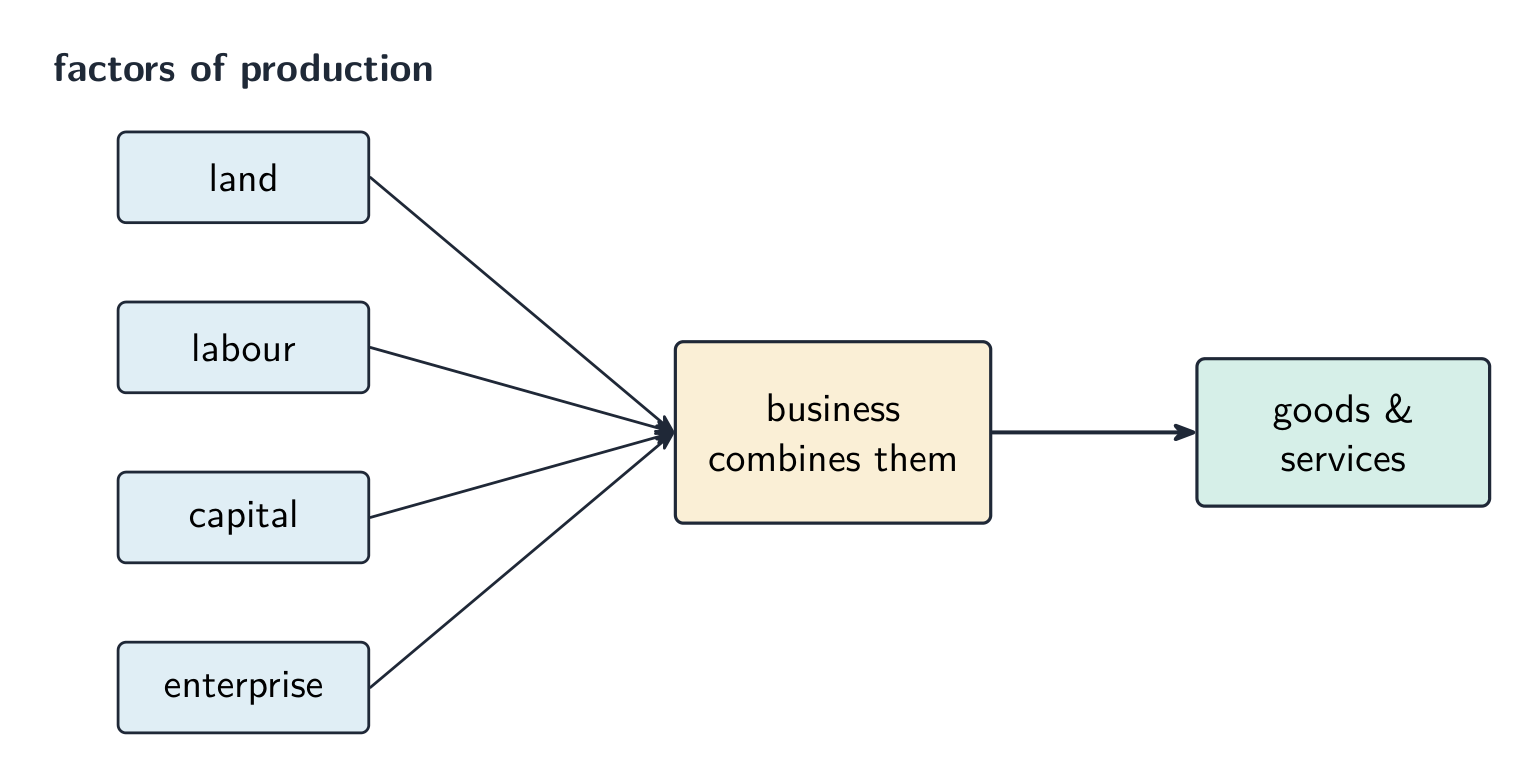
To do this, a business uses resources 资源. We sort resources into four factors of production 生产要素:
land 土地 — natural things, such as soil, water and minerals.
labour 劳动力 — the work done by people.
capital 资本 — the machines, tools, buildings and money used to produce.
enterprise 创业精神 — the skill of bringing the other three together and taking the risk 风险 to start a business.
Resources are scarce 稀缺 — there are not enough to meet everyone's wants. So every business must choose how to use them well.
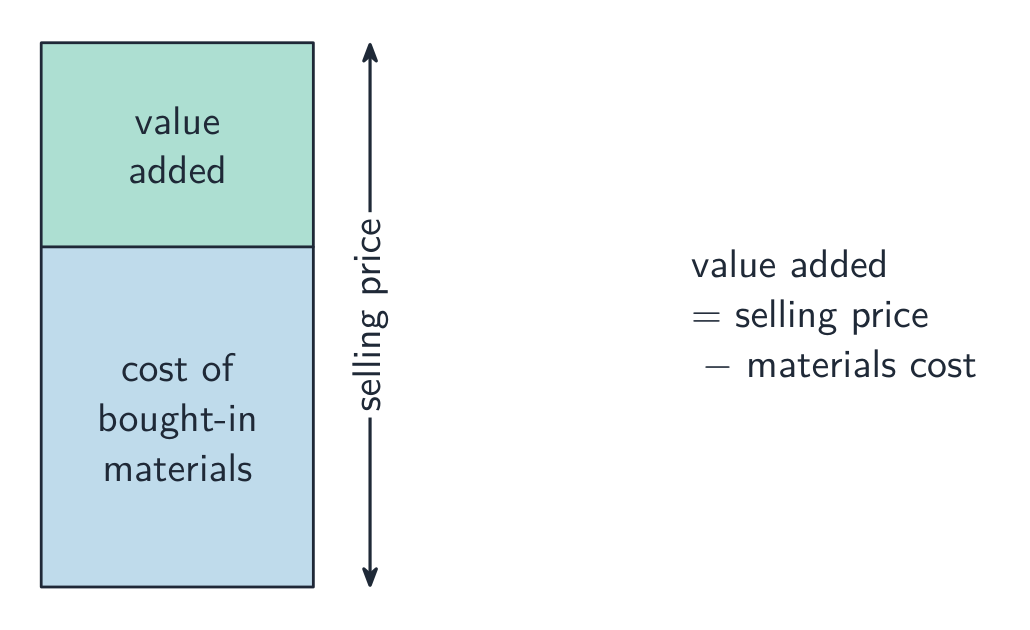
Adding value 增值 means the selling price of a product is higher than the cost of the inputs 投入 (the bought-in materials) used to make it.
$$\text{value added} = \text{selling price} - \text{cost of bought-in materials}$$
A business can add value by branding 品牌, better quality, good design, fast service, or convenience. More value added can mean more profit 利润, but only if costs stay under control.
日本語
付加価値とは、製品の販売価格が、製造に用いた投入品(購入材)の原価より高い状態を指す。
$$\text{value added} = \text{selling price} - \text{cost of bought-in materials}$$
Change the bought-in cost, the selling price and other costs to see exactly where value added — and profit — come from. · 仕入コスト、販売価格、その他のコストを変化させ、付加価値と利益の exact な源泉を特定せよ。
1.1
Entrepreneurs and intrapreneurs · エンタープライザーとイントラプレナー
English
An entrepreneur 企业家 is a person who takes the risk to set up and run a business. They have the idea, organise the factors of production, and make the decisions. If the business fails, they can lose their money.
An intrapreneur 内部创业者 is an employee inside a larger business who acts like an entrepreneur. They build new ideas, products or ways of working, using the company's resources.
Characteristics of successful entrepreneurs
Successful entrepreneurs are usually:
innovative 有创新精神的 — full of new ideas.
willing to take risks, but in a careful way.
hard-working and determined 有决心的 — they do not give up easily.
self-confident 自信的 and good at making decisions.
good leaders who can plan ahead and manage money.
Why enterprise matters to a country
When people start new businesses (business start-ups 初创企业), the whole country can gain:
new jobs are created, which lowers unemployment 失业.
more goods and services are made, which raises output 产出 (and the country's GDP 国内生产总值).
more competition 竞争, giving customers lower prices and more choice.
some firms grow and export 出口, bringing money into the country.
economic growth 经济增长 and a higher standard of living.
Source: Cambridge International syllabus · 出典: Cambridge International シラバス
English
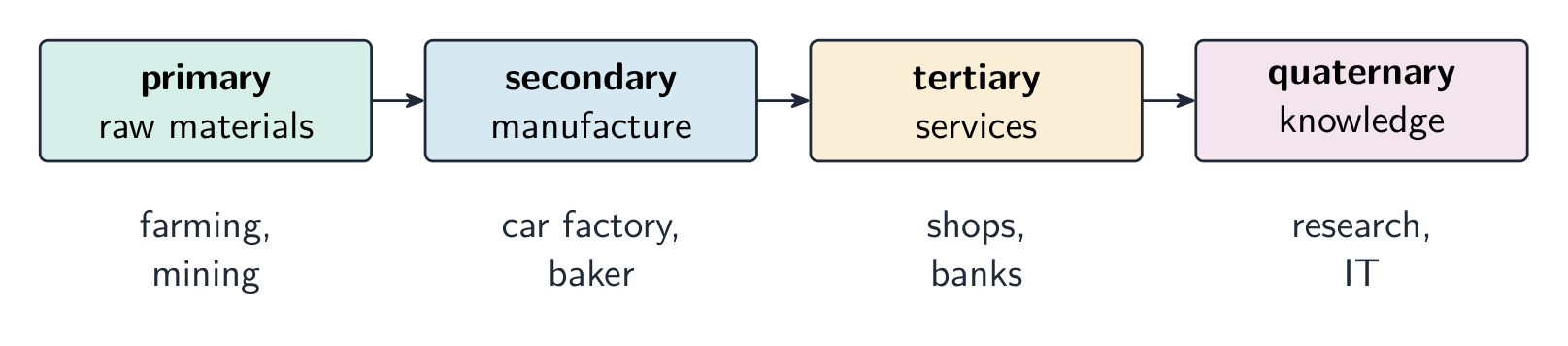
Every business works in one of four sectors:
Sector
What it does
Example
primary sector 第一产业
takes raw materials from nature
farming, mining, fishing
secondary sector 第二产业
makes (manufactures) goods
car factory, baker
tertiary sector 第三产业
provides services
shops, banks, transport
quaternary sector 第四产业
knowledge and information services
research, IT, consulting
Here raw materials 原材料 are the natural inputs a business starts with, and to manufacture 制造 means to make goods in large amounts. As a country develops, it usually moves from mostly primary work towards more tertiary and quaternary work.
The private sector 私营部门 is made up of businesses owned by private people. Their main aim is usually profit.
The public sector 公共部门 is made up of organisations owned by the government, such as state schools and public hospitals. Their aim is usually to provide a service, not to make profit.
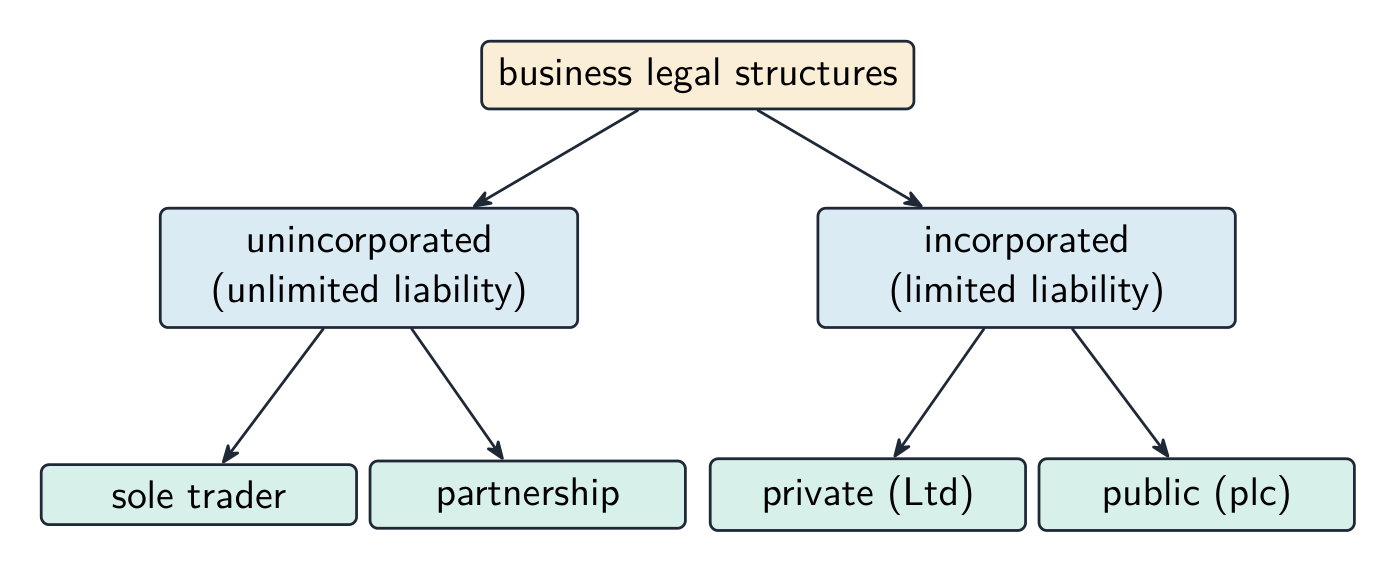
A business must choose a legal form. The main ones are below.
A sole trader 个体经营者 is owned by one person. It is easy to set up and the owner keeps all the profit, but raising money is hard.
A partnership 合伙企业 is owned by two or more partners who share the work and profit. They often sign a deed of partnership 合伙协议 that sets out each partner's share.
A private limited company 私人有限公司 (Ltd) sells shares 股份 to a small group, such as family and friends. Its owners are shareholders 股东. Its shares are not sold to the public.
A public limited company 上市公司 (plc) sells its shares to the public on the stock exchange 证券交易所. It can raise large amounts of money, but it must follow more rules and faces the risk of a takeover 收购.
A franchise 特许经营 lets one firm use another firm's brand and business model. The franchisor 特许方 owns the brand; the franchisee 加盟方 pays a fee and a royalty 提成 to run a branch.
A joint venture 合资企业 is when two businesses join to run one project and share the costs and risks.
A social enterprise 社会企业 trades like a normal business but aims to do social or environmental 环境 good, and reinvests most of its profit.
Liability 责任 means who must pay the business's debts 债务 if it cannot pay them itself.
limited liability 有限责任 — the owners can only lose the money they put in. Their personal things, like a house or car, are safe. Companies have limited liability.
unlimited liability 无限责任 — the owners are personally responsible for all the debts. They could lose personal things. Sole traders and most partnerships have unlimited liability.
A company is a separate legal identity 独立法人 — it can own things, owe money, and be taken to court in its own name, apart from its owners.
Source: Cambridge International syllabus · 出典: Cambridge International シラバス
English
Economies of scale: average cost falls
There is no single best way to measure how big a business is. Common measures are:
the number of employees 员工.
revenue 营业收入 (also called sales turnover) — the value of what it sells.
capital employed 所用资本 — the total money invested in the business.
market share 市场份额 — the firm's sales as a percentage of the whole market.
market capitalisation 市值 — the total value of a company's shares (for a plc).
Different measures can give different answers, so it is best to use more than one.
Why small businesses matter
Small businesses create jobs, serve local communities 社区, give personal service, react quickly to change, bring new ideas, and supply parts and services to large firms.
Internal growth 内部增长 (organic growth) — the business grows by itself: selling more, opening new branches, or adding new products. It is slower but lower risk.
External growth 外部增长 — the business joins with another firm. This is called integration 整合, and it happens by:
a merger 合并 — two firms agree to join together as one.
a takeover — one firm buys control of another.
There are three types of integration:
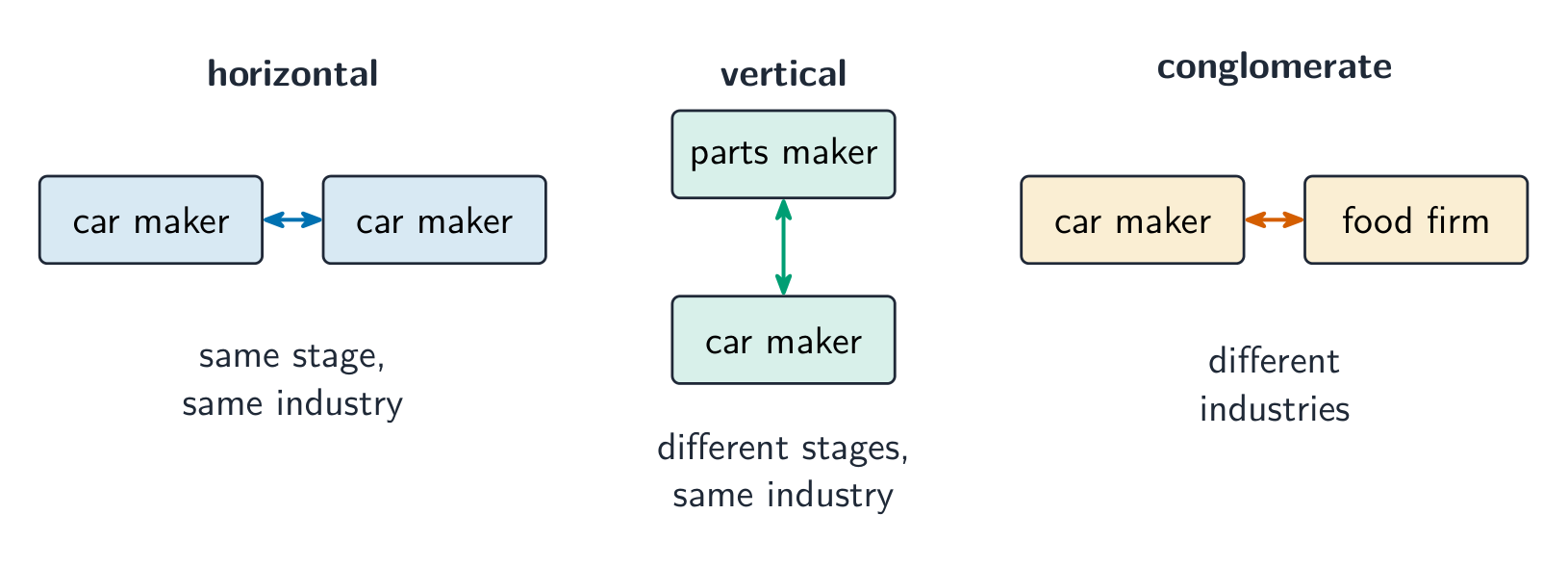
horizontal integration 横向整合 — joining a firm at the same stage in the same industry (e.g. two car makers).
vertical integration 纵向整合 — joining a firm at a different stage in the same industry. Forward integration 前向整合 is towards the customer (e.g. buying a shop); backward integration 后向整合 is towards the supplier (e.g. buying a parts maker).
conglomerate integration 混合整合 — joining a firm in a completely different industry. This spreads risk, which is called diversification 多元化.
Firms grow to lower their costs, win a bigger market share and more market power 市场支配力, raise profit, and spread risk. But growth also brings problems: higher average costs, harder management and communication, different company cultures 企业文化 that may clash, and a need for a lot of finance.
Economies of scale 规模经济 are the cost savings a business gets as it grows larger. The average cost 平均成本 of each unit falls as output rises. The main types are:
Type
How it lowers cost
purchasing
buying in bulk 大批量 earns discounts
technical
large machines are more efficient
financial
large firms borrow at lower interest 利息
managerial
the firm can employ expert specialist managers
marketing
advertising cost is spread over more units
Diseconomies of scale 规模不经济 happen when a firm grows too big and the average cost starts to rise again. The usual causes are:
communication 沟通 becomes slow and unclear.
the coordination 协调 of many departments is hard.
workers may feel unimportant and lose motivation 激励.
Worked example. A factory making 10,000 units has fixed costs of £200,000 and variable costs of £6 per unit. It expands to 50,000 units, and bulk buying cuts the variable cost to £5. Find the unit cost at each output and explain the fall. Unit cost = total cost ÷ output. At 10,000: total = 200,000 + (10,000 × 6) = £260,000, so the unit cost is 260,000 ÷ 10,000 = £26. At 50,000: total = 200,000 + (50,000 × 5) = £450,000, so the unit cost is 450,000 ÷ 50,000 = £9. Two economies of scale are at work: the fixed costs are spread over far more units (£20 down to £4 each), and purchasing economies cut the variable cost. Note that the fixed cost total does not change - only the fixed cost per unit falls. Writing "fixed costs fall" is the error that loses the mark.
Source: Cambridge International syllabus · 出典: Cambridge International シラバス
English
A mission statement 使命宣言 is a short sentence that says why the business exists and what it wants to be. It guides everyone in the firm.
From the mission come aims 目的 (broad, long-term goals), and then objectives 目标 (the specific targets that help reach the aims).
Good objectives are SMART — the first letters of:
Specific 具体的 — clear and exact.
Measurable 可衡量的 — you can check it with numbers.
Achievable 可实现的 — it is possible to reach.
Realistic 现实的 — sensible for the resources you have.
Time-bound 有时限的 — it has a deadline.
A strategy 战略 is the long-term plan to meet objectives. Tactics 策略 are the short-term actions that carry out the strategy. Objectives are shaped by the size and age of the firm, who owns it, the company culture, and conditions in the market.
staying in business, vital for new firms and in hard times
market share
winning a larger share of the market
social and ethical 道德 objectives
doing what is morally right, such as fair pay
Corporate social responsibility 企业社会责任 (CSR) is the idea that a business should act in the best interests of society and the environment, not just make profit. Examples are treating workers fairly, cutting pollution 污染, and helping the local community.
A firm's objectives can change over time. A new firm may aim to survive; later it may aim to grow; a large, safe firm may focus on profit or CSR.
Type to search notes, lessons, code, vocabulary and past-paper questions across every subject. · すべての科目でノートImplemented、Implemented、コード、語彙、過去問問題を検索するために入力してください。