Entrepreneurs, plans and sectors
Introduced| English | Meaning |
|---|---|
| going concern/ˈɡəʊɪŋ kənˈsɜːn/ | going concern |
| sector/ˈsektə/ | A distinct part of an economy, industry or organisation grouped by its activities or ownership. |
| business plan/ˈbɪznəs plæn/ | A document setting out a business's aims, activities, resources and expected financial position. |
| finances/faɪˈnænsɪz/ | finances |
| raising finance/ˈreɪzɪŋ ˈfaɪnæns/ | raising finance |
| investor/ɪnˈvestə/ | A person or organisation that commits resources with the expectation of a future return. |
| primary/ˈpraɪməri/ | The economic sector concerned with obtaining natural resources, such as farming, fishing and mining. |
| raw materials/rɔː məˈtɪərɪəlz/ | Basic substances used as inputs in making products. |
| secondary/ˈsekəndəri/ | The economic sector concerned with manufacturing, processing and construction. |
| manufacturing/ˌmænjuːˈfæktʃərɪŋ/ | The production of physical goods by processing materials or assembling components. |
| construction/kənˈstrʌkʃn/ | construction |
| tertiary/ˈtɜːʃjəri/ | The economic sector that provides services to consumers or other organisations. |
| retail/ˈriːteɪl/ | retail |
| forecast/ˈfɔːkɑːst/ | forecast |
From idea to going concern 持续经营
- A good idea is only the start. Turning it into a working business takes a plan — and a place in the wider economy.
- Every firm also sits in one of three sectors 部门 of production.
Classify business activity
Sort real firms by the sector they mainly belong to.
A key purpose of a business plan is to:
Difficulty 1/5 · 100 coins + a small bonus on first completion today
Lenders and investors expect a plan; it also clarifies the idea.
A document setting out a new business's idea, market and finances is a business ______.
Difficulty 1/5 · 100 coins + a small bonus on first completion today
The business plan is used to clarify the idea and raise finance.
The business plan 商业计划书
- A business plan sets out the idea, the market, the operations and the finances 财务.
- It helps the entrepreneur think it through and is essential for raising finance 融资 from banks or investors 投资者.
Match each sector to an example activity.
Difficulty 2/5 · 140 coins + a small bonus on first completion today
Primary extracts, secondary makes, tertiary serves.
A furniture factory operates in which sector?
Difficulty 1/5 · 100 coins + a small bonus on first completion today
Manufacturing is the secondary sector.
The three sectors
- Primary 第一产业: extracting raw materials 原材料 (farming, mining, fishing).
- Secondary 第二产业: making and building (manufacturing 制造业, construction 建筑业).
- Tertiary 第三产业: providing services (retail 零售, banking, transport).
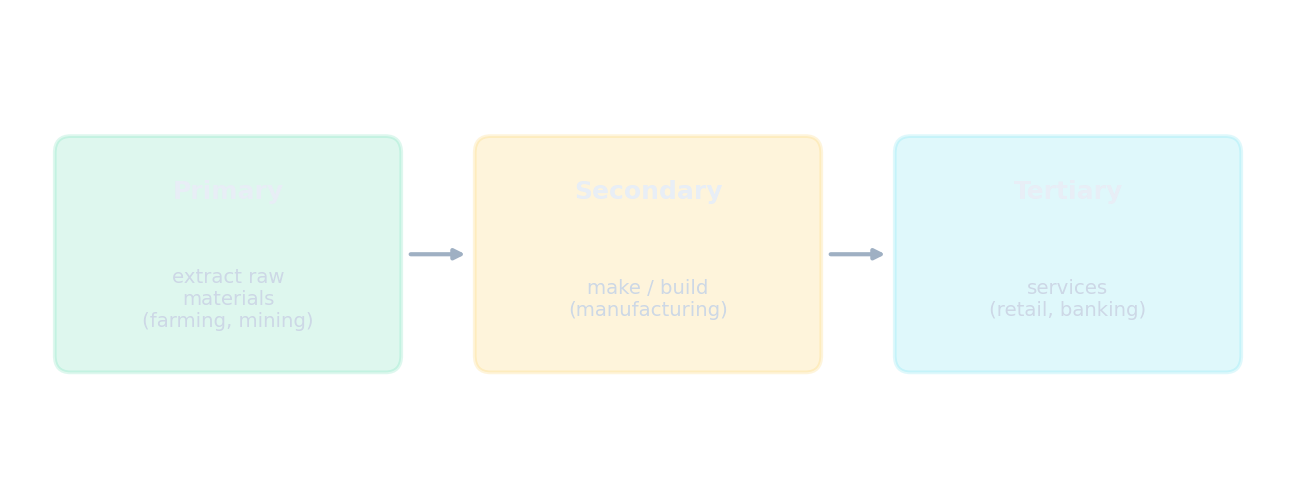
Raw materials (primary) are turned into goods (secondary) and sold as services (tertiary).
As an economy develops, employment tends to shift towards the:
Difficulty 1/5 · 100 coins + a small bonus on first completion today
Developed economies are service-dominated.
The changing balance of sectors
- As a country develops, employment shifts from primary → secondary → tertiary.
- Rich economies are dominated by the tertiary (service) sector.
A plan reduces risk, it doesn't remove it. Even a detailed business plan rests on forecasts 预测 that may be wrong. It improves the odds and persuades lenders, but the entrepreneur still bears real risk.
You've got it
- a business plan sets out the idea, market, operations and finances — vital to raise finance
- three sectors: primary (raw materials), secondary (make), tertiary (services)
- development shifts activity toward the tertiary sector
Write from 130 service workers
- A country has 200 workers.
- 20 work in farming, 50 make goods and the rest provide services.
- Say which sector has 130 workers.
Of 200 workers, 20 extract raw materials and 50 make goods. The rest provide services. How many work in the tertiary sector, and what does that label mean?
200 minus 70 is 130.
How many workers are in the tertiary sector?
Difficulty 1/5 · 100 coins + a small bonus on first completion today
Services are what remain after primary and secondary jobs. Other options — 50 (the workers who make goods); 20 (the workers who extract raw materials).