Berikut adalah kesalahan campur aduk yang paling umum dalam Biologi IGCSE. Respirasi bukanlah bernapas. Bernapas adalah gerakan udara masuk dan keluar paru-paru Anda — sebuah tindakan fisik…
English narration · English + 中文 subtitles burned in · Narasi bahasa Inggris · Subtitle bahasa Inggris + 中文 disematkan langsung
12.1
Respiration and energy · Respirasi dan energi
Syllabus · Silabus
English
Core
Supplement
1 State the uses of energy in living organisms, including: muscle contraction, protein synthesis, cell division, active transport, growth, the passage of nerve impulses and the maintenance of a constant body temperature
2 Investigate and describe the effect of temperature on respiration in yeast
Bahasa Indonesia
Inti
Tambahan
1 Nyatakan penggunaan energi pada organisme hidup, termasuk: kontraksi otot, sintesis protein, pembelahan sel, transpor aktif, pertumbuhan, perjalanan impuls saraf, dan pemeliharaan suhu tubuh yang konstan
2 Investigasi dan deskripsikan efek suhu terhadap respirasi pada ragi
Source: Cambridge International syllabus · Sumber: Silabus Cambridge International
English
Aerobic respiration
Respiration 呼吸作用 is the release of energy 能量 from food, and it happens in every living cell, all the time. (It is not the same as breathing.) Cells use this energy for many jobs:
muscle 肌肉 contraction (movement).
protein synthesis 蛋白质合成 (building proteins).
cell division 分裂 (making new cells).
active transport 主动运输.
growth.
the passage of nerve impulses 神经冲动.
keeping a constant body temperature 温度.
You can investigate respiration in yeast 酵母: warmer yeast respires faster (up to its best temperature), giving off bubbles of carbon dioxide 二氧化碳.
Bahasa Indonesia
Respirasi aerobik
Respirasi adalah pelepasan energi dari makanan, dan terjadi di setiap sel hidup, sepanjang waktu. (Ini bukan sama dengan bernapas.) Sel menggunakan energi ini untuk banyak tugas:
kontraksi otot (pergerakan).
sintesis protein (membangun protein).
pembelahan sel (membuat sel baru).
transportasi aktif.
pertumbuhan.
perjalanan impuls saraf.
menjaga suhu tubuh yang konstan.
Sel menggunakan energi dari respirasi untuk berbagai tugas yang berbeda
Anda dapat menyelidiki respirasi pada ragi: ragi yang lebih hangat bernapas lebih cepat (hingga suhu optimalnya), mengeluarkan gelembung karbon dioksida.
Explore · Jelajahi
Respiration releases energy · Respirasi melepaskan energi
Every living cell respires to release energy from glucose for its life processes. · Setiap sel hidup bernapas untuk melepaskan energi dari glukosa untuk proses kehidupannya.
1 Describe aerobic respiration as the chemical reactions in cells that use oxygen to break down nutrient molecules to release energy
2 State the word equation for aerobic respiration as: glucose + oxygen → carbon dioxide + water
3 State the balanced chemical equation for aerobic respiration as: $\text{C}_6\text{H}_{12}\text{O}_6 + 6\text{O}_2 \rightarrow 6\text{CO}_2 + 6\text{H}_2\text{O}$
Bahasa Indonesia
Inti
Tambahan
1 Deskripsikan respirasi aerobik sebagai reaksi kimia dalam sel yang menggunakan oksigen untuk memecah molekul nutrisi guna melepaskan energi
2 Nyatakan persamaan kata untuk respirasi aerobik sebagai: glukosa + oksigen → karbon dioksida + air
3 Nyatakan persamaan kimia setara untuk respirasi aerobik sebagai: $\text{C}_6\text{H}_{12}\text{O}_6 + 6\text{O}_2 \rightarrow 6\text{CO}_2 + 6\text{H}_2\text{O}$
Source: Cambridge International syllabus · Sumber: Silabus Cambridge International
English
Aerobic respiration 有氧呼吸 uses oxygen 氧气 to break down nutrient molecules 营养物质 (mainly glucose 葡萄糖) and release energy.
Respirasi aerobik melepaskan banyak energi dari setiap molekul glukosa.
Explore · Jelajahi
Aerobic respiration · Respirasi aerobik
Aerobic respiration releases a LOT of energy from glucose using oxygen. · Respirasi aerobik melepaskan BANYAK energi dari glukosa menggunakan oksigen.
1 Describe anaerobic respiration as the chemical reactions in cells that break down nutrient molecules to release energy without using oxygen
2 State that anaerobic respiration releases much less energy per glucose molecule than aerobic respiration
3 State the word equation for anaerobic respiration in yeast as: glucose → alcohol + carbon dioxide
5 State the balanced chemical equation for anaerobic respiration in yeast as: $\text{C}_6\text{H}_{12}\text{O}_6 \rightarrow 2\text{C}_2\text{H}_5\text{OH} + 2\text{CO}_2$
4 State the word equation for anaerobic respiration in muscles during vigorous exercise as: glucose → lactic acid
6 State that lactic acid builds up in muscles and blood during vigorous exercise causing an oxygen debt
7 Outline how the oxygen debt is removed after exercise, limited to: (a) continuation of fast heart rate to transport lactic acid in the blood from the muscles to the liver (b) continuation of deeper and faster breathing to supply oxygen for aerobic respiration of lactic acid (c) aerobic respiration of lactic acid in the liver
Bahasa Indonesia
Inti
Tambahan
1 Jelaskan respirasi anaerob sebagai reaksi kimia dalam sel yang menguraikan molekul nutrisi untuk melepaskan energi tanpa menggunakan oksigen
2 Nyatakan bahwa respirasi anaerob melepaskan jauh lebih sedikit energi per molekul glukosa dibandingkan respirasi aerob
3 Nyatakan persamaan kata untuk respirasi anaerob pada ragi sebagai: glukosa → alkohol + karbon dioksida
5 Nyatakan persamaan kimia setara untuk respirasi anaerob pada ragi sebagai: $\text{C}_6\text{H}_{12}\text{O}_6 \rightarrow 2\text{C}_2\text{H}_5\text{OH} + 2\text{CO}_2$
4 Nyatakan persamaan kata untuk respirasi anaerob pada otot selama olahraga berat sebagai: glukosa → asam laktat
6 Nyatakan bahwa asam laktat menumpuk di otot dan darah selama olahraga berat menyebabkan defisit oksigen
7 Uraikan bagaimana defisit oksigen dihilangkan setelah olahraga, terbatas pada: (a) kelanjutan detak jantung cepat untuk mengangkut asam laktat dalam darah dari otot ke hati (b) kelanjutan napas yang lebih dalam dan cepat untuk menyediakan oksigen bagi respirasi aerob asam laktat (c) respirasi aerob asam laktat di hati
Source: Cambridge International syllabus · Sumber: Silabus Cambridge International
English
Anaerobic respiration 无氧呼吸 breaks down glucose to release energy without oxygen. It releases much less energy from each glucose molecule than aerobic respiration, because the glucose is not fully broken down.
The alcohol 酒精 made by yeast is used to make bread rise and to brew drinks.
In muscles (Supplement)
During hard exercise your muscles cannot get enough oxygen, so they respire anaerobically:
$$\text{glucose} \rightarrow \text{lactic acid}$$
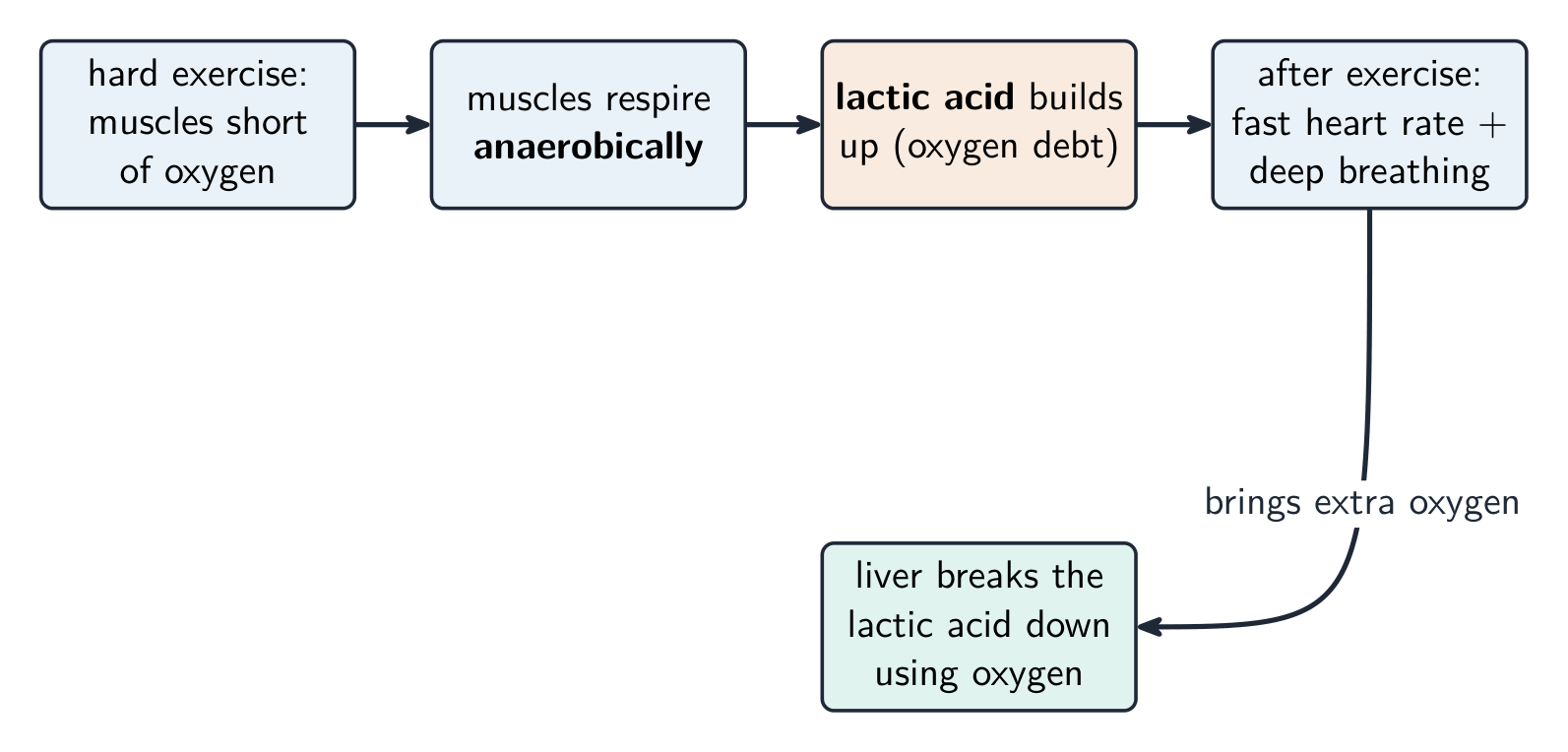
The lactic acid 乳酸 builds up in the muscles and the blood. This creates an oxygen debt 氧债 — the extra oxygen the body will need later to break that lactic acid down.
After you stop exercising, the oxygen debt is repaid:
your heart rate 心率 stays high, carrying the lactic acid in the blood from the muscles to the liver 肝脏.
you keep breathing deeply and quickly, taking in extra oxygen.
the liver uses this oxygen to break the lactic acid down by aerobic respiration.
Worked example. A runner sprints hard for 20 seconds, then breathes deeply for several minutes after stopping. Explain why. During the sprint the muscles cannot get oxygen fast enough, so they respire anaerobically and lactic acid builds up, creating an oxygen debt. The deep breathing afterwards takes in the extra oxygen the liver needs to break that lactic acid down by aerobic respiration, while a high heart rate carries the acid from the muscles to the liver. The breathing repays a debt built up during the sprint - it is not simply "because the muscles are still working".
Bahasa Indonesia
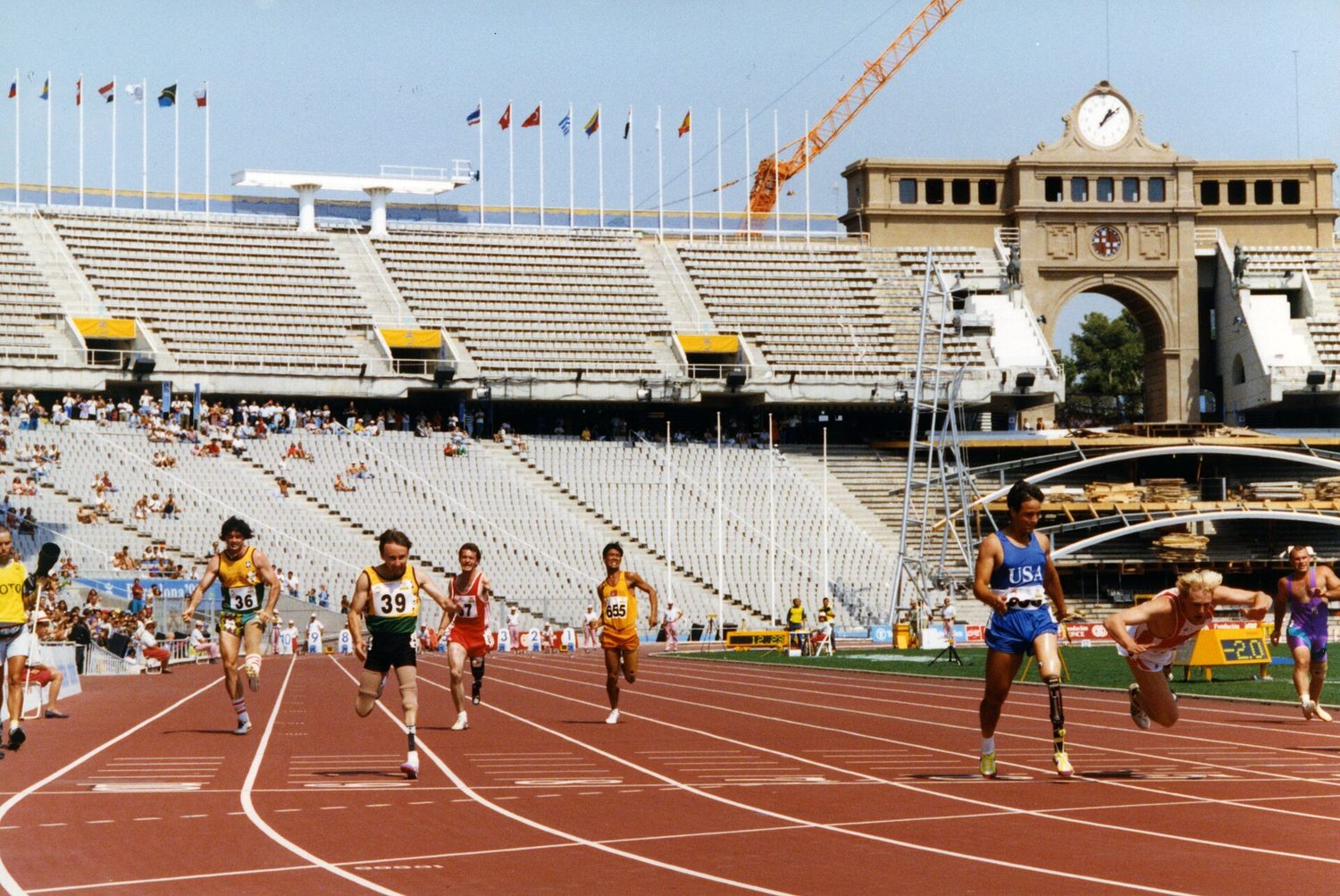
Sprint keras mengandalkan respirasi anaerobik, yang menumpuk asam laktat.
Respirasi anaerobik memecah glukosa untuk melepaskan energi tanpa oksigen. Ini melepaskan jauh lebih sedikit energi dari setiap molekul glukosa dibandingkan respirasi aerobik, karena glukosa tidak terurai sepenuhnya.
Respirasi aerob memerlukan oksigen dan menghasilkan banyak energi; anaerob menghasilkan jauh lebih sedikit
Alkohol yang dihasilkan oleh ragi digunakan untuk membuat roti mengembang dan untuk membuat minuman.
Pada otot (Suplemen)
Selama latihan berat, otot Anda tidak mendapatkan cukup oksigen, sehingga mereka bernapas secara anaerobik:
$$\text{glucose} \rightarrow \text{lactic acid}$$
Asam laktat menumpuk di otot dan darah. Hal ini menciptakan utang oksigen — oksigen ekstra yang diperlukan tubuh nanti untuk menguraikan asam laktat tersebut.
Setelah Anda berhenti berolahraga, utang oksigen dibayar:
detak jantung Anda tetap tinggi, membawa asam laktat dalam darah dari otot ke hati.
Anda terus bernapas dalam-dalam dan cepat, mengambil oksigen tambahan.
hati menggunakan oksigen ini untuk memecah asam laktat melalui respirasi aerobik.
Asam laktat dari respirasi anaerob diuraikan kemudian, menggunakan oksigen tambahan
Contoh terpecahkan. Seorang pelari berlari sprint dengan keras selama 20 detik, lalu bernapas dalam-dalam selama beberapa menit setelah berhenti. Jelaskan mengapa. Selama sprint, otot tidak mendapatkan oksigen dengan cukup cepat, sehingga mereka melakukan respirasi anaerobik dan asam laktat menumpuk, menciptakan utang oksigen. Napas dalam afterwards mengambil oksigen ekstra yang dibutuhkan hati untuk memecah asam laktat itu melalui respirasi aerobik, sementara detak jantung yang tinggi mengangkut asam tersebut dari otot ke hati. Napas tersebut membayar utang yang terbentuk selama sprint - bukan sekadar "karena otot masih bekerja".
Explore · Jelajahi
Anaerobic respiration · Respirasi anaerob
Without oxygen, glucose is only partly broken down — far less energy, and a different waste product. · Tanpa oksigen, glukosa hanya terurai sebagian — jauh lebih sedikit energi, dan produk limbah yang berbeda.
Pick one and the site follows you — notes, papers, videos and practice all open on it. · Pilih satu dan situs mengikuti Anda — catatan, kertas, video, dan latihan semua terbuka di sana.
Type to search notes, lessons, code, vocabulary and past-paper questions across every subject. · Ketik untuk mencari catatan, pelajaran, kode, kosakata, dan pertanyaan soal lama di setiap mata pelajaran.