Berikut adalah teka-teki yang menghancurkan fisika klasik. Arahkan lampu merah terkuat yang Anda temukan ke pelat logam. Tambahkan cahaya semakin banyak. Namun — tidak ada apa-apa…
English narration · English + 中文 subtitles burned in · Narasi bahasa Inggris · Subtitle bahasa Inggris + 中文 disematkan langsung
22.1
Photons: the particle nature of light · Foton: sifat partikel cahaya
Syllabus · Silabus
English
understand that electromagnetic radiation has a particulate nature
understand that a photon is a quantum of electromagnetic energy
recall and use $E = hf$
use the electronvolt (eV) as a unit of energy
understand that a photon has momentum and that the momentum is given by $p = E/c$
Bahasa Indonesia
pahami bahwa radiasi elektromagnetik memiliki sifat partikulat
pahami bahwa foton adalah kuantum energi elektromagnetik
ingat dan gunakan $E = hf$
gunakan elektronvolt (eV) sebagai satuan energi
pahami bahwa foton memiliki momentum dan momentum diberikan oleh $p = E/c$
Source: Cambridge International syllabus · Sumber: Silabus Cambridge International
English
Electromagnetic radiation behaves like particles as well as like a wave. The particles of EM radiation are photons 光子 — small packets ("quanta" 量子) of EM energy that travel at the speed of light.
"State what is meant by a photon" (two marks).A photon is a quantum (a discrete packet) of energy of electromagnetic radiation. Both halves score: quantum or packet (or "discrete amount"), and of electromagnetic radiation (or "of light"). "A particle of light" alone is not enough. That radiation comes in such packets is what the syllabus calls its particulate nature 粒子性: energy is delivered in lumps of $hf$, never in smaller pieces.
Energy of a photon
A photon of frequency 频率$f$ has energy
$$E = h f,$$
where $h = 6.63 \times 10^{-34}\ \text{J s}$ is the Planck constant 普朗克常量. Using $c = f\lambda$:
$$E = \frac{h c}{\lambda}.$$
Worked example. Find the energy of a photon of green light of wavelength $500\ \text{nm}$. ($h = 6.63 \times 10^{-34}\ \text{J s}$, $c = 3.0 \times 10^{8}\ \text{m s}^{-1}$.)
It is the kinetic energy 动能 an electron 电子 gains moving through a potential difference 电势差 of 1 V. For example, a visible photon ($\lambda \approx 500\ \text{nm}$) has energy $\approx 2.5\ \text{eV}$. To go eV → J multiply by $1.60 \times 10^{-19}$; J → eV divide.
Using the electronvolt. Photon energies, work functions and energy levels are all a few eV, so the exam quotes them that way and expects you to move between units without fuss: a $2.0\ \text{eV}$ work function is $2.0 \times 1.60 \times 10^{-19} = 3.2 \times 10^{-19}\ \text{J}$; a photon of $4.0 \times 10^{-19}\ \text{J}$ is $2.5\ \text{eV}$. A useful shortcut for wavelengths: $hc = 1.99 \times 10^{-25}\ \text{J m} = 1240\ \text{eV nm}$, so a $2.0\ \text{eV}$ photon has $\lambda = 1240/2.0 = 620\ \text{nm}$ (red) and a $400\ \text{nm}$ photon carries $3.1\ \text{eV}$.
Momentum of a photon
A photon also carries momentum 动量:
$$p = \frac{E}{c} = \frac{h}{\lambda}.$$
It has zero rest mass but a non-zero momentum $E/c$. Radiation pressure (photons pushing on a surface) follows from this.
"Show that $p = h/\lambda$." Start from the two photon relations: $E = hf$ and $p = E/c$. Then $p = hf/c$, and since $c = f\lambda$, $f/c = 1/\lambda$, so $p = h/\lambda$. Give both starting equations and the wave equation; the mark is for the chain, not the result.
Worked example. A photon in free space has momentum $9.5 \times 10^{-28}\ \text{N s}$. Show that it is a photon of red light.
$\lambda = h/p = 6.63 \times 10^{-34}/9.5 \times 10^{-28} = 7.0 \times 10^{-7}\ \text{m} = 700\ \text{nm}$, which lies at the red end of the visible spectrum ($400$–$700\ \text{nm}$). The energy is $pc = 2.9 \times 10^{-19}\ \text{J} = 1.8\ \text{eV}$.
Radiation pressure 辐射压. A beam of intensity $I$ (power per unit area) falling on area $A$ delivers $IA/(hf)$ photons per second, each with momentum $h/\lambda$. Force is the rate of change of momentum. On a mirror each photon bounces back, so its momentum changes by $2p$ and the force is $F = 2IA/c$ (pressure $2I/c$); on a black surface each photon is absorbed, the change is $p$, and the pressure is $I/c$. Two things follow, and both are examined: the pressure depends on the intensity, not on the colour, because blue light of the same intensity has fewer photons per second but each carries proportionally more momentum; and even sunlight ($I \approx 1\ \text{kW m}^{-2}$) exerts only a few micropascals.
Worked example. Red light of intensity $160\ \text{W m}^{-2}$ falls normally on a plane mirror; each photon has momentum $9.5 \times 10^{-28}\ \text{N s}$. Find the number of photons hitting $1.0\ \text{m}^{2}$ of the mirror per second, and the pressure on it.
Photon energy $E = pc = (9.5 \times 10^{-28})(3.00 \times 10^{8}) = 2.85 \times 10^{-19}\ \text{J}$. Photons per second on $1.0\ \text{m}^{2}$: $160/2.85 \times 10^{-19} = 5.6 \times 10^{20}\ \text{s}^{-1}$. Each is reflected, so the force is $F = 5.6 \times 10^{20} \times 2 \times 9.5 \times 10^{-28} = 1.1 \times 10^{-6}\ \text{N}$ on $1.0\ \text{m}^{2}$: a pressure of $1.1 \times 10^{-6}\ \text{Pa}$ (check: $2I/c = 320/3.00 \times 10^{8} = 1.1 \times 10^{-6}\ \text{Pa}$). Replace the beam with blue light of the same intensity and the pressure is unchanged.
Worked example. A laser emits $2.0\ \text{mW}$ of light of wavelength $650\ \text{nm}$. Find the number of photons it emits per second, and the force on a surface that absorbs the beam completely.
$E = hc/\lambda = (6.63 \times 10^{-34})(3.00 \times 10^{8})/(650 \times 10^{-9}) = 3.06 \times 10^{-19}\ \text{J}$, so the rate is $P/E = 2.0 \times 10^{-3}/3.06 \times 10^{-19} = 6.5 \times 10^{15}\ \text{s}^{-1}$. The force is the momentum delivered per second: $F = P/c = 2.0 \times 10^{-3}/3.00 \times 10^{8} = 6.7 \times 10^{-12}\ \text{N}$ (or $6.5 \times 10^{15} \times h/\lambda$, the same thing).
Bahasa Indonesia
Radiasi elektromagnetik berperilaku seperti partikel serta seperti gelombang. Partikel radiasi EM adalah foton — paket kecil ("kuanta") energi EM yang bergerak dengan kecepatan cahaya.
"Nyatakan arti foton" (dua nilai).Foton adalah kuantum (paket diskrit) energi radiasi elektromagnetik. Kedua bagian bernilai: kuantum atau paket (atau "jumlah diskrit"), dan radiasi elektromagnetik (atau "cahaya"). "Partikel cahaya" saja tidak cukup. Fakta bahwa radiasi datang dalam paket-paket inilah yang disebut kurikulum sebagai sifat partikulat: energivideo diberikan dalam gumpalan $hf$, tidak pernah dalam potongan yang lebih kecil.
Foton adalah paket energi, E = hf
Energi foton
Foton dengan frekuensi$f$ memiliki energi
$$E = h f,$$
di mana $h = 6.63 \times 10^{-34}\ \text{J s}$ adalah konstanta Planck. Menggunakan $c = f\lambda$:
$$E = \frac{h c}{\lambda}.$$
Contoh terpecahkan. Temukan energi foton cahaya hijau dengan panjang gelombang $500\ \text{nm}$. ($h = 6.63 \times 10^{-34}\ \text{J s}$, $c = 3.0 \times 10^{8}\ \text{m s}^{-1}$.)
Foton berfrekuensi lebih tinggi (panjang-gelombang lebih pendek) membawa energi lebih banyak: satu foton sinar-$\gamma$ membawa jauh lebih banyak daripada satu foton radio.
Elektronvolt
Elektronvolt (eV) adalah satuan energi yang berguna pada skala atom:
Ini adalah energi kinetik yang diperoleh elektron bergerak melalui beda potensial sebesar 1 V. Sebagai contoh, foton terlihat ($\lambda \approx 500\ \text{nm}$) memiliki energi $\approx 2.5\ \text{eV}$. Untuk mengubah eV → J kalikan dengan $1.60 \times 10^{-19}$; J → eV bagi.
Menggunakan elektronvolt. Energi foton, fungsi kerja, dan tingkat energi semuanya beberapa eV, sehingga ujian mengutipnya dengan cara tersebut dan mengharapkan Anda berpindah antar satuan tanpa ribet: fungsi kerja $2.0\ \text{eV}$ adalah $2.0 \times 1.60 \times 10^{-19} = 3.2 \times 10^{-19}\ \text{J}$; foton $4.0 \times 10^{-19}\ \text{J}$ adalah $2.5\ \text{eV}$. Singkatan berguna untuk panjang gelombang: $hc = 1.99 \times 10^{-25}\ \text{J m} = 1240\ \text{eV nm}$, sehingga foton $2.0\ \text{eV}$ memiliki $\lambda = 1240/2.0 = 620\ \text{nm}$ (merah) dan foton $400\ \text{nm}$ membawa $3.1\ \text{eV}$.
Momentum foton
Foton juga membawa momentum:
$$p = \frac{E}{c} = \frac{h}{\lambda}.$$
Memiliki massa diam nol namun momentum tak-nol $E/c$. Tekanan radiasi (foton mendorong permukaan) berasal dari hal ini.
"Buktikan bahwa $p = h/\lambda$." Mulai dari dua hubungan foton: $E = hf$ dan $p = E/c$. Kemudian $p = hf/c$, dan karena $c = f\lambda$, $f/c = 1/\lambda$, sehingga $p = h/\lambda$. Berikan kedua persamaan awal dan persamaan gelombang; poin diberikan untuk rantai penalaran, bukan hasilnya.
Contoh terpecahkan. Foton di ruang bebas memiliki momentum $9.5 \times 10^{-28}\ \text{N s}$. Tunjukkan bahwa itu adalah foton cahaya merah.
$\lambda = h/p = 6.63 \times 10^{-34}/9.5 \times 10^{-28} = 7.0 \times 10^{-7}\ \text{m} = 700\ \text{nm}$, yang terletak di ujung merah spektrum tampak ($400$–$700\ \text{nm}$). Energinya adalah $pc = 2.9 \times 10^{-19}\ \text{J} = 1.8\ \text{eV}$.
Tekanan radiasi: gaya sama dengan jumlah foton yang tiba per detik dikali perubahan momentum setiap foton; cermin menggandakan perubahan, penyerap tidak
Tekanan radiasi. Sinar dengan intensitas $I$ (daya per satuan luas) jatuh pada area $A$ mengirimkan $IA/(hf)$ foton per detik, masing-masing dengan momentum $h/\lambda$. Gaya adalah laju perubahan momentum. Pada cermin, setiap foton memantul balik, sehingga perubahan momennya adalah $2p$ dan gayanya adalah $F = 2IA/c$ (tekanan $2I/c$); pada permukaan hitam, setiap foton diserap, perubahannya $p$, dan tekanannya $I/c$. Dua hal mengikuti, dan keduanya diujikan: tekanan bergantung pada intensitas, bukan pada warna, karena cahaya biru dengan intensitas yang sama memiliki lebih sedikit foton per detik tetapi masing-masing membawa momentum proporsional lebih besar; dan bahkan sinar matahari ($I \approx 1\ \text{kW m}^{-2}$) hanya memberikan beberapa mikropascal.
Contoh terpecahkan. Cahaya merah dengan intensitas $160\ \text{W m}^{-2}$ jatuh tegak lurus pada cermin datar; setiap foton memiliki momentum $9.5 \times 10^{-28}\ \text{N s}$. Tentukan jumlah foton yang mengenai $1.0\ \text{m}^{2}$ cermin per detik, dan tekanannya.
Energi foton $E = pc = (9.5 \times 10^{-28})(3.00 \times 10^{8}) = 2.85 \times 10^{-19}\ \text{J}$. Foton per detik pada $1.0\ \text{m}^{2}$: $160/2.85 \times 10^{-19} = 5.6 \times 10^{20}\ \text{s}^{-1}$. Masing-masing dipantulkan, sehingga gayanya $F = 5.6 \times 10^{20} \times 2 \times 9.5 \times 10^{-28} = 1.1 \times 10^{-6}\ \text{N}$ pada $1.0\ \text{m}^{2}$: tekanan $1.1 \times 10^{-6}\ \text{Pa}$ (cek: $2I/c = 320/3.00 \times 10^{8} = 1.1 \times 10^{-6}\ \text{Pa}$). Ganti sinar dengan cahaya biru dengan intensitas yang sama dan tekanannya tidak berubah.
Contoh terpecahkan. Laser memancarkan $2.0\ \text{mW}$ cahaya dengan panjang gelombang $650\ \text{nm}$. Tentukan jumlah foton yang dipancarkan per detik, dan gaya pada permukaan yang menyerap sinar sepenuhnya.
$E = hc/\lambda = (6.63 \times 10^{-34})(3.00 \times 10^{8})/(650 \times 10^{-9}) = 3.06 \times 10^{-19}\ \text{J}$, sehingga lajunya $P/E = 2.0 \times 10^{-3}/3.06 \times 10^{-19} = 6.5 \times 10^{15}\ \text{s}^{-1}$. Gayanya adalah momentum yang disalurkan per detik: $F = P/c = 2.0 \times 10^{-3}/3.00 \times 10^{8} = 6.7 \times 10^{-12}\ \text{N}$ (atau $6.5 \times 10^{15} \times h/\lambda$, hal yang sama).
Explore · Jelajahi
Energy of a photon · Energi foton
E = h·f
Photon energy is proportional to frequency — the gradient is Planck's constant h. · Energi foton berbanding lurus dengan frekuensi — gradiennya adalah konstanta Planck h.
understand that photoelectrons may be emitted from a metal surface when it is illuminated by electromagnetic radiation
understand and use the terms threshold frequency and threshold wavelength
explain photoelectric emission in terms of photon energy and work function energy
recall and use $hf = \Phi + \frac{1}{2}m{v_{\text{max}}}^2$
explain why the maximum kinetic energy of photoelectrons is independent of intensity, whereas the photoelectric current is proportional to intensity
Bahasa Indonesia
memahami bahwa fotoelektron dapat dipancarkan dari permukaan logam ketika diterangi oleh radiasi elektromagnetik
memahami dan menggunakan istilah frekuensi ambang dan panjang gelombang ambang
menjelaskan emis fotoelektrik dalam hal energi foton dan energi fungsi kerja
mengingat dan menggunakan $hf = \Phi + \frac{1}{2}m{v_{\text{max}}}^2$
menjelaskan mengapa energi kinetik maksimum fotoelektron tidak bergantung pada intensitas, sedangkan arus fotoelektrik berbanding lurus dengan intensitas
Source: Cambridge International syllabus · Sumber: Silabus Cambridge International
English
The photoelectric effect, photon by photon
When EM radiation of high enough frequency hits a metal, electrons are emitted. These are photoelectrons 光电子, and the effect is the photoelectric effect 光电效应.
"State what is meant by the photoelectric effect."The emission of electrons from (the surface of) a metal when electromagnetic radiation of high enough frequency is incident on it. Two marks: emission of electrons and from a metal surface illuminated by electromagnetic radiation (or "when light is shone on it"). It is the syllabus's evidence for the particulate nature of radiation, because a wave could not explain what follows.
Threshold frequency and work function
Each metal has a lowest photon frequency, the threshold frequency 极限频率$f_{0}$, below which no electrons come out, however bright the light. The work function 逸出功$\Phi$ is the least energy needed to free an electron from the surface:
$$\Phi = h f_{0}.$$
Different metals have different work functions (about $2$–$5\ \text{eV}$).
The two-mark definitions.The work function energy of a metal is the minimum energy needed to remove an electron from the surface of the metal. Both "minimum" and "from the surface" carry marks: an electron deeper in the metal needs more, which is why the equation gives a maximum kinetic energy. The threshold frequency is the minimum frequency of radiation for which photoelectrons are emitted, and the threshold wavelength 极限波长$\lambda_{0} = c/f_{0} = hc/\Phi$ is the corresponding maximum wavelength: longer wavelengths do nothing.
Worked example. Light of wavelength $400\ \text{nm}$ falls on four metals whose work functions are: caesium $2.1\ \text{eV}$, sodium $2.3\ \text{eV}$, zinc $4.3\ \text{eV}$, platinum $5.6\ \text{eV}$. Which emit photoelectrons, and with what maximum kinetic energy?
The photon energy is $hc/\lambda = 1240/400 = 3.1\ \text{eV}$. Emission needs $hf \geq \Phi$, so caesium ($3.1 - 2.1 = 1.0\ \text{eV}$) and sodium ($0.8\ \text{eV}$) emit; zinc and platinum do not, however intense the light. To make zinc emit, the wavelength must fall below $\lambda_{0} = 1240/4.3 = 290\ \text{nm}$, in the ultraviolet, which is why the electroscope demonstration needs a UV lamp on zinc.
Worked example. A polished magnesium sheet in a vacuum emits electrons only when the ultraviolet frequency is at least $8.8 \times 10^{14}\ \text{Hz}$. It is illuminated at $1.2 \times 10^{15}\ \text{Hz}$. Find the work function and the maximum speed of the photoelectrons.
$\Phi = hf_{0} = (6.63 \times 10^{-34})(8.8 \times 10^{14}) = 5.8 \times 10^{-19}\ \text{J}$ ($3.6\ \text{eV}$). Then $\tfrac{1}{2}mv_{\text{max}}^{2} = h(f - f_{0}) = (6.63 \times 10^{-34})(1.2 \times 10^{15} - 8.8 \times 10^{14}) = 2.1 \times 10^{-19}\ \text{J}$, so $v_{\text{max}} = \sqrt{2 \times 2.1 \times 10^{-19}/9.11 \times 10^{-31}} = 6.8 \times 10^{5}\ \text{m s}^{-1}$. Subtract the frequencies before multiplying by $h$; rounding $hf$ and $\Phi$ separately loses a significant figure in the small difference.
Einstein's photoelectric equation
One photon gives all its energy to one electron. If the photon energy $hf$ is more than the work function, the electron escapes with kinetic energy up to a maximum:
$$h f = \Phi + \tfrac{1}{2} m v_{\text{max}}^{2}, \qquad\text{so}\qquad \tfrac{1}{2} m v_{\text{max}}^{2} = h(f - f_{0}).$$
Worked example. A metal has a work function of $2.0\ \text{eV}$. Light made of photons of energy $3.5\ \text{eV}$ shines on it. Find the maximum kinetic energy of the photoelectrons.
So the maximum KE of photoelectrons depends linearly on frequency, not on brightness.
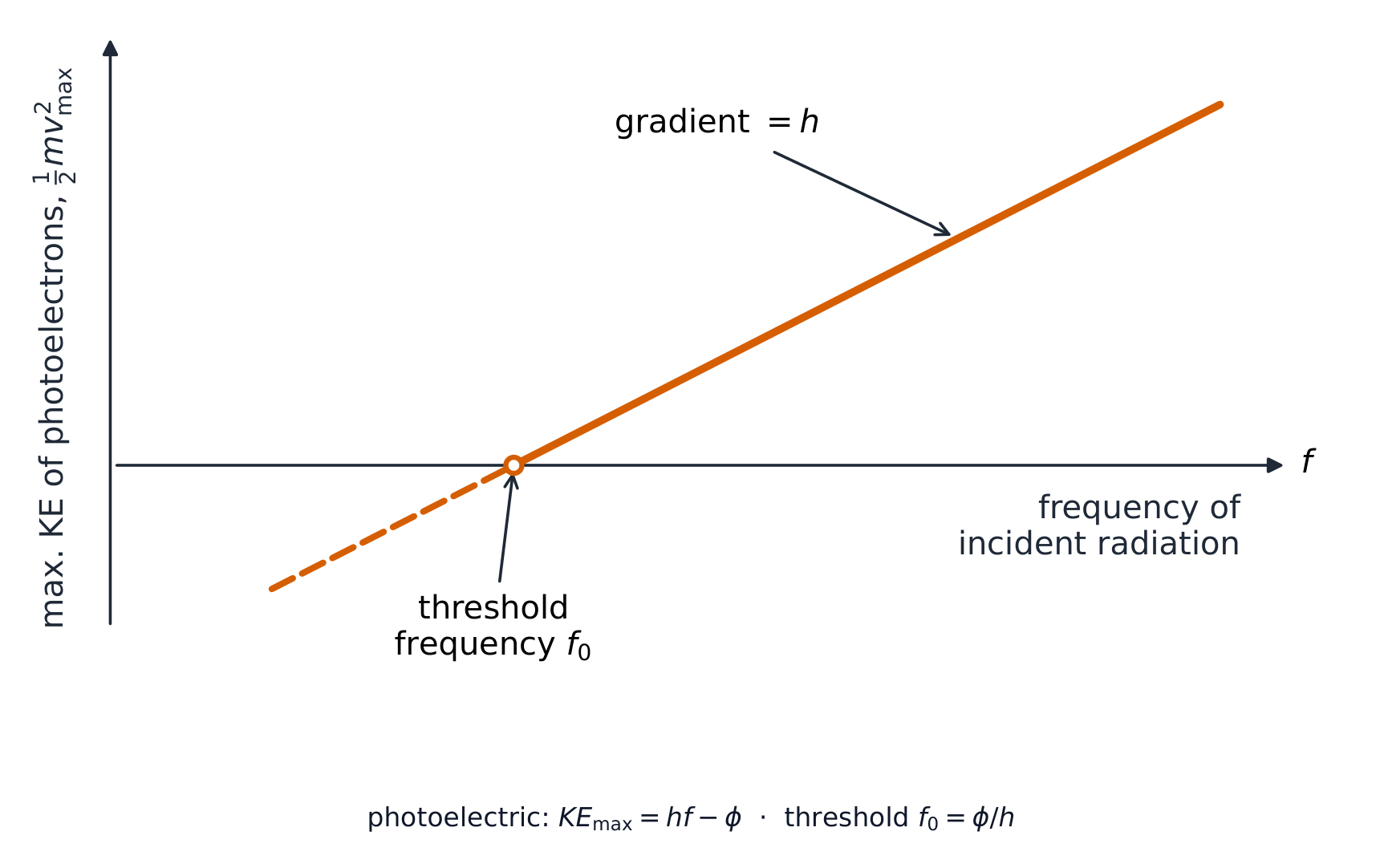
Reading the graph. Write the equation as $E_{\text{K,max}} = hf - \Phi$: a straight line of gradient $h$, intercept $-\Phi$ on the energy axis and $f_{0} = \Phi/h$ on the frequency axis. So a graph for two metals shows two parallel lines (same gradient $h$ for every metal), the metal with the larger work function cutting the frequency axis further to the right; the intensity of the light moves neither line. This is how the Planck constant is measured, and "sketch the line for metal Y" is marked on exactly those two features.
Measuring the maximum kinetic energy. In a photocell the photoelectrons cross a vacuum to a collector and the current is a count of electrons per second. Make the collector negative and the electrons must climb a potential hill; raise the reverse p.d. until the current just reaches zero, the stopping potential 遏止电势$V_{\text{s}}$, and then $eV_{\text{s}} = E_{\text{K,max}}$. Two results, both examined: at fixed frequency, doubling the intensity doubles the current at low reverse p.d. but leaves $V_{\text{s}}$ unchanged; raising the frequency raises $V_{\text{s}}$ but, at fixed intensity, does not raise the current.
Why the wave model fails
A wave model predicts that brightness should set the electrons' kinetic energy, and that emission should happen at any frequency given enough time. But experiments show:
no emission below the threshold frequency, however bright.
immediate emission at or above the threshold, even when dim.
maximum KE depends on frequency, not brightness.
the number of photoelectrons (the current) depends on brightness.
The photon model explains this: light arrives as photons each of energy $hf$. One photon–electron interaction either has enough energy to free the electron ($hf \geq \Phi$) or it does not.
Why max KE is fixed but current grows with brightness
A brighter beam of the same frequency has more photons per second, but each still carries $hf$. So the maximum KE of any electron is $hf - \Phi$ (set by $f$ only), while the rate of emission (the current) grows with the number of photons, i.e. with brightness. Doubling the brightness doubles the current but does not change the maximum KE.
Writing the explanation (a standard three-marker). (1) Each photon interacts with, and gives all its energy to, one electron. (2) The photon energy $hf$ depends only on the frequency, so the maximum energy an electron can leave with, $hf - \Phi$, is fixed by the frequency. (3) Increasing the intensity at the same frequency increases the number of photons per second, so more electrons are emitted per second (a larger current), but each still receives the same energy. A wave, by contrast, would spread its energy over the surface, so a brighter wave should have given faster electrons and a dim one should have needed a delay to accumulate energy; neither happens.
Bahasa Indonesia
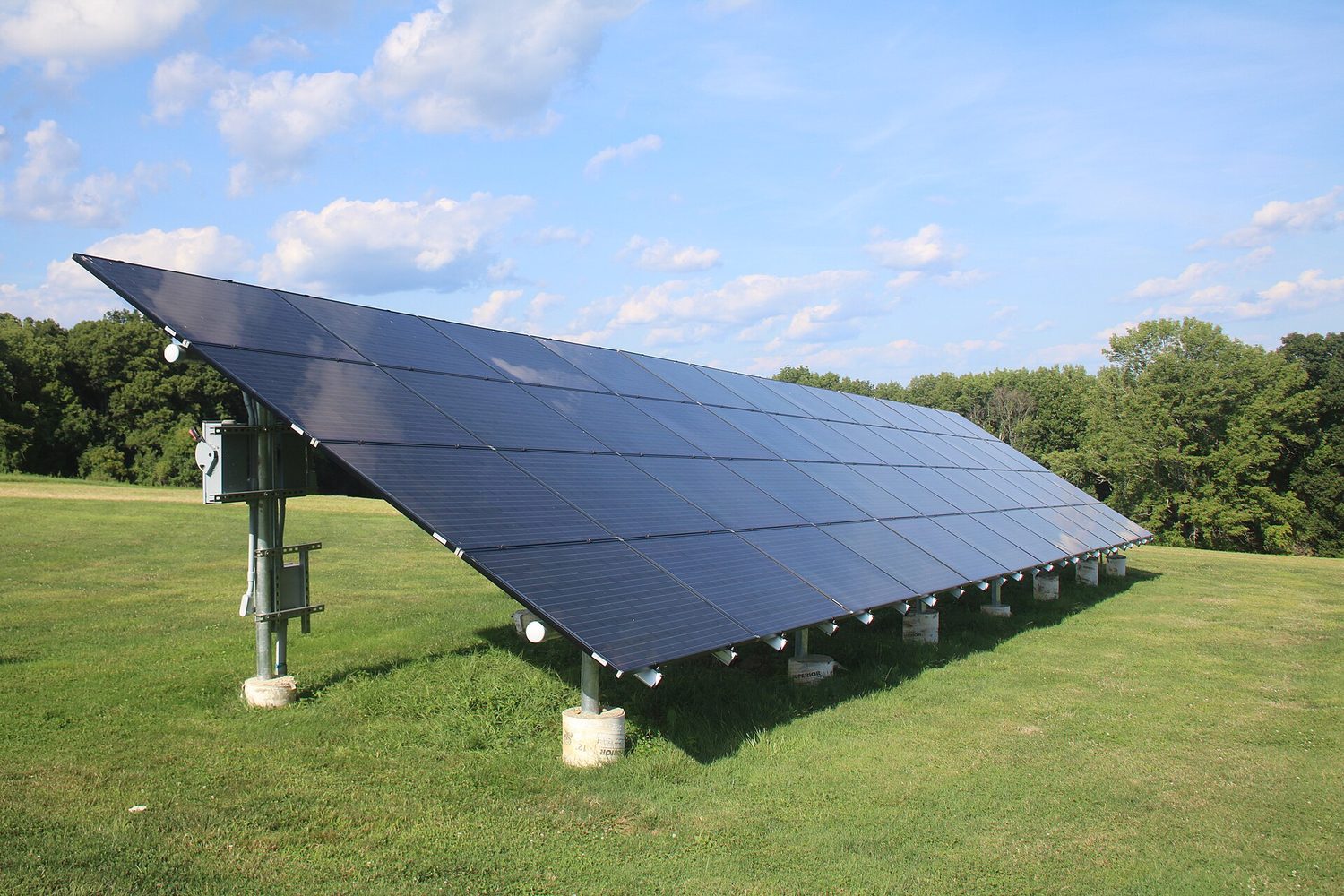
Efek fotolistrik, foton demi fotonSel surya menggunakan efek fotolistrik untuk mengubah cahaya menjadi listrik.
Ketika radiasi EM dengan frekuensi cukup tinggi mengenai logam, elektron dipancarkan. Ini disebut fotoelektron, dan fenomena ini adalah efek fotolistrik.
"Jelaskan makna efek fotolistrik."Pemancaran elektron dari (permukaan) logam ketika radiasi elektromagnetik dengan frekuensi cukup tinggi menyinari permukaannya. Dua nilai: pemancaran elektron dan dari permukaan logam yang diterangi radiasi elektromagnetik (atau "ketika cahaya diarahkan ke sana"). Ini merupakan bukti kurikulum tentang sifat partikel radiasi, karena gelombang tidak dapat menjelaskan apa yang terjadi selanjutnya.
Satu foton memberikan energinya $hf$ kepada satu elektron: sebagian membebaskannya (fungsi kerja $\Phi$), sisanya adalah KE elektronPelat seng bermuatan kehilangan muatannya — daun emas turun — ketika cahaya ultraviolet menyinari pelat tersebut
Frekuensi ambang dan fungsi kerja
Setiap logam memiliki frekuensi foton terendah, yaitu frekuensi ambang$f_{0}$, di bawahnya tidak ada elektron yang keluar, secerah apa pun cahayanya. Fungsi kerja$\Phi$ adalah energi terkecil yang diperlukan untuk membebaskan elektron dari permukaan:
$$\Phi = h f_{0}.$$
Logam berbeda memiliki fungsi kerja yang berbeda (sekitar $2$–$5\ \text{eV}$).
Definisi dua nilai.Fungsi kerja energi suatu logam adalah energi minimum yang diperlukan untuk melepaskan elektron dari permukaan logam tersebut. Kata "minimum" dan "dari permukaan" masing-masing bernilai poin: elektron yang berada lebih dalam dalam logam membutuhkan energi lebih banyak, itulah sebabnya persamaan tersebut menghasilkan energi kinetik maksimum. Frekuensi ambang adalah frekuensi minimum radiasi yang memancarkan fotoelektron, dan panjang gelombang ambang$\lambda_{0} = c/f_{0} = hc/\Phi$ adalah panjang gelombang maksimum yang sesuai: panjang gelombang lebih panjang tidak akan menghasilkan apa-apa.
Contoh terpecahkan. Cahaya dengan panjang gelombang $400\ \text{nm}$ mengenai empat logam dengan fungsi kerja sebagai berikut: caesium $2.1\ \text{eV}$, natrium $2.3\ \text{eV}$, seng $4.3\ \text{eV}$, platinum $5.6\ \text{eV}$. Manakah yang memancarkan fotoelektron, dan dengan energi kinetik maksimum berapa?
Energi foton adalah $hc/\lambda = 1240/400 = 3.1\ \text{eV}$. Emisi memerlukan $hf \geq \Phi$, sehingga sesium ($3.1 - 2.1 = 1.0\ \text{eV}$) dan natrium ($0.8\ \text{eV}$) memancarkan; seng dan platinum tidak, bagaimanapun intensitas cahayanya. Agar seng memancarkan, panjang gelombang harus turun di bawah $\lambda_{0} = 1240/4.3 = 290\ \text{nm}$, di daerah ultraviolet, itulah sebabnya demonstrasi elektroskop memerlukan lampu UV pada seng.
Contoh terpecahkan. Lembar magnesium dipoles dalam vakum memancarkan elektron hanya jika frekuensi ultraviolet setidaknya $8.8 \times 10^{14}\ \text{Hz}$. Lembar tersebut diterangi pada $1.2 \times 10^{15}\ \text{Hz}$. Tentukan fungsi kerja dan kecepatan maksimum fotoelektron.
$\Phi = hf_{0} = (6.63 \times 10^{-34})(8.8 \times 10^{14}) = 5.8 \times 10^{-19}\ \text{J}$ ($3.6\ \text{eV}$). Kemudian $\tfrac{1}{2}mv_{\text{max}}^{2} = h(f - f_{0}) = (6.63 \times 10^{-34})(1.2 \times 10^{15} - 8.8 \times 10^{14}) = 2.1 \times 10^{-19}\ \text{J}$, sehingga $v_{\text{max}} = \sqrt{2 \times 2.1 \times 10^{-19}/9.11 \times 10^{-31}} = 6.8 \times 10^{5}\ \text{m s}^{-1}$. Kurangkan frekuensinya sebelum mengalikannya dengan $h$; pembulatan $hf$ dan $\Phi$ secara terpisah akan menghilangkan satu angka penting dalam selisih kecil.
Persamaan fotolistrik Einstein
Satu foton memberikan seluruh energinya kepada satu elektron. Jika energi foton $hf$ lebih besar dari fungsi kerja, elektron akan melarikan diri dengan energi kinetik hingga mencapai nilai maksimum:
$$h f = \Phi + \tfrac{1}{2} m v_{\text{max}}^{2}, \qquad\text{so}\qquad \tfrac{1}{2} m v_{\text{max}}^{2} = h(f - f_{0}).$$
Contoh terpecahkan. Sebuah logam memiliki fungsi kerja $2.0\ \text{eV}$. Cahaya yang terdiri dari foton dengan energi $3.5\ \text{eV}$ menyinari logam tersebut. Tentukan energi kinetik maksimum fotoelektron.
Sehingga KE maksimum fotoelektron bergantung secara linear pada frekuensi, bukan pada kecerahan.
Energi kinetik maksimum fotoelektron meningkat secara linear dengan frekuensi, mencapai nol pada frekuensi ambang $f_0$Dua logam dalam satu grafik: garis sejajar (gradiennya adalah konstanta Planck untuk keduanya), masing-masing memotong sumbu frekuensi pada ambangnya sendiri dan sumbu energi pada minus fungsi kerjanya sendiri
Membaca grafik. Tulis persamaan sebagai $E_{\text{K,max}} = hf - \Phi$: sebuah garis lurus dengan gradien $h$, intersep $-\Phi$ pada sumbu energi dan $f_{0} = \Phi/h$ pada sumbu frekuensi. Jadi grafik untuk dua logam menunjukkan dua garis sejajar (gradien sama $h$ untuk setiap logam), logam dengan fungsi kerja lebih besar memotong sumbu frekuensi lebih jauh ke kanan; intensitas cahaya tidak menggeser salah satu garis pun. Inilah cara konstanta Planck diukur, dan "sketsa garis untuk logam Y" dinilai tepat pada dua fitur tersebut.
*Menyelidiki efek: arus mengukur laju emisi, dan tegangan balik yang tepat menghentikan elektron tercepat mengukur energi kinetik maksimum mereka
Mengukur energi kinetik maksimum. Dalam sel foto, fotoelektron melintasi vakum menuju pengumpul dan arus adalah jumlah elektron per detik. Buatlah pengumpul negatif dan elektron harus menaiki bukit potensial; naikkan tegangan balik hingga arus tepat mencapai nol, potensial penghentian$V_{\text{s}}$, dan kemudian $eV_{\text{s}} = E_{\text{K,max}}$. Dua hasil, keduanya ditinjau: pada frekuensi tetap, menggandakan intensitas menggandakan arus pada tegangan balik rendah tetapi tidak mengubah $V_{\text{s}}$; menaikkan frekuensi menaikkan $V_{\text{s}}$ tetapi, pada intensitas tetap, tidak menaikkan arus.
Mengapa model gelombang gagal
Model gelombang memprediksi bahwa kecerahan seharusnya menentukan energi kinetik elektron, dan emisi harus terjadi pada frekuensi apa pun jika waktunya cukup. Namun eksperimen menunjukkan:
tidak ada emisi di bawah frekuensi ambang, semahir apa pun.
emisi segera pada atau di atas ambang, bahkan saat redup.
KE maksimum bergantung pada frekuensi, bukan kecerahan.
jumlah fotoelektron (arus) bergantung pada kecerahan.
Model foton menjelaskan hal ini: cahaya datang sebagai foton-foton, masing-masing berenergi $hf$. Satu interaksi foton–elektron memiliki cukup energi untuk melepaskan elektron ($hf \geq \Phi$) atau tidak.
Mengapa KE max tetap tapi arus bertambah dengan kecerahan
Sinar yang lebih terang dari frekuensi yang sama memiliki lebih banyak foton per detik, tetapi masing-masing tetap membawa $hf$. Jadi energi kinetik maksimum setiap elektron adalah $hf - \Phi$ (ditentukan hanya oleh $f$), sementara laju emisi (arus) bertambah seiring jumlah foton, yaitu sebanding dengan kecerahan. Menggandakan kecerahan menggandakan arus tetapi tidak mengubah KE maksimum.
Menulis penjelasan (standar tiga penanda). (1) Setiap foton berinteraksi dengan, dan memberikan seluruh energinya kepada, satu elektron. (2) Energi foton $hf$ hanya bergantung pada frekuensi, sehingga energi maksimum yang dapat dibawa elektron keluar, $hf - \Phi$, ditetapkan oleh frekuensi. (3) Meningkatkan intensitas pada frekuensi yang sama meningkatkan jumlah foton per detik, sehingga lebih banyak elektron teremisikan per detik (arus lebih besar), tetapi masing-masing masih menerima energi yang sama. Sebaliknya, gelombang akan menyebarkan energinya di permukaan, sehingga gelombang yang lebih terang seharusnya menghasilkan elektron lebih cepat dan gelombang redup seharusnya membutuhkan penundaan untuk mengumpulkan energi; kedua hal itu tidak terjadi.
Explore · Jelajahi
The photoelectric effect · Efek fotolistrik
KEmax = h·f − φ
Max KE is a straight line in frequency, with intercept −φ (the work function). · KE maksimum adalah garis lurus terhadap frekuensi, dengan intersep −φ (fungsi kerja).
understand that the photoelectric effect provides evidence for a particulate nature of electromagnetic radiation while phenomena such as interference and diffraction provide evidence for a wave nature
describe and interpret qualitatively the evidence provided by electron diffraction for the wave nature of particles
understand the de Broglie wavelength as the wavelength associated with a moving particle
recall and use $\lambda = h/p$
Bahasa Indonesia
memahami bahwa efek fotoelektrik memberikan bukti akan sifat partikel radiasi elektromagnetik, sementara fenomena seperti interferensi dan difraksi memberikan bukti akan sifat gelombang
menggambarkan dan menafsirkan secara kualitatif bukti yang diberikan oleh difraksi elektron untuk sifat gelombang partikel
memahami panjang gelombang de Broglie sebagai panjang gelombang yang terkait dengan partikel yang bergerak
mengingat dan menggunakan $\lambda = h/p$
Source: Cambridge International syllabus · Sumber: Silabus Cambridge International
English
The photoelectric effect is strong evidence for the particle nature of light. But interference 干涉 (Young's double slit, the diffraction grating 衍射光栅) and diffraction 衍射 show its wave nature. So light has both wave and particle sides — this is wave–particle duality 波粒二象性.
"Describe what is meant by wave–particle duality" (two marks).Electromagnetic radiation (and matter) can exhibit both wave properties, such as interference and diffraction, and particle properties, such as the photoelectric effect (or, for matter, discrete collisions). Asked for one piece of evidence for each nature of radiation, give: particulate, the photoelectric effect (the threshold frequency and the immediate emission); wave, diffraction or interference (Young's slits, a diffraction grating). For matter, the wave evidence is electron diffraction.
De Broglie hypothesis
If a wave can act like particles, perhaps particles can act like waves. De Broglie proposed that any moving particle has a de Broglie wavelength 德布罗意波长:
$$\lambda = \frac{h}{p},$$
where $p = mv$. Example: an electron at $v = 4.9 \times 10^{7}\ \text{m s}^{-1}$ has $p = 4.46 \times 10^{-23}\ \text{kg m s}^{-1}$, so $\lambda = 1.49 \times 10^{-11}\ \text{m} \approx 0.015\ \text{nm}$ — close to atomic spacings.
"State what is meant by the de Broglie wavelength."The wavelength associated with a moving particle, or the wavelength of the wave associated with a particle of momentum $p$, given by $\lambda = h/p$ where $h$ is the Planck constant. In "state the formula and the meaning of any other symbol", name $h$ as the Planck constant and $p$ as the momentum of the particle. The wavelength is small because $h$ is small: a $0.10\ \text{kg}$ ball at $10\ \text{m s}^{-1}$ has $\lambda = 6.6 \times 10^{-34}\ \text{m}$, far below any slit or lattice spacing, which is why everyday objects show no diffraction.
Electron diffraction
When electrons are fired at a crystal lattice 晶格 (e.g. thin graphite), they make a diffraction pattern of bright rings on a screen — exactly what waves of wavelength $\lambda = h/p$ would do. This is direct evidence for the wave nature of particles (electron diffraction 电子衍射): only waves diffract, yet electrons do.
A faster electron has more momentum, so a shorter de Broglie wavelength, which diffracts less — the rings move closer together. Slowing the electrons spreads the rings apart. To calculate: $p = \sqrt{2 m E_{\text{K}}}$, and for an electron accelerated through p.d. $V$, $E_{\text{K}} = eV$, so $\lambda = h/\sqrt{2m_{e} e V}$.
Worked example. An electron is accelerated from rest through a p.d. of $2500\ \text{V}$. Find its de Broglie wavelength. ($m_{e} = 9.11 \times 10^{-31}\ \text{kg}$, $e = 1.6 \times 10^{-19}\ \text{C}$, $h = 6.63 \times 10^{-34}\ \text{J s}$.)
Its kinetic energy is $E_{\text{K}} = eV$, so $\lambda = \dfrac{h}{\sqrt{2 m_{e} e V}}$:
This is close to the spacing between atoms in a crystal, which is why the electrons diffract off the graphite.
Deriving $\lambda$ for an accelerated electron. An electron of mass $m$ and charge $q$ accelerated from rest through a p.d. $V$ gains kinetic energy $qV = \tfrac{1}{2}mv^{2}$, so $v = \sqrt{2qV/m}$ and $p = mv = \sqrt{2mqV}$; hence $\lambda = h/\sqrt{2mqV}$. Two consequences the exam asks for: increasing$V$ increases the momentum and shortens the wavelength, so the diffraction rings shrink towards the centre; halving the wavelength needs four times the p.d.
Describing electron diffraction (four marks). (1) Electrons from a heated filament are accelerated through a high p.d. into a beam. (2) The beam meets a thin polycrystalline 多晶的 graphite film; the regular spacing of the carbon atoms, about $10^{-10}\ \text{m}$, acts as a diffraction grating. (3) On a fluorescent screen the electrons produce a bright central spot surrounded by concentric rings. (4) Rings are a diffraction pattern, and diffraction is a wave property, so the electrons are behaving as waves; the ring radii match a wavelength $h/p$, which confirms de Broglie's relation. Sketch the pattern as rings, not spots or a fringe pattern. A faster beam gives rings of smaller radius.
Bahasa Indonesia
Efek fotolistrik adalah bukti kuat sifat partikel cahaya. Tetapi interferensi (celah ganda Young, kisi difraksi) dan difraksi menunjukkan sifat gelombang-nya. Jadi cahaya memiliki kedua sisi gelombang dan partikel — ini disebut dualisme gelombang–partikel.
"Jelaskan yang dimaksud dengan dualisme gelombang–partikel" (dua nilai).Radiasi elektromagnetik (dan materi) dapat menunjukkan sifat-sifat gelombang, seperti interferensi dan difraksi, serta sifat partikel, seperti efek fotolistrik (atau, untuk materi, tumbukan diskrit). Diminta satu bukti untuk setiap sifat radiasi, berikan: partikel, efek fotolistrik (frekuensi ambang dan emisi segera); gelombang, difraksi atau interferensi (celah Young, kisi difraksi). Untuk materi, bukti gelombangnya adalah difraksi elektron.
Hipotesis de Broglie
Jika gelombang bisa bertindak seperti partikel, mungkin partikel bisa bertindak seperti gelombang. De Broglie mengusulkan bahwa setiap partikel bergerak memiliki panjang gelombang de Broglie:
$$\lambda = \frac{h}{p},$$
di mana $p = mv$. Contoh: elektron pada $v = 4.9 \times 10^{7}\ \text{m s}^{-1}$ memiliki $p = 4.46 \times 10^{-23}\ \text{kg m s}^{-1}$, sehingga $\lambda = 1.49 \times 10^{-11}\ \text{m} \approx 0.015\ \text{nm}$ — mendekati jarak antaratom.
"Nyatakan yang dimaksud dengan panjang gelombang de Broglie."Panjang gelombang yang terkait dengan partikel bergerak, atau panjang gelombang dari gelombang yang terkait dengan partikel bermomentum $p$, diberikan oleh $\lambda = h/p$ di mana $h$ adalah konstanta Planck. Dalam "nyatakan rumus dan arti simbol lainnya", sebut $h$ sebagai konstanta Planck dan $p$ sebagai momentum partikel. Panjang gelombangnya kecil karena $h$ kecil: bola $0.10\ \text{kg}$ pada $10\ \text{m s}^{-1}$ memiliki $\lambda = 6.6 \times 10^{-34}\ \text{m}$, jauh di bawah celah atau jarak kisi manapun, itulah sebabnya benda sehari-hari tidak menunjukkan difraksi.
Difraksi elektron
Ketika elektron ditembakkan ke sebuah kisi kristal (misalnya grafit tipis), mereka menghasilkan pola difraksi berupa cincin-cincin terang pada layar — persis seperti yang akan dilakukan gelombang dengan panjang gelombang $\lambda = h/p$. Ini adalah bukti langsung dari sifat gelombang partikel (difraksi elektron): hanya gelombang yang mengalami difraksi, namun elektron juga melakukannya.
Elektron yang lebih cepat memiliki momentum lebih besar, sehingga panjang gelombang de Broglie yang lebih pendek, yang menyebabkan difraksi kurang — cincin-cincin tersebut bergerak lebih dekat satu sama lain. Memperlambat elektron menyebarkan cincin-cincin tersebut menjauh. Untuk menghitung: $p = \sqrt{2 m E_{\text{K}}}$, dan untuk elektron yang dipercepat melalui beda potensial p.d. $V$, $E_{\text{K}} = eV$, sehingga $\lambda = h/\sqrt{2m_{e} e V}$.
Elektron yang ditembakkan ke grafit membentuk pola difraksi cincin — hanya gelombang yang mengalami difraksi, jadi elektron berperilaku sebagai gelombang
Contoh terpecahkan. Sebuah elektron dipercepat dari keadaan diam melalui beda potensial sebesar $2500\ \text{V}$. Tentukan panjang gelombang de Broglinya. ($m_{e} = 9.11 \times 10^{-31}\ \text{kg}$, $e = 1.6 \times 10^{-19}\ \text{C}$, $h = 6.63 \times 10^{-34}\ \text{J s}$.)
Energi kinetiknya adalah $E_{\text{K}} = eV$, sehingga $\lambda = \dfrac{h}{\sqrt{2 m_{e} e V}}$:
Nilai ini mendekati jarak antar atom dalam sebuah kristal, itulah sebabnya elektron mengalami difraksi oleh grafit.
Menurunkan $\lambda$ untuk elektron yang dipercepat. Elektron bermassa $m$ dan muatan $q$ yang dipercepat dari keadaan diam melalui beda potensial $V$ memperoleh energi kinetik $qV = \tfrac{1}{2}mv^{2}$, sehingga $v = \sqrt{2qV/m}$ dan $p = mv = \sqrt{2mqV}$; oleh karena itu $\lambda = h/\sqrt{2mqV}$. Dua konsekuensi yang diminta dalam ujian: meningkatkan$V$ meningkatkan momentum dan memperpendek panjang gelombang, sehingga cincin difraksi menyusut menuju pusat; memperparah panjang gelombang membutuhkan empat kali beda potensial.
Mendeskripsikan difraksi elektron (empat nilai). (1) Elektron dari filamen yang dipanaskan dipercepat melalui beda potensial tinggi menjadi sebuah sinar. (2) Sinar tersebut mengenai film grafit polikristalin yang tipis; jarak teratur atom karbon, sekitar $10^{-10}\ \text{m}$, bertindak sebagai kisi difraksi. (3) Pada layar fosfor, elektron menghasilkan titik terang di tengah yang dikelilingi oleh cincin konsentris. (4) Cincin merupakan pola difraksi, dan difraksi adalah sifat gelombang, sehingga elektron berperilaku sebagai gelombang; jari-jari cincin sesuai dengan panjang gelombang $h/p$, yang mengonfirmasi hubungan de Broglie. Gambarlah pola tersebut sebagai cincin, bukan titik atau pola interferensi. Sinar yang lebih cepat menghasilkan cincin dengan jari-jari yang lebih kecil.
Explore · Jelajahi
The de Broglie wavelength · Panjang gelombang de Broglie
λ = h/p
A particle's wavelength is inversely proportional to its momentum — faster, heavier particles have shorter waves. · Panjang gelombang partikel berbanding terbalik dengan momentumnya—partikel yang lebih cepat dan berat memiliki gelombang yang lebih pendek.
Energy levels in atoms · Tingkat energi dalam atom
Syllabus · Silabus
English
understand that there are discrete electron energy levels in isolated atoms (e.g. atomic hydrogen)
understand the appearance and formation of emission and absorption line spectra
recall and use $hf = E_1 - E_2$
Bahasa Indonesia
memahami bahwa terdapat tingkat energi elektron diskrit dalam atom terisolasi (misalnya hidrogen atom)
memahami tampilan dan pembentukan spektra garis emisi dan spektra garis absorpsi
ingat dan gunakan $hf = E_1 - E_2$
Source: Cambridge International syllabus · Sumber: Silabus Cambridge International
English
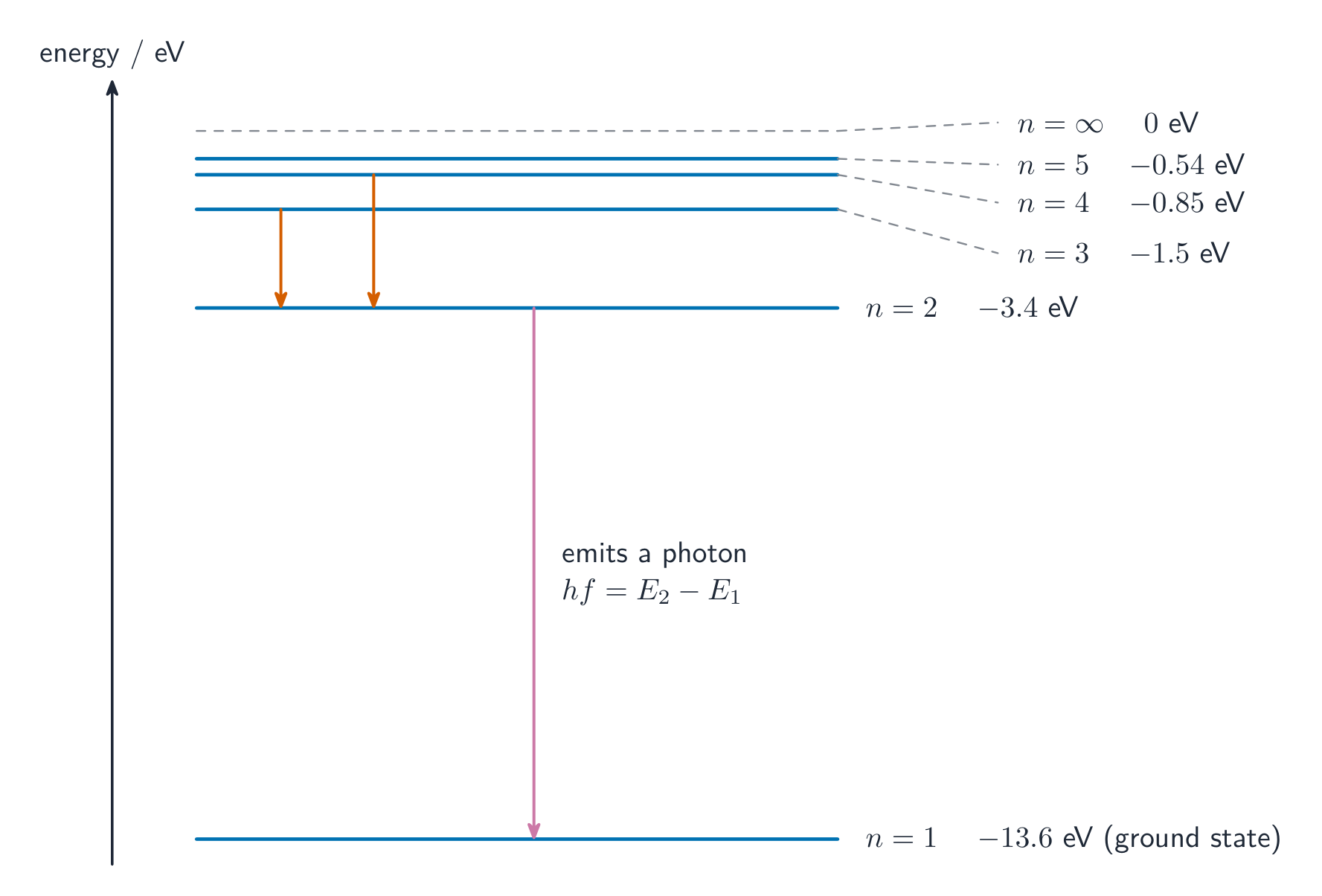
In an isolated atom, electrons can only sit at certain discrete 分立energy levels 能级 — never in between. The lowest is the ground state 基态; the others are excited states 激发态.
By convention, energies are written negative, with $E = 0$ for an electron just free of the atom. For hydrogen the ground state is $E_{1} = -13.6\ \text{eV}$; higher states approach zero.
Emission spectrum
When an electron drops from a higher level $E_{2}$ to a lower level $E_{1}$, it emits one photon of energy
$$h f = E_{2} - E_{1}.$$
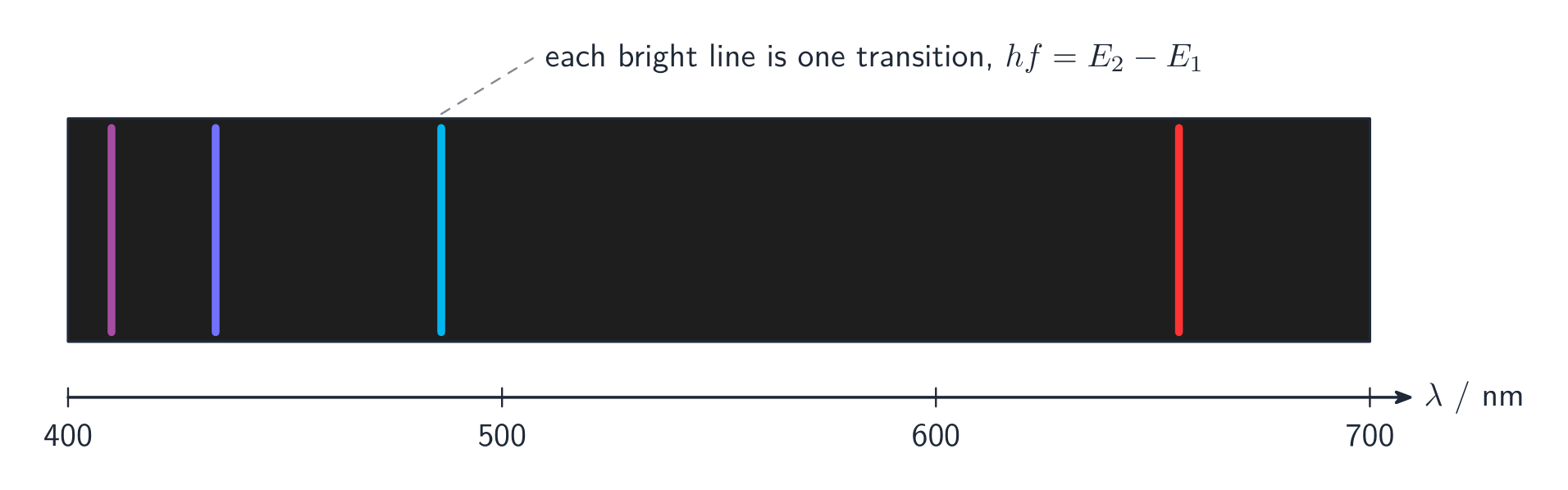
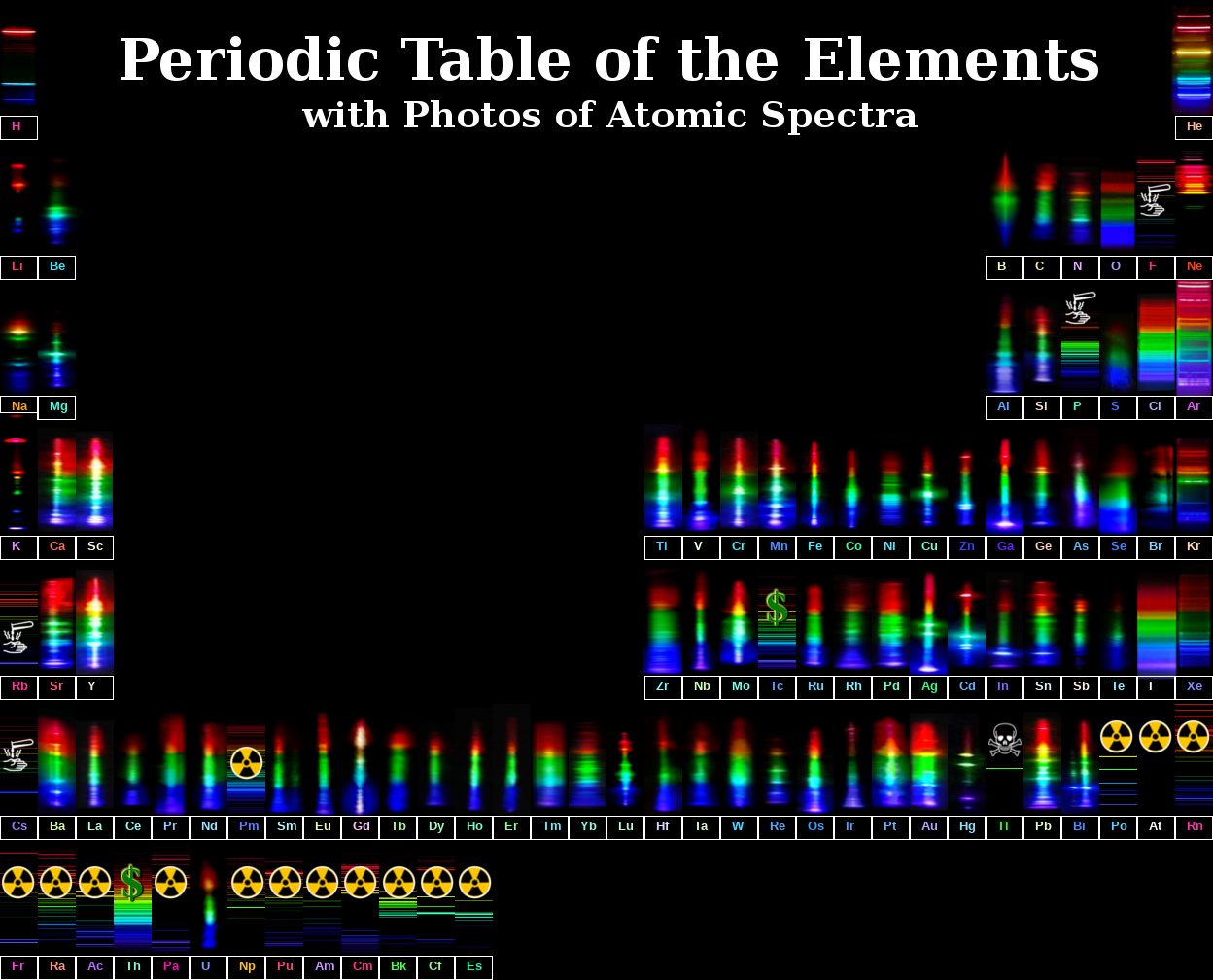
(Both energies are negative; their difference is positive.) Because the levels are discrete, only certain photon energies — and so certain wavelengths — come out. The emission spectrum 发射光谱 is a set of sharp bright lines on a dark background, one line per transition 跃迁. The pattern is a "fingerprint" of the element.
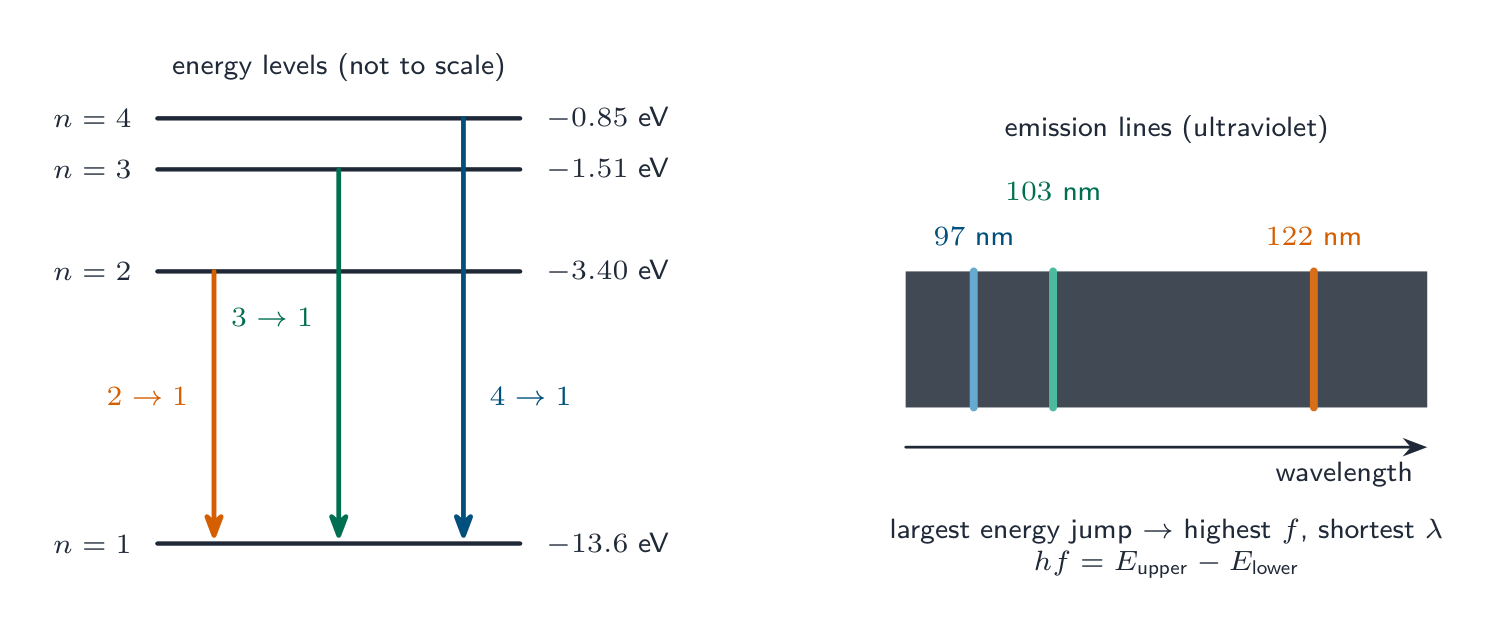
Explaining a line spectrum (the standard four-marker). (1) The electrons in an isolated atom can only occupy discrete energy levels. (2) An electron in an excited state falls to a lower level and the energy it loses is emitted as one photon. (3) The photon energy equals the difference between the two levels, $hf = E_{2} - E_{1}$, so only certain frequencies (wavelengths) are emitted. (4) Each possible transition gives one line; the same set of levels gives the same lines every time, which is why a spectrum identifies the element. Asked to match lines to transitions: the largest energy gap gives the line of highest frequency and shortest wavelength.
Absorption spectrum
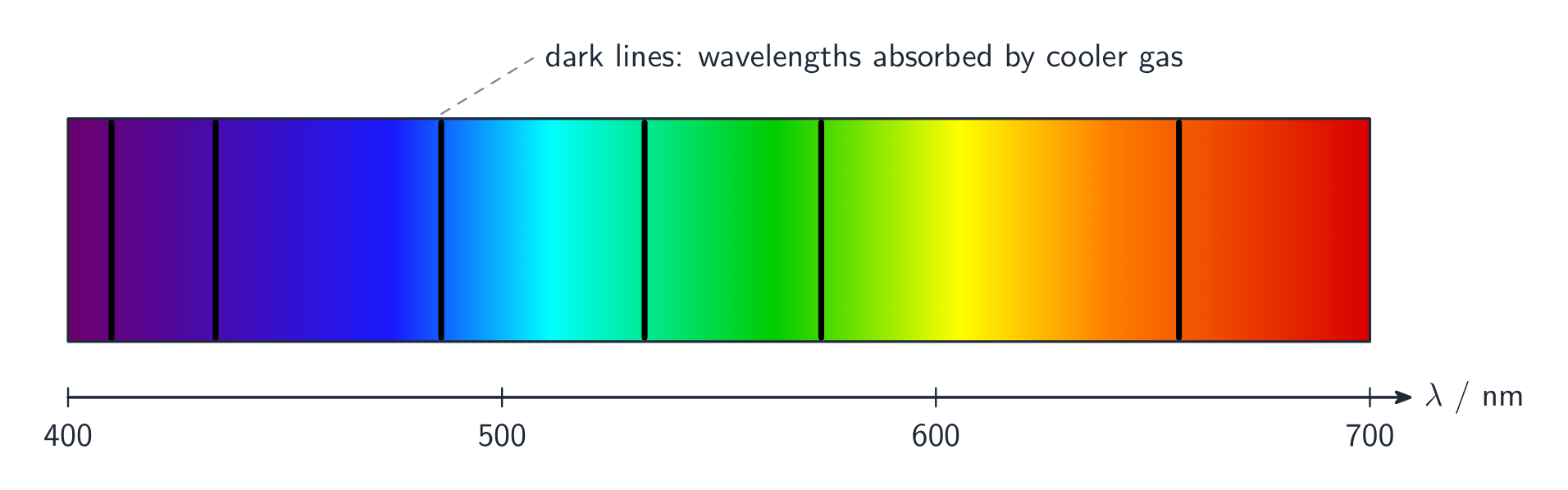
When white light passes through a cool gas, photons whose energy exactly matches an upward transition are absorbed. The light then shows dark lines on a bright background — the absorption spectrum 吸收光谱. The dark lines sit at the same wavelengths as the emission lines of the same gas.
Explaining the dark lines. Photons whose energy equals the difference between two levels are absorbed, raising an electron to the higher level; the excited electron soon falls back and re-emits a photon of the same energy, but in a random direction, so almost none of that light continues along the original path. The rest of the white light, whose photons match no gap, passes through unchanged. Hence dark lines at exactly the wavelengths the same gas would emit: the Sun's spectrum shows the absorption lines of the cooler gases in its outer layers.
Work in consistent units — convert eV to joules (× $1.60 \times 10^{-19}$) before finding $\lambda$ in metres, or use $hc \approx 1240\ \text{eV nm}$ for a quick estimate.
Worked example. The lowest four energy levels of hydrogen are $-13.6$, $-3.40$, $-1.51$ and $-0.85\ \text{eV}$. Find the wavelengths of the three lines produced by transitions to the ground state, and the number of lines these four levels can produce altogether.
Transition $2 \to 1$: $\Delta E = 13.6 - 3.40 = 10.2\ \text{eV}$, so $\lambda = 1240/10.2 = 122\ \text{nm}$. $3 \to 1$: $12.09\ \text{eV}$, $\lambda = 103\ \text{nm}$. $4 \to 1$: $12.75\ \text{eV}$, $\lambda = 97.3\ \text{nm}$: all ultraviolet, the largest jump giving the shortest wavelength. Four levels allow $4 \to 3$, $4 \to 2$, $4 \to 1$, $3 \to 2$, $3 \to 1$ and $2 \to 1$: six lines. The visible red line of hydrogen is $3 \to 2$: $1.89\ \text{eV}$, $656\ \text{nm}$. (Working in joules: $10.2\ \text{eV} = 1.63 \times 10^{-18}\ \text{J}$, $\lambda = hc/E = 1.99 \times 10^{-25}/1.63 \times 10^{-18} = 1.22 \times 10^{-7}\ \text{m}$.)
Worked example. A laser emits red light of wavelength $650\ \text{nm}$ when electrons drop from one level to another. Find the energy gap between the two levels.
$\Delta E = hc/\lambda = 1240/650 = 1.91\ \text{eV} = 3.1 \times 10^{-19}\ \text{J}$. The gap, not either level, fixes the colour: two atoms with different levels but the same gap emit the same line.
Worked example (annihilation). An electron and a positron, each moving slowly, meet and annihilate 湮灭, producing two identical photons. Find the wavelength of each photon. ($m_{\text{e}} = 9.11 \times 10^{-31}\ \text{kg}$.)
The rest energy of each particle is $E = mc^{2} = (9.11 \times 10^{-31})(3.00 \times 10^{8})^{2} = 8.2 \times 10^{-14}\ \text{J}$ ($0.51\ \text{MeV}$), and momentum conservation shares the energy between two photons moving in opposite directions, so each carries $8.2 \times 10^{-14}\ \text{J}$: $\lambda = hc/E = 1.99 \times 10^{-25}/8.2 \times 10^{-14} = 2.4 \times 10^{-12}\ \text{m}$, a gamma ray. (Any kinetic energy the pair had is added to the photon energies.)
Bahasa Indonesia
Dalam atom terisolasi, elektron hanya dapat berada pada tingkat energi diskrit tertentu — tidak pernah di antaranya. Tingkat terendah disebut keadaan dasar; yang lainnya adalah keadaan tereksitasi.
Berdasarkan konvensi, energi ditulis negatif, dengan $E = 0$ untuk elektron yang tepat bebas dari atom. Untuk hidrogen, keadaan dasarnya adalah $E_{1} = -13.6\ \text{eV}$; tingkat-tingkat yang lebih tinggi mendekati nol.
Tingkat energi elektron hidrogen bersifat diskrit dan negatif, dengan keadaan dasar pada $-13.6\ \text{eV}$
Spektrum emisi
Ketika elektron turun dari tingkat yang lebih tinggi $E_{2}$ ke tingkat yang lebih rendah $E_{1}$, ia memancarkan satu foton dengan energi
$$h f = E_{2} - E_{1}.$$
(Kedua energi bernilai negatif; selisihnya positif.) Karena tingkat-tingkatnya diskrit, hanya energi foton tertentu — dan karena itu panjang gelombang tertentu — yang keluar. Spektrum emisi adalah serangkaian garis terang tajam pada latar belakang gelap, satu garis per transisi. Pola ini adalah "sidik jari" dari elemen tersebut.
Menjelaskan spektrum garis (penanda standar empat). (1) Elektron dalam atom terisolasi hanya dapat menempati tingkat energi diskrit. (2) Elektron dalam keadaan tereksitasi jatuh ke tingkat yang lebih rendah dan energi yang hilangnya dipancarkan sebagai satu foton. (3) Energi foton sama dengan selisih antara kedua tingkat tersebut, $hf = E_{2} - E_{1}$, sehingga hanya frekuensi tertentu (panjang gelombang tertentu) yang dipancarkan. (4) Setiap transisi yang mungkin menghasilkan satu garis; himpunan tingkat yang sama menghasilkan garis yang sama setiap saat, itulah sebabnya spektrum mengidentifikasi elemen. Ditanya mencocokkan garis dengan transisi: celah energi terbesar menghasilkan garis dengan frekuensi tertinggi dan panjang gelombang terpendek.
Spektrum emisi hidrogen adalah serangkaian garis terang tajam pada latar belakang gelapSpektrum emisi asli dari elemen-elemen: masing-masing merupakan himpunan garis terang yang unik — sidik jari dari elemen tersebut
Spektrum absorpsi
Ketika cahaya putih melewati gas dingin, foton-foton yang energinya sesuai persis dengan transisi naik diserap. Cahaya kemudian menampilkan garis gelap pada latar terang — spektrum absorpsi. Garis-garis gelap tersebut berada pada panjang gelombang yang sama dengan garis-garis emisi dari gas yang sama.
Menjelaskan garis-garis gelap. Foton-foton yang energinya sama dengan selisih antara dua tingkat diserap, mengangkat elektron ke tingkat yang lebih tinggi; elektron yang tereksitasi segera jatuh kembali dan memancarkan kembali foton dengan energi yang sama, tetapi dalam arah acak, sehingga hampir tidak ada cahaya itu yang melanjutkan perjalanan sepanjang jalur asli. Sisa cahaya putih, yang foton-fotonnya tidak sesuai dengan celah energi, tembus tanpa berubah. Oleh karena itu terdapat garis-garis gelap pada panjang gelombang yang sama persis dengan yang akan dipancarkan oleh gas yang sama: spektrum Matahari menunjukkan garis-garis absorpsi dari gas-gas dingin di lapisan luarnya.
Garis penyerapan gelap dalam spektrum Matahari menandakan panjang gelombang yang diserap oleh gas yang lebih dingin
Kerjakan dengan unit yang konsisten — ubah eV menjadi joule (× $1.60 \times 10^{-19}$) sebelum mencari $\lambda$ dalam meter, atau gunakan $hc \approx 1240\ \text{eV nm}$ untuk anggaran cepat.
Dari tingkat ke garis: setiap transisi turun menuju keadaan dasar menghasilkan satu garis, dan lompatan terbesar mendarat paling jauh ke arah ujung panjang gelombang pendek
Contoh terpecahkan. Empat tingkat energi terendah hidrogen adalah $-13.6$, $-3.40$, $-1.51$ dan $-0.85\ \text{eV}$. Temukan panjang gelombang dari ketiga garis yang dihasilkan oleh transisi ke keadaan dasar, dan jumlah garis yang dapat dihasilkan keempat tingkat ini secara keseluruhan.
Transisi $2 \to 1$: $\Delta E = 13.6 - 3.40 = 10.2\ \text{eV}$, sehingga $\lambda = 1240/10.2 = 122\ \text{nm}$. $3 \to 1$: $12.09\ \text{eV}$, $\lambda = 103\ \text{nm}$. $4 \to 1$: $12.75\ \text{eV}$, $\lambda = 97.3\ \text{nm}$: semua ultraviolet, lonjakan terbesar memberikan panjang gelombang terpendek. Empat tingkat memungkinkan $4 \to 3$, $4 \to 2$, $4 \to 1$, $3 \to 2$, $3 \to 1$ dan $2 \to 1$: enam garis. Garis merah terlihat pada hidrogen adalah $3 \to 2$: $1.89\ \text{eV}$, $656\ \text{nm}$. (Bekerja dalam joule: $10.2\ \text{eV} = 1.63 \times 10^{-18}\ \text{J}$, $\lambda = hc/E = 1.99 \times 10^{-25}/1.63 \times 10^{-18} = 1.22 \times 10^{-7}\ \text{m}$.)
Contoh terpecahkan. Laser memancarkan cahaya merah dengan panjang gelombang $650\ \text{nm}$ ketika elektron turun dari satu tingkat ke tingkat lain. Temukan celah energi antara kedua tingkat tersebut.
$\Delta E = hc/\lambda = 1240/650 = 1.91\ \text{eV} = 3.1 \times 10^{-19}\ \text{J}$. Celah, bukan salah satu tingkat, menentukan warna: dua atom dengan tingkat berbeda tetapi celah yang sama memancarkan garis yang sama.
Contoh terpecahkan (pembasmian). Sebuah elektron dan sebuah positron, masing-masing bergerak lambat, bertemu dan membasmi, menghasilkan dua foton identik. Temukan panjang gelombang setiap foton. ($m_{\text{e}} = 9.11 \times 10^{-31}\ \text{kg}$.)
Energi diam setiap partikel adalah $E = mc^{2} = (9.11 \times 10^{-31})(3.00 \times 10^{8})^{2} = 8.2 \times 10^{-14}\ \text{J}$ ($0.51\ \text{MeV}$), dan kekekalan momentum membagi energi antara dua foton yang bergerak berlawanan arah, sehingga masing-masing membawa $8.2 \times 10^{-14}\ \text{J}$: $\lambda = hc/E = 1.99 \times 10^{-25}/8.2 \times 10^{-14} = 2.4 \times 10^{-12}\ \text{m}$, sebuah sinar gamma. (Energi kinetik apa pun yang dimiliki pasangan ditambahkan ke energi foton.)
Explore · Jelajahi
Make an element's spectral lines · Membuat garis spektral suatu unsur
An electron dropping between fixed energy levels emits a photon of exactly the gap's energy — a fixed wavelength and colour. Each jump is one line of the element's barcode. · Elektron yang turun antara tingkat energi tetap memancarkan foton dengan energi tepat sebesar selisihnya—panjang gelombang dan warna yang tetap. Setiap lompatan adalah satu garis dari kode batang unsur tersebut.
Definitions the examiner accepts · Definisi yang diterima oleh penguji
English
A definition question is marked against fixed wording. Learn these exactly, and give one answer only.
Term
Definition
photon
a quantum (discrete packet) of energy of electromagnetic radiation
electronvolt
the energy gained by an electron accelerated through a potential difference of one volt; $1.60 \times 10^{-19}\ \text{J}$
photoelectric effect
the emission of electrons from a metal surface when electromagnetic radiation of high enough frequency is incident on it
work function energy
the minimum energy needed to remove an electron from the surface of the metal
threshold frequency
the minimum frequency of radiation that causes photoelectric emission from a metal
threshold wavelength
the maximum wavelength of radiation that causes photoelectric emission, $\lambda_{0} = hc/\Phi$
wave–particle duality
radiation and matter show both wave properties (diffraction, interference) and particle properties (photoelectric effect, discrete collisions)
de Broglie wavelength
the wavelength associated with a moving particle, $\lambda = h/p$
energy level
one of the discrete energies an electron in an isolated atom may have
emission line spectrum
a set of bright lines of definite wavelengths, each from a transition between two energy levels
absorption line spectrum
dark lines on a continuous spectrum at the wavelengths absorbed by transitions to higher levels
Bahasa Indonesia
Soal definisi dinilai berdasarkan frasa tetap. Hafalkan ini persis, dan berikan hanya satu jawaban.
Istilah
Definisi
foton
kuantum (paket diskrit) energi radiasi elektromagnetik
elektronvolt
energi yang diperoleh elektron yang dipercepat melalui beda potensial satu volt; $1.60 \times 10^{-19}\ \text{J}$
efek fotoelektrik
pembebasan elektron dari permukaan logam ketika radiasi elektromagnetik dengan frekuensi cukup tinggi menyinari permukaannya
energi fungsi kerja
energi minimum yang diperlukan untuk melepaskan elektron dari permukaan logam
frekuensi ambang
frekuensi minimum radiasi yang menyebabkan pembebasan fotoelektrik dari suatu logam
panjang gelombang ambang
panjang gelombang maksimum radiasi yang menyebabkan pembebasan fotoelektrik, $\lambda_{0} = hc/\Phi$
dualitas gelombang-partikel
radiasi dan materi menunjukkan sifat gelombang (difraksi, interferensi) dan sifat partikel (efek fotoelektrik, tumbukan diskrit)
panjang gelombang de Broglie
panjang gelombang yang terkait dengan partikel yang bergerak, $\lambda = h/p$
tingkat energi
salah satu energi diskrit yang mungkin dimiliki elektron dalam atom terisolasi
spektrum garis emisi
serangkaian garis terang dengan panjang gelombang tertentu, masing-masing berasal dari transisi antara dua tingkat energi
spektrum garis absorpsi
garis-garis gelap pada spektrum kontinu pada panjang gelombang yang diserap oleh transisi ke tingkat yang lebih tinggi
22.4
Exam tips · Tips ujian
English
Photon: $E = hf = hc/\lambda$, $p = E/c = h/\lambda$. Use $hc = 1240\ \text{eV nm}$ to move between wavelength and energy in eV, then convert to joules only if the answer demands it.
Photoelectric equation $hf = \Phi + \tfrac{1}{2}mv_{\text{max}}^{2}$: maximum energy, one photon to one electron; the graph of $E_{\text{K,max}}$ against $f$ has gradient $h$ and intercepts $f_{0}$ and $-\Phi$.
Intensity changes the number of photons per second (the current); frequency changes the energy of each (the maximum kinetic energy). Keep those two sentences apart and every explanation writes itself.
Evidence: photoelectric effect for particles, diffraction and interference for waves; electron diffraction for the wave nature of matter, with $\lambda = h/p = h/\sqrt{2mqV}$.
Line spectra: discrete levels, one photon per transition, $hf = E_{2} - E_{1}$; the biggest gap gives the shortest wavelength; absorption lines sit where emission lines would, because the absorbed light is re-emitted in all directions.
Radiation pressure: force $=$ photons per second $\times$ momentum change per photon; $2p$ for a mirror, $p$ for an absorber; pressure depends on intensity, not colour.
Common mistakes
Defining a photon as "a particle of light" without "quantum/packet of energy", or the work function without "minimum" and "from the surface".
Saying brighter light gives faster photoelectrons, or that below the threshold frequency emission happens eventually.
Mixing eV and joules in one equation; forgetting to subtract the work function; using $\tfrac{1}{2}mv^{2}$ with the maximum kinetic energy in eV.
Writing the de Broglie wavelength for an accelerated electron as $h/(mv)$ with $v$ guessed, instead of $h/\sqrt{2mqV}$.
Describing electron diffraction as bright fringes or spots; the pattern is concentric rings, and a higher p.d. makes them smaller.
Getting the direction of a transition wrong: emission is a fall to a lower level, absorption a rise; the photon energy is the difference, never the energy of one level.
Claiming the largest energy gap gives the longest wavelength.
Forgetting that a reflected photon changes momentum by $2p$, or that the pressure of blue light of the same intensity is the same as red.
Bahasa Indonesia
Foton: $E = hf = hc/\lambda$, $p = E/c = h/\lambda$. Gunakan $hc = 1240\ \text{eV nm}$ untuk berpindah antara panjang gelombang dan energi dalam eV, lalu ubah ke joule hanya jika jawaban mensyaratkannya.
Persamaan fotoelektrik $hf = \Phi + \tfrac{1}{2}mv_{\text{max}}^{2}$: energi maksimum, satu foton ke satu elektron; grafik $E_{\text{K,max}}$ terhadap $f$ memiliki gradien $h$ dan perpotongan $f_{0}$ dan $-\Phi$.
Intensitas mengubah jumlah foton per detik (arus); frekuensi mengubah energi setiap foton (energi kinetik maksimum). Pisahkan dua kalimat itu dan setiap penjelasan akan menulis dirinya sendiri.
Bukti: efek fotoelektrik untuk partikel, difraksi dan interferensi untuk gelombang; difraksi elektron untuk sifat gelombang materi, dengan $\lambda = h/p = h/\sqrt{2mqV}$.
Spektrum garis: tingkat-tingkat diskrit, satu foton per transisi, $hf = E_{2} - E_{1}$; celah terbesar menghasilkan panjang gelombang terpendek; garis absorpsi berada di tempat garis emisi akan ada, karena cahaya yang diserap dipancarkan kembali ke segala arah.
Tekanan radiasi: gaya $=$ foton per detik $\times$ perubahan momentum per foton; $2p$ untuk cermin, $p$ untuk penyerap; tekanan bergantung pada intensitas, bukan warna.
Kesalahan umum
Mendefinisikan foton sebagai "partikel cahaya" tanpa "kuantum/paket energi", atau fungsi kerja tanpa "minimum" dan "dari permukaan".
Mengatakan cahaya lebih terang menghasilkan fotoelektron lebih cepat, atau bahwa di bawah frekuensi ambang pembebasan terjadi pada akhirnya.
Mencampur eV dan joule dalam satu persamaan; lupa mengurangi fungsi kerja; menggunakan $\tfrac{1}{2}mv^{2}$ dengan energi kinetik maksimum dalam eV.
Menulis panjang gelombang de Broglie untuk elektron yang dipercepat sebagai $h/(mv)$ dengan $v$ ditebak, alih-alih $h/\sqrt{2mqV}$.
Mendeskripsikan difraksi elektron sebagai garis terang atau bintik; polanya adalah cincin konsentris, dan p.d. yang lebih tinggi membuatnya lebih kecil.
Mendapatkan arah transisi salah: emisi adalah penurunan ke tingkat yang lebih rendah, absorpsi adalah kenaikan; energi foton adalah selisihnya, never energi dari satu tingkat.
Mengklaim celah energi terbesar menghasilkan panjang gelombang terpanjang.
Lupa bahwa foton yang dipantulkan berubah momentum sebesar $2p$, atau bahwa tekanan cahaya biru dengan intensitas yang sama adalah sama dengan cahaya merah.
Interactive lessons on this topic · Pelajaran interaktif untuk topik ini
Work through it step by step, with instant-check exercises. · Kerjakan langkah demi langkah, dengan latihan pengecekan instan.
Pick one and the site follows you — notes, papers, videos and practice all open on it. · Pilih satu dan situs mengikuti Anda — catatan, kertas, video, dan latihan semua terbuka di sana.
Type to search notes, lessons, code, vocabulary and past-paper questions across every subject. · Ketik untuk mencari catatan, pelajaran, kode, kosakata, dan pertanyaan soal lama di setiap mata pelajaran.





 *Menyelidiki efek: arus mengukur laju emisi, dan tegangan balik yang tepat menghentikan elektron tercepat mengukur energi kinetik maksimum mereka