Dua benda di saku Anda bekerja berdasarkan kimia yang sama. Sebuah baterai: reaksi yang ingin terjadi mendorong elektron melalui kabel. Dan pengisi daya: kita mendorong elektron-elektron itu…
English narration · English + 中文 subtitles burned in · Narasi bahasa Inggris · Subtitle bahasa Inggris + 中文 disematkan langsung
24.1
Electrolysis · Elektrolisis
Syllabus · Silabus
English
predict the identities of substances liberated during electrolysis from the state of electrolyte (molten or aqueous), position in the redox series (electrode potential) and concentration
state and apply the relationship $F = Le$ between the Faraday constant, $F$, the Avogadro constant, $L$, and the charge on the electron, $e$
calculate: (a) the quantity of charge passed during electrolysis, using $Q = It$ (b) the mass and/or volume of substance liberated during electrolysis
describe the determination of a value of the Avogadro constant by an electrolytic method
Bahasa Indonesia
mengidentifikasi identitas zat yang terbebaskan selama elektrolisis berdasarkan keadaan elektrolit (lelehan atau larutan), posisi dalam seri redoks (potensi elektroda), dan konsentrasi
menyatakan dan menerapkan hubungan $F = Le$ antara konstanta Faraday, $F$, konstanta Avogadro, $L$, dan muatan elektron, $e$
menghitung: (a) jumlah muatan yang dialirkan selama elektrolisis, menggunakan $Q = It$ (b) massa dan/atau volume zat yang terbebaskan selama elektrolisis
menggambarkan penentuan nilai konstanta Avogadro melalui metode elektrolitik
Source: Cambridge International syllabus · Sumber: Silabus Cambridge International
English
Electrolysis: ions discharge at the electrodes
Electrolysis 电解 uses electricity to break down a molten or aqueous electrolyte 电解质. Positive ions move to the negative electrode and negative ions move to the positive electrode.
At each electrode 电极 a half-reaction happens:
at the cathode 阴极 (negative): positive ions gain electrons (reduction).
at the anode 阳极 (positive): negative ions lose electrons (oxidation).
Predicting the products
a molten electrolyte gives the metal at the cathode and the non-metal at the anode.
an aqueous electrolyte also contains water. At the cathode, a less reactive metal is released, but for a reactive metal you get hydrogen instead. At the anode you usually get oxygen, but a concentrated halide solution gives the halogen.
Calculations
The charge on one mole of electrons is the Faraday constant 法拉第常量, linked to the Avogadro constant 阿伏伽德罗常量 ($L$) and the charge on one electron ($e$) by $F = Le$.
The charge passed is $Q = It$ (current $\times$ time). Then:
moles of electrons $= Q / F$.
use the half-equation to find moles of product.
find the mass ($\times M_r$) or the gas volume.
Measuring the mass deposited for a known charge lets you work back to a value of the Avogadro constant.
Worked example. A current of $2.0\ \text{A}$ flows for $30$ minutes through copper(II) sulfate solution, depositing copper at the cathode: $\text{Cu}^{2+} + 2\text{e}^- \rightarrow \text{Cu}$. Find the mass of copper deposited. ($F = 96\,500\ \text{C mol}^{-1}$, $A_r$ Cu $= 64$.)
Charge passed: $Q = It = 2.0 \times (30 \times 60) = 3600\ \text{C}$. Moles of electrons $= Q/F = 3600/96\,500 = 0.0373\ \text{mol}$. From the half-equation, $2\ \text{mol}$ of electrons give $1\ \text{mol}$ of Cu, so $n(\text{Cu}) = 0.0187\ \text{mol}$ and
Elektrolisis menggunakan listrik untuk menguraikan elektrolit cair atau berair. Ion positif bergerak ke elektroda negatif dan ion negatif bergerak ke elektroda positif.
Di setiap elektroda terjadi reaksi separuh:
di katoda (negatif): ion positif menerima elektron (reduksi).
di anoda (positif): ion negatif melepaskan elektron (oksidasi).
Elektrolisis: sumber DC mendorong ion positif ke katoda (reduksi) dan ion negatif ke anoda (oksidasi)Voltameter Hofmann untuk elektrolisis air: sumber daya mengalirkan arus melalui dua elektroda, dan gas yang terbentuk di masing-masing terkumpul di tabungnya masing-masing
Memprediksi produk
elektrolit cair menghasilkan logam di katoda dan non-logam di anoda.
elektrolit berair juga mengandung air. Di katoda, logam yang kurang reaktif akan terbebas, tetapi untuk logam reaktif Anda mendapatkan hidrogen sebagai gantinya. Di anoda biasanya Anda mendapatkan oksigen, tetapi larutan halida pekat menghasilkan halogen.
Elektrolit lebur menghasilkan logam dan non-logam; berair juga memiliki air
Perhitungan
Muatan pada satu mol elektron adalah konstanta Faraday, yang terkait dengan konstanta Avogadro ($L$) dan muatan satu elektron ($e$) melalui $F = Le$.
Muatan yang dilalui adalah $Q = It$ (arus $\times$ waktu). Maka:
mol elektron $= Q / F$.
gunakan persamaan separuh untuk menemukan mol produk.
temukan massa ($\times M_r$) atau volume gas.
Mengukur massa yang diendapkan untuk muatan yang diketahui memungkinkan Anda menghitung kembali nilai konstanta Avogadro.
Contoh soal. Arus $2.0\ \text{A}$ mengalir selama $30$ menit melalui larutan tembaga(II) sulfat, mengendapkan tembaga di katoda: $\text{Cu}^{2+} + 2\text{e}^- \rightarrow \text{Cu}$. Temukan massa tembaga yang diendapkan. ($F = 96\,500\ \text{C mol}^{-1}$, $A_r$ Cu $= 64$.)
Muatan yang dilalui: $Q = It = 2.0 \times (30 \times 60) = 3600\ \text{C}$. Mol elektron $= Q/F = 3600/96\,500 = 0.0373\ \text{mol}$. Dari persamaan separuh, $2\ \text{mol}$ elektron memberikan $1\ \text{mol}$ Cu, sehingga $n(\text{Cu}) = 0.0187\ \text{mol}$ dan
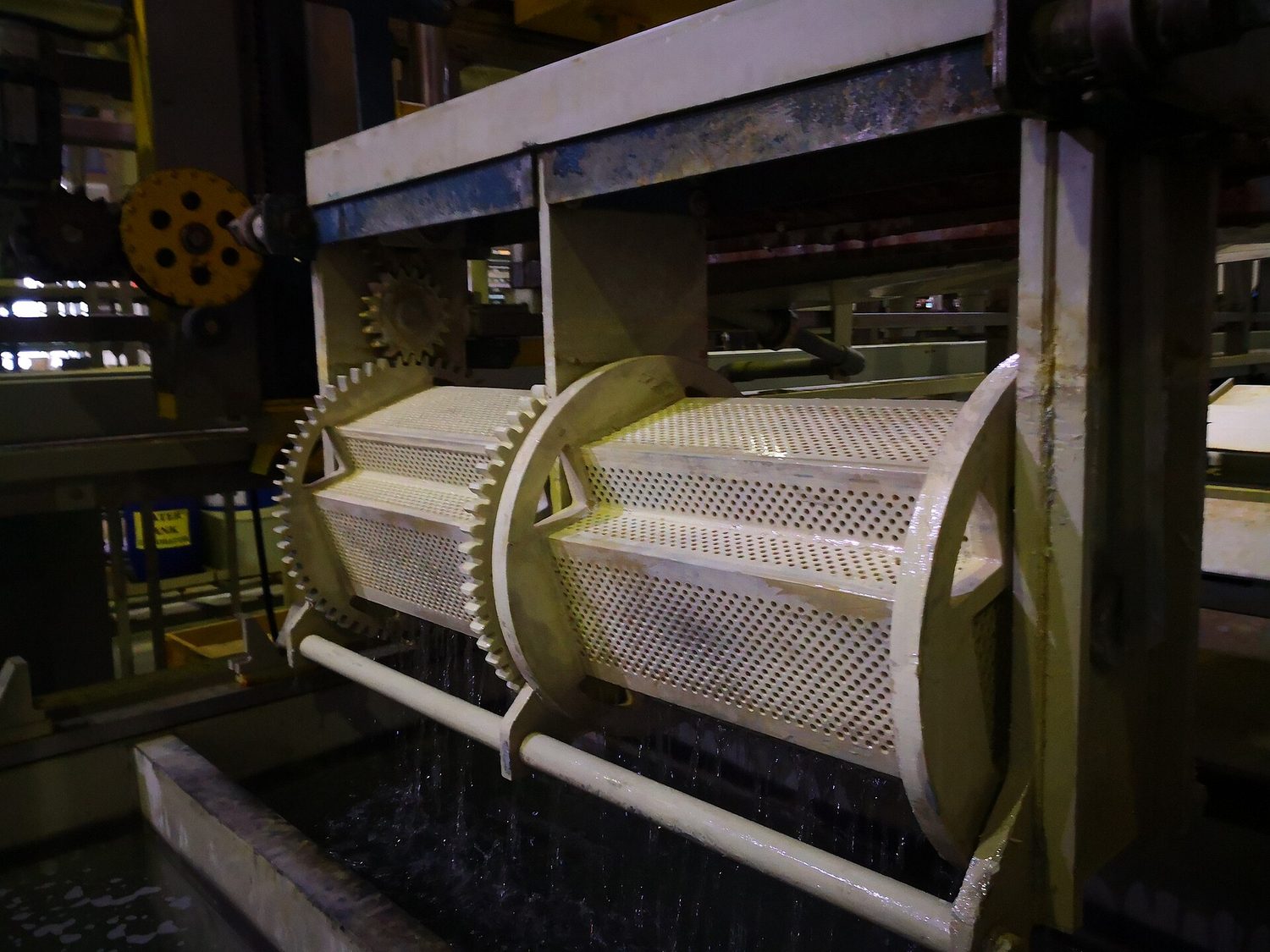
Elektrolisis digunakan untuk melapisi suatu benda dengan lapisan tipis dan mengkilap dari logam seperti kromium
Explore · Jelajahi
Faraday's first law · Hukum Faraday pertama
m = k·Q
Mass deposited is proportional to the charge passed (Faraday's law). · Massa yang diendapkan berbanding lurus dengan muatan yang dialirkan (Hukum Faraday).
Explore · Jelajahi
Inside an electrolysis cell · Di dalam sel elektrolisis
Choose an electrolyte and watch the ions move: cations to the cathode, anions to the anode, where they are discharged. · Pilih elektrolit dan saksikan ion bergerak: kation ke katode, anion ke anode, tempat mereka dilepaskan muatannya.
Standard electrode potentials and cell potentials · Potensial elektroda standar dan potensial sel
Syllabus · Silabus
English
define the terms: (a) standard electrode (reduction) potential (b) standard cell potential
describe the standard hydrogen electrode
describe methods used to measure the standard electrode potentials of: (a) metals or non-metals in contact with their ions in aqueous solution (b) ions of the same element in different oxidation states
calculate a standard cell potential by combining two standard electrode potentials
use standard cell potentials to: (a) deduce the polarity of each electrode and hence explain/deduce the direction of electron flow in the external circuit of a simple cell (b) predict the feasibility of a reaction
deduce from $E^{\ominus}$ values the relative reactivity of elements, compounds and ions as oxidising agents or as reducing agents
construct redox equations using the relevant half-equations
predict qualitatively how the value of an electrode potential, $E$, varies with the concentrations of the aqueous ions
use the Nernst equation, e.g. $E = E^{\ominus} + (0.059/z) \log \frac{[\text{oxidised species}]}{[\text{reduced species}]}$, to predict quantitatively how the value of an electrode potential varies with the concentrations of the aqueous ions; examples include $\text{Cu}^{2+}(\text{aq}) + 2\text{e}^- \rightleftharpoons \text{Cu}(\text{s})$, $\text{Fe}^{3+}(\text{aq}) + \text{e}^- \rightleftharpoons \text{Fe}^{2+}(\text{aq})$
understand and use the equation $\Delta G^{\ominus} = -n E^{\ominus}_{\text{cell}} F$
Bahasa Indonesia
mendefinisikan istilah: (a) potensial elektroda (reduksi) standar (b) potensial sel standar
menggambarkan elektroda hidrogen standar
menggambarkan metode yang digunakan untuk mengukur potensial elektroda standar dari: (a) logam atau non-logam yang bersentuhan dengan ionnya dalam larutan air (b) ion dari unsur yang sama dalam bilangan oksidasi berbeda
menghitung potensial sel standar dengan menggabungkan dua potensial elektroda standar
menggunakan potensial sel standar untuk: (a) menyimpulkan polaritas setiap elektroda dan karenanya menjelaskan/menyimpulkan arah aliran elektron dalam rangkaian luar sel sederhana (b) memprediksi kelayakan suatu reaksi
menyimpulkan dari nilai $E^{\ominus}$ reaktivitas relatif unsur, senyawa, dan ion sebagai agen pengoksidasi atau agen pereduksi
menyusun persamaan redoks menggunakan setengah persamaan yang relevan
memprediksi secara kualitatif bagaimana nilai potensial elektroda, $E$, bervariasi dengan konsentrasi ion dalam larutan
menggunakan persamaan Nernst, mis. $E = E^{\ominus} + (0.059/z) \log \frac{[\text{oxidised species}]}{[\text{reduced species}]}$, untuk memprediksi secara kuantitatif bagaimana nilai potensial elektroda bervariasi dengan konsentrasi ion dalam larutan; contohnya meliputi $\text{Cu}^{2+}(\text{aq}) + 2\text{e}^- \rightleftharpoons \text{Cu}(\text{s})$, $\text{Fe}^{3+}(\text{aq}) + \text{e}^- \rightleftharpoons \text{Fe}^{2+}(\text{aq})$
memahami dan menggunakan persamaan $\Delta G^{\ominus} = -n E^{\ominus}_{\text{cell}} F$
Source: Cambridge International syllabus · Sumber: Silabus Cambridge International
English
The electrode potential 电极电势 ($E$) of a half-cell shows how easily it is reduced. We measure it against a reference, under standard conditions, to get the standard electrode potential 标准电极电势 ($E^{\ominus}$), always written as a reduction.
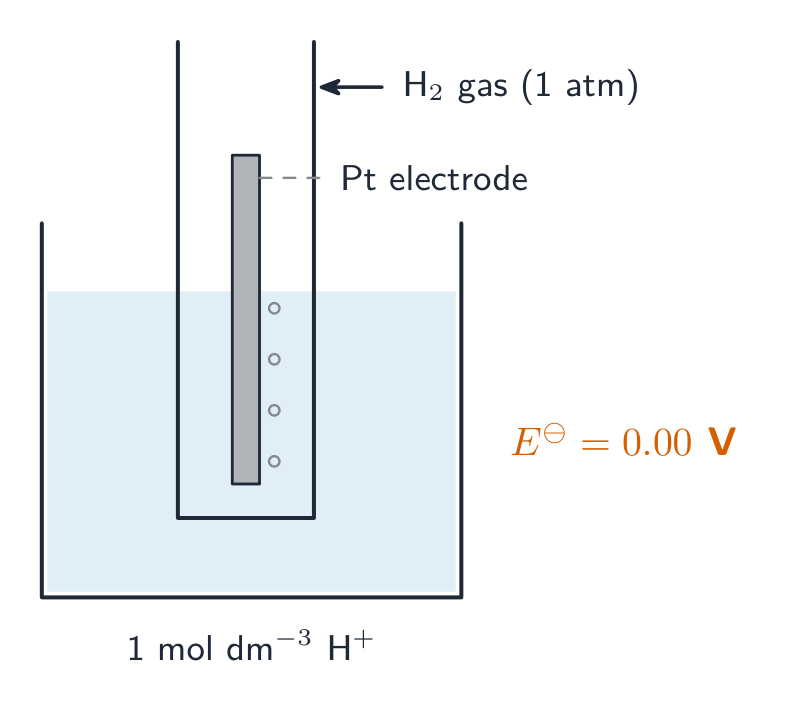
The reference is the standard hydrogen electrode 标准氢电极: hydrogen gas at $1\ \text{atm}$ over platinum in $1\ \text{mol dm}^{-3}$$\text{H}^+$, defined as exactly $0.00\ \text{V}$.
To measure an $E^{\ominus}$, connect the half-cell to the standard hydrogen electrode and read the voltage. A metal sits in a solution of its ions; for two ions of the same element (such as $\text{Fe}^{3+}/\text{Fe}^{2+}$), a platinum electrode dips into a solution containing both.
Combining half-cells
The standard cell potential 标准电池电势 is the difference between the two standard electrode potentials:
Worked example. Find the standard cell potential of a cell built from the $\text{Zn}^{2+}/\text{Zn}$ half-cell ($E^{\ominus} = -0.76\ \text{V}$) and the $\text{Cu}^{2+}/\text{Cu}$ half-cell ($E^{\ominus} = +0.34\ \text{V}$).
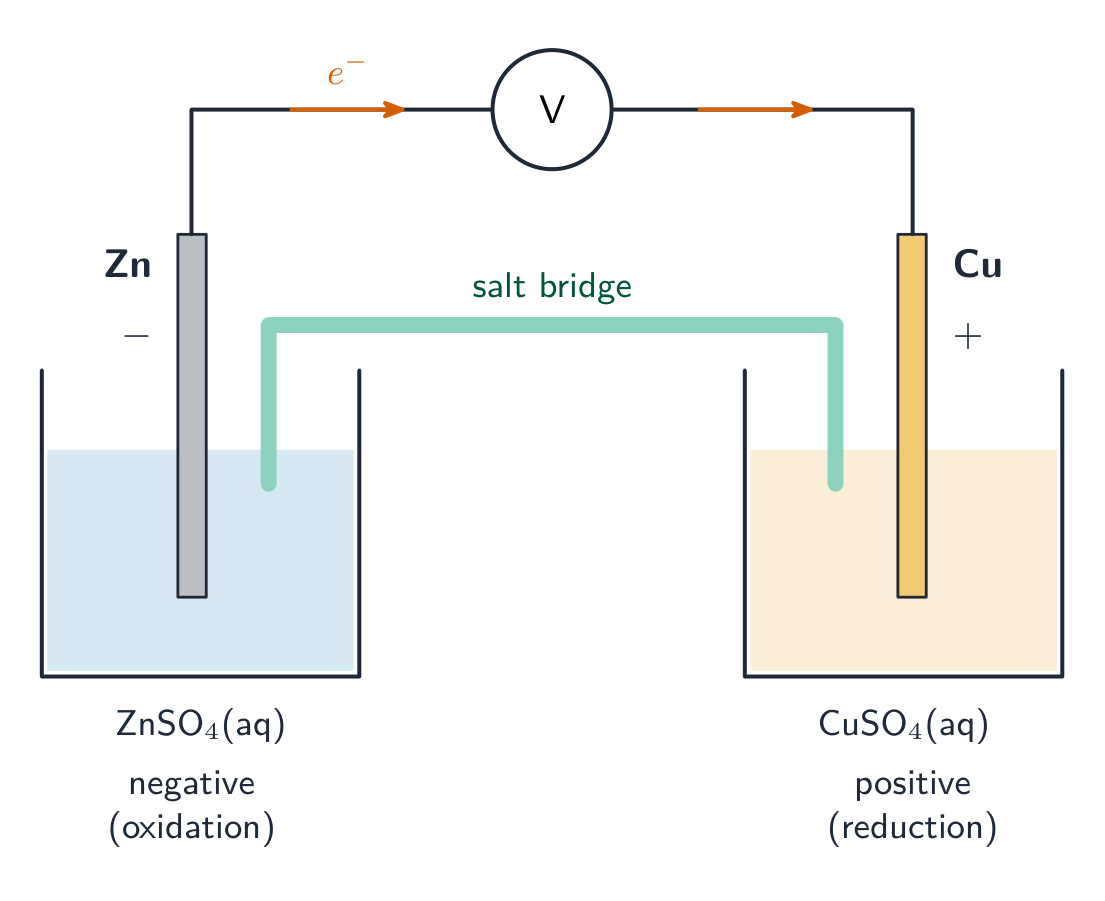
find the polarity: the more negative electrode is the negative terminal, and electrons flow from it through the external circuit to the positive electrode.
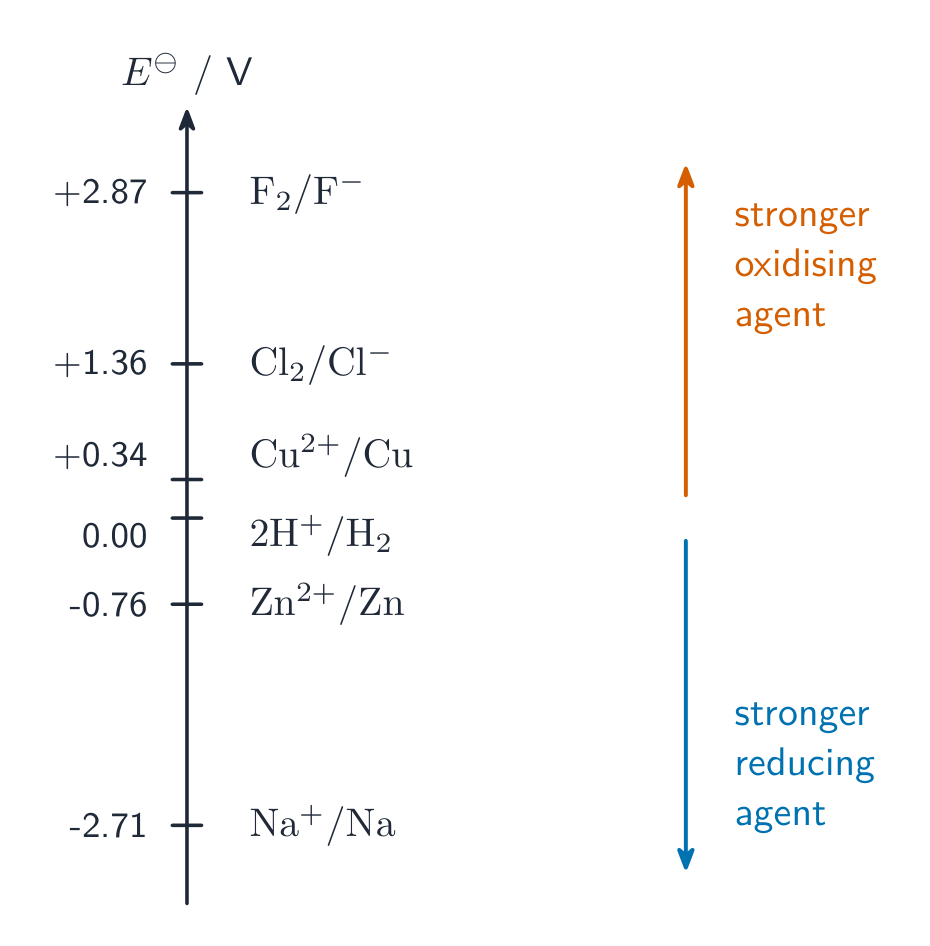
judge reactivity: a more positive $E^{\ominus}$ means a better oxidising agent 氧化剂 (easily reduced); a more negative $E^{\ominus}$ means a better reducing agent 还原剂.
Feasibility and redox equations
A reaction is feasible when $E^{\ominus}_{\text{cell}}$ is positive. To build the full equation, take the two half-equations 半反应方程式, reverse the one that is oxidised, and add them so the electrons cancel. This $E^{\ominus}$ test tells you the feasibility 可行性 of the reaction.
You can also link it to free energy: $\Delta G^{\ominus} = -n E^{\ominus}_{\text{cell}} F$, where $n$ is the moles of electrons.
The Nernst equation
If the concentrations are not standard, the electrode potential changes. Raising the concentration of the oxidised species makes $E$ more positive. The Nernst equation 能斯特方程 gives the exact value:
where $z$ is the number of electrons in the half-equation.
Bahasa Indonesia
Potensial elektroda ($E$) dari setengah sel menunjukkan seberapa mudah ia direduksi. Kami mengukurnya terhadap referensi, di bawah kondisi standar, untuk mendapatkan potensial elektroda standar ($E^{\ominus}$), selalu ditulis sebagai reduksi.
Referensinya adalah elektroda hidrogen standar: gas hidrogen pada $1\ \text{atm}$ di atas platinum dalam $1\ \text{mol dm}^{-3}$$\text{H}^+$, didefinisikan tepat sebesar $0.00\ \text{V}$.
Elektroda hidrogen standar: H$_2$ pada 1 atm di atas platinum dalam 1 mol dm$^{-3}$ H$^+$, referensi $0.00$ V untuk setiap potensial elektroda
Untuk mengukur $E^{\ominus}$, hubungkan setengah sel ke elektroda hidrogen standar dan bacalah tegangan. Logam berada dalam larutan ionnya; untuk dua ion dari unsur yang sama (seperti $\text{Fe}^{3+}/\text{Fe}^{2+}$), elektroda platinum dicelupkan ke dalam larutan yang mengandung keduanya.
Menggabungkan setengah sel
Potensial sel standar adalah perbedaan antara dua potensial elektroda standar:
Sel sederhana: dua setengah sel yang dihubungkan oleh jembatan garam, dengan voltmeter. Elektron mengalir dari elektroda negatif (Zn) ke elektroda positif (Cu)
Contoh soal. Temukan potensial sel standar dari sel yang dibangun dari setengah sel $\text{Zn}^{2+}/\text{Zn}$ ($E^{\ominus} = -0.76\ \text{V}$) dan setengah sel $\text{Cu}^{2+}/\text{Cu}$ ($E^{\ominus} = +0.34\ \text{V}$).
menemukan kutub: elektroda yang lebih negatif adalah terminal negatif, dan elektron mengalir darinya melalui sirkuit eksternal ke elektroda positif.
menilai reaktivitas: $E^{\ominus}$ yang lebih positif berarti agen pengoksidasi yang lebih baik (mudah direduksi); $E^{\ominus}$ yang lebih negatif berarti agen pereduksi yang lebih baik.
Seri elektrokimia: $E^{\ominus}$ yang lebih positif (atas) adalah agen pengoksidasi yang lebih kuat; $E^{\ominus}$ yang lebih negatif (bawah) adalah agen pereduksi yang lebih kuat
Kelayakan dan persamaan redoks
Reaksi layak ketika $E^{\ominus}_{\text{cell}}$ bernilai positif. Untuk menyusun persamaan penuh, ambil dua persamaan separuh, balik persamaan yang mengalami oksidasi, dan tambahkan keduanya agar elektron saling menghilangkan. Uji $E^{\ominus}$ ini memberi tahu Anda kelayakan reaksi.
Anda juga dapat menghubungkannya dengan energi bebas: $\Delta G^{\ominus} = -n E^{\ominus}_{\text{cell}} F$, di mana $n$ adalah mol elektron.
Persamaan Nernst
Jika konsentrasi tidak standar, potensial elektroda berubah. Meningkatkan konsentrasi spesies teroksidasi membuat $E$ lebih positif. Persamaan Nernst memberikan nilai yang tepat:
$E^{\ominus}_{\text{cell}} = E^{\ominus}(\text{more positive}) - E^{\ominus}(\text{less positive})$; a positive$E^{\ominus}_{\text{cell}}$ means the reaction is feasible.
Standard conditions for $E^{\ominus}$: 298 K, $1\ \text{mol dm}^{-3}$, 100 kPa, platinum electrode — state them if asked.
A more negative electrode potential means a stronger reducing agent; use the series to predict the direction.
For electrolysis quantities use $Q = It$ and moles of electrons $= Q/F$.
Bahasa Indonesia
$E^{\ominus}_{\text{cell}} = E^{\ominus}(\text{more positive}) - E^{\ominus}(\text{less positive})$; sebuah $E^{\ominus}_{\text{cell}}$positif berarti reaksi tersebut memungkinkan.
Kondisi standar untuk $E^{\ominus}$: 298 K, $1\ \text{mol dm}^{-3}$, 100 kPa, elektroda platinum — sebutkan jika ditanyakan.
Potensial elektroda yang lebih negatif berarti agen pereduksi yang lebih kuat; gunakan seri untuk memprediksi arah.
Untuk jumlah zat elektrolisis gunakan $Q = It$ dan mol elektron $= Q/F$.
Interactive lessons on this topic · Pelajaran interaktif untuk topik ini
Work through it step by step, with instant-check exercises. · Kerjakan langkah demi langkah, dengan latihan pengecekan instan.
Pick one and the site follows you — notes, papers, videos and practice all open on it. · Pilih satu dan situs mengikuti Anda — catatan, kertas, video, dan latihan semua terbuka di sana.
Type to search notes, lessons, code, vocabulary and past-paper questions across every subject. · Ketik untuk mencari catatan, pelajaran, kode, kosakata, dan pertanyaan soal lama di setiap mata pelajaran.