English
- recall the reactions (reagents and conditions) by which halogenoalkanes can be produced: (a) the free-radical substitution of alkanes by $\text{Cl}_2$ or $\text{Br}_2$ in the presence of ultraviolet light, as exemplified by the reactions of ethane (b) electrophilic addition of an alkene with a halogen, $\text{X}_2$, or hydrogen halide, $\text{HX(g)}$, at room temperature (c) substitution of an alcohol, e.g. by reaction with $\text{HX(g)}$; or with $\text{KCl}$ and concentrated $\text{H}_2\text{SO}_4$ or concentrated $\text{H}_3\text{PO}_4$; or with $\text{PCl}_3$ and heat; or with $\text{PCl}_5$; or with $\text{SOCl}_2$
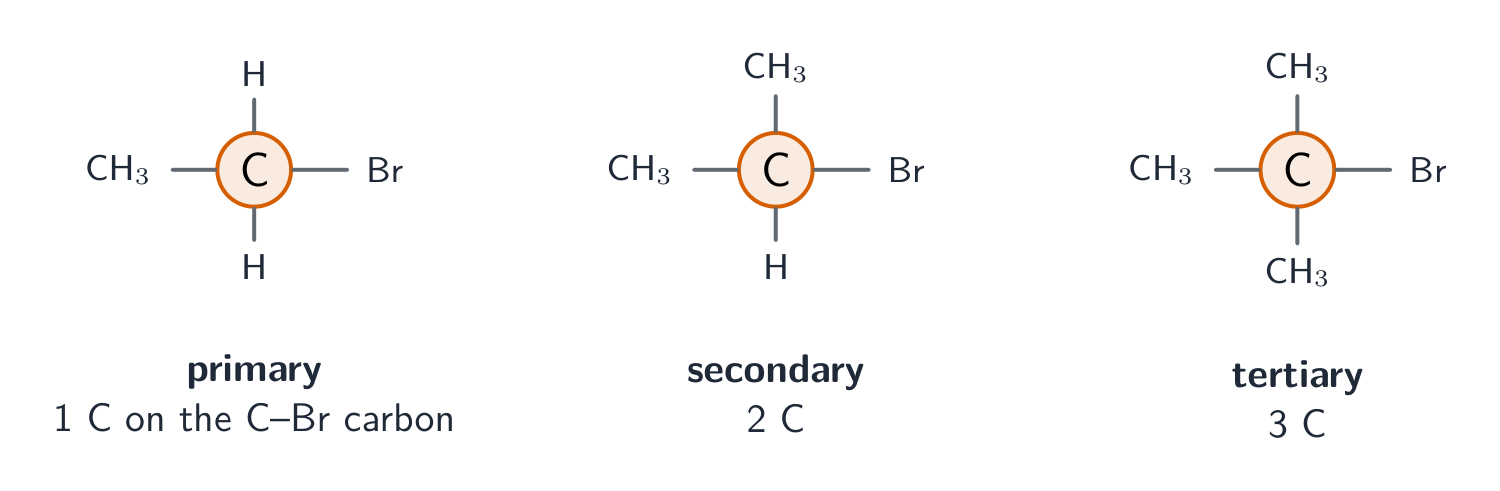
- classify halogenoalkanes into primary, secondary and tertiary
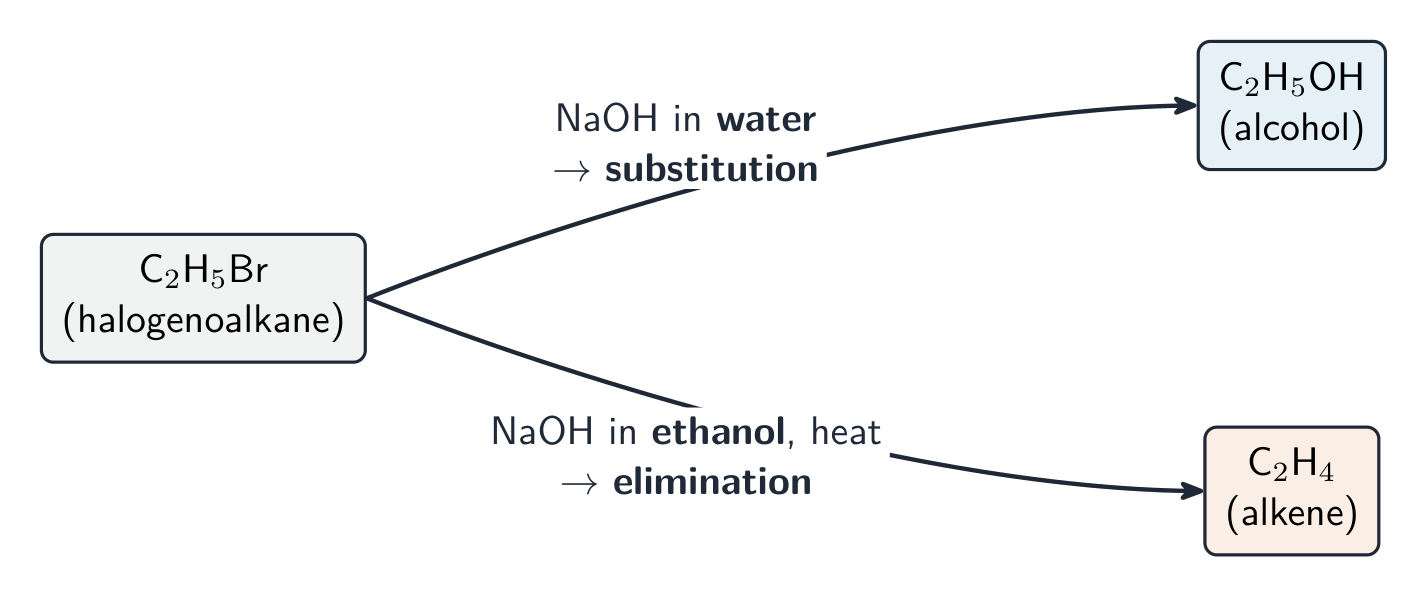
- describe the following nucleophilic substitution reactions: (a) the reaction with $\text{NaOH(aq)}$ and heat to produce an alcohol (b) the reaction with $\text{KCN}$ in ethanol and heat to produce a nitrile (c) the reaction with $\text{NH}_3$ in ethanol heated under pressure to produce an amine (d) the reaction with aqueous silver nitrate in ethanol as a method of identifying the halogen present as exemplified by bromoethane
- describe the elimination reaction with $\text{NaOH}$ in ethanol and heat to produce an alkene as exemplified by bromoethane
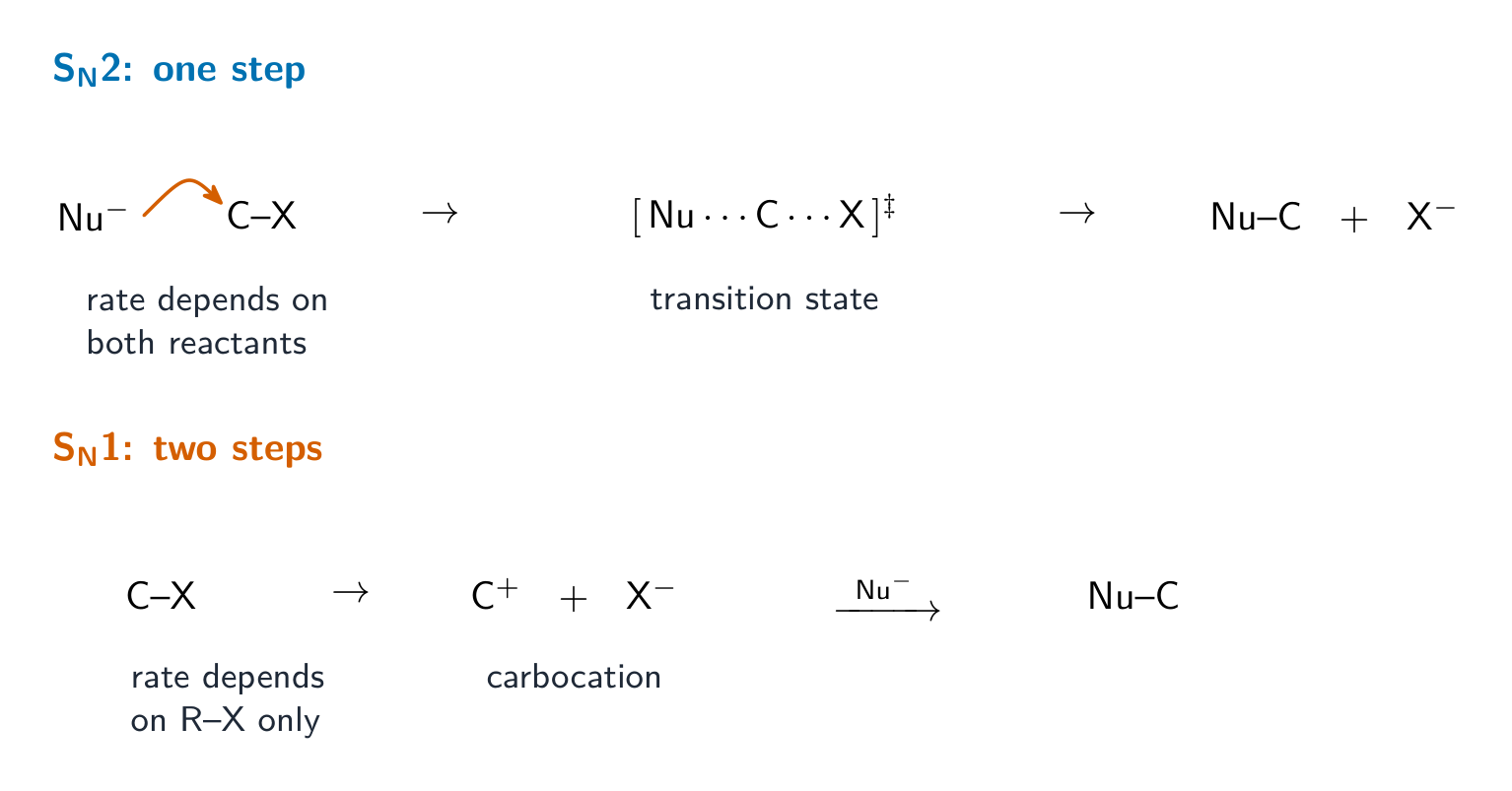
- describe the $\text{S}_\text{N}1$ and $\text{S}_\text{N}2$ mechanisms of nucleophilic substitution in halogenoalkanes including the inductive effects of alkyl groups
- recall that primary halogenoalkanes tend to react via the $\text{S}_\text{N}2$ mechanism; tertiary halogenoalkanes via the $\text{S}_\text{N}1$ mechanism; and secondary halogenoalkanes by a mixture of the two, depending on structure
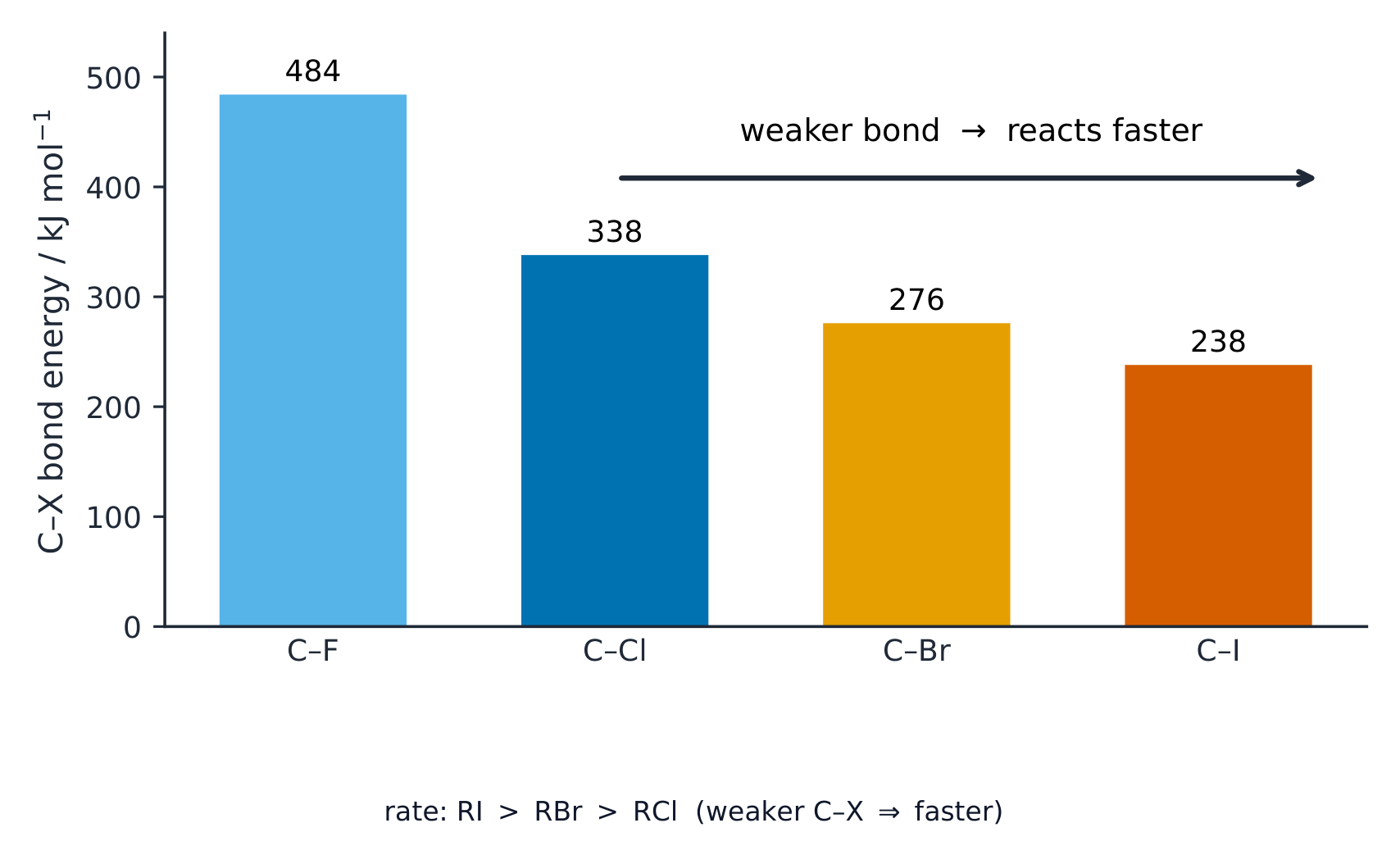
- describe and explain the different reactivities of halogenoalkanes (with particular reference to the relative strengths of the C–X bonds as exemplified by the reactions of halogenoalkanes with aqueous silver nitrates)
Bahasa Indonesia
- ingat kembali reaksi (reagen dan kondisi) melalui mana halogenoalkana dapat diproduksi: (a) substitusi radikal bebas alkana oleh $\text{Cl}_2$ atau $\text{Br}_2$ dalam kehadiran cahaya ultraviolet, seperti yang ditunjukkan oleh reaksi etana (b) penambahan elektrofilik alkena dengan halogen, $\text{X}_2$, atau hidrogen halida, $\text{HX(g)}$ pada suhu ruang (c) substitusi alkohol, misalnya dengan reaksi terhadap $\text{HX(g)}$; atau dengan $\text{KCl}$ dan $\text{H}_2\text{SO}_4$ pekat atau $\text{H}_3\text{PO}_4$ pekat; atau dengan $\text{PCl}_3$ dan panas; atau dengan $\text{PCl}_5$; atau dengan $\text{SOCl}_2$
- klasifikasikan halogenoalkana ke dalam primer, sekunder dan tertier
- deskripsikan reaksi substitusi nukleofilik berikut: (a) reaksi dengan $\text{NaOH(aq)}$ dan panas untuk menghasilkan alkohol (b) reaksi dengan $\text{KCN}$ dalam etanol dan panas untuk menghasilkan nitril (c) reaksi dengan $\text{NH}_3$ dalam etanol dipanaskan di bawah tekanan untuk menghasilkan amina (d) reaksi dengan silver nitrat berair dalam etanol sebagai metode identifikasi halogen yang ada sebagai contoh bromoetana
- deskripsikan reaksi eliminasi dengan $\text{NaOH}$ dalam etanol dan panas untuk menghasilkan alkena sebagai contoh bromoetana
- deskripsikan mekanisme $\text{S}_\text{N}1$ dan $\text{S}_\text{N}2$ dari substitusi nukleofilik pada halogenoalkana termasuk efek induktif gugus alkil
- ingat kembali bahwa halogenoalkana primer cenderung bereaksi melalui mekanisme $\text{S}_\text{N}2$; halogenoalkana tersier melalui mekanisme $\text{S}_\text{N}1$; dan halogenoalkana sekunder melalui campuran keduanya, tergantung struktur
- deskripsikan dan jelaskan reaktivitas yang berbeda dari halogenoalkana (dengan merujuk khusus pada kekuatan relatif ikatan C–X seperti yang ditunjukkan oleh reaksi halogenoalkana dengan silver nitrat berair)