Sebelum rontgen lambung, pasien diminta meminum cairan putih kental. Cairan itu penuh dengan barium — dan ion barium bersifat beracun. Menelan garam barium yang larut…
English narration · English + 中文 subtitles burned in · Narasi bahasa Inggris · Subtitle bahasa Inggris + 中文 disematkan langsung
10.1
The Group 2 metals · Logam Kelompok 2
Syllabus · Silabus
English
describe, and write equations for, the reactions of the elements with oxygen, water and dilute hydrochloric and sulfuric acids
describe, and write equations for, the reactions of the oxides, hydroxides and carbonates with water and dilute hydrochloric and sulfuric acids
describe, and write equations for, the thermal decomposition of the nitrates and carbonates, to include the trend in thermal stabilities
describe, and make predictions from, the trends in physical and chemical properties of the elements involved in the reactions in 10.1.1 and the compounds involved in 10.1.2, 10.1.3 and 10.1.5
state the variation in the solubilities of the hydroxides and sulfates
Bahasa Indonesia
deskripsikan, dan tuliskan persamaan untuk, reaksi unsur dengan oksigen, air, serta asam hidroklorida dan sulfat encer
deskripsikan, dan tuliskan persamaan untuk, reaksi oksida, hidroksida, dan karbonat dengan air, serta asam hidroklorida dan sulfat encer
deskripsikan, dan tuliskan persamaan untuk, dekomposisi termal nitrat dan karbonat, termasuk stabilitas termal
deskripsikan, dan buat prediksi dari, tren dalam sifat fisik dan kimia unsur yang terlibat dalam reaksi 10.1.1 dan senyawa yang terlibat dalam 10.1.2, 10.1.3, dan 10.1.5
nyatakan variasi kelarutan hidroksida dan sulfat
Source: Cambridge International syllabus · Sumber: Silabus Cambridge International
English
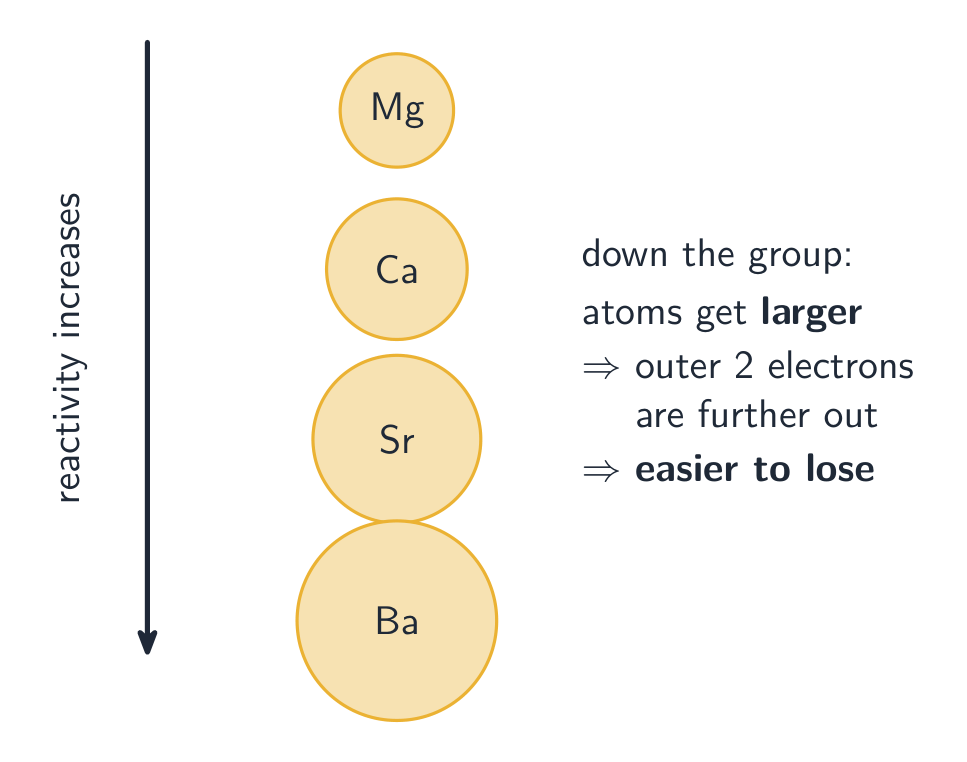
Group 族 2 holds the metals magnesium, calcium, strontium and barium. They all have two outer electrons, which they lose to form $2+$ ions. Going down the group, the atoms get larger and the outer electrons are easier to lose, so the metals get more reactive — their reactivity 反应活性 increases down the group.
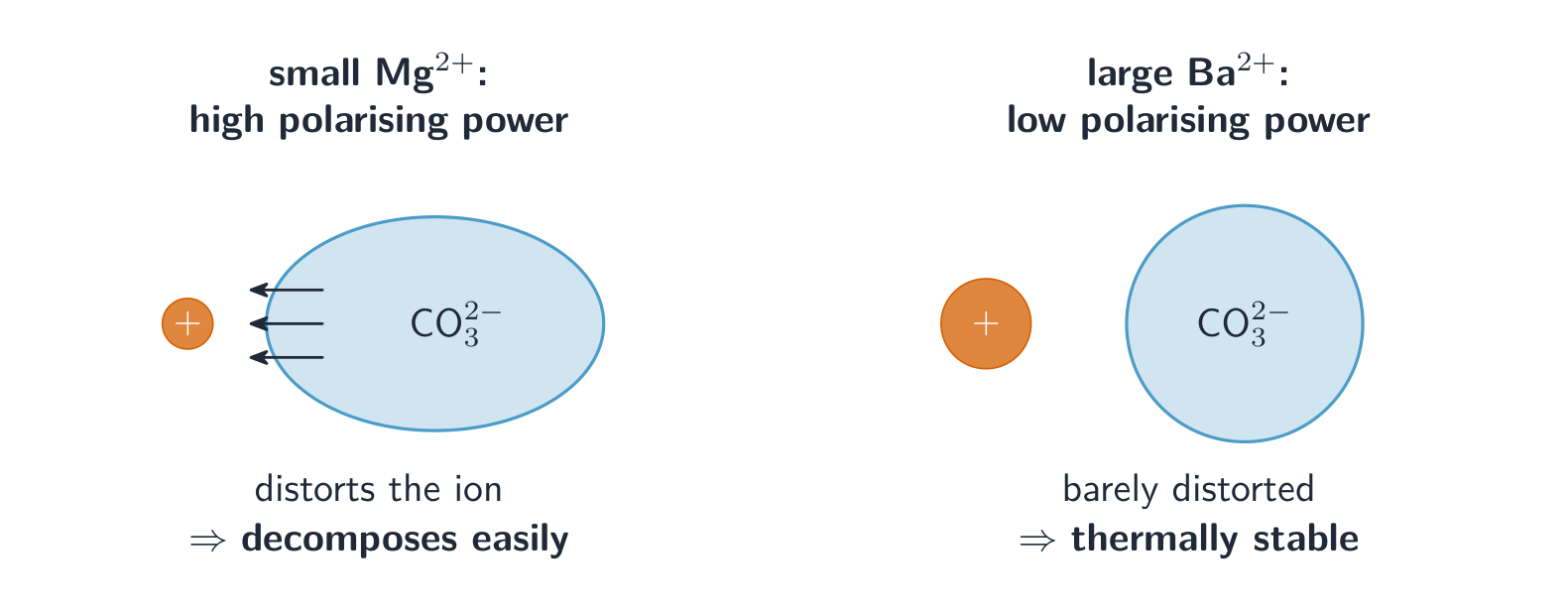
The thermal stability 热稳定性 of both the carbonates and the nitrates increases down the group. A larger metal ion pulls less on the carbonate or nitrate ion, so the compound is harder to break apart — it needs a higher temperature. So magnesium carbonate decomposes most easily, and barium carbonate is the hardest.
Trends in solubility
Compound
Trend in solubility 溶解度 down the group
hydroxides
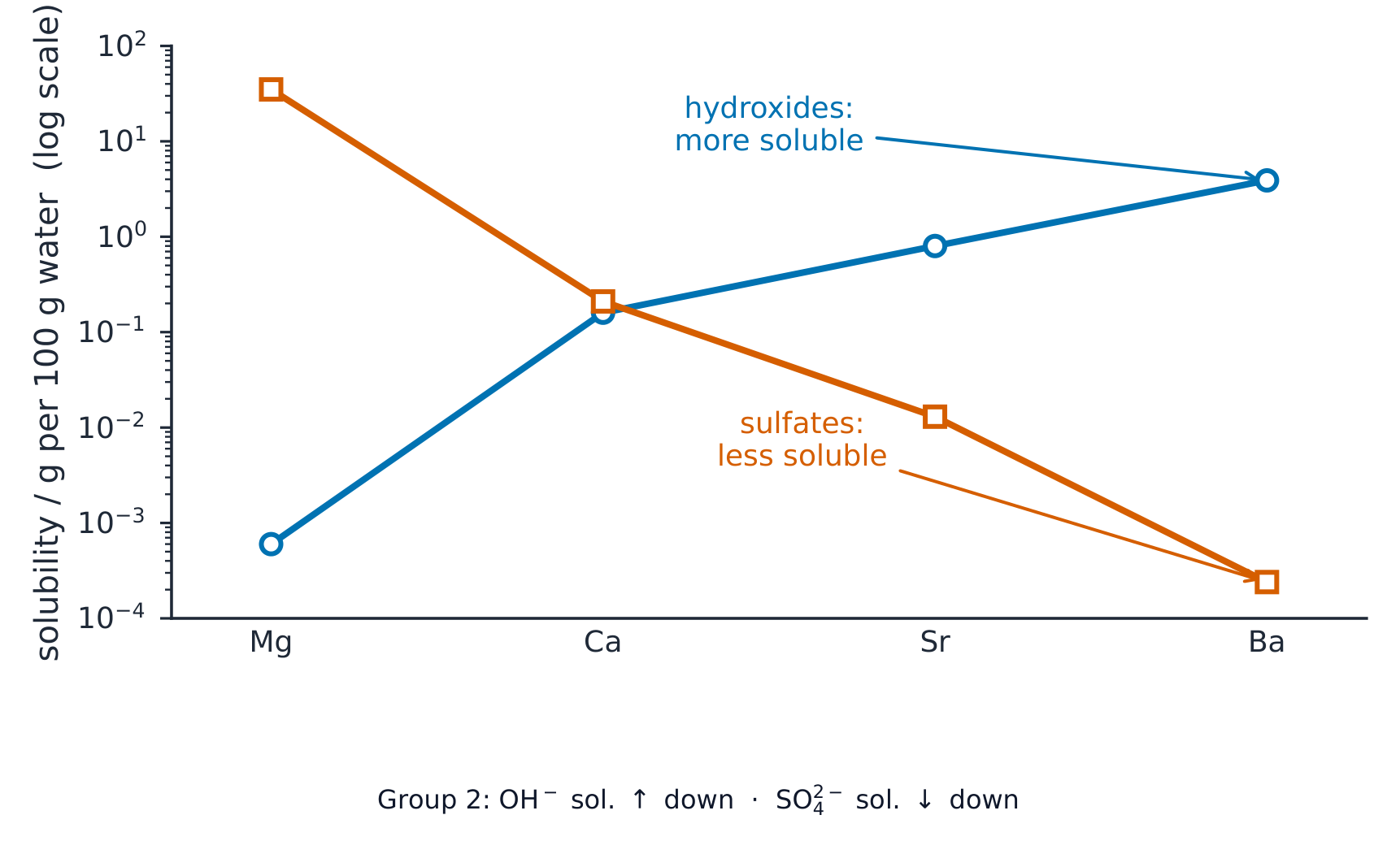
increase (Mg(OH)$_2$ almost insoluble; Ba(OH)$_2$ soluble)
sulfates
decrease (MgSO$_4$ soluble; BaSO$_4$ insoluble)
From these trends you can predict the properties of the next element down, radium, and of its compounds.
Worked example.$\text{MgCO}_3$ decomposes at about $540\ °\text{C}$ and $\text{BaCO}_3$ at about $1360\ °\text{C}$. Explain the trend and predict where $\text{CaCO}_3$ sits. Going down Group 2 the cation gets larger, so its charge is spread over a bigger surface and its polarising power falls. A less polarising cation distorts the carbonate ion less, so the $\text{C-O}$ bond is weakened less and more heat is needed to break it. Thermal stability therefore increases down the group, and $\text{CaCO}_3$, lying between Mg and Ba, decomposes at an intermediate temperature of about $900\ °\text{C}$. Argue the whole chain - cation size, then polarising power, then distortion of the anion; "it is more reactive" explains nothing here.
Bahasa Indonesia
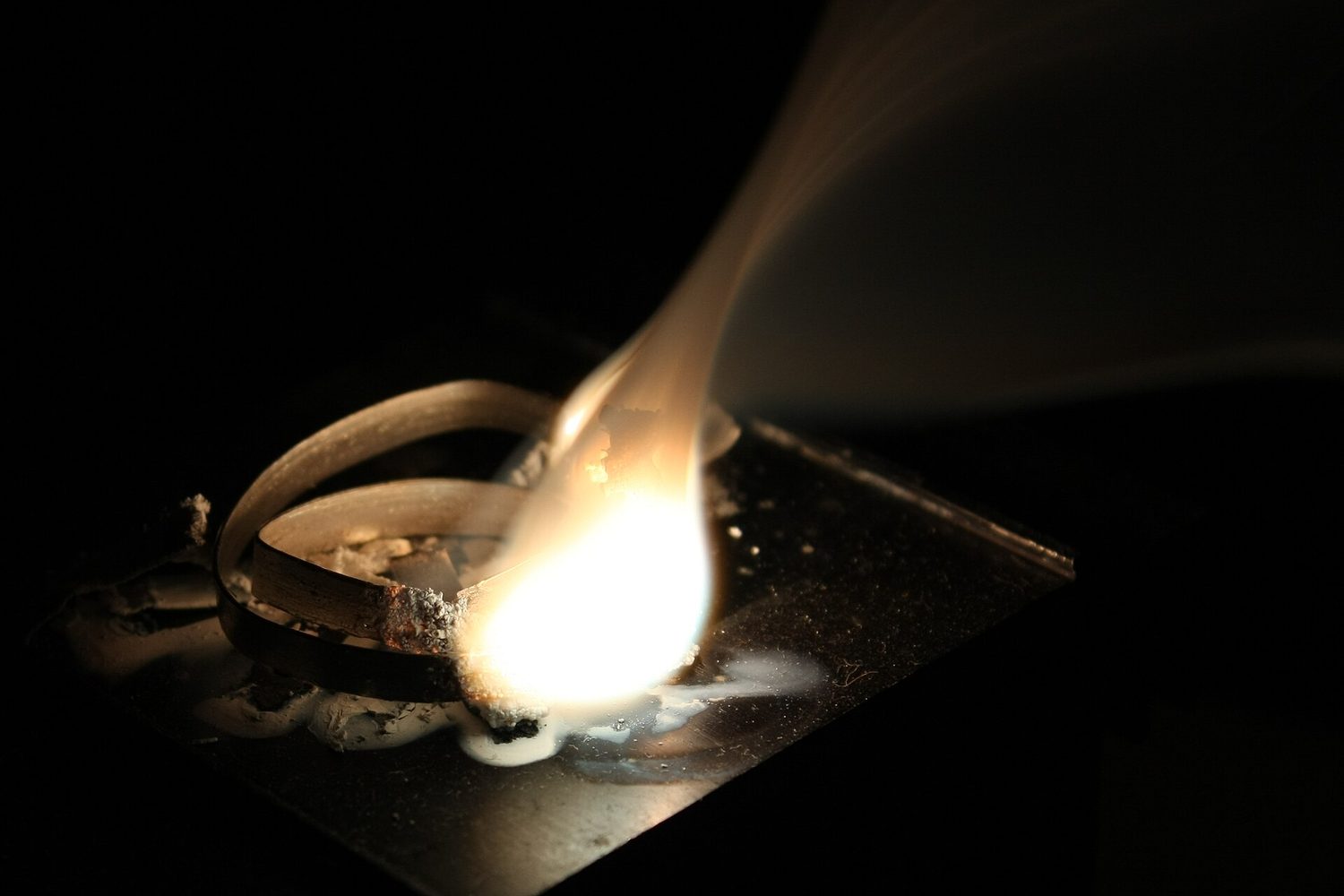
Kapur adalah kalsium karbonat — senyawa logam Kelompok 2 yaitu kalsium.
Golongan 2 mencakup logam magnesium, kalsium, stronsium, dan barium. Semua logam memiliki dua elektron terluar yang dilepaskan untuk membentuk ion $2+$. Menurun menuju bawah golongan, atom menjadi lebih besar dan elektron terluar lebih mudah dilepas, sehingga logam menjadi lebih reaktif—reaktivitas mereka meningkat ke arah bawah golongan.
Reaktivitas meningkat dari atas ke bawah Kelompok 2: atom yang lebih besar menahan dua elektron valensinya kurang kuat, sehingga lebih mudah dilepas
Stabilitas termal baik karbonat maupun nitrat meningkat dari atas ke bawah. Ion logam yang lebih besar menarik lebih lemah pada ion karbonat atau nitrat, sehingga senyawa lebih sulit dipecah — membutuhkan suhu lebih tinggi. Jadi magnesium karbonat paling mudah terurai, dan barium karbonat paling sulit.
Stabilitas termal naik dari atas ke bawah: kation kecil memolarisasi (mendistorsi) ion karbonat lebih banyak, melemahkannya sehingga lebih mudah terurai
Tren kelarutan
Senyawa
Tren kelarutan dari atas ke bawah
hidroksida
meningkat (Mg(OH)$_2$ hampir tidak larut; Ba(OH)$_2$ larut)
sulfat
menurun (MgSO$_4$ larut; BaSO$_4$ tidak larut)
Dari atas ke bawah Kelompok 2, hidroksida menjadi lebih larut sementara sulfat menjadi kurang larut (perhatikan skala log)
Dari tren-tren ini Anda dapat memprediksi sifat elemen berikutnya dari atas, radium, dan senyawa-senyawanya.
Contoh terpecahkan.$\text{MgCO}_3$ terurai pada sekitar $540\ °\text{C}$ dan $\text{BaCO}_3$ pada sekitar $1360\ °\text{C}$. Jelaskan tren ini dan ramalkan posisi $\text{CaCO}_3$. Turun Group 2, kation menjadi lebih besar, sehingga muatannya tersebar di permukaan yang lebih luas dan daya polarisasinya menurun. Kation dengan daya polarisasi lebih rendah mendistorsi ion karbonat lebih sedikit, sehingga ikatan $\text{C-O}$ melemah lebih sedikit dan membutuhkan lebih banyak panas untuk memutusnya. Oleh karena itu, stabilitas termal menurun ke bawah grup, dan $\text{CaCO}_3$, yang terletak antara Mg dan Ba, terurai pada suhu perantara sekitar $900\ °\text{C}$. Argumenkan seluruh rantai - ukuran kation, kemudian daya polarisasi, kemudian distorsi anion; "lebih reaktif" tidak menjelaskan apa-apa di sini.
Explore · Jelajahi
Group 2 reactivity ladder · Tangga reaktivitas Golongan 2
Move down Group 2 and see why reactions become more vigorous. · Gerak turun Golongan 2 dan lihat mengapa reaksi menjadi lebih vigorous.
Explore · Jelajahi
Group 2 trend lab · Lab tren Golongan 2
Compare thermal stability and solubility trends down Group 2. · Bandingkan tren stabilitas termal dan kelarutan ke bawah Golongan 2.
Pick one and the site follows you — notes, papers, videos and practice all open on it. · Pilih satu dan situs mengikuti Anda — catatan, kertas, video, dan latihan semua terbuka di sana.
Type to search notes, lessons, code, vocabulary and past-paper questions across every subject. · Ketik untuk mencari catatan, pelajaran, kode, kosakata, dan pertanyaan soal lama di setiap mata pelajaran.