מזרק אבן בברכה והגלים מתפשטים החוצה. אבל צפו על עלי שטוח על הפנים – הוא רק זז מעלה ומטה; הוא לא נע יחד עם הגליגולים.…
English narration · English + 中文 subtitles burned in · קריאת קול באנגלית · תרגום אנגלי + סינית שרוף בתוך הסרטון
3.1
General properties of waves · תכונות כלליות של גלים
Syllabus · סיילבוס
English
Core
Supplement
1 Know that waves transfer energy without transferring matter
2 Describe what is meant by wave motion as illustrated by vibrations in ropes and springs, and by experiments using water waves
3 Describe the features of a wave in terms of wavefront, wavelength, frequency, crest (peak), trough, amplitude and wave speed
4 Recall and use the equation for wave speed $v = f \lambda$
5 Know that for a transverse wave, the direction of vibration is at right angles to the direction of propagation and understand that electromagnetic radiation, water waves and seismic S-waves (secondary) can be modelled as transverse
6 Know that for a longitudinal wave, the direction of vibration is parallel to the direction of propagation and understand that sound waves and seismic P-waves (primary) can be modelled as longitudinal
7 Describe how waves can undergo: (a) reflection at a plane surface (b) refraction due to a change of speed (c) diffraction through a narrow gap
9 Describe how wavelength and gap size affects diffraction through a gap
8 Describe the use of a ripple tank to show: (a) reflection at a plane surface (b) refraction due to a change in speed caused by a change in depth (c) diffraction due to a gap (d) diffraction due to an edge
10 Describe how wavelength affects diffraction at an edge
עברית
ליבה
תוספת
1 ידוע כי גלים מעבירים אנרגיה ללא העברת חומר
2 תאר מה מתכוונים בתנועת גל כפי שמומחש על ידי רעידות בחבל ובקפיצים, וכן על ידי ניסויים עם גלי מים
3 תאר את מאפייני הגל במונחים חזית גל, אורך גל, תדירות, שיא (פסגה), שפל, משרעת ומהירות גל
4 זכור והשתמש במשוואה עבור מהירות גל $v = f \lambda$
5 דע כי בגל רוחבי, הכיוון של הרעידה הוא מאונך לכיוון ההתפשטות, והבן שקרינה אלקטרומגנטית, גלי מים וגלי S סיסמיים (משניים) יכולים להיות מודלים כגלים רוחביים
6 דע כי בגל אורכי, הכיוון של הרעידה מקביל לכיוון ההתפשטות, והבן שגלי קול וגלי P סיסמיים (ראשוניים) יכולים להיות מודלים כגלים אורכיים
7 תאר כיצד גלים יכולים לחוות: (א) החזרה על פני מישור (ב) שבירה עקב שינוי מהירות (ג) דיפרקציה דרך חריץ צר
9 תאר כיצד אורך גל וגודל החריץ משפיעים על דיפרקציה דרך חריץ
8 תאר את השימוש באגן גלים כדי להציג: (א) החזרה על פני מישור (ב) שבירה עקב שינוי מהירות הנגרם משינוי בעומק (ג) דיפרקציה עקב חריץ (ד) דיפרקציה עקב קצה
10 תאר כיצד אורך גל משפיע על דיפרקציה בקצה
Source: Cambridge International syllabus · מקור: הסיילבוס הבינלאומי של קמבריד'ג'
English
Transverse vs longitudinal waves
A wave 波 carries energy 能量 from place to place without carrying matter. For example, a water wave makes a floating cork bob up and down, but the cork does not travel along with the wave. You can make a wave on a rope by shaking one end up and down, or on a long spring by pushing one end back and forth. In a ripple tank 波纹水槽 (a shallow tray of water with a light above it) you can watch water waves on a screen below.
Describing a wave
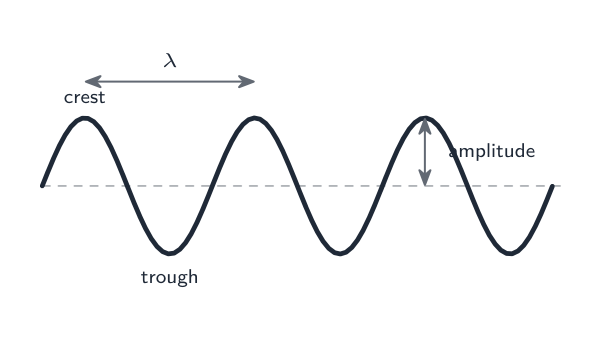
wavefront 波前: a line joining points on a wave that move together (for example, the top of one ripple)
wavelength 波长 ($\lambda$): the distance between two neighbouring wavefronts (one full wave)
frequency 频率 ($f$): the number of waves passing a point each second, measured in hertz (Hz)
crest 波峰 (also called the peak 峰, the top) and trough 波谷 (bottom)
amplitude 振幅: the largest distance a point moves from its rest position
wave speed 波速 ($v$): how fast a wavefront travels
These are linked by the wave equation:
$$v = f\lambda$$
Worked example. A sound wave travels at $340\ \text{m/s}$ and has a frequency of $170\ \text{Hz}$. Find its wavelength.
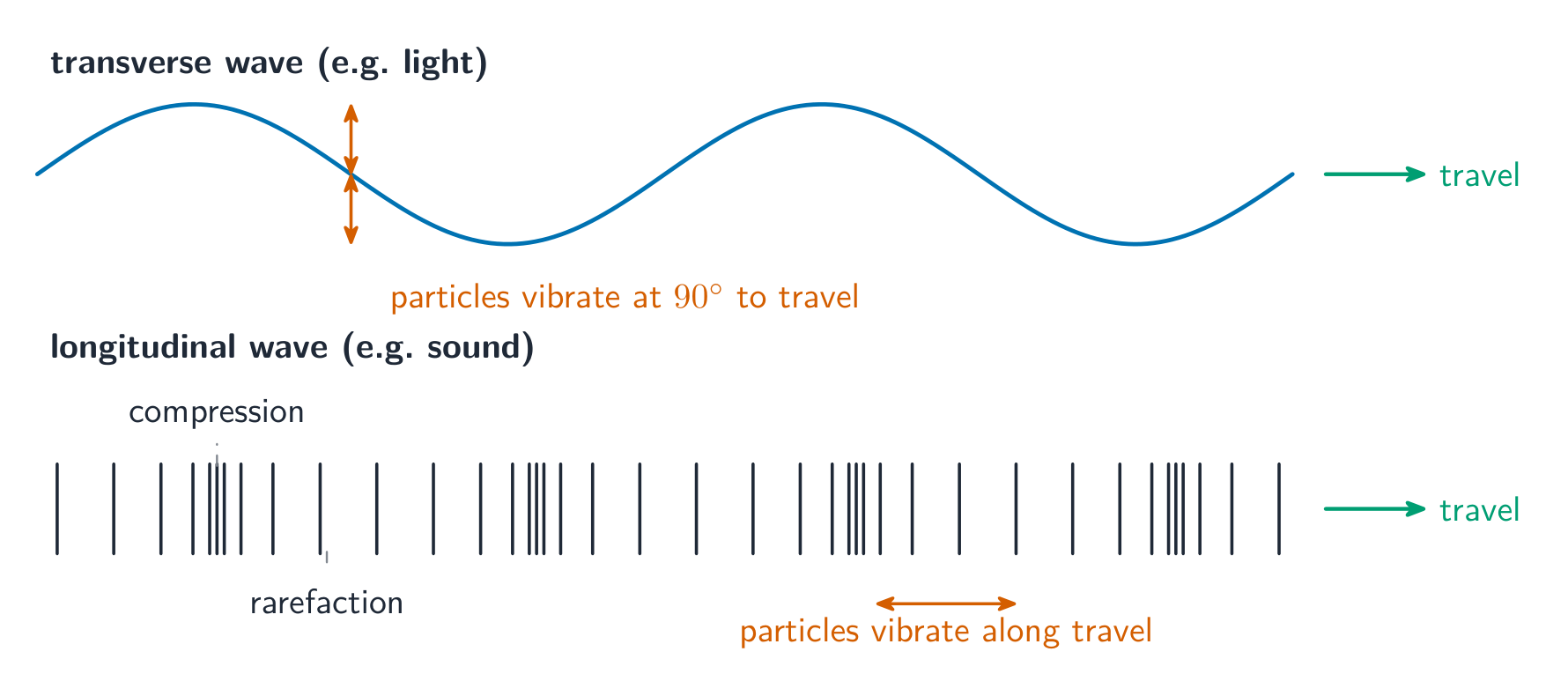
In a transverse wave 横波 the particles vibrate at right angles (90°) to the direction the wave travels (its propagation 传播). Light, water waves and seismic S-waves (the sideways shaking in an earthquake) are transverse.
In a longitudinal wave 纵波 the particles vibrate along the same direction as the wave travels. Sound and seismic P-waves are longitudinal.
Wave behaviour
All waves can show three behaviours, which you can see in a ripple tank:
reflection 反射: the wave bounces off a surface.
refraction 折射: the wave changes speed (and usually direction) when it enters a different material or depth.
diffraction 衍射: the wave spreads out after passing through a gap or around an edge. The spreading is greatest when the gap is about the same size as the wavelength.
עברית
גלים רוחביים מול אורכיים
גל מעביר אנרגיה ממקום למקום בלי להעביר חומר. לדוגמה, גל מים גורם לקרקפת צפה לבצע תנועה עליון-תחתון, אך הקרקפת אינה נעתנת יחד עם הגל. ניתן ליצור גל על חבל על ידי ניעור קצה אחד למעלה ולמטה, או על קפיץ ארוך על ידי דחיפה של קצה אחד קדימה ואחורה. באגן גלים (מגש רד עם מים ותאורה מעליו) ניתן לצפות בגלי מים על מסך התחתון.
תיאור גל
חזית גל: קו המחבר נקודות בגל הנעות יחד (למשל, הפסגה של גל גליל אחד)
אורך גל ($\lambda$): המרחק בין שתי חזיתות גל סמוכות (גל מלא אחד)
תדר ($f$): מספר הגלים העוברים נקודה נתונה בכל שנייה, נמדד בהרץ (Hz)
פסגה (נקראת גם שיא, החלק העליון) ושוואה (החלק התחתון)
משרעת: המרחק הגדול ביותר שמנקודה נעתקת ממנו ממצב השקט שלה
מהירות גל ($v$): האופן שבו חזית גל נעתקת
חלקי הגל: אורך גל, רמת תנודה, פסגה ושפל
אלמנטים אלו קשורים זה לזה על ידי משוואת הגל:
$$v = f\lambda$$
האורך הוא המרחק בין שתי פסגות; המשרעת היא הגובה ממצב השקט ועד לפסגה
דוגמה מופתרת. גל קול נע ב$340\ \text{m/s}$ והתדר שלו הוא $170\ \text{Hz}$. מצאו את אורך הגל.
העברת $v = f\lambda$ מניבה $\lambda = \dfrac{v}{f}$:
$$\lambda = \frac{340}{170} = 2.0\ \text{m}$$
שני סוגי גלים
בגל רוחבי חלקיקים רועדים במאונך (90°) לכיוון התנועה של הגל (התפשטות). אור, גלי מים וגלי S זلزליים (רעידת הצד באירוע זלזלי) הם גלים רוחביים.
בגל אורכי חלקיקים רועדים לאורך אותו כיוון שבו הגל נע. קול וגלי P זلزליים הם גלים אורכיים.
בגל רוחבי החלקיקים רועדים מאונך לכיוון התנועה; בגל אורכי הם רועדים לאורכו, ויוצרים דחיסות והתקממויות
התנהגות גלים
כל הגלים יכולים להציג שלושה סוגי התנהגויות, אותן ניתן לראות בבריכת גלים:
השתקפות: הגל קופץ על פני משטח.
שבירה: הגל משנה את מהירותו (ובדרך כלל גם כיוונו) כאשר הוא נכנס לחומר או לעומק שונים.
עיפוף: הגל מתפזר לאחר שעבר דרך פתח או סביב קצה. ההתפזרות היא הגדולה ביותר כאשר גודל הפתח הוא בערך זהה לאורך הגל.
גלי מישוריים העוברים דרך פתח צר מתפשטים לגלים עקומים — הדיפרציה חזקה ביותר כאשר רוחב הפתח הוא בערך אורך גל אחדגלים מישוריים בבריכת גלים משתקפים מחוסום ישר: חזיתות הגל המשתקפות יוצאות בזווית זהה לזו שהגיעו בה
Explore · חקור
Properties of waves · תכונות גלים
y = a sin(bx + c)
A wave: a is amplitude, b sets the wavelength. · גל: a הוא המשרעת, b קובע את אורך הגל.
Flip between a transverse wave (particles bob up and down, like water and light) and a longitudinal one (particles slide back and forth, bunching into compressions, like sound). The wave moves; the particles stay put. · מעבר בין גל רוחבי (חלקיקים מזנקים ומורידים, כמו במים ובאור) לגל ארוכי (חלקיקים נעים ימינה ושמאלה, צפופים ליצירת דחיסות, כמו בקול). הגל נע; החלקיקים נשארים במקום.
Explore · חקור
Two waves overlapping · שתי גלים חופפים
Change the second wave. Where waves meet they add — sometimes reinforcing, sometimes cancelling. · שנו את הגל השני. כאשר גלים נפגשים הם מתחברים – לעיתים מחזקים זה את זה ולעיתים מבטלים זה את זה.
1 Define and use the terms normal, angle of incidence and angle of reflection
2 Describe the formation of an optical image by a plane mirror and give its characteristics, i.e. same size, same distance from mirror, virtual
3 State that for reflection, the angle of incidence is equal to the angle of reflection; recall and use this relationship
4 Use simple constructions, measurements and calculations for reflection by plane mirrors
3.2.2 Refraction of light
Core
Supplement
1 Define and use the terms normal, angle of incidence and angle of refraction
2 Describe an experiment to show refraction of light by transparent blocks of different shapes
6 Define refractive index, $n$, as the ratio of the speeds of a wave in two different regions
3 Describe the passage of light through a transparent material (limited to the boundaries between two mediums only)
7 Recall and use the equation
$$n = \frac{\sin i}{\sin r}$$
4 State the meaning of critical angle
8 Recall and use the equation
$$n = \frac{1}{\sin c}$$
5 Describe internal reflection and total internal reflection using both experimental and everyday examples
9 Describe the use of optical fibres, particularly in telecommunications
3.2.3 Thin lenses
Core
Supplement
1 Describe the action of thin converging and thin diverging lenses on a parallel beam of light
2 Define and use the terms focal length, principal axis and principal focus (focal point)
3 Draw and use ray diagrams for the formation of a real image by a converging lens
6 Draw and use ray diagrams for the formation of a virtual image by a converging lens
4 Describe the characteristics of an image using the terms enlarged/same size/diminished, upright/inverted and real/virtual
7 Describe the use of a single lens as a magnifying glass
5 Know that a virtual image is formed when diverging rays are extrapolated backwards and does not form a visible projection on a screen
8 Describe the use of converging and diverging lenses to correct long-sightedness and short-sightedness
3.2.4 Dispersion of light
Core
Supplement
1 Describe the dispersion of light as illustrated by the refraction of white light by a glass prism
2 Know the traditional seven colours of the visible spectrum in order of frequency and in order of wavelength
3 Recall that visible light of a single frequency is described as monochromatic
עברית
3.2.1 החזרת אור
ליבה
תוספת
1 הגדר והשתמש במונחים נורמל, זווית פגיעה וזווית החזרה
2 תאר את היווצרות התמונה האופטית על ידי מראה שטוח ותן את מאפייניה, כלומר: אותו גודל, אותה מרחק מהמראה, וירטואלית
3 נסח כי בהחזרה, זווית הפגיעה שווה לזווית ההחזרה; זכור והשתמש בקשר זה
4 השתמש בבנייה פשוטה, מדידות וחישובים עבור החזרה על ידי מראות שטוחים
3.2.2 שבירת אור
ליבה
תוספת
1 הגדר והשתמש במונחים נורמל, זווית פגיעה וזווית שבירה
2 תאר ניסוי להראות שבירת אור על ידי בלוקים שקופים בצורות שונות
6 הגדר מדד שבירה, $n$, כחסר המהירויות של גל בשתי אזורים שונים
3 תאר מעבר האור דרך חומר שקוף (במגבלת הגבולות בין שני תווכים בלבד)
7 זכור והשתמש במשוואה
$$n = \frac{\sin i}{\sin r}$$
4 נסח את המשמעות של זווית קריטית
8 זכור והשתמש במשוואה
$$n = \frac{1}{\sin c}$$
5 תאר החזרה פנימית והחזרה פנימית מלאה באמצעות דוגמאות ניסוייות ואופייניות
9 תאר את השימוש בסיבים אופטיים, במיוחד בתקשורת
3.2.3 עדשות דקות
ליבה
תוספת
1 תאר את השפעת עדשות דקות מכנסות ועדשות דקות מפיצות על קרן אור מקבילה
2 הגדר ושתמש במונחים אורך מוקד, ציר ראשי ומוקד ראשי (נקודת המוקד)
3 צייר והשתמש במערכות קרניים ליצירת תמונה אמיתית על ידי עדשה מכנסת
6 צייר והשתמש במערכות קרניים ליצירת תמונה זולה על ידי עדשה מכנסת
4 תאר מאפייני תמונה באמצעות המונחים: מוגדל/אותו גודל/מוקטן, זקוף/הפוך ואמיתי/זול
7 תאר את השימוש בעדשה יחידה כמגדלת
5 לדעת כי תמונה זולה נוצרת כאשר קרנים מופיעות מוארכות לאחור ואינה יוצרת הצלמה נראית על מסך
8 תאר את השימוש בעדשות מכנסות ומפיצות לתיקון ראייה רחוקה וקצרה
3.2.4 פיזור אור
ליבה
תוספת
1 תאר את פיזור האור כפי שמוצג על ידי שבירה של אור לבן על ידי משולש זכוכית
2 לדעת את שבעת הצבעים המסורתיים של הספקטרום הנראה בסדר עריכה ובסדר אורך גל
3 להיזכר שאור נראה בתדר יחיד מתואר כמונוכרומטי
Source: Cambridge International syllabus · מקור: הסיילבוס הבינלאומי של קמבריד'ג'
English
A converging lens forms an imageTotal internal reflection
Reflection
When light hits a mirror, it reflects. We measure angles from the normal 法线 (a line at 90° to the surface).
The law of reflection: the angle of incidence 入射角 equals the angle of reflection 反射角.
A plane mirror 平面镜 forms an image that is the same size as the object, the same distance behind the mirror, and virtual (it cannot be caught on a screen).
Refraction
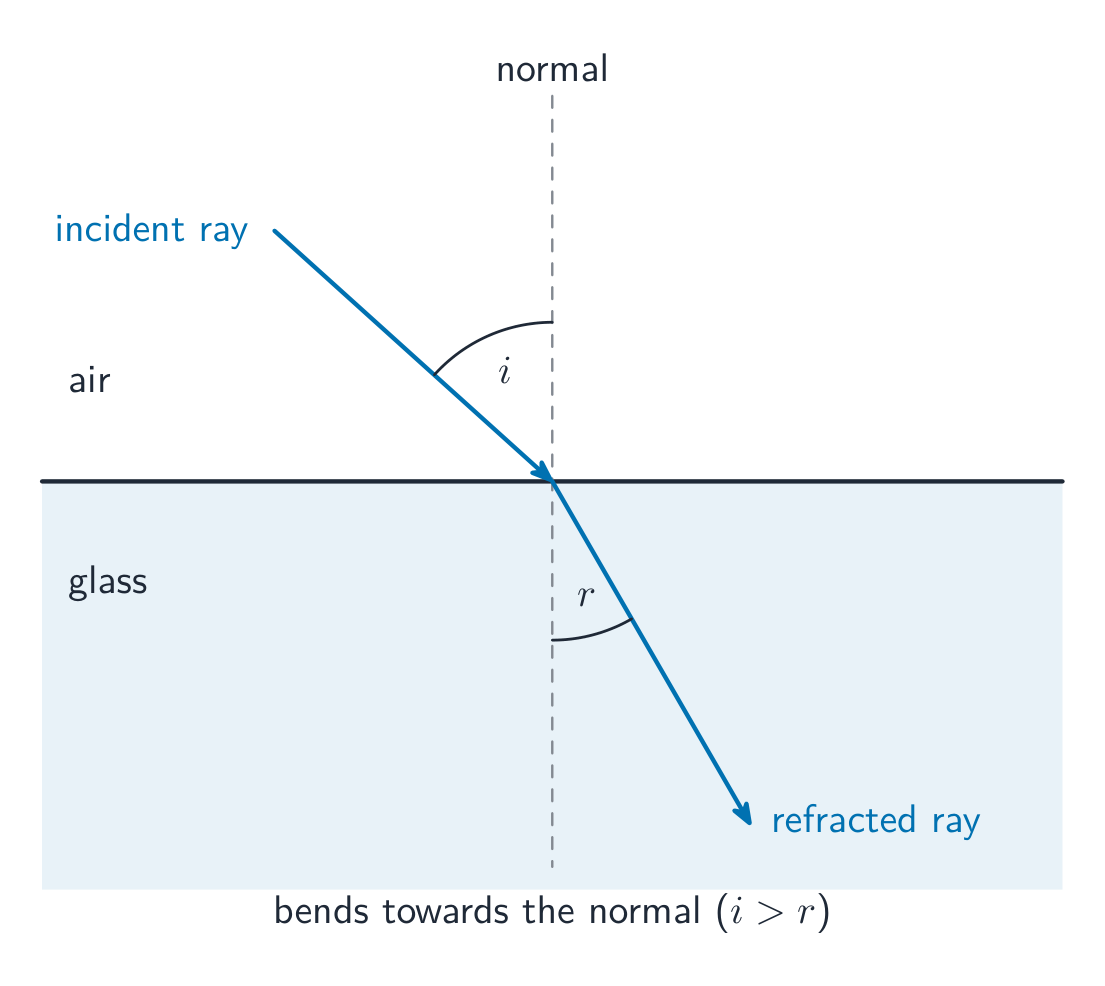
When light passes from one material into another, it changes speed and bends. The angle in the second material is the angle of refraction 折射角.
Seeing refraction. Shine a narrow ray from a ray box 光线盒 into a rectangular glass block standing on paper. Mark the ray going in and the ray coming out, remove the block, and join the marks to draw the ray inside the glass. Draw the normal where the ray enters and measure the angle of incidence and the angle of refraction with a protractor. Repeat with a semicircular block or a prism: the ray always bends towards the normal on entering the glass and away from the normal on leaving.
The refractive index 折射率$n$ compares the speed of light in the two materials:
$$n = \frac{\sin i}{\sin r}$$
Worked example. A ray of light passes from air into glass. The angle of incidence is 60° and the angle of refraction is 35°. Find the refractive index of the glass. (Take $\sin i = 0.87$ and $\sin r = 0.57$.)
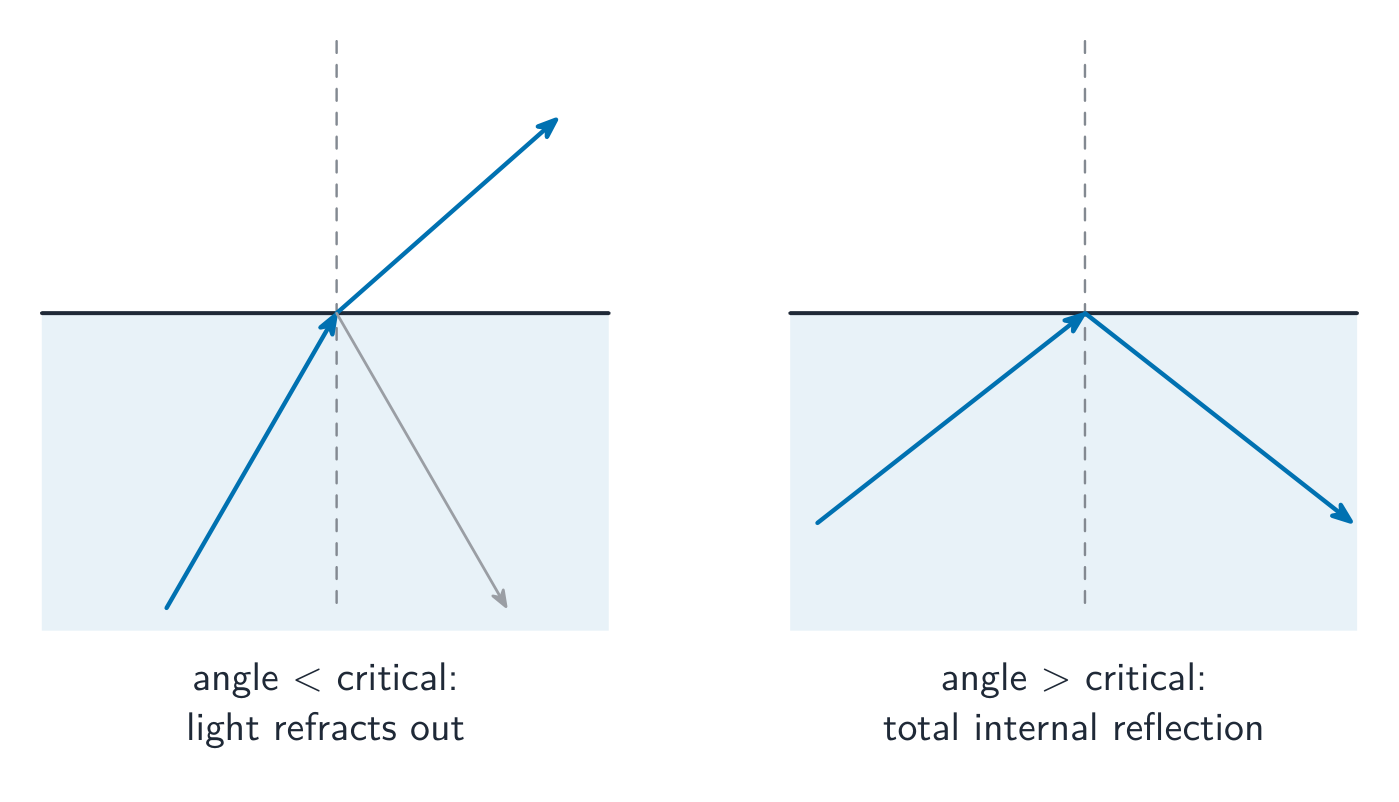
When light tries to leave glass or water and the angle is too large, it cannot get out and instead reflects completely. This is total internal reflection 全反射. It happens when the angle inside is bigger than the critical angle 临界角$c$:
$$n = \frac{1}{\sin c}$$
This effect is used in optical fibres 光纤, thin glass threads that carry light signals for telephones and the internet.
Lenses
A converging lens 凸透镜 (fat in the middle) bends parallel rays inwards to a point called the principal focus 焦点. The principal axis 主光轴 is the straight line through the centre of the lens at right angles to it; the principal focus lies on this axis. The distance from the centre of the lens to the principal focus is the focal length 焦距. A diverging lens 凹透镜 (thin in the middle) spreads parallel rays out, as if they came from a focus on the incoming side.
A converging lens can form a real image 实像 (rays really meet; can be shown on a screen) or, when the object is very close, a virtual image 虚像 (rays only seem to come from it). Used close to the eye, a converging lens is a magnifying glass 放大镜.
Describe an image with three pairs of words: enlarged 放大的 or diminished 缩小的 (or the same size), upright 正立 or inverted 倒立 (upside down), and real or virtual. An object far beyond the focus gives a diminished, inverted, real image (as in a camera). An object between the focus and the lens gives an enlarged, upright, virtual image (a magnifying glass).
Correcting sight. A person with short-sightedness 近视 sees near things clearly but distant things are blurred: the eye focuses the light in front of the retina 视网膜 (the back of the eye). A diverging lens in front of the eye spreads the rays out first, so they focus on the retina. A person with long-sightedness 远视 sees distant things clearly but near things are blurred: the eye focuses the light behind the retina. A converging lens brings the rays together a little before they enter the eye.
Dispersion
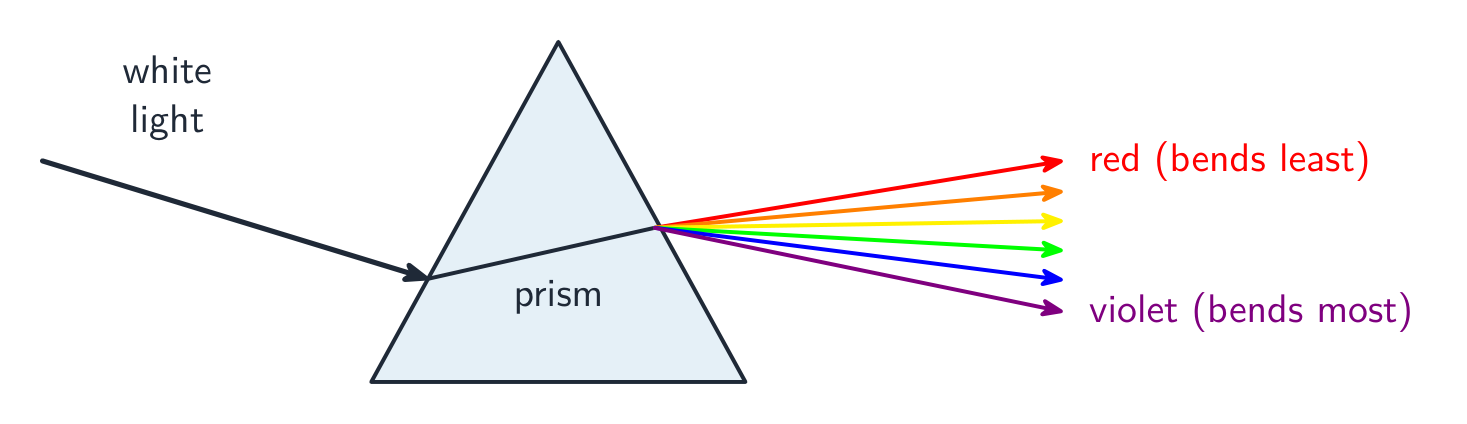
A glass prism 棱镜 splits white light into the colours of the spectrum 光谱. This splitting is called dispersion 色散.
The order of colours is red, orange, yellow, green, blue, indigo, violet. Red light has the longest wavelength and the lowest frequency; violet is the opposite. Light of a single frequency (one pure colour) is monochromatic 单色.
עברית
עדשה מתכנסת יוצרת תמונההשתכפות פנימית מלאה
השתקפות
כאשר אור פוגע במראה, הוא משתקף. אנו מדדים זוויות מהנורמל (קו ב90° למשטח).
חוק ההשתקפות: זווית הפגיעה שווה לזווית ההשתקפות.
מראה מישורית יוצרת תמונה בגודל זהה למצופה, במרחק זהה מאחורי המראה, והיא מדומה (לא ניתן לתפוס אותה על מסך).
במראה מישורית זווית הפגיעה $i$ שווה לזווית ההשתקפות $r$, שתיהן נמדדות ביחס לנורמל
שבירה
כאשר אור עובר מחומר אחד למשנהו, מהירותו משתנה והוא מתעקם. הזווית בחומר השני נקראת זווית השבירה.
בעת מעבר מאוויר לתוך זכוכית האור מאט ומתעקם לעבר הנורמל, לכן $i > r$
צפייה בשבירה. הפנה קרן צרה מתיבת קרניים אל בלוק זכוכית מלבני המונח על נייר. סמן את הקרן הנכנסת ואת הקרן היוצאת, הסר את הבלוק וחבר בין הסימונים כדי לצייר את הקרן בתוך הזכוכית. צייר את הנורמל בנקודה שבה הקרן נכנסת ומדוד את זווית ההתכה ואת זווית השבירה באמצעות סוגר-זוויות. חזור עם בלוק חצי-עיגול או פריזמה: הקרן תמיד מתעקמת לעבר הנורמל בעת הכניסה לזכוכית ורחוק ממנו בעת יציאה.
מדד השבירה$n$ משווה את מהירות האור בשני החומרים:
$$n = \frac{\sin i}{\sin r}$$
דוגמה פותרת. קרן אור עוברת מאוויר לתוך זכוכית. זווית ההתכה היא 60° וזווית השבירה היא 35°. מצא את מדד השבירה של הזכוכית. (קח $\sin i = 0.87$ ו$\sin r = 0.57$.)
כאשר אור מנסה לצאת מזכוכית או ממים והזווית גדולה מדי, הוא אינו יכול לצאת ואליו מתבצע השתקפות מלאה. זהו השתקפות פנימית מלאה. היא מתרחשת כאשר הזווית בתוך החומר גדולה יותר מזווית הקריטית$c$:
$$n = \frac{1}{\sin c}$$
מתחת לזווית הקריטית האור נשבר החוצה; מעליה האור משתקף פנימית לחלוטין
אפקט זה משמש בסיבי אופטיים, חוטים דקים מזכוכית המובילים אותות אור לטלפונים ולאינטרנט.
השתקפות פנימית מלאה שומרת על האור קופץ לאורך כל סיב עד שהוא זוהר בקצהו
עדשות
עדשה מכנסת (עבה במרכז) מעקמת קרנות מקבילות פנימה לנקודה הנקראת המיקוד הראשי. הציר הראשי הוא הקו הישר העובר במרכז העדשה מאונך לה; המיקוד הראשי נמצא על ציר זה. המרחק ממרכז העדשה למיקוד הראשי הוא המרחק הפוקסלי. עדשה מפזרת (דקה במרכז) מפזרת קרנות מקבילות כאילו הגיעו ממיקוד בצד הכניסה.
עדשה מכנסת יכולה ליצור תמונה אמיתית (קרנות מתכנסות בפועל; ניתן להציגה על מסך) או, כאשר האובייקט קרוב מאוד, תמונה וירטואלית (קרנות נראות כאילו מגיעות ממנה). שימוש קרוב לעין הופך את העדשה לכנסת לזכוכית מגדלת.
תיאר תמונה בעזרת שלושה זוגות מילים: מוגדלת או מוזערת (או באותו גודל), זקופה או הפוכה (הפוכה), ואמיתית או וירטואלית. אובייקט הרחוק מהמיקוד נותן תמונה מוזערת, הפוכה ואמיתית (כמו במצלמה). אובייקט בין המיקוד לעדשה נותן תמונה מוגדלת, זקופה וירטואלית (זכוכית מגדלת).
תיקון ראייה. אדם הסובל מקוצר ראיה רואה ברורה דברים קרובים אך דברים רחוקים מטושטשים: העין מתמקדת את האור לפני הרטינה (חלק האחורי של העין). עדשה מפזרת שמול העין מפזרת את הקרנות תחילה כך שהן מתמקדות על הרטינה. אדם הסובל מאורך ראיה רואה ברורה דברים רחוקים אך דברים קרובים מטושטשים: העין מתמקדת את האור מאחורי הרטינה. עדשה מכנסת מאחדת את הקרנות מעט לפני כניסתן לעין.
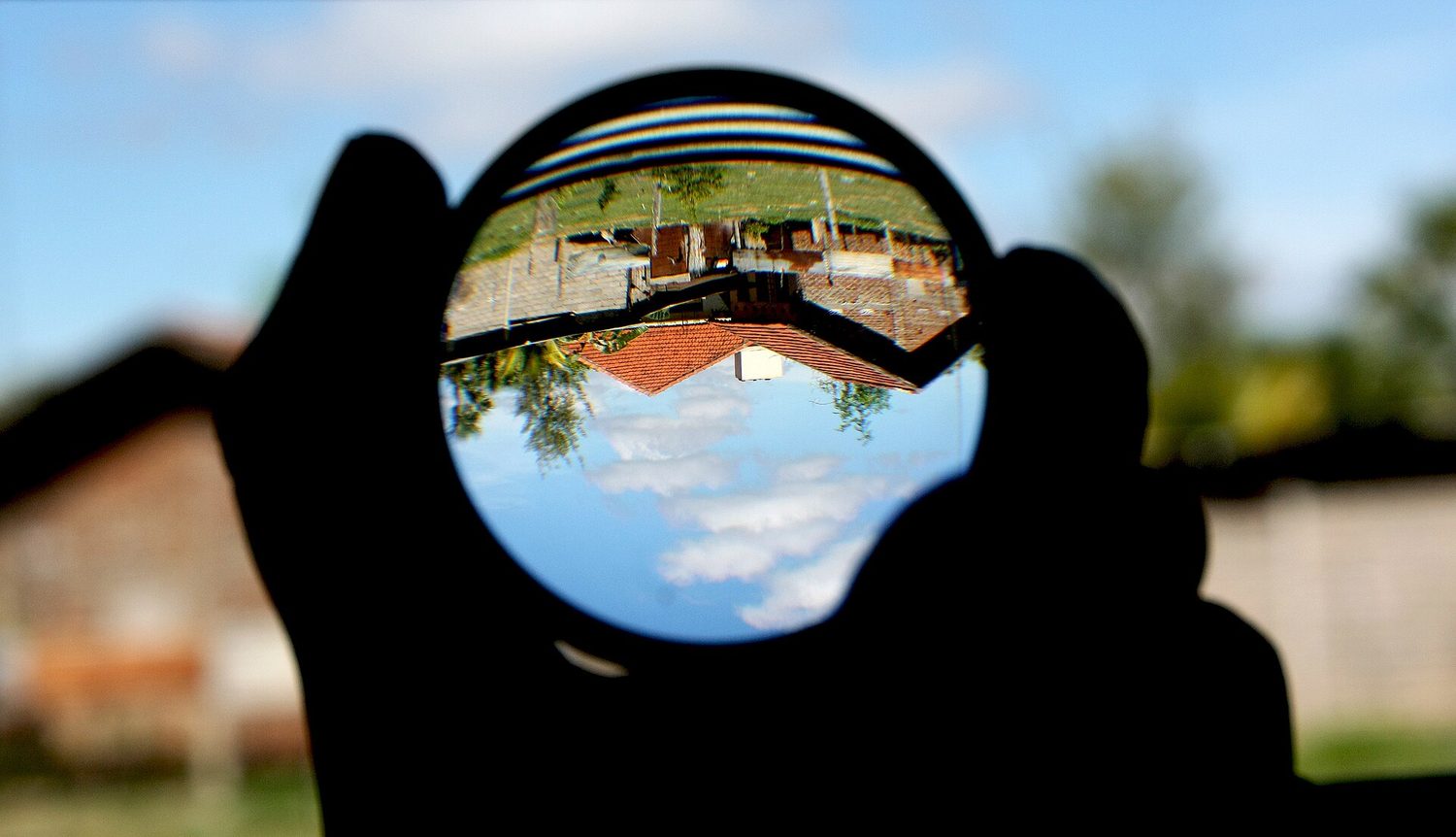
המרחק מהעין, עדשה מתכנסת יוצרת תמונה אמיתית – כאן הבתים מאחוריה נראים הפוכים
פיזור
פריזמה זכוכית מפילה אור לבן לצבעי הספקטרום. תהליך זה קרוי פיזור.
פריזמה מכניעה את האור סגול ביותר ואת האור האדום פחות מכל, ולכן אור לבן מתפשט לספקטרום
סדר הצבעים הוא אדום, כתום, צהוב, ירוק, כחול, תכלת, סגול. לאור האדום יש אורך גל ארוך ביותר ותדר נמוך ביותר; סגול הוא ההפך. אור בעל תדר בודד (צבע טהור אחד) הוא מונוכרומטי.
אור לבן הנכנס לפריזמת זכוכית אמיתית מתפשט לכל ספקטרום הצבעים
Explore · חקור
Bend a light ray · כיפוף קרן אור
Shine light into water, glass or diamond and change the angle. The ray slows and bends toward the normal — the denser the material (higher n), the more it bends. That bending is why a straw looks broken in a glass, and why diamonds sparkle. · להטיב אור לתוך מים, זכוכית או יהלום ולשנות את הזווית. הקרן מאטה ונתכופפת לעבר הנורמל — כל הרכיב הצפוף יותר (n גבוה יותר), כך יותר מתכופף. כיפוף זה הוא הסיבה לכך שמחט נראה שבור בכוס, ולמה יהלומים זוהרים.
Explore · חקור
Image formation by a converging lens · יצירת תמונה על ידי עדשה מתכנסת
Trace the three special rays from the object — where they meet is the image. Move the object closer than the focal point to flip it into a magnifying glass. · סמן את שלושת הקרניים המיוחדות מהגוף — הנקודה שבה הן נפגשות היא התמונה. הזז את הגוף קרוב יותר לנקודת המוקד כדי להפוך אותו לעדשת מגדלת.
The electromagnetic spectrum 电磁波谱 · הספקטרום האלקטרומגנטי
Syllabus · סיילבוס
English
Core
Supplement
1 Know the main regions of the electromagnetic spectrum in order of frequency and in order of wavelength
2 Know that all electromagnetic waves travel at the same high speed in a vacuum
6 Know that the speed of electromagnetic waves in a vacuum is $3.0 \times 10^8\text{ m/s}$ and is approximately the same in air
3 Describe typical uses of the different regions of the electromagnetic spectrum including: (a) radio waves; radio and television transmissions, astronomy, radio frequency identification (RFID) (b) microwaves; satellite television, mobile phones (cell phones), microwave ovens (c) infrared; electric grills, short range communications such as remote controllers for televisions, intruder alarms, thermal imaging, optical fibres (d) visible light; vision, photography, illumination (e) ultraviolet; security marking, detecting fake bank notes, sterilising water (f) X-rays; medical scanning, security scanners (g) gamma rays; sterilising food and medical equipment, detection of cancer and its treatment
4 Describe the harmful effects on people of excessive exposure to electromagnetic radiation, including: (a) microwaves; internal heating of body cells (b) infrared; skin burns (c) ultraviolet; damage to surface cells and eyes, leading to skin cancer and eye conditions (d) X-rays and gamma rays; mutation or damage to cells in the body
5 Know that communication with artificial satellites is mainly by microwaves: (a) some satellite phones use low orbit artificial satellites (b) some satellite phones and direct broadcast satellite television use geostationary satellites
7 Know that many important systems of communications rely on electromagnetic radiation including: (a) mobile phones (cell phones) and wireless internet use microwaves because microwaves can penetrate some walls and only require a short aerial for transmission and reception (b) Bluetooth uses radio waves because radio waves pass through walls but the signal is weakened on doing so (c) optical fibres (visible light or infrared) are used for cable television and high-speed broadband because glass is transparent to visible light and some infrared; visible light and short wavelength infrared can carry high rates of data
8 Know the difference between a digital and analogue signal
9 Know that a sound can be transmitted as a digital or analogue signal
10 Explain the benefits of digital signalling including increased rate of transmission of data and increased range due to accurate signal regeneration
עברית
ליבה
תוספת
1 לדעת את האזורים העיקריים של הספקטרום האלקטרומגנטי בסדר עריכה ובסדר אורך גל
2 לדעת שמכל הגלי האלקטרומגנטיים עוברים באותה מהירות גבוהה בוואקום
6 לדעת שמ מהירות הגלים האלקטרומגנטיים בוואקום היא $3.0 \times 10^8\text{ m/s}$ וכמעט זהה באוויר
3 תאר שימושים אופייניים באזורים השונים של הספקטרום האלקטרומגנטי כולל: (א) גלי רדיו; שידורי רדיו וטלוויזיה, אסטרונומיה, זיהוי בתדר רדיאו (RFID) (ב) מיקרוגל; טלוויזיה לוויינית, טלפונים ניידים (טלפונים סלולריים), תנורי מיקרוגל (ג) אינפרה-אדום; גרילים חשמליים, תקשורת בטווח קצר כמו שלטים רחוקים לטלוויזיות, אזעקות פורצים, הדמיית תרמית, סיבי אופטי (ד) אור נראה; ראייה, צילום, תאורה (ה) אולטרה-סגול; סימון ביטחוני, גילוי שטרות מזויפים, חיטוי מים (ו) קרני X; סריקות רפואיות, סורקי ביטחון (ז) קרני גמא; חיטוי מזון וציוד רפואי, גילוי סרטן וטיפול בו
4 תאר את ההשפעות הרעילות על אנשים כתוצאה מחשיפה מוגברת לקרינה אלקטרומגנטית, כולל: (א) מיקרוגל; חימום פנימי של תאי הגוף (ב) אינפרה-אדום; כוויות עור (ג) אולטרה-סגול; נזק לתאי השטח ולעיניים, המוביל לסרטן עור ולמחלות עיניים (ד) קרני X וקרני גמא; מוטציה או נזק לתאים בגוף
5 לדעת שתקשורת עם לוויינים מלאכותיים נעשית בעיקר באמצעות מיקרוגל: (א) חלק מטלפוני לוויין משתמשים בלוויינים בק orbit נמוך (ב) חלק מטלפוני לוויין וטלוויזיה בשידור ישיר ללוויין משתמשים בלוויינים גיאוסטציונריים
7 לדעת שמערכות תקשורת חשובות רבות נסמכות על קרינה אלקטרומגנטית כולל: (א) טלפונים ניידים (טלפונים סלולריים) ואינטרנט אלחוטי משתמשים במיקרוגל משום שהמיקרוגל יכול לחדור דרך חלק מהקירות ודורש רק אנטנה קצרה לשליחה וקבלה (ב) Bluetooth משתמש בגלי רדיו משום שקרני רדיו עוברות דרך קירות אך האות מתחלש בכך (ג) סיבים אופטיים (אור נראה או אינפרה-אדום) משמשים לטלוויזיה בחיבור וברחב-פס מהיר משום שזכוכית שקופה לאור נראה ולחלק מאינפרה-אדום; אור נראה ואינפרה-אדום בעל אורך גל קצר יכולים לשאת קצבי נתונים גבוהים
8 לדעת את ההבדל בין אות דיגיטלי ואות אנלוגי
9 לדעת שקול יכול להיות מעביר כאות דיגיטלי או אנלוגי
10 הסבר את היתרונות של אותות דיגיטליים כולל עליית קצב העברת הנתונים וגילוי מוגבר בשל התחדשות מדויקת של האות
Source: Cambridge International syllabus · מקור: הסיילבוס הבינלאומי של קמבריד'ג'
English
The electromagnetic spectrum is a family of waves that all travel at the same high speed in a vacuum 真空, $3.0 \times 10^8\ \text{m/s}$. In order from longest wavelength (lowest frequency) to shortest:
As you go from radio waves to gamma rays, the frequency rises, the wavelength falls, and the energy (and danger) rises. The speed of electromagnetic waves in air is almost the same as in a vacuum.
Satellites. Communication with artificial satellites 人造卫星 mainly uses microwaves, because they pass through the atmosphere. Some satellite phones use satellites in low orbit 低轨道, close to the Earth. Other satellite phones, and direct broadcast satellite television, use satellites in geostationary orbit 地球静止轨道, which stay above the same point on the Earth.
Digital and analogue signals
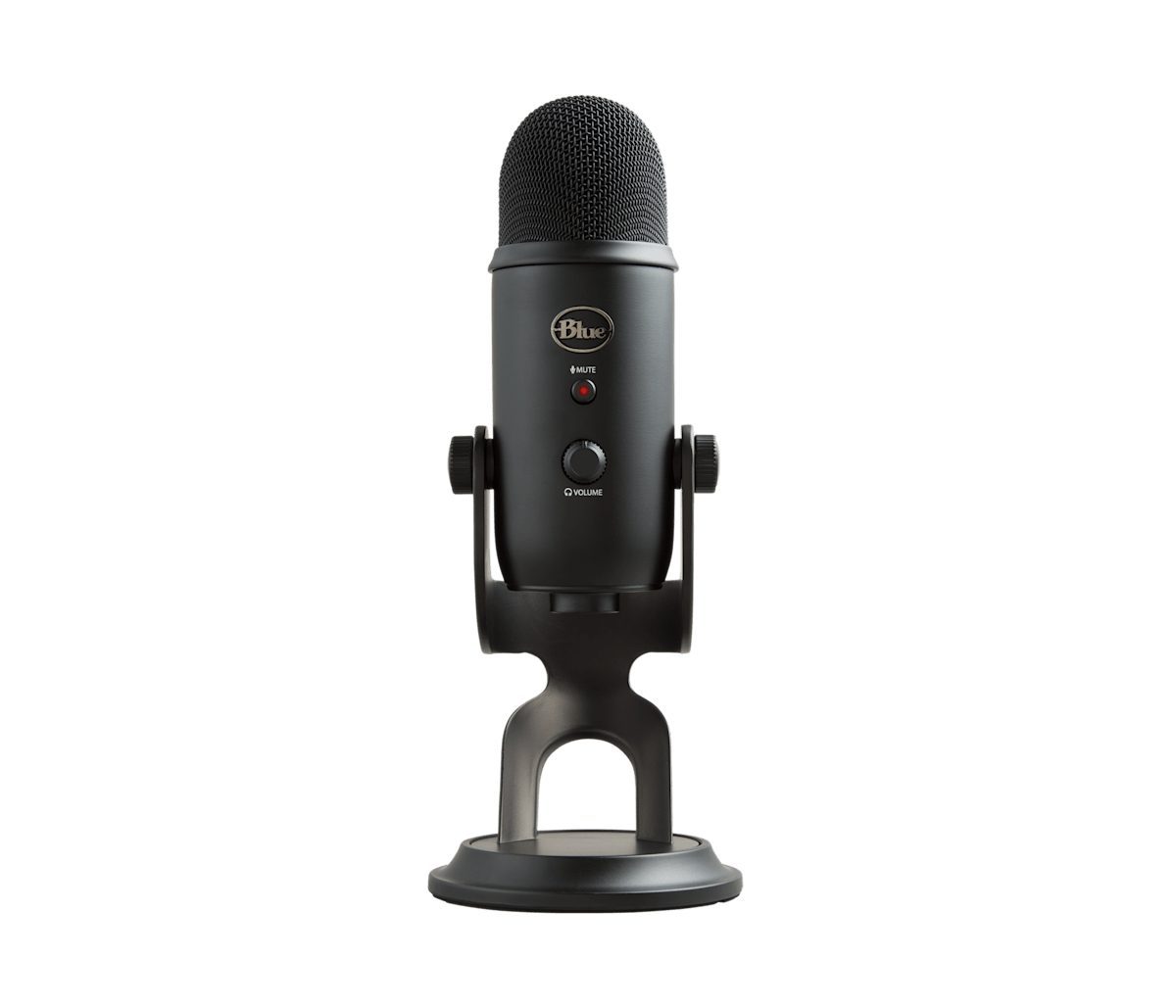
Radio waves and microwaves carry information as signals, and a signal is either analogue 模拟 or digital 数字. An analogue signal varies continuously and can take any value; a digital signal is a stream of just two values, on or off (1 or 0). Sound can be sent as either kind of signal: a microphone gives an analogue signal, which can be turned into a digital one.
Modern communication prefers digital signalling for two reasons the exam asks for:
a higher rate of data transmission;
a greater range: a weak digital signal can be regenerated back to a clean 1/0 exactly, because only two levels have to be told apart, so noise picked up along the way is removed. An analogue signal cannot be cleaned up this way, so its noise builds up.
עברית
הספקטרום האלקטרומגנטי הוא משפחה של גלים שכולם נעים באותה מהירות גבוהה בוואקום, $3.0 \times 10^8\ \text{m/s}$. בסדר מיד אורך הגל הארוך (התדר הנמוך) ועד הקצר ביותר:
אזור
שימוש נפוץ
סיכון מדידה מוגברת
גלי רדיו
אותות רדיו וטלוויזיה, אסטרונומיה, תגי RFID
—
גלי מיקרו
טלפונים ניידים, טלוויזיה לוויינית, בישול
חימום תאי הגוף
אינפרה-אדום
שלטים רחוקים, צילום תרמי, גרילים, סיבי אופטי
כוויות עור
אור נראה
ראייה, צילום
—
אולטרה-סגול
חיטוי מים, בדיקת שטרות
סרטן עור, נזק לעיניים
רנטגן X
סריקות רפואיות ואבטחה
נזק לתאים
גamma rays
חיטוי ציוד, טיפול בסרטן
מוטציות בתאים
ככל שעוברים מגלי רדיו לגלי gamma, התדר עולה, אורך הגל יורד, והאנרגיה (והסיכון) עולים. מהירות הגלים האלקטרומגנטיים באוויר היא כמעט זהה לזו בוואקום.
לוויינים. תקשורת עם לוויינים מלאכותיים משתמשת בעיקר בגלי מיקרו, משום שהם חודרים דרך האטמוספירה. חלק מטלפוני הלוויינים משתמשים בלוויינים במסלול נמוך, קרוב לכדור הארץ. טלפוני לוויינים אחרים, וטלוויזיה לוויינית בשידור ישיר, משתמשים בלוויינים במסלול גיאוסטציונרי, שנשארים מעל אותו נקודה באדמה.
מגלי רדיו ועד גלי gamma אורך הגל יורד בעוד שהתדר והאנרגיה עולים
אותות דיגיטליים ואנלוגיים
גלי רדיו ומיקרוגלים מעבירים מידע באמצעות אותות, ואות יכול להיות אנלוגי או דיגיטלי. אות אנלוגי משתנה ברצף ויכול לקבל כל ערך; אות דיגיטלי הוא זרם של שני ערכים בלבד, דולק או כבוי (1 או 0). קול ניתן לשדר כסוג כלשהו של אות: מיקרופון מספק אות אנלוגי, שיכול להפוך לדיגיטלי.
תקשורת מודרנית מעדיפה סימון דיגיטלי בשתי סיבות שהמבחן דורש:
קצב גבוה יותר של העברת נתונים;
טווח גדול יותר: אות דיגיטלי חלש יכול להיות מוחזר למצב תקין בדיוק ל-1/0, מכיוון שיש להבחין בין רמות בלבד, ולכן הרעש שנכנס לאורך הדרך נסגר. אות אנלוגי לא ניתן לטיה בכך, ולכן הרעש בו מצטבר.
Explore · חקור
Slide across the spectrum · החלקה לאורך הספקטרום
Radio waves, visible light and gamma rays are all the same wave — only the wavelength changes, and with it the frequency, photon energy and everyday use. · גלי רדיו, אור נראה וגרעיניים הם אותו סוג של גל — רק אורך הגל משתנה, ועמם התדירות, אנרגיית הפוטון והשימוש היומיומי.
1 Describe the production of sound by vibrating sources
2 Describe the longitudinal nature of sound waves
10 Describe compression and rarefaction
3 State the approximate range of frequencies audible to humans as 20Hz to 20000Hz
4 Know that a medium is needed to transmit sound waves
5 Know that the speed of sound in air is approximately 330–350m/s
11 Know that, in general, sound travels faster in solids than in liquids and faster in liquids than in gases
6 Describe a method involving a measurement of distance and time for determining the speed of sound in air
7 Describe how changes in amplitude and frequency affect the loudness and pitch of sound waves
8 Describe an echo as the reflection of sound waves
9 Define ultrasound as sound with a frequency higher than 20kHz
12 Describe the uses of ultrasound in non-destructive testing of materials, medical scanning of soft tissue and sonar including calculation of depth or distance from time and wave speed
עברית
ליבה
תוספת
1 תאר את יצירת הקול על ידי מקורות רועדים
2 תאר את האופק של גלי קול
10 תאר דחיסה והתרחבות
3 ציין את הטווח המשוער של תדרים הנשמעים לעין האדם כ20Hz עד 20000Hz
4 דע כי נדרש אמצעי למסור גלי קול
5 דע שמהירות הקול באוויר היא בקרוב 330–350m/s
11 דע שברוב המקרים, קול נוסע מהר יותר במוצקים מאשר בנוזלים, ומהר יותר בנוזלים מאשר בגזים
6 תאר שיטה הכוללת מדידת מרחק וזמן לקביעת מהירות הקול באוויר
7 תאר כיצד שינויים במיקום ובתדר משפיעים על רעש וגובה הצליל של גלי קול
8 תאר הדהוד כהשתקפות של גלי קול
9 הגדר אולטרה-סאונד כצליל בתדר גבוה מ-20kHz
12 תאר את השימושים של אולטרה-סאונד בבדיקות אינטרנטיות של חומרים, סריקת רקמות רכות רפואית וסונאר, כולל חישוב עומק או מרחק מתוך זמן ומהירות גל
Source: Cambridge International syllabus · מקור: הסיילבוס הבינלאומי של קמבריד'ג'
English
Sound is made by a vibrating object. It is a longitudinal wave: the air is squeezed into a compression 压缩 (particles close together) and stretched into a rarefaction 稀疏 (particles far apart).
Sound needs a medium 介质 (a material) to travel through, so it cannot travel through a vacuum.
Humans can hear frequencies from about $20\ \text{Hz}$ to $20\,000\ \text{Hz}$.
Sound travels much slower than light (about $340\ \text{m/s}$ in air), and faster in liquids and solids than in gases.
A larger amplitude makes a louder sound (greater loudness 响度); a higher frequency makes a higher pitch 音调. So a dolphin's rapid clicks are high-pitched, and a hard drum-hit (big vibration) is loud.
A reflected sound is an echo 回声.
Measuring the speed of sound. Two students stand a known distance apart, for example 500 m, measured with a tape or a trundle wheel. One bangs two blocks of wood together. The other starts a stopwatch when they see the blocks hit and stops it when they hear the bang. Light arrives almost at once, so the time measured is the time the sound takes, and speed = distance ÷ time. Repeat and take an average to reduce the reaction-time error. The echo method needs one person: clap at a known distance from a large wall and time the reflected sound, remembering that the sound travels there and back.
Worked example. A student stands 85 m from a large wall and claps once. The echo returns 0.50 s later. Find the speed of sound.
The sound travels to the wall and back, a distance of $2 \times 85 = 170\ \text{m}$, in $0.50\ \text{s}$:
Ultrasound 超声波 is sound above $20\,000\ \text{Hz}$ – too high for humans to hear. Its uses rely on reflection: sonar measures water depth, medical scanning images a baby or soft tissue, and non-destructive testing finds cracks inside metal without cutting it open. Like an echo, an ultrasound pulse travels there and back, so halve the total distance to reach the object.
Worked example. A sonar pulse returns from the seabed $0.10\ \text{s}$ after it is sent; sound travels at $1500\ \text{m/s}$ in water. The pulse covers $s = v\times t = 1500\times0.10 = 150\ \text{m}$ there and back, so the sea is $150/2 = 75\ \text{m}$ deep.
עברית
קול נוצר על ידי אובייקט רועד. זהו גל אורכי: האוויר נדחס ל-דחיסה (חלקיקים קרובים זה לזה) ונמתח ל-התנדפות (חלקיקים רחוקים זה מזה).
קול זקוק ל-ביניים (חומר) כדי להתפשט, ולכן אינו יכול לנוע בוואקום.
בני אדם שומעים תדרים בטווח של כ-$20\ \text{Hz}$ עד $20\,000\ \text{Hz}$.
קול נע לאט משמעותית מאור (כ-$340\ \text{m/s}$ באוויר), ומהיר נוזלים ומוצקים מאשר בגזים.
משרעת גדולה יותר יוצרת קול חזק יותר (רעשנות גבוהה); תדר גבוה יותר יוצר גובה צליל גבוה. כך שקליקי הדולפינים המהירים הם בעלי גובה צליל גבוה, והמכות בחליל (רעידה חזקה) הן רועשות.
צליל מחוזר הוא **הדהוד (אקו).
מדידת מהירות הקול. שני סטודנטים עומדים במרחק ידוע זה מזה, לדוגמה 500 מטר, הנמדד עם סרט מדידה או גלגל מדידה. אחד מקשקש שני בלוקי עץ יחד. השני מדליק סטופר כשרוא את המגע ועוצר אותו כשמ شنע את הקול. האור מגיע כמעט מיד, ולכן הזמן הנמדד הוא הזמן שמקול לוקח, ומהירות = מרחק זמן. יש לחזור על התהליך ולקחת ממוצע כדי להקטין את טעות זמן התגובה. שיטת ההדהוד דורשת אדם אחד: להקליף במרחק ידוע מקיר גדול ולמדוד את זמן הצליל החוזר, תוך זיכרון לכך שהקול עובר שם וחזרה.
דוגמה פותרת. סטודנט עומד 85 מטר מקיר גדול ומקליף פעם אחת. ההדהוד חוזר לאחר 0.50 שניות. מצאו את מהירות הקול.
הקול עובר לקיר וחזרה, במרחק של $2 \times 85 = 170\ \text{m}$, בזמן של $0.50\ \text{s}$:
אולטרסאונד הוא קול מעל $20\,000\ \text{Hz}$ – גבוה מדי לבני אדם לשמוע. השימושים בו מבוססים על החזרות: סונאר מודד עומק מים, סריקת רפואית יוצרת תמונת עוברים או רקמות רכות, ובדיקות ללא הרס מזהות סדקים בתוך מתכת ללא פתיחתה. כמו בהדהוד, פרסת אולטרסאונד עוברת שם וחזרה, ולכן יש לחלק את המרחק הכולל בשניים כדי להגיע לעומק האובייקט.
דוגמה פותרת. פרסת סונאר חוזרת מתחתית הים $0.10\ \text{s}$ לאחר שליחתה; הקול נע ב$1500\ \text{m/s}$ במים. הפרסה עברה $s = v\times t = 1500\times0.10 = 150\ \text{m}$ שם וחזרה, ולכן הים עמוק $150/2 = 75\ \text{m}$.
מיקרופון ממיר רעידות קול באוויר לאות חשמלי
Explore · חקור
Sound · צליל
y = a sin(bt + c)
Louder = bigger amplitude; higher pitch = higher frequency. · קול חזק יותר = משרעת גדולה יותר; צליל גבוה יותר = תדר גבוה יותר.
Learn $v = f\lambda$ and be ready to rearrange it. Measure all angles of incidence, reflection and refraction from the normal (the line at 90° to the surface), never from the surface itself.
Transverse waves vibrate across the direction of travel (light, water); longitudinal waves vibrate along it (sound). Sound needs a medium, so it cannot cross a vacuum; light can.
Total internal reflection happens only when light travels from a denser material to a less dense one and the angle inside is bigger than the critical angle.
Know the electromagnetic spectrum in order — radio, microwave, infrared, visible, ultraviolet, X-ray, gamma. All travel at the same speed in a vacuum; frequency and energy rise from radio to gamma.
Going into a denser material (air → glass) light slows down and bends towards the normal; leaving it (glass → air) light speeds up and bends away.
עברית
לימוד $v = f\lambda$ והתכוננות לסדר מחדש אותו. למדו את כל זוויות הפגיעה, ההחזרה והשבירה מהניצב (הקו ב-90° לפני השטח), לעולם לא מהשטח עצמו.
גלים רוחביים רועדים בצורה מאונכת לכיוון ההתפשטות (אור, מים); גלים אורכיים רועדים לאורכו (קול). קול זקוק לביניים, ולכן אינו יכול לחצות ואקום; אור יכול.
החזרה פנימית מלאה מתרחשת רק כאשר אור עובר מחומר צפוף יותר לזה פחות צפוף וגם הזווית בתוך החומר גדולה מה-זווית הקריטית.
יש לדעת את הספקטרום האלקטרומגנטי בסדר: רדיו, מיקרוגל, אינפרא-אדום, נראה, אולטרה סגול, קרני X, גמא. כולם נעים באותו מהירות בוואקום; התדר והאנרגיה עולים מרדיו עד לגמא.
בכניסה לחומר צפוף יותר (אוויר → זכוכית) האור מאט ומתכופף כלפי הניצב; ביציאה ממנו (זכוכית → אוויר) האור מאיץ ומתכופף כלפי הרחק.
Interactive lessons on this topic · שיעורים אינטראקטיביים בנושא זה
Work through it step by step, with instant-check exercises. · לעבור על הדברים צעד אחר צעד, עם תרגילים לבדיקה מיידית.
Pick one and the site follows you — notes, papers, videos and practice all open on it. · בחרו נושא אחד והאתר יעקוב אחריו — הערות, מסמכים, וידאו ותרגולים פתוחים בו.
Type to search notes, lessons, code, vocabulary and past-paper questions across every subject. · הקלד כדי לחפש הערות, שיעורים, קוד, אוצר מילים ושאלות מבחנים בכל הנושאים.