החזיקו כוס מים אחת. זה נראה פשוט מספיק. אבל בתוכה יש יותר מולקולות מאשר תוכלו לספור לעולם. מול אחד של מים — רק שמונה עשר גרם, מ…
English narration · English + 中文 subtitles burned in · קריאת קול באנגלית · תרגום אנגלי + סינית שרוף בתוך הסרטון
15.1
The mole · המול
Syllabus · סיילבוס
English
understand that amount of substance is an SI base quantity with the base unit mol
use molar quantities where one mole of any substance is the amount containing a number of particles of that substance equal to the Avogadro constant$N_{\text{A}}$
עברית
להבין שכמות חומר היא כמות בסיס במערכת SI עם היחידה הבסיסית מול
להשתמש בכמויות מולריות כאשר מול אחד של כל חומר הוא הכמות המכילה מספר חלקיקים של חומר זה השווה לקבוע אווגדרו$N_{\text{A}}$
Source: Cambridge International syllabus · מקור: הסיילבוס הבינלאומי של קמבריד'ג'
English
Amount of substance 物质的量 is an SI base quantity. Its unit is the mole 摩尔 (mol) — one of the seven SI base units, with the kilogram, metre, second, ampere and kelvin 开尔文 from Topic 1.
One mole of any substance has a number of particles equal to the Avogadro constant 阿伏伽德罗常量:
A "particle" means whatever you are counting — atoms 原子 for a monatomic 单原子 element like helium, molecules 分子 for $\text{O}_{2}$ or $\text{H}_{2}\text{O}$. Always say what you are counting.
For $n$ moles, the number of particles is $N = n N_{\text{A}}$.
The molar mass 摩尔质量$M_{\text{m}}$ is the mass of one mole ($\text{kg mol}^{-1}$ or $\text{g mol}^{-1}$). Mass of $n$ moles is $M = n M_{\text{m}}$. Mass of one particle is $m_{0} = M_{\text{m}} / N_{\text{A}}$.
The examiner's wording.The Avogadro constant is the number of atoms (or molecules) in one mole of a substance — one mark; adding "in $0.012\ \text{kg}$ of carbon-12" is accepted but not needed. Asked for "the relationship between $N_{\text{A}}$, $R$ and $k$", write $k = R/N_{\text{A}}$ (or $R = N_{\text{A}}k$).
Worked example. Oxygen has a molar mass of $32\ \text{g mol}^{-1}$. Find the mass of one oxygen molecule, and the number of molecules in $8.0\ \text{g}$ of oxygen.
$m_{0} = \dfrac{M_{\text{m}}}{N_{\text{A}}} = \dfrac{0.032}{6.02 \times 10^{23}} = 5.3 \times 10^{-26}\ \text{kg}$. $8.0\ \text{g}$ is $n = 8.0/32 = 0.25\ \text{mol}$, so $N = nN_{\text{A}} = 1.5 \times 10^{23}$ molecules. Keep molar masses in $\text{kg mol}^{-1}$ when the answer is in kilograms — the factor of $1000$ is the usual slip.
עברית
כמות חומר היא גודל בסיסי ב-SI. היחידה שלה היא מול (mol) — אחד משבעת יחידות הבסיס ב-SI, לצד הקילוגרם, המטר, השנייה, האמפר וה-קלווין מנושא 1.
מול אחד מכיל את מספר אוגדרו של חלקיקים
למול אחד מכל חומר יש מספר חלקיקים השווה ל-קבוע אוגדרו:
"חלקיק" מתייחס לכל דבר שאתה סופר — אטומים ל-יסוד חד-אטומי כמו הליום, מולקולות ל-$\text{O}_{2}$ או $\text{H}_{2}\text{O}$. תמיד אמור מה אתה סופר.
עבור $n$ מולים, מספר החלקיקים הוא $N = n N_{\text{A}}$.
המסה המולרית$M_{\text{m}}$ היא המסה של מול אחד ($\text{kg mol}^{-1}$ או $\text{g mol}^{-1}$). המסה של $n$ מולים היא $M = n M_{\text{m}}$. המסה של חלקיק אחד היא $m_{0} = M_{\text{m}} / N_{\text{A}}$.
ניסוח המבקר.קבוע אווגדרו הוא המספר של אטומים (או מולקולות) במול אחד של חומר — נקודה אחת; הוספת "ב-$0.012\ \text{kg}$ של פחמן-12" מקובלת אך אינה נדרשת. נשאל על "היחס בין $N_{\text{A}}$, $R$ ו-$k$", כתוב $k = R/N_{\text{A}}$ (או $R = N_{\text{A}}k$).
דוגמה מוצעת. לחמצן יש מסה מולרית של $32\ \text{g mol}^{-1}$. חשב את מספר המולקולות ב-$8.0\ \text{g}$ של חמצן.
$m_{0} = \dfrac{M_{\text{m}}}{N_{\text{A}}} = \dfrac{0.032}{6.02 \times 10^{23}} = 5.3 \times 10^{-26}\ \text{kg}$. $8.0\ \text{g}$ הוא $n = 8.0/32 = 0.25\ \text{mol}$, ולכן $N = nN_{\text{A}} = 1.5 \times 10^{23}$ מולקולות. שמור על מסות מולריות ב-$\text{kg mol}^{-1}$ כאשר התשובה בקילוגרמים — הגורם של $1000$ הוא הטעות הנפוצה ביותר.
Equation of state of an ideal gas · משוואת מצב של גז אידיאלי
Syllabus · סיילבוס
English
understand that a gas obeying $pV \propto T$, where $T$ is the thermodynamic temperature, is known as an ideal gas
recall and use the equation of state for an ideal gas expressed as $pV = nRT$, where $n =$ amount of substance (number of moles) and as $pV = NkT$, where $N =$ number of molecules
recall that the Boltzmann constant$k$ is given by $k = R/N_{\text{A}}$
עברית
להבין שגז המקיים את $pV \propto T$, כאשר $T$ היא הטמפרטורה התרמודינמית, נקרא גז אידיאלי
לזכור ולהשתמש במשוואת המצב לגז אידיאלי המבויאת כ$pV = nRT$, כאשר $n =$ היא כמות החומר (מספר המולים) ובכפוף ל$pV = NkT$, כאשר $N =$ הוא מספר המולקולות
לזכור שקבוע בולצמן$k$ נתון על ידי $k = R/N_{\text{A}}$
Source: Cambridge International syllabus · מקור: הסיילבוס הבינלאומי של קמבריד'ג'
English
An ideal gas 理想气体 obeys $pV \propto T$ exactly, where $T$ is the thermodynamic temperature 热力学温度.
The equation of state 状态方程 can be written two equal ways:
$$p V = n R T \qquad\text{or}\qquad p V = N k T.$$
Here:
$p$ — pressure 压强 (Pa).
$V$ — volume 体积 (m³).
$T$ — thermodynamic temperature in kelvin (never °C).
Since $N = n N_{\text{A}}$, we get $k = R/N_{\text{A}}$: $k$ is the gas constant per molecule, as $R$ is per mole.
The two-mark definition.An ideal gas is one that obeys $pV = nRT$ (or $pV \propto T$, with $T$ the thermodynamic temperature) at all values of pressure, volume and temperature. Both marks need the equation (or the proportionality with $T$ named as thermodynamic) and "at all values" or "for all $p$, $V$ and $T$". Asked to "state the meaning of each symbol in $pV = NkT$": $p$ is the pressure, $V$ the volume, $N$ the number of molecules, $k$ the Boltzmann constant and $T$ the thermodynamic temperature — a real gas is nearly ideal at low pressure and high temperature, where its molecules are far apart.
Using the equation of state
List the variables you have, find the unknown, and choose the form that matches your "amount" (moles → $nRT$; molecules → $NkT$). Always use SI units: Pa, m³, K.
Worked example. A cylinder of volume $0.020\ \text{m}^{3}$ holds gas at $27\ ^{\circ}\text{C}$ and a pressure of $2.0 \times 10^{5}\ \text{Pa}$. How many moles of gas are there? ($R = 8.31\ \text{J mol}^{-1}\ \text{K}^{-1}$.)
Convert to kelvin: $T = 27 + 273 = 300\ \text{K}$. Then from $pV = nRT$,
Worked example. A fixed mass of gas at $300\ \text{K}$ occupies $0.50\ \text{m}^{3}$. It is heated to $450\ \text{K}$ at constant pressure. Find the new volume.
Worked example. A sealed vessel of volume $0.0500\ \text{m}^{3}$ contains $0.0424\ \text{kg}$ of an ideal gas at $227\ ^{\circ}\text{C}$ and $1.37 \times 10^{5}\ \text{Pa}$. Find the amount of gas, the mass of one molecule, and the mean-square speed of its molecules.
$T = 227 + 273 = 500\ \text{K}$. $n = \dfrac{pV}{RT} = \dfrac{1.37 \times 10^{5} \times 0.0500}{8.31 \times 500} = 1.65\ \text{mol}$. The molar mass is $0.0424/1.65 = 0.0257\ \text{kg mol}^{-1}$, so one molecule has mass $0.0257/(6.02 \times 10^{23}) = 4.3 \times 10^{-26}\ \text{kg}$. From $\tfrac{1}{2}m\langle c^{2}\rangle = \tfrac{3}{2}kT$, $\langle c^{2}\rangle = \dfrac{3kT}{m} = \dfrac{3 \times 1.38 \times 10^{-23} \times 500}{4.27 \times 10^{-26}} = 4.8 \times 10^{5}\ \text{m}^{2}\ \text{s}^{-2}$ (an r.m.s. speed of about $700\ \text{m s}^{-1}$).
Worked example. Cylinder X (volume $0.0260\ \text{m}^{3}$, $0.740\ \text{mol}$) and cylinder Y (volume $0.0180\ \text{m}^{3}$, $0.320\ \text{mol}$) contain ideal gas and are in thermal equilibrium with each other at $290\ \text{K}$. Find the pressure in each, and explain what happens to the number of molecules in each cylinder if a tap joining them is opened.
$p_{\text{X}} = \dfrac{nRT}{V} = \dfrac{0.740 \times 8.31 \times 290}{0.0260} = 6.86 \times 10^{4}\ \text{Pa}$ and $p_{\text{Y}} = \dfrac{0.320 \times 8.31 \times 290}{0.0180} = 4.28 \times 10^{4}\ \text{Pa}$. Gas flows from the higher pressure (X) to the lower (Y) until the pressures are equal; the temperature is unchanged, so the final pressure is $p = \dfrac{(n_{\text{X}} + n_{\text{Y}})RT}{V_{\text{X}} + V_{\text{Y}}} = 5.8 \times 10^{4}\ \text{Pa}$, and X ends with $n_{\text{X}} = pV_{\text{X}}/RT = 0.63\ \text{mol}$ — it loses about $0.11\ \text{mol}$ to Y.
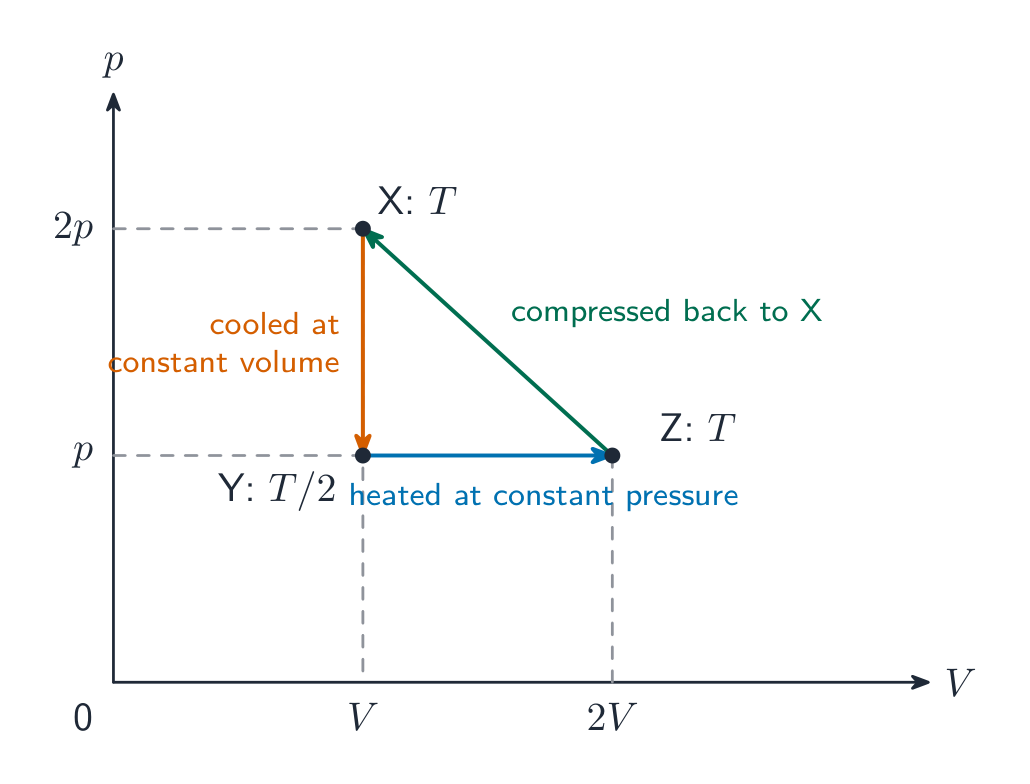
Worked example. A fixed amount of ideal gas at temperature $T$ is in state X, with pressure $2p$ and volume $V$. It is cooled at constant volume to state Y, where its pressure is $p$; then heated at constant pressure to state Z, where its volume is $2V$; then returned to X. Find the temperatures at Y and Z, and describe how the internal energy changes round the cycle.
X to Y is at constant volume, so $p/T$ is constant: halving the pressure halves the temperature, $T_{\text{Y}} = T/2$. Y to Z is at constant pressure, so $V/T$ is constant: doubling the volume doubles the temperature, $T_{\text{Z}} = T$. The internal energy of an ideal gas depends only on temperature, so it falls from X to Y (by $\tfrac{3}{2}nR \cdot T/2$), rises by the same amount from Y to Z, and is unchanged from Z back to X. Read each leg off the diagram before writing an equation: vertical means constant $V$, horizontal means constant $p$.
Special cases:
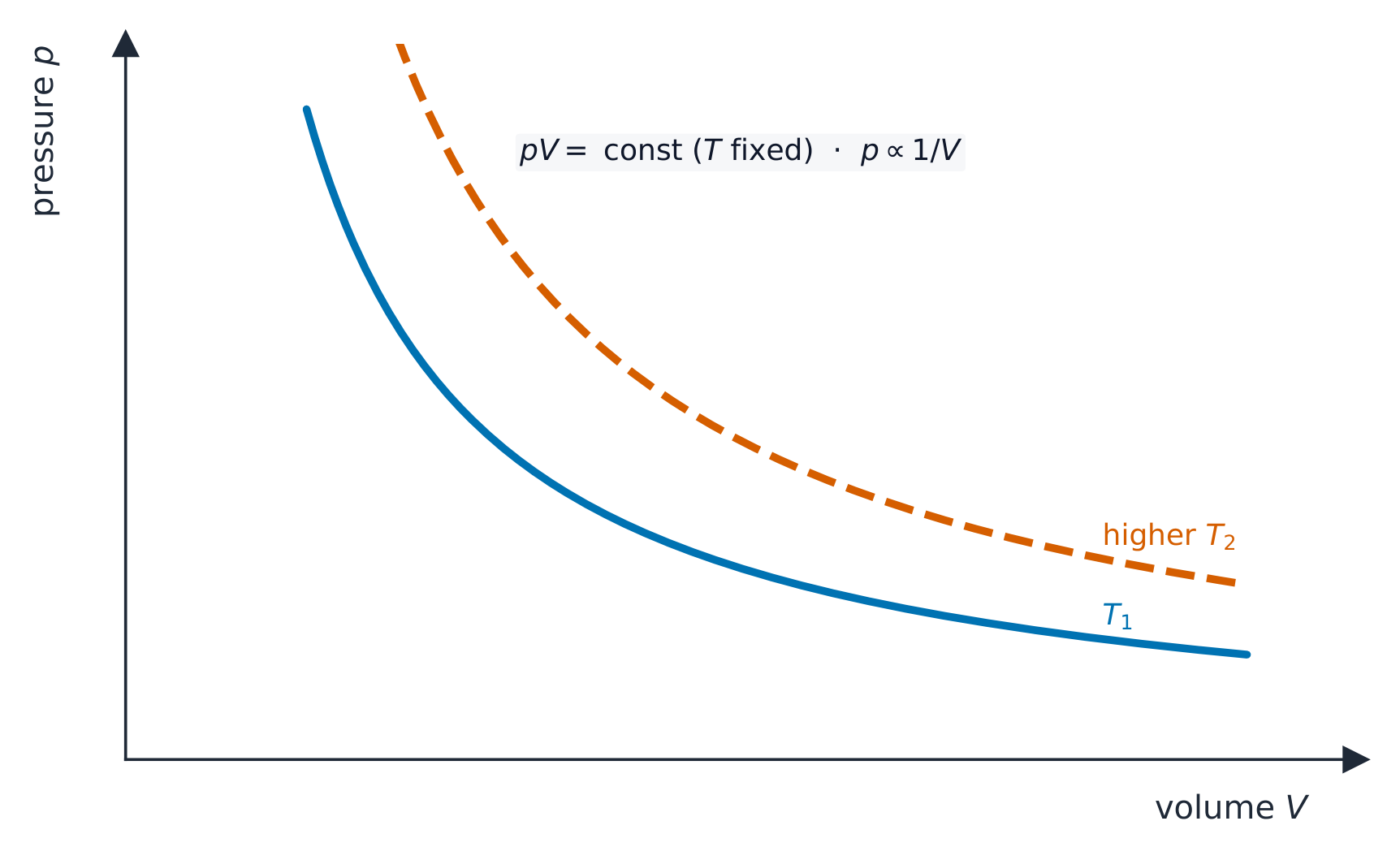
constant temperature (Boyle's law 玻意耳定律): $p_{1} V_{1} = p_{2} V_{2}$.
constant pressure (Charles's law 查理定律): $V / T = \text{constant}$.
constant volume (pressure law 气体压强定律): $p / T = \text{constant}$.
A common mistake is using °C instead of K — $pV \propto T$ only holds with $T$ in kelvin.
עברית
בקבוקי גז דחוסים מאחסנים מסה קבועה של גז בלחץ גבוה.
גז אידיאלי מקיים בדיוק את $pV \propto T$, כאשר $T$ היא ה-טמפרטורה התרמודינמית.
ניתן לכתוב את משוואת המצב בשתי צורות שוות ערך:
$$p V = n R T \qquad\text{or}\qquad p V = N k T.$$
מכיוון ש-$N = n N_{\text{A}}$, אנו מקבלים $k = R/N_{\text{A}}$: $k$ הוא קבוע הגז לכל מולקולה, כמו ש-$R$ הוא למול אחד.
הגדרה בעלת שני נקודות.גז אידיאלי הוא גז המקיים את $pV = nRT$ (או $pV \propto T$, כאשר $T$ היא הטמפרטורה התרמודינמית) בכל ערכי הלחץ, הנפח והטמפרטורה. שתי הנקודות דורשות גם את המשוואה (או את היחס הישר עם $T$ שמכונה תרמודינמית) וגם "בכל ערכי" או "עבור כל $p$, $V$ ו-$T$". כאשר מבקשים ל-"ציין את המשמעות של כל סמל ב-$pV = NkT$": $p$ הוא הלחץ, $V$ הנפח, $N$ ה-מספר המולקולות, $k$ קבוע בולצמן ו-$T$ הטמפרטורה התרמודינמית — גז אמיתי מתנהג כגז אידיאלי כמעט לחלוטין בלחץ נמוך וטמפרטורה גבוהה, שם המולקולות רחוקות זו מזו.
שימוש במשוואת המצב
רשימו את המשתנים שיש לכם, מצאו את הנעלם ובחרו בצורה המתאימה ל-"כמות" שלך (מולים → $nRT$; מולקולות → $NkT$). השתמשו תמיד ביחידות SI: Pa, m³, K.
דוגמה פותרת. בקבוק בנפח $0.020\ \text{m}^{3}$ מכיל גז בטמפרטורה $27\ ^{\circ}\text{C}$ ולחץ של $2.0 \times 10^{5}\ \text{Pa}$. כמה מולים של גז יש? ($R = 8.31\ \text{J mol}^{-1}\ \text{K}^{-1}$.)
המירו לקלווין: $T = 27 + 273 = 300\ \text{K}$. ולאחר מכן מ-$pV = nRT$,
דוגמה פותרת. מיכל סגור בנפח $0.0500\ \text{m}^{3}$ מכיל $0.0424\ \text{kg}$ של גז אידיאלי בטמפרטורה של $227\ ^{\circ}\text{C}$ ולחץ של $1.37 \times 10^{5}\ \text{Pa}$. מצא את כמות הגז, את מסת המולקולה האחת, ואת מהירות הריבוע הממוצע של מולקולותיו.
דוגמה פותרת. צילינדר X (נפח $0.0260\ \text{m}^{3}$, $0.740\ \text{mol}$) וצילינדר Y (נפח $0.0180\ \text{m}^{3}$, $0.320\ \text{mol}$) מכילים גז אידיאלי ונמצאים באיזון תרמי זה עם זה בטמפרטורה של $290\ \text{K}$. מצא את הלחץ בכל אחד, והסבר מה קורה לכמות המולקולות בכל צילינדר כאשר שסתום המרכיב ביניהם נפתח.
$p_{\text{X}} = \dfrac{nRT}{V} = \dfrac{0.740 \times 8.31 \times 290}{0.0260} = 6.86 \times 10^{4}\ \text{Pa}$ ו-$p_{\text{Y}} = \dfrac{0.320 \times 8.31 \times 290}{0.0180} = 4.28 \times 10^{4}\ \text{Pa}$. גז זורם מהלחץ הגבוה (X) לנמוך (Y) עד שהלחצים מתאחדים; הטמפרטורה אינה משתנה, ולכן הלחץ הסופי הוא $p = \dfrac{(n_{\text{X}} + n_{\text{Y}})RT}{V_{\text{X}} + V_{\text{Y}}} = 5.8 \times 10^{4}\ \text{Pa}$, ו-X נותר עם $n_{\text{X}} = pV_{\text{X}}/RT = 0.63\ \text{mol}$ — היא מאבדת כ-$0.11\ \text{mol}$ ל-Y.
מחזור על דיאגרמת $p$–$V$: קו אנכי הוא נפח קבוע, קו אופקי הוא לחץ קבוע, ו-$pV/T$ זהה בכל מצב
דוגמה מופתרת. כמות קבועה של גז אידיאלי בטמפרטורה $T$ נמצאת במצב X, עם לחץ $2p$ ונפח $V$. הקירור בנפח קבוע למצב Y, שבו הלחץ שלו הוא $p$; לאחר מכן חימום בלחץ קבוע למצב Z, שבו הנפח שלו הוא $2V$; ואז חזרה ל-X. מצאו את הטמפרטורות ב-Y וב-Z, וקבלו תיאור כיצד האנרגיה הפנימית משתנה לאורך המחזור.
מ-X ל-Y בנפח קבוע, ולכן $p/T$ נשאר קבוע: הכפל בלחץ מכפיל בהתאם את הטמפרטורה, $T_{\text{Y}} = T/2$. מ-Y ל-Z בלחץ קבוע, ולכן $V/T$ נשאר קבוע: הכפל בנפח מכפיל בהתאם את הטמפרטורה, $T_{\text{Z}} = T$. האנרגיה הפנימית של גז אידיאלי תלויה רק בטמפרטורה, ולכן היא יורדת מ-X ל-Y (על ידי $\tfrac{3}{2}nR \cdot T/2$), עולה באותו סכום מ-Y ל-Z, ואינה משתנה מ-Z חזרה ל-X. קראו כל שלב בגרף לפני כתיבת המשוואה: אנכי מסמן נפח קבוע $V$, אופקי מסמן לחץ קבוע $p$.
טעות נפוצה היא שימוש ב-°C במקום K — $pV \propto T$ תקף רק עם $T$ בקלובין.
חוק בอยל: בטמפרטורה קבועה $pV$ הוא קבוע, ולכן גרף של $p$–$V$ הוא היפרבולהבעקב לחץ קבוע נפח הגז עולה ליניארית עם הטמפרטורה, ומגיע לאפס בטמפרטורה האבסולוטית (חוק צ'ארלס)
Explore · חקור
The ideal gas (Boyle) · הגז האידיאלי (בויל)
p = k / V
At constant temperature p ∝ 1/V — squeeze the volume and pressure rises. · בטמפרטורה קבועה, p ∝ 1/V — צמצום הנפח גורם לעליית הלחץ.
Kinetic theory of gases · התאוריה הקינטית של גזים
Syllabus · סיילבוס
English
state the basic assumptions of the kinetic theory of gases
explain how molecular movement causes the pressure exerted by a gas and derive and use the relationship $pV = \frac{1}{3}Nm\langle c^2 \rangle$, where $\langle c^2 \rangle$ is the mean-square speed (a simple model considering one-dimensional collisions and then extending to three dimensions using $\frac{1}{3}\langle c^2 \rangle = \langle c_x^2 \rangle$ is sufficient)
understand that the root-mean-square speed$c_{\text{r.m.s.}}$ is given by $\sqrt{\langle c^2 \rangle}$
compare $pV = \frac{1}{3}Nm\langle c^2 \rangle$ with $pV = NkT$ to deduce that the average translational kinetic energy of a molecule is $\frac{3}{2}kT$, and recall and use this expression
עברית
נסח את ההנחות הבסיסיות של התיאוריה הקינטית של גזים
הסבר כיצד תנועת המולקולות גורמת ל-לחץ שהגז מפעיל, ונגרם וישתמש בקשר $pV = \frac{1}{3}Nm\langle c^2 \rangle$, כאשר $\langle c^2 \rangle$ הוא מהירות הריבוע הממוצעת (מודל פשוט שמתייחס להתנגשויות חד-ממדיות ולאחר מכן מרחיב לשימוש בשלושה מימדים באמצעות $\frac{1}{3}\langle c^2 \rangle = \langle c_x^2 \rangle$ מספיק)
הבן ש-מהירות השורש-ממוצע-ריבועי$c_{\text{r.m.s.}}$ נתונה על ידי $\sqrt{\langle c^2 \rangle}$
השווה בין $pV = \frac{1}{3}Nm\langle c^2 \rangle$ ל-$pV = NkT$ כדי להסיק כי אנרגיה קינטית תרגולית ממוצעת של מולקולה היא $\frac{3}{2}kT$, וזכור ושתמש בביטוי זה
Source: Cambridge International syllabus · מקור: הסיילבוס הבינלאומי של קמבריד'ג'
English
Kinetic theory: gas pressure
The kinetic theory 分子动理论 explains a gas's large-scale behaviour from the random motion 无规则运动 of its molecules.
Assumptions
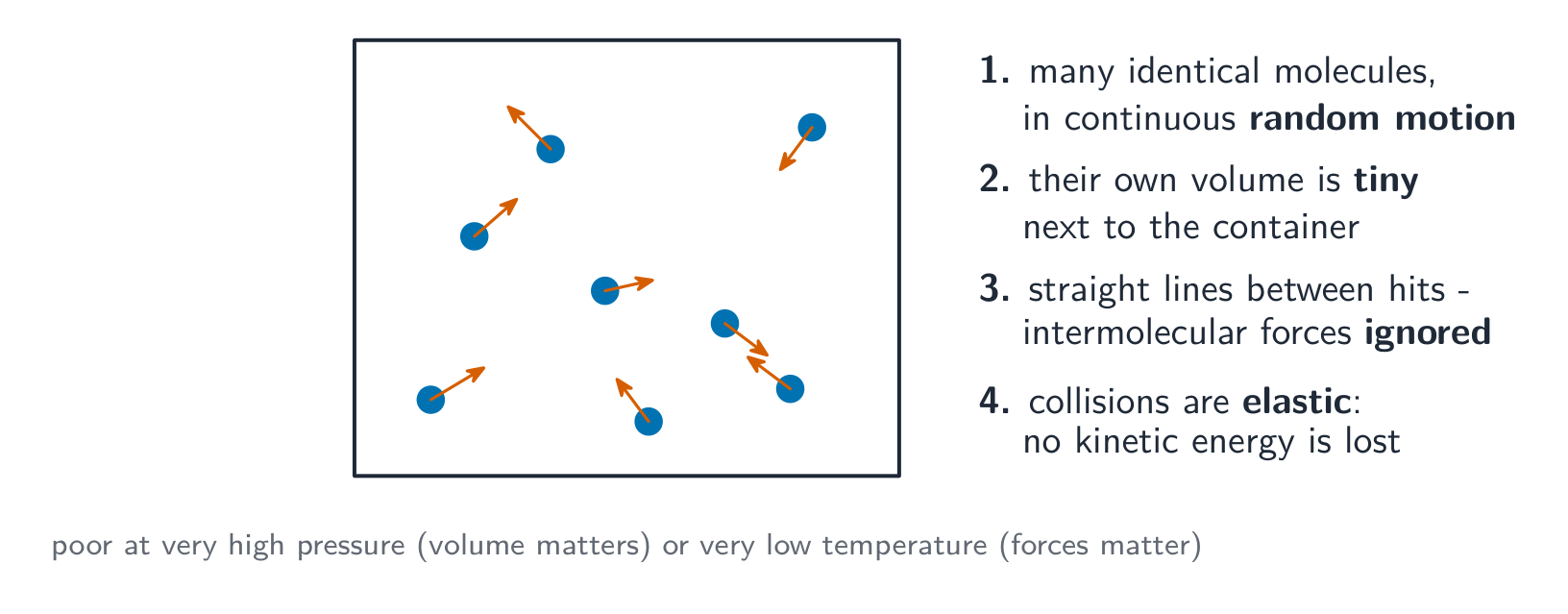
For an ideal gas:
a large number of identical molecules in continuous random motion.
the molecules' own volume is too small to matter compared with the container.
the time of each collision is too short to matter compared with the time between collisions.
intermolecular 分子间 forces are ignored except during collisions (molecules go in straight lines between them).
collisions (with the walls and with each other) are elastic — an elastic collision 弹性碰撞 loses no kinetic energy, so the gas does not cool down by itself.
Newton's laws apply.
These assumptions become poor at very high pressure (molecular volume matters) or very low temperature (intermolecular forces matter).
As the exam asks it. "State two (or three) basic assumptions of the kinetic theory": choose from the molecules are in continuous random motion; the volume of the molecules is negligible compared with the volume of the gas; there are no forces between the molecules except during collisions; the collisions are perfectly elastic; the time of a collision is negligible compared with the time between collisions. "State what is meant by an elastic collision": one in which the total kinetic energy is conserved (as well as momentum). "Use the assumptions to suggest why the gas at the surface of a star, at very high pressure, is not ideal": the molecules are so close together that their own volume is not negligible compared with the gas volume, and intermolecular forces act between them — the two assumptions that fail when a gas is compressed.
Worked example. A balloon contains $0.40\ \text{mol}$ of hydrogen ($m = 3.34 \times 10^{-27}\ \text{kg}$ per molecule) in $9.8 \times 10^{-3}\ \text{m}^{3}$. Estimate the average separation of the molecules, the gravitational force between neighbouring molecules, and comment on the kinetic-theory assumption this tests.
$N = 0.40 \times 6.02 \times 10^{23} = 2.4 \times 10^{23}$ molecules, so each occupies $V/N = 4.1 \times 10^{-26}\ \text{m}^{3}$ and the average separation is $d = (V/N)^{1/3} = 3.4 \times 10^{-9}\ \text{m}$. The gravitational force between two molecules is $F = \dfrac{Gm^{2}}{d^{2}} = \dfrac{6.67 \times 10^{-11} \times (3.34 \times 10^{-27})^{2}}{(3.4 \times 10^{-9})^{2}} = 6 \times 10^{-47}\ \text{N}$ — some $10^{20}$ times smaller than a molecule's own weight ($mg = 3.3 \times 10^{-26}\ \text{N}$). Forces between molecules really are negligible except during collisions, as the theory assumes.
Pressure of a gas — outline of the derivation
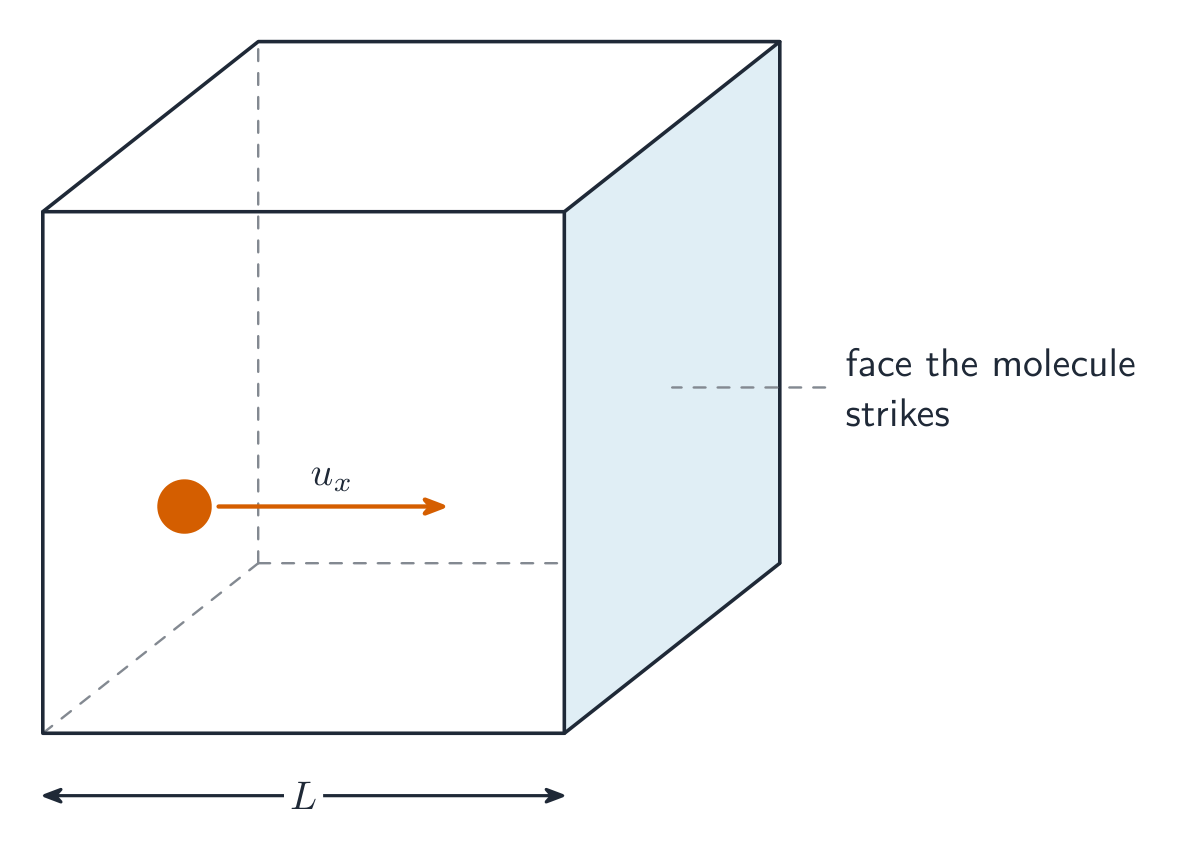
Take a cubic box of side $L$ with $N$ molecules, each of mass $m$. Look at one molecule moving along the $x$-axis with velocity $u_{1}$.
one collision with the right wall: velocity reverses to $-u_{1}$, change in momentum 动量$\Delta p_{x} = -2 m u_{1}$. By Newton's third law the wall gets an impulse 冲量 of $+2 m u_{1}$.
time between hits on that wall: travel $2L$ there and back, so $\Delta t = 2L/u_{1}$.
average force from this molecule: $F_{1} = \Delta p / \Delta t = m u_{1}^{2} / L$.
add over all molecules: $F = (Nm/L)\langle u_{x}^{2} \rangle$, where $\langle u_{x}^{2} \rangle$ is the mean square 均方 of the $x$-velocity.
pressure: $p = F/L^{2} = N m \langle u_{x}^{2} \rangle / V$.
In 3-D, by symmetry $\langle u_{x}^{2} \rangle = \tfrac{1}{3} \langle c^{2} \rangle$, where $\langle c^{2} \rangle$ is the mean-square speed 均方速率. So
$$p V = \tfrac{1}{3} N m \langle c^{2} \rangle.$$
"Explain how molecular movement causes the pressure exerted by a gas" (3 marks). The molecules move randomly and collide with the walls of the container; at each collision a molecule's momentum changes (it rebounds), so by Newton's second law the wall exerts a force on it, and by the third law it exerts an equal force on the wall; the very many collisions each second produce a steady total force on the wall, and the pressure is that force per unit area. The syllabus phrase "a simple model considering one-dimensional collisions" means the derivation above: it is sufficient to follow one molecule bouncing between two opposite faces and then average.
The density form. Since $Nm$ is the total mass of the gas and $Nm/V$ is its density $\rho$, the same result reads $p = \tfrac{1}{3}\rho\langle c^{2}\rangle$ — the version to use when a question gives a density instead of $N$ and $m$.
Worked example. An ideal gas at a pressure of $1.6 \times 10^{5}\ \text{Pa}$ has a density of $1.9\ \text{kg m}^{-3}$. Show that the r.m.s. speed of its molecules is about $500\ \text{m s}^{-1}$.
$\langle c^{2}\rangle = \dfrac{3p}{\rho} = \dfrac{3 \times 1.6 \times 10^{5}}{1.9} = 2.53 \times 10^{5}\ \text{m}^{2}\ \text{s}^{-2}$, so $c_{\text{r.m.s.}} = \sqrt{2.53 \times 10^{5}} = 503\ \text{m s}^{-1} \approx 500\ \text{m s}^{-1}$. In a "show that", keep an extra figure ($503$) before comparing with the value given.
Root-mean-square speed
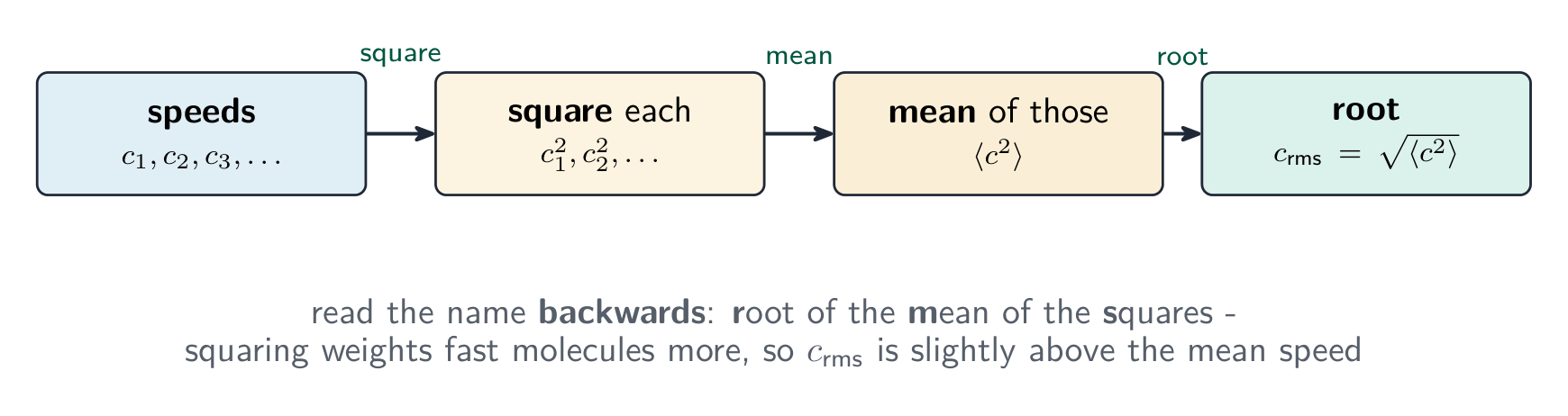
The square root of $\langle c^{2} \rangle$ is the root-mean-square 均方根 (r.m.s.) speed:
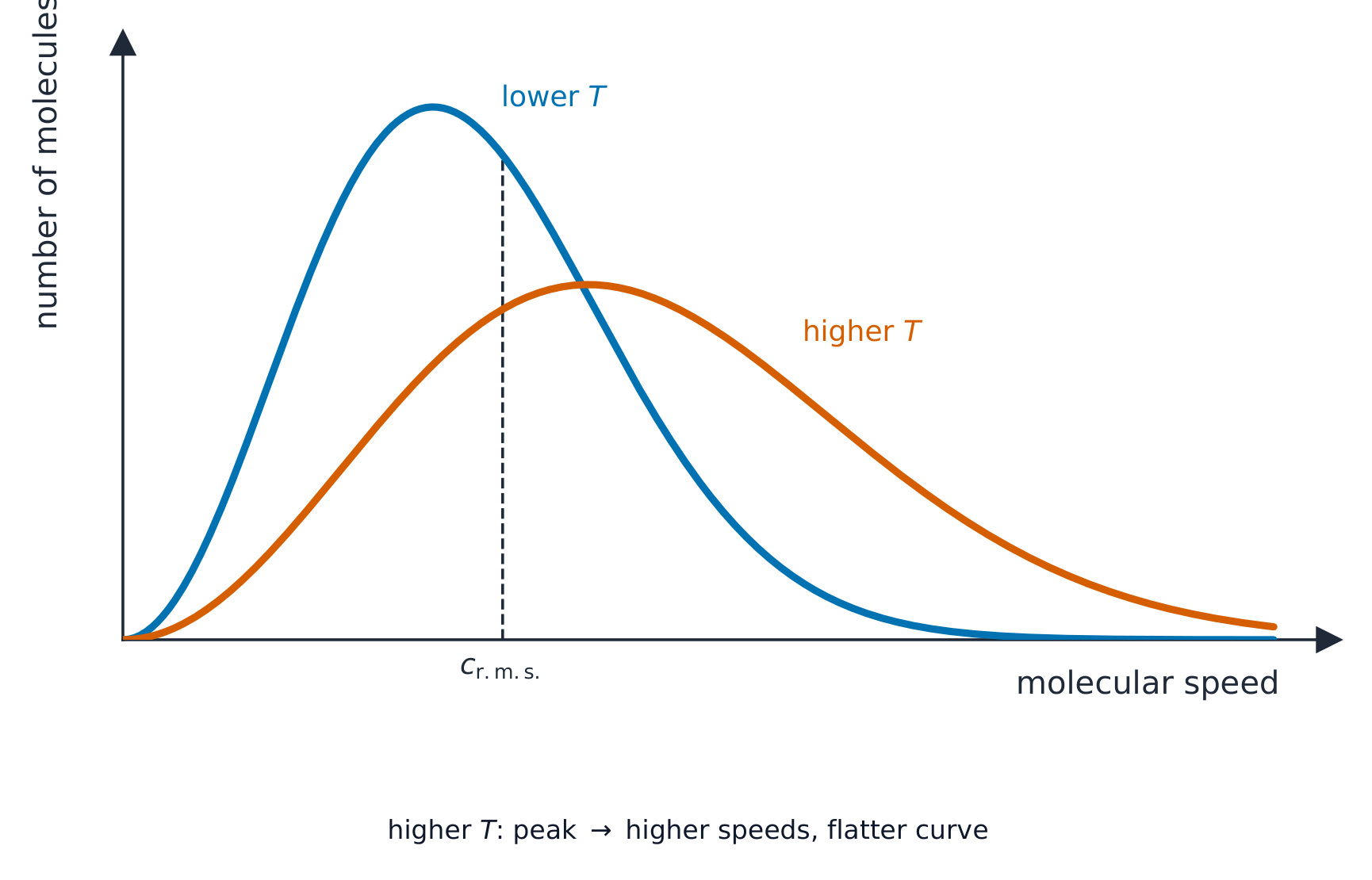
It is a useful single measure of how fast the molecules move, slightly larger than the mean speed (squaring weights fast molecules more).
עברית
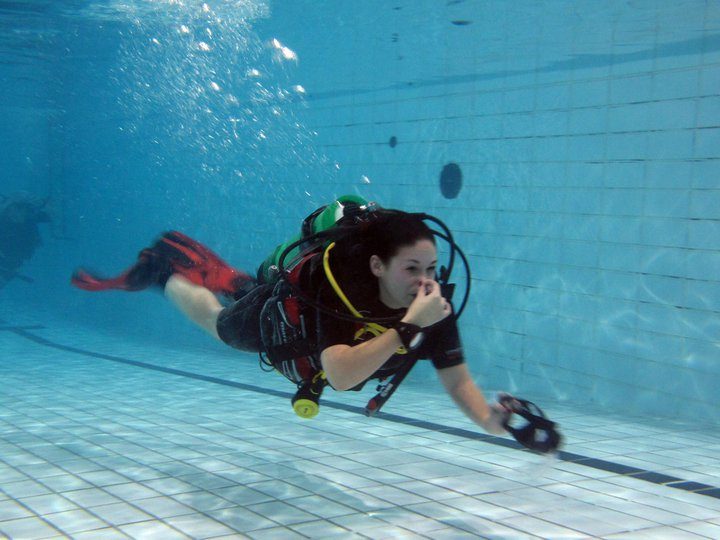
תורת הקינטיקה: לחץ גזצולל נושם גז דחוס; הלחץ, הנפח והטמפרטורה שלו כולם קשורים זה לזה.
התורת הקינטית מסבירה את התנהגות הגז בקנה מידה גדול על בסיס התנועה האקראית של המולקלות שלו.
הנחות יסוד
עבור גז אידיאלי:
מספר רב של מולקלות זהות בתנועה אקראית רציפה.
נפח המולקלות עצמן קטן מדי כדי להיות משמעותי בהשוואה לנפח המיכל.
הזמן של כל התנגשות קצר מדי כדי להיות משמעותי בהשוואה לזמן בין ההתנגשויות.
כוחות בינ-מולקולריים מתעלמים מלבד בזמן ההתנגשויות (המולקלות נעות בקווים ישרים ביניהן).
התנגשויות (עם הקירות ועם עצמן) הן אלסטיות — התנגשות אלסטית אינה מאבדת אנרגיה קינטית, ולכן הגז לא מתקרר מעצמו.
חוקי نیוטון חלים.
ההנחות המרכזיות של תורת הקינטיקה עבור גז אידיאלי
הנחות אלו הופכות ללא מדויקות בלחץ גבוה מאוד (כאשר נפח המולקלות משמעותי) או בטמפרטורה נמוכה מאוד (כאשר כוחות בינ-מולקולריים משמעותיים).
כפי שנשאל במבחן. "ציינו שתי (או שלוש) הנחות יסוד בסיסיות בתורת הקינטיקה": לבחור מתוך המולקלות נעות בתנועה אקראית רציפה; הנפח של המולקלות זניח בהשוואה לנפח הגז; אין כוחות בין המולקלות מלבד בזמן ההתנגשויות; ההתנגשויות הן אלסטיות לחלוטין; זמן ההתנגשות זניח בהשוואה לזמן בין ההתנגשויות. "ציינו מה מכוון בהתנגשות אלסטית": התנגשות שבה האנרגיה הקינטית הכוללת שמורה (כמו גם תנע). "השתמשו בהנחות כדי להציע מדוע הגז בפני השטח של כוכב, בלחץ גבוה מאוד, אינו אידיאלי": המולקלות קרובות מדי זו לזו כך שהנפח העצמי שלהן אינו זניח בהשוואה לנפח הגז, וכוחות בינ-מולקולריים פועלים ביניהן — שתי ההנחות הכושלות כאשר גז נדחס.
דוגמה מוצרת. בלונג' יש $0.40\ \text{mol}$ מימן ($m = 3.34 \times 10^{-27}\ \text{kg}$ למולקולה) ב$9.8 \times 10^{-3}\ \text{m}^{3}$. העריכו את המרחק הממוצע בין המולקלות, את כוח הכבידה בין מולקלות שכנות, ותגלו על ההנחה בתורת הקינטיקה שזו בודקת.
$N = 0.40 \times 6.02 \times 10^{23} = 2.4 \times 10^{23}$ מולקולות, ולכן כל אחת תופסת $V/N = 4.1 \times 10^{-26}\ \text{m}^{3}$ והמרחק הממוצע ביניהן הוא $d = (V/N)^{1/3} = 3.4 \times 10^{-9}\ \text{m}$. הכוח הכבידה בין שתי מולקולות הוא $F = \dfrac{Gm^{2}}{d^{2}} = \dfrac{6.67 \times 10^{-11} \times (3.34 \times 10^{-27})^{2}}{(3.4 \times 10^{-9})^{2}} = 6 \times 10^{-47}\ \text{N}$ — מעט ⋘$10^{20}$ פעמים קטן מהמשקל העצמי של מולקולה ($mg = 3.3 \times 10^{-26}\ \text{N}$). הכוחות בין מולקולות אמתly זניחים למעט בזמן ההתנגשויות, כפי שהתיאוריה מניחה.
לחץ של גז — סיכום החילוץ
קחו קופסה קובית בעלת צלע $L$ המכילה $N$ מולקולות, כל אחת במסה $m$. התבוננו במולקולה אחת הנעה לאורך ציר ה-$x$ עם מהירות $u_{1}$.
הגזירה ללחץ מבחינה את רכיב המהירות $u_x$ של מולקולה אחת, האנכי לפנים של קוביית הגז
התנגשות אחת עם הקיר הימני: המהירות מתהפכת ל-$-u_{1}$, השינוי ב-תנע הוא $\Delta p_{x} = -2 m u_{1}$. לפי חוק השלישי של ניוטון, הקיר מקבל דחיפה (אימפולס) של $+2 m u_{1}$.
הזמן בין פגיעות באותו קיר: המולקולה עוברת מרחק $2L$ ההלוך ושוב, ולכן זמן זה הוא $\Delta t = 2L/u_{1}$.
הכוח הממוצע שמפעילה מולקולה זו: $F_{1} = \Delta p / \Delta t = m u_{1}^{2} / L$.
סיכום לכל המולקולות: $F = (Nm/L)\langle u_{x}^{2} \rangle$, כאשר $\langle u_{x}^{2} \rangle$ הוא הריבוע הממוצע של מהירות ה-$x$.
לחץ: $p = F/L^{2} = N m \langle u_{x}^{2} \rangle / V$.
ב-3-D, על פי סימטריה $\langle u_{x}^{2} \rangle = \tfrac{1}{3} \langle c^{2} \rangle$, כאשר $\langle c^{2} \rangle$ הוא מהירות הריבוע הממוצעת. לכן
$$p V = \tfrac{1}{3} N m \langle c^{2} \rangle.$$
"הסבירו כיצד תנועת מולקולות גורמת ללחץ שמפעיל גז" (3 נקודות). המולקולות נעות אקראית ומתנגדות לקירות המכל; בכל התנגשות, תנע המולקולה משתנה (היא קופצת בחזרה), ולכן לפי החוק השני של ניוטון הקיר מפעיל כוח עליה, ולפי החוק השלישי היא מפעילה כוח שווה על הקיר; מספר רב מאוד של התנגשות בשנייה מייצר כולל יציב על הקיר, והלחץ הוא הכוח הזה ליחידת שטח. הביטוי בסילבוס "מודל פשוט המתבונן בהתנגדויות חד-ממדיות" מתייחס לגזירה למעלה: מספיק לעקוב אחר מולקולה אחת בקפיצה בין שני פנים נגודיים ואז לבצע ממוצע.
הצורה הצפיפות. מכיוון ש-$Nm$ היא המסה הכוללת של הגז ו-$Nm/V$ היא הצפיפות שלו ⟨$\rho$⟩, התוצאה זהה נכתבת כך: $p = \tfrac{1}{3}\rho\langle c^{2}\rangle$ — הגרסה שיש להשתמש בה כאשר שאלה נותנת צפיפות במקום $N$ ו-$m$.
דוגמה מפורטת. גז אידיאלי בלחץ של $1.6 \times 10^{5}\ \text{Pa}$ יש לו צפיפות של $1.9\ \text{kg m}^{-3}$. הוכיחו שהמהירות האפקטיבית (r.m.s.) של מולקולותיו היא כ-$500\ \text{m s}^{-1}$.
$\langle c^{2}\rangle = \dfrac{3p}{\rho} = \dfrac{3 \times 1.6 \times 10^{5}}{1.9} = 2.53 \times 10^{5}\ \text{m}^{2}\ \text{s}^{-2}$, ולכן $c_{\text{r.m.s.}} = \sqrt{2.53 \times 10^{5}} = 503\ \text{m s}^{-1} \approx 500\ \text{m s}^{-1}$. בתרגיל "הוכיחו", שמרו ספרה נוספת ($503$) לפני השוואה עם הערך הנתון.
מהירות הריבוע הממוצע (r.m.s.)
השורש הרבועי של $\langle c^{2} \rangle$ הוא מהירות הריבוע הממוצע (r.m.s.):
זהו מדד יחיד שימושי לכמות המהירות שבה המולקולות נעות, מעט גדול יותר מהמהירות הממוצעת (הריבוע משקלל מולקולות מהירות יותר).
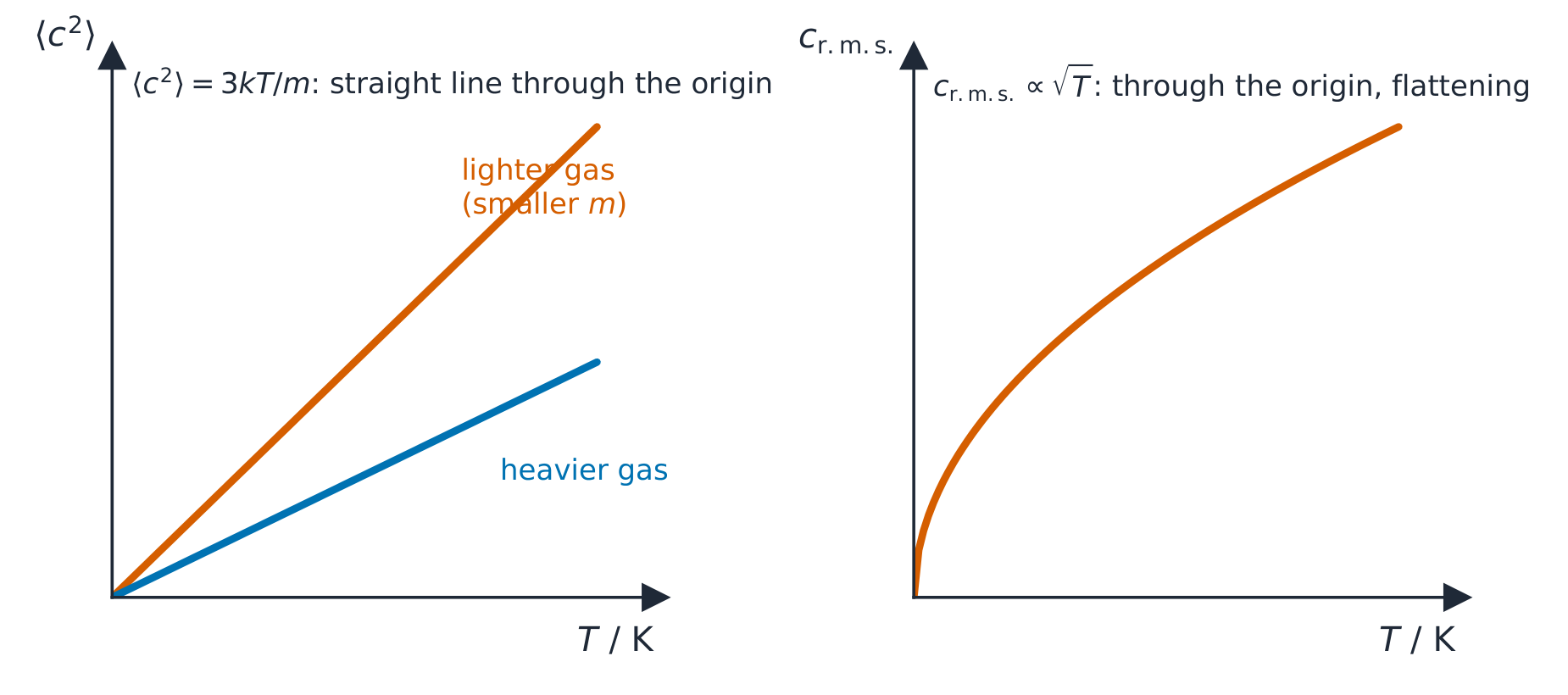
מהירות הריבוע הממוצע: לרבות כל מהירות, לקחת את הממוצע, ולאחר מכן את השורש הרבועיהפיזור במהירויות מולקולריות: טמפרטורה גבוהה מרחיבה את העקומה ומזיזה אותה למהירויות גבוהות יותרהגרפים ששואלים ממך לעלות במבחן: $\langle c^{2}\rangle \propto T$ הוא קו ישר העובר באות, ולכן $c_{\text{r.m.s.}}$ עולה כ$\sqrt{T}$
Explore · חקור
Boyle's law · חוק בואיל
p ∝ 1/V
At constant temperature, pressure is inversely proportional to volume — squash the gas and the pressure rises. · בטמפרטורה קבועה, הלחץ פרופורציוני הפוך לנפח — לחיצת הגז גורמת לעליית הלחץ.
Average translational kinetic energy · אנרגיה קינטית תנועה ממוצעת
English
Compare the two expressions for $pV$:
$$p V = N k T \quad\text{and}\quad p V = \tfrac{1}{3} N m \langle c^{2} \rangle.$$
Set them equal, cancel $N$, and multiply by $\tfrac{3}{2}$:
$$\tfrac{3}{2} k T = \tfrac{1}{2} m \langle c^{2} \rangle.$$
The right side is the average translational kinetic energy 平动动能$\langle E_{\text{k}} \rangle$ of one molecule. So
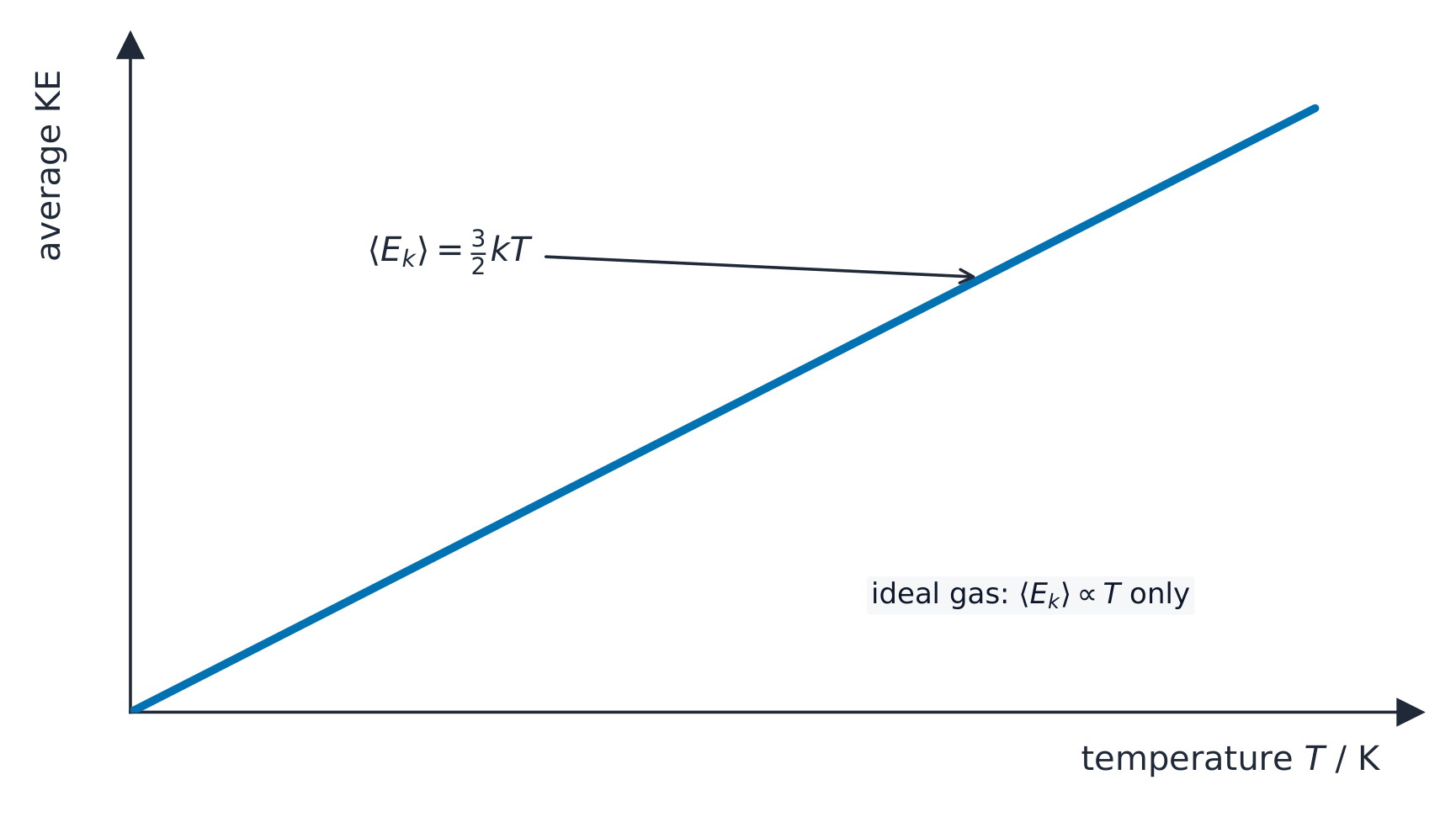
$$\langle E_{\text{k}} \rangle = \tfrac{1}{2} m \langle c^{2} \rangle = \tfrac{3}{2} k T.$$
This is a key result: the average translational kinetic energy of an ideal-gas molecule depends only on the thermodynamic temperature, not on the type of gas or its pressure.
Worked example. Find the root-mean-square speed of oxygen molecules at $300\ \text{K}$. (Mass of one $\text{O}_{2}$ molecule $= 5.3 \times 10^{-26}\ \text{kg}$, $k = 1.38 \times 10^{-23}\ \text{J K}^{-1}$.)
From $\tfrac{1}{2}m\langle c^{2}\rangle = \tfrac{3}{2}kT$, the mean-square speed is $\langle c^{2}\rangle = 3kT/m$:
Worked example. The surface of the Moon reaches about $400\ \text{K}$ in sunlight. Calculate the r.m.s. speed of hydrogen molecules ($m = 3.34 \times 10^{-27}\ \text{kg}$) at this temperature, and use the Moon's escape speed of $2.4\ \text{km s}^{-1}$ to suggest why the Moon has no hydrogen atmosphere.
$c_{\text{r.m.s.}} = \sqrt{\dfrac{3kT}{m}} = \sqrt{\dfrac{3 \times 1.38 \times 10^{-23} \times 400}{3.34 \times 10^{-27}}} = 2.2 \times 10^{3}\ \text{m s}^{-1}$. This r.m.s. speed is close to the escape speed, and the speeds are spread widely about it, so a large fraction of the molecules move faster than $2.4\ \text{km s}^{-1}$ at any moment and escape; over time the hydrogen is lost.
Worked example. The gas at the surface of a star is mainly hydrogen atoms ($m = 1.67 \times 10^{-27}\ \text{kg}$) with an r.m.s. speed of $9300\ \text{m s}^{-1}$. Find the temperature of the surface.
Worked example. For a fixed sample of gas, a graph of $pV$ against $kT$ is a straight line through the origin of gradient $7.2 \times 10^{22}$. When $pV = 270\ \text{J}$ the r.m.s. speed of the molecules is $1900\ \text{m s}^{-1}$. Find the number of molecules and the mass of one molecule in u.
From $pV = NkT$ the gradient is $N = 7.2 \times 10^{22}$. From $pV = \tfrac{1}{3}Nm\langle c^{2}\rangle$: $m = \dfrac{3pV}{N\langle c^{2}\rangle} = \dfrac{3 \times 270}{7.2 \times 10^{22} \times 1900^{2}} = 3.1 \times 10^{-27}\ \text{kg} = \dfrac{3.1 \times 10^{-27}}{1.66 \times 10^{-27}} = 1.9\ \text{u}$ — hydrogen molecules, within the rounding.
Comparing gases and samples. At the same temperature every gas has the same average kinetic energy per molecule, so $\langle c^{2}\rangle \propto 1/m$: hydrogen ($M_{\text{m}} = 2$) and oxygen ($M_{\text{m}} = 32$) have $\dfrac{c_{\text{H}}}{c_{\text{O}}} = \sqrt{\dfrac{32}{2}} = 4$. Two samples at the same $T$ — X with $N$ molecules of mass $m$ in volume $V$, Y with $2N$ molecules of mass $2m$ in volume $2V$ — have the same pressure ($p = NkT/V$ and both $N$ and $V$ double), the same average kinetic energy per molecule, but Y's molecules have half the mean-square speed ($3kT/2m$) and Y has twice the internal energy (twice as many molecules).
Consequences
doubling the absolute temperature doubles the average KE of each molecule, so $\langle c^{2} \rangle$ doubles and $c_{\text{r.m.s.}}$ grows by $\sqrt{2}$.
for two gases at the same temperature, the lighter gas has a larger $\langle c^{2} \rangle$. Hydrogen molecules move faster on average than oxygen molecules in the same room.
total translational KE of $N$ molecules: $\tfrac{3}{2} N k T = \tfrac{3}{2} n R T$.
Internal energy of an ideal gas
For an ideal gas the molecules are point particles with no intermolecular potential energy and (in this simple model) no rotation or vibration. So the internal energy 内能 is just the total kinetic energy 动能:
$$U = \tfrac{3}{2} N k T = \tfrac{3}{2} n R T.$$
So the internal energy of an ideal gas is proportional to the thermodynamic temperature — doubling $T$ doubles $U$.
As the exam asks it. "Use one of the basic assumptions to explain what can be deduced about the potential energy of the molecules": there are no forces between the molecules (except in collisions), so there is no potential energy associated with their separation — the random-motion energy is entirely kinetic. "Explain why the internal energy of an ideal gas is directly proportional to thermodynamic temperature" (2 marks): the internal energy is the sum of the kinetic and potential energies of the molecules; the potential energy is zero (no intermolecular forces), and the average kinetic energy of a molecule is $\tfrac{3}{2}kT$, proportional to $T$; so the total, $U = \tfrac{3}{2}NkT$, is proportional to $T$. "Derive $\tfrac{3}{2}kT$" (2 marks): equate $pV = NkT$ with $pV = \tfrac{1}{3}Nm\langle c^{2}\rangle$, cancel $N$, and rearrange to $\tfrac{1}{2}m\langle c^{2}\rangle = \tfrac{3}{2}kT$ — show the cancelling and the factor of $\tfrac{3}{2}$.
Worked example. A sample of $0.26\ \text{m}^{3}$ of an ideal gas is at $2.0 \times 10^{5}\ \text{Pa}$ and $290\ \text{K}$. Find the number of molecules, the average translational kinetic energy of a molecule, and the internal energy of the gas.
Doubling $p$ at fixed $T$ (by squeezing the gas to half its volume) does not change $\langle E_{\text{k}} \rangle$ — that depends only on $T$. There are more wall collisions per second, but each molecule has the same average kinetic energy.
עברית
השוו בין שתי הביטויים עבור $pV$:
$$p V = N k T \quad\text{and}\quad p V = \tfrac{1}{3} N m \langle c^{2} \rangle.$$
השוו ביניהם, צמצמו $N$, והכפילו ב$\tfrac{3}{2}$:
$$\tfrac{3}{2} k T = \tfrac{1}{2} m \langle c^{2} \rangle.$$
הצד הימני הוא אנרגיה קינטית תנועה ממוצעת$\langle E_{\text{k}} \rangle$ של מולקולה אחת. לכן
$$\langle E_{\text{k}} \rangle = \tfrac{1}{2} m \langle c^{2} \rangle = \tfrac{3}{2} k T.$$
זוהי תוצאה מרכזית: אנרגיה קינטית תנועה ממוצעת של מולקולת גז אידיאלי תלויה רק בטמפרטורה התרמודינמית, ולא בסוג הגז או בלחצו.
דוגמה פותרת. מצאו את מהירות השרשור הממוצע (r.m.s.) של מולקולות חמצן בטמפרטורה $300\ \text{K}$. (מסה של מולקולה אחת $\text{O}_{2}$ היא $= 5.3 \times 10^{-26}\ \text{kg}$, $k = 1.38 \times 10^{-23}\ \text{J K}^{-1}$.)
דוגמה מופתרת. פני הירח מגיעים לכ-$400\ \text{K}$ באור השמש. חשבו את מהירות ה-r.m.s. של מולקולות מימן ($m = 3.34 \times 10^{-27}\ \text{kg}$) בטמפרטורה זו, והשתמשו במהירות הבריחה של הירח, שהיא $2.4\ \text{km s}^{-1}$, כדי להציע מדוע לירח אין אטמוספתרת מימן.
$c_{\text{r.m.s.}} = \sqrt{\dfrac{3kT}{m}} = \sqrt{\dfrac{3 \times 1.38 \times 10^{-23} \times 400}{3.34 \times 10^{-27}}} = 2.2 \times 10^{3}\ \text{m s}^{-1}$. מהירות זו היא r.m.s. קרובה למהירות הבריחה, והמהירויות מתפזרות רחוק סביבה, כך שחלק גדול מהמולקולים נעים מהר יותר מ$2.4\ \text{km s}^{-1}$ בכל רגע ונוספים; לאורך זמן מימן נאבד.
דוגמא פתורה. הגז במשטח כוכב מורכב בעיקר מאטומי מימן ($m = 1.67 \times 10^{-27}\ \text{kg}$) עם מהירות r.m.s. של $9300\ \text{m s}^{-1}$. מצאו את טמפרטורת המשטח.
דוגמא פתורה. לדוגמה גז נתונה, גרף של $pV$ מול $kT$ הוא קו ישר העובר דרך הראשית עם שיפוע $7.2 \times 10^{22}$. כאשר $pV = 270\ \text{J}$ המהירות ה-r.m.s. של המולקולות היא $1900\ \text{m s}^{-1}$. מצאו את מספר המולקולות ואת מסת מולקולה אחת ב-u.
השוואת גזים ודגימות. באותה טמפרטורה לכל גז יש אותו אנרגיה קינטית ממוצעת למולקולה, ולכן $\langle c^{2}\rangle \propto 1/m$: מימן ($M_{\text{m}} = 2$) וחמצן ($M_{\text{m}} = 32$) יש $\dfrac{c_{\text{H}}}{c_{\text{O}}} = \sqrt{\dfrac{32}{2}} = 4$. שתי דגימות באותה $T$ — X עם $N$ מולקולות של מסה $m$ בנפח $V$, Y עם $2N$ מולקולות של מסה $2m$ בנפח $2V$ — יש לחץ זהה ($p = NkT/V$ ושניהם $N$ ו-$V$ משושים), אותה אנרגיה קינטית ממוצעת למולקולה, אך למולקולות של Y יש מחצית מהמהירות המרובעת הממוצעת ($3kT/2m$) ו-Y יש פי שניים באנרגיה פנימית (פי שניים מולקולות).
השלכות
הכפלת הטמפרטורה המוחלטת מכפילה את האנרגיה הקינטית הממוצעת של כל מולקולה, ולכן $\langle c^{2} \rangle$ כפול ו$c_{\text{r.m.s.}}$ גדל ב$\sqrt{2}$.
עבור שני גזים בטמפרטורה זהה, הגז הקל יותר בעל $\langle c^{2} \rangle$ גדול יותר. מולקולות מימן נעות במהירות ממוצעת גבוהה יותר מאשר מולקולות חמצן באותו חדר.
סך האנרגיה הקינטית התרגולית של $N$ מולקולות: $\tfrac{3}{2} N k T = \tfrac{3}{2} n R T$.
אנרגיה פנימית של גז אידיאלי
עבור גז אידיאלי המולקולות הן חלקיקי נקודה ללא אנרגיה פוטנציאלית בין-מולקולרית ו(במודל הפשוט הזה) ללא סיבוב או רעידה. לכן האנרגיה הפנימית היא סך האנרגיה הקינטית:
$$U = \tfrac{3}{2} N k T = \tfrac{3}{2} n R T.$$
לכן האנרגיה הפנימית של גז אידיאלי פרופורציונלית לטמפרטורה התרמודינמית — הכפלת $T$ מכפילה את $U$.
כפי שהמבחן דורש זאת. "השתמש בהנחה בסיסית אחת כדי להסביר מה ניתן להסיק לגבי האנרגיה הפוטנציאלית של המולקולות": אין כוחות בין המולקולות (מעבר להתנגשויות), ולכן אין אנרגיה פוטנציאלית הקשורה להפרדה ביניהן — אנרגיית התנועה האקראית היא כולה קינטית. "הסבר מדוע האנרגיה הפנימית של גז אידיאלי פרופורציונלית ישירות לטמפרטורה התרמודינמית" (2 נקודות): האנרגיה הפנימית היא סך האנרגיות הקינטיות והפוטנציאליות של המולקולות; האנרגיה הפוטנציאלית היא אפס (אין כוחות בין-מולקולריים), ואנרגיה קינטית ממוצעת של מולקולה היא $\tfrac{3}{2}kT$, פרופורציונלית ל$T$; לכן הסך, $U = \tfrac{3}{2}NkT$, פרופורציונלי ל$T$. "גזור $\tfrac{3}{2}kT$" (2 נקודות): השוו $pV = NkT$ ל$pV = \tfrac{1}{3}Nm\langle c^{2}\rangle$, בצע ביטול על $N$, וסדר מחדש ל$\tfrac{1}{2}m\langle c^{2}\rangle = \tfrac{3}{2}kT$ — הראה את הביטול ואת המקדם $\tfrac{3}{2}$.
דוגמה מוצגת. מדגם של $0.26\ \text{m}^{3}$ של גז אידיאלי נמצא בטמפרטורה $2.0 \times 10^{5}\ \text{Pa}$ ובלחץ $290\ \text{K}$. מצא את מספר המולקולות, את האנרגיה הקינטית התרגולית הממוצעת של מולקולה, ואת האנרגיה הפנימית של הגז.
הכפלת $p$ בטמפרטורה קבועה $T$ (ע ידי צביטת הגז לעומס מחצית הנפח שלו) אינה משנה $\langle E_{\text{k}} \rangle$ — זה תלוי רק ב$T$. ישנם יותר התנגשויות עם הדופן בשנייה, אך לכל מולקולה יש אותה אנרגיה קינטית ממוצעת.
15.3
Definitions the examiner accepts · הגדרות מקובלות בקורס
English
A definition question is marked against fixed wording. Learn these exactly, and give one answer only.
Term
Definition
mole
the amount of substance containing a number of particles equal to the Avogadro constant
Avogadro constant
the number of atoms or molecules in one mole of a substance, $6.02 \times 10^{23}\ \text{mol}^{-1}$
ideal gas
a gas that obeys $pV = nRT$ (equivalently $pV \propto T$, $T$ thermodynamic) at all values of $p$, $V$ and $T$
Boltzmann constant
the gas constant per molecule, $k = R/N_{\text{A}}$
elastic collision
a collision in which the total kinetic energy is conserved
mean-square speed
the mean of the squares of the speeds of the molecules, $\langle c^{2}\rangle$
root-mean-square speed
the square root of the mean-square speed, $c_{\text{r.m.s.}} = \sqrt{\langle c^{2}\rangle}$
average translational kinetic energy of a molecule
$\tfrac{1}{2}m\langle c^{2}\rangle = \tfrac{3}{2}kT$, depending only on thermodynamic temperature
internal energy of an ideal gas
the total kinetic energy of its molecules, $\tfrac{3}{2}NkT$, since there is no potential energy
עברית
שאלת הגדרה מוקדמת לפי טקסט קבוע. לימודן במדויק, ותן תשובה אחת בלבד.
מונח
הגדרה
מול
כמות החומר המכילה מספר חלקיקים השווה לקבוע אוגדרו
קבוע אוגדרו
מספר האטומים או המולקולות במול אחד של חומר, $6.02 \times 10^{23}\ \text{mol}^{-1}$
גז אידיאלי
גז המקיים את $pV = nRT$ (או בשוויון ערכים $pV \propto T$, $T$ תרמודינמי) בכל ערכי $p$, $V$ ו-$T$
קבוע בולצמן
קבוע הגז למולקולה, $k = R/N_{\text{A}}$
התנגשות אלסטית
התנגשות שבה סך האנרגיה הקינטית שמור
מהירות רבועית-ממוצעת
הממוצע של רבועי המהירויות של המולקולות, $\langle c^{2}\rangle$
מהירות שורש ממוצעת
שורש ריבועי של הממוצע-ריבועי, $c_{\text{r.m.s.}} = \sqrt{\langle c^{2}\rangle}$
אנרגיה קינטית תנועתית ממוצעת של מולקולה
$\tfrac{1}{2}m\langle c^{2}\rangle = \tfrac{3}{2}kT$, תלויה רק בטמפרטורה תרמודינמית
האנרגיה הפנימית של גז אידיאלי
סך כל האנרגיות הקינטיות של מולקולותיו, $\tfrac{3}{2}NkT$, מכיוון שאין אנרגיה פוטנציאלית
15.3
Exam tips · טיפים לבחינות
English
Use $pV = nRT$ ($n$ in mol) or $pV = NkT$ ($N$ molecules), with temperature in kelvin and volume in $\text{m}^{3}$ ($1\ \text{cm}^{3} = 10^{-6}\ \text{m}^{3}$).
Learn the kinetic-theory assumptions word for word (random motion, negligible molecular volume, no intermolecular forces except in collisions, elastic collisions, negligible collision time), and know which two fail at high pressure.
Mean translational KE $= \frac{3}{2}kT$ — it depends only on temperature; at the same $T$ a lighter molecule is faster, $\langle c^{2}\rangle \propto 1/m$.
For a "show that" about pressure, give the chain: collisions with the wall, change of momentum, force (Newton's second and third laws), force per unit area.
$p = \tfrac{1}{3}\rho\langle c^{2}\rangle$ when a density is given; $U = \tfrac{3}{2}NkT = \tfrac{3}{2}pV$ when the internal energy is asked.
Common mistakes
Using °C in $pV = nRT$ or in $\langle E_{\text{k}}\rangle = \tfrac{3}{2}kT$. Convert first; a temperature ratio only works in kelvin.
Defining an ideal gas by "obeys $pV = nRT$" alone. Add "at all values of $p$, $V$ and $T$".
Confusing $n$ (moles) with $N$ (molecules), or $R$ with $k$. $N = nN_{\text{A}}$ and $k = R/N_{\text{A}}$.
Giving "molecules move randomly" as the reason for pressure. The mark is for the change of momentum at the wall and the resulting force per unit area.
Sketching $c_{\text{r.m.s.}}$ against $T$ as a straight line. $\langle c^{2}\rangle$ is linear in $T$; $c_{\text{r.m.s.}}$ rises as $\sqrt{T}$.
Saying a molecule's kinetic energy changes when the pressure is doubled at constant temperature. Only the number of collisions per second changes.
עברית
השתמש ב$pV = nRT$ ($n$ במול) או ב$pV = NkT$ ($N$ מולקולות), עם טמפרטורה בקלווין ובנפח ב$\text{m}^{3}$ ($1\ \text{cm}^{3} = 10^{-6}\ \text{m}^{3}$).
למד את הנחות התיאוריה הקינטית מילה במילה (תנועה אקראית, נפח מולקולות זניח, אין כוחות בין-מולקולאריים מלבד בהתנגשויות, התנגשויות אלסטיות, זמן התנגשות זניח), ודע ששתי הנחות כושלות בלחץ גבוה.
אנרגיה קינטית תנועתית ממוצעת $= \frac{3}{2}kT$ — היא תלויה רק בטמפרטורה; באותה $T$ מולקולה קלה יותר תהיה מהירה יותר, $\langle c^{2}\rangle \propto 1/m$.
עבור שאלת "הוכח" על לחץ, תן את הסדרה: התנגשויות עם הקיר, שינוי בתנע, כוח (חוקי נ्यूטון השני והשלישי), כוח ליחידת שטח.
$p = \tfrac{1}{3}\rho\langle c^{2}\rangle$ כאשר נתון צפיפות; $U = \tfrac{3}{2}NkT = \tfrac{3}{2}pV$ כאשר מבוקשת האנרגיה הפנימית.
טעויות נפוצות
שימוש ב°C ב$pV = nRT$ או ב$\langle E_{\text{k}}\rangle = \tfrac{3}{2}kT$. יש להמיר תחילה; יחס טמפרטורות חל רק בקלווין.
הגדרת גז אידיאלי על ידי "עומד ב$pV = nRT$" בלבד. יש להוסיף "בכל ערכי ה$p$, ה$V$ וה$T$".
לבלבל בין $n$ (מולים) לבין $N$ (מולקולות), או בין $R$ לבין $k$. $N = nN_{\text{A}}$ ו$k = R/N_{\text{A}}$.
לתת את "המולקולות נעות אקראית" כהסבר ללחץ. הנקודה נותנית על שינוי בתנע בקיר ועל הכוח הנובע ליחידת שטח.
לשרטט $c_{\text{r.m.s.}}$ כנגד $T$ כקו ישר. $\langle c^{2}\rangle$ הוא ליניארי ב$T$; $c_{\text{r.m.s.}}$ עולה ככל שה$\sqrt{T}$ גדל.
לטעון שאנרגיה קינטית של מולקולה משתנה כאשר הלחץ מכופל בטמפרטורה קבועה. רק מספר ההתנגשות לשנייה משתנה.
Interactive lessons on this topic · שיעורים אינטראקטיביים בנושא זה
Work through it step by step, with instant-check exercises. · לעבור על הדברים צעד אחר צעד, עם תרגילים לבדיקה מיידית.
Pick one and the site follows you — notes, papers, videos and practice all open on it. · בחרו נושא אחד והאתר יעקוב אחריו — הערות, מסמכים, וידאו ותרגולים פתוחים בו.
Type to search notes, lessons, code, vocabulary and past-paper questions across every subject. · הקלד כדי לחפש הערות, שיעורים, קוד, אוצר מילים ושאלות מבחנים בכל הנושאים.