Skip to content · ⁨דלג לתוכן⁩

Analytical techniques · ⁨טכניקות אנליטיות⁩

A-Level Chemistry · ⁨כימיה A-Level⁩ · Topic 37 · ⁨נושא 37⁩

Video lesson for this topic · ⁨שיעור וידאו לנושא זה⁩ Open the video page · ⁨פתח את עמוד הוידאו⁩
8:06

טכניקות אנליטיות (A2): NMR

הנה שבע מולקולות שונות. לכל אחת מהן יש חמש אטומי פחמן, עשר אטומי מימן ואטום חמצן אחד, ולכל אחת מהן יש קבוצת קרבוניל. שקלו אותן במספר מסה…

English narration · English + 中文 subtitles burned in · ⁨קריאת קול באנגלית · תרגום אנגלי + סינית שרוף בתוך הסרטון⁩

37.1

Thin-layer chromatography · ⁨כרומטוגרפיה שכבתית דקה⁩

Syllabus · ⁨סיילבוס⁩
English
  1. describe and understand the terms (a) stationary phase, for example aluminium oxide (on a solid support) (b) mobile phase; a polar or non-polar solvent (c) $R_{\text{f}}$ value (d) solvent front and baseline
  2. interpret $R_{\text{f}}$ values
  3. explain the differences in $R_{\text{f}}$ values in terms of interaction with the stationary phase and of relative solubility in the mobile phase
עברית
  1. לתאר ולהבין את המונחים (a) שלב עומד, לדוגמה אלומינה (על תמיכה מוצקה) (b) שלב זז: ממס קוטבי או לא-קוטבי (c) ערך $R_{\text{f}}$ (d) חזית הממס וקו הבסיס
  2. לפרש ערכי $R_{\text{f}}$
  3. להסביר את ההבדלים בערכי $R_{\text{f}}$ בהתאם לקשר עם השלב העומד ולפי הסיכון היחסי בממס הזז
Source: Cambridge International syllabus · ⁨מקור: הסיילבוס הבינלאומי של קמבריד'ג'⁩

English

Chromatography 色谱 separates a mixture using two "phases" — one that stays still and one that moves. In thin-layer chromatography 薄层色谱 (TLC):

  • the stationary phase 固定相 stays still (for example aluminium oxide on a plate).
  • the mobile phase 流动相 moves (a polar or non-polar solvent that travels up the plate).
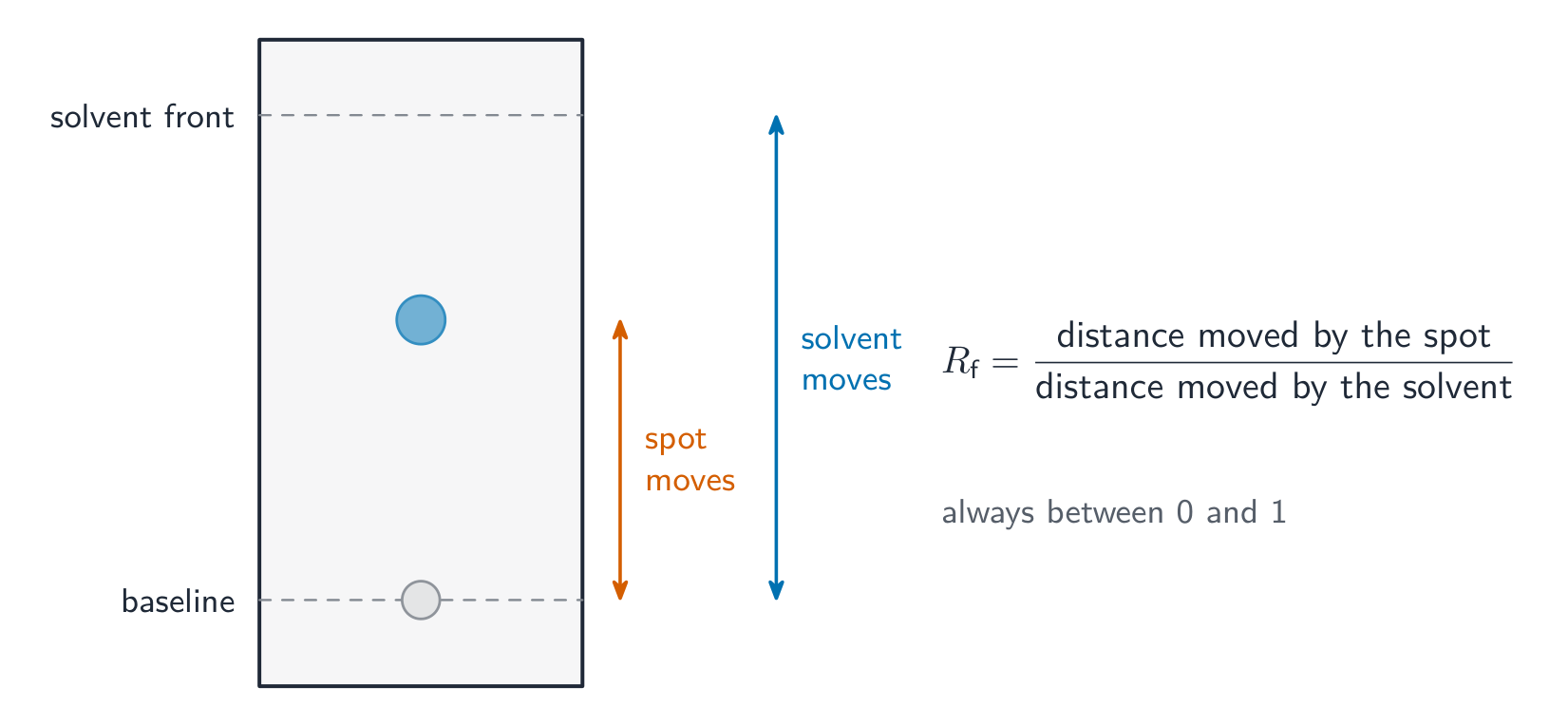
  • the baseline 基线 is the starting line where the spots are placed; the solvent front 溶剂前沿 is the highest level the solvent reaches.

The $R_{\text{f}}$ value compares how far a spot moves with how far the solvent moves:

$$R_{\text{f}} = \frac{\text{distance moved by the spot}}{\text{distance moved by the solvent front}}$$

It is always between 0 and 1. A substance that sticks more strongly to the stationary phase, or is less soluble in the mobile phase, moves less and has a smaller $R_{\text{f}}$.

עברית

כרומטוגרפיה מפרידה תערובת באמצעות שתי "פזות" – אחת שנשארת במקום ואחת שנעה. בכרומטוגרפיה שכבתית דקה (TLC):

  • ה-פזה העומדת נשארת במקום (למשל, אלומינה על לוח).
  • ה-פזה הנעה נעה (ממס קוטבי או לא קוטבי שעולה על הלוח).
  • ה-קו הבסיס הוא הקו ההתחלתי בו ממוקמים הנקודות; חזית הממס היא הגובה המקסימלי שהממס מגיע אליו.

ערך ה-$R_{\text{f}}$ משווה כמה נקודה זזה לעומת כמה הממס זז:

$$R_{\text{f}} = \frac{\text{distance moved by the spot}}{\text{distance moved by the solvent front}}$$

הוא תמיד נמצא בין 0 ל-1. חומר שנדבק חזק יותר לפאזה הניידת, או שפחות מומס בפאזה הנעה, זז פחות ויש לו ערך $R_{\text{f}}$ קטן יותר.

לוח TLC עם קו בסיס, קו גבול הממס וכתם שהזז חלק מהדרך כלפי מעלה, עם סימון מרחקי הכתם והממס
כרומטוגרפיה בשכבה דקה: הערך $R_\text{f}$ הוא המרחק שנקודה נעה חלקי המרחק שהחומר המזיין נעה

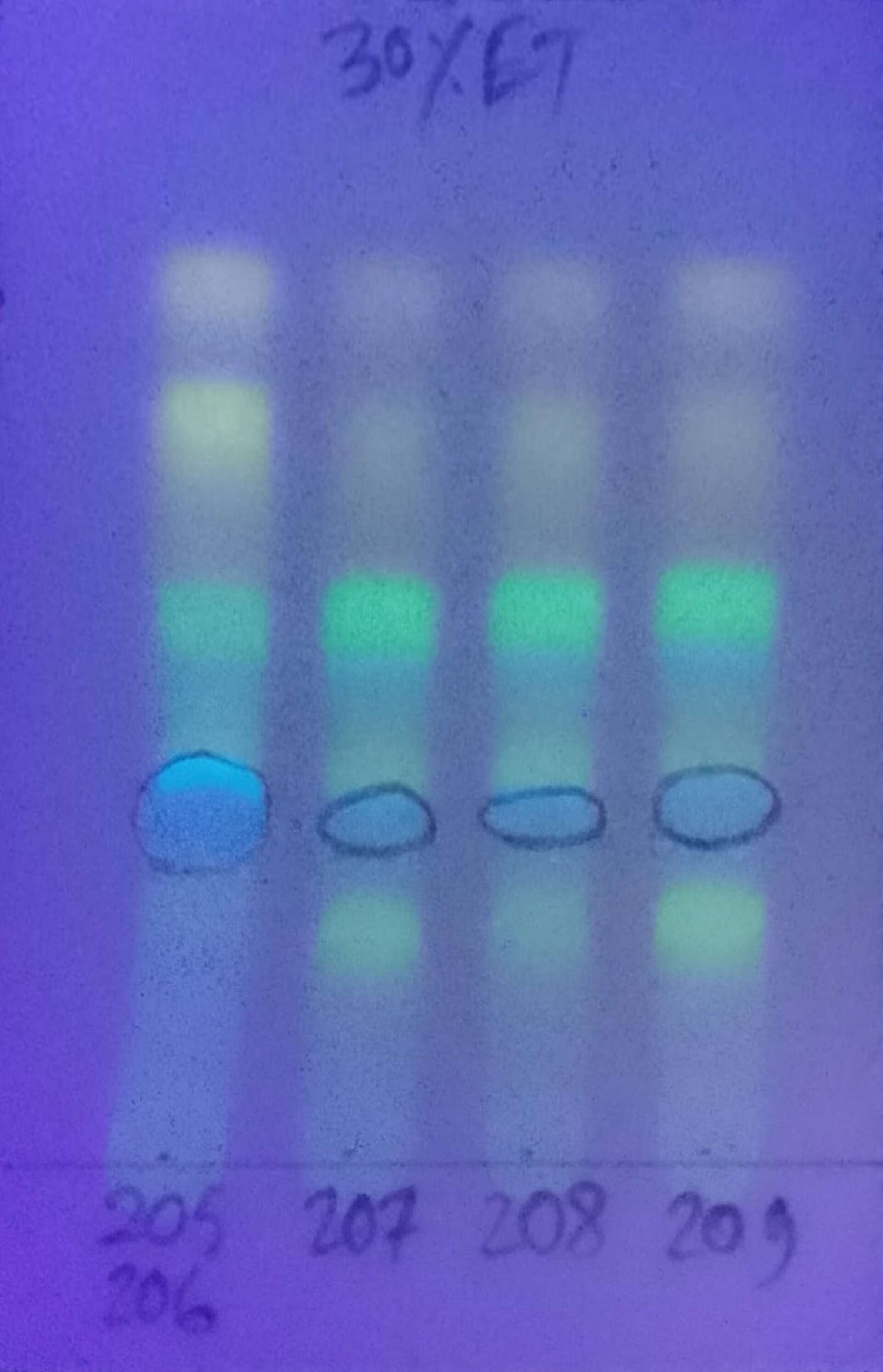
צלחת TLC מפותחת זוהרת באור אולטרה סגול *צלחת TLC אמיתית תחת אור UV: כל נקודה זוהרת היא רכיב מופרד מהתערובת
Explore · ⁨חקור⁩

TLC route · ⁨שיטת TLC⁩

Follow a spot up a plate and use Rf to identify substances. · ⁨עקוב אחרי כתם למעלה על לוח ושתמש ב-Rf כדי לזהות חומרים.⁩

Vocabulary · ⁨מילון מונחים⁩ Train · ⁨אימון⁩
English עברית
chromatography/krəʊməˈtɒɡrəfi/ כרומטוגרפיה
thin-layer chromatography/θɪn ˈleɪə krəʊməˈtɒɡrəfi/ כרומטוגרפיה בשכבה דקה
stationary phase/ˈsteɪʃənəri feɪz/ שלב עומד
mobile phase/ˈməʊbaɪl feɪz/ פאזה זזה
baseline/ˈbeɪslaɪn/ בסיס
solvent front/ˈsɒlvənt frʌnt/ חזית הממס
gas/liquid chromatography/ɡæs ˈlɪkwɪd krəʊməˈtɒɡrəfi/ כרומטוגרפיית גז/נוזל
retention time/rɪˈtenʃn taɪm/ זמן התמדה
37.2

Gas/liquid chromatography · ⁨כרומטוגרפיית גז/נוזל⁩

Syllabus · ⁨סיילבוס⁩
English
  1. describe and understand the terms (a) stationary phase; a high boiling point non-polar liquid (on a solid support) (b) mobile phase; an unreactive gas (c) retention time
  2. interpret gas/liquid chromatograms in terms of the percentage composition of a mixture
  3. explain retention times in terms of interaction with the stationary phase
עברית
  1. לתאר ולהבין את המונחים (a) שלב עומד: נוזל לא-קוטבי בעל נקודת רתיחה גבוהה (על תמיכה מוצקה) (b) שלב זז: גז לא-פעיל (c) זמן שמירה
  2. לפרש כרומוגרמות של גז/נוזל בהתאם לריכוז האחוזי של התערובת
  3. להסביר את זמני השמירה בהתאם לקשר עם השלב העומד

Source: Cambridge International syllabus · ⁨מקור: הסיילבוס הבינלאומי של קמבריד'ג'⁩

English

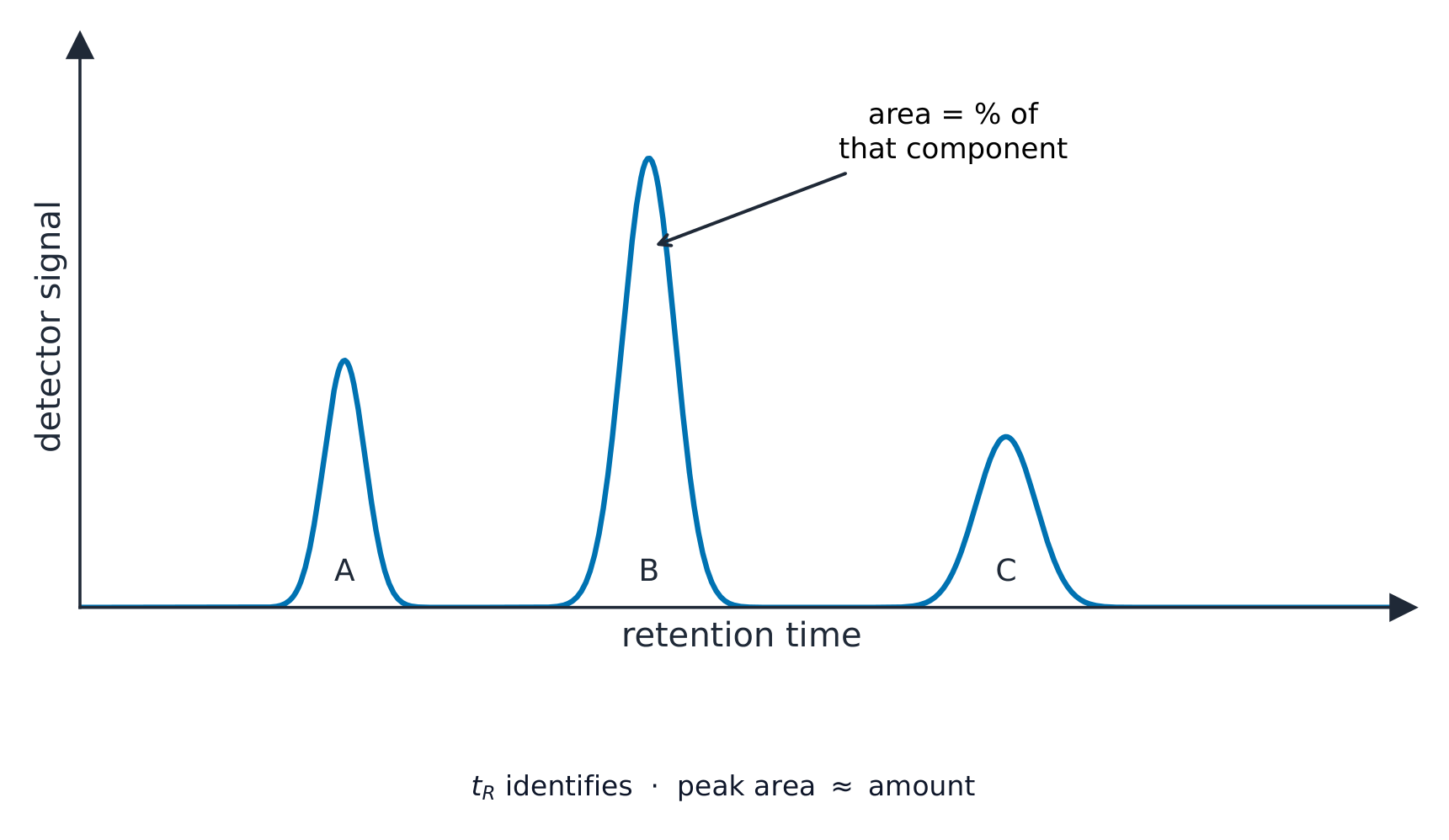
In gas/liquid chromatography 气液色谱 (GLC):

  • the stationary phase is a high-boiling-point non-polar liquid on a solid support.
  • the mobile phase is an unreactive carrier gas.
  • the retention time 保留时间 is how long a component takes to pass through.

The area of each peak gives the percentage of that component in the mixture. A component that interacts more with the stationary phase has a longer retention time.

עברית

בכרומטוגרפיית גז/נוזל (GLC):

  • הפזה עומדת היא נוזל לא-קוטבי בעל נקודת רתיחה גבוהה על תמיכה מוצקה.
  • הפזה זזה היא גז נשיא שאינו מגיב.
  • זמן ההתמדה הוא הזמן שלוקח לרכיב כדי לעבור דרך המערכת.

שטח של כל פס נותן את האחוז של הרכיב ההוא בתערובת. רכיב שמגיב יותר עם הפזה עומדת יש לו זמן התמדה ארוך יותר.

כרומטוגרם עם שלושה פסים בזמני התמדה שונים, שטח הפס נותן את אחוז הרכיב בכל אחד *כרומטוגרם גז-נוזל: לכל רכיב יש פס בזמן ההתמדה שלו, ושטח הפס הוא האחוז שלו בתערובת

Explore · ⁨חקור⁩

Gas/liquid chromatography route · ⁨דרך כרומטוגרפיה גז/נוזל⁩

Follow a volatile sample through column separation to a chromatogram. · ⁨מעקב אחרי דוגמה תכליתית דרך הפרדה בעמודה עד לקבלת כרומטוגרם.⁩

37.3

Carbon-13 NMR spectroscopy · ⁨ספקטרוסקופיית NMR של פחמן-13⁩

Syllabus · ⁨סיילבוס⁩
English
  1. analyse and interpret a carbon-13 NMR spectrum of a simple molecule to deduce: (a) the different environments of the carbon atoms present (b) the possible structures for the molecule
  2. predict or explain the number of peaks in a carbon-13 NMR spectrum for a given molecule
עברית
  1. לנתח ולפרש ספקטרום NMR של פחמן-13 של מולקולה פשוטה כדי לגזור: (a) הסביבות השונות של אטומי הפחמן הקיימים (b) המבנים האפשריים עבור המולקולה
  2. לחזות או להסביר את מספר הפיקים בספקטרום NMR של פחמן-13 עבור מולקולה נתונה

Source: Cambridge International syllabus · ⁨מקור: הסיילבוס הבינלאומי של קמבריד'ג'⁩

English

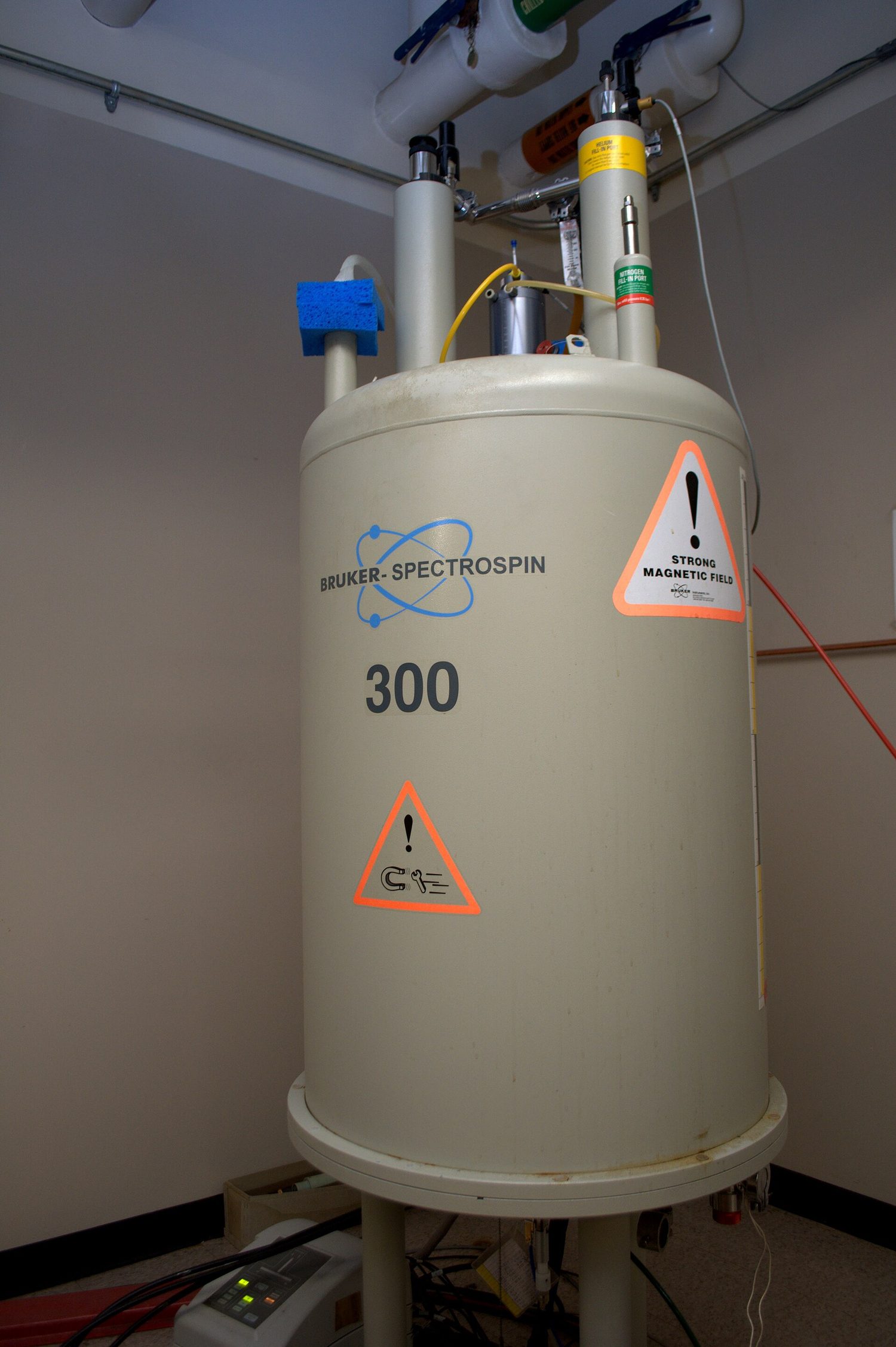
NMR 核磁共振 (nuclear magnetic resonance) studies how certain nuclei behave in a strong magnetic field.

In carbon-13 NMR, each different chemical environment 化学环境 of carbon gives one peak. So:

  • the number of peaks tells you how many different carbon environments there are (equivalent carbons share a peak).
  • the position of each peak (its chemical shift) suggests the type of carbon, which helps you deduce possible structures.
עברית

NMR (תהודה מגנטית גרעינית) לומדת כיצד גרעינים מסוימים מתנהגים בשדה מגנטי חזק.

ספקטרומטר NMR צילינדריות גבוהה עומדת במעבדה, מסומנת באזהרת שדה מגנטי חזק *ספקטרומטר NMR: הצילינדר הגדול מכיל מגנט סופר-מוליך היוצר את השדה המגנטי החזק מאוד שהטכניקה זקוקה לה

ב-NMR של פחמן-13, כל סביבה כימית שונה של פחמן נותנת פס אחד. לכן:

  • מספר הפסים מספר לך כמה סביבות פחמן שונות קיימות (פחמנים שקולים משתפים פס).
  • מיקום כל פס (ההיסוך הכימי שלו) מציע את סוג הפחמן, מה שעוזר לך להסיק מבניות אפשריות.
Explore · ⁨חקור⁩

Carbon-13 NMR lab · ⁨מעבדת NMR של פחמן-13⁩

Match carbon environments to C-13 NMR evidence. · ⁨התאם סביבות פחמן להוכחות C-13 NMR.⁩

Vocabulary · ⁨מילון מונחים⁩ Train · ⁨אימון⁩
English עברית
NMR/ˌen em ˈɑː/ NMR
chemical environment/ˈkemɪkl enˈvaɪrənmənt/ סביבה כימית
37.4

Proton (¹H) NMR spectroscopy · ⁨ספקטרוסקופיית NMR של פרוטון (¹H)⁩

Syllabus · ⁨סיילבוס⁩
English
  1. analyse and interpret a proton ($^1\text{H}$) NMR spectrum of a simple molecule to deduce: (a) the different environments of proton present using chemical shift values (b) the relative numbers of each type of proton present from relative peak areas (c) the number of equivalent protons on the carbon atom adjacent to the one to which the given proton is attached from the splitting pattern, using the $n + 1$ rule (limited to singlet, doublet, triplet, quartet and multiplet) (d) the possible structures for the molecule
  2. predict the chemical shifts and splitting patterns of the protons in a given molecule
  3. describe the use of tetramethylsilane, TMS, as the standard for chemical shift measurements
  4. state the need for deuterated solvents, e.g. $\text{CDCl}_3$, when obtaining a proton NMR spectrum
  5. describe the identification of O–H and N–H protons by proton exchange using $\text{D}_2\text{O}$
עברית
  1. לנתח ולפרש ספקטרום NMR של פרוטון ($^1\text{H}$) של מולקולה פשוטה כדי לגזור: (a) הסביבות השונות של הפרוטונים הקיימים באמצעות ערכי הזזה כימית (b) המספרים היחסיים של כל סוג של פרוטון הקיים מהשטחים היחסיים של הפיקים (ג) מספר הפרוטונים השווים על אטום הפחמן הסמוך לזה שאליו מחובר הפרוטון הנתון, מתוך תבנית ההתפצלות, באמצעות הכלל $n + 1$ (מוגבל לסנגלט, דובלט, טריפלט, קווארטט ומולטיפלט) (ד) המבנים האפשריים עבור המולקולה
  2. לחזות את ההזזות הכימיות ותבניות ההתפצלות של הפרוטונים במולקולה נתונה
  3. לתאר את השימוש ב-טטרה-מתיל-סילאן, TMS, כסטנדרט למדידות הזזה כימית
  4. לציין את הצורך בממסים מדוטרים, למשל $\text{CDCl}_3$, בזמן קבלת ספקטרום NMR של פרוטון
  5. תאר את זיהוי פרוטונים של O–H וN–H על ידי החלפת פרוטונים באמצעות $\text{D}_2\text{O}$

Source: Cambridge International syllabus · ⁨מקור: הסיילבוס הבינלאומי של קמבריד'ג'⁩

English

Proton NMR looks at the hydrogen atoms (proton 质子 nuclei). From the spectrum you read off:

  • chemical environments: protons in different environments appear at different chemical shift 化学位移 values.
  • relative numbers: the relative peak areas give the ratio of each type of proton.
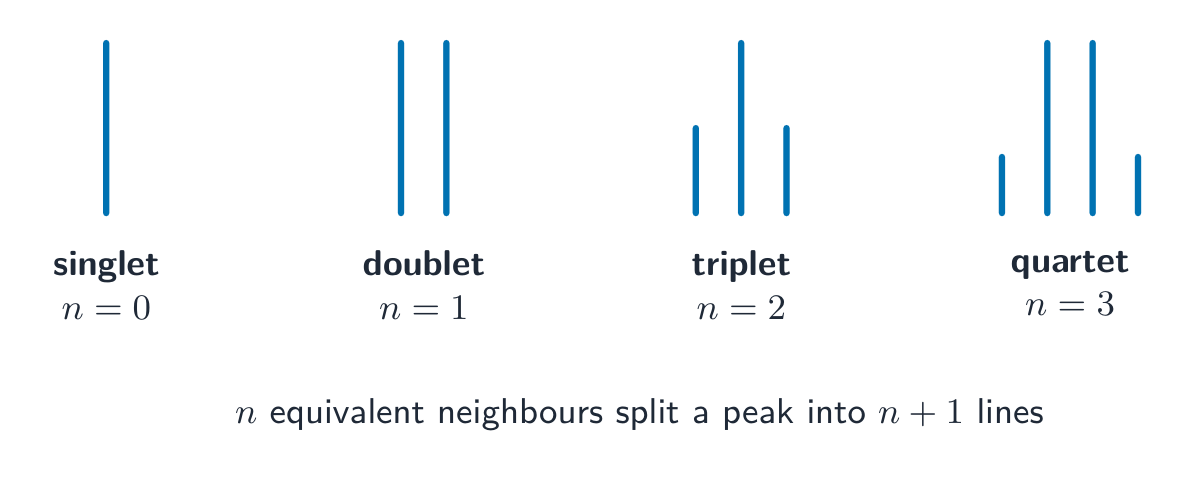
  • splitting 裂分: a peak is split by the protons on the neighbouring carbon, following the $n+1$ rule — $n$ equivalent neighbours split a peak into $n+1$ lines:
Neighbours ($n$) Pattern
0 singlet 单峰
1 doublet 双峰
2 triplet 三峰
3 quartet 四峰
many multiplet 多重峰

Practical points

  • tetramethylsilane 四甲基硅烷 (TMS) is the standard, set at a chemical shift of $0$.
  • a deuterated solvent 氘代溶剂 (such as $\text{CDCl}_3$) is used so that the solvent itself gives no proton signal.
  • shaking the sample with $\text{D}_2\text{O}$ makes the O–H and N–H peaks disappear (their hydrogen is swapped for deuterium), which identifies those protons.

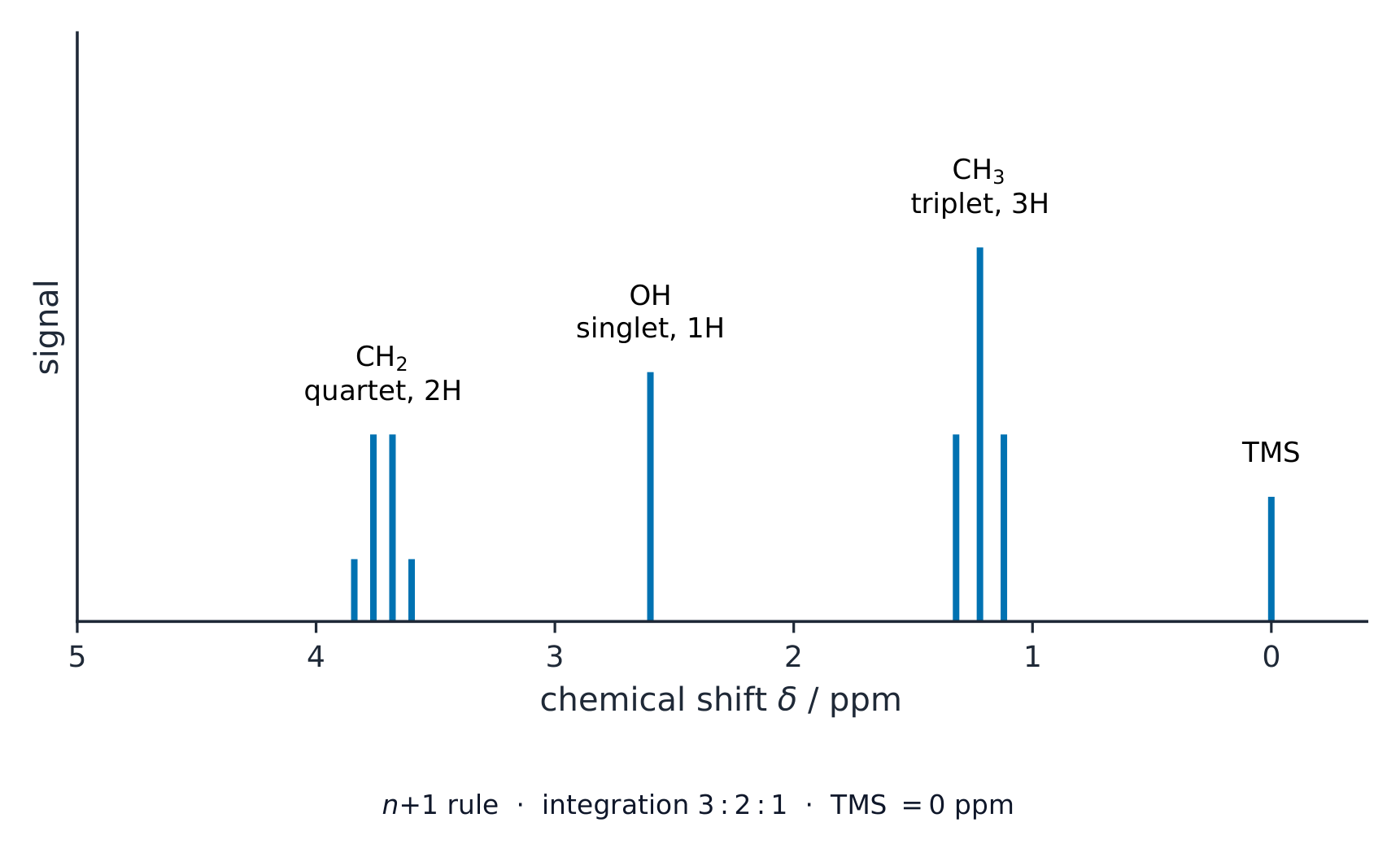
Worked example. A compound $\text{C}_4\text{H}_8\text{O}_2$ gives three proton NMR peaks: a triplet at $\delta\ 1.2$ (area 3), a quartet at $\delta\ 4.1$ (area 2), and a singlet at $\delta\ 2.0$ (area 3). Deduce the structure. Read the areas first, then the splitting. Areas $3:2:3$ give three proton environments holding 3, 2 and 3 hydrogens. Apply the $n+1$ rule in reverse: a triplet (area 3) is a $\text{CH}_3$ with 2 neighbours, and a quartet (area 2) is a $\text{CH}_2$ with 3 neighbours - each splitting the other, which is the classic ethyl group, $\text{CH}_3\text{CH}_2-$. That $\text{CH}_2$ lies far downfield at $\delta\ 4.1$, so it is attached to an oxygen. The remaining singlet (area 3) is a $\text{CH}_3$ with no neighbours at $\delta\ 2.0$, so it sits next to the C=O. Together: $\text{CH}_3\text{COOCH}_2\text{CH}_3$, ethyl ethanoate. A triplet-and-quartet pair is almost always an ethyl group - spot it first and the rest follows.

עברית

NMR של פרוטון בוחן את אטומי המימן (גרעיני פרוטון). מהספקטרום קוראים:

  • סביבות כימיות: פרוטונים בסביבות שונות מופיעים בערכי היסוך כימי שונים.
  • מספרים יחסיים: השטחים היחסיים של השיאים נותנים את היחס בין סוגי הפרוטונים השונים.
  • התפצלות: שיא מתפצל על ידי פרוטונים על הקרבון הסמוך, לפי $n+1$ כלל — $n$ שיינים שווים מקיפים מפצלים שיא ל-$n+1$ קווים:
שכנים ($n$) דפוס
0 סינגלט
1 דייבלט
2 טריוולט
3 קוורטט
רבים מולטיפלט
ארבעה דגמי שיאי NMR: קו יחיד, שני קווים, שלושה קווים וארבעה קווים, מסומנים כסינגלט, דובלט, טריילט וקוורטט
ה-$n+1$ כלל: $n$ פרוטונים שיינים מקיפים מפצלים שיא ל-$n+1$ קווים (סינגלט, דייבלט, טריוולט, קוורטט)
ספקטרום פרוטון NMR של אתנול עם שלושה קבוצות שיאים: טריילט CH3, קוורטט CH2 וסינגלט OH, בנוסף למפנה TMS באפס
פרוטון NMR של אתנול: שלושה סביבות נותנות טריילט CH$_3$, קוורטט CH$_2$ וסינגלט OH, עם שטחים ביחס $3:2:1$

נקודות מעשיות

  • טטרה-מתיל-סילאן (TMS) הוא הסטנדרט, מוגדר במיקום כימי של $0$.
  • משתמשים בנוזל מופקדוטרייט (כגון $\text{CDCl}_3$) כדי שהנוזל עצמו לא ייתן אות פרוטונים.
  • עירבוב הדגימה עם $\text{D}_2\text{O}$ גורם לשיאי O–H ו-N–H להיעלם (ההידרוגן שלהם מחולף בדאוטריום), מה שמזהה פרוטונים אלו.

דוגמה פתורה. תרכובת $\text{C}_4\text{H}_8\text{O}_2$ נותנת שלושה פיקים ב-NMR של פרוטונים: סינגלט ב-$\delta\ 1.2$ (שטח 3), קוורטט ב-$\delta\ 4.1$ (שטח 2) ו-סינגלט ב-$\delta\ 2.0$ (שטח 3). גזור את המבנה. קרא תחילה את השטחים, ואז את ההפרדה. שטחים $3:2:3$ מעידים על שלושה סביבות פרוטון החזקות 3, 2 ו-3 אטומי מימן. יישם את כלל ה-$n+1$ הפוך: סינגלט (שטח 3) הוא קבוצת $\text{CH}_3$ עם 2 שכנים, ו-קוורטט (שטח 2) הוא קבוצת $\text{CH}_2$ עם 3 שכנים – כל אחד מבודד את השני, וזהו ה-אלקיל הקלאסי, $\text{CH}_3\text{CH}_2-$. זה ה-$\text{CH}_2$ מופיע רחוק בשדה (downfield) ב-$\delta\ 4.1$, ולכן הוא מחובר לחמצן. ה-סינגלט הנותר (שטח 3) הוא קבוצת $\text{CH}_3$ ללא שכנים ב-$\delta\ 2.0$, ולכן היא יושבת צמוד לקרינה C=O. יחד: $\text{CH}_3\text{COOCH}_2\text{CH}_3$, אתיל אתנואט. זוג סינגלט-קוורטט הוא כמעט תמיד קבוצת אלקיל – זיהוי ראשוני והשאר יוביל.

Explore · ⁨חקור⁩

Proton NMR lab · ⁨מעבדת NMR פרוטון⁩

Match proton evidence to chemical environment and neighbours. · ⁨התאם עדויות פרוטון לסביבה כימית ולשכנים.⁩

Vocabulary · ⁨מילון מונחים⁩ Train · ⁨אימון⁩
English עברית
proton/ˈprəʊtɒn/ פרוטון
chemical shift/ˈkemɪkl ʃɪft/ הזזה כימית
splitting/ˈsplɪtɪŋ/ פיצול
singlet/ˈsɪŋɡlɪt/ סינגלט
doublet/ˈdʌblət/ דבלט
triplet/ˈtrɪplɪt/ משולש
quartet/kwɔːˈtet/ קוורטט
multiplet/ˈmʌltɪplɪt/ מולטיפלט
tetramethylsilane/ˈtetrəmiːθɪlsɪleɪn/ טטרה-מתיל סילאן
deuterated solvent/ˈdjuːtəreɪtɪd ˈsɒlvənt/ ממס מודגש
37.4

Exam tips · ⁨טיפים לבחינות⁩

English
  • In $^{13}\text{C}$ NMR the number of peaks equals the number of carbon environments — use symmetry to count them.
  • In $^1\text{H}$ NMR use chemical shift (data booklet), integration (ratio of H's) and splitting (the $n+1$ rule): a triplet + quartet means an ethyl group.
  • TMS is the reference ($\delta = 0$); a $\text{D}_2\text{O}$ shake removes O-H and N-H peaks.
  • Combine IR, mass spectrum and NMR to deduce a structure, stating which evidence gives which feature.
עברית
  • ב-NMR של $^{13}\text{C}$ מספר השיאים שווה למספר סביבות הפחמן — השתמשו בסמטריות לספירתן.
  • ב-NMR של $^1\text{H}$ השתמשו במיקום כימי (ספר נתונים), אינטגרציה (יחס H's) והתפצלות (ה-$n+1$ כלל): טריוולט + קוורטט פירושו אתיל קבוצה.
  • TMS הוא הרפרנס ($\delta = 0$); $\text{D}_2\text{O}$ עירבוב מסיר שיאי O-H ו-N-H.
  • שלב IR, ספקטרום מסה ו-NMR כדי להסיק מבנה, תוך ציון איזה עדות נותנת איזה מאפיין.

Interactive lessons on this topic · ⁨שיעורים אינטראקטיביים בנושא זה⁩

Work through it step by step, with instant-check exercises. · ⁨לעבור על הדברים צעד אחר צעד, עם תרגילים לבדיקה מיידית.⁩

Past Papers · ⁨מבחני עבר⁩

More topics in A-Level Chemistry · ⁨כימיה A-Level⁩ · ⁨נושאים נוספים בA-Level Chemistry · ⁨כימיה A-Level⁩⁩

Log in or create account · ⁨היכנס או צור חשבון⁩

IGCSE, A-Level & AP