מים עם ברומ בצבע כתום הם המבחן הקלאסי לקשר כפול. מערבבים אותו עם אלקן, והצבע הכתום נעלם מיד. כעת מערבבים את אותו ברומ בדיוק…
English narration · English + 中文 subtitles burned in · קריאת קול באנגלית · תרגום אנגלי + סינית שרוף בתוך הסרטון
30.1
Arenes · ארנים
Syllabus · סיילבוס
English
describe the chemistry of arenes as exemplified by the following reactions of benzene and methylbenzene: (a) substitution reactions with $\text{Cl}_2$ and with $\text{Br}_2$ in the presence of a catalyst, $\text{AlCl}_3$ or $\text{AlBr}_3$, to form halogenoarenes (aryl halides) (b) nitration with a mixture of concentrated $\text{HNO}_3$ and concentrated $\text{H}_2\text{SO}_4$ at a temperature between $25\text{ }^{\circ}\text{C}$ and $60\text{ }^{\circ}\text{C}$ (c) Friedel–Crafts alkylation by $\text{CH}_3\text{Cl}$ and $\text{AlCl}_3$ and heat (d) Friedel–Crafts acylation by $\text{CH}_3\text{COCl}$ and $\text{AlCl}_3$ and heat (e) complete oxidation of the side-chain using hot alkaline $\text{KMnO}_4$ and then dilute acid to give a benzoic acid (f) hydrogenation of the benzene ring using $\text{H}_2$ and $\text{Pt/Ni}$ catalyst and heat to form a cyclohexane ring
describe the mechanism of electrophilic substitution in arenes: (a) as exemplified by the formation of nitrobenzene and bromobenzene (b) with regards to the effect of delocalisation (aromatic stabilisation) of electrons in arenes to explain the predomination of substitution over addition
predict whether halogenation will occur in the side-chain or in the aromatic ring in arenes depending on reaction conditions
describe that in the electrophilic substitution of arenes, different substituents direct to different ring positions (limited to the directing effects of $-\text{NH}_2$, $-\text{OH}$, $-\text{R}$, $-\text{NO}_2$, $-\text{COOH}$ and $-\text{COR}$)
עברית
תאר את הכימיה של ארנים על בסיס התגובות הבאות של בנזן ומתילבנזן: (א) תגובות הצבה עם $\text{Cl}_2$ ועם $\text{Br}_2$ בנוכחות חומר זריק, $\text{AlCl}_3$ או $\text{AlBr}_3$, ליצירת הלוארנים (הלוגני אריל) (ב) ניטרציה בעזרת תערובת של $\text{HNO}_3$ מרוכז ו-$\text{H}_2\text{SO}_4$ מרוכז בטמפרטורה בין $25\text{ }^{\circ}\text{C}$ ל-$60\text{ }^{\circ}\text{C}$ (ג) אלקיציית פרידל-קראפט על ידי $\text{CH}_3\text{Cl}$ ו-$\text{AlCl}_3$ בחום (ד) אצילציות פרידל-קראפט על ידי $\text{CH}_3\text{COCl}$ ו-$\text{AlCl}_3$ בחום (ה) חמצון מלא של השלשלת צד באמצעות $\text{KMnO}_4$ עורפי וחם ולאחר מכן חומצה דלולה לקבלת חומצה בנזואית (ו) הידרוגנציה של טבעת הבנזן באמצעות $\text{H}_2$ ו-$\text{Pt/Ni}$ כחומר זריק ובחום ליצירת טבעת סיקלוהקסן
תאר את המנגנון של הצבה אלקטרופילית בארנים: (א) כפי שמוצג בהיווצרות ניטרובנזן וברומובנזן (ב) בהתייחס להשפעת הדילוקליזציה (הייצוב הארומטי) של אלקטרונים בארנים כדי להסביר את ההעדיפות לתגובות הצבה לעומת תגובות הוספה
נבא האם תתרחש הלגנציה בשלשלת הצד או בטבעת הארומטית בארנים בהתאם לתנאי התגובה
תאר כי בהצבה אלקטרופילית של ארנים, מצבים שונים מדריכים לתפקידים שונים בטבעת (מוגבל לאפקטים המכוונים של $-\text{NH}_2$, $-\text{OH}$, $-\text{R}$, $-\text{NO}_2$, $-\text{COOH}$ ו-$-\text{COR}$)
Source: Cambridge International syllabus · מקור: הסיילבוס הבינלאומי של קמבריד'ג'
English
Arenes 芳烃 are aromatic hydrocarbons, built on the benzene 苯 ring. The delocalised ring of electrons is stable and electron-rich, so benzene mostly reacts by electrophilic substitution 亲电取代 — keeping the ring — rather than by addition.
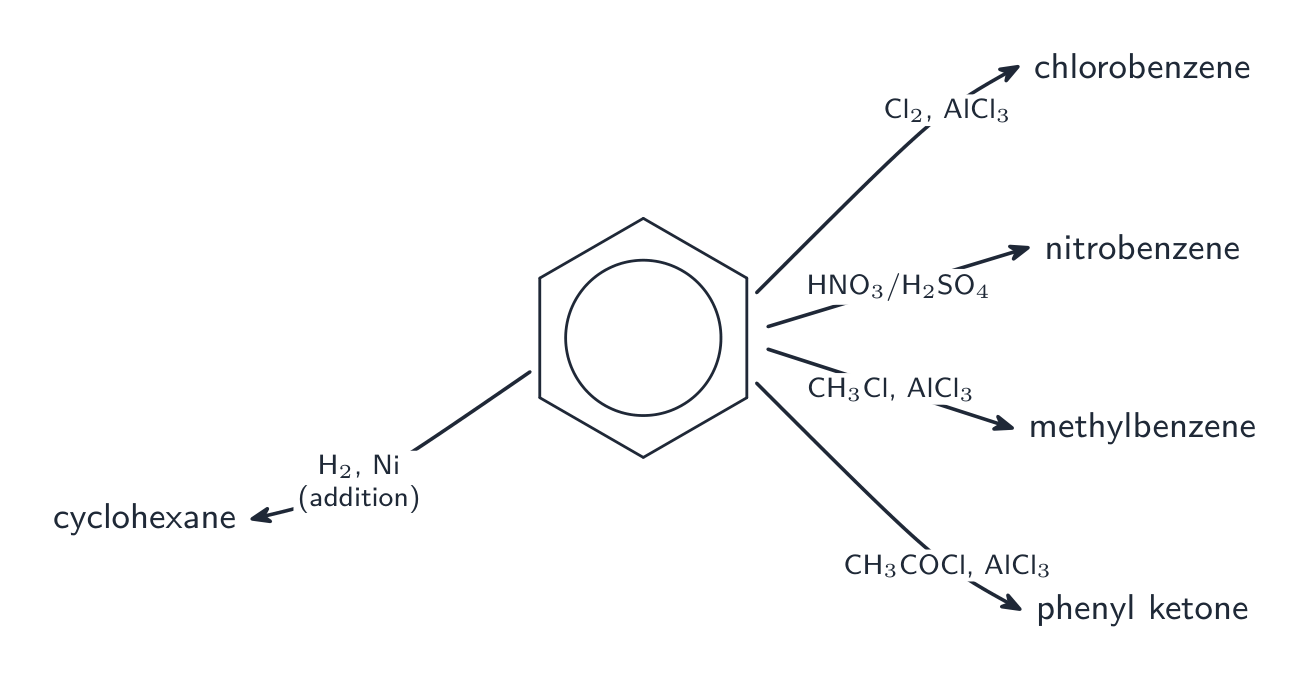
Reactions of benzene and methylbenzene
Reaction
Reagents and conditions
Product
halogenation
$\text{Cl}_2$ or $\text{Br}_2$, with $\text{AlCl}_3$ or $\text{AlBr}_3$ as a catalyst 催化剂
In the side-chain oxidation, the whole side-chain 侧链 (such as the $\text{–CH}_3$ on methylbenzene) is turned into a $\text{–COOH}$ group, giving benzoic acid. In the hydrogenation, three molecules of $\text{H}_2$ add to the benzene ring 苯环 to make a saturated cyclohexane ring.
The mechanism: electrophilic substitution
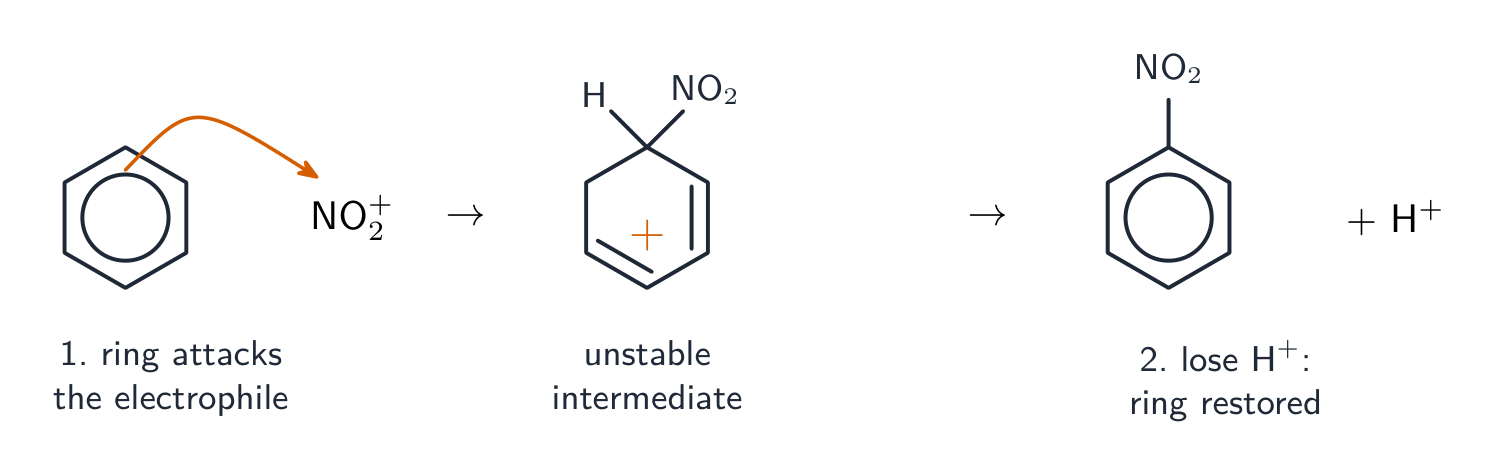
Take nitration as the example. The acid mix makes the electrophile $\text{NO}_2^+$. Then:
the delocalised electrons of the ring form a bond to the electrophile, giving an unstable intermediate.
an $\text{H}^+$ is lost from that carbon, which restores the stable ring.
Substitution wins over addition because the delocalisation 离域 (aromatic stabilisation) of the ring is kept. Addition would destroy this stable system, so it is not favoured.
Side-chain or ring?
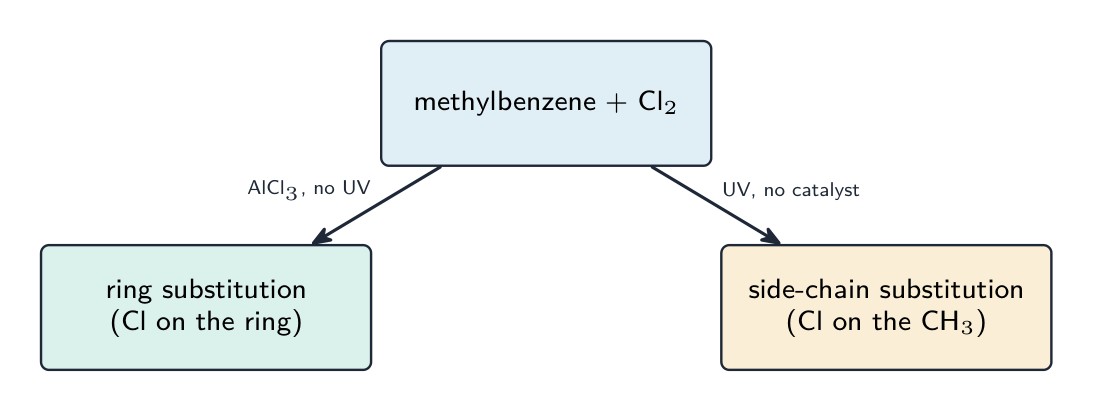
Where a halogen reacts depends on the conditions:
with a halogen-carrier catalyst (such as $\text{AlCl}_3$) and no UV light → substitution in the ring.
with UV light and no catalyst → free-radical substitution in the side-chain.
Directing effects
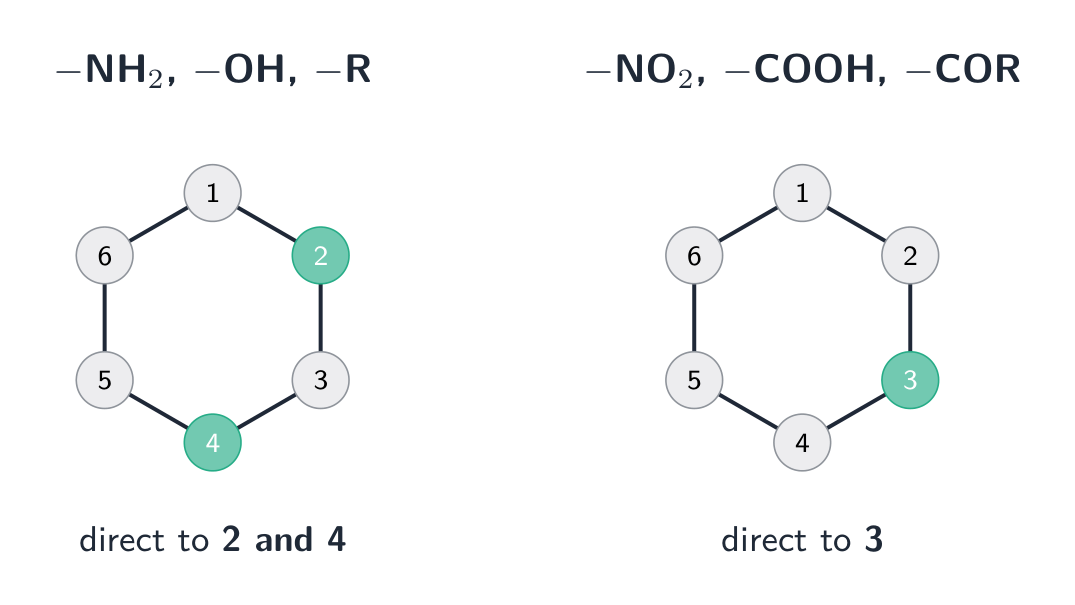
A group already on the ring decides where the next group goes — its directing effect 定位效应:
Group already present
Directs the new group to
$\text{–NH}_2$, $\text{–OH}$, $\text{–R}$
positions 2 and 4
$\text{–NO}_2$, $\text{–COOH}$, $\text{–COR}$
position 3
Worked example. Methylbenzene and nitrobenzene are each nitrated. Predict where the new $\text{NO}_2$ group goes, and which compound reacts faster. Look at the group already on the ring. In methylbenzene the $\text{–CH}_3$ is an alkyl group: it directs the new group to positions 2 and 4, and it releases electrons into the ring, making the ring more attractive to an electrophile - so methylbenzene nitrates faster than benzene. In nitrobenzene the $\text{–NO}_2$ directs to position 3, and it withdraws electrons from the ring - so nitrobenzene nitrates more slowly than benzene. The group already present controls both the position and the rate, and the two always travel together: 2,4-directors activate the ring, 3-directors deactivate it.
עברית
ארנים הם הידרוקרבונים ארומטיים, המבוססים על טבעת הבנזן. הטבעת המוצללת של אלקטרונים היא יציבה ועשירה באלקטרונים, ולכן בנזן מגיב בעיקר באמצעות החלפה אלקטרופילית - שמירה על הטבעת - ולא באמצעות הוספה.
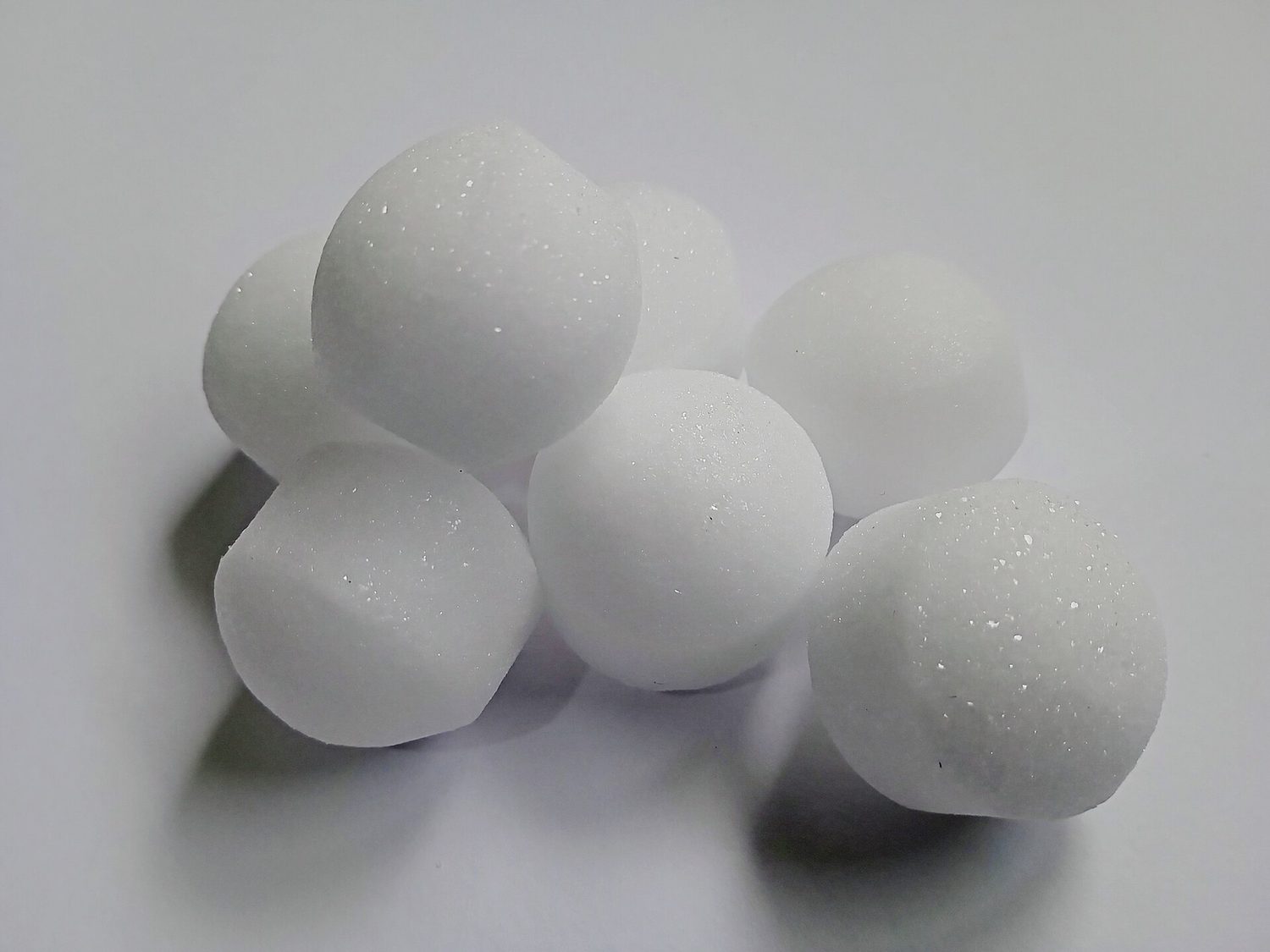
נפתלן, המשמש בכדורי כדורמיסה, הוא ארן פשוט - שתי טבעות בנזן מחוברות זו לזו
תגובות של בנזן ומתילבנזן
תגובה
חומרי גלם ותנאים
מוצר
הלוגנציה
$\text{Cl}_2$ או $\text{Br}_2$, עם $\text{AlCl}_3$ או $\text{AlBr}_3$ כקטליזטור
פרידל-קרפטס: אלקילציה מוסיפה קבוצה אלקילית, אצילציה מוסיפה קבוצה אציליתבנזן שומר על הטבעת היציבה שלו, ורוב התגובות שלו הן החלפה אלקטרופילית (וחיבור מתרחש רק עם מימן)
בחמצון השלשלת הצד, כל השלשלת הצד (כמו ה$\text{–CH}_3$ במטילבנזן) הופכת לקבוצת $\text{–COOH}$, ונוצר חומצה בנזואי. בהידרוגנציה, שלושה מולקולות של $\text{H}_2$ נוספות לטבעת הבנזן ליצירת טבעת ציקלוהקסאן רוויה.
המנגנון: החלפה אלקטרופילית
נניח את ההשלחה כדוגמה. תערובת החומצה יוצרת את האלקטרופיל $\text{NO}_2^+$. אז:
האלקטרונים המעוכבים בטבעת יוצרים קשר עם האלקטרופיל, ונוצר אינטרמדיום לא יציב.
החלפה עדיפה על חיבור מכיוון שהמעוכבות (הייצוב הארומטי) של הטבעת נשמרת. חיבור היה הרס מערכת יציבה זו, ולכן הוא אינו מועדף.
החלפה אלקטרופילית (השלחה): הטבעת תוקפת את האלקטרופיל NO$_2^+$ לנוצרת אינטרמדיום לא יציב, ואז מאבדת H$^+$ כדי להחזיר את הטבעת
שלשלת צד או טבעת?
המיקום בו הלוגן מגיב תלוי בתנאים:
עם מצעין נשיאת הלוגן (כמו ה$\text{AlCl}_3$) וללא אור UV → החלפה בטבעת.
עם אור UV וללא מצעין → החלפת רדיקלים חופשיים בשלשלת הצד.
התנאים קובעים: נשיאת הלוגן (AlCl₃) מחליפה את הטבעת; אור UV מחליף את שלשלת הצד
השפעות כוונוניות
קבוצה שכבר נמצאת בטבעת קובעת היכן תגיע הקבוצה הבאה — ההשפעה הכווננת שלה:
קבוצה שכבר בטבעת מכוונת את הבאה: –NH$_2$/–OH/–R שולחים אותה למיקומים 2 ו-4; –NO$_2$/–COOH/–COR שולחים אותה למיקום 3
קבוצה קיימת
מכינה את הקבוצה החדשה ל-
$\text{–NH}_2$, $\text{–OH}$, $\text{–R}$
מיקומים 2 ו-4
$\text{–NO}_2$, $\text{–COOH}$, $\text{–COR}$
מיקום 3
דוגמה פתורה. מתיילבנזן וניטרובנזן עוברים ניטרציה כל אחד. תחזי איפה ייכנס הקבוצה החדשה $\text{NO}_2$, ואילו תרכובת מגיבה מהר יותר. ראה את הקבוצה שכבר קיימת על הטבעת. במתיילבנזן, ה-$\text{–CH}_3$ הוא קבוצה אלקילית: היא מפנה את הקבוצה החדשה למיקומים 2 ו-4, והיא משחררת אלקטרונים אל הטבעת, מה שהופך אותה למשיכה טובה יותר לאלקטרופיל - לכן מתיילבנזן עובר ניטרציה מהר יותר מאשר בנזן. בניטרובנזן, ה-$\text{–NO}_2$ מפנה למיקום 3, והוא מושך אלקטרונים מהטבעת - לכן ניטרובנזן עובר ניטרציה איט יותר מאשר בנזן. הקבוצה הקיימת קובעת גם את המיקום גם את הקצב, ושני הדברים תמיד נעים יחד: מקצבי 2,4 מפעילים את הטבעת, מקצבי 3 מדעירים אותה.
Explore · חקור
Arene substitution route · מסלול החלפת ארנאים
Follow electrophilic substitution on benzene. · עקוב אחר ההצבה האלקטרופילית בביזול.
Explore · חקור
Directing effects lab · מעבדה: אפקטים כוונתיים
Classify substituents by how they affect the benzene ring. · מיינו סובסטיטואנטים לפי השפעתם על טבעת הבנזן.
Benzene undergoes electrophilic substitution, not addition, because addition would destroy the stable delocalised ring.
Learn nitration (concentrated $\text{HNO}_3$/$\text{H}_2\text{SO}_4$, $50-60\ ^\circ\text{C}$) and halogenation (halogen + $\text{AlCl}_3$) with the electrophile-generating step.
Compare reactivity: benzene resists addition far more than an alkene because of delocalisation.
עברית
בנזן עובר החלפה אלקטרופילית, לא תוספת, משום שתוספת הייתה מרוסה את הטבעת המבוזלת היציבה.
למד ניטרציה ($\text{HNO}_3$/$\text{H}_2\text{SO}_4$ מרוכז, $50-60\ ^\circ\text{C}$) והלוגנציה (הלוגן + $\text{AlCl}_3$) עם שלב יצירת האלקטרופיל.
השווה תגובתיות: בנזן מתנגד לתוספת הרבה יותר מאשר אלקן בשל הבוזלציה.
Interactive lessons on this topic · שיעורים אינטראקטיביים בנושא זה
Work through it step by step, with instant-check exercises. · לעבור על הדברים צעד אחר צעד, עם תרגילים לבדיקה מיידית.
Pick one and the site follows you — notes, papers, videos and practice all open on it. · בחרו נושא אחד והאתר יעקוב אחריו — הערות, מסמכים, וידאו ותרגולים פתוחים בו.
Type to search notes, lessons, code, vocabulary and past-paper questions across every subject. · הקלד כדי לחפש הערות, שיעורים, קוד, אוצר מילים ושאלות מבחנים בכל הנושאים.