שני דברים בכיס שלך פועלים על אותה כימיה. סוללה: תגובה שאינה רוצה לקרות דוחפת אלקטרונים דרך חוט. ומטען: אנחנו דוחפים את האלקטרונים הללו…
English narration · English + 中文 subtitles burned in · קריאת קול באנגלית · תרגום אנגלי + סינית שרוף בתוך הסרטון
24.1
Electrolysis · אלקטרוליזה
Syllabus · סיילבוס
English
predict the identities of substances liberated during electrolysis from the state of electrolyte (molten or aqueous), position in the redox series (electrode potential) and concentration
state and apply the relationship $F = Le$ between the Faraday constant, $F$, the Avogadro constant, $L$, and the charge on the electron, $e$
calculate: (a) the quantity of charge passed during electrolysis, using $Q = It$ (b) the mass and/or volume of substance liberated during electrolysis
describe the determination of a value of the Avogadro constant by an electrolytic method
עברית
לחזות את זהויות החומרים המשתחררים במהלך אלקטרוליזה על בסיס מצב האלקטרוליט (ממיסה מותכת או מימית), מיקום בסדרת התחזור-חמצון (פוטנציאל אלקטרודה) והריכוז
לנסח ולשקף את הקשר $F = Le$ בין קבוע פארדיי, $F$, קבוע אווגדרו, $L$, ומטען האלקטרון, $e$
לבצע: (א) חישוב כמות המטען שעברה במהלך האלקטרוליזה, באמצעות $Q = It$; (ב) חישוב מסה ו/או נפח של חומר שנשחרר במהלך האלקטרוליזה
לתאר את קביעת ערך קבוע אווגדרו באמצעות שיטה אלקטרוליטית
Source: Cambridge International syllabus · מקור: הסיילבוס הבינלאומי של קמבריד'ג'
English
Electrolysis: ions discharge at the electrodes
Electrolysis 电解 uses electricity to break down a molten or aqueous electrolyte 电解质. Positive ions move to the negative electrode and negative ions move to the positive electrode.
At each electrode 电极 a half-reaction happens:
at the cathode 阴极 (negative): positive ions gain electrons (reduction).
at the anode 阳极 (positive): negative ions lose electrons (oxidation).
Predicting the products
a molten electrolyte gives the metal at the cathode and the non-metal at the anode.
an aqueous electrolyte also contains water. At the cathode, a less reactive metal is released, but for a reactive metal you get hydrogen instead. At the anode you usually get oxygen, but a concentrated halide solution gives the halogen.
Calculations
The charge on one mole of electrons is the Faraday constant 法拉第常量, linked to the Avogadro constant 阿伏伽德罗常量 ($L$) and the charge on one electron ($e$) by $F = Le$.
The charge passed is $Q = It$ (current $\times$ time). Then:
moles of electrons $= Q / F$.
use the half-equation to find moles of product.
find the mass ($\times M_r$) or the gas volume.
Measuring the mass deposited for a known charge lets you work back to a value of the Avogadro constant.
Worked example. A current of $2.0\ \text{A}$ flows for $30$ minutes through copper(II) sulfate solution, depositing copper at the cathode: $\text{Cu}^{2+} + 2\text{e}^- \rightarrow \text{Cu}$. Find the mass of copper deposited. ($F = 96\,500\ \text{C mol}^{-1}$, $A_r$ Cu $= 64$.)
Charge passed: $Q = It = 2.0 \times (30 \times 60) = 3600\ \text{C}$. Moles of electrons $= Q/F = 3600/96\,500 = 0.0373\ \text{mol}$. From the half-equation, $2\ \text{mol}$ of electrons give $1\ \text{mol}$ of Cu, so $n(\text{Cu}) = 0.0187\ \text{mol}$ and
אלקטרוליזה: מקור ה-DC מדריך יונים חיוביים לקתודה (רידוקציה) ויונים שליליים לאנודה (חמצון)וולטמטר הופמן לאלקטרוליזה של מים: מקור החשמל מניע זרם דרך שני הקטבים, והגז שנוצר בכל אחד מהם נאסף בצינור הצדדי שלו
חוזות תוצרי התגובה
אלקטרוליט נוזלי נותן מתכת בקתודה ולא-מתכת באנודה.
אלקטרוליט מימי מכיל גם מים. בקתודה משתחרר מתכת פחות תגובתית, אך עבור מתכת תגובתית מתקבל חמצן במקום זאת. באנודה בדרך כלל מתקבל חמצן, אך תמיסת הלוגנידים רכוזה נותנת את ההלוגן.
אלקטרוליט מהותך נותן מתכת ואי-מתכת; תמיסה מימית מכילה גם מים
חישובים
המטען על מול אחד של אלקטרונים הוא קבוע פאראדיי, הקשור לקבוע אווגדרו ($L$) ולמטען על אלקטרון אחד ($e$) לפי $F = Le$.
המטען שעבר הוא $Q = It$ (זרם $\times$ זמן). לאחר מכן:
מולים של אלקטרונים $= Q / F$.
השתמש במשוואת החצי כדי למצוא מולים של המוצר.
מצא את המסה ($\times M_r$) או נפח הגז.
מדידת המסה שהושקעה למטען ידוע מאפשרת לחשב ערך של קבוע אווגדרו.
דוגמה מפורטת. זרם של $2.0\ \text{A}$ זורם במשך $30$ דקות בתמיסת נחושת(II) גופרית, ומשקע נחושת בקתודה: $\text{Cu}^{2+} + 2\text{e}^- \rightarrow \text{Cu}$. מצא את מסת הנחושת שהושקעה. ($F = 96\,500\ \text{C mol}^{-1}$, $A_r$ Cu $= 64$.)
המטען שעבר: $Q = It = 2.0 \times (30 \times 60) = 3600\ \text{C}$. מולים של אלקטרונים $= Q/F = 3600/96\,500 = 0.0373\ \text{mol}$. ממשוואת החצי, $2\ \text{mol}$ של אלקטרונים נותנים $1\ \text{mol}$ של Cu, לכן $n(\text{Cu}) = 0.0187\ \text{mol}$ ו
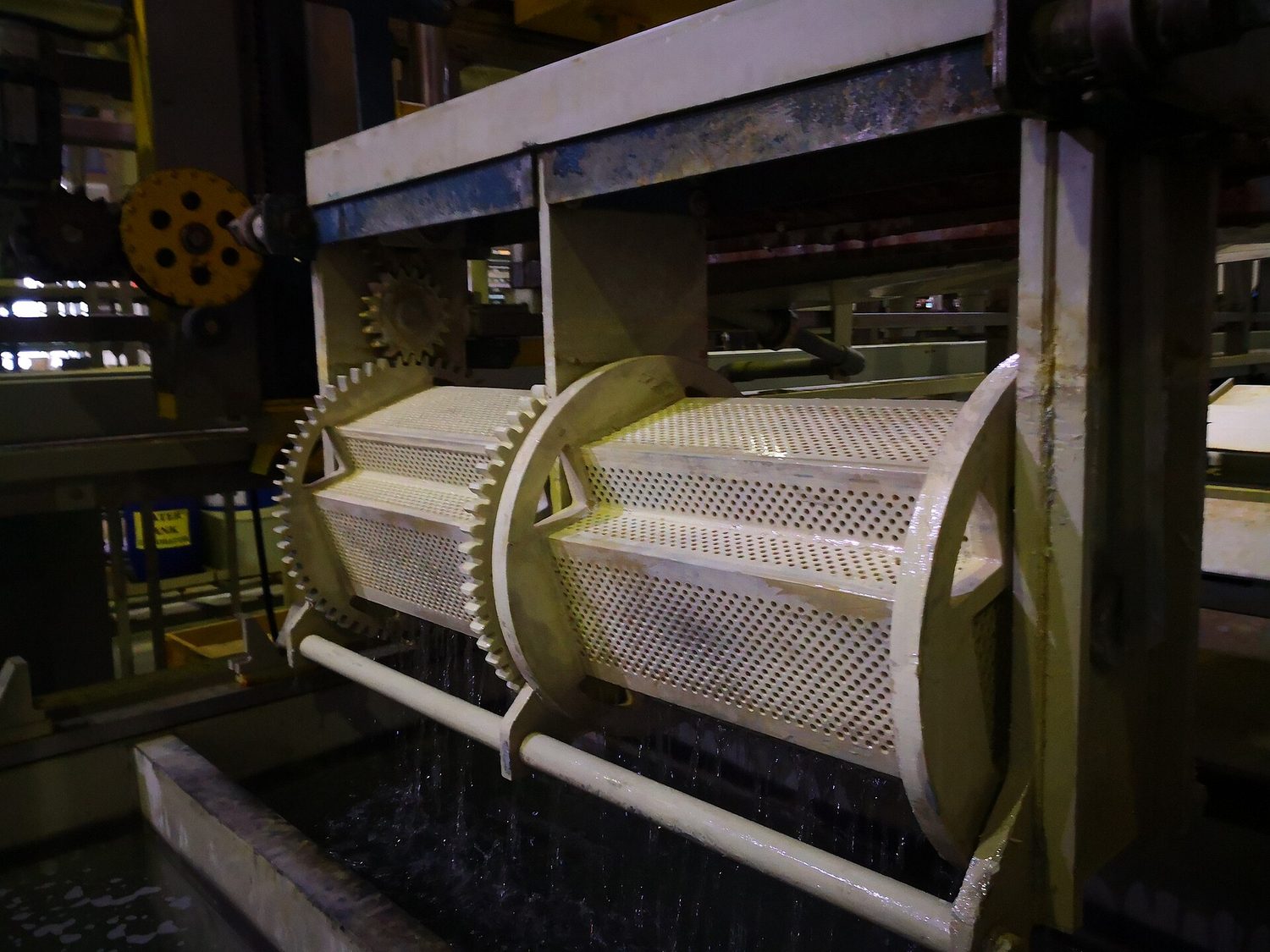
אלקטרוליזה משמשת לצפייה בעצם בשכבה דקה ומבריקה של מתכת כמו כרום
Explore · חקור
Faraday's first law · החוק הראשון של פארדיי
m = k·Q
Mass deposited is proportional to the charge passed (Faraday's law). · המסה המושקעת פרופורציונלית למטען העובר (חוק פארדיי).
Explore · חקור
Inside an electrolysis cell · בתוך תא אלקטרוליזה
Choose an electrolyte and watch the ions move: cations to the cathode, anions to the anode, where they are discharged. · בחר אלקטרוליט ותצפה את היונים זזים: קטיונים אל הקתודה, אניונים אל האנודה, שם הם משתחררים.
Standard electrode potentials and cell potentials · פוטנציאלים אלקטרודי סטנדרטיים ופוטנציאל תא
Syllabus · סיילבוס
English
define the terms: (a) standard electrode (reduction) potential (b) standard cell potential
describe the standard hydrogen electrode
describe methods used to measure the standard electrode potentials of: (a) metals or non-metals in contact with their ions in aqueous solution (b) ions of the same element in different oxidation states
calculate a standard cell potential by combining two standard electrode potentials
use standard cell potentials to: (a) deduce the polarity of each electrode and hence explain/deduce the direction of electron flow in the external circuit of a simple cell (b) predict the feasibility of a reaction
deduce from $E^{\ominus}$ values the relative reactivity of elements, compounds and ions as oxidising agents or as reducing agents
construct redox equations using the relevant half-equations
predict qualitatively how the value of an electrode potential, $E$, varies with the concentrations of the aqueous ions
use the Nernst equation, e.g. $E = E^{\ominus} + (0.059/z) \log \frac{[\text{oxidised species}]}{[\text{reduced species}]}$, to predict quantitatively how the value of an electrode potential varies with the concentrations of the aqueous ions; examples include $\text{Cu}^{2+}(\text{aq}) + 2\text{e}^- \rightleftharpoons \text{Cu}(\text{s})$, $\text{Fe}^{3+}(\text{aq}) + \text{e}^- \rightleftharpoons \text{Fe}^{2+}(\text{aq})$
understand and use the equation $\Delta G^{\ominus} = -n E^{\ominus}_{\text{cell}} F$
עברית
להגדיר את המושגים: (א) פוטנציאל אלקטרודה סטנדרטי (התחזור); (ב) פוטנציאל תא סטנדרטי
לתאר את אלקטרודת המימן הסטנדרטית
לתאר שיטות המשמשות למדידת פוטנציאלים סטנדרטיים של אלקטרודה עבור: (א) מתכות או אל-מתכות בשcontact עם יונין בממיסה מימית; (ב) יונים מאותו יסוד במצבי חמצון שונים
לחשב פוטנציאל תא סטנדרטי על ידי שילוב שני פוטנציאלים סטנדרטיים של אלקטרודה
להשתמש בפוטנציאלים סטנדרטיים של תא כדי: (א) להסיק את הקוטביות של כל אלקטרודה ולכן להסביר/להסיק את כיוון זרימת האלקטרונים במעגל החיצוני של תא פשוט; (ב) לחזות את האפשרות של תגובה
להסיק מערכי $E^{\ominus}$ את הרעילות היחסית של יסודות, תרכובות ויונים כחומרי חמצון או כחומרי חמצון
לבנות משוואות תחזור-חמצון באמצעות משוואות מחצית רלוונטיות
לחזות באופן איכותי כיצד ערך פוטנציאל אלקטרודה, $E$, משתנה בהתאם לריכוזי היונים בממיסה המימית
להשתמש במשוואת נרנסט, לדוגמה $E = E^{\ominus} + (0.059/z) \log \frac{[\text{oxidised species}]}{[\text{reduced species}]}$, כדי לחזות באופן כמותי כיצד ערך פוטנציאל אלקטרודה משתנה בהתאם לריכוזי היונים בממיסה המימית; דוגמאות כוללות $\text{Cu}^{2+}(\text{aq}) + 2\text{e}^- \rightleftharpoons \text{Cu}(\text{s})$, $\text{Fe}^{3+}(\text{aq}) + \text{e}^- \rightleftharpoons \text{Fe}^{2+}(\text{aq})$
להבין ולהשתמש במשוואה $\Delta G^{\ominus} = -n E^{\ominus}_{\text{cell}} F$
Source: Cambridge International syllabus · מקור: הסיילבוס הבינלאומי של קמבריד'ג'
English
The electrode potential 电极电势 ($E$) of a half-cell shows how easily it is reduced. We measure it against a reference, under standard conditions, to get the standard electrode potential 标准电极电势 ($E^{\ominus}$), always written as a reduction.
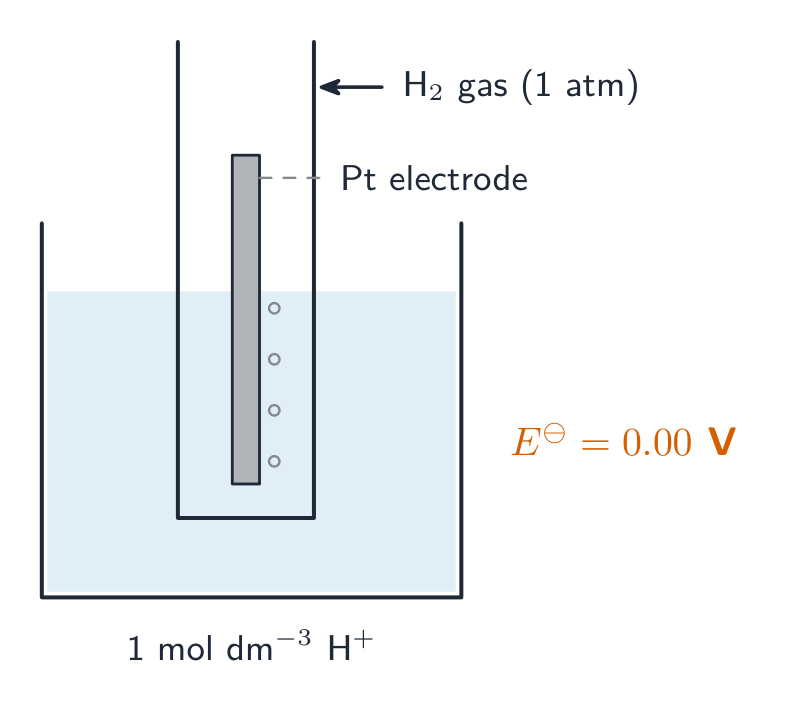
The reference is the standard hydrogen electrode 标准氢电极: hydrogen gas at $1\ \text{atm}$ over platinum in $1\ \text{mol dm}^{-3}$$\text{H}^+$, defined as exactly $0.00\ \text{V}$.
To measure an $E^{\ominus}$, connect the half-cell to the standard hydrogen electrode and read the voltage. A metal sits in a solution of its ions; for two ions of the same element (such as $\text{Fe}^{3+}/\text{Fe}^{2+}$), a platinum electrode dips into a solution containing both.
Combining half-cells
The standard cell potential 标准电池电势 is the difference between the two standard electrode potentials:
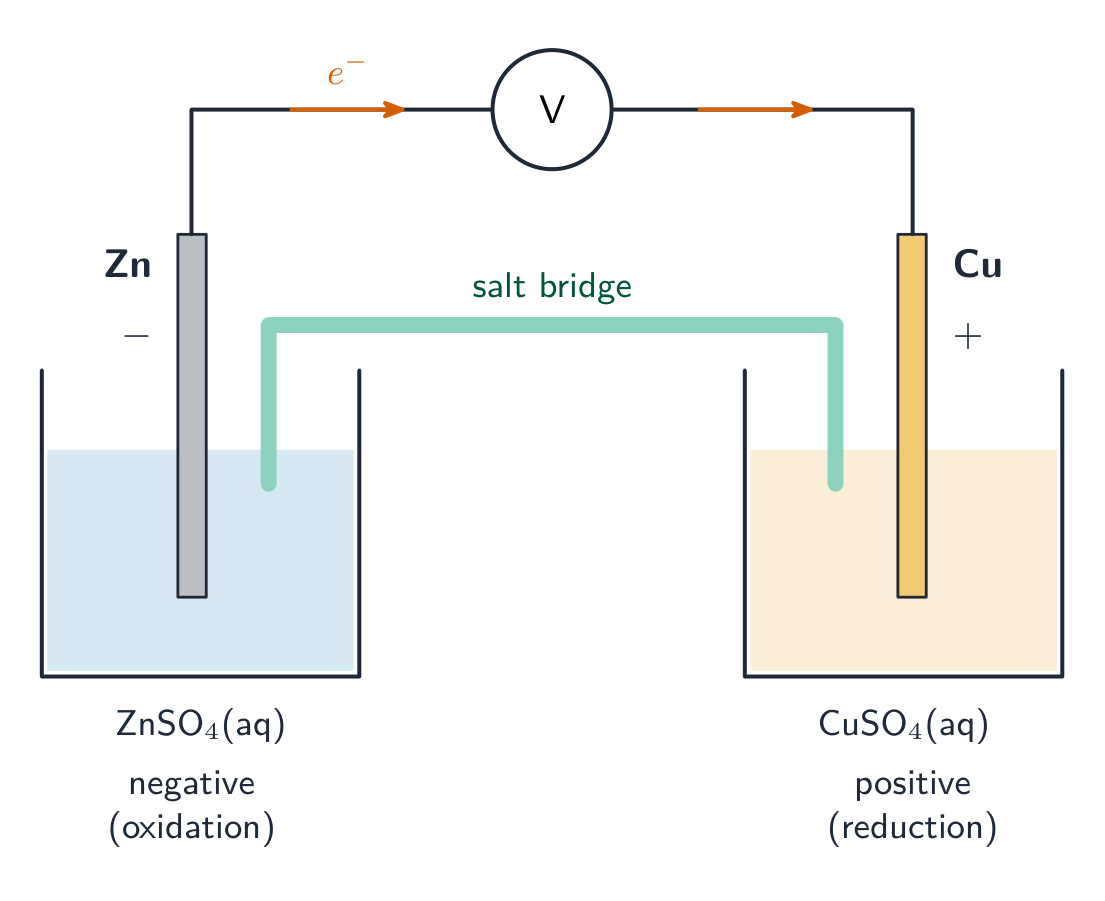
Worked example. Find the standard cell potential of a cell built from the $\text{Zn}^{2+}/\text{Zn}$ half-cell ($E^{\ominus} = -0.76\ \text{V}$) and the $\text{Cu}^{2+}/\text{Cu}$ half-cell ($E^{\ominus} = +0.34\ \text{V}$).
find the polarity: the more negative electrode is the negative terminal, and electrons flow from it through the external circuit to the positive electrode.
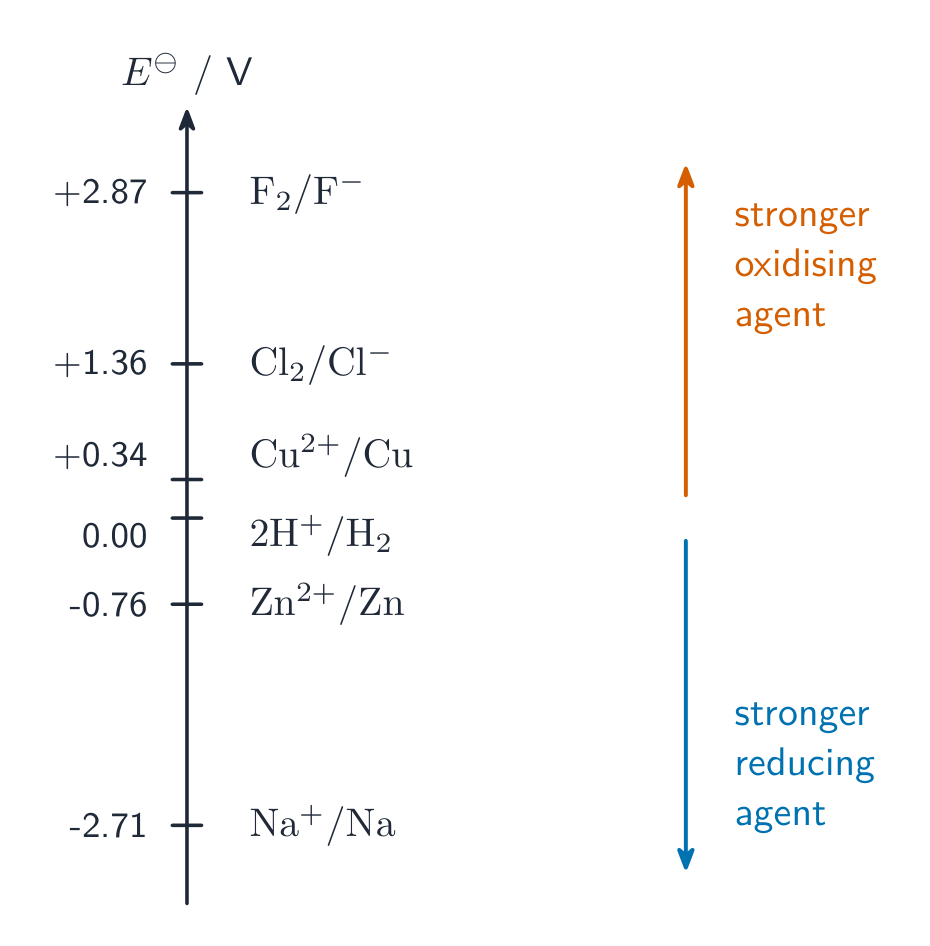
judge reactivity: a more positive $E^{\ominus}$ means a better oxidising agent 氧化剂 (easily reduced); a more negative $E^{\ominus}$ means a better reducing agent 还原剂.
Feasibility and redox equations
A reaction is feasible when $E^{\ominus}_{\text{cell}}$ is positive. To build the full equation, take the two half-equations 半反应方程式, reverse the one that is oxidised, and add them so the electrons cancel. This $E^{\ominus}$ test tells you the feasibility 可行性 of the reaction.
You can also link it to free energy: $\Delta G^{\ominus} = -n E^{\ominus}_{\text{cell}} F$, where $n$ is the moles of electrons.
The Nernst equation
If the concentrations are not standard, the electrode potential changes. Raising the concentration of the oxidised species makes $E$ more positive. The Nernst equation 能斯特方程 gives the exact value:
where $z$ is the number of electrons in the half-equation.
עברית
הפוטנציאל האלקטרודי ($E$) של מחצית-תא מראה עד כמה קל להפחתתו. אנחנו מודדים אותו ביחס לנקודת ייחוס, בתנאים סטנדרטיים, כדי לקבל אתהפוטנציאל האלקטרודי הסטנדרטי ($E^{\ominus}$), שכתוב תמיד כהפחתה.
נקודת הייחוס היא האלקטרודה הסטנדרטית של חמצן: גז חמצן בלחץ של $1\ \text{atm}$ מעל פלטינה בתמיסה של $1\ \text{mol dm}^{-3}$$\text{H}^+$, המוגדרת בדיוק כ$0.00\ \text{V}$.
האלקטרודה הסטנדרטית של חמצן: H$_2$ בלחץ של 1 atm מעל פלטינה ב-1 mol dm$^{-3}$ H$^+$, ה$0.00$ V נקודת הייחוס לכל פוטנציאל אלקטרודי
כדי למדוד $E^{\ominus}$, חבר את מחצית-התא לאלקטרודה הסטנדרטית של חמצן וקרא את המתח. מתכת נמצאת בתמיסת יוניה; עבור שני יונים מאותו אלמנט (כמו $\text{Fe}^{3+}/\text{Fe}^{2+}$), אלקטרודת פלטינה טבולה בתמיסה המכילה שניהם.
שילוב מחציות-תא
הפוטנציאל הסטנדרטי של תא הוא ההפרד בין שני פוטנציאלי האלקטרודה הסטנדרטיים:
תא פשוט: שני חצי-תאים המחוברים על ידי גשר מלחים, עם גולמטר. אלקטרונים זורמים מהאלקטרודה השלילית (Zn) אל האלקטרודה החיובית (Cu)
דוגמה מופרדת. מצאו את הפוטנציאל הסטנדרטי של תא הנבנה מחצי-ת ה$\text{Zn}^{2+}/\text{Zn}$ ($E^{\ominus} = -0.76\ \text{V}$) ומחצי-ת ה$\text{Cu}^{2+}/\text{Cu}$ ($E^{\ominus} = +0.34\ \text{V}$).
למצוא את הקוטביות: האלקטרודה השלילית יותר היא הקוטב השלילי, ואלקטרונים זורמים ממנו דרך המעגל החיצוני אל האלקטרודה החיובית.
לשפוט תגובה: ערך $E^{\ominus}$ חיובי יותר משמעו חומר מחמצן טוב יותר (קל להפחתה); ערך $E^{\ominus}$ שלילי יותר משמעו חומר מחזר טוב יותר.
הסדרה האלקטרוכيمית: ערך $E^{\ominus}$ חיובי יותר (בראש) הוא חומר מחמצן חזק יותר; ערך $E^{\ominus}$ שלילי יותר (בתחתית) הוא חומר מחזר חזק יותר
אפשרות ביצוע ומשוואות רידוקס
תגובה היא אפשרית כאשר $E^{\ominus}_{\text{cell}}$ הוא חיובי. כדי לבנות את המשוואה המלאה, לקחת את שתי משוואות החצי, להפוך את זו שהופחתה, ולהוסיף אותן כך שהאלקטרונים יתאבדו. מבחן זה $E^{\ominus}$ מספק לך את האפשרות של התגובה.
ניתן גם לקשר זאת לאנרגיה חופשית: $\Delta G^{\ominus} = -n E^{\ominus}_{\text{cell}} F$, כאשר $n$ הוא מול האלקטרונים.
משוואת נרנסט
אם הריכוזים אינם סטנדרטיים, הפוטנציאל של האלקטרודה משתנה. העלאת ריכוז של המין המוחמצן הופכת את $E$ לחיובי יותר. משוואת נרנסט נותנת את הערך המדויק:
$E^{\ominus}_{\text{cell}} = E^{\ominus}(\text{more positive}) - E^{\ominus}(\text{less positive})$; a positive$E^{\ominus}_{\text{cell}}$ means the reaction is feasible.
Standard conditions for $E^{\ominus}$: 298 K, $1\ \text{mol dm}^{-3}$, 100 kPa, platinum electrode — state them if asked.
A more negative electrode potential means a stronger reducing agent; use the series to predict the direction.
For electrolysis quantities use $Q = It$ and moles of electrons $= Q/F$.
Pick one and the site follows you — notes, papers, videos and practice all open on it. · בחרו נושא אחד והאתר יעקוב אחריו — הערות, מסמכים, וידאו ותרגולים פתוחים בו.
Type to search notes, lessons, code, vocabulary and past-paper questions across every subject. · הקלד כדי לחפש הערות, שיעורים, קוד, אוצר מילים ושאלות מבחנים בכל הנושאים.