English
- recall the reactions (reagents and conditions) by which halogenoalkanes can be produced: (a) the free-radical substitution of alkanes by $\text{Cl}_2$ or $\text{Br}_2$ in the presence of ultraviolet light, as exemplified by the reactions of ethane (b) electrophilic addition of an alkene with a halogen, $\text{X}_2$, or hydrogen halide, $\text{HX(g)}$, at room temperature (c) substitution of an alcohol, e.g. by reaction with $\text{HX(g)}$; or with $\text{KCl}$ and concentrated $\text{H}_2\text{SO}_4$ or concentrated $\text{H}_3\text{PO}_4$; or with $\text{PCl}_3$ and heat; or with $\text{PCl}_5$; or with $\text{SOCl}_2$
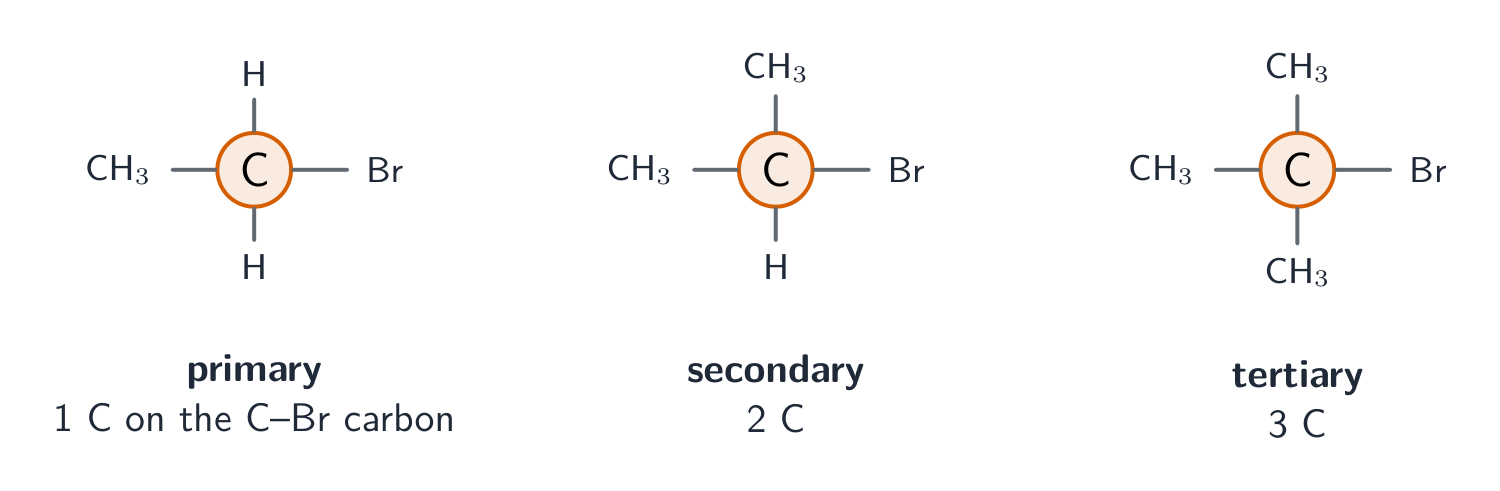
- classify halogenoalkanes into primary, secondary and tertiary
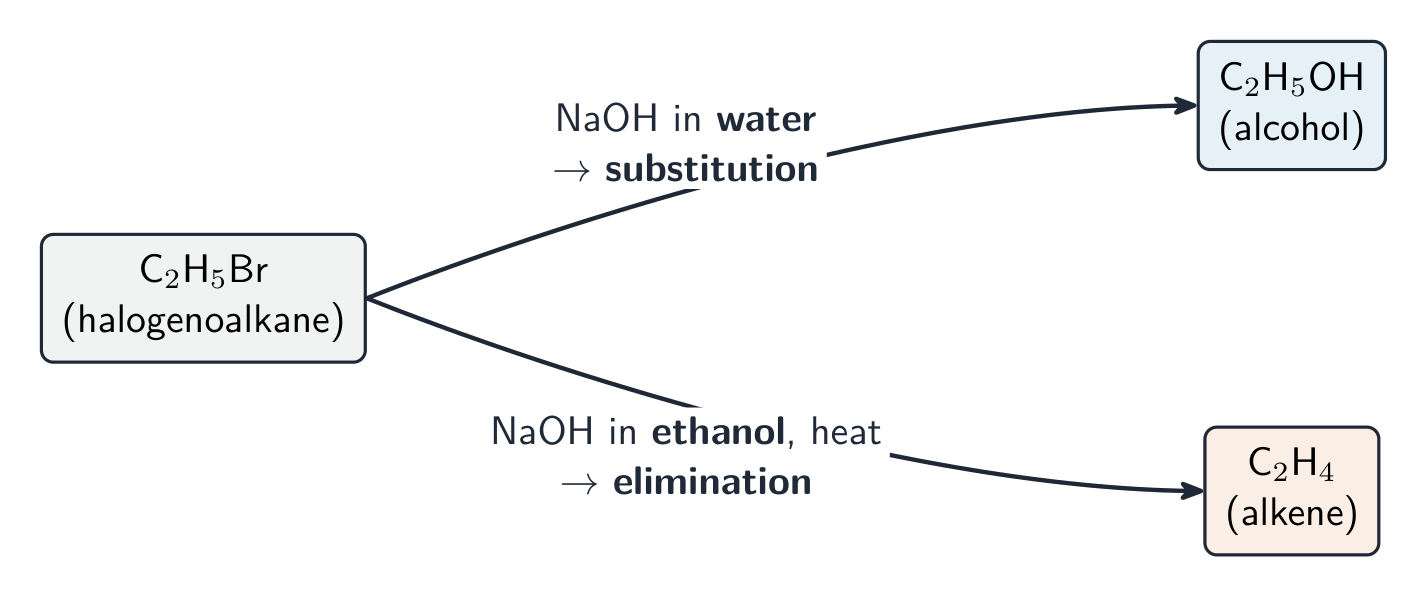
- describe the following nucleophilic substitution reactions: (a) the reaction with $\text{NaOH(aq)}$ and heat to produce an alcohol (b) the reaction with $\text{KCN}$ in ethanol and heat to produce a nitrile (c) the reaction with $\text{NH}_3$ in ethanol heated under pressure to produce an amine (d) the reaction with aqueous silver nitrate in ethanol as a method of identifying the halogen present as exemplified by bromoethane
- describe the elimination reaction with $\text{NaOH}$ in ethanol and heat to produce an alkene as exemplified by bromoethane
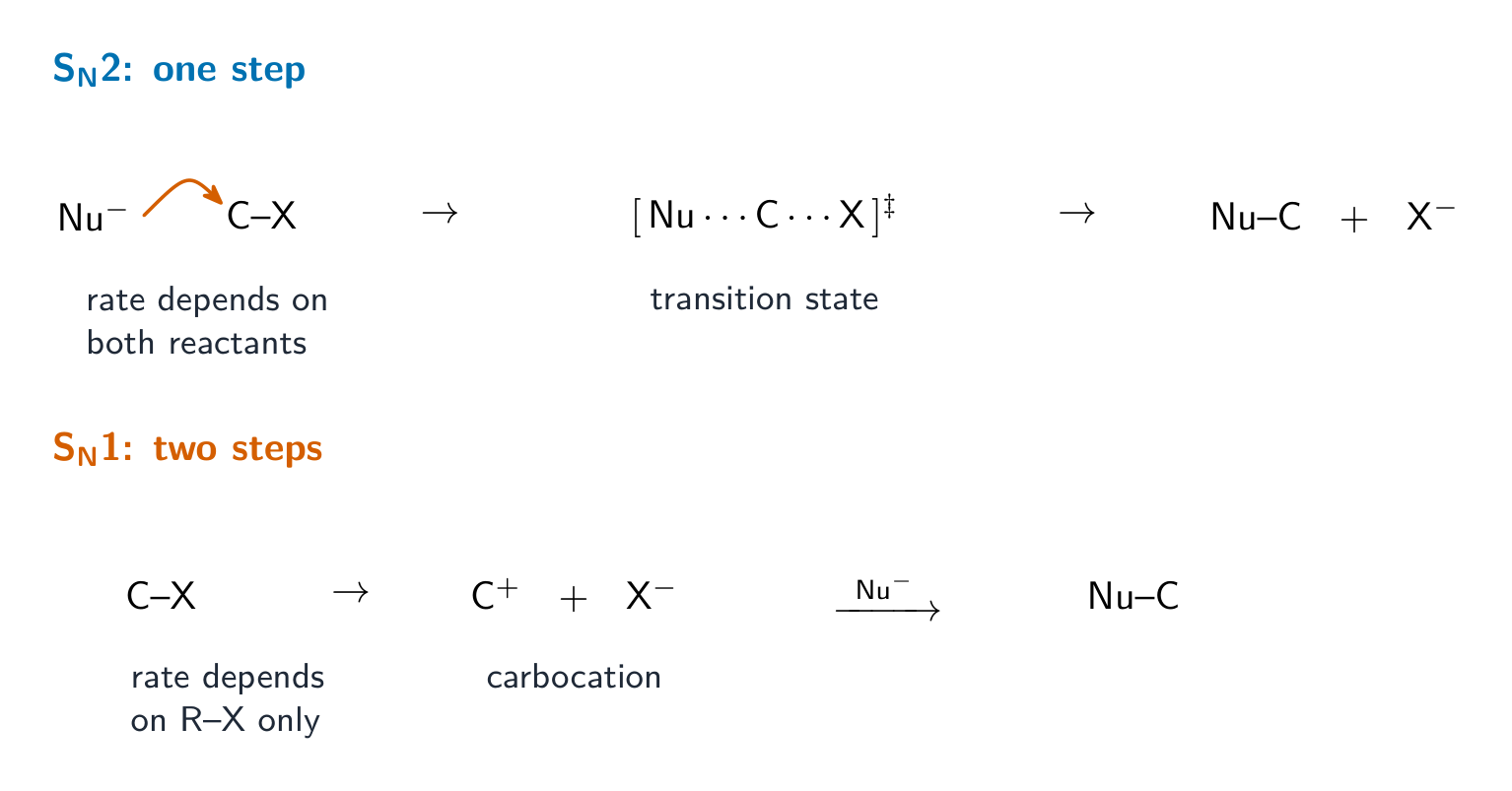
- describe the $\text{S}_\text{N}1$ and $\text{S}_\text{N}2$ mechanisms of nucleophilic substitution in halogenoalkanes including the inductive effects of alkyl groups
- recall that primary halogenoalkanes tend to react via the $\text{S}_\text{N}2$ mechanism; tertiary halogenoalkanes via the $\text{S}_\text{N}1$ mechanism; and secondary halogenoalkanes by a mixture of the two, depending on structure
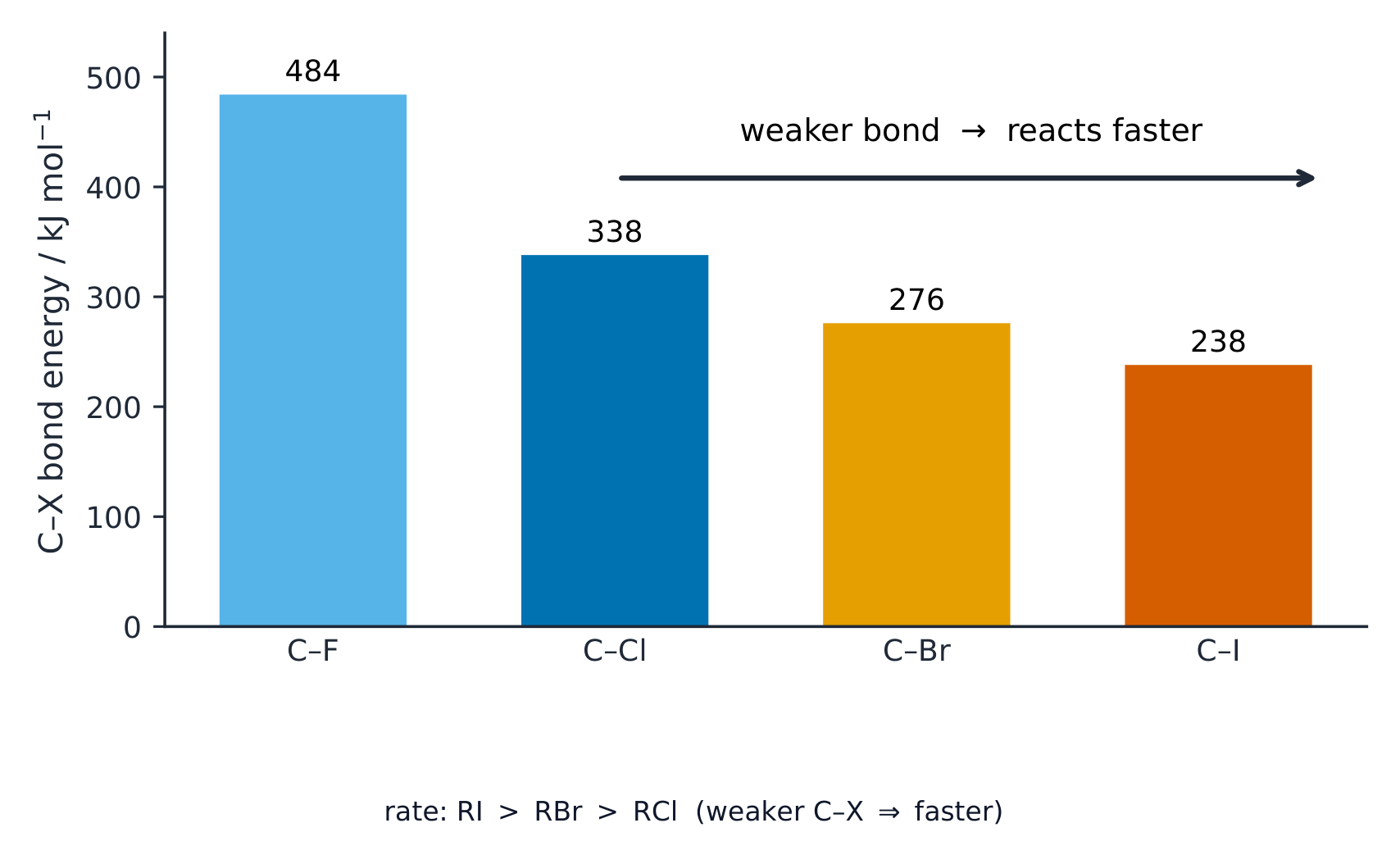
- describe and explain the different reactivities of halogenoalkanes (with particular reference to the relative strengths of the C–X bonds as exemplified by the reactions of halogenoalkanes with aqueous silver nitrates)
עברית
- זכור את התגובות (החומרים והתנאים) על ידי הן הלוגנואלקנים יכולים להיוצר: (א) ההצבה ברדיקלים חופשיים של אלקנים על ידי $\text{Cl}_2$ או $\text{Br}_2$ בנוכחות אור אולטרה סגול, כפי שמדגמת תגובות האתאן (ב) תוספת אלקטרופילית של אלקן עם הלוגן, $\text{X}_2$, או חומצה הלוגני, $\text{HX(g)}$, בטמפרטורת החדר (ג) הצבה של אלכוהול, למשל על ידי תגובה עם $\text{HX(g)}$; או עם $\text{KCl}$ וחומצה מרוכזת $\text{H}_2\text{SO}_4$ או חומצה מרוכזת $\text{H}_3\text{PO}_4$; או עם $\text{PCl}_3$ וחום; או עם $\text{PCl}_5$; או עם $\text{SOCl}_2$
- סווג הלוגנואלקנים לראשוניים, משניים ומשולשים
- תאר את התגובות הבאות של הצבה נוקלئופילית: (א) התגובה עם $\text{NaOH(aq)}$ וחום ליצירת אלכוהול (ב) התגובה עם $\text{KCN}$ באתנול וחום ליצירת ניטריל (ג) התגובה עם $\text{NH}_3$ באתנול מחומם בלחץ ליצירת אמינים (ד) התגובה עם נחושת נitrate במים באתנול כשיטה לזיהוי ההלוגן הנוכחי כפי שמדגמת ברומואתאן
- תאר את תגובת האלימינציה עם $\text{NaOH}$ באתנול וחום ליצירת אלקן כפי שמדגמת ברומואתאן
- תאר את המנגנונים $\text{S}_\text{N}1$ ו$\text{S}_\text{N}2$ של הצבה נוקלئופילית בהלוגנואלקנים, כולל השפעות אינדוקטיביות של קבוצות אלקיל
- זכור שהלוגנואלקנים ראשויים נוטים להגיב לפי המנגנון $\text{S}_\text{N}2$; הלוגנואלקנים משולשים לפי המנגנון $\text{S}_\text{N}1$; והלוגנואלקנים משניים לערבוב של שניהם, תלוי במבנה
- תאר והסבר את ההתנהגויות השונות של הלוגנואלקנים (עם התייחסות מיוחדת לחוזק היחסי של הקשרים C–X כפי שמדגמות תגובות הלוגנואלקנים עם נחושת נitrate במים)